What baffles me is the inverse ratio between the rarity of Foale and Tuffin, and the prices they command. I think Marion Foale and Sally Tuffin were arguably a greater talent than Mary Quant. And they certainly knew when to call it quits and draw back gracefully from the fashion world (they both ‘retired’ in 1973 to spend more time with their families). Licensing? They wouldn’t have dreamed of it. Yes, MQ, I’m looking at you in your waterproof poncho – don’t think I can’t see you! 😉
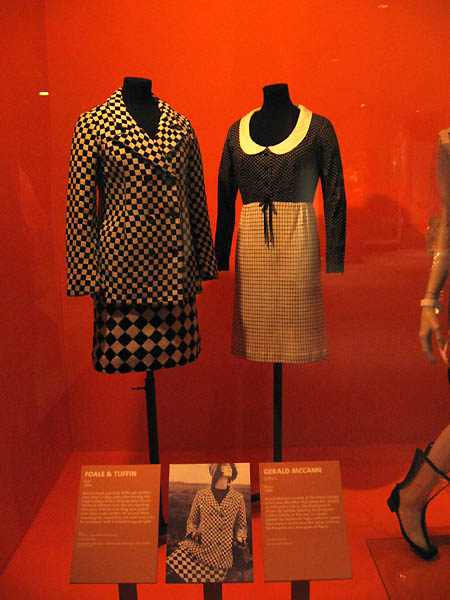
Their early work was vibrant, youthful, fun and always exquisitely tailored. They originated trouser suits for women (yet another creative theft by Yves Saint Laurent ensured they rarely get credited for this – more rantings on him some other time…), used the ‘op art’ trend in a quirky way (rather like my other passion, John Bates) and helped build the Carnaby Street image – the driving force behind the emergence of Britain as a world leader in fashion.
They moved easily into the softer look of the late 60s and early 70s, continuing to favour Liberty prints and did all sorts of lovely frilled and flared things. In retrospect, their decision to quit in 1973 seems really rather intelligent. The mid-late 70s saw the crash and burn phenomenon of so many designers, Ossie Clark and Barbara Hulanicki at Biba being the most notable casualties. So they got out at the right time.
Their work is fairly rare. Goodness only knows why, you can hardly miss the label! They were a popular fixture in Vogue and a big part of the Youthquake British Invasion of the USA in 1965.
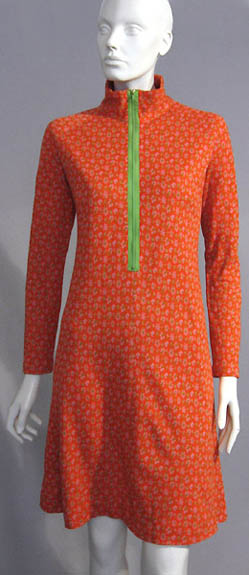
 Two Foales from my private collection. 1963 and 1965 respectively.
However, in recent months (after loudly bemoaning the non-existence of ANY F&T pieces in my personal collection) I seem to have accumulated a nice little collection of their work. I still sit here, look at the frocks and think; “How the HECK did I manage that?”. I have my limits as to how much I will pay for pieces for my collection, it’s just that the prices have been shockingly low for what they are. Even the recent Kerry Taylor auctions sale for Sothebys sold two Foale and Tuffin frocks (early 70s) for the opening bid of £100. I recall one of the major US auction houses sold two Foales not that long ago for a similar price.
So, while I can’t complain on a personal level that the prices aren’t really reflecting the rarity and beauty of their work – it does seem utterly wrong. Mary Quant’s work is fairly cheap these days – especially considering her cultural importance. But F&T didn’t license their names to death. So in reality, they should be making a whole lot more.
Just a little rant. I feel much the same way about Gerald McCann. I guess I’ll just have to keep collecting these labels rather than selling them! *sigh*





 Liz Eggleston