
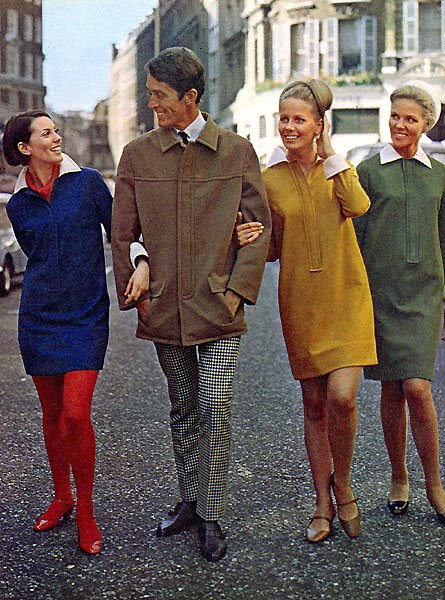
“Women are often dishonest – dishonest with themselves. They refuse to see themselves as they really are!” John Bates, the 27 year-old dress designer, doesn’t believe in mincing words. “And they might fool themselves,” he goes on, “but they don’t fool anyone else. I’m all for people trying to minimize their bad points, but sometimes women disguise faults which could be eradicated altogether, if they got down to some hard dieting and exercise.”
John feels that with so much good inexpensive, wholesale fashion, a girl has to concentrate on her face and figure. “Fashion is a challenge and I think it’s a challenge women need. Nowadays, with so many people buying the same clothes, a girl has to decide how best to present it so that she gives her wardrobe an individual stamp.”
Despite his vested interest in fashion – he is the designer for fashion house Jean Varon and recently designed Diana Rigg’s Avengers wardrobe – John doesn’t think one should follow it slavishly. “Study it to see what’s in it for you. I’m always hearing complaints that current fashion is directed at just one type, but that’s nonsense.
“I have three different types of girl to model my designs. Look at this design.” He showed me a short fly-fronted dress. “It’s classic really. Worn a little longer, maybe in a different colour, it would be ideal for the older woman. And to prove his point, we took the photograph left, of a simple dress from his collection adapted and worn by three women of different ages.
“Appearance is not all-important – there has to be something else – but it is quite important. Like all men, when I first meet a girl, I react to her appearance. It’s only after the physical impressions that you listen to what she has to say. So it is important to be attractive as well as interesting.”
And what makes a woman interesting? “Constant change,” says John emphatically. “When you’ve found your style, don’t stick to it or you’ll find yourseld in a rut. Don’t be ‘dated’ by fashion or make-up. Be bold. Try different styles as they come in – you’ll be surprised how much suits you. And don’t let it stop there. Change the furniture around; try new dishes on the family. It’s the secret of keeping interested – and interesting!”
And if you’re going to be bold, leave your husband at home when you go shopping is John’s advice. “He’ll insist on your playing safe – Englishmen are dreadfully conservative – and then he’ll spend an entire evening gazing at a girl in the outfit you might have bought if you’d shopped alone.”
John feels that English women have a rough deal. “Seventy per cent. of their problems would be solved if only Englishmen were more appreciative. They just don’t care; so who can wonder if the womne don’t care of give up? I blame segregated education and clubs.
“Englishmen will drool at the mention of a French woman and never look at their own. Yet English women are the best in the world. They have the best figures, skins and colouring, and a marvellous sense of humour. French girls are marvellous only because their men tell them they are.”
Rejecting emigration as an answer to the problem, what did John suggest?
“She must rebel. She must ignore any lack of interest from her man and make the changes she wants, dress to please herself, say what she thinks. Do be subtle about this. Express your opinions pleasantly and watch your timing. But a woman can get her own way if she goes the right way about it.”
John says that women must remember that they are people.
“That’s why I think that they shouhld carry on with their jobs after they are married. This ensures that they are still part of the human race – it keeps them bright and interested. It’s terrible for them to be cut off from the outside world and plunged into domesticity. And thre’s no reason why babies should stop them; if a woman finds babies aren’t enough to keep her occupied and happy, she should use nurseries…work to pay an au pair girl, if necessary.”
Not that John wants to see women imitate men; he just wants us to drop the age-old idea of the battle of the sexes and get down to enjoying life, and he thinks women can achieve this.
He enjoys working with women. “They’ll always have a go at trying to achieve the effect you want,” he explains. “Men approach problems in a different way. They’re apt to apply a slide-rule and, if you suggest trying something slightly different, they’ll insist it can’t be done. But women don’t approach things like that, and what might seem illogical to a mere man, actually works in practice. In fact, very often I don’t see their reasoning at all.
Fashion Icon: Pamela Des Barres
1960s, fashion icon of the moment, groupies, pamela des barres
I was recently loaned a copy of I’m With The Band and felt a natural affinity to Miss Pamela’s romantic ups and downs. Her desire to find her niche in life is very powerfully expressed and she’s an engaging hostess for her own life story. Perhaps because she was amongst the first recognised groupies, you feel she’s more genuine than most who followed in her wake. She really was genuinely being swept along by the music and the sexual revolution of the Sixties, rather than seeking the celebrity which so many seem to be motivated towards. And, of course, the word ‘groupie’ has different meanings for different people: for the Girls Together Outrageously it was clearly more about comradeship.
She was also attainably gorgeous. Even before I had read the book, I knew her as an absolute style icon. One of the handful of such women who could actually convince me to go blonde, because it just looks so fantastic on her. That soft, hippy look which was usually quite homemade and ramshackle – giving it an extra level of charm. Remnants and rags were stitched together to create dresses which look like they’ve been sized up from a tatty Victorian doll, and she painted the biggest eyelashes I’ve ever seen. Then in the early Seventies she darkened her hair and smartened up her look for a full-on vamp groupie look, with platforms and stockings, curls and lipstick. She still looks incredible now, and from what I hear is an incredibly lovely person. So, Miss Pamela, we salute you!
Christies: Avant Garde (a.k.a Miss Peelpants is in heaven)
1960s, 1970s, 1980s, alkasura, mr freedom, ossie clark, vivienne westwood, zandra rhodesOh dear oh dear. Just when I thought it was safe to come out from my little cocoon of New Romanticism and delve back into relative normality again after my break in Yorkshire, Christies go and post photos of their upcoming Avant Garde auction. I’m just a puddle of lust over some of these frocks, some you might expect and others you might not. But here are some of my favourites!

 Pierre Cardin
 Norma Kamali
 Jean-Paul Gaultier
 Let It Rock (Vivienne Westwood)
 Zandra Rhodes
 Paco Rabanne
 Giorgio Di Sant’Angelo
 Stephen Burroughs
 Mr Freedom
 Alkasura
 Ossie Clark

eBay shenanigans…..
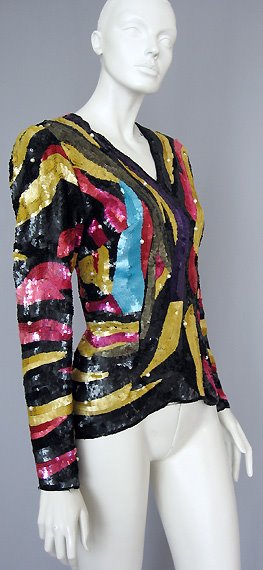
1960s, 1970s, 1980s, ebay listings, eye candy, gerald mccannVeering a little off my normal and natural course with some more recent vintage on eBay at the moment, but I couldn’t resist! Firstly, some may find it heinous but I actually think it’s rather fab and a cut above the usual of this type…..
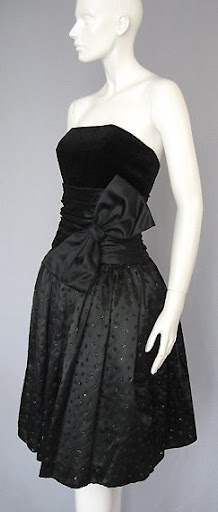
Next a little something for big-bow-lovers in this super cute little prom dress with pailettes all over the skirt!
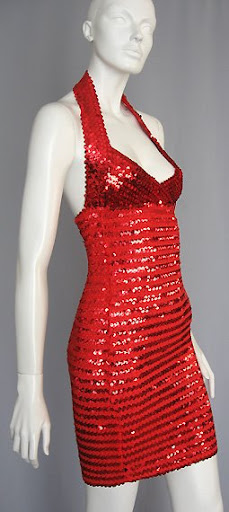
And then there’s a seriously sexy sequined mini dress which is pretty much guaranteed to stop traffic.

Emmapeel… dress
1960s, alun hughes, avengers, avengerswear, diana rigg, emma peel, eye candy, john bates, personal collection, vintage fangirl squeeI alluded, in an earlier post, to having recently acquired an original Avengerswear piece. Now before you go getting too excited on my behalf (because, you know, I imagine you would…..), it’s not a John Bates one. That remains my holy grail of collecting…
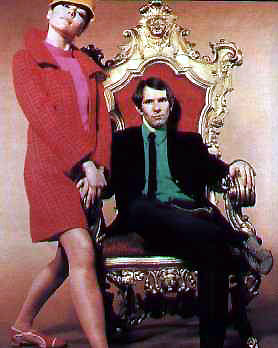
Diana and Alun
In the first colour season of The Avengers, Alun Hughes took over from John Bates as costume designer. Although strictly speaking Bates was never the costume designer per se, he simply provided Mrs Peel with a fully equipped working mod-girl wardrobe. Which would be used in various ways by the designer and whoever else happened to be making such decisions. Explaining why so many fabulous outfits, in which Diana Rigg was heavily photographed for publicity, made only brief appearances – if at all.
The colour episodes had been intended to be designed in a similar ‘working wardrobe’ manner by Pierre Cardin, who was already creating Steed’s very elegant suits [Shocking! A Frenchman designing our beloved Avengers? Whatever next??], but he was unable to complete the task and Hughes was brought on board as designer instead. Unfortunately I know very little about the man himself, but it would seem he actually was a costume designer rather than a fashion designer like Bates or Cardin. With the new colour format, and the strong overseas interest in the show, Hughes had new challenges to those of Bates with the black and white. He attacked it with gusto, using vivid colours, prints and playing with new synthetic fabrics. There’s also the varied influences, reflecting the ever-changing fashion scene of the time. We still have space-age cut-outs and skin tight gear, but also feathers and psychedelic silks. The look is more way-out, and more feminine than ever. He also invented the Emmapeeler, which was a more ‘Pop’ take on the leather and pvc catsuits of the earlier series.
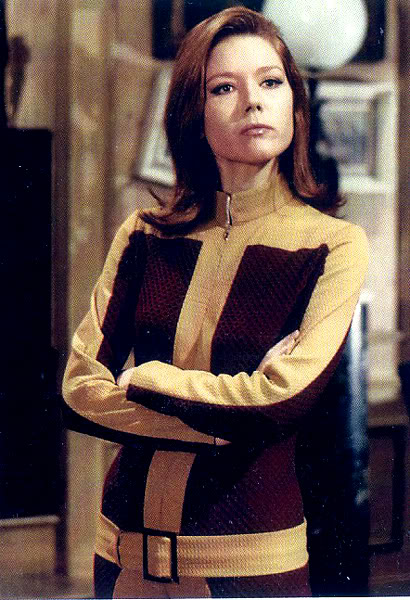
“Don’t diss my mustard emmapeelers!”
As with Bates, and Frederick Starke before him, an Avengerswear range of clothes was produced and licensed out to different manufacturers and shops. Unlike Bates, whose Avengerswear collection was largely complete replicas of the Mrs Peel-worn originals, Hughes’ designs were used as templates for a wider range of colours and styles. Most items were produced in different colourways to the one seen on screen, again unlike Bates who was largely working in black and white anyway, and it would also seem that some items were produced in different lengths.
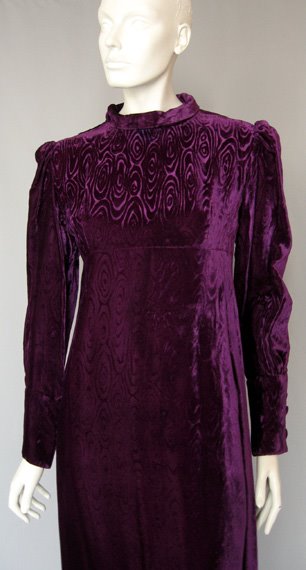
This stunning moire patterned velvet dress is clearly the same design as the one she wears in Return Of The Cybernauts. Emma’s is black (or perhaps dark green, it’s difficult to tell with early colour television) and a mini. Mine is purple and a maxi length. Nevertheless, it’s my first – and possibly only piece of Hughes’ Avengerswear and I feel very honoured to now have it in my possession.
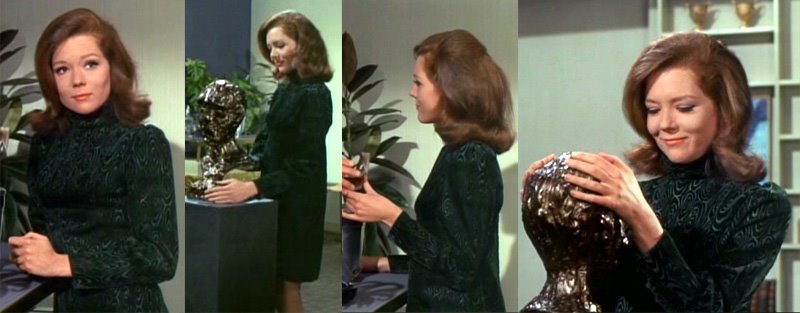
Little Miss Hornby and a gap now filled
1960s, british boutique movement, celebrity boutiques, eye candy, personal collection, twiggy, vintage fangirl squee As many of you know from reading my blog and my website, I’m quite a keen collector as well as a seller. Together with the fact that I love wearing British Boutique-era clothing as well, it’s a wonder I ever sell anything. But thankfully, for you, I do and I don’t hold back the good stuff either. But occasionally, with something magnificent and as yet unrepresented in my collection, I do decide to buy something for myself and myself alone. It’s my ambition to have a representative collection of British Boutique designers and boutiques, some designers I will always have more than others because I have more of an interest in their career. But for some, one representative piece is all I can possibly hope for (or even afford). Like Thea Porter, or Bill Gibb…….or now, Twiggy.
Twiggy’s own label started in 1966, designed by RCA graduates Pam Proctor and Paul Babb, as one of the many ways in which Twiggy and her manager/boyfriend Justin De Villeneuve could utilize her fame and bankability. Twiggy was eager to be involved in the entire process of the clothes production, as a keen home dressmaker and frustrated designer herself, and this means that it was perhaps one of the better made and most genuinely stylish celebrity boutique labels of the time. Originally the idea had been mooted by Berkertex, but when Twiggy realised they were simply wanting to put her name on an existing range of clothes with no input by her, she turned to the Taramina Textiles firm. Smaller but happy to leave the creative decisions to the Twiggy camp and the two designers.
 “We made sure the dresses were really good and they were all things that I would be happy to wear. I still think it was a very good, young collection of clothes–cat-suits, print shifts gathered under the bust, Bermuda-length jump suits, shirt dresses with long pointed collars, jersey culotte dresses, a pinstripe gangster style trouser suit–and all for between six and twelve guineas.” Twiggy by Twiggy (p51)
 Sadly, the small British manufacturers behind the label were unable to keep up with the demand the Twiggy line had produced in both Europe and the USA and the line eventually folded by the end of the decade. This leaves the label as one of the rarest and most highly sought after boutique brands of the time, due to the iconic status of Twiggy and the brevity of its existence.
I was overjoyed to finally get me a piece of Twiggy’s range, it had been a glaring hole in my collection so far. Then a few days later, I was sorting out my image files on my computer and found these photos of Twiggy actually wearing the dress in question. Unfortunately it does show me that the sleeves have been hacked off at some point…..but honestly, I care not! I have photos of Twiggy in my dress and as any regular readers will know, I’m slightly obsessed with original photos and particularly of the designers in or with the garments in question.
Sadly, the small British manufacturers behind the label were unable to keep up with the demand the Twiggy line had produced in both Europe and the USA and the line eventually folded by the end of the decade. This leaves the label as one of the rarest and most highly sought after boutique brands of the time, due to the iconic status of Twiggy and the brevity of its existence.
I was overjoyed to finally get me a piece of Twiggy’s range, it had been a glaring hole in my collection so far. Then a few days later, I was sorting out my image files on my computer and found these photos of Twiggy actually wearing the dress in question. Unfortunately it does show me that the sleeves have been hacked off at some point…..but honestly, I care not! I have photos of Twiggy in my dress and as any regular readers will know, I’m slightly obsessed with original photos and particularly of the designers in or with the garments in question.
Don’t mind me, I’m just doing a little happy dance here!
Doctor Who Girls: The Sixties
1960s, british boutique movement, doctor who, doctor who companion fashion, john bates, mary quant, ossie clark, zandra rhodesSome of you may or may not know of my slight….slight obsession with vintage Doctor Who. Yes indeed, coupled with my love of Blakes 7, The Avengers and Sapphire and Steel I think that gives me fairly impressive geek credentials, no? A lot of it is childhood nostalgia, particularly in the Eighties series which I grew up with but also for the occasional Seventies story which my brother would acquire via third generation videotapes recorded from Australian TV, but even the episodes I didn’t grow up watching hold a magical quality for me. Not least because The Doctor was always adept at finding himself aided by a gorgeous companion wearing seriously groovy gear from her own time. Even the few exceptions to this (Leela – Warrior Princess and Romana – Time Lady) look very much ‘of’ the time in which the stories were made.
So I’ll start by introducing you all to the notable young ‘Who girls of the Swinging Sixties. 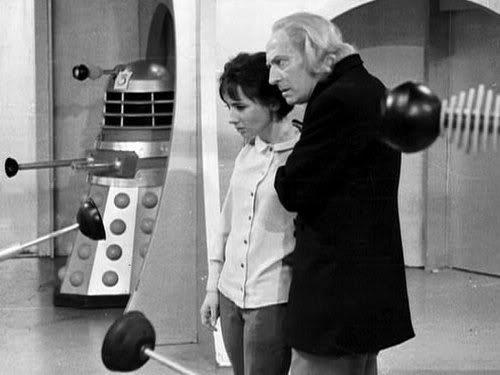 It began with the Queen of the Ankle Twist, Susan (Right: Carole Ann Ford 1963-65) and her Mary Quant outfits. Susan was The Doctor’s granddaughter and a schoolgirl of exceptional talents. The actors often wore their own clothes due to budget limitations and Carole Ann Ford has said that a lot of her gear was Mary Quant. The show began in 1963 and in many ways is an interesting time capsule for the dramatically changing fashions of the time and I think Carole was the archetypal Quant girl with her elfin hair and boyish figure. The clothes were fairly simple, little jumpers and cropped trousers or pinafore dresses and roll neck sweaters.
 Her immediate successor was a young girl from the future named Vicki (Left: found on the planet Dido, I kid ye not!), played by Maureen O’Brien (1965), who somehow seems to have found the off-screen Tardis boutique and was usually dressed in a similar manner to Susan. Nothing extraordinary, just your very average girl about town for the time. Although it was 1965 and the advent of the mini skirt, her hemlines remained very modest as you can see in the picture to the left.
The ridiculously named Dodo (Jackie Lane 1966) was the next gal Billy Hartnell ‘picked up’, running straight into the Tardis from Swinging Sixties London of 1966. Yes indeed, Dodo was conceived as a trendy young thing designed to appeal to the more fashionable young audience.  Sadly, she didn’t last long and remains something of a joke to most serious Who fans, but she wore some very groovy little numbers (as we can see on the right from The Celestial Toymaker [Sorry, I had to have a picture of the divine Peter Purves in his youth *licks lips*] she’s working the op-art look!) and deserved more of a send-off than the disappearing act she manages in The War Machines….
 …..Which itself introduced us to Polly. Ahhhh, now that’s more like it! Polly (Anneke Wills 1966-67) was a modern London girl with long legs, long blonde hair and big dolly girl eyes. Her introduction was possibly the first time that there was a bit of a something for the dads, with her mini skirts and beauty she was more sexy and womanly than any of her predecessors had ever been. She was also, unfortunately, ill-used mainly for tea-making (Polly put the kettle on?) and screaming in her brief tenure in the Tardis and sadly most of her episodes have been wiped/burned (a fate which has befallen most of the Sixties girls to some degree or another). Polly was the companion who eased the viewers into the regeneration of Hartnell to Patrick Troughton, but eventually left him to return to her own time.
 High Priestess of the Piercing Scream, Deborah Watling, entered the Tardis as Victorian orphan and Dalek survivor,
 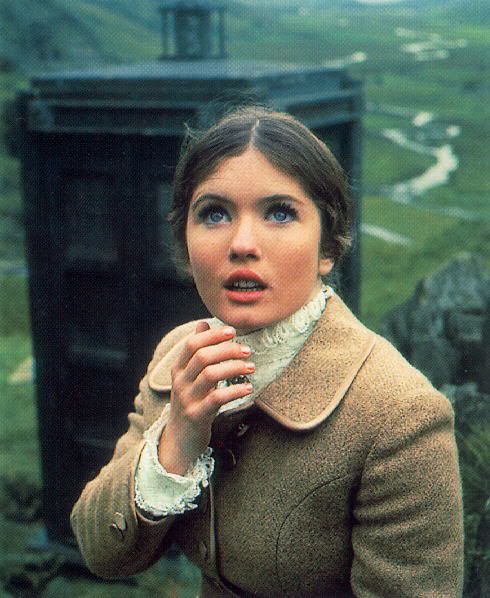 Victoria (1967-68). Her transition from crinoline to mini skirt was swift and amusing but fairly inevitable. And she really went for it, from the modest little dress she dons in Tomb of the Cybermen to the super micro hippy girl mini dress she is happily traipsing around in by The Web of Fear, via a gorgeous tweed jacket and knickerbocker ensemble in The Abominable Snowmen. Victoria gets a hard time for her girlishness and screaming (utilised to defeat a monster in her departure story Fury from the Deep) but I think her portrayal of a fish out of water is very poignant and she would certainly benefit from having more stories in existence today.
 Finally we come to Zoe (Wendy Padbury 1968-69) who, in contrast to Victoria, was a brainbox girl from the future. Zoe has achieved legend status mainly from her infamous silver catsuit in The Mind Robber and the arse contained within it, but she was also known for running around the universe in some eye-wateringly short mini skirts. The maxi was beginning to creep in by this point, out in the real world, but Doctor Who would not embrace the long skirt for a good while yet.
 My favourite Zoe outfit is a toss up between the [what looks like a John Bates] mini dress from The Dominators and what may well be a Celia-print Ossie Clark ensemble from The Invasion. [T
 hey mention shopping at Quorum in the commentary for this episode, but her friend is wearing a fantastic Zandra Rhodes lipstick print Fulham Road Clothes Shop ensemble so it’s perfectly possible Zoe’s is as well, I just can’t see it clearly enough to tell!]
Zoe was sent back to her own time and her memory wiped, let’s just hope she managed to keep some of her outfits!
Pick of this week’s eBay offerings: Radley in Celia print and Biba catalogue scrumptiousness….
1960s, 1970s, biba, british boutique movement, celia birtwell, ebay listings, radleyRADLEY Once upon a time, I happened across a Radley own-label dress with a print which screamed Celia Birtwell. It was very like her later, crazier prints you see on the later Ossie pieces. I was fascinated, and perplexed because it was definitely a later Radley piece with the ‘girly face’ label. But it was definitely Celia.
 I wondered if it was a one-off. But now I’ve found this little beauty, which is exactly the same design of dress, with a totally different print – but also a very distinctly Celia one! I can only surmise that Birtwell remained contracted to Radley after her divorce from Ossie Clark and continued to create at least one collection under their label.
Printed sketchy flowers and squiggles cover the deep plum sheer chiffon of this delicious dress. The gathered waist, the draped faux-wrap bodice and the draped back from the fitted yoke give it a wonderful grecian goddess feel. I love the very subtle effect of the pale topstitching, and the sheerness without lining means you can be as audacious as you like – whether you wear a slip or undies is up to you! And that, is the influence of Ossie! 😉
£38 Starting bid over at eBay
 BIBA
BIBA
I always get very excited by Biba pieces which were featured in the catalogues of the late Sixties. Perhaps because Biba was often so ephemeral and fast-moving, and not always featured as heavily in magazines of the time as you might think, it’s lovely to see them in situ and be able to date them (and see the original prices!).
This lace blouse was originally part of an ensemble with a skirt (which could be long or short apparently) but clearly is extremely wearable on its own.
In the catalogue’s own description “Spider lace peplum suit. A close fitting waisted jacket with narrow sleeves, buttoning to a high Edwardian neck.” The full suit was £7 7s in 1969.
Starting bid of £45 over at eBay
But that ain’t all…..there’s also a delicious couture label Ossie Clark ensemble, a superb bohemian Janice Wainwright, a super sweet candy pink Jean Varon dress and some other lovely non-designer pieces. Please do go and check it out!

Alice Pollock and a Vintage Holy Grail
1960s, alice pollock, british boutique movement, celia birtwell, ossie clark, website listings There are a few holy grails in the vintage world. Some you start to suspect don’t exist, others you are lead to believe absolutely do not exist by the numerous tomes written about the history of fashion. I certainly never thought I’d see the day when I encountered an Alice Pollock-designed piece bearing a Celia Birtwell print. We all know how jealously Ossie guarded Celia’s work, and Alice’s work lent itself more towards plain block colours or more graphic prints than Celia’s.
 But, this is an Alice blouse and it is a Celia print (shown in the V&A’s Ossie Clark retrospective book on page 120 and described as one of Celia’s earliest. It is, as yet, the only time I’ve seen this print in real life!).
That it’s an early Celia print is very apparent. It’s much more regimented and restrained than the flowing, weaving florals we usually see.  The floral butterflies are contained within frames, rather like framed butterflies on the wall of a Victorian study. The blouse is pure, understated Pollock chic. Those ‘in-the-know’ know that often a Pollock piece can be ten times more wearable than an Ossie, perhaps because Alice knew what women needed in reality (not just in their Ossie-fuelled fantasies). Two of my favourite vintage pieces are Alice (both blouses, both crepe and both wonderful) and this piece is only available for sale because, as regular readers will know, I can’t wear this colour to save my life. It’s weird, most people I know can wear it with aplomb, but not me. So here it is, one of the rarest creatures you’ll ever see…much like the butterflies within the frames who so inspired Celia’s print.
Available over at Vintage-a-Peel.co.uk

Marit Allen RIP
1960s, Foale and Tuffin, john bates, marit allen, mary quant, ossie clark, Vogue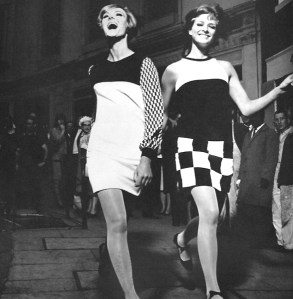 I can’t find any information online about it, but a friend has told me that the wonderful Marit Allen has passed away. The name might be meaningless to most of you, but she was instrumental in the careers of people like John Bates and Ossie Clark.
She worked as the ‘Young Ideas’ editor at Vogue in the mid-Sixties and her youthful approach to the clothes, styling and photographs ensured that the designs popular out on the street became widely appreciated through exposure in Vogue. She championed the young Bates, thus enabling him to continue creating the designs he had been struggling to get noticed with. Young Ideas also featured Ossie Clark’s work in the same summer that he graduated from the RCA and started working for Quorum, so Marit was certainly a visionary and true talent-spotter!
She accumulated a vast archive of pieces from the British Boutique Movement, including her wedding suit which was a Bates design, and this collection filled many gaps in the V&A’s Sixties Exhibition last year. I was ridiculously proud that my handful of pieces were being exhibited alongside hers.
She later developed a career in costume design, being designer for films like Brokeback Mountain and Thunderbirds (amongst many others).
I also had the very, VERY great pleasure of meeting her in January at a study day linked with the Sixties exhibition at the V&A. In retrospect, she was possibly the person I was the most excited about hearing speak and then meeting. And bearing in mind that Barbara Hulanicki and Foale & Tuffin were also in attendance, well that’s saying something about my respect for Marit.
It was so lovely to hear her talk about her experiences and views on the era, with photographs and thoughts on the designers. I had begun to think that the day would pass by with no mention of John Bates’ contribution to British fashion but, as in the Boutique book by Marnie Fogg, Marit sought to emphasize his talent and defend his forgotten claim to have been the first designer to really ‘do’ the mini skirt. And with Mary Quant herself in attendance, it was a brave move. The talk was only too brief, most frustrating that it was curtailed to keep the timing of the day and give Mary Quant more time to witter on about her make-up range and how she ‘invented’ the duvet cover (I kid ye not). I wanted to listen to Marit forever, and to see all her photos and hear all her experiences.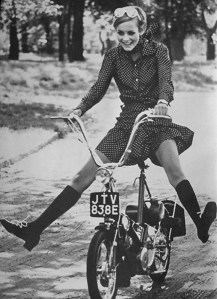 Thankfully I summoned up the courage to speak with her afterwards. I somehow found myself turning around to face her, and realised this was my big chance. We chatted a little about Bates, I told her about my collection and how grateful I was that she had mentioned him (we agreed he was a very underrated talent) and about how unlikely it was that such a boom time in British fashion would ever happen again. Mainly due to the cost of clothing production and shop rental in London.
Now, even more than before, I’m so glad I had those brief few moments speaking with her. I am so in awe of her talent and vision and, in a week where we’ve also lost the wondrous TV producer Verity Lambert, the world is a much gloomier place without these pioneering women.
Above and Right: Two photos from Marit’s Young Ideas section of Vogue. John Bates designs from 1965 above and Twiggy in Foale and Tuffin from 1967 on the right.
 Liz Eggleston