
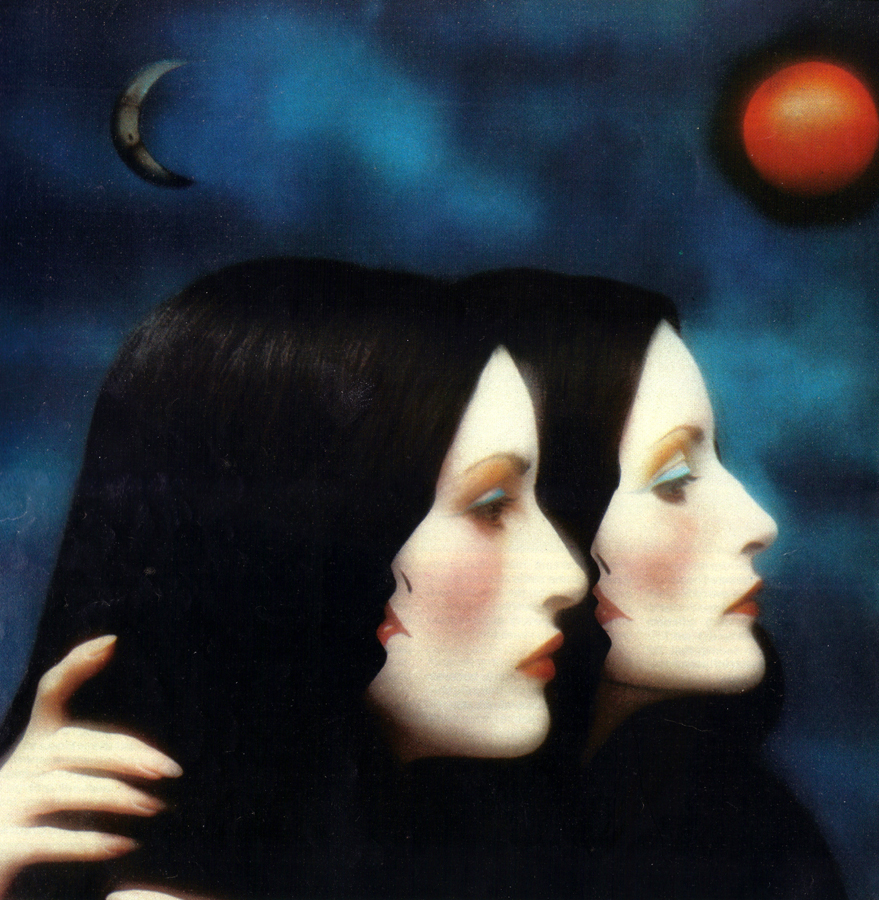
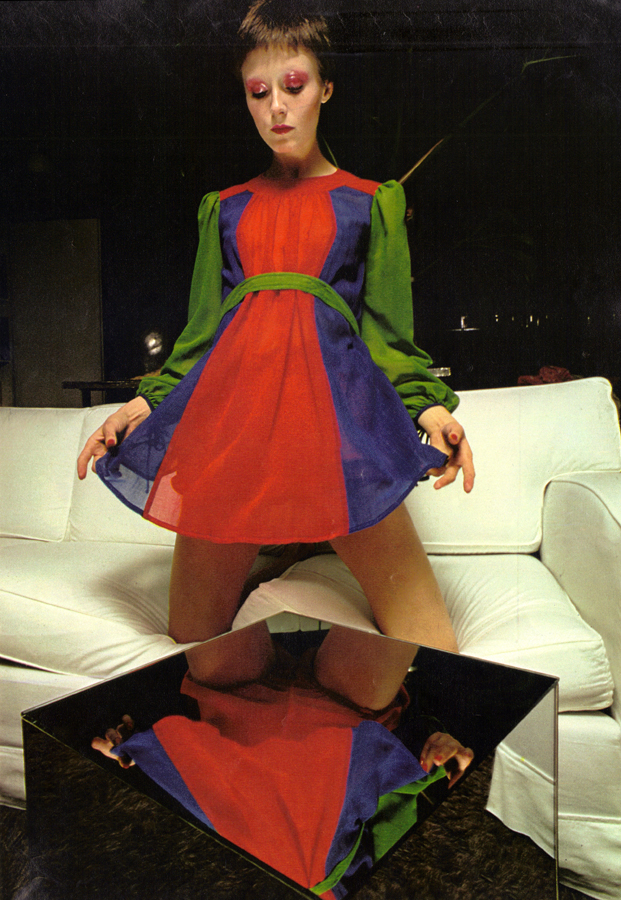
The skill and impact of good make-up artistry never ceases to amaze and move me.
Make-up designed and applied by China Rice. Photographed by Eric Howard.
Scanned by Miss Peelpants from 19 Magazine, June 1973
The skill and impact of good make-up artistry never ceases to amaze and move me.
Make-up designed and applied by China Rice. Photographed by Eric Howard.
Scanned by Miss Peelpants from 19 Magazine, June 1973
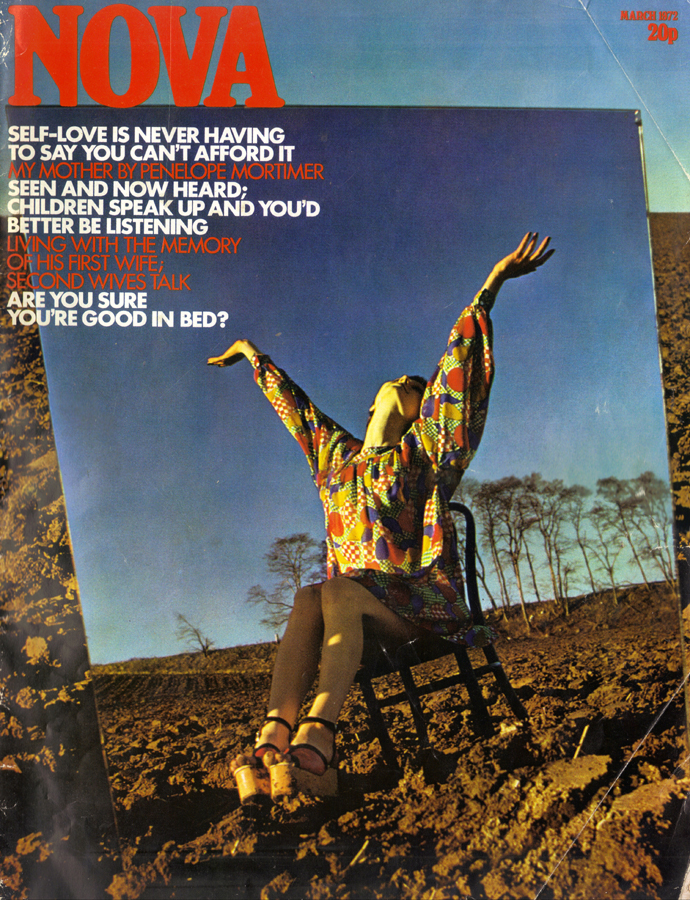
Dress by Jean Muir
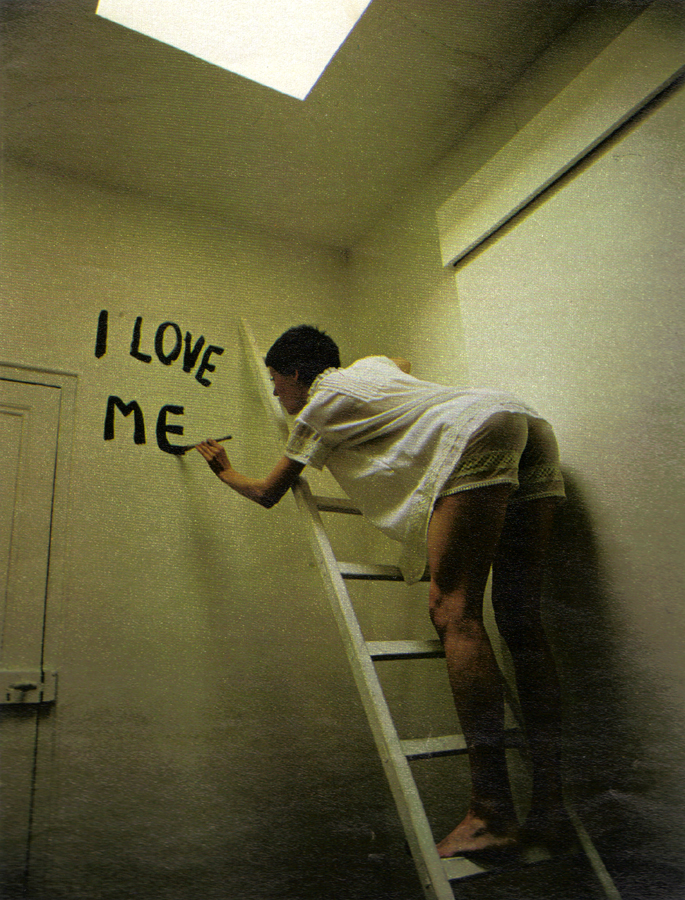
Impossibly beautiful editorial, even if it is touching on the rather unpleasant subject of narcissism. There are a few images from this which have been reproduced many times, but these others less so – so I thought I would give them a well-deserved airing here.
Photographed by Jeanloup Sieff. Styled by Caroline Baker. Make-up and nails by Biba.
Scanned by Miss Peelpants from Nova, March 1972
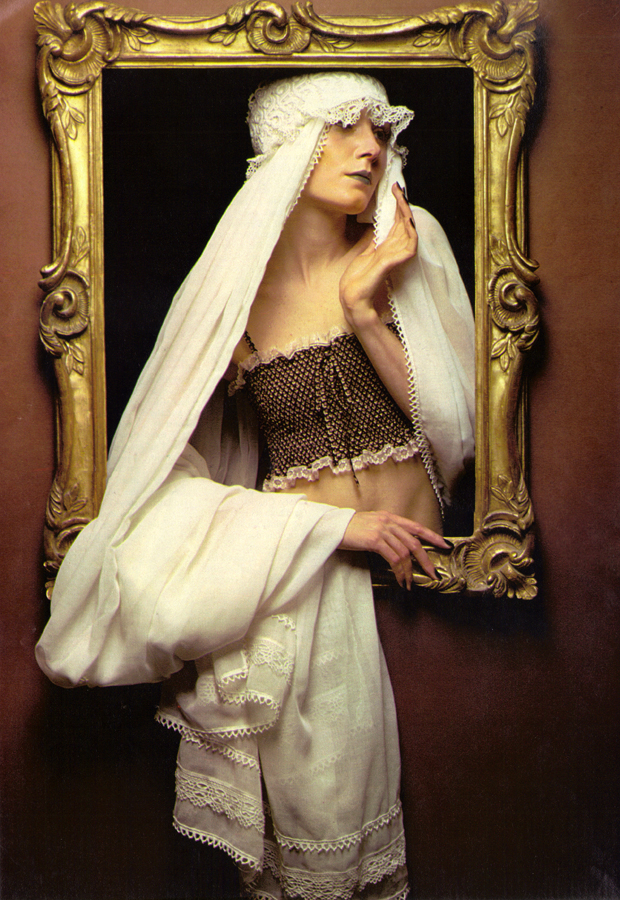
Sun top (matching trousers not shown) and headress by Gina Fratini
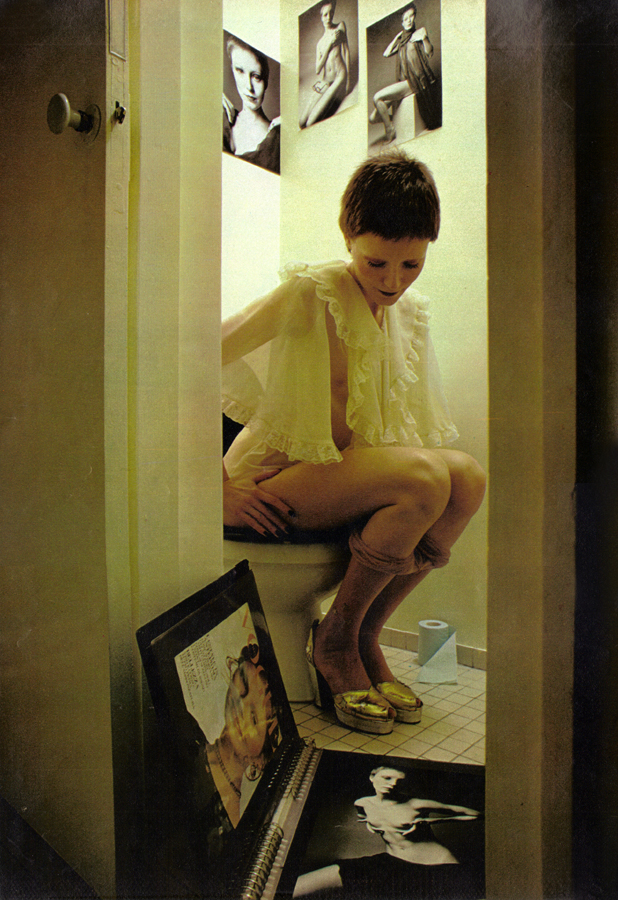
Blouse by Annacat. Shoes by Chelsea Cobbler.
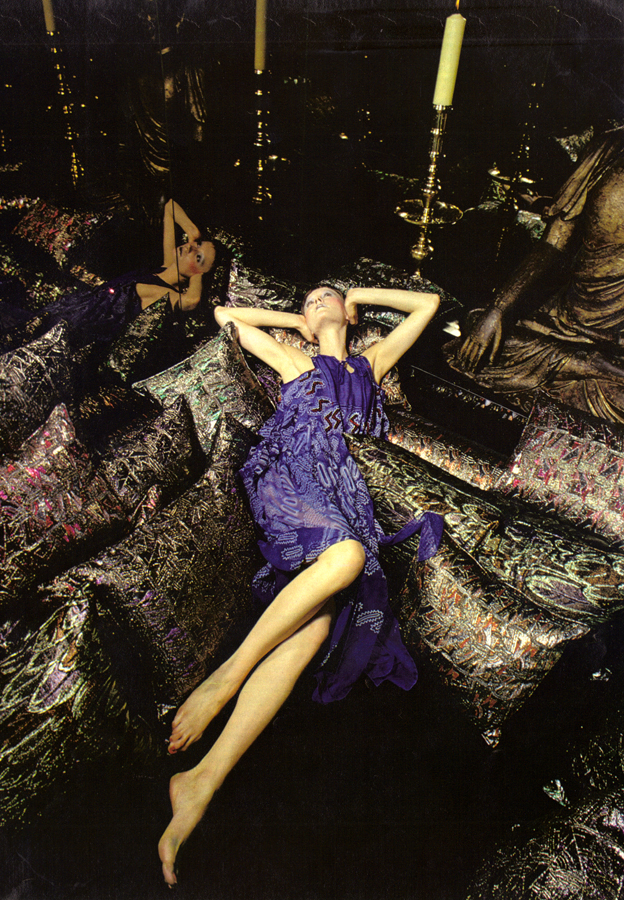
Tunic and knee-length skirt by Zandra Rhodes
Tunic and shorts by Gina Fratini
Chiffon dress with matching short bloomer-knickers by Jean Muir
Scanned by Miss Peelpants from Nova, April 1968
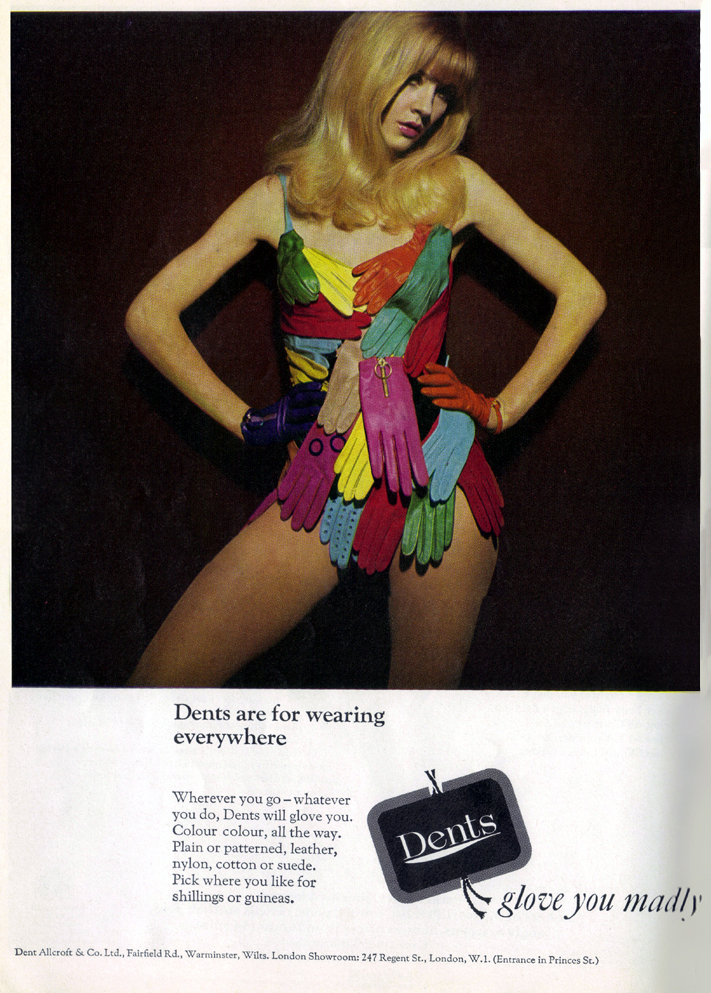
I seriously want that dress.
Scanned by Miss Peelpants from Queen, November 1968
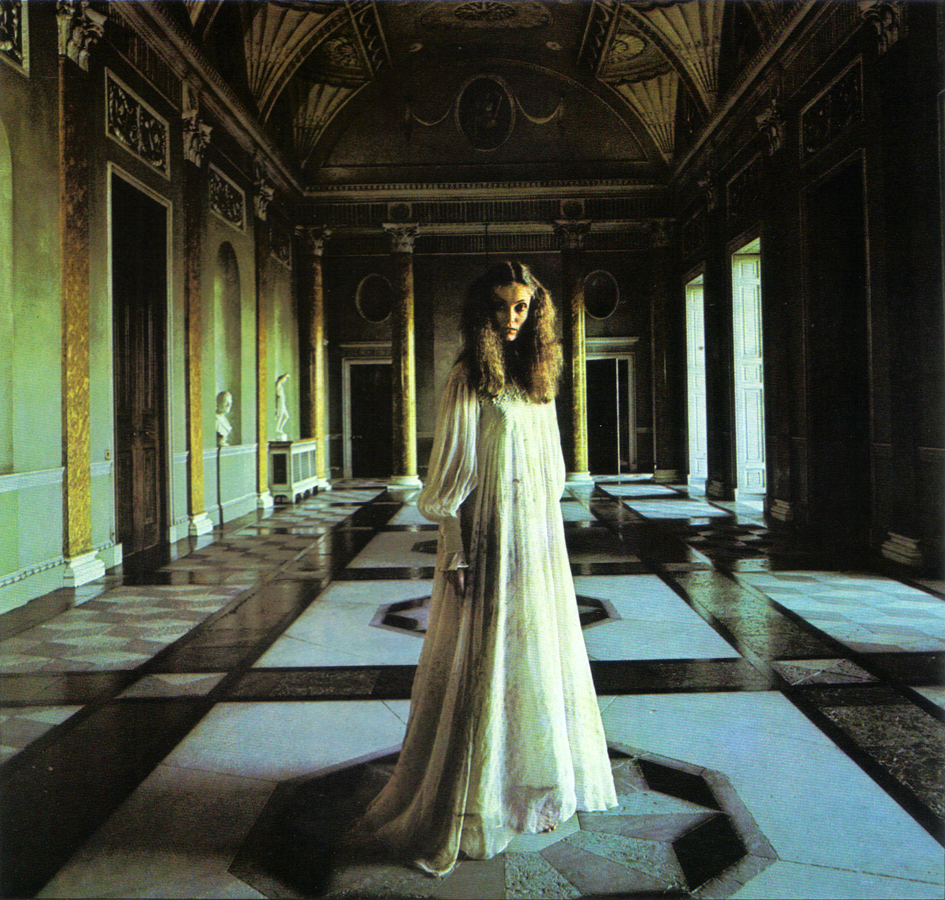
Photographed by John Hedgecoe. Date unknown (book published 1976).
The dress looks like it could be Gina Fratini but is uncredited in this book.
Scanned by Miss Peelpants from The Book of Photography by John Hedgecoe.
Sometimes life can be overwhelming. I have many lovely experiences to recount from the last few weeks, but putting finger to keyboard has not come very easily to me lately. So apologies for the lateness of this post.
Three weeks ago, I was very kindly invited to meet Barbara Hulanicki (designer, illustrator and general legendary goddess…) at Paper Dress Vintage in East London by the gorgeous Sophia of Black Spring Press who have just published Seamless From Biba. Shoreditch is not a natural habitat for Miss Peelpants, and I knew I was limited on time due to working that evening, but it was Barbara Hulanicki… how could I not?
As a ‘blogger’ event, I had assumed that there would be a veritable vintage scrum and scramble. I was pleasantly surprised to walk into a peaceful and beautifully appointed vintage shop, and see Margaret of Penny Dreadful Vintage, Liz of Advantage in Vintage and Lisa of Snoodlebug. Later I realised that Ana of Where The Roses Go was also in attendance, but sadly didn’t get a chance to talk to her (though I did admire her amazing hair from afar…). And that, was pretty much that. It was intimate, casual and so, SO much fun.
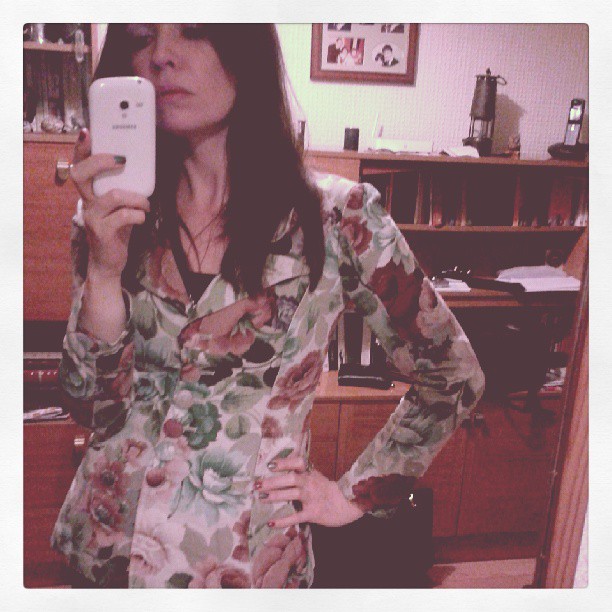
Sadly I didn’t have any of my more – ahem – flamboyant Biba pieces to hand, as I was staying with my mum in London, but I was able to wear my most favourite and wearable piece of Biba. A thick cotton fitted jacket with the most extraordinary floral print, which I knew I had to possess the moment I first saw it in the V&A Cutting Edge book. Possibly the second most exciting moment of the evening was when we were introduced to Barbara and she spotted my jacket, did a double take and pointed at me with an exclamation of ‘I recognise that!!’. She was able to confirm that it was indeed, as I had heard rumoured, a Sanderson upholstery fabric. She went on to say that they produced it in four colourways, and reminisced about taking four models to Italy – all wearing the same suit in a different colourway. ‘The Italians thought we were mad!‘.
What followed was more like, as Barbara said, a tea party. We all sat in a small circle, on squishy sofas and this all rendered it rather hard for me to take many photos or make many notes. It really felt like she was in conversation with all of us, and as I was directly opposite I just wanted to enjoy having a natter with one of my all-time inspirational people. So I made some sketchy notes afterwards and make no claims to precise quotations, just details.
I took the chance to ask if it was true that she used ‘vintage’ fabrics from the Thirties and Forties, and she confirmed that they did indeed. Kensington High Street was home to three department stores, Barkers and Derry & Toms being the most well-known but Pontings (further down from Derry & Toms, to the left as you emerge from High Street Kensington station) was famous for its haberdashery department. So in the early Seventies, when Pontings was on its uppers, Barbara was able to purchase rolls of unused fabric from thirty/forty years earlier. She admitted that they often had to cut around faded panels and other flaws from storage and age.
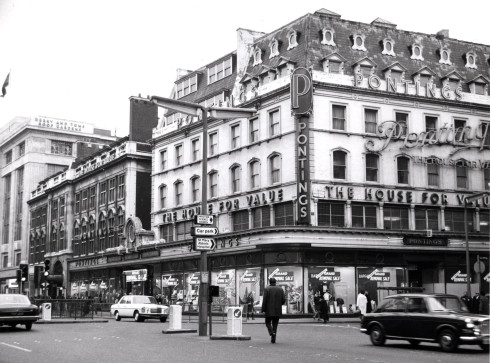
Pontings Department Store (Derry & Toms, later Big Biba can be seen on the far left). http://rbkclocalstudies.wordpress.com/tag/pontings/
During a discussion about how films had inspired her designs from a very young age, and then the fact that Biba clothes were often used in films of the time (I’ll Never Forget What’s’isname was cited as an example, and roundly dismissed as being terrible. Something with which I greatly disagree but wasn’t about to get started on…), Barbara admitted that many things were filmed in Big Biba (including the Suzi Quatro video for Devil Gate Drive) without her knowledge. She laughed as she remembered driving past the building late one night and seeing lights on; something was being filmed and she had no idea!
I couldn’t resist the urge to share my “discovery” of the sequence from Side by Side (not the greatest film in the world but it has value and merit as ‘of its kind’, if you get my drift…) which was filmed in the rooftop restaurant. And, sure enough, she had never even heard of the film. Which is probably understandable, but it is getting a proper release 
I was keen to ask her about whether or not she had experienced much sexism, or whether Fitz had largely protected her from the worst of it. ‘Ohhh yes‘, she exclaimed, and said that, in the early days of Biba, nobody had taken her seriously and the suppliers she was dealing with would often leer at her ‘girls’ in their mini skirts and were dubious as to whether they should even be dealing with her. Of course, later on, when they saw how successful Biba was and were trying desperately to sell her things, she took her revenge. Explaining that they had a meeting room with a very, very low and large table, she laughed as she remembered that they were expected to sit on cushions on the floor. ‘And of course they’d all come straight from boozy lunches and when they sat down, their stomachs were hanging out over their trousers. And then we’d send the girls in, and they didn’t know what to do‘. Psychological warfare on lecherous pigs? Barbara is definitely my kind of lady!
When asked about the make-up colours, including green and blue lipsticks and blushers, Barbara confirmed that they all sold well and that there was always a veritable scrum surrounding new colours appearing in store. She remembered another occasion in Italy, as their make-up was being sold through Fiorucci there, where they had models each made-up with a single colour scheme. So one had blue eyeshadow, mascara, cheeks and lips, another green, and so on, and they all piled into the back of a taxi afterwards. Of course the taxi driver was too stunned at what he saw in his mirror to drive off, those mad English!
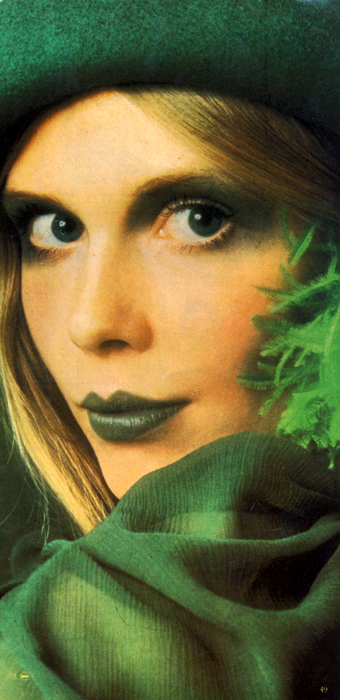
Green Biba make-up, photographed by Caroline Arber and scanned by Miss Peelpants. Featured in this previous blog post: https://lizegglestonarchive.wordpress.com/2011/11/05/the-colour-craze/
The majority of Biba models were taken from the shop floor, including Madeline Smith, except for a few notable exceptions such as Stephanie Farrow and Ingrid Boulting. The latter of whom Barbara admitted was her favourite model. She remembered an occasion where Boulting had been hired for a make-up shoot, and then said – on the day – that she couldn’t wear mascara. ‘But we’re paying you to wear the mascara‘ – she exclaimed in mock frustration at the memory. She also remembered a photoshoot where Sarah Moon had burned every single negative except for one. ‘This is the only one which came out’ claimed Moon, Barbara laughed as she said ‘She meant that was the only one she was happy with and had burnt the rest!‘. Fitz refused to let her use the solitary negative, ‘as it had cost us £1000!‘ and put it in the safe. (It was, apparently, used at a later date when the shock had worn off…).
She also said, with great sadness, that Helmut Newton was one of her favourite photographers to have worked with, but that she was too nervous to ask him again. Then, years later, his widow told her that he had loved doing the Biba catalogue and was hoping to be asked again. Which I’m pretty sure is an important lesson in ‘it never hurts to ask’ that we could all do with heeding.
One of the first questions I asked, but which feels more appropriate to mention here last, was for her opinion on having been so widely criticized at the time, in quality terms, and yet now so widely collected and sought after by serious collectors and museums. She smiled and said ‘Oh it’s wonderful. I only wish that Fitz had been alive to see it!‘.
I get the feeling that he always knew, because he always had faith in her and in Biba. It’s a testament to the both of them that it is still so coveted to this day, and retains a mystique despite all the copies and relaunches.
There were many other questions, answers and anecdotes, too many of which I have probably forgotten:
We moved to pick up our books and have them signed, and she very kindly took our business cards. As I handed mine over, I had a momentary panic – my logo girl illustration is the image on the front of my business card! I’m basically handing over my puny illustration to Barbara Hulanicki, a woman whose illustration-style I worship (while trying desperately hard NOT to copy…). The panic dissipated as she asked if the illustration was mine, and then said something very complimentary. I’m not going to try and quote her, as I wouldn’t want to put the wrong words in her mouth, but needless to say – if Barbara Hulanicki compliments you on your illustration, your life is pretty bloody amazing at that precise moment.
As we talked about living in Brighton, and the recent exhibition, I remembered how upset I was to miss the opening event there due to a pesky toe-breakage. I think it’s safe to say that the karmic universe delivered me a more than sufficient replacement. It was an hour of pure joy, which I will always treasure. Thank you to everyone who made it possible, and mainly to Barbara herself for being so engaging and friendly.
Seamless from BIBA
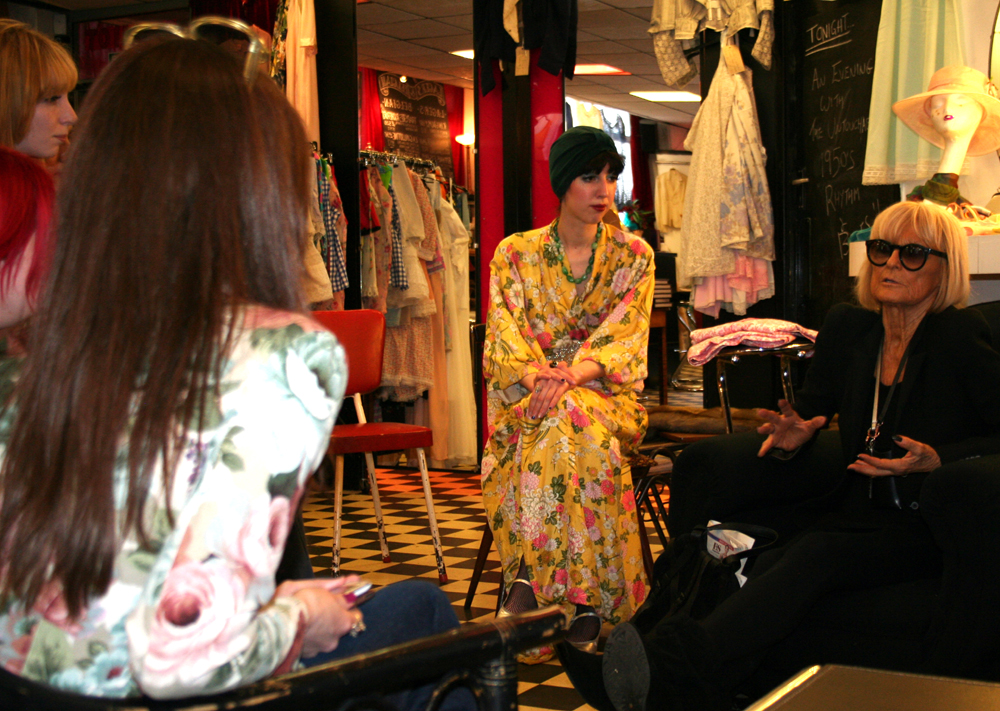
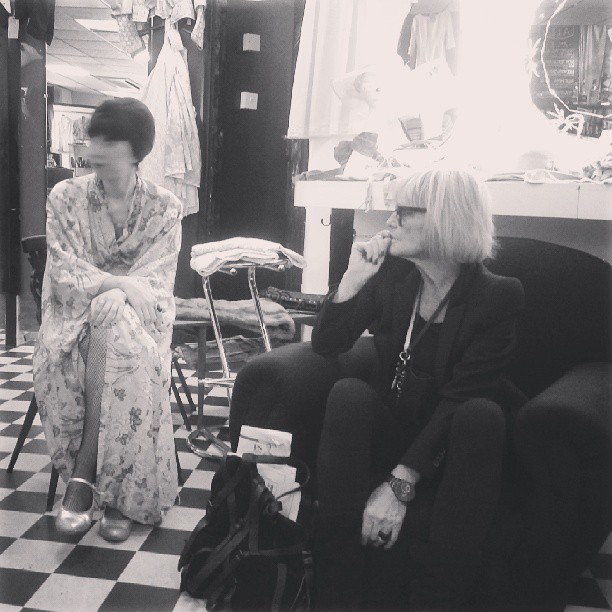
Note the Peter Robinson bag on the floor (Peter Robinson was the progenitor of Topshop)
I recently picked up this phenomenal booklet which came free with Vanity Fair magazine in 1971. Entitled ‘Nice Girls Do’, it is supposedly intended to be a guide to modern life for young women confused by the new sexual revolution and women’s liberation. With a few gorgeous inspirational images thrown in for good measure. It’s also a brilliant insight into the mindset of the early Seventies woman, but also not really a million miles away from such small-minded, hypocritical women’s journalism now. Plus ça change…
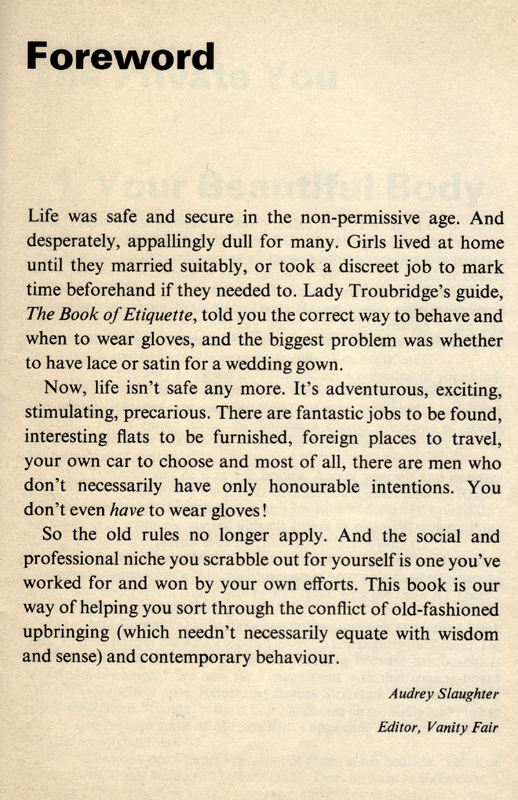
Here is a small excerpt relating to fashion:
Talk about liberation! Suddenly all the old rules of dress have been suspended. Unisex, the Great Pants Revolution, ten million boots marching across the nation, and the great unleashing of bras have swept a century of fuss and fogginess onto the junk heap.
Once the strictures were clear as crystal, hats for church and town, gloves always, no bare legs on nice girls—ever, girdles an absolute must, trousers strictly for the country, and still only for the young. Now nurses and bank clerks wear trousersuits, patrician matrons dine in transparent pyjamas, and women of ‘a certain age’ boldly appear in black body-stockings and ammunition belts. Alas, it’s easy to become a laughing stock unless you have innate style. There is still one rule: propriety. That means wear what’s right for you and what’s right for what you are going to do. Everything you put on should polish your assets like sterling and blur your flaws like camouflage.
‘Look for the woman in the dress’ was a favourite theme of the late Coco Chanel. ‘If there is no woman, there is no dress.’ And . . . ‘In love, what counts is to please a man,’ Coco liked to say. ‘If it pleases him, paint yourself green.’
Dress to please the man in your life. But don’t overdo it. Dressing for a man doesn’t mean dragging him to your favourite stores to make him choose what he likes on you. It means you wear what makes you look appealing and avoid the chaff. Men can be drearily conservative. They resist change and need to be lured to a new look or a new length, slowly and gradually. Stay aware and try.
The man who falls all over the giggly brunette with the pop-up bosom or the naked tummy or the shortest shorts in the room will want to fade into the wallpaper if you —his adored— appear in the same costume. Be careful . . . even if you happen to be in better trim than Miss Pop-Up Bosom.
Go with fashion, but don’t sell yourself into fashion slavery. Twelve girls at the same film premiere in velvet knickerbockers, identical bullet belts, and fringed boots are pathetic. You, in the same panné velvet knickerbockers but with a suede belt and an old art-nouveau buckle, are infinitely more interesting. Style is individual. It’s what you do with fashion to make it yours alone! When everyone in your crowd is rigged up like a strolling gypsy or Moroccan princess, do not underestimate the power of sleek black simplicity.
Not every new style will suit you, but somewhere there is a proportion cut just for you. Impossible, you say: Aha. You’re in serious trouble and need to shed twenty pounds. Quick.
A dress you can’t move or cuddle in without worrying about moulting feathers or splitting a seam is a disaster . . . no matter how divine it looked in Vanity Fair. Give it away and avoid others with similar faults. You’re going to be a grouch all evening if that groovy buckle digs into your rib cage with every breath. Choose clothes you feel relaxed wearing.
Nothing can ruin your day more efficiently than a shoe that pinches, rubs, and digs. You can read the pain plain as yoghurt on your face. If the glass slipper doesn’t slip on easily in mid-afternoon when your feet are most vulnerable . . . forget it. You can’t break in a shoe . . . it only breaks you with pain and wasted cash.
1. A close lit is no fit at all. A good alteration lady is your third best friend (after Mother and the hairdresser).
2. Clean underwear every day.
3. If you hate to wash and iron, don’t buy clothes that need it. (I didn’t own an iron until a friend —considering me a poverty case— passed one along three months ago. I haven’t used it yet). But you will need a large budget for cleaning bills. If you don’t have money, learn to wash and iron and avoid buying clothes that must be cleaned!
4. It’s a little rip . . . sew it now. Hoard extra buttons when you find ones you like.
5. Weed out the inevitable flaw: snagged stockings, pulled threads, a spot of tomato juice on your doeskin glove, a rip in the lining of your handsome ostrich handbag. Repair it before you wear it again . . . or give it away.
6. Prune the cupboard mercilessly. Don’t drag rejects with you the rest of your life . . . if you haven’t worn an item in two years (a decade?), discard it. Clean it, and donate it to a charity.
A lot of the most ghastly mistakes were made when women were encouraged to do their own thing. It’s one thing to have didactic fashion laws arbitrarily laid down by a toffy-nosed fashion magazine not geared to your way of life; it’s quite another to be let loose on a bewildering range of styles and left to your own devices. A great sense of style and chic is needed to steer through that morass.
1. Study yourself in a leotard betore a well-lit, full-length mirror. If this experience drives you to drink . . . vow to re—form your form.
2. Who are you ? What are you trying to say about yourself? What is your image ? Are you playing a romantic Ali MacGraw? Or a carefree groupie? Are you a girl with her eye on Mary Quant’s throne? Are you a lean drink of spring water or a bubbly dolly bird or a languorous sensualist? Decide! Then you will develop antennae that tell you when gingham is right and where a monkey-fur fringe is definitely excessive.
3. Decide whose style you admire or consider close to your ideal. Analyse what this paragon has done and be inspired . . . don’t imitate blindly.
4. lf you see someone wearing an item you absolutely must have—even a total stranger on a bus—say so and ask where she bought it. Don’t ask the price.
5. Read the fashion magazines. Out of the wild and exaggerated fancy there is a message: brown is great for summer . . . length doesn’t really matter anymore . . . superstructured underpinnings are dead. Especially note the accessories: bags, belts, gloves, jewels, hats.
6. If you find a store that pleases you, make it your hang-out. Loyalty is rewarded. When you stumble across a salesgirl with taste and energy, pursue her. Call to see if she’s on hand before you venture across town on a shopping spree. Ask her to telephone you when she has something just your style . . . or when that Cardin coat you’ve been sighing over is reduced 20 per cent.
7. If you are one of those indecisive creatures who cannot tell whether a dress with pleats and flounces in shrimp crépe is as good as it sounds till it’s hung on the cupboard door at home for a week, then never never buy clothes marked ‘final sale’ or ‘not returnable.’
8. Learn about fabrics, seams, and construction. Go to fashion shows and try on a dress by Jean Muir or Ossie Clark so you’ll get a feeling for what makes a £70 shirtwaister different from a £7 one.
9. If you find a bra or panty or shoe that’s ideal for you . . . tights that are like a second skin . . . a ribbed polo sweater that makes you feel like Jeanne Moreau, buy in quantity. That’s what Jacqueline Onassis does. Even on your budget, it makes sense. If you wait until you need replacements, the style or colour may no longer exist . . .
Q. Is it better to put all my money into one status Gucci handbag or buy half a dozen bags for different occasions ?
A. A recognisably fine bag has great impact and lasts ages. But it really won’t go everywhere. Invest in the quality leather as your mainstay. And then collect for pennies—a larger canvas tote bag, an old doctor’s satchel (from a junk shop), a small wicker basket or champagne wicker tied tight with a bandanna hanky, an Oriental brass box from an antique shop, a denim over·the-shoulder newsboy bag you make yourself.
Q. Are there any rigid fashion rules that still count these days?
A. Yes. White for tennis (unless you’re playing on your own court at home) and plimsolls. Warmth for skiing, hunting, cold-weather sailing—if you neglect warmth for chic you’ll ruin your day and everyone else’s as well. Rubber-soled shoes for yachting, preferably those with a special-grip rubber bottom. Rules for formal riding and the hunt are specific: visit a shop that specialises in riding clothes and do what they tell you.
Q. Must I wear a hat to church?
A. Women should wear hats in Roman Catholic churches and Orthodox synagogues. And many women do wear a hat to church even where it is not a must, But today a laoe mantilla or a bit of veiling is considered ‘hat enough.’ No woman should ever let lack of hair covering keep her from entering a church on impulse for a few moments of meditation. Attitude is more important than a hat. And anyway, hats are back. I couldn’t live without my giant wolf beret that covers my ears in winter or half a dozen felt and straw cowboy hats in spring and summer. You need to learn clever scarf tricks for your head, a flattering all-over hat for days when your hair just doesn’t cooperate.
Q. Is it right for a divorcee to wear her wedding and engagement rings? Mine are so beautiful.
A. Do you really want a constant reminder of the past? Why not have the stones reset into a marvellous ring you can wear on your index finger or, if you’re not the type, something smashing for your little finger.
Q. Where can l go to find out what to wear at a Bar Mitzvah?
A. A standard etiquette book will tell you what dress is expected at weddings, funerals, and other ceremonies of life. Or you might phone the women’s page editor of your local paper and ask advice.
Your sweet little lace blouse worn one day too many.
Tell-tale-grey nylon underwear (tint it purple or red or espresso brown).
Structural safety pins.
Wrinkles, spots, baggy anything, runs, rundown heels.
Shoes clearly beyond their prime.
A handbag that had it two years ago, still ‘making do’.
Festive party gear in the office.
Ruffles when you are much more the slinky jersey type.
Too-big coats and shoddy tailoring.
Superclunk shoes.
Ice-cream-cone bosoms.
Bulges . . . panties that bind and show-through.
Drooping hems . . . make a fast temporary repair with sticky tape, then sew that very evening.
Baby-doll costumes on women over thirty-five unless you have the figure and complexion of a twenty-year-old.
See-through blouse with a utilitarian bra in full view.
Clothes you’ve hopefully squeezed into and kidded yourself you can wear. Try one size up —you’ll look slimmer, and every hook and eye on your bra won’t be visible at ten paces.
Anything that looks like it’s wearing you.
Itsy-bitsy fragile little jewellery. If you can’t afford knock-out jewellery in 18-carat gold, buy some smashing fakery.
Last year’s rejects or rotting nightgowns as at-home clothes . . . give the family a break.
Toting an adorable Lilliputian evening bag and loading your man’s pockets with survival paraphernalia . . . learn to survive on less.
Undressing for an audience is a sadly neglected art. Too many women just peel everything off with no thought to the effect . . . rudely tossing crumpled garments here and there . . . and then slopping around in an abused and mutilated housecoat.
Men hate to see you in the bedroom clumping about in high-heeled day shoes and bare feet. Most of them prefer you to take your bra off before your pants. Practise doing it quickly, gracefully, and if he’s in a mood for being teased—tease him. Let him see you in a lacy slip you know flatters you. Don’t wear superstructured bras or girdles. Let him catch a glimpse of you through an open door, spotless bare back, creamed gleamy skin, brushing your hair or spraying yourself with scent just for him. It arouses him to know you want him.
America’s COSMOPOLITAN once ran a wise little article about ‘How to Strip for Your Husband.’ Tassels and twelve-button gloves are not necessary. But attractive undressing, sensuous underpinnings, and flattering, fresh at-home wear is kind to your audience—that one special person.
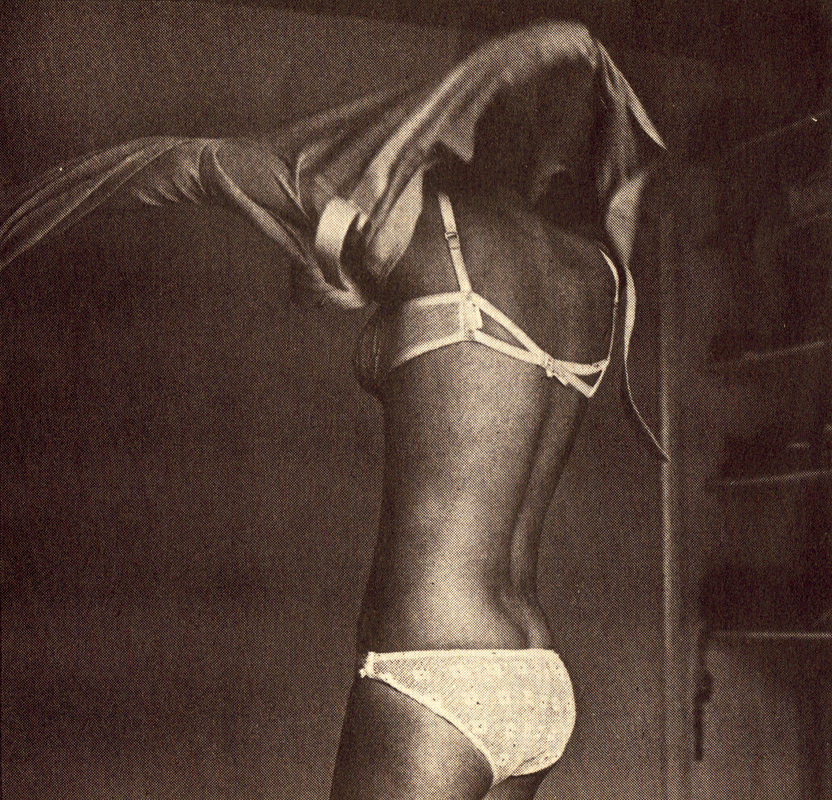
More from ‘Nice Girls Do’ some other time…
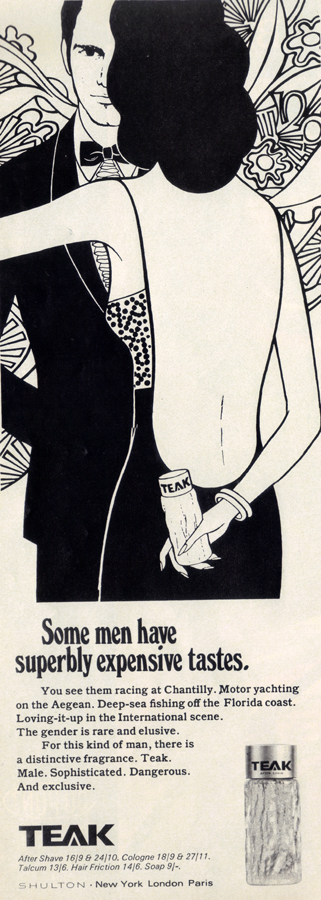
It doesn’t get more mid-century than an aftershave called ‘Teak’…
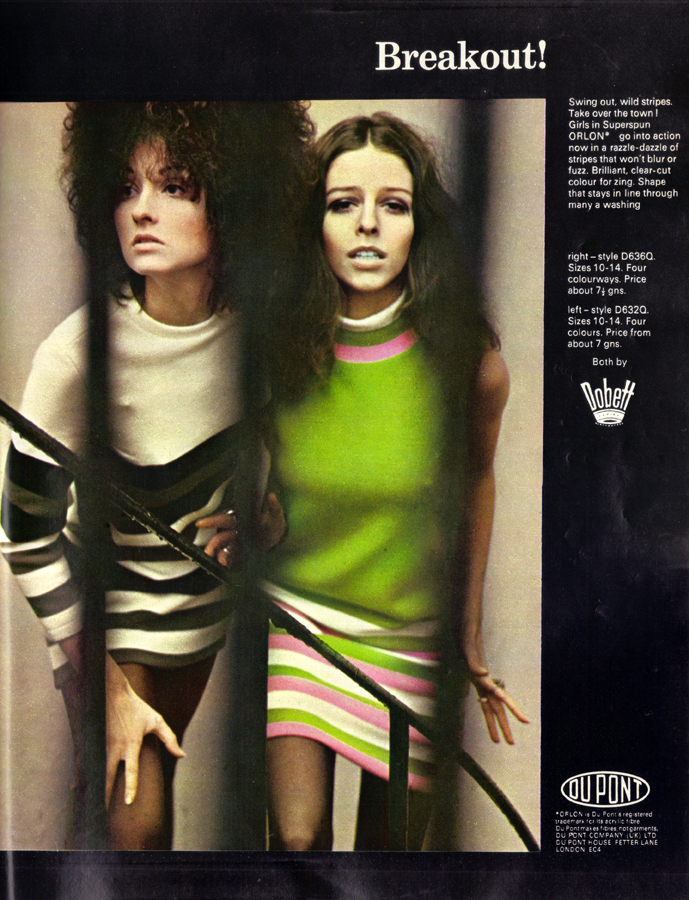
Scanned by Miss Peelpants from Nova, April 1968

Richard Myhill – 21 Days in Soho (1975)
With a cover like that, and songs such as “Lazy Lady” (Never operational til the sun has left the sky) and “Backstage Judy” (You look hot but you’re cucumber cool), how could I resist?
Sleeve design, photography etc by Mick Rock. Styling by Sheila. Legs by Noelle. Shot at The Last Resort restaurant, Fulham Road, London. Thanks to Sue Machin for making the kimono with amazing speed.
Scanned by Miss Peelpants.
It Takes Two To Tango (1978) was Myhill’s biggest UK hit, and he later worked with my beloved Durans on some of my favourite songs (including Tel Aviv and My Own Way)
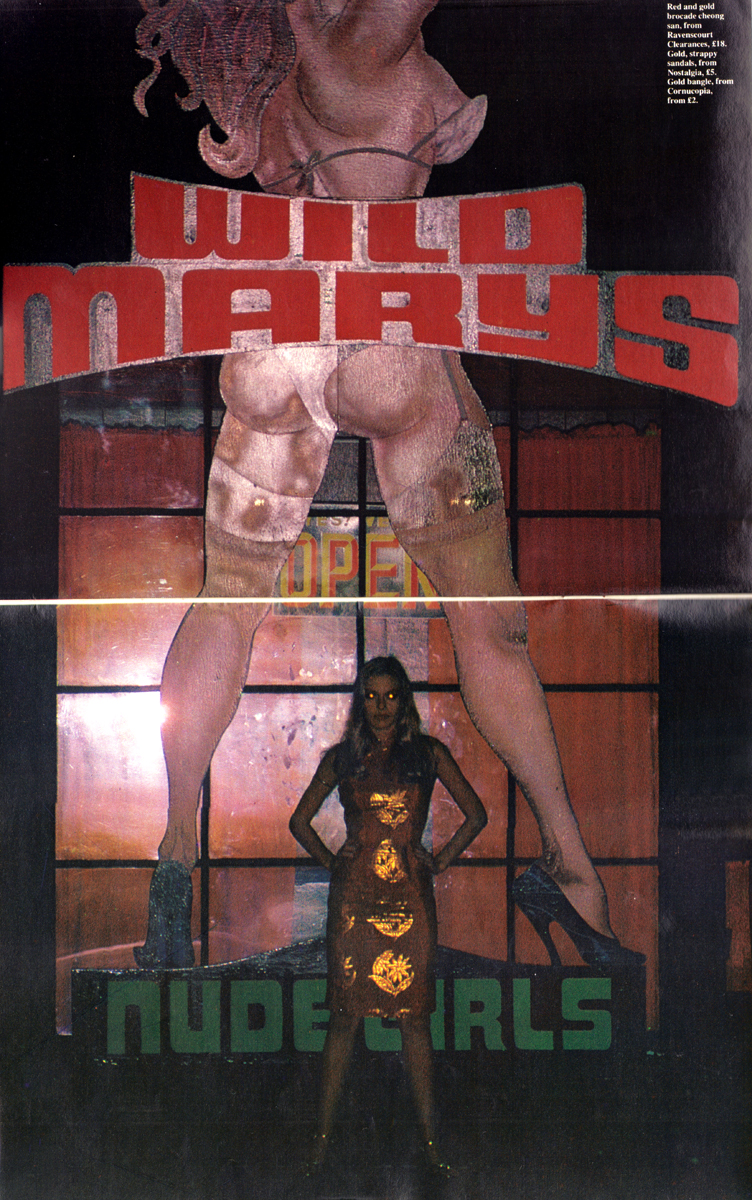
Cheong-san from Ravenscourt Clearances. Sandals from Nostalgia.
Photographed by Mike Berkofsky. Scanned by Miss Peelpants from 19 Magazine, January 1975
 Liz Eggleston