
There are times when Allen Jones makes a highly plausible bid to be taken for a fetishist. His paintings of shoes with impossibly high heels are in the realm of phantasy and can only be worn by the phantom of sex appeal that slips them on in the mind’s eye, but they are more likely to be rhinoceros horn to rouse and sustain. Even his paintings of legs, conspicuously shape-conscious though they are, could have been devised to celebrate the stockings. But the true fetishist places his faith on inanimate objects or parts of the body as far away as possible from the sexual zones, and although Jones rarely paints the whole figure, his euphoric images of the cleavage and the crotch are evidence enough that he is far from being at the mercy of symbolic displacements. Until recently, he could probably be described as an aficionado of the choice view, but suddenly all the evocative fragments have come together in three life-size effigies of girls which look so breathtakingly real that when I first saw them in the artist’s flat I felt that I shouldn’t have entered the room without knocking.
They are made for instant recognition and maximum confrontation. They turn into works of art by rapid but clear-cut stages. Twice over, they are not what they seem. At first they are blindingly girls. Then they are brilliant imitations of girls, cool and arrogant but incapable of lifting a finger against close and impertinent inspection. Finally, inpection makes it clear that their proportions are not human. They are not imitations. They bring to a kind of perfection a convention that has arisen on art’s difficult road back to a humanist figuration.
They present a strong case for the artist as director. Everyone who knows Allen Jones’s paintings will agree that the effigies disclose his formal preoccupations at every turn: but he has not actually made them. It all started on one of his trips to the States, when someone mentioned that there were people in London who were making fabulous life-size dolls. Back in London, he went to see one of these dolls, a likeness of Carroll Baker that had been commissioned by a film director. Only the head had been specially modelled; the body was that of a conventional shop window dummy. The visit brought up the name of Dik Beech, a commercial sculptor who works as a freelance in close association with a company named Gems Wax Models, which makes the moulds and casts for Madame Tussaud`s. Beech brought great professionalism and the neutrality of a craftsman to the task of turning Jones’s drawings and specitications into three-dimensional figures. They were then cast in fibreglass by Gems Wax Models, and sprayed and rubbed down and sprayed again to give them an impeccably smooth, flesh-tinted finish. At this point they were taken over by Lucina della Rocca and entirely repainted by hand. She works for Tussaud’s, and she brought the surfaces of the casts to life with imperceptible nuances of tone. They were now looking the picture of decadent health. The eyes too are painted, and the faces have been given a bold but not exaggerated make·up. Other experts were called in. The leather accessories, including the strap-work on the standing figure, were made by John Sutcliffe of Atomage. The Lurex pants of the girl on her hands and knees were made by Zandra Rhodes and required three fittings. The wigs are by Beyond the Fringe. The gloves, bought at Weiss of Shaftesbury Avenue, are the only accessories that didn’t have to be specially designed.
The figure on hands and knees gazing into a mirror has been designed so that the back of her head and her rear are exactly the same height, to support the clear glass panel which has been made and fixed by Design Animations. It turns her into an anthropomorphic table. Her pose perhaps suggests an undignified obedience, but she can he freed from her glass plate to occupy an easy chair; her arms then stretch out in a striking “hands-off” gesture calculated to send one to the opposite side of the room. It’s indicative of the artist’s purely visual interest in the gear that he was not aware that the strap running from the standing girl’s collar to her G-string would be at the back on a real girl, to compel her to stand up straight: it seems to confirm one’s impression that the girls come from a strip-joint not of this world.
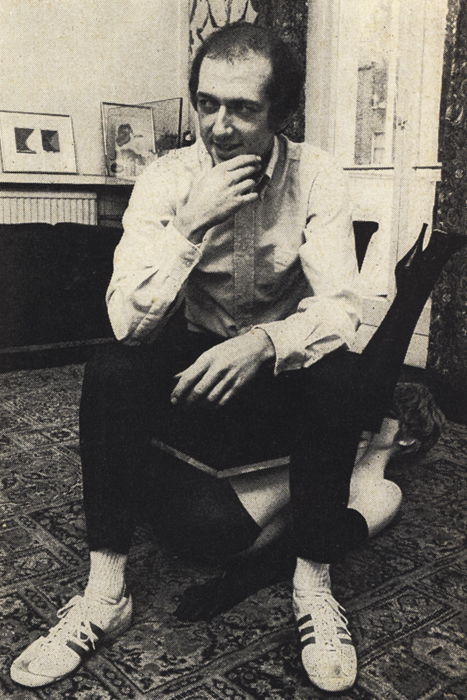
Allen Jones at home, above: his wife and two dollies, opposite. His three life-size effigies, each in an edition of six, will be on show in New York from January 6 at Richard Feigen; in Cologne from mid-January at Gallery Rudolph Zwirner; in London from January 23 at Tooth’s, 31 Bruton St, WC1.





 Liz Eggleston