When you collect and devour as many vintage magazines as I do, there are a few important life lessons you begin to realise. The first is that regardless of what they may say, all photos now are airbrushed. You can tell this because all photos in vintage magazines are not airbrushed. People have blemishes and bumps, you either re-shot the entire editorial or you put it in, warts and all. The second is that people’s major life problems and desires are no different now to how they were then. There might be a little more of a whiff of old-fashioned values, but, ultimately, people just want a rewarding job, sizzling sex life and somewhere nice to live.
A more interesting and less generic lesson is this: Not everyone who has a large magazine feature about them and their talent is guaranteed any level of success. Surely most people are somewhat susceptible to that green-eyed monster, when they see a rival (or, worse, someone they’ve never heard of) featured heavily in a magazine article about ‘up and coming’ talents or ‘renowned authorities’. You wish nothing but success for fellow human beings, naturally, but you may wonder why you have been overlooked or fear you have missed some vital step on the road to becoming a major player in your chosen field.
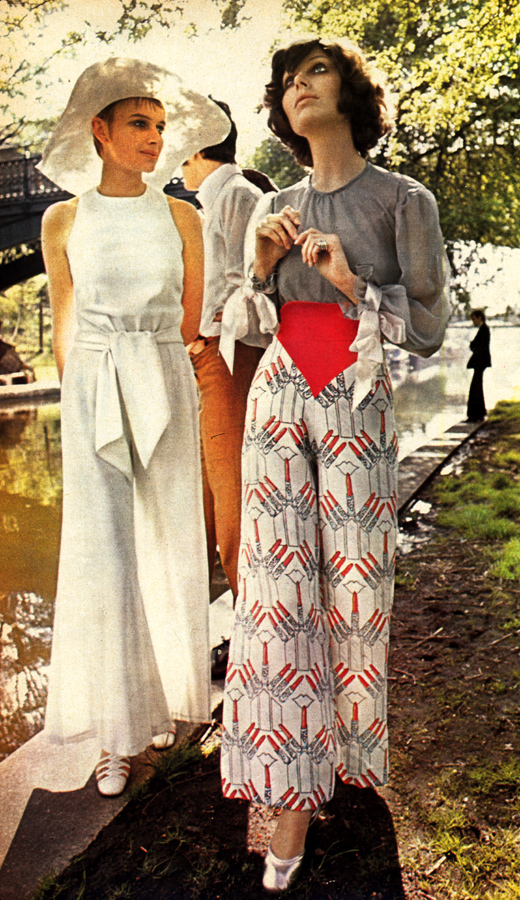
But the number of magazines I read, which feature ‘up and coming’ new fashion designers who even I have never heard of (me, boutique-geek, not the foggiest….), is astonishing. This particular article from 19 Magazine is one of the most striking. The incredible photo, the incredible clothes, the fact that they are the main feature in an article which also covers Wendy Dagworthy. Tell me, who on earth has ever heard of Preston and Saunders? I’ve googled, and googled. Unless I’m missing something, there’s nary a trace of them anywhere.
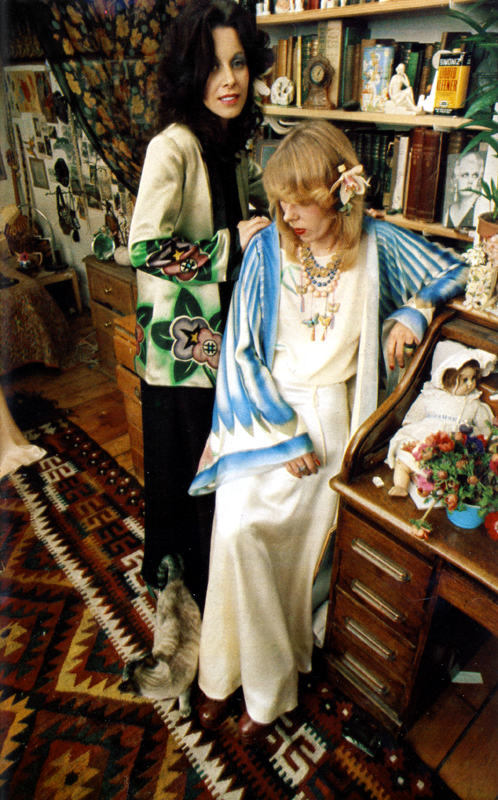
Laverne Preston wears a hand-sprayed and beaded jacket with print designed by Jane Wealands. Sue Saunders in her hand-sprayed Egyptian printed kimono.
Which is a shame. Clearly they had talent. But what happened to them? Where are the Preston and Saunders clothes? Why is this the only reference in any magazine I’ve ever seen?
I must admit, I’m really hoping that either will google themselves and find me. I really want to know what happened to them! I also think this is a very good quote, and remains an important point to make in 2011.
“There is no reason why we can’t do hand embroidery just because we’re living in 1974”
19 Magazine. May, 1974. Photo by Graham Hughes.
Leading Ladies with Designs on You
Laverne Preston and Sue Saunders have just formed Preston & Saunders with no capital at all. They’ve been offered backing, but it’s a case of once bitten, twice shy.
Of the designers we interviewed, we found that Laverne had the most ‘experiences’.
“l’ve lost thousands of pounds . . . people I’ve done collections for that have made a fortune out of me, and, of course, names! I’ve made two companies complete, you know, names, and earned very little money out of it for myself.
So we decided to eliminate such people. That’s why we really don’t want backing, a few thousands, yes, but not real backing. Once you get that, you make a name for the company, you get masses of Press, you get a story for them—and then, that’s it. “I had four years at art college, a year in Paris making tea, before I became a designer for Maggy Rouff under an architect called Serge Matta. This had the biggest influence ever on my designing because he was so pure and I was very into architects, anyway.
“Then I went to Kiki Byrne, Young Jaeger, Consortium, C&A Modes and, finally, Maudie Moon, which was great fun. I then decided to give up the whole rag trade, buy antiques, study embroidery, etc. I tra- velled all over England looking at different handicrafts.
“After this, I worked again for another company and was nearly had up for assault—I blackened an eye—so I left, called Sue and said, `Why don’t we get together. because I can’t keep blackening people’s eyes’, and that was it.”
Sue Saunders has had gentler experiences. She spent eight years at art colleges, start- ing in the provinces and end· ing up at The Royal College of Art. then she taught silk-screen printing in the graphics department of East Ham College of Technology for two years, and freelanced.
“I started up the printing studio with a company called Luckies, which used to do pop furniture. It went bust so I got out of that. Then I met Jane Wealands, whom I was with at college, and we set up OK. Textiles, which was just short runs of our designs, We could not get them into production as nobody wanted to buy that sort of thing. We started off wanting to do furnishing fabric, but it ended up with most of our designs being used for things like men’s shirting.
“We did lovely stuff for Johnson & Johnson and Alkasura, and have done jackets for Rod Stewart and Marc Bolan and people like that. It was at that time that I met Laverne. “Jane wanted to go into graphics and I was left on my own. I wanted to do something worthwhile and design for an end product. I had no control over the things I sold – what they were used for.
“They were usually men’s things and I thought it would be nice to do things for ladies for a change. It also gave me an outlet for my sprayed fabrics, which are hand··sprayed with spray guns, as well as printed. I would much rather do one-off things than produce yards and yards of fabric.
“I can do any print I want, but I do change things for Laverne if it doesn’t fit the pattern of the garment. The kimono I’m wearing (it had a beautiful Egyptian print) was done for my boyfriend, Jeffrey Mitchell. He’s just got a new band called Hollywood, and I guess we’ll be doing things for them. It’s nice to do special things for people. This is specially for Jeffrey, because he’s into Egyptian things and so am I.”
Did she think that art colleges helped one to get jobs in a practical sense?
“No, I don’t think they do. They are good in that they give you some time to be able to learn certain things and be able to experiment. One can’t do that once out of college and into a set-up like ours. College gave me the opportunity to do mad, inflatable things which I wouldn’t be interested in doing now. I’ve got it out of my system. I think students should spend a month a year working for a commercial company and then go back to reassess their thinking.”
Preston. & Saunders will be a fairly expensive label to start with. They have done a range to sell exclusively at Elle shops, and all the garments will be a mixture of tamber beading, hand embroidery and hand-padded flowers in relief on velvet.
Laverne adds: “The more money we earn, the more staff we can employ, and the prices will come down. I don’t want to use factories. All they want to do is shove through an order for 800 garments at a time. “There are masses of women at home who have children and can’t go out to work because of them, and this gives them a chance to do something interesting.
“There is no reason why we can’t do hand embroidery just because we’re living in 1974. I always wear antique clothes and love anything with embroidery or texture. One of the reasons I went into this is because the really beautiful antique clothes are completely out-priced.”


 Liz Eggleston