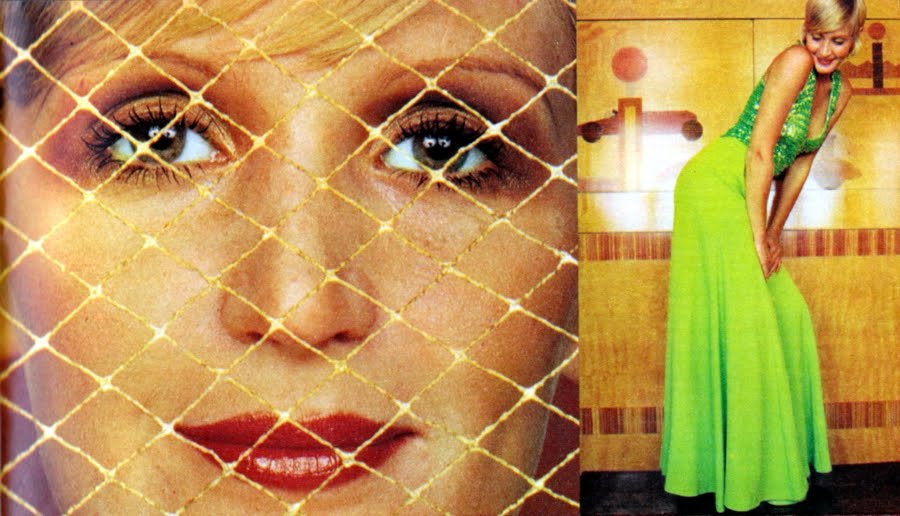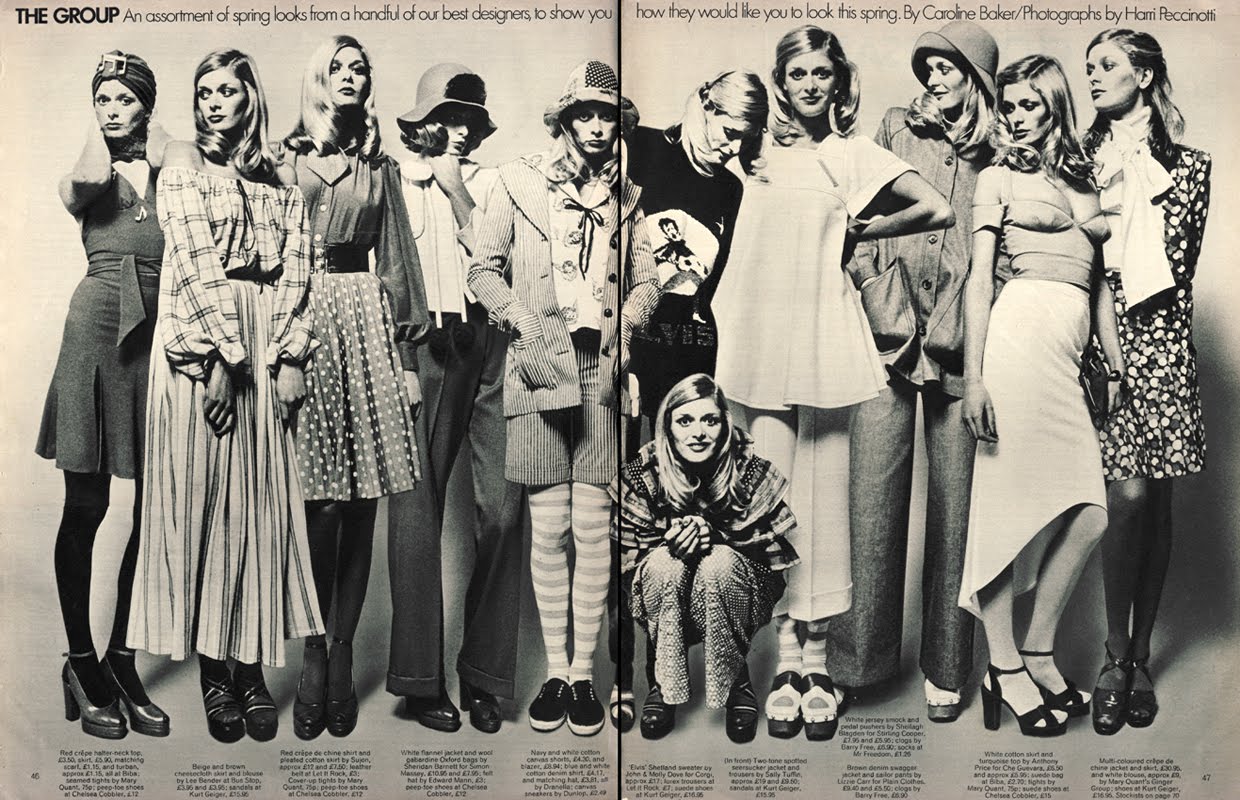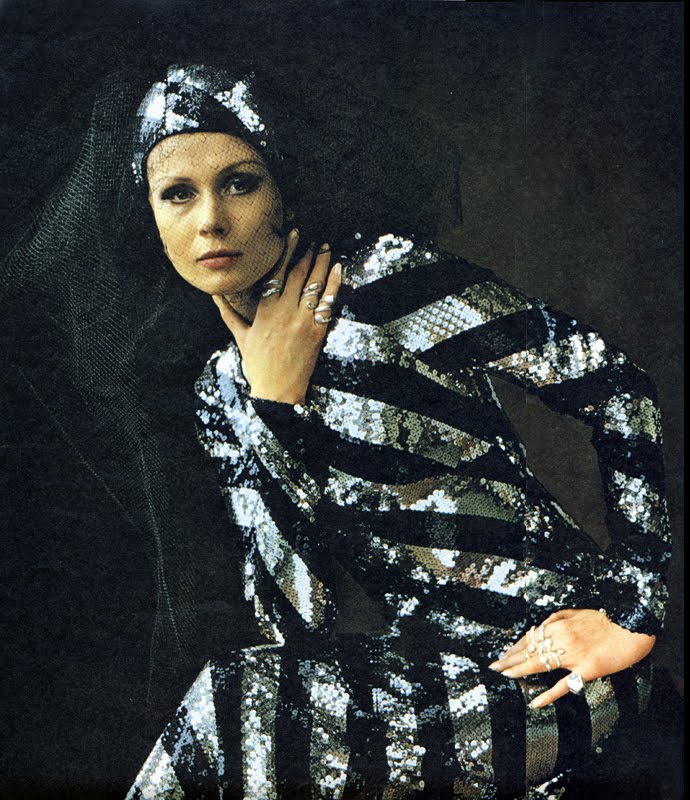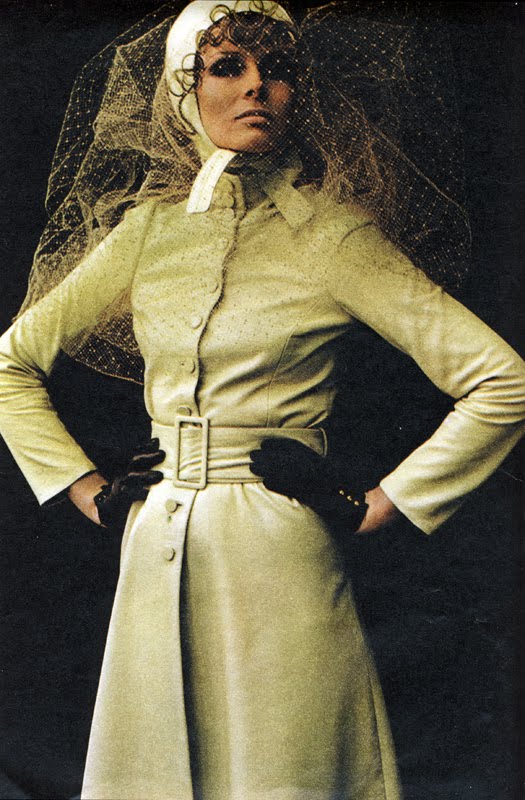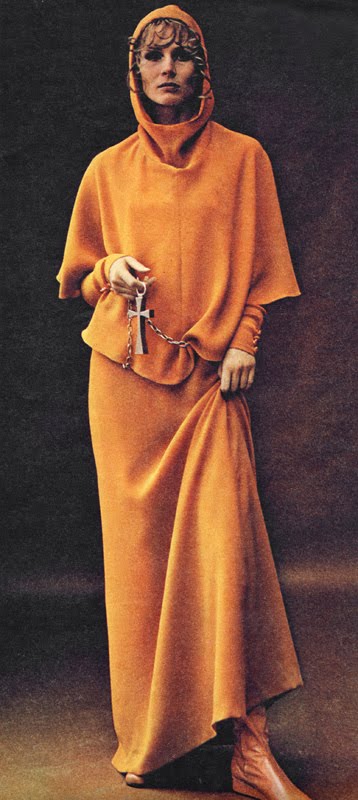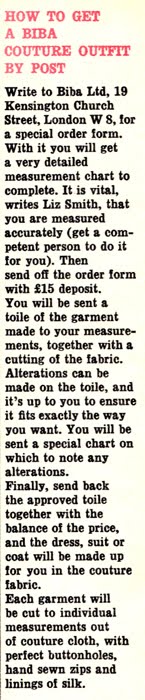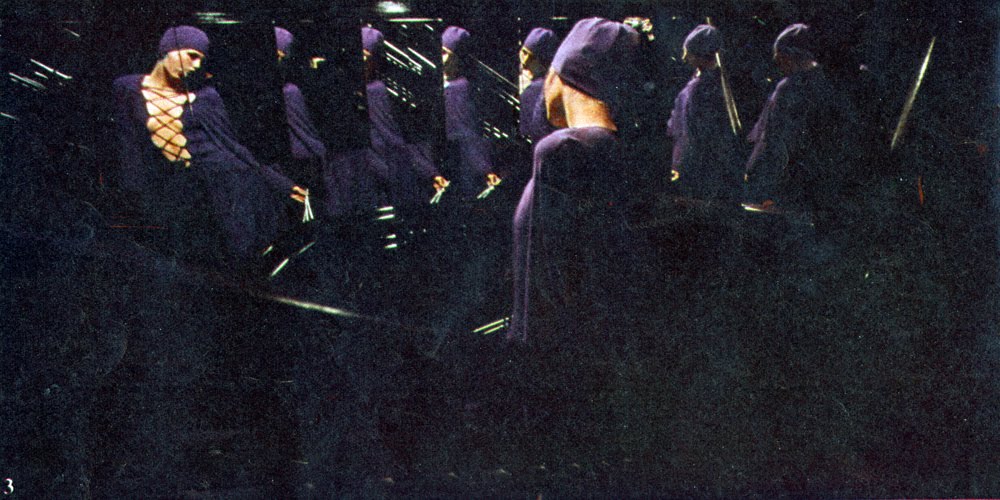
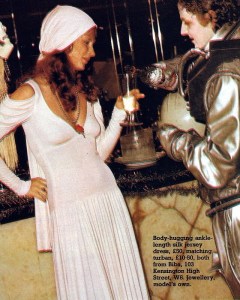
I have this dress in dark blue. (It’s the notorious £50 dress which Barbara Hulanicki feared wouldn’t sell because of the high price. It sold out.) One of these days, I’m actually going to find the occasion to wear it…
The room is large, brown-ceilinged, brown-carpeted and the wallpaper is edged with stripes that remind you of nineteen-thirties’ cinema architecture. It is the office of Barbara Hulanicki and her husband Stephen Fitz Simon who together are BIBA.
Barbara curls over the arm of the sofa in the curvy kind of art nouveau shape she has made famous again in furnishings.
“When do I show a new clothes collection to Fitz? Never!” Barbara laughs at the idea. “It’s got nothing to do with men. They mustn’t decide what ladies like to wear.”
Herein lies the success of the Biba empire, a look, an environment, some say a way of life, created by one girl whose husband knows when not to interfere. “I haven’t a creative idea in my head and I’m colour blind,” he says. “What Barbara wants to do, what she feels is right, is absolutely up to her.”
How right is proved by the tide of events which has swept BIBA from her first poky back-street dolly-girl clothes shop into a seven-floor Kensington, London, store. For in September, 1973, the entire building that used to be Derry & Toms, a monument of British store tradition, will be filled from top to bottom by BIBA. A Biba that is bigger, more influential than ever before.
From eve shadow through to refrigerators, from hairslides to washing machines, from underslips to sauce-pans, the Biba look will permeate our lives.
Barbara’s trademark began with a fluid body-clinging style in clothes made up in old-fashioned fabrics with old-fashioned prints in smoky, sleepy colours. Everything about them was soft and slithery and nostalgic. She loved old things. “Modern ones are so cold,” she said.
So what Barbara began in 1964 was the “granny look” but she sold it to dolly girls and the Biba Way of Life had begun. Though you may never have been one of the eager crowd straining the corners of her first pint-sized boutique in West London, you have been affected just the same.
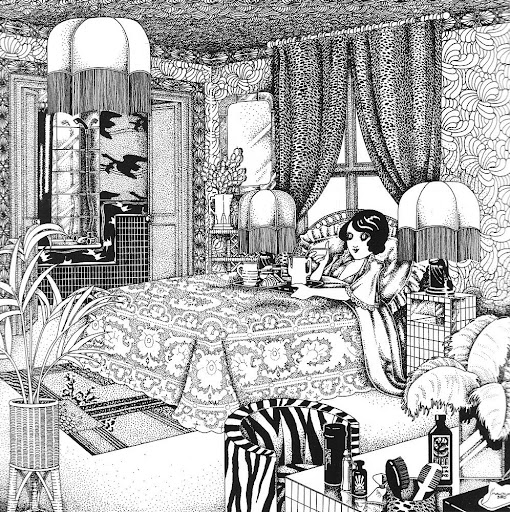
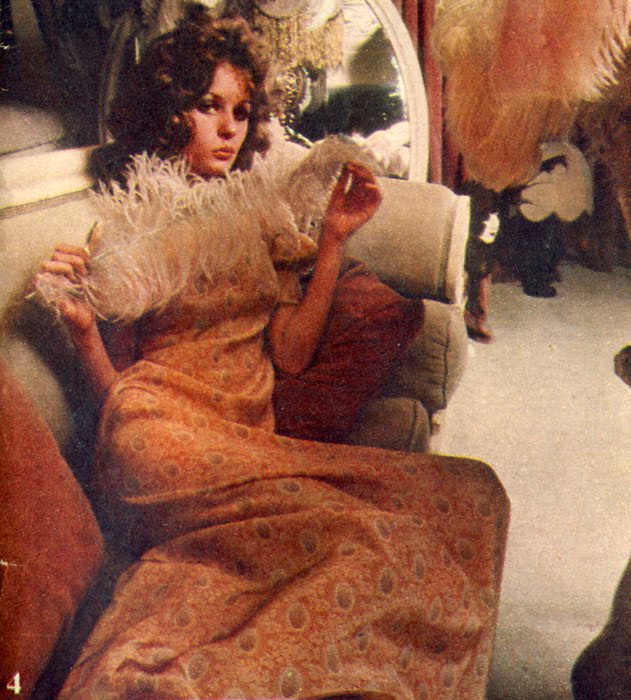
For Barbara, a fragile-faced girl with the. straight blonde hair of a child, wide high cheekbones, fine hairline eyebrows, has turned out to be the powerhouse for an explosion in looks. No one could seem shyer: no one could appear less dominating or more likely to mind her own business. That merely shows how misleading appearances can be. For when you look in the shops and see slinky little crêpe dresses, pretty puffed sleeves, romantic shirring, tucking and bias cuts, they may not say BIBA on their labels but, make no mistake, it’s Barbara from whom the whole idea of them sprang. When you glamorize the furnishings of your house with satin cushions or switch to romantic old Tiffany lampshades of satin and fringe or hunt down some graceful junk—she is the girl who set free this feeling for the pretty ideas of the past. “I need things that have lived,” she says.
And when in 1970 she produced a range of make-ups in oil portrait tones, inevitably we deepened our facial colour schemes and left the hard lines off our eyes. Such clumsy artifices simply were not the BIBA Way of Life.
How Barbara developed that distinctive taste which marks all her work is an interesting conjecture. We know she is Polish by birth and parentage but came to this country as a small girl and was brought up with her two sisters in Hove, Sussex.
We imagine, then, a child who, like her father, loved to draw: a gentle environment which fostered her soft and romantic style of sketching. When she came out of Brighton Art School and moved to London to draw for the papers, the Slavonic stamp in her own looks also characterized the girls she sketched. They were cool gentle blondes with spun-glass features, soft hair done simply, no gawky edges. Whether she knew it or not, she drew herself. We picture an elegant home too. As a. friend of hers told me: “Plushy fabrics, high ceilings, decorative cornices—all the paraphernalia of Edwardian elegance we’re beginning to yearn for and appreciate again—Barbara lived with these and it’s largely thanks to her that we’re getting a taste of them back.”
Looking at Barbara’s wallpapers, cushions, lampshades and ornaments, at the mauve and moody bedrooms of friends who have decorated decorated in the Biba style, I agree. The astonishing thing is that her ideas took seed—and survived—in the op, pop, and Space era of the sixties. Clean functional lines in clothes and homes were the order of the day.
But: “I don’t believe fashion is dictated by the lives we lead,” said Barbara. And predicted long, really long day skirts at the height of the mini: sludgey prunes, greys and purples in the heat of the Courreges white and red craze: flat silky hair when towering, back-brushed domes were in their prime: and old-world furnishings when the Technological Revolution was upon us.
How did she sense we would take to these alien things? Sagittarians, she was born on December 9, 1938, are supposed to be strong on intuition! In her bones she felt that people would retaliate against the growing speed, rush and noise by dressing and furnishing in a nostalgic style.
“Old things are interesting be cause they have a lot of workman ship, a lot of feeling,” Barbara says. “I have to design new thing,, for mass production but I try to give them the look of attention.
“It’s a struggle. Today people know what they like—and they like clothes on the bias with frills and a handworked look. It is increasingly difficult for manufacturers to produce what I want—good machinists are hard to come by. But we fight on.”
Barbara always fights for the colours of her make-ups, her tights, her boots, her bags, sends them back time and again. The shades must be exactly right because they have to match clothes, even furnishings. “I’ve made myself awful problems by co-ordinating everything but working girls and busy wives haven’t time to charge around matching one thing to another. They want to buy it all in one go.” It is Barbara’s ability to see the whole picture which makes people call her enterprise a way of life. She shrugs at the suggestion. “All I’ve done is try to provide what I need myself! At the time I started, people used to talk about investing money in a dress. What a crazy idea that would be now! Imagine always feeling a dress was something to feel guilty about unless it was a sound investment. Fashion should be as cheap as possible so that it can be lighthearted,” she says.
Everything of Barbara’s is blindingly recognizable and usually worn by several women -in any moderately crowded room, but such is the standing of Biba that it is one-up-womanship to be wearing it. Her sway is incredible. Quite vulgar plastic baubles and brooches are all right—Biba says so. Armholes cut fiendishly narrow are okay–Biba has made them so. She it was who plunged clothes-shopping into darkness and beset it with the deafening throb of pop. These things don’t go with your romantic, nostalgic look, I complain to her. “One gets both extremes today,” she replies. “That’s what’s fun.”
Fun it certainly is for Barbara. She gets a big kick out of the sheer audacity of some of her clothes—leopard print heels on platform shoes, big leopard print gauntlets on gloves, sequinned tops and culottes to wear with felt hats and veils. Wearing’ a camel coloured sweater with quietly matching pants —but swinging a foot shod in an outrageous five-inch heeled shoe!—she declares:
“The charm today is in all the contradictions. The tarts look like ladies in good mink coats and crocodile bags and shoes. And the ladies look tarty in platform soles and ankle straps.” It’s this humour that her few critics don’t catch on to. The fancy dress element in Biba is a chuckle, a chuckle we needed. The potted palms and the curly bentwood hat-stands. The knee-length ropes of coloured beads and the bizarre tassels. At the time she began Biba, Barbara was visiting couture fashion collections in London, Paris and Rome to sketch clothes for the newspapers. “Dozens of little black padded numbers. They were stiff, self-conscious, serious and boring.”

It was the pompousness of fashion she was out to slay, and she is still at it. “All the really grisly fabrics are coming back,” she warns with great relish. “Cheap shiny nylons we used to sneer at—they’ll look marvellous, though. They’re stretchier, softer. People will never get into hard clothes again.”
Biba salesgirls do not offer assistance—it is rumoured they would get the sack. Barbara is also responsible for communal changing rooms, which lots of us hate, but the owners of Biba can worry all the way to the bank about that! “If we provided individual rooms for every customer, half the store would be changing rooms,” says Barbara.
Biba is now not just a London store, but a world-wide selling organization. They compute the quantities in which Biba will stock and sell Barbara’s creations, chase suppliers, arrange the link-ups which have built up the company into a world-wide industry selling clothes in America and cosmetics all over the world. Dorothy Perkins, the chain which stocks Biba make-up through Britain, has a seventy-five per cent holding in Biba and is behind the huge new store.
Barbara and her husband work from early morning to eight and nine o’clock at night, often for long unbroken periods—then they spot a gap and fly off somewhere like Istanbul for a long weekend with Withold, their five year old son. They are a tight, devoted threesome and—in this publicity-minded age—very private people indeed. It is a fetish with them. Their home, furnished from top to bottom in Biba products, is a fortress. For all her beauty, Barbara hates having photographs taken. She is scared to be seen on television or heard on radio and would faint if she had to address a group. She is a doer, not a talker. Although she is backed by a strong team, most of whom have been with her the full eight years of Biba’s existence, she herself designs the prototypes of every line and is never influenced by other fashion pundits. That is her claim. In fashion I would say it is a justified one. She does her own thing and that is what has made her a cult.
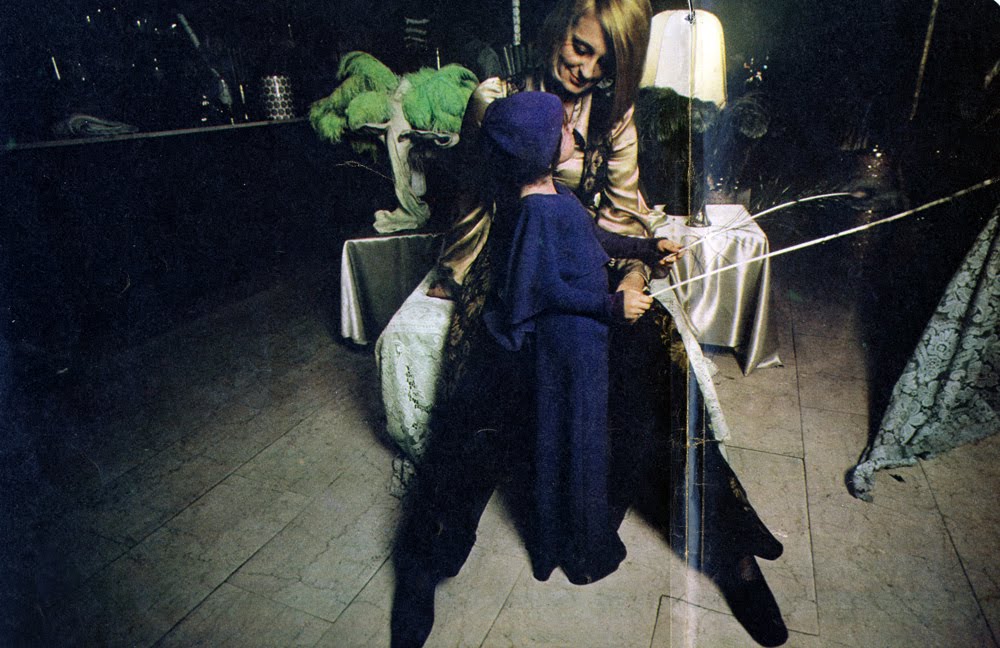
In furnishing, WOMAN Home Editor Edith Blair says: “Barbara came in at a time when young people were wanting to make their homes glamorous, but hadn’t the antiques, old china, Victoriana their parents owned. Biba introduced excitement with inexpensive ideas. Her dyed feathers are marvellous—you don’t have to buy flowers or plants. Her fringing brought a cosiness into decor. Satin and huge cushions look romantic. Her softer look as penetrated many homes.”
Woman magazine, December 23rd 1972

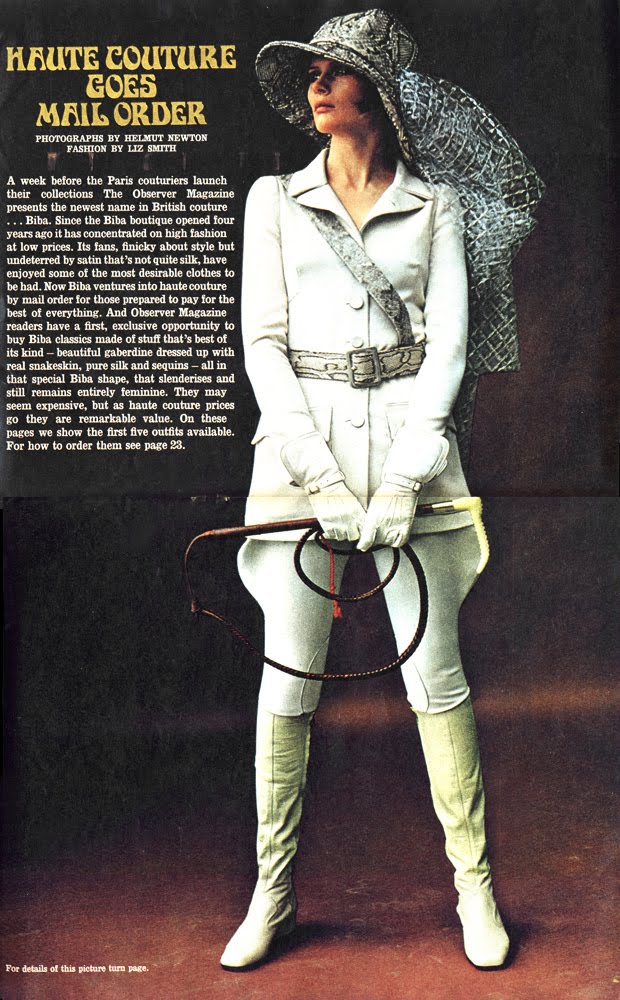
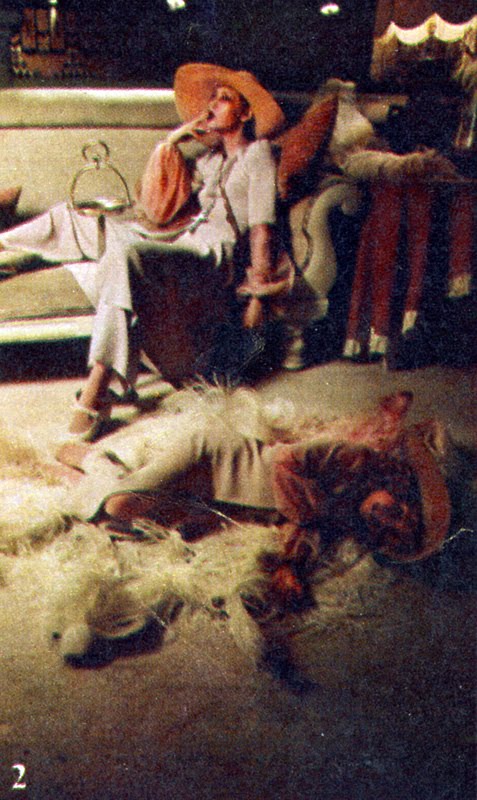
Safari jacket, 80 gn with jodphurs, 75 gn with skirt. Hat (without veil) 22 gn. Sam Browne belt, 20 gn.
It’s a funny old world. One of the main reasons the regular Biba relaunches have failed so dismally, each time since 1975, has been the price issue. Barbara Hulanicki, whether you agree with her or not, has always had a firm belief in affordable, fast fashion. £200 for a middling quality dress, as seen in the most recent attempts to reignite the brand, is simply not acceptable in an age of fast, cheap fashion and quirky high-end designers with real personality and bite. To whom are they appealing? I’m afraid I judge people who buy House of Fraser Biba. I just can’t help myself. So there can be little or no cachet to buying that gear, from either Biba geeks or fashion freaks. And the quality isn’t good enough to be seen alongside the likes of Jaegar and Hobbs for the ‘medium’ level appeal.
Biba was cheap, cheerful, young and undeniably cool. Nothing has come close. Primark has the prices, Topshop supposedly has the cool and youth, but none of them have the quality or uniqueness of their oft-copied ancestor. Yes, I said quality. Biba might have had a reputation for badly-made clothes but it simply wasn’t true. It was an assumption, based on the price. And fair enough, it wasn’t couture-quality, but it was no worse than anything being produced by Saint Laurent for his Rive Gauche, Ossie Clark and other British Boutique designers of the era. Certainly a cut above anything being made by many big name designers, these days.
My vintage Bibas are beautifully well-made. They couldn’t have survived forty-odd years otherwise. A seam might have deteriorated here, a small moth-hole appeared there, and perhaps a zip has busted after a particularly raucous night out. But I’ve seen Paris couture from a mere ten years earlier in a far sorrier state than that.
So if shop-floor Bibas are still doing the trick after four decades, can you imagine what a couture Biba must have been like? And if Barbara was baulking at a higher-than-usual price tag for a voluminous jersey dress (which I own) and feared it wouldn’t sell (it sold out), then what on earth was she thinking about offering a coat for 120 guineas?
I had heard vague things about Biba couture over the years, but I’m not entirely sure I’ve ever seen anything like this article before. I do so wish I could see some Biba couture pieces now. The original owners must have remembered they were such, so I would hope that the provenance would be forever attached to the piece as it passed from careful owner to careful owner.
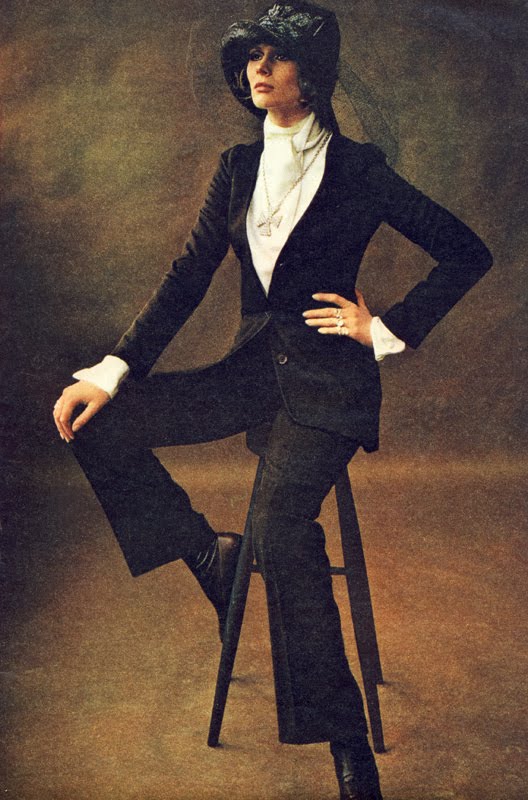
Dreamy. And certainly not hindered by some incredible photos by the legendary Helmut Newton and footwear by The Chelsea Cobbler.
Observer Magazine, 19th January 1969.
Oh dearest readers. I have been laid up in agony for most of the weekend courtesy of a pulled/trapped something-or-other in my shoulder/arm. It’s been a bit hellish at times, two nights in a row I was only able to get four hours sleep and I’m still waking up every two or so hours in almost unbearable pain. Hot water bottles and codeine are my friends right now.
It started out so beautifully though. For M’s birthday, we went to a beautiful hotel in the Sussex countryside. In fact, the same location as last year. I’m hoping it will become an annual tradition because the hotel, grounds and restaurant are completely and utterly divine. Even *I* managed breakfast on both days. And I never do breakfast in hotels.
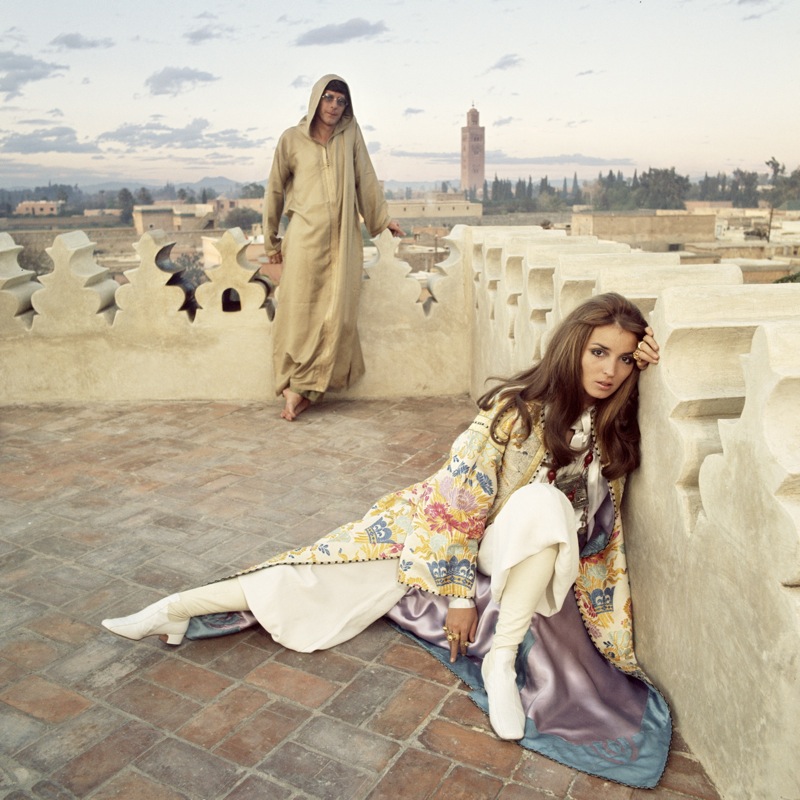
M is now in possession of a menswear Biba nightshirt/kaftan (I keep saying it makes him look very John Paul Getty. I wish I looked like Talitha.) and a draught-excluder, made by mine own fair hands, *proud of self*, amongst other things. We celebrated by doing quite a lot of walking in the crisp, misty February air, drinking some champagne and, later, a scrum-diddly-umptious beanfeast. With no beans involved. And with a Michelin star.
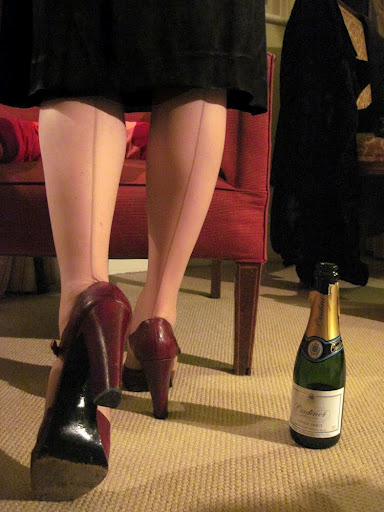
My hair wasn’t really behaving, as per, and I’m in a bit of a shy mood photographically right now. But here are my YSL shoes (having long-overdue outing), seamed stockings and the hem of my Bus Stop dress.
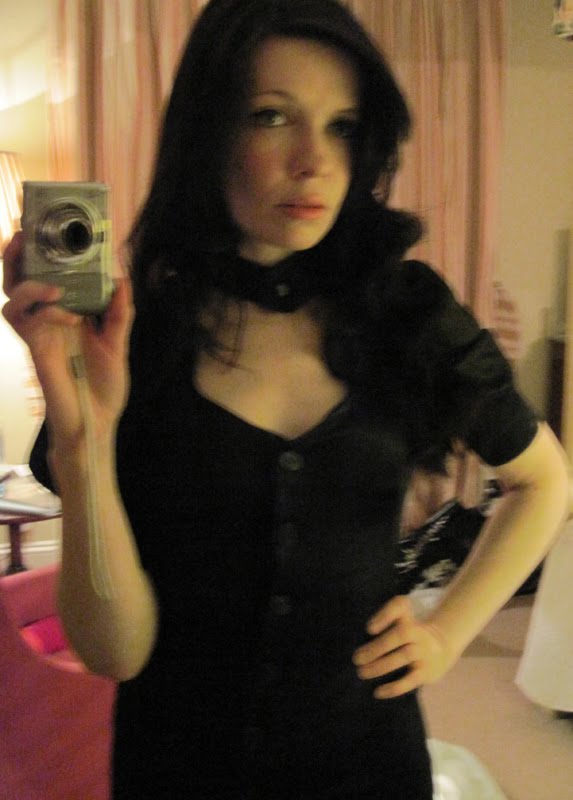
And here is a [deliberately] blurry photo of the top of the dress. It’s black satin, ridiculously puffed sleeves and an integral choker, which is perfect for a jewellery dunce like me. I always forget to either bring anything or to put it on before leaving, so I’m rather fond of things which prevent me from even needing it.
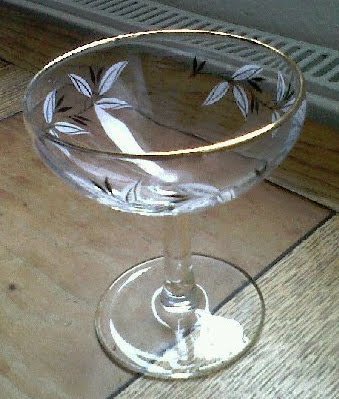
On the way back, we found a splendiferously old-school charity shop where I picked up some decorated coupes for myself (£1 each). It’s rare enough to find coupes which aren’t Babycham-branded, but decorated non-Babycham coupes have got to be worth picking up!
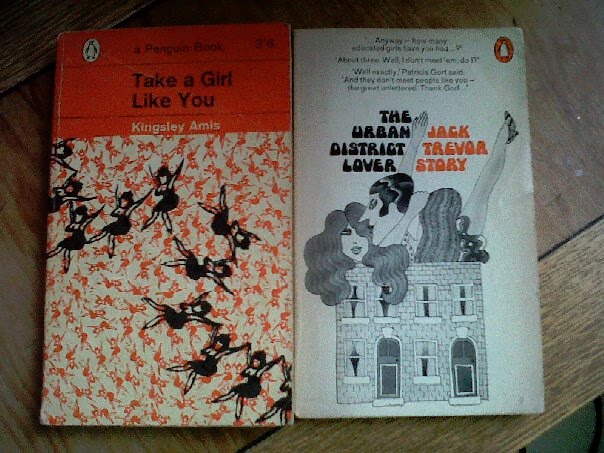
And I have decided to become the anti-platitude by buying two books largely for the incredibly illustrated covers.
It has caused me to ponder if judging a book by its cover is really such a bad thing? After all, the point of a cover is to give an impression of the insides, otherwise it’s not doing its job, surely? Musings about appearance and clothes ensue, and I find myself going round in circles. Far more interesting, for me, than London Fashion Week anyway…
The amazing Mr Brownwindsor has furnished me with a much-desired copy of the [would be a cult if anyone knew about it] film Side by Side. From 1975, it has a lot to recommend it if you are anything like me and care not for plot or characterisation when there’s glam rock groups, immensely outrageous clothes and period location shooting involved. Even my beloved Fox make an appearance.
Most amazingly, there’s an incredible segment recorded on location at the Biba rooftop restaurant. Wicker peacock chairs, fringed lampshades et al. An incredible, and rare, insight into the then-soon-to-be-lost world of Big Biba and one which seems to have itself largely been lost in the mists of time.
No longer!
I’m currently avoiding the cold (and the general public) by working on some gorgeous new listings, including Biba, Janice Wainwright, Marie France and many more, and immersing myself in my beloved clothes, films, tv and music – like some strange, velvet-clad hobbit.
Thankfully, gorgeous people like Laurakitty are on hand to point me back towards the amazing person on Youtube who has access to footage from the German programme ‘London Aktuell’ and a whole host of seriously groovy easy-listening music of the era. I posted about this a while back, but hadn’t realised some new editions had been posted. Utterly droolworthy the lot of them, and containing precious footage of Carnaby Street, the King’s Road and Kensington High Street. ‘Scuse me while I dribble…
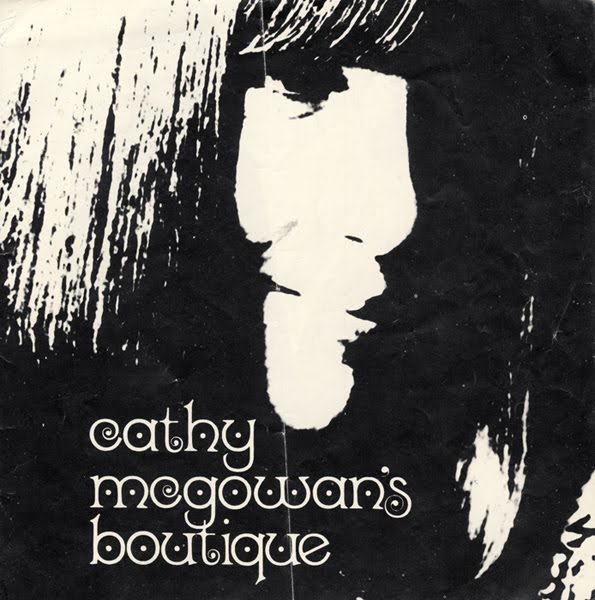
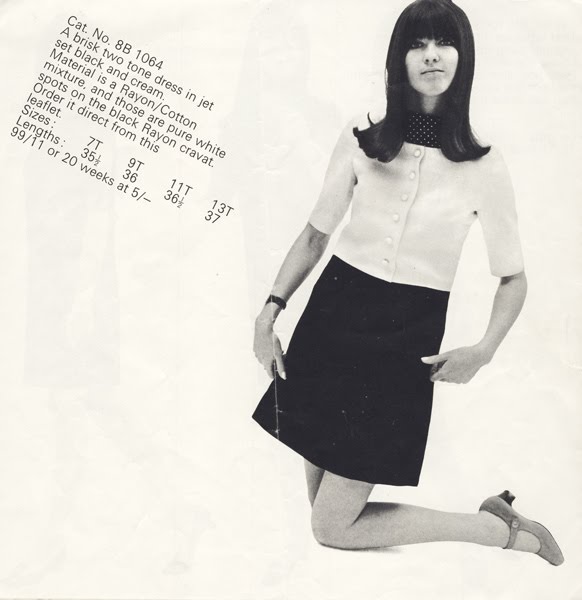
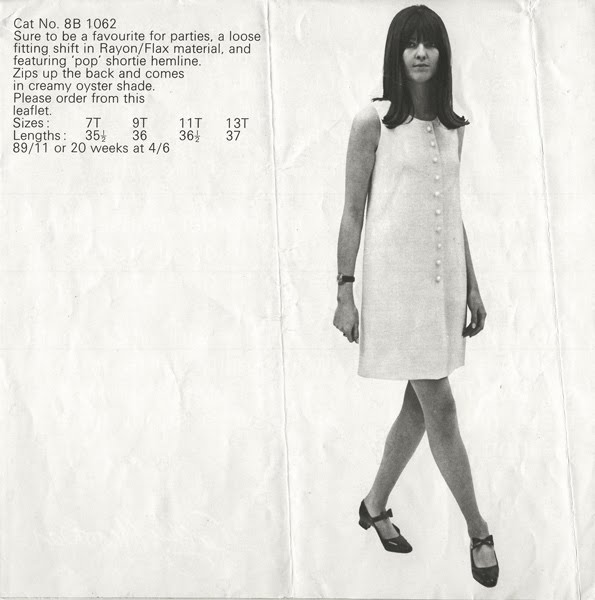
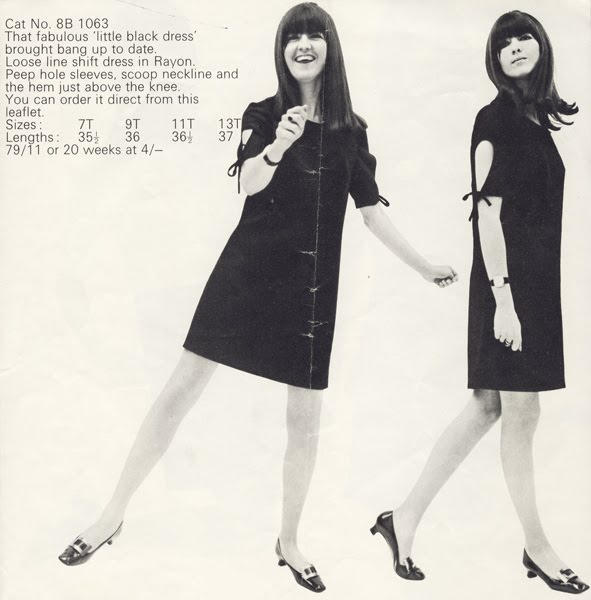
One of my treasured pieces of fashion ‘ephemera’ is a flimsy paper catalogue for Cathy McGowan’s boutique range of clothes, which launched in 1965. I was pleased for it to be used in Richard Lester’s new book Boutique London: A History: King’s Road to Carnaby Street but, since only the front page was scanned and featured, I thought I ought to scan and share the rest of it!
Cathy ended up getting married in an amazing Celia-print Ossie Clark dress, but at this point she was alternating between Foale and Tuffin and Biba for presenting Ready Steady Go!. You can see a definite Foale and Tuffin influence in these clothes, I think, and I have often wondered how ‘proper’ designers at the time felt about these strange new celebrity “boutiques”.
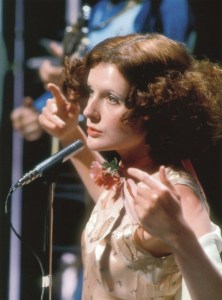
There are many reasons to slobber and pore over Dominic Lutyens and Kirsty Hislop’s superb book 70s Style and Design, but the most spectacular image, for me, is the incredible shot of Noosha Fox which opens this review. I really do struggle to do ‘regular’ book reviews; I just want to scan the pretty images and gush most tragically over the contents. Assuming the contents are gush-worthy, but you needn’t worry about that with Seventies Style and Design.
From start to finish there are more lush visuals on offer than any other book tackling the era. It suffers, if suffering is exquisite, from the same problem as Marnie Fogg’s Boutique book in that, frankly, you’ll probably read it about twenty times before you actually come close to reading the text. I sat down, determined to read it from cover to cover for this review, and my determination was flagging after the midway point because I just wanted to gaze at the images. Which in turn got me thinking about the potential of a ‘double book’ where you have a separate tome dedicated to the images, and can sit down and properly concentrate on the written word; clearly researched extremely well and full of ‘new’ information, which just gets lost or swiftly forgotten amongst the visuals. Tricky, but well worth it, I reckon.
My gushing only hesitates at two issues, which is quite amazing for picky little me. The first is probably too general to explain properly, the second is horribly specific.
Firstly, the ‘theming’ of the subject matter into edible chapter-sized chunks (Pop to Post-Modernism, Belle Epoque, Supernature and Avant Garde). I completely understand the motivation behind this, and the themes aren’t your average “chapter one: Psychedelia, chapter two: Glam Rock” type. Thank goodness. Thought and care has gone into them. But it’s always going to struggle a bit in an era which the authors even admit was something of a ‘free for all’ in its style and design themes. You could be forgiven for exiting from the last page with an idea that the Seventies was relentlessly fabulous, iconic and glamorous in its appearance. They even make punk look mouth-wateringly elegant. It is wide in its coverage, but it still orbits only in the atmosphere of what is now perceived to be interesting, beautiful and/or iconic. Which is a curious kind of Russian doll trap, given that the chapter on the Art Deco revival goes into the very interesting notion of cherry-picking from the Twenties and Thirties.
Page 73, 70s Style and Design
I’m not sure how self-aware the authors are, but it amused me to see this in a book which itself contributes to the modern synthesis of the Seventies into a more glamorous, louche and decadent era than most ‘average’ people who lived through it would recall. I know I’m guilty of much the same thing, especially when writing my blog and listing my wares, but I’m also deeply attracted to the more mundane, everyday primary sources. I love dull, contemporary documentaries, unfunny and borderline-gloomy sitcoms, films and dramas, pictures of slightly iffy looking people in iffy looking clothes and naff interiors and objets. It can’t always be high-gloss, high-sparkle.
I know examples of bad taste are ‘clichés’, but many great aspects of the Seventies are in danger of becoming as much clichés themselves. See the likes of Lady GaGa. When one becomes tired of Bowie, has one become tired of life? Sadly, I have found myself pondering this lately.
Saying that, it’s always wonderfully refreshing to read a book about Seventies design which doesn’t set out to sneer or incite howls of I-can’t-believe-people-dressed-like-that laughter.
Plus, high-gloss and high-sparkle are exactly what we need these days. And I don’t blame anyone choosing to jettison Gloomy Style and Design from their research, not least because the book would be twice the length and half the fun with those things included.
My second criticism, and it really is horribly specific, is the omission of Janice Wainwright. There! I said it was specific. If you want a pure-as-the-purest-spring-water example of the best of the Seventies aesthetic, I would say she was high up amongst the greats. Ossie, Biba, Mr Freedom, Bill Gibb are included, certainly, but Janice remains as yet unsung. In a book which gives us references to Universal Witness, Antony Price’s Plaza, Manolo Blahnik’s Zapata, Strawberry Studio and Kitsch-22, it seems a shame to leave anyone out!
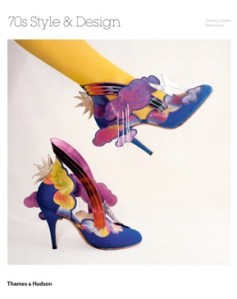
What I love about the design of the book is that there are plenty of full-page, high quality images which have never been seen before, interspersed with a more scrapbook-esque mish mash of visual references. Adverts, photoshoots, posters, labels; some are annoyingly small but it’s just so nice to see them all included without any detriment to the written word. The inclusion of many lesser-known designers and characters is quite wonderful; I hadn’t encountered Thea Cadabra and her incredible shoes (see front cover) before, and now I’m a bit obsessed.
Also, any book which contains a half page reproduction of a Malcolm Bird illustration, the aforementioned full page photo of Noosha Fox and which uses the word ‘splendiforously’ is always going to take pride of place on my bookshelf.
Highly recommended for any vintage wishlist this Christmas (and beyond).
BIBA
254 Kensington High Street, W8
Biba, probably the best known of all the boutiques, began business six years ago with a mail order offer of a gingham shift and scarf for 25s, because fashion illustrator Barbara Hulanicki thought it was impossible to buy inexpensive well designed clothes and decided to do something about it. At the end of last year, in premises 16 times the size of the original boutique in Abingdon Road, Biba opened as a store selling not only clothes but also accessories, make up and home furnishings, Barbara Hulanicki’s distinctive style is carried through all her designs, sold only at the store and by mail order catalogue. She works with her husband, Stephen Fitzsimon.