
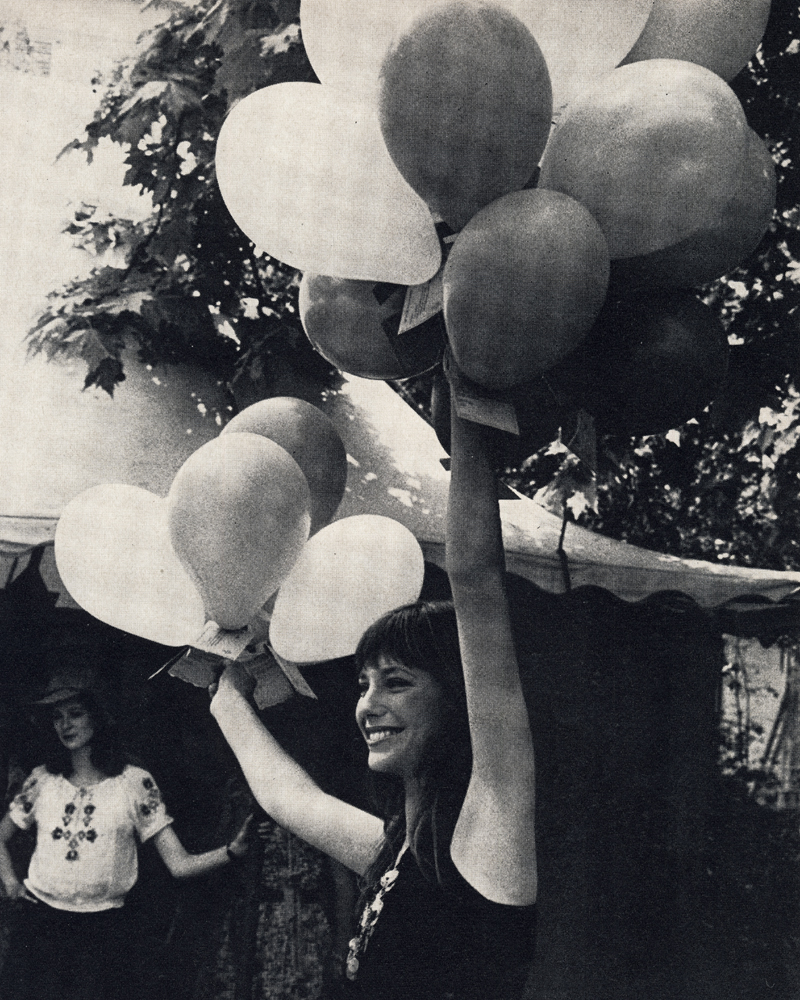
Photographed by Annette Green
Scanned by Miss Peelpants from Vogue, August 1970
Photographed by Annette Green
Scanned by Miss Peelpants from Vogue, August 1970
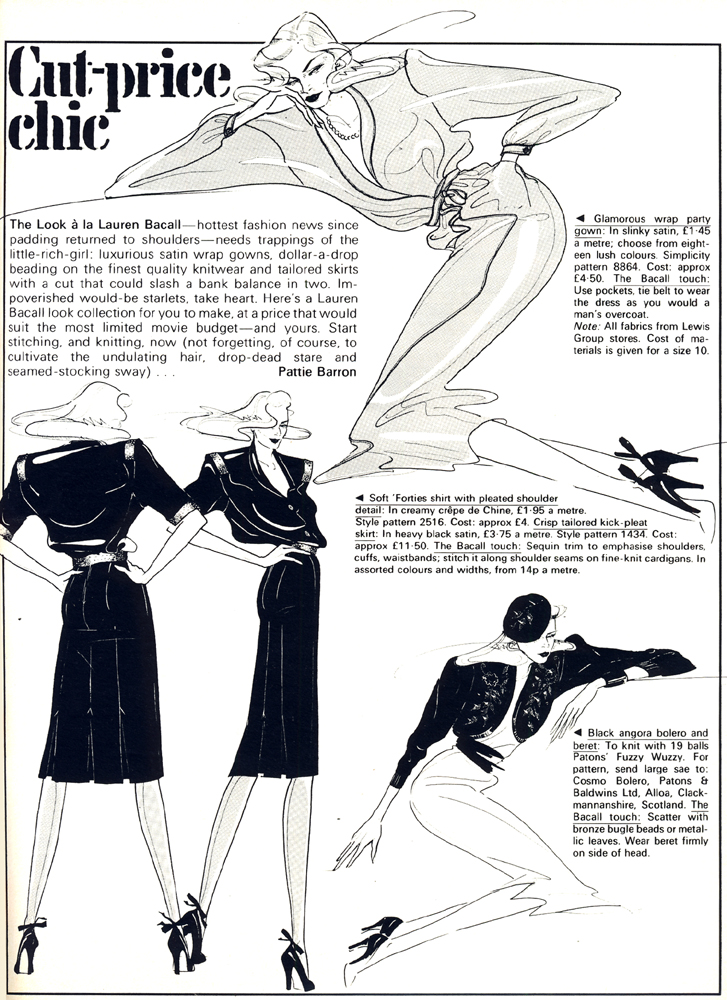
Illustrations by Anne Delaney.
Scanned by Miss Peelpants from Cosmopolitan, April 1979

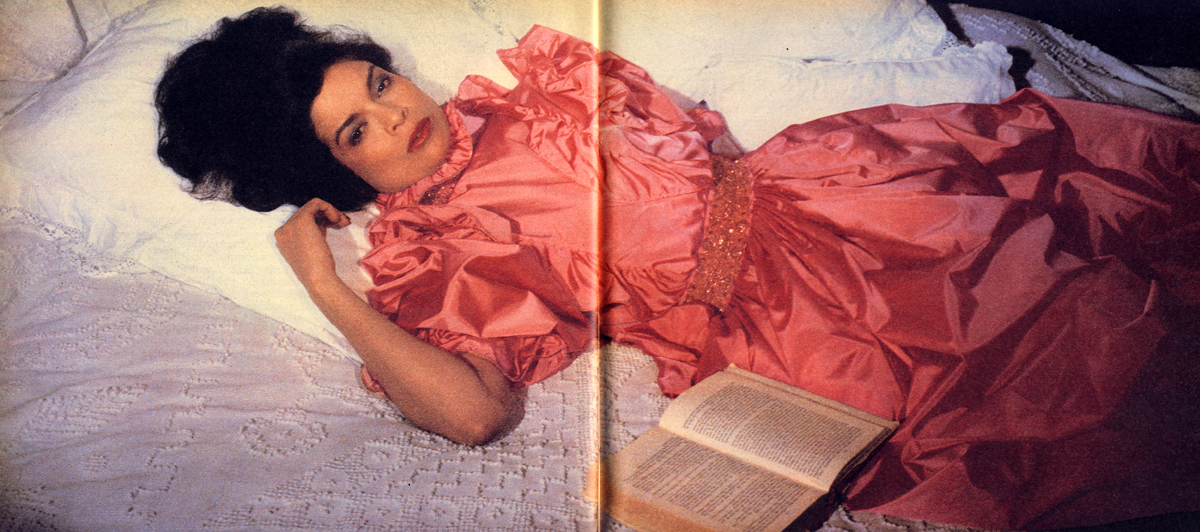
Words by Tina Brown. Photographs by Pat Booth.
When Bianca Jagger wants to be dismissive her favourite word is “marginal”. Los Angeles is marginal: “Une ville suspendue — no cultural route at all.” Mrs Trudeau is marginal: “Where is her decorum? Her lack of self-composure is amazing.” Fashion is marginal: “lt is woman’s greatest enemy – an industry to produce shirts, shoes and dresses. l have become anti-fashion.” What about rock stars? She shrugs. “l had no intention of marrying one, if that‘s what you mean.” Yes, one feels, definitely marginal.
Bianca Jagger’s divorce is giving her a new bruised energy which becomes her. Gone are the days of late entrances, made in a whirl of impromptu glamour which took five hours to prepare. For lunch at the Connaught in London she arrives punctually, wearing an old, black corduroy jacket over a white shirt and (admittedly) a pair of purple crépe de Chine pantaloons. On her a lapel is a badge labelled “outsider”.
Like a lot of head·turning women, feature by feature she is not a pretty girl, but the confluence is incendiary. Eyes, nose and mouth are all a fraction on the slant, a piquant asymmetry which makes her stillness brooding and her smile foxy. There is also her voice, a lazy Latin American murmur.
“She looks so deliciously mean and ratty,” her friend and fan, shoe designer Manolo Blahnik enthused. “l met her in Paris at a fancy dress party ten years ago, when she was in her extravagant feather boa phase. She was sensational then: but she’s so much better now. She always wears the same thing – a St Laurent blazer she‘s had copied 12 times over and, of course, my shoes. Have you noticed her feet? I find it very hard to like a person with horrible feet. Bianca’s are exquisite, tiny.” Sure enough, beneath the Connaught’s plat du jour the tiny feet teeter in a pair of purple suede stilettos from Manolo’s shop, Zapata.
Mrs Jagger attributes her brave new change of direction to physical discipline. Whether she is in London, New York or California she goes to a gym and works out like a demon for two hours. In London she frequents the Grosvenor House. Here, most aftemoons when she is in town, she changes into a grey plastic pixie suit (for extra weight loss) and joins a trio of sweating, middle-aged men screaming with pain as they do their situps and jacknives on a rubber mattress. No one takes much notice of Bianca. A panting bonhomie prevails. “You training to fight Joe Louis or what?”, asks the trainer, as Bianca hurls herself into a manic press-up routine. “lt’s just,” she growls, “my sexual tension coming out.”
It is also, she admits, a way of blotting out the frustration of her divorce. On the day we met she had heard that her $5,000,000 lawsuit against Mick Jagger might be foiled by the fact that he is no longer domiciled in Califomia. “Now you can see why l need Marvin Mitchelson to be my lawyer,” she says. “I had a decent old-fashioned Englishman acting for me, but I got nowhere.
“Mick is avoiding taxes in every country in the world and he has 13 lawyers helping him to do it. Why should I be denied my freedom and a decent allowance for the sake of his tax situation?
“Then I read in the papers that Marsha Hunt had been awarded the I same sum from Mick in her paternity suit that I, his legal wife, am given to bring up our daughter and run the house. I felt fed up, furious. It was at that point that Mitchelson called me from Los Angeles and offered to help me. He likes women. He has a sense of justice. He made me see that if Mick wants a fight, I must use the same weapons.”
This speech is delivered with an impressive nostril-flaring hauteur. Mrs Jagger is not given to blabbing about her private life. “I’ve always felt that if you tell lots of intimate revelations it’s one more thing you don’t own anymore.” Other sources, however, con- firm that marriage to the rock world’s most notorious tightwad has been no picnic for the “Nicaraguan firecracker”.
“He had this awful working-class chauvinism towards her,” one of Jagger’s old cronies told me. “He pretended to support her acting aspirations, but actually dreaded her being financially independent. He liked to have the whip hand, so that she would always have to beg. She had to keep up the image of being the jet·setting Mrs Jagger on a Marks and Spencers budget. She got over it by developing such style that top designers like Halston rushed to offer her free outfits as a walking advertisement.”
Bianca Perez-Mora de Macias has always been a girl with more cachet than cash. Sceptics say that even the cachet was self-invented: “She could’ve come from Wapping for all l know,” said one of the King’s Road meritocrats with whom she used to knock around in the sixties. “She never would talk about her past. Then, again, there were never any rough edges to her and you don’t just pick up four languages by the age of 18.”
She was born in Nicaragua 32 years ago. Her father, she says, had a coffee plantation. There were three children, Bianca, Carlos – now 25 and living in Paris trying to be a painter – and Indiana, 26, who married a lawyer and stayed in Nicaragua. “My mother was a great classical beauty.” Bianca told me, with the ruefulness of a woman who still privately rates conventional prettiness over her own transcending feats of style. “She was blonde and fair-skinned in a country where most people are brunettes. She overshadowed me completely.”
When Bianca was quite small her parents were divorced for reasons she will not divulge. “Nicaragua is very Catholic. The family was very Catholic. My mother had a hard time as a divorced woman.”
It was, perhaps, the ructions at home and the social opprobrium directed at her mother which made Bianca plot her escape. At 16 she left for Paris with ambitions to become a diplomat. “For Latin Americans at the time Europe was the place for culture. The only other place to go was the United States, but that struck me as a vulgar cliché. I thought of Paris as the sinful city. In fact, it turned out to be quite marginal.” She studied politics at L’Ecole de Science Politique for three years and swiftly penetrated a chic Bohemian set. She put away her diplomatic bag and drifted to London, where she became involved with Michael Caine; then back to Paris. “How did I meet Mick? You know. I always find that an offensive question. If you’re intelligent and pretty you can meet anyone you want. Altematively, if you haven’t got it you can be hanging around the right places for years and not meet anybody interesting at all. Ironically enough, I find it harder to meet new people now than I did when I was that shy little girl from Nicaragua.”
Actually, the shy little girl from Nicaragua was already the girlfriend of the boss of a record company who took her to a Rolling Stones concert in Paris and brought Bianca to the inevitable party afterwards.
Her impact on Mick Jagger was immediate. She pulled out all the stops and beamed her mystery at him.
She would stand him up, appear and disappear. While the other Stones’ wives grouped gratefully around back- stage, Bianca would be doing Big Thinks in a corner, displaying a thumbed copy of a novel by Kafka or Camus. All right, she did not retum to Nicaragua to defeat, as she had vowed to do – “the disgusting oligarchy that prevails there”- but as she brooded behind dark glasses on the flights to New York, Rome or Rio it was clear that she was contemplating it. She even called her preoccupation with clothes “a concern with statics”. Jagger was impressed, particularly when she made it plain that she would not lose herself to the rock·star life, like Marianne Faithfull (a previous Jagger flame), or Anita Pallenberg, Keith Richard‘s longstanding girlfriend.
“If I’d been around Cocteau I might have smoked opium,” she says. “To be around Keith and Anita and have my teeth fall out from shooting smack is not, I think, the same thing.” She recognised that Jagger‘s band was something she could never crack. “The Stones are a secret society. Mick would go through fire and water for Keith. He‘ll forgive him anything. To be one of those wives, involved but not included, is very disturbing. I used to go on gigs with them until I read in an interview with Mick that he hated it when his old lady came along.” By such means do rock stars’ wives discover their husbands‘ feelings.
Today Bianca spends most of her time in her house on the Embankment in Chelsea, “leaming to live alone”. The exterior was recently painted pink, she says, in a sudden expression by Mr Jagger of his rights of ownership. “l said, Mick, why pink? You don‘t live here, I do. He said ‘Because it’s my house and I happen to want it pink’.” Jade her seven-year~old daughter, attends a smart London day school nearby.
“I’m so glad I had her,” she says. “Without her I’d just drift. l’m such a rootless person I wouldn’t care what city I was in, who l was with. I tend to live in a daydream, but Jade is my link with reality, the everyday business of schools and shopping and early bedtime. I try to give her a normal life. I keep her away from photographers because I know from my own experience that publicity should be your own l choice. The problems with her father have drawn us very close. She has great dignity and poise. She knows never to say too much: but, in fact, she sees and senses everything.”
Bianca assured me that she had not forgotten her political aims, That Nicaraguan oligarchy still gets her down. Meanwhile she is pursuing her dreams of being a film star. Thisyear she will be seen at the Cannes Film Festival in Flesh Colour, co-starring with Denis Hopper. “I play the head of the Mafia,” she says. “I interpret her as a woman with ice-cold intelligence and a touch of cruelty, but at the same time romantic and vulnerable.” She also appears with Ned Beatty in an American film, The Ringer, directed by Bill Richart. In it she plays a 1930 courtesan: “a woman who, though highly sensual, is, at the same time…”
She is very aware of the bad publicity which surrounded her abortive film début in Trick or Treat four years ago. Filming stopped midway because Bianca refused to strip. Fortunes were lost in botched rescue jobs and litigation, all due, it was alleged, to Bianca’s prima donnaism. The experience chastened her. “Pressures alter people. Believe me, when you’ve lived through big trouble, you change.”
Some of her old friends refuse to take the new, austere Bianca seriously. As one put it, “She needs a daft earl to bail her out now. I mean, she can’t go on jumping out of Concorde and waiting about with poofs and pavement artists for ever, can she?” They feel that Mitchelson’s lawsuit will make or break Bianca. My own feeling is that even if Bianca does not boogey all the way to the bank, her strange quality will see her through. We have yet to see if she can act. If she can, she might turn out to be a Dietrich; if she cannot, maybe she will be a Nancy Cunard. At any rate, she will not be marginal.
Images scanned and text copied by Miss Peelpants from The Telegraph Magazine, May 13th 1979
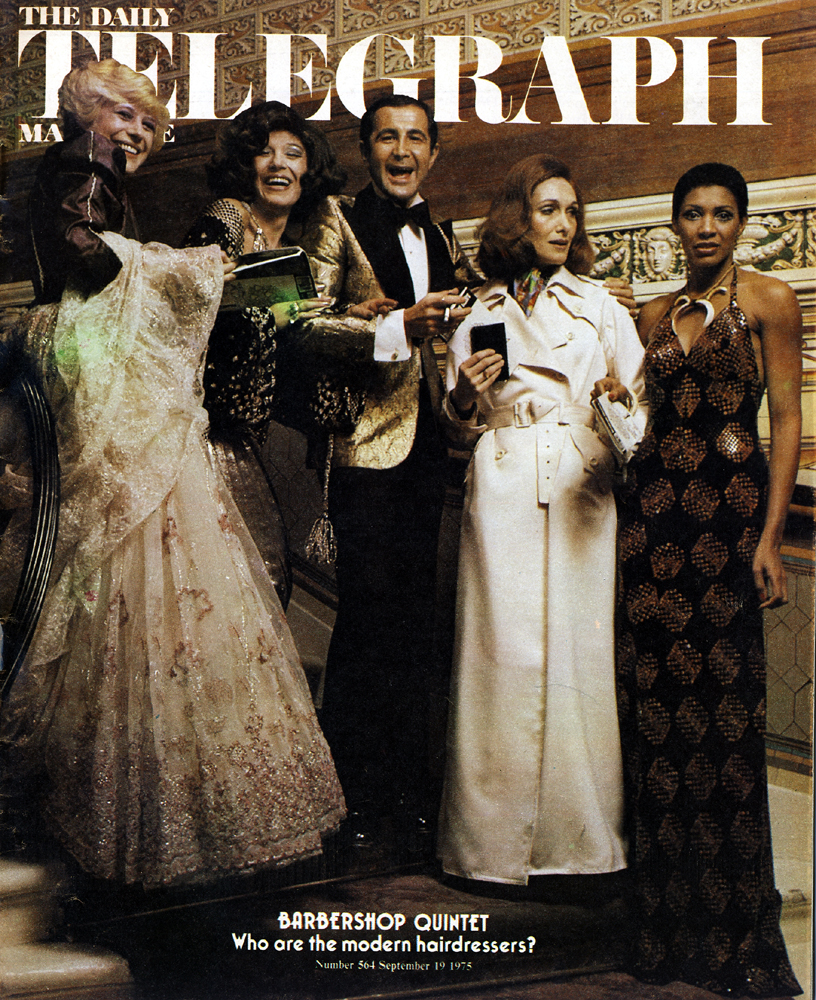
In the Fifties a trip to the hairdresser’s was a daunting ordeal – for you and for each hair on your head. Vidal Sassoon changed all that in 1964, and substituted the welcome breeziness of the blow-drying second-generation stylists. Who are the other top hairdresses, and who goes to them?
There are no credits for the clothes, but I think Marianne’s glorious ensemble must be a Bill Gibb, and Sian Phillips’s elegant coat looks like a John Bates to me. Such a glorious array of celebs, I think Michaeljohn win on numbers (but Ricci Burns really ought to win, purely because of the way his ladies are dressed!).
Photographed by Geg Germany.
Scanned by Miss Peelpants from The Telegraph Magazine, September 19th 1975
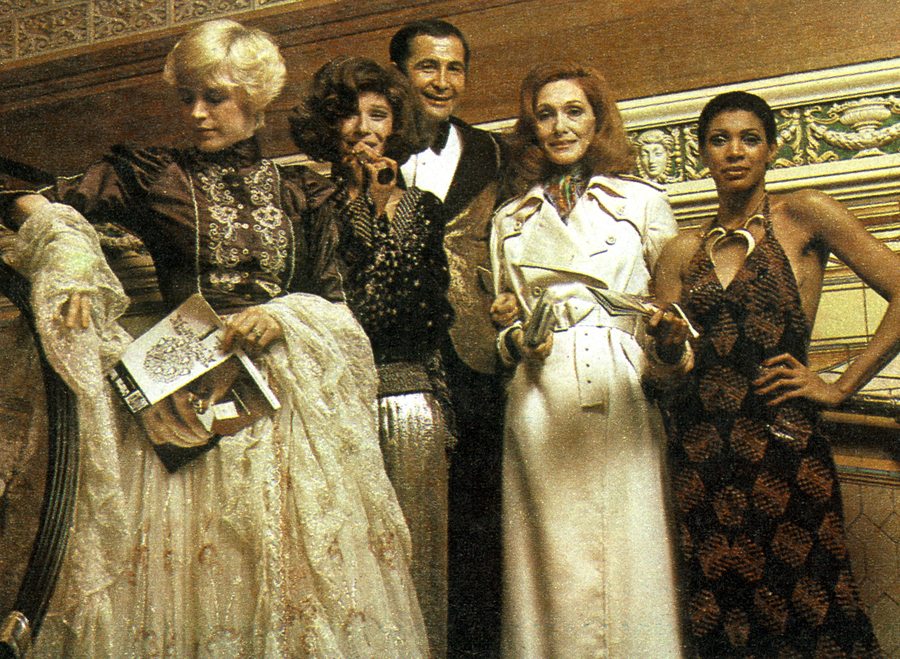
At Ricci Burns: Marianne Faithfull, Fenella Fielding, Ricci Burns, Sian Phillips, Brenda Arnaud. Ricci started in hairdressing at the age of 15, worked for Vidal Sassoon for ten years and opened his own salon in the King’s Road five years ago. Now has a second salon in George Street, and did have one in Marrakesh “until the coup, darling”.
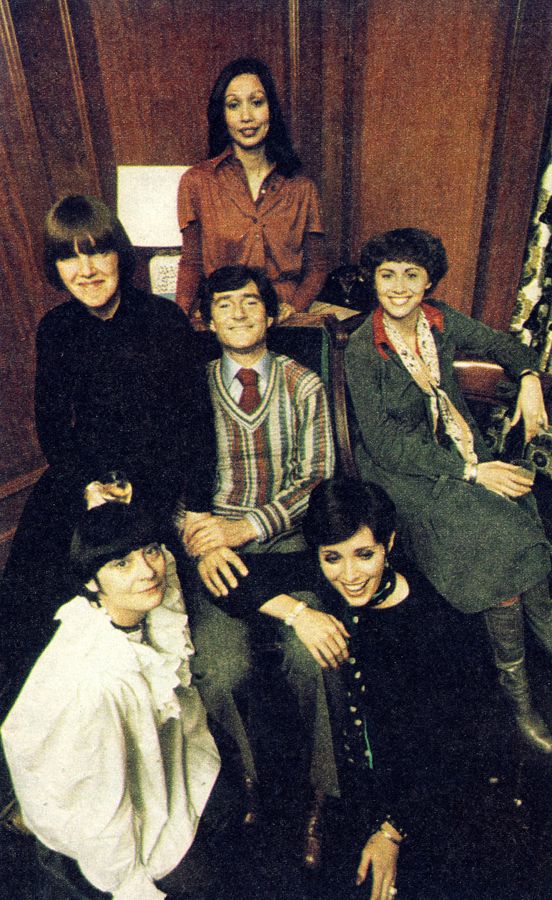
At Vidal Sassoon: Lady Russell (back), Mary Quant, Vidal Sassoon and Kate Nelligan (centre). Shirley (Mrs Ken) Russell, Beverly Sassoon.
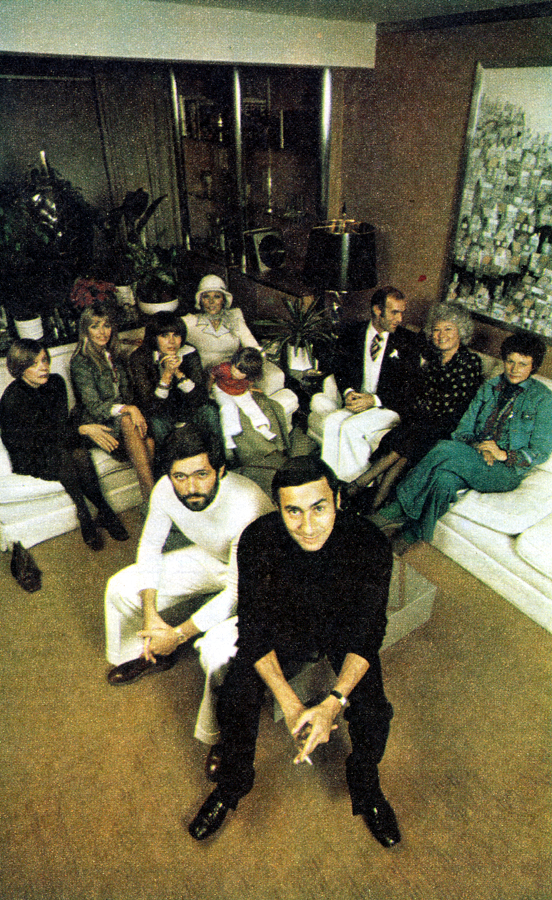
At Michaeljohn: Back row, from left: Jean Muir, Britt Ekland, Joanna Lumley, Joan Collins and her daughter Sasha, Tom Gilbey, Gina Fratini and Diane Logan. Front: John Isaacs and Michael Rasser (one time colleagues at Leonard), who started Michaeljohn in 1967.
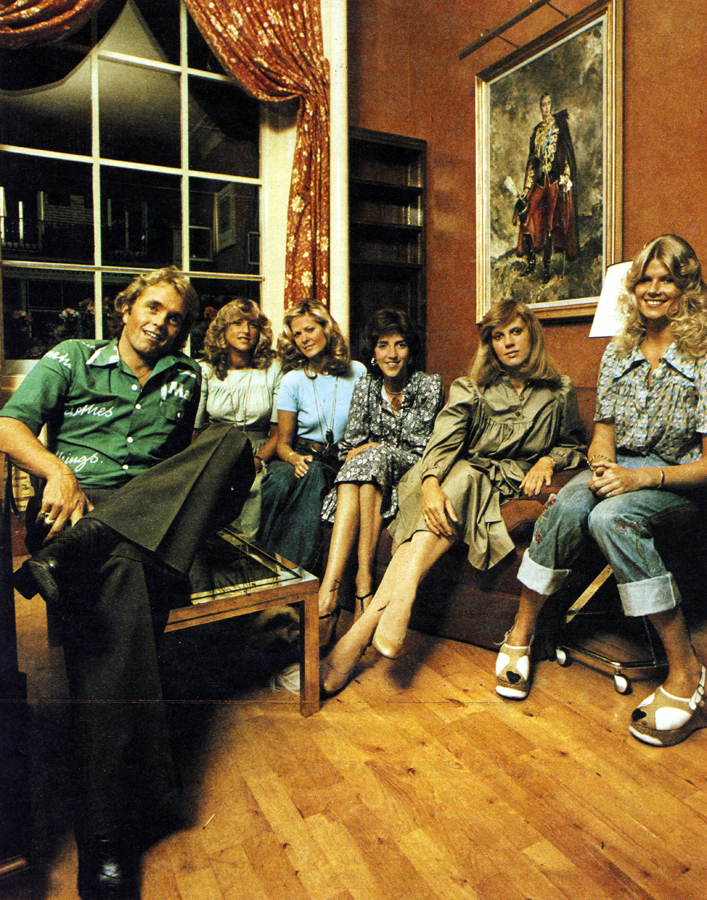
At Figurehead: George Britnell, proprietor, with clients (from left) Catherine Parent, Kari Lai, Lady Charles Spencer Churchill, Tessa Kennedy, Lady Charlotte Anne Curzon. This is the newest salon of them all – it opened in Pont Street this year.
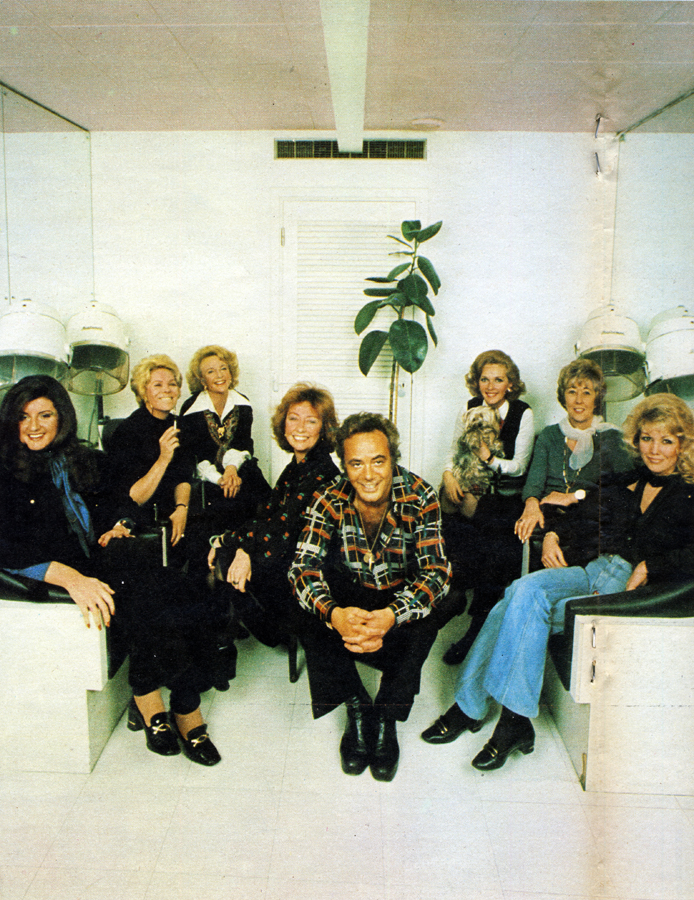
At the Cadogan Club: (from left to right) Ariana Stassinopolos, Rachel Roberts, Moira Lister, Patricia Millbourn and Aldo Bigozzi (partners), Katie Boyle, Joan Benham and Annette Andre.

The girl they picked to play Daisy
Dress from Essenses. Ropes of pearl, crystal , peach and turquoise beads, bangles from a selection at The Purple Shop.
Photographed by Snowdon. Scanned by Miss Peelpants from Vogue, March 1973
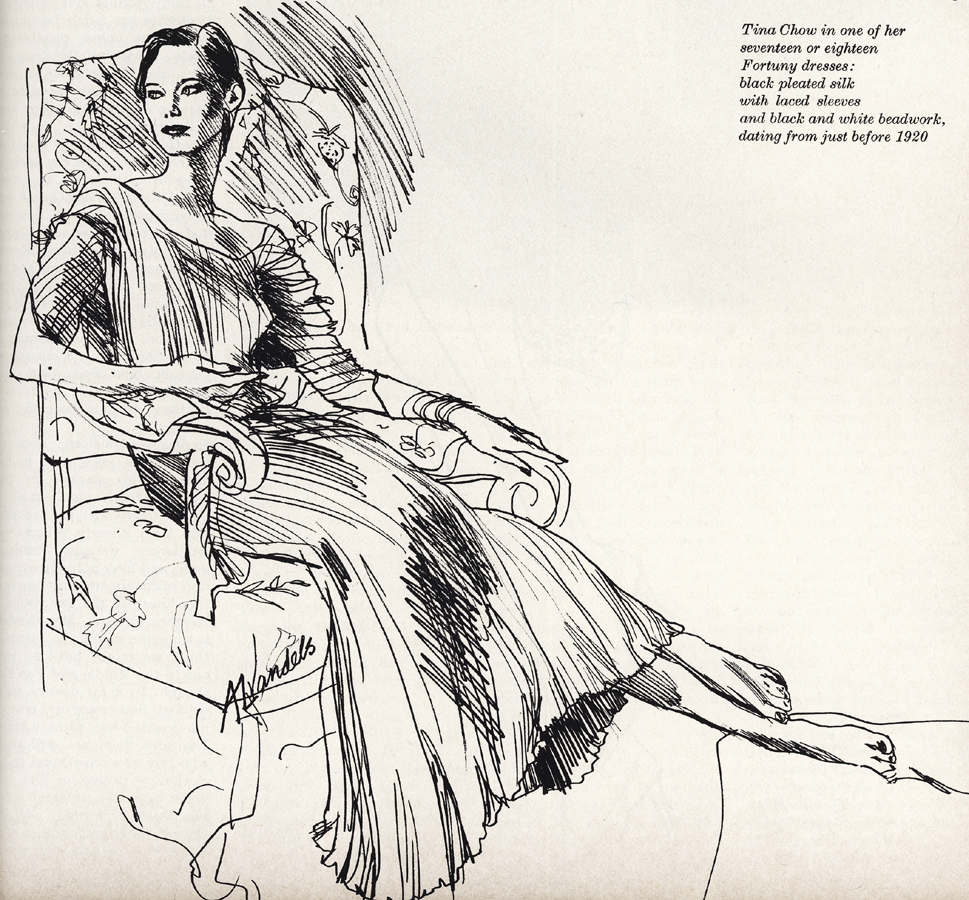
Tina Chow in one of her seventeen or eighteen Fortuny dresses: black pleated silk with laced sleeves and black and white beadwork, dating from just before 1920.
Another one to add to the pile of ‘liking vintage is nothing new or extraordinary’ is this illustration and the article it accompanies entitled: “Come up and see my Schiaparellis”, promoting an upcoming Christie’s sale. I have plucked some choice sections, but the whole article is brilliant.
“Once an area in which museums could bid uncontested for period clothes, dealers and private customers now more or less consistently outbid institutional collectors and have pushed prices to dizzy heights which inflation alone could not have done.“
“The collector pur sang, the ideal, is Tina Chow, wife of the restauranteur. Her fan club is led by cheerleader Madeleine Ginsburg: ‘Tina Chow buys Fortunys. Her husband loves her to wear them, and she takes impeccable care of the dresses… We know Mrs Chow loves the dresses as we do, and she cares about them and cares for them. Poor Mrs Chow, when she goes to parties in one of her Fortuny dresses she only stands up and does not even eat’.”
“[dress as a subject] seems, 99 times out of 100, to attract the crackpot, the misguided or the downright perverted. Many is the museum whose shoe or underwear collection has been transformed overnight by the demise of some lonely soul whose solace was in rooms or drawers full of leather and lingerie.” – Quote from Roy Strong
“It is the passion to collect old clothes. Not rag picking, you understand, but Balenciagas and Vionnets and Jean Muirs and that sort of thing.”
Nice to see Jean Muir was already being talked about in the same breath as Vionnet et al, even as early as 1978.
Illustration by Angela Landels. Scanned by Miss Peelpants from Harpers and Queen, December 1978.

So today, I went to pick up an enormous job lot of magazines I bought on eBay. It’s a very mixed bag, but included some early Cosmopolitans (which always get me rather excitable…). Flicking through a few tonight, what should fall out of the October 1972 copy, but bloody junk advertising. Pah! Typical! But, wait, Seventies junk advertising is no ordinary advertising. It was the specially made Smirnoff guide to seduction (Complete and unabridged!) – “Elements of all the best seductions as discovered by Cosmopolitan for Smirnoff” with six top models who “reveal their personal approaches to the art“. Isn’t it glorious? Best of all, this is the kind of ephemera which falls out of a magazine and we just throw away, but somehow this survived…
Photographer and garments uncredited. Scanned by Miss Peelpants. Believed to date from October 1972.
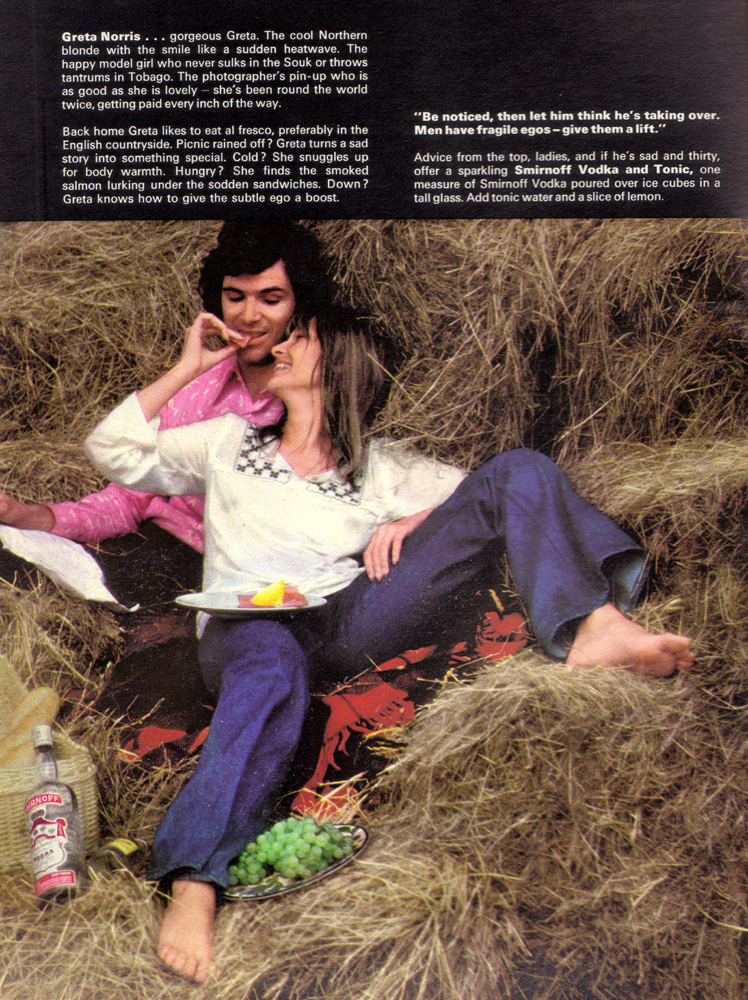
Greta Norris

Paulene Stone
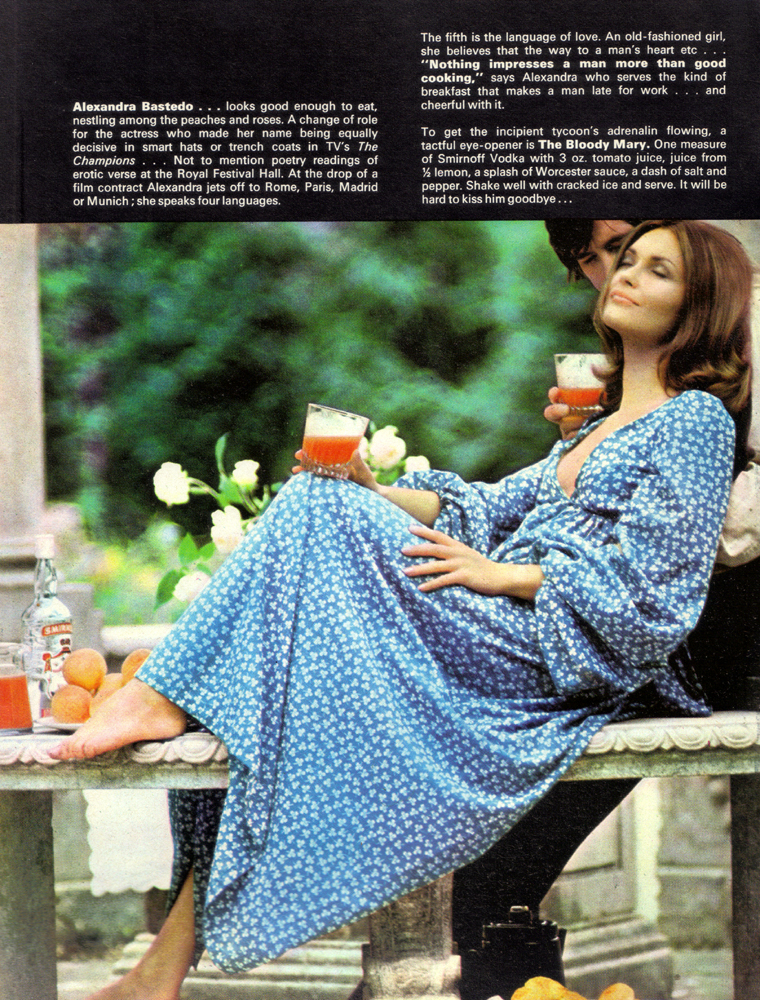
Alexandra Bastedo (in Biba, I think)

Mercedes
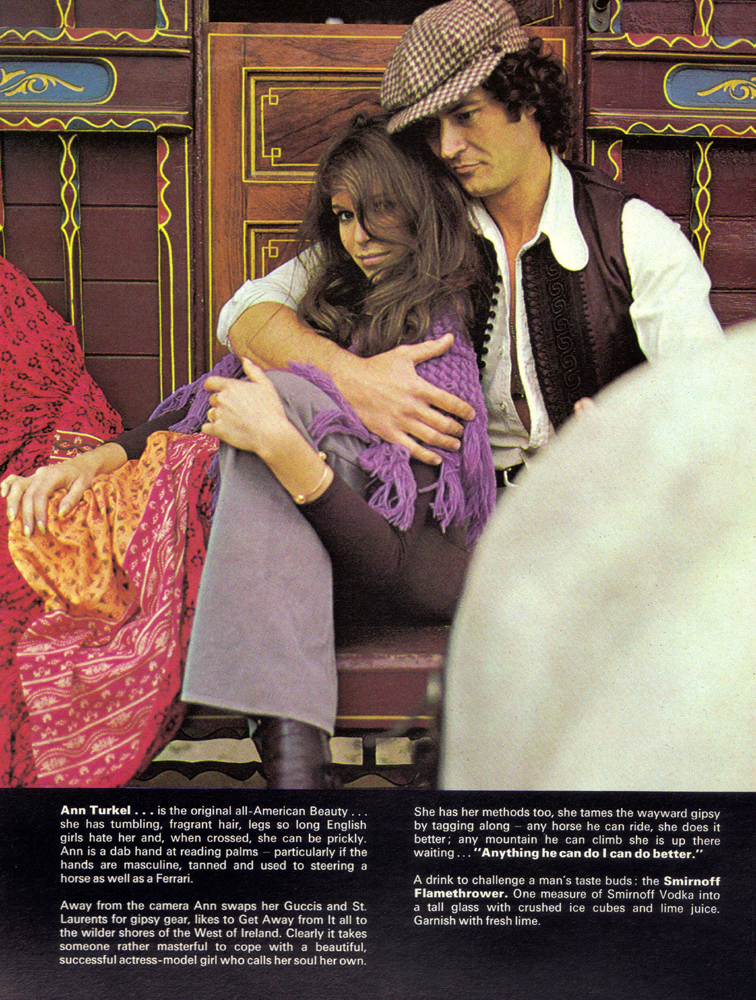
Ann Turkel

Randall Lawrence
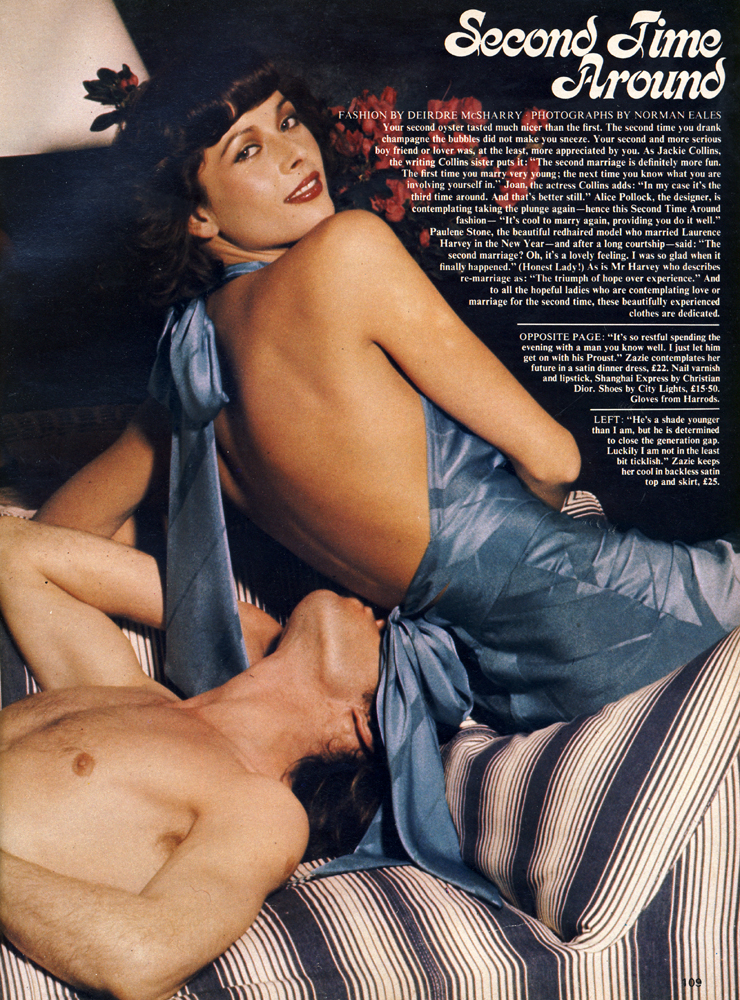
“He’s a shade younger than I am, but he’s determined to close the generation gap. Luckily I’m not in the least bit ticklish”.
Your second oyster tasted much nicer than the first. The second time you drank champagne the bubbles did not make you sneeze… As Jackie Collins, the writing Collins sister puts it: “The second marriage is definitely more fun. The first time you marry very young; the next time you know what you are involving yourself in.” Joan, the actress Collins adds: “In my case it’s the third time around. And that’s better still. ” Alice Pollock, the designer, is contemplating taking the plunge again – hence this Second Time Around fashion – “It’s cool to marry again, providing you do it well. ” Paulene Stone, the beautiful redhaired model who married Laurence Harvey in the New Year – and after a long courtship – said: “The second marriage? Oh, it’s a lovely feeling. I was so glad when it finally happened.” (Honest lady!) As is Mr Harvey who describes re-marriage as: “The triumph of hope over experience.” And to all the hopeful ladies who are contemplating love or marriage for the second time, these beautifully experienced clothes are dedicated.
All clothes by Alice Pollock at Quorum. Fashion by Deirdre McSharry. Photographed by Norman Eales. Modelled by Zazie.
Scanned by Miss Peelpants from Cosmopolitan, May 1973.
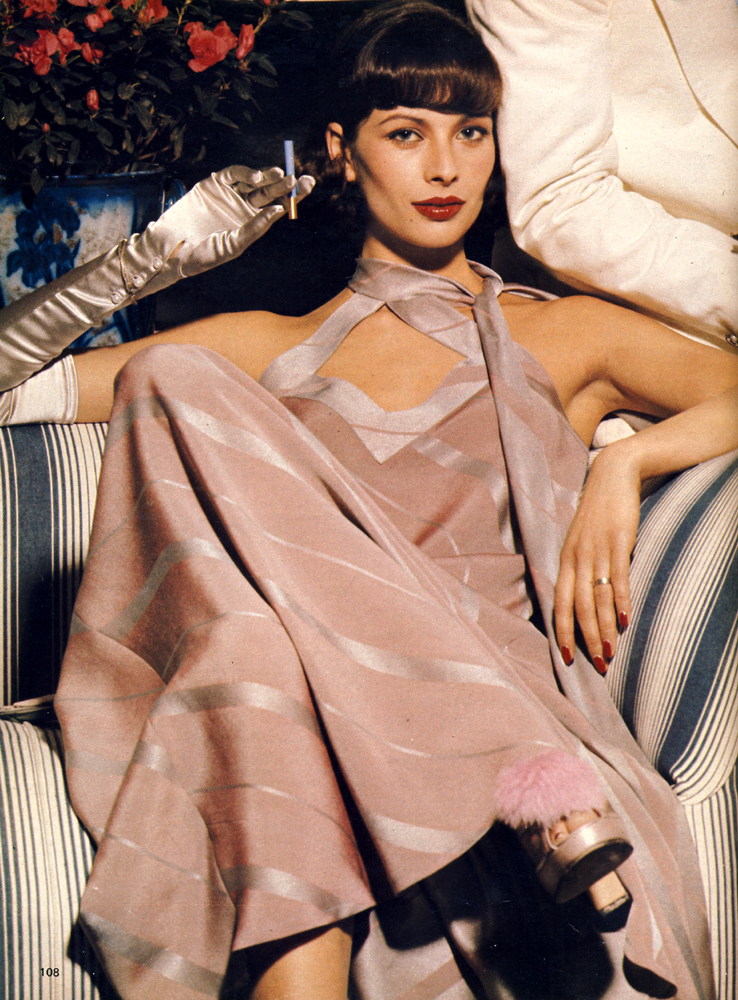
“It’s so restful spending the evening with a man you know well. I just let him get on with his Proust.” Shoes by City Lights
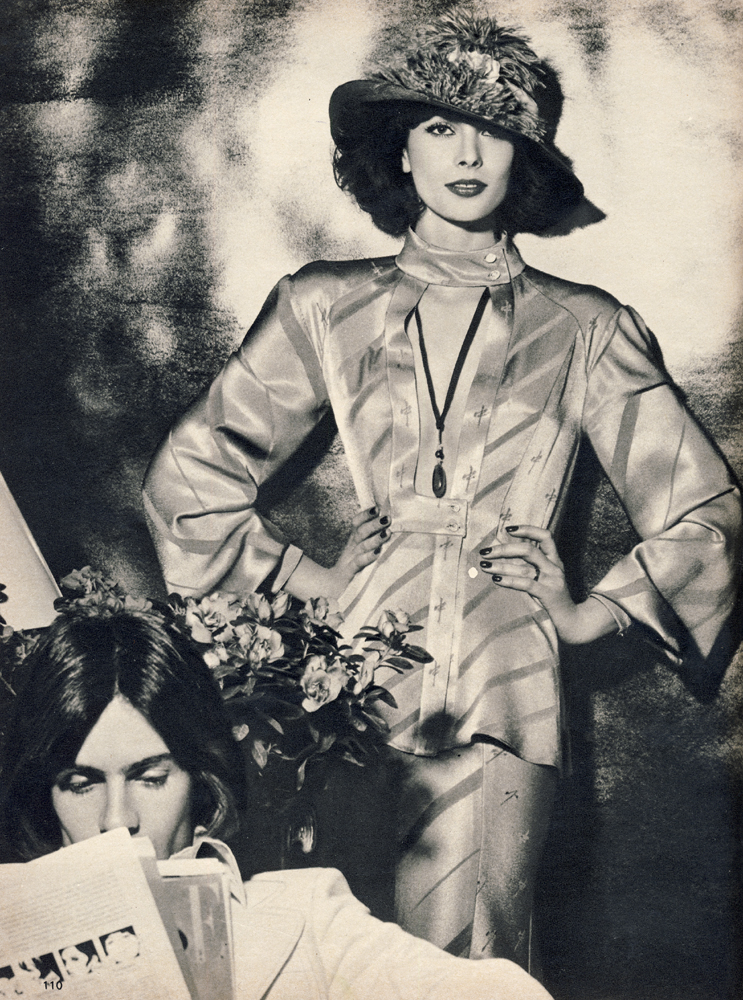
“Well we got to Caxton Hall in time. I picked him up in my Porsche just in case.” Hat by Sarah Frearson. Pendant from L’Odeon.
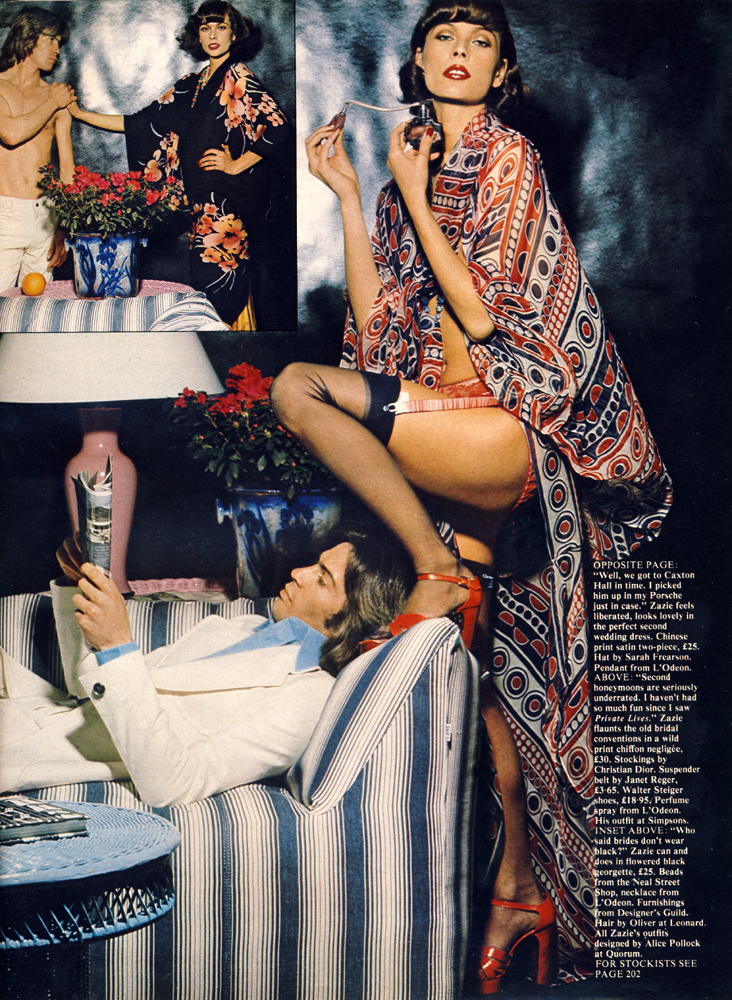
Inset Above: “Who says brides don’t wear black?” / Above: “Second honeymoons are seriously underrated. I haven’t had so much fun since I saw Private Lives.” Suspender belt by Janet Reger. Shoes from Walter Steiger. His outfit at Simpsons.
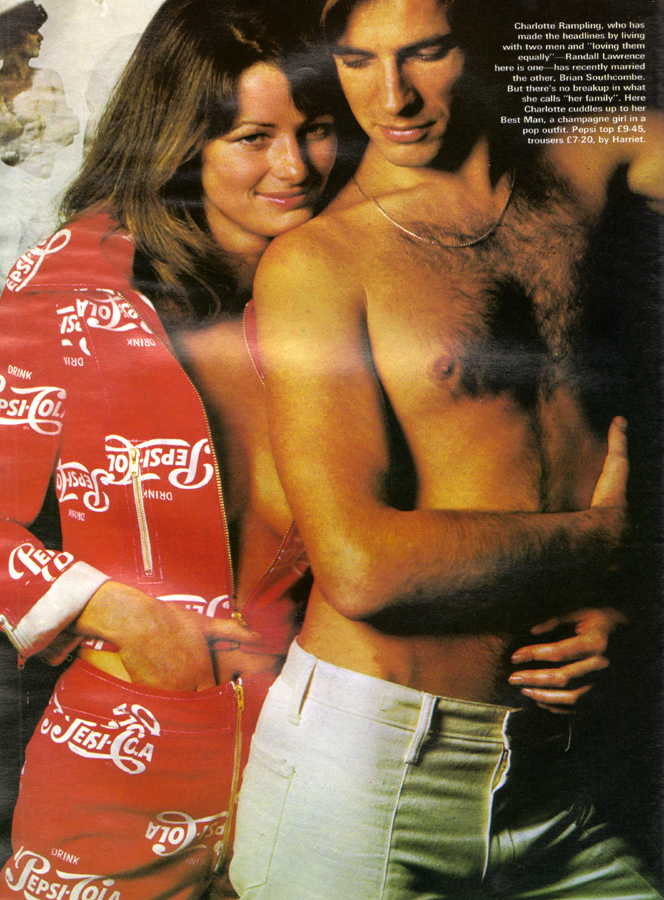
Charlotte Rampling, who has made the headlines by living with two men and “loving them equally” – Randall Lawrence here is one – has recently married the other, Brian Southcombe. But there’s no breakup in what she calls “her family”. Here Charlotte cuddles up to her Best Man, a champagne girl in a pop outfit. Pepsi top and trousers by Harriet.
Some stunning photos of the divine Charlotte Rampling, wearing some incredible clothes, scanned from [a slightly crinkly copy of] Cosmopolitan, April 1972. Shame the copy is so utterly, horridly anti-feminist. What gives, Deirdre McSharry? This is Cosmo, after all…
Scanned by Miss Peelpants from Cosmopolitan, April 1972. Photographed by Barry McKinley.
Even the most liberated, jeans-uniformed, free-thinking women will be melting at the seams this summer. She’ll be babying herself in cheesecloth, swathing her shoulders in chiffons, oozing into tight, bright “message” clothes and generally dressing up as if she hadn’t got the vote. If your mind is ticking over OK, what’s the matter with appearing as “woman-as-a-sex-object”? A little female fragility never hurt a good fight yet … If you dress in a fragile manner you’ll be handled with care.
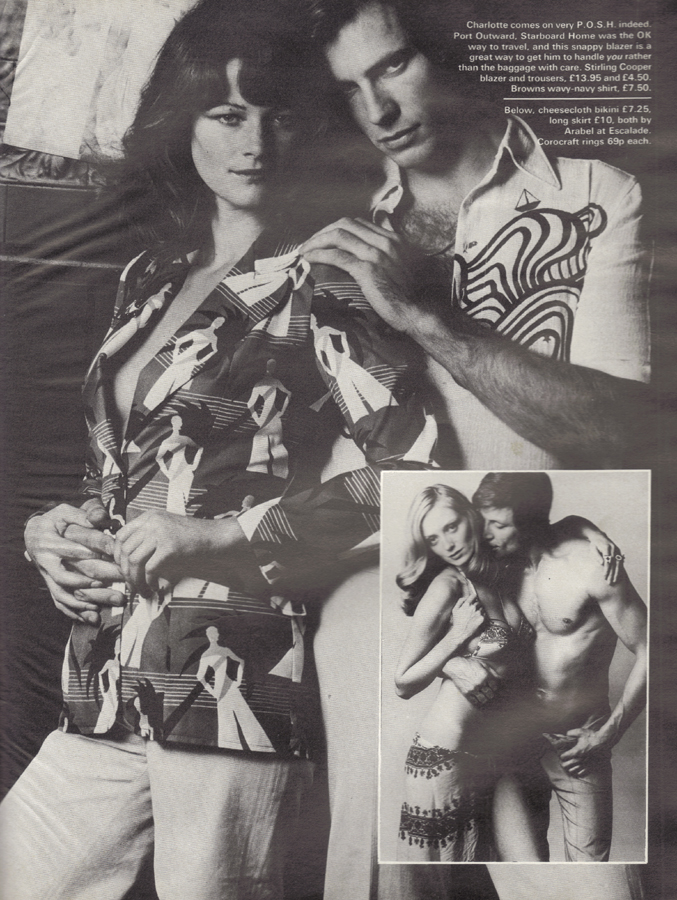
Stirling Cooper blazer and trousers. Wavy Navy shirt by Browns.
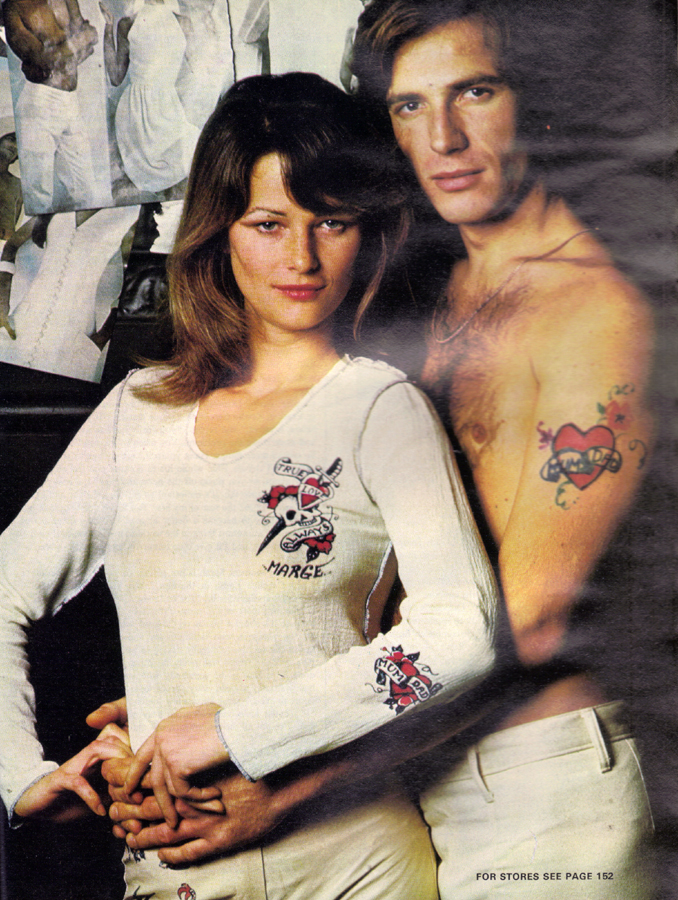
How to be tattooed while staying a lady. Charlotte has the art in this cheesecloth t-shirt and leather trousers. Tattoos turn a lot of men on – but if not you can just slip this lot off. By Henry Miura.
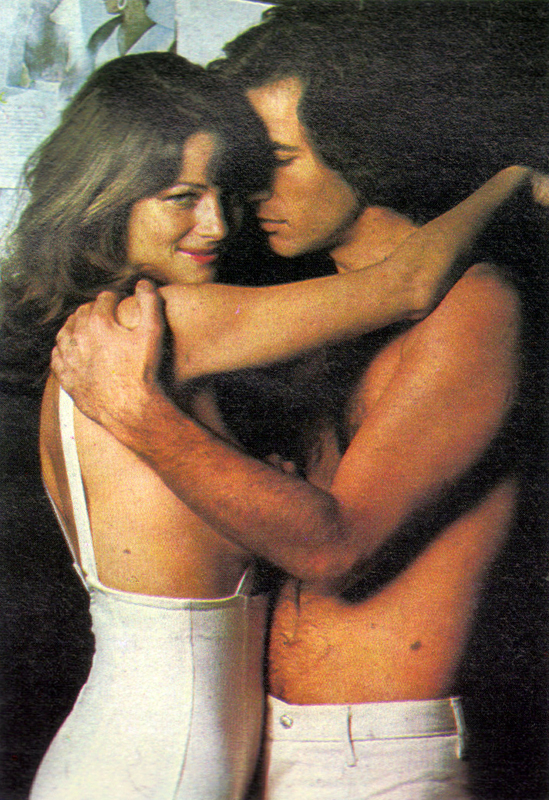
Cream flannel trousers with straps by Ossie Clark
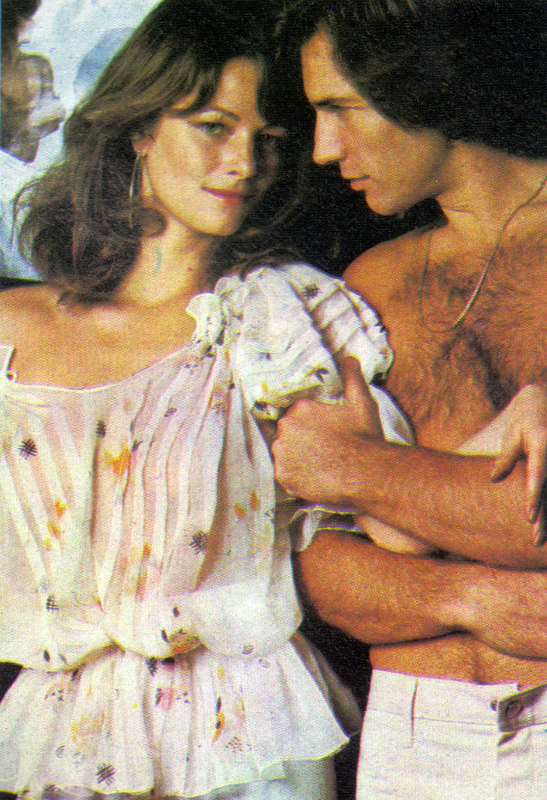
Blouse printed by Celia Birtwell and designed by Ossie Clark
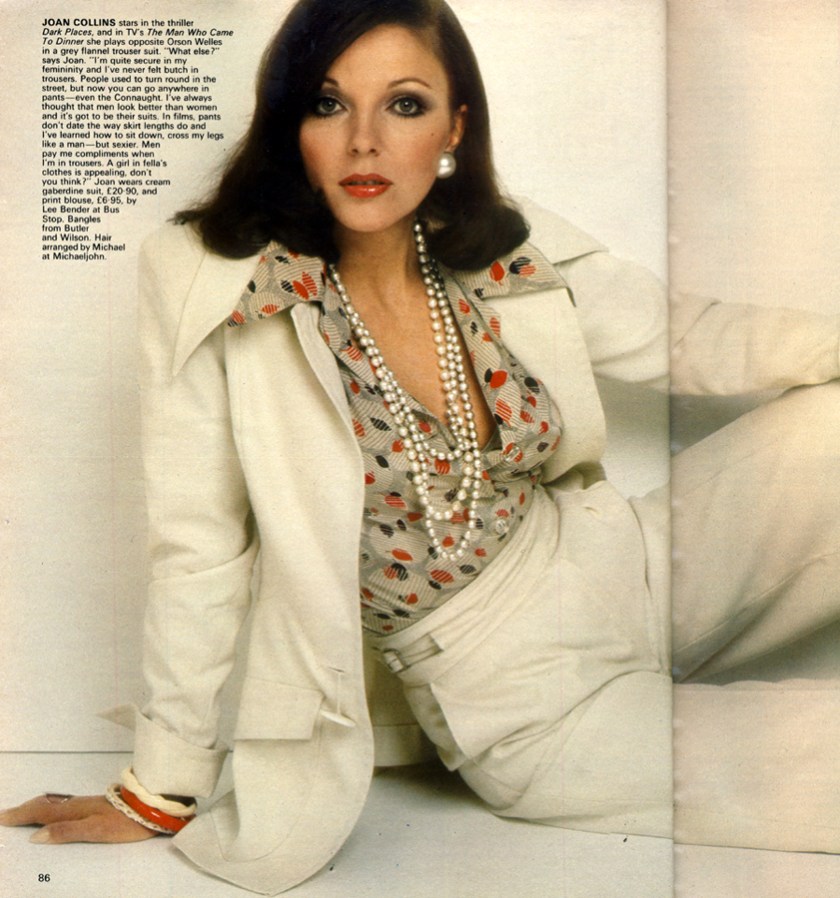
Photographed by Norman Eales
Scanned by Miss Peelpants from Cosmopolitan, March 1973
 Liz Eggleston