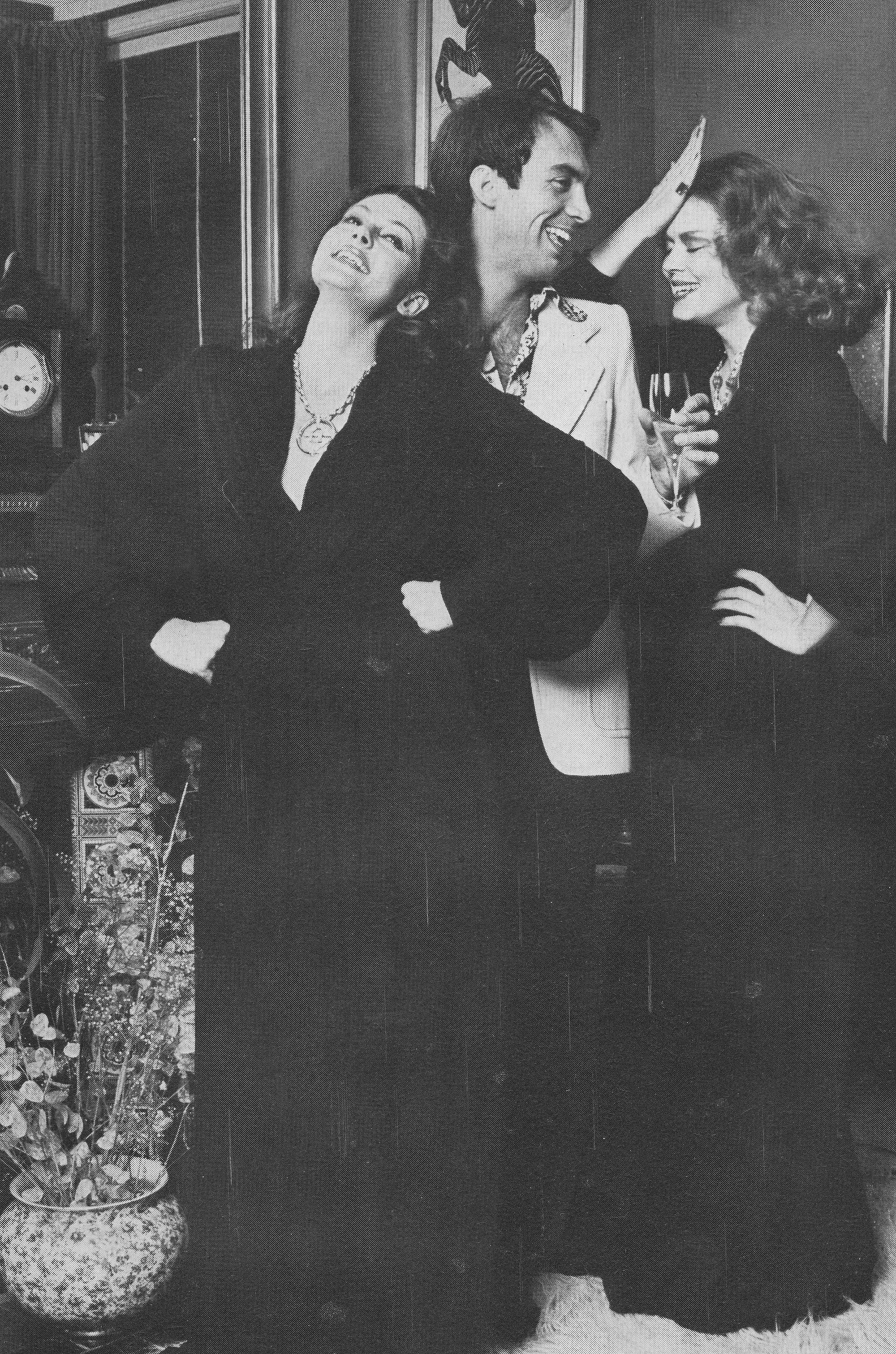
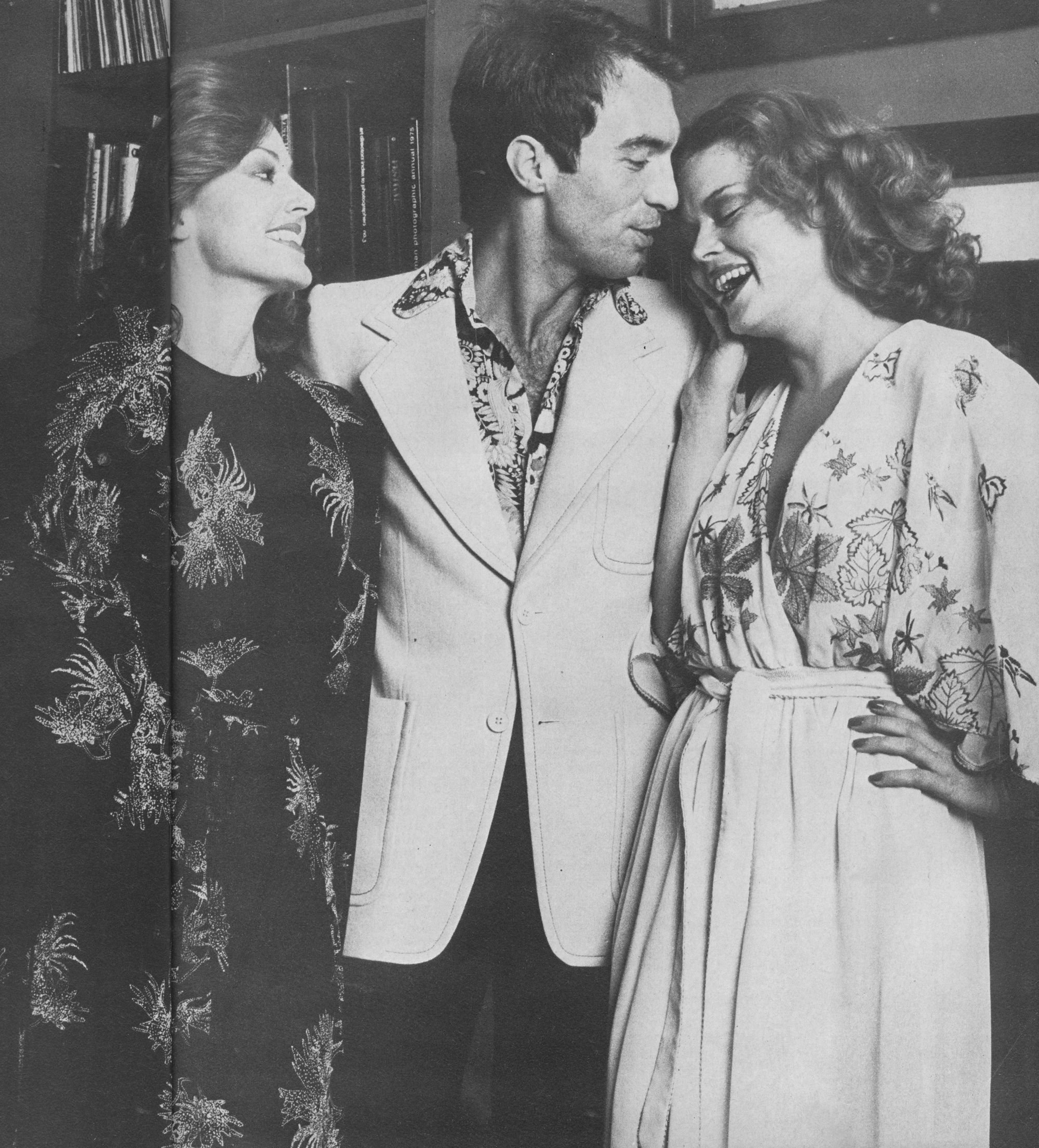
Left: Full-length black dress with long, cuffed sleeves and a deep V-neck. The collar and shoulders are embroidered with tiny black beads. £65. Christopher McDonnell. Gold and diamond pendant. Graff. Right: Full-length black silky jersey dress with a square neck. £76. Salvador at Match Club. Lapis and diamond pendant. Graff
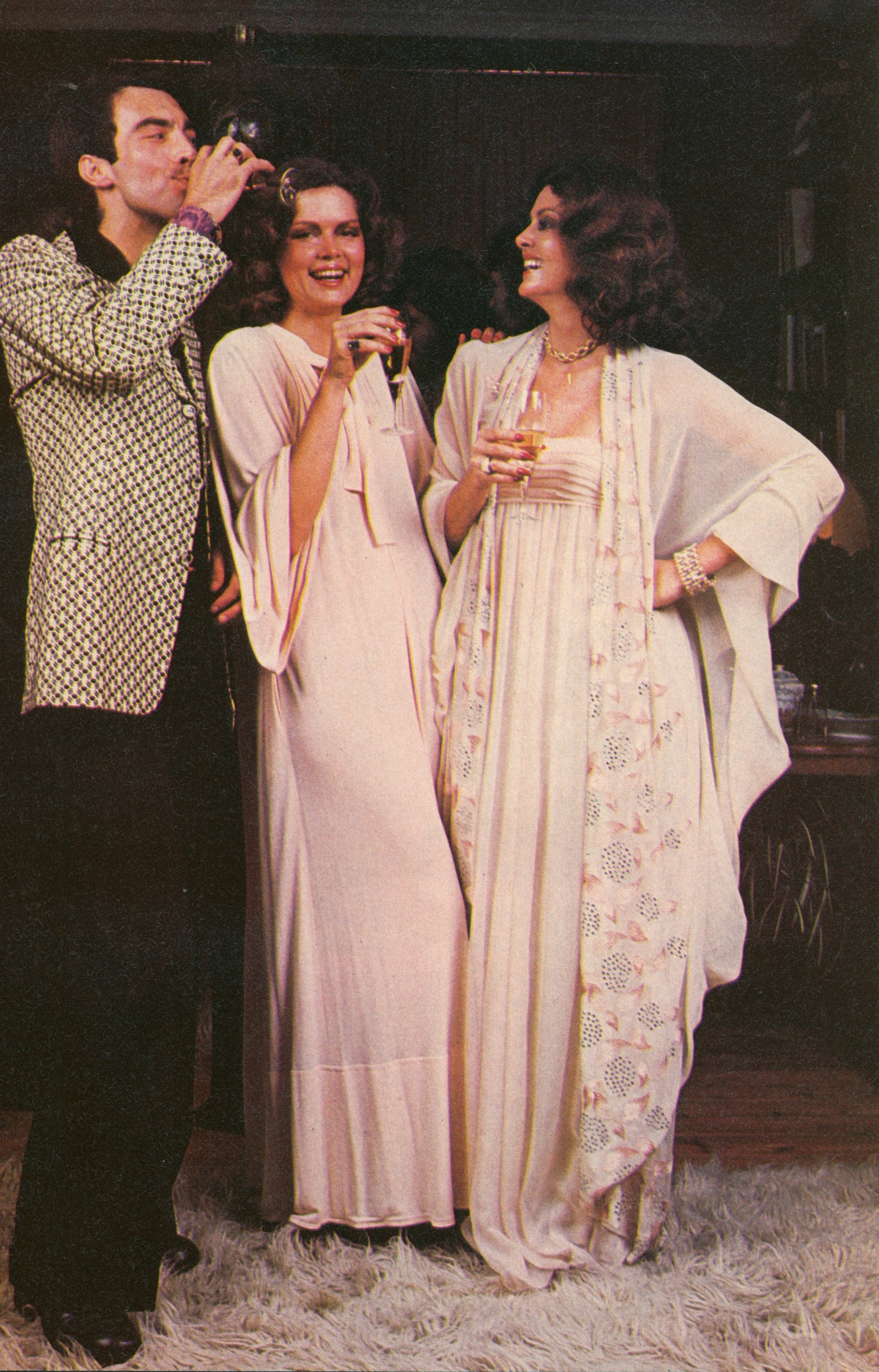
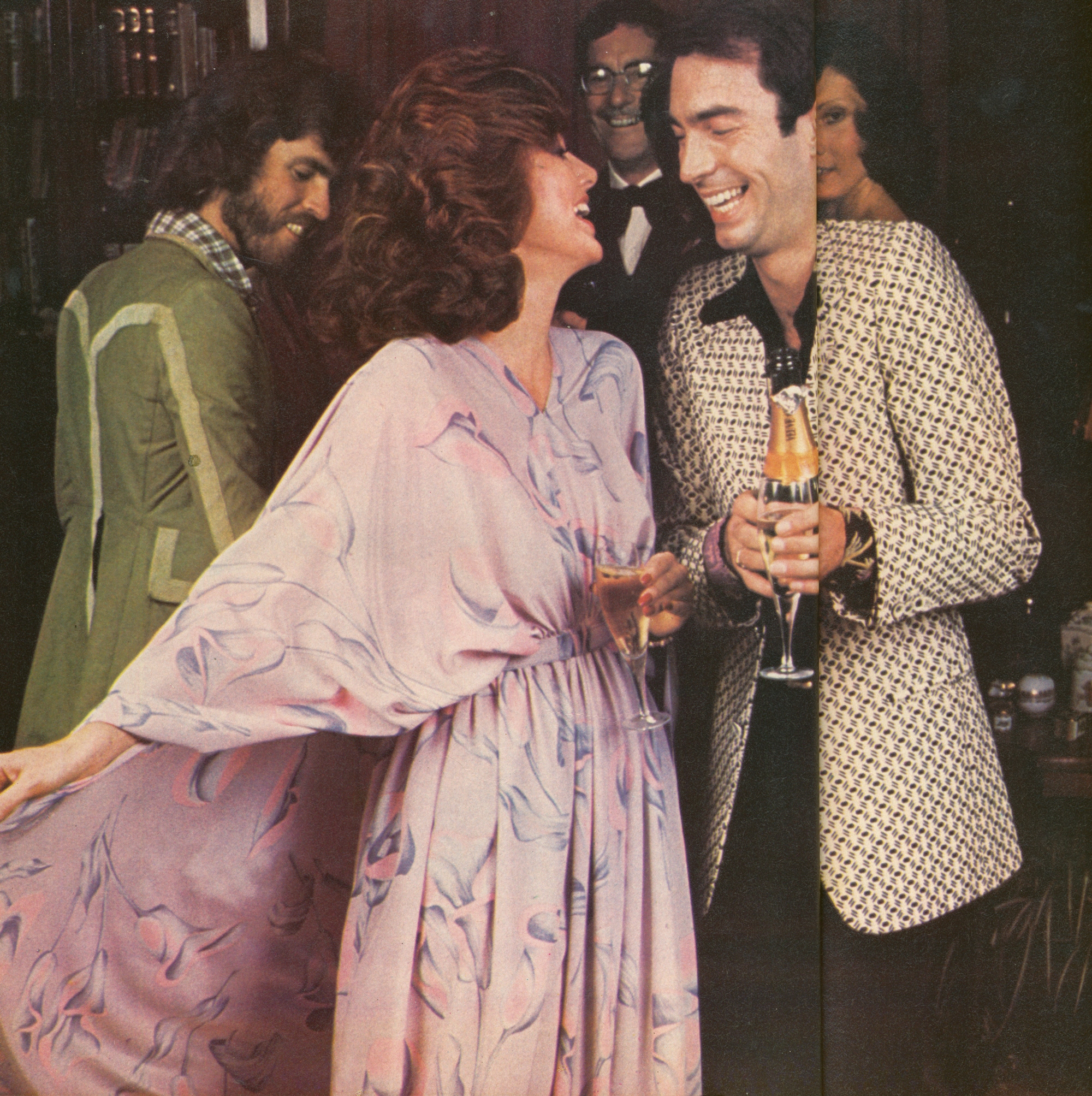
Parties are part and parcel of the festive season and once the harrowing run-up to the 25th is over, you just have to throw caution to the winds and enjoy yourself ! Make Christmas a really special event this year and buy yourself a present—a dress that will make a room go quiet; a dress that will make heads turn . . . in other words, a real showstopper. And, because it’s anything but inexpensive, a showstopper that’s not just tied to this winter, but will go on and on in its dateless line. Party dresses are designed to make an impact—so be the centre of attraction, and while you’re enjoying yourself, don’t forget to propose a toast to Christmas.
Photographed by Jeany.
Scanned from Woman’s Journal, December 1975.
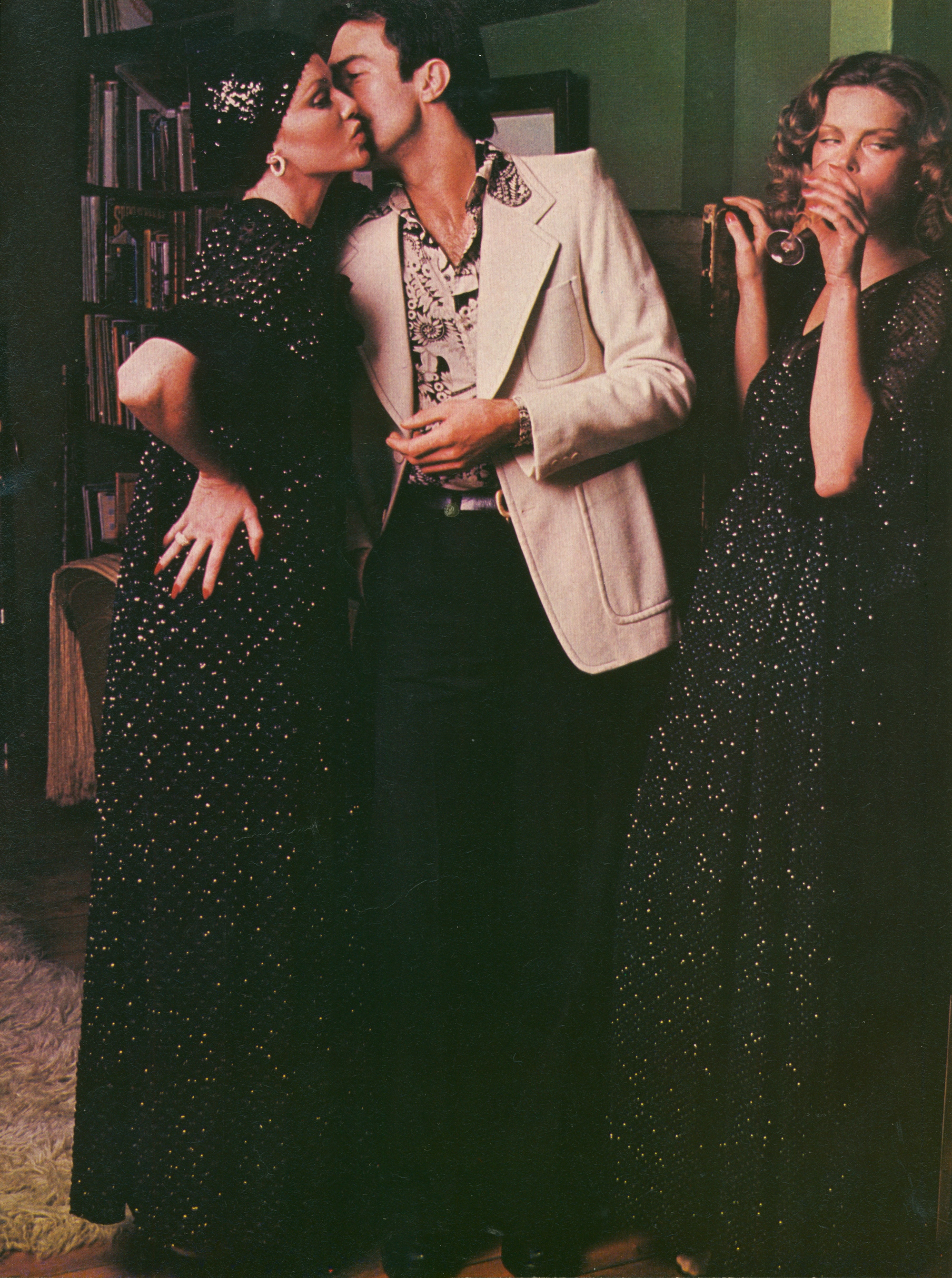
Left: Long black glitter dress covered in black and silver diamante, with a tie at neck, short flared sleeves and toggle back fastening. £196. Black sequinned pull-on hat. £56. Jean Muir. Pave diamond earrings. Pave diamond ring. Both by Graff. Black suede ankle-strap shoes. £33. Charles Jourdan. Right: Black georgette dress with a V-neck and gathered waistband covered in black and silver diamante, worn over a black silk underdress with shoe-string straps. £106. Salvador at Feathers. Elegant glitter shoes. £30.50. Rayne.
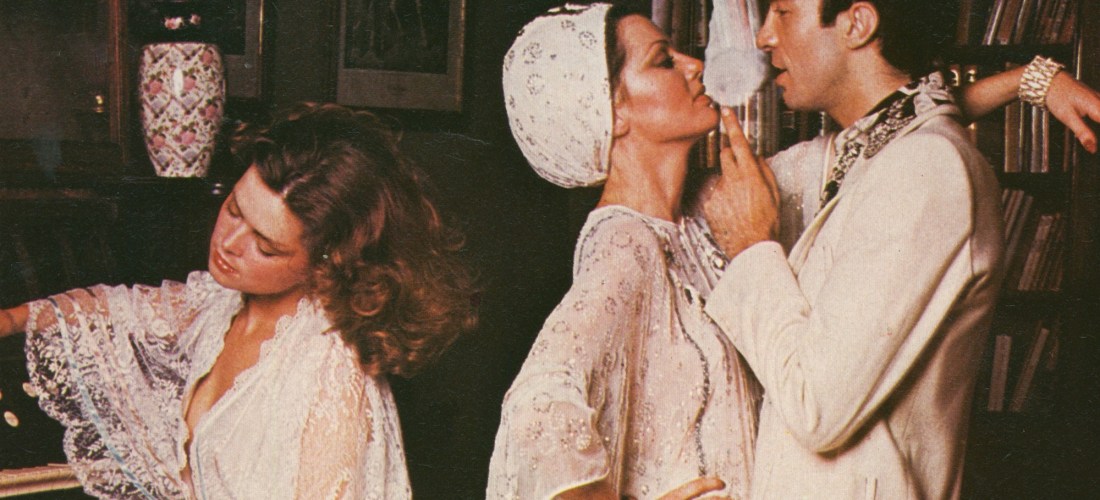
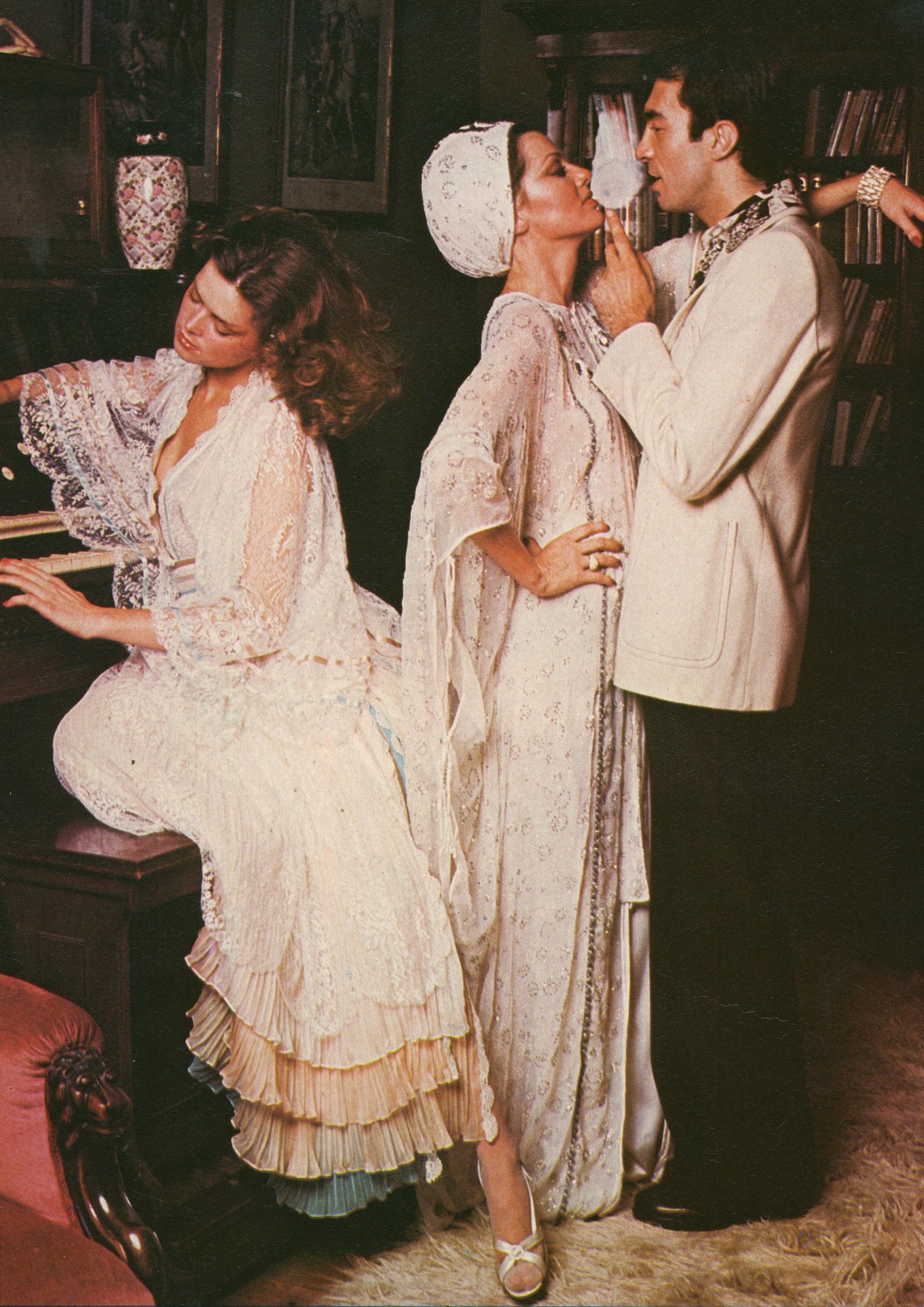
Left: White lace dress with bodice, waist and sleeves trimmed with peach, coffee and turquoise ribbons, matched by the silk chiffon flounces on the underskirt. £390. Bill Gibb at Feathers. White strappy satin shoes with a silver-coloured clasp. £29.50. Rayne. Right: White silk chiffon spangled coat with embroidered appliqués and attached tie-belt. £450. Wide white satin trousers. £92. Matching turban. £50. By Thea Porter. Gold and diamond bracelet. Pave diamond ring. Both by Graff
Centre: Peach silk dress with a tie at the neck, seamed shoulders and long, flared sleeves. The back is fastened with toggle-shaped buttons. £138. Jean Muir at Browns. Right: Peach silk chiffon dress with shoe-string straps and a pleated bandeau top which ties at the back. Matching cape bordered with peach embroidery and rhinestones. £440. Gina Fratini. Pave diamond ring. Diamond and gold bracelet. Gold and diamond chain. All by Graff.
Stunning pink and lilac full-length silk dress with a V-neck at front and back, tie-belt, and a high waist threaded with elastic. The batwing sleeves fall to form a flowing cape at the back. £350. Chloe at Browns. Diamond and gold bracelet. Graff.
Left: Backless black and cream djellaba with a tie at waist and back of neck. £76. Caroline Charles. Right: Cream chiffon dress with gathered waist. The batwing bodice is embroidered with multi-coloured flowers and birds; the sleeves fall into a cape at the back. £90.50. Rosemary at Leonard.
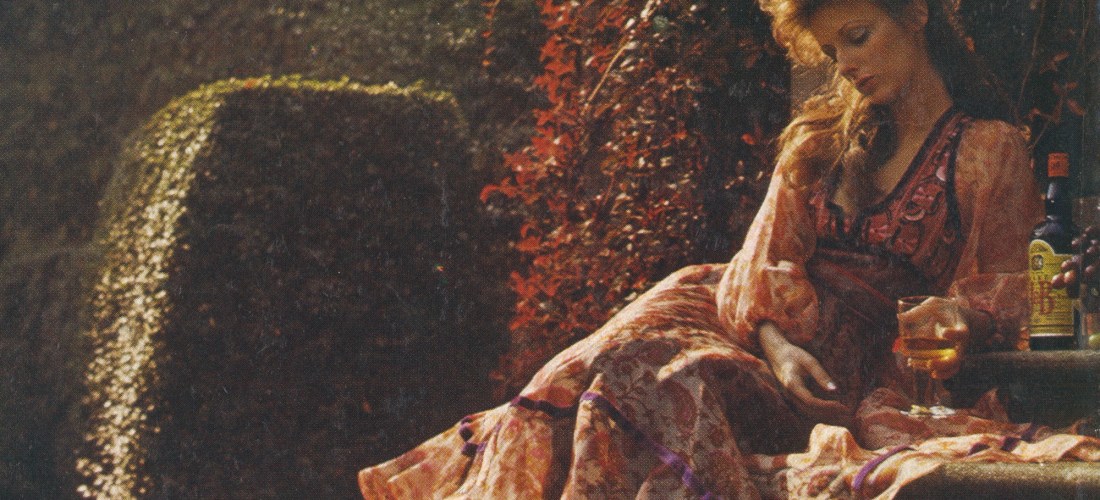
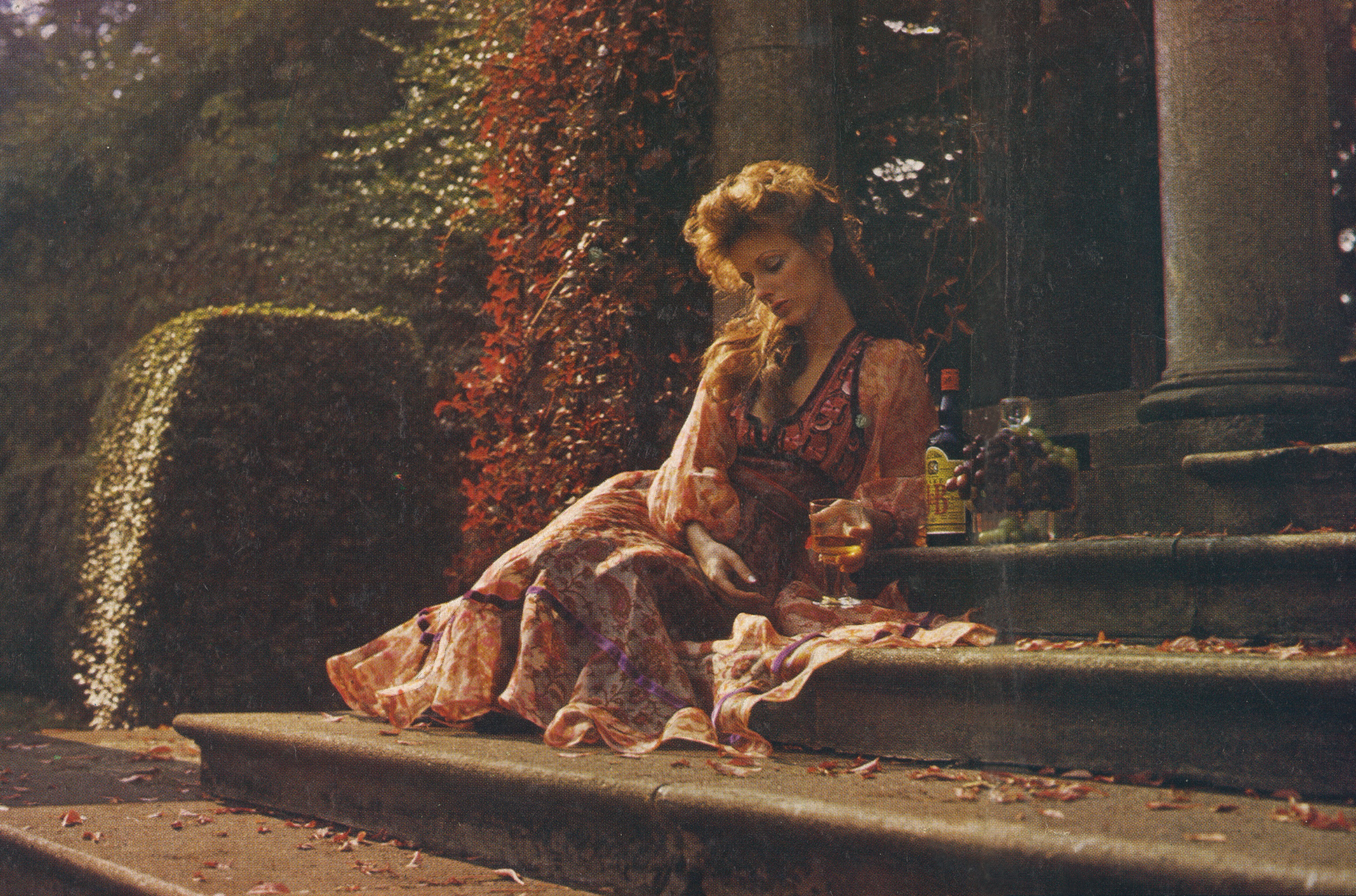
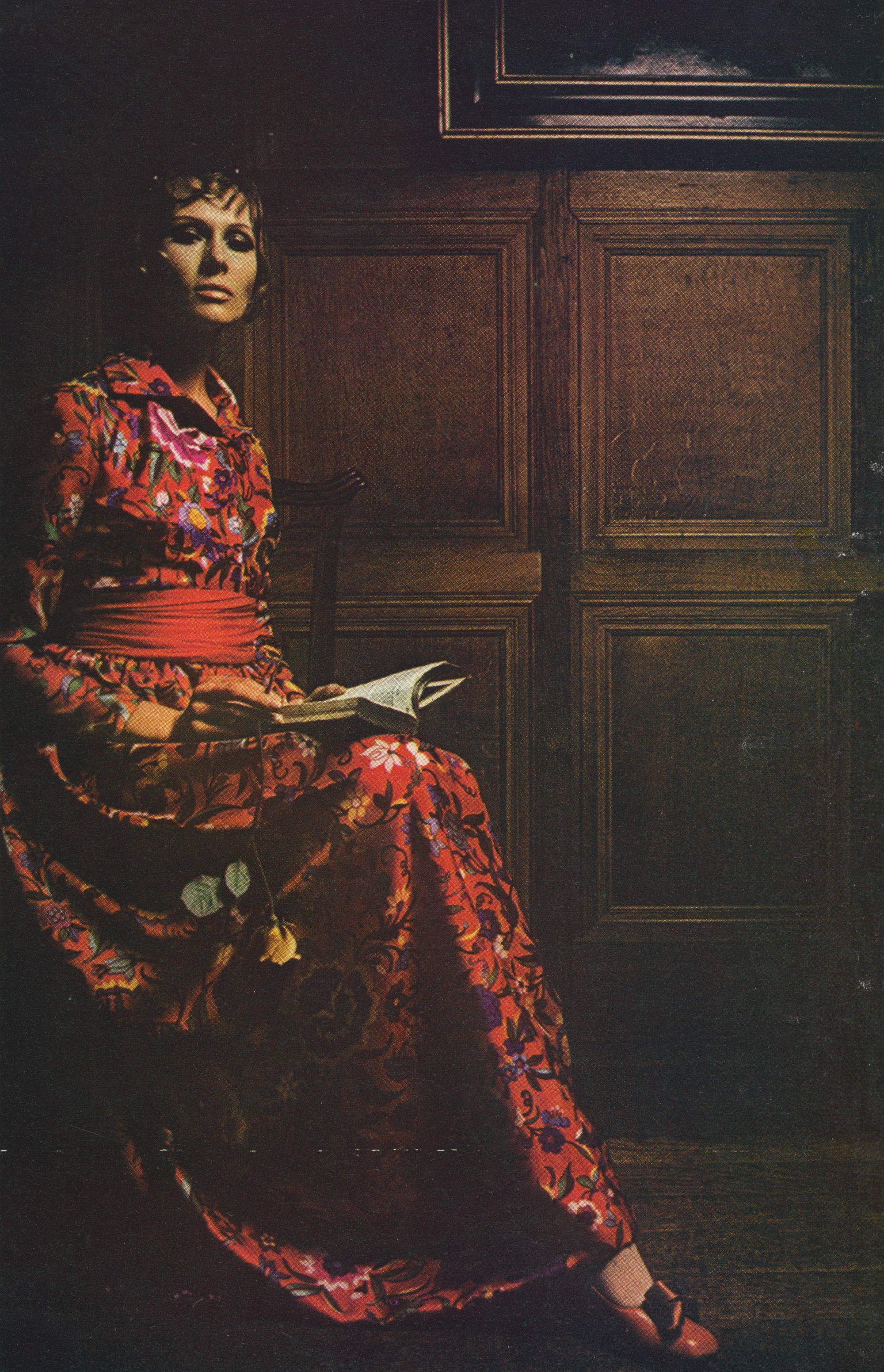
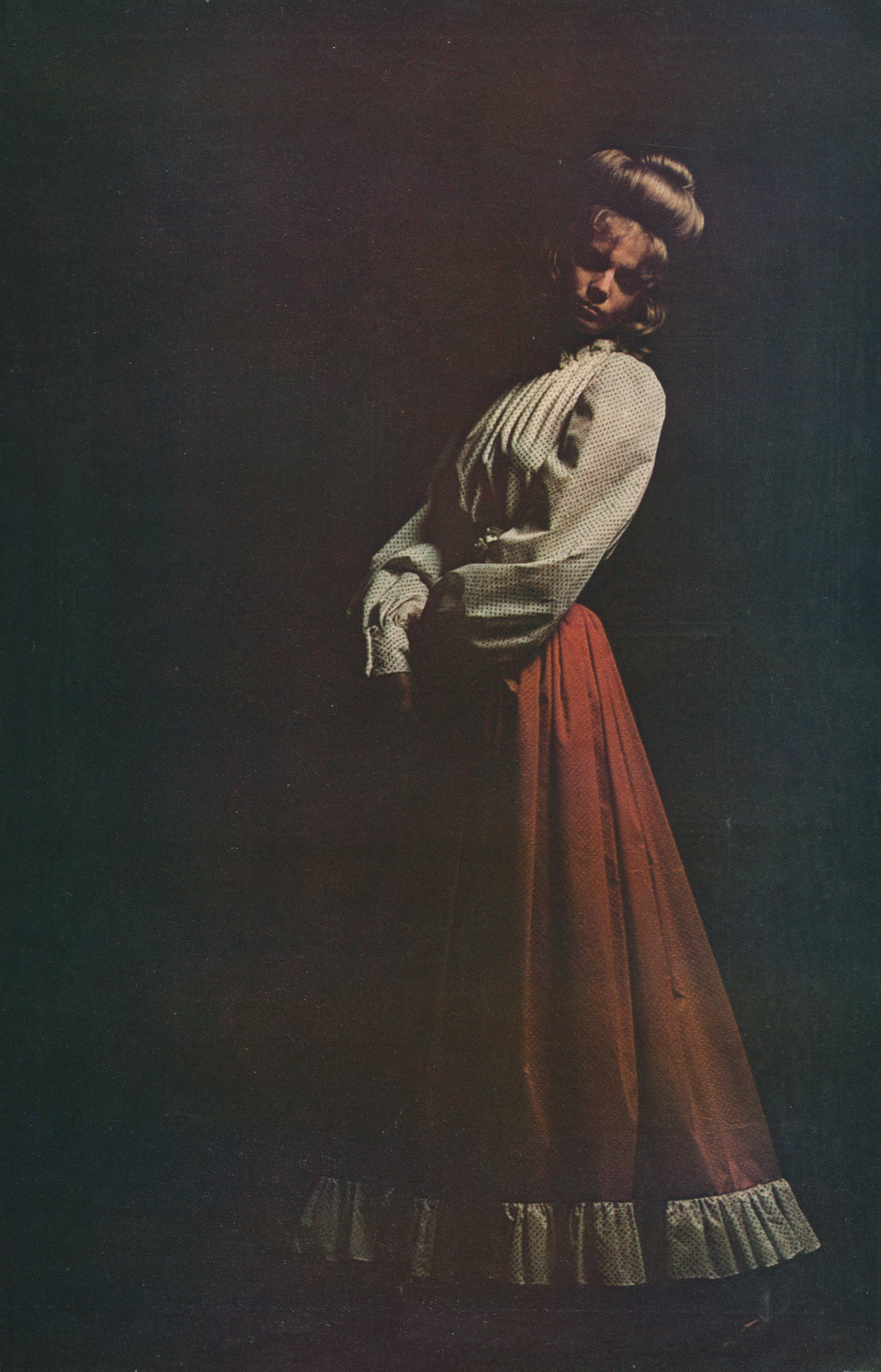
Taking your J & B casual: Burgundy and pink silk gauze dress, with a bodice of raw silk and velvet; £60 at Thea Porter, 8 Greek Street, W1.
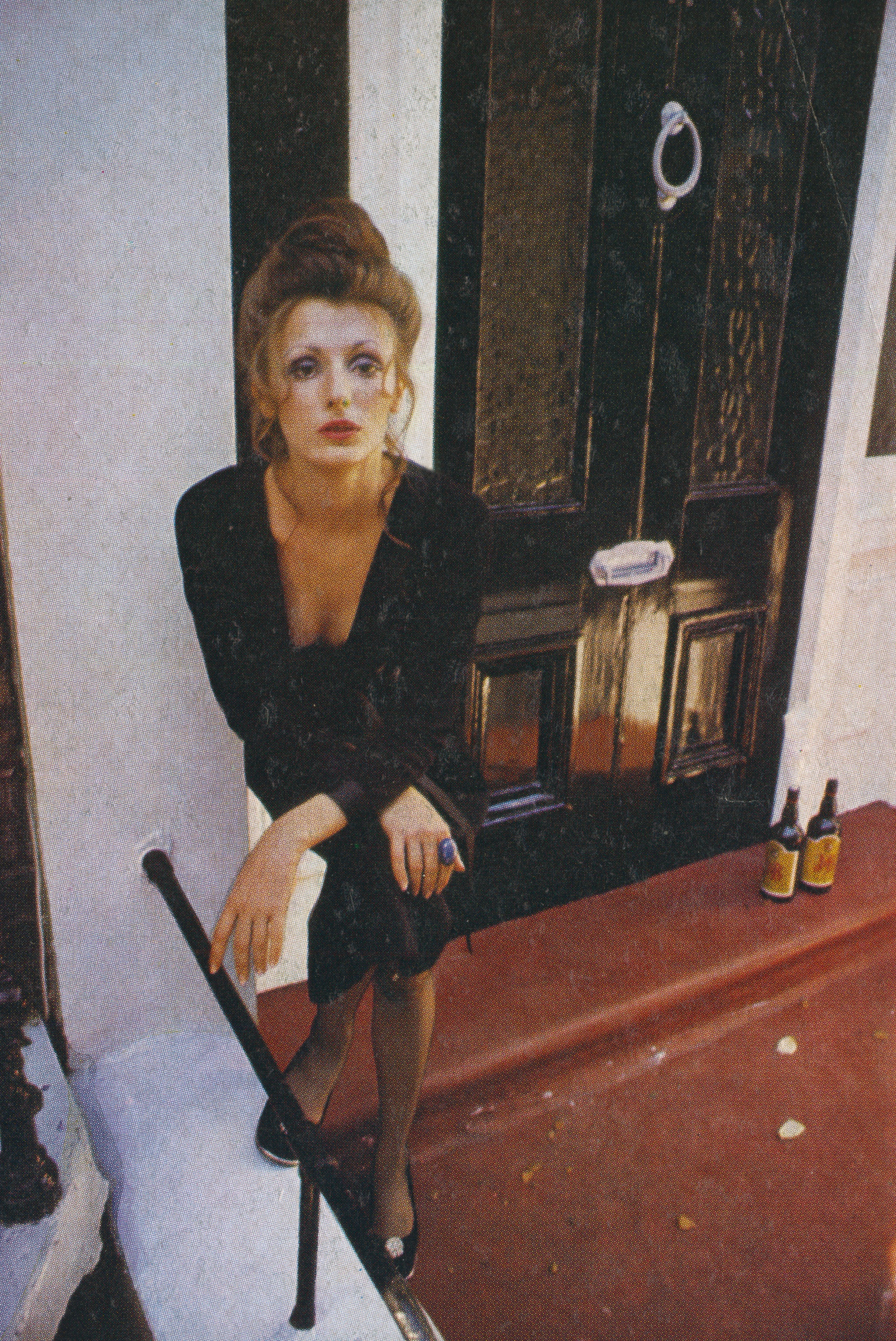
There were 2,554 entrants in the amateur photographic competition organised by J & B Rare Whisky and QUEEN. First prize was a fee-paid fashion assignment. The result was the photo finish above, by joint winners Jeanne Hendry (above) and N. Patrick Allen (below), who shared the prize-money and each received a case of J & B Rare.
Photographed by Jeanne Hendry and N. Patrick Allen.
Scanned from Queen, 12th-25th November 1969.
Taking your J & B neat: Trim black maxi-length dress, £21 10s at Derry & Toms, Kensington High Street, W8. Crêpe shoes, silver trimmed; £6 19s at Russell & Bromley, New Bond Street, W1. Black stockings; by Aristoc, 7s at Liberty, Regent Street, W1. Hair by Valerie at Cheveux. All glass from Maples, Tottenham Court Road, W1.
Transparent silk chiffon dress hand-painted in smudges of soft yellow and prune, sashed with long chiffon scarfs from Liberty, £2 12s 6d each. Dress, £45, Thea Porter, 8 Greek St, W1. Rings from Savita, 30 Lowndes St, SW1. All-in-one bodysuit and tights, £1 5s 6d, Fenwicks, W1. Pumps in beige crepe with jewelled heels, 28gns to order from Ferragamo, 24 Old Bond St, W1.
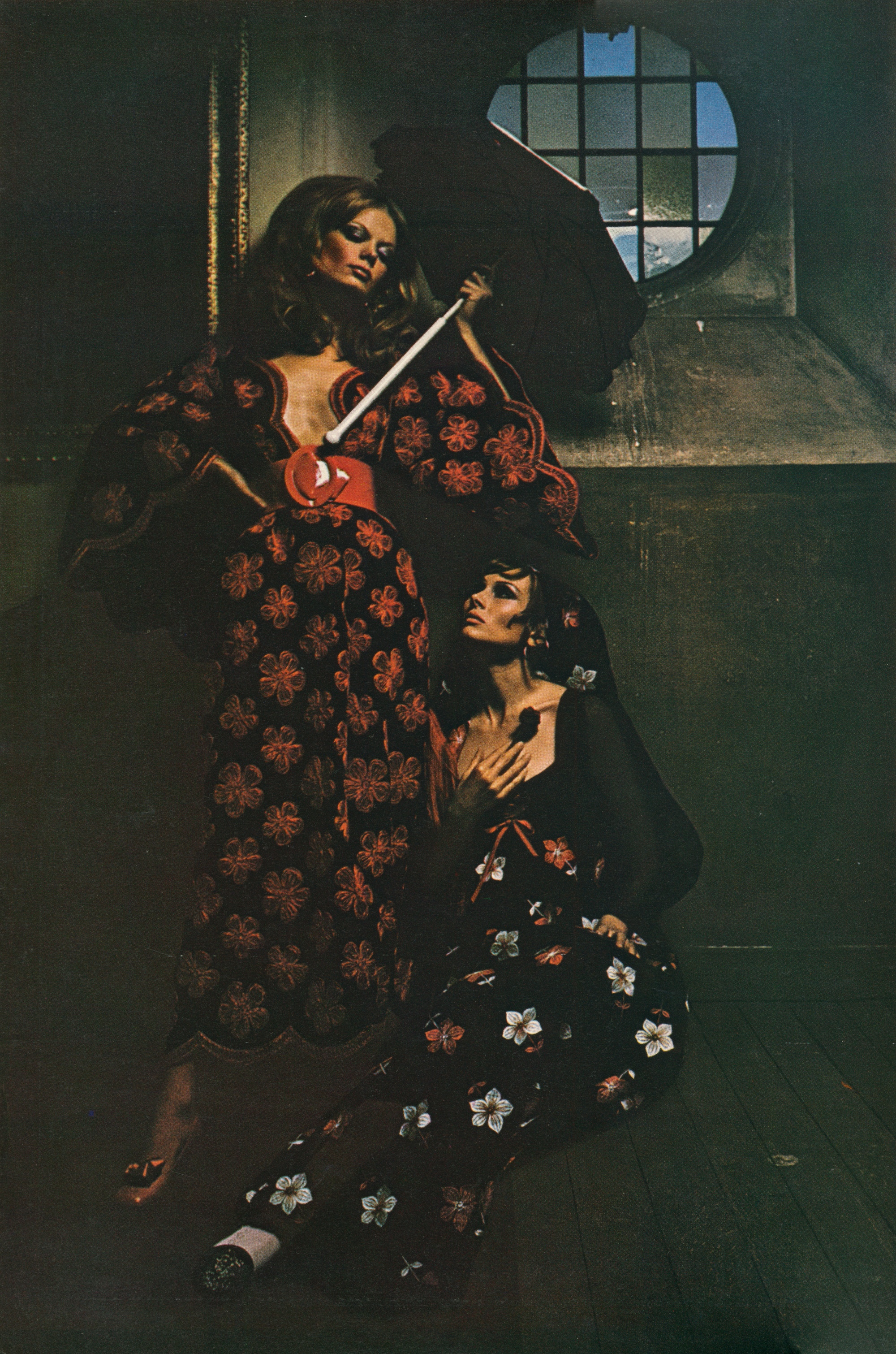
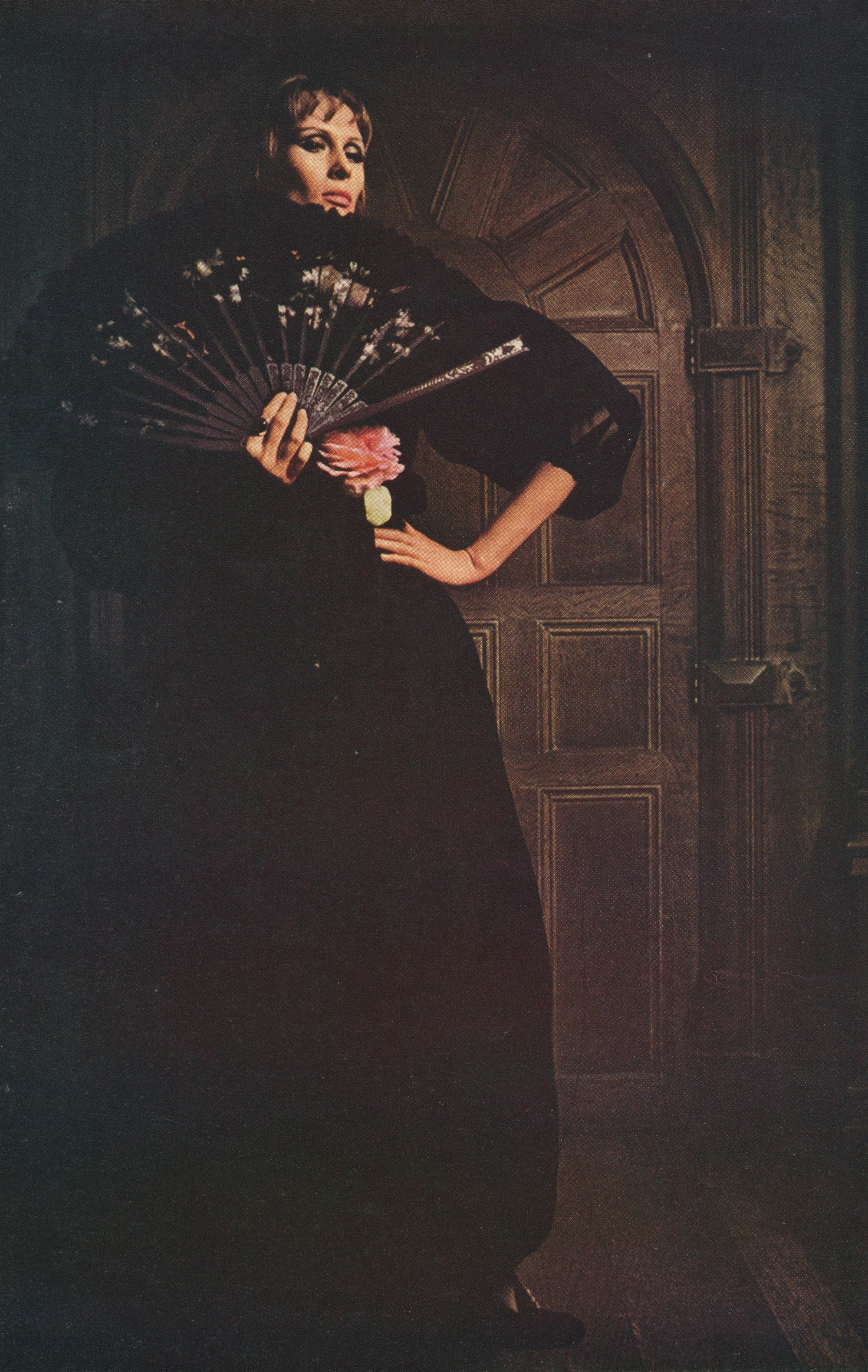
Glyndebourne in summer where the season opened on May 25th with Massenet’s Werther and Mozart’s Cosi fan Tutte. Balls, long, long English summer evenings for wearing fragile chiffon, delicate lace, organdie and brilliant silk; for baring arms and feet and dancing far into the dawn. These photographs were taken in the Organ Room at Glyndebourne.
I worked at Glyndebourne for a few seasons, a few years ago. Whilst it meant I was lucky enough to get to be in the audience several times, and visit the Organ Room, I’m now extremely sad that I didn’t have these dresses to wear!
All the hairstyles, using hair pieces by Toyer Tresses, by Oliver at Leonard, Upper Grosvenor St.
Photographed by John Claridge.
Scanned from Harpers Bazaar, June 1969.
Left: Black organdie dress embroidered with red raffia (fabric, Forster Willi), to order from Clive, 17 St George Street, W1. Red leather shoes; 12gns, Charles Jourdan. Red Mary Quant tights; 13s 11d, Selfridges. Earhoops; £3 1 5s, Paris House, W1. Parasol hired from Bermans, W1. Right: Black silk organza dress and shawl with white and red flowers; Bellville Couture, 95 Cadogan Lane, SW1. White Twiggy tights ; 16s 11 d, Galeries Lafayette, W1. Embroidered satin shoes ; 15gns, Kurt Geiger, Gilt earhoops; £3 1 5s, Paris House, W1.
Black nylon chiffon dress tiered in lace —a truly grand opera gown — with shoulder-wide scalloped neckline, tight bodice, satin sash; Capriccio Collection by Roter, about £35 10s, Harvey Nichols, SW1. Fan hired from Bermans, W1. Embroidered satin shoes; 15gns, Kurt Geiger. Nude tights by Berkshire; 11s 6d, John Lewis W1. Jet and gold ring from the Chelsea Antique Market.
Shirtdress splashed with flowers in brilliant Liberty silk ; Nettie Vogues, about £45, Fortnum & Mason, W1. Silk scarves ; Richard Allan, about £1 12s 6d each, Fenwicks, W1. Sheer Cling Tights Cantrece by Elbeo ; 15s, Selfridges, W1. Red shoes; 12gns, Charles Jourdan. Jet beads in hair ; Adrien Mann, £17s 6d, Dickins & Jones, W1.
Red and white flocked nylon dress — the prettiest of the Season —with gathers from neckline to waist, wide navy belt: Nettie Vogues, about 22gns, Dickins & Jones, W1. White Twiggy tights; 16s 11d, Galeries Lafayette, W1. Red shoes; 12gns, Charles Jourdan.
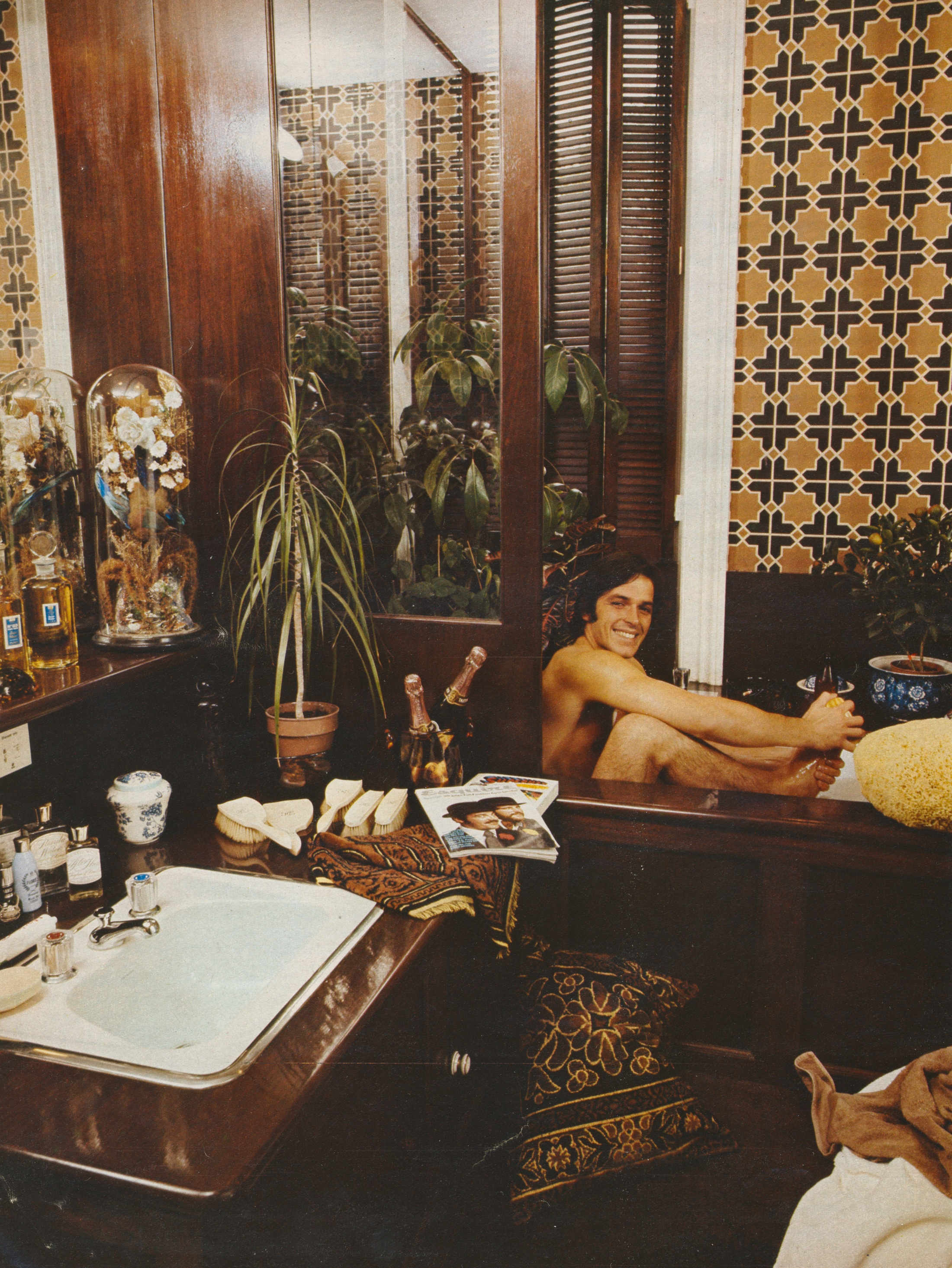
Dishy model Michel Julien playing it cool in David Evers’ masculine bathroom.
The bathroom as an erogenous zone.
No room is more intimate than your bathroom. There is nowhere better to relax and get in the mood … to succumb to the sheer sensuality of soaking in scented water, indulging fantasies and anticipating future pleasures.
Your bathroom should be a place to feel beautiful in. to lacquer your toenails or finish a novel, henna your hair, water your plants or even paint a picture. No reason why it shouldn’t be your bathroom-boudoir-dressing-room-studio all in one. Even better if there’s room for a bed .. .
The bathroom is where you imprint your personality. Dare to be exotic with jungle prints, orchids growing in glass tanks. Or keep it cool with ice-white decor, stark modern art, a Japanese Bonsai tree.
Whatever your style, remember the importance of warmth, the comforting feel of thick pile rugs and heated towels. There’s no greater turn-off than getting goose pimples in a chilly cheerless bathroom. We photographed three highly individual bathrooms designed with great flair, and each styled perfectly for their owner’s lives. But all with a single thought in common—comfort.
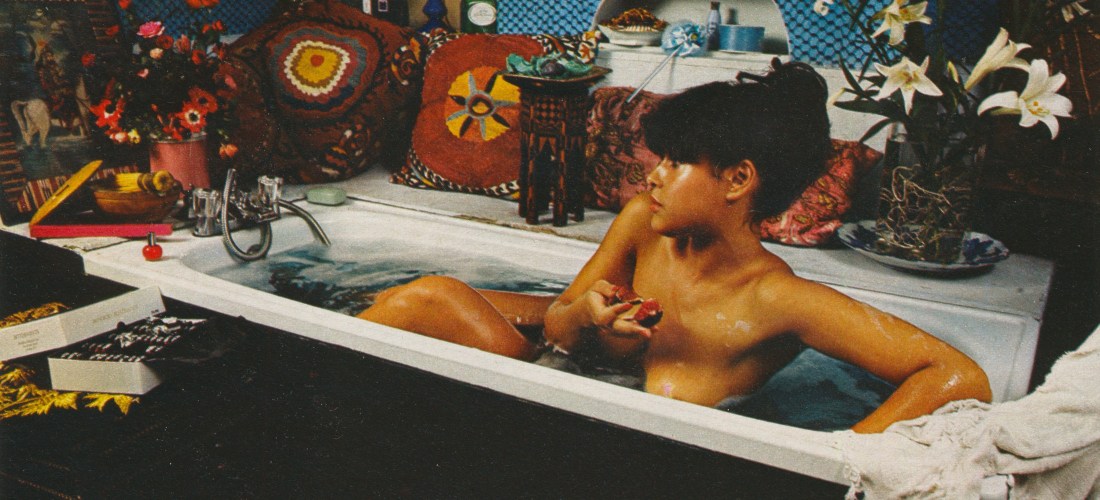
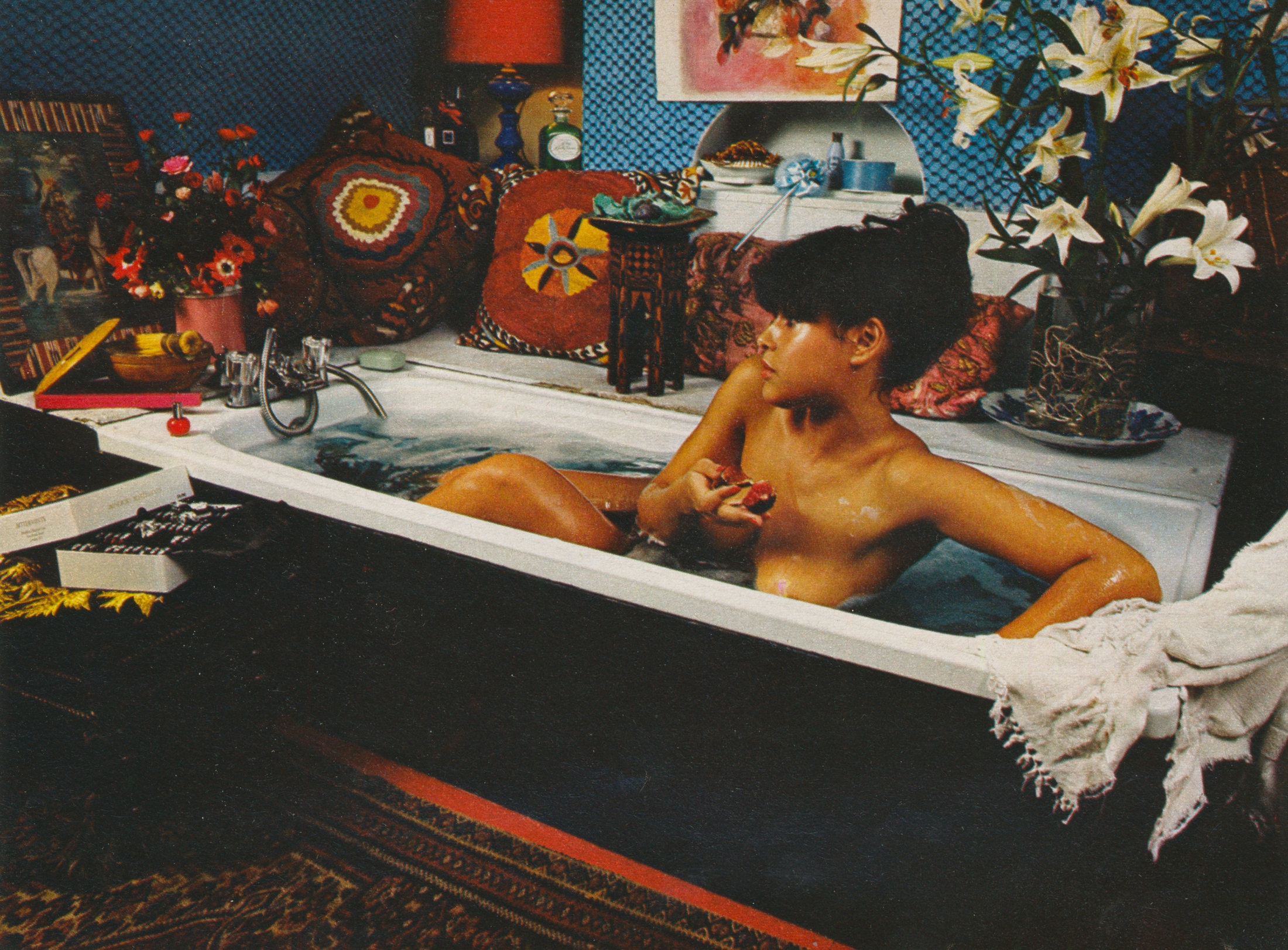
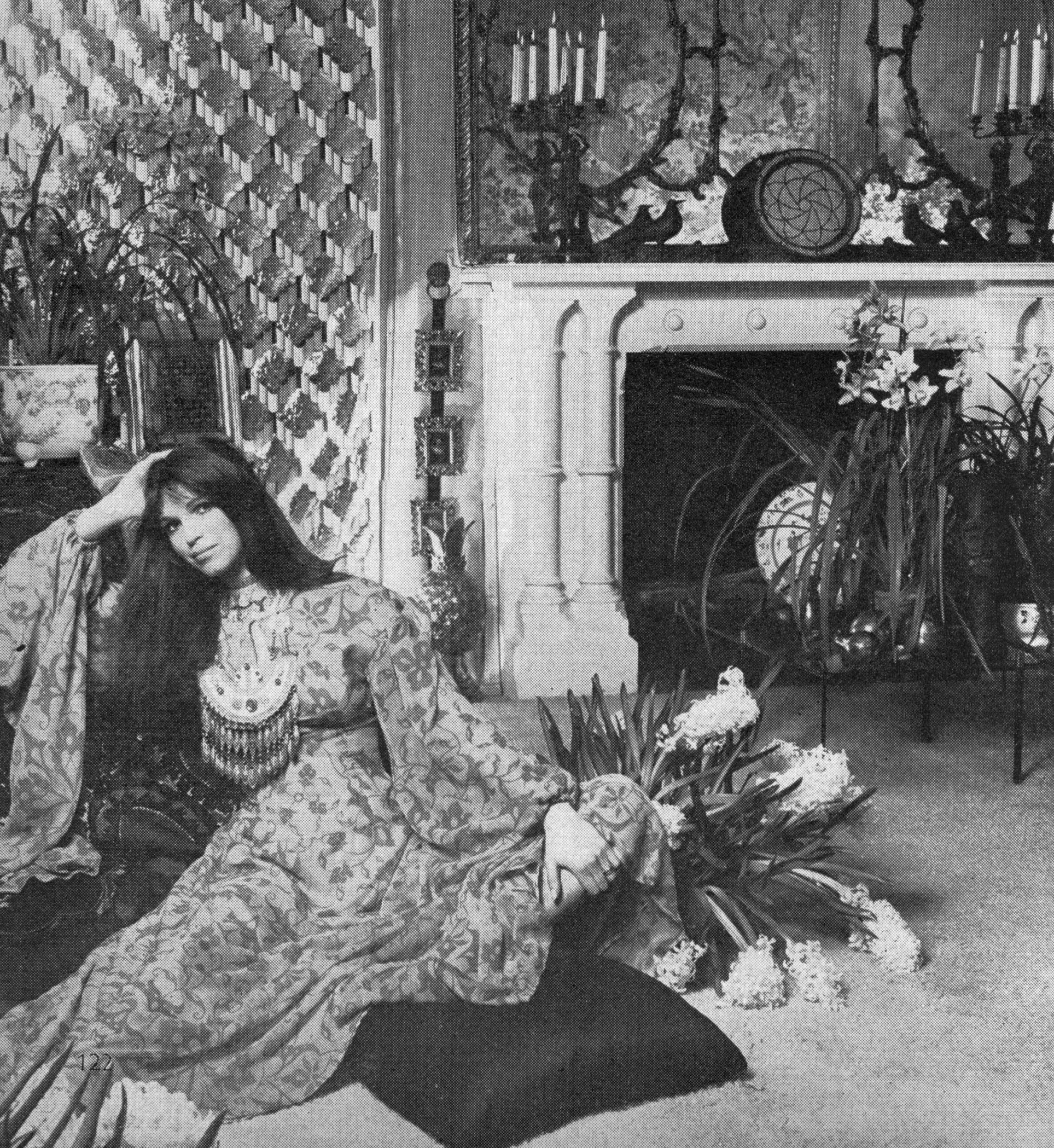
The lure of the East for international fashion designer, Thea Porter. She designed her Mayfair bathroom with a Moorish interior in mind . . . wide built-in seats with heavily embroidered cushions. a little arch cut into the wall to display treasured objects. Thea doubles her exciting room as a studio, hangs her paintings around the walls.
If you want to please a man, model your bathroom on the one good-looking London businessman David Evers owns, with handsome polished mahogany fitted units, ivory backed brushes and green plants. David says the atmosphere reminds him of a St James’ men’s club.
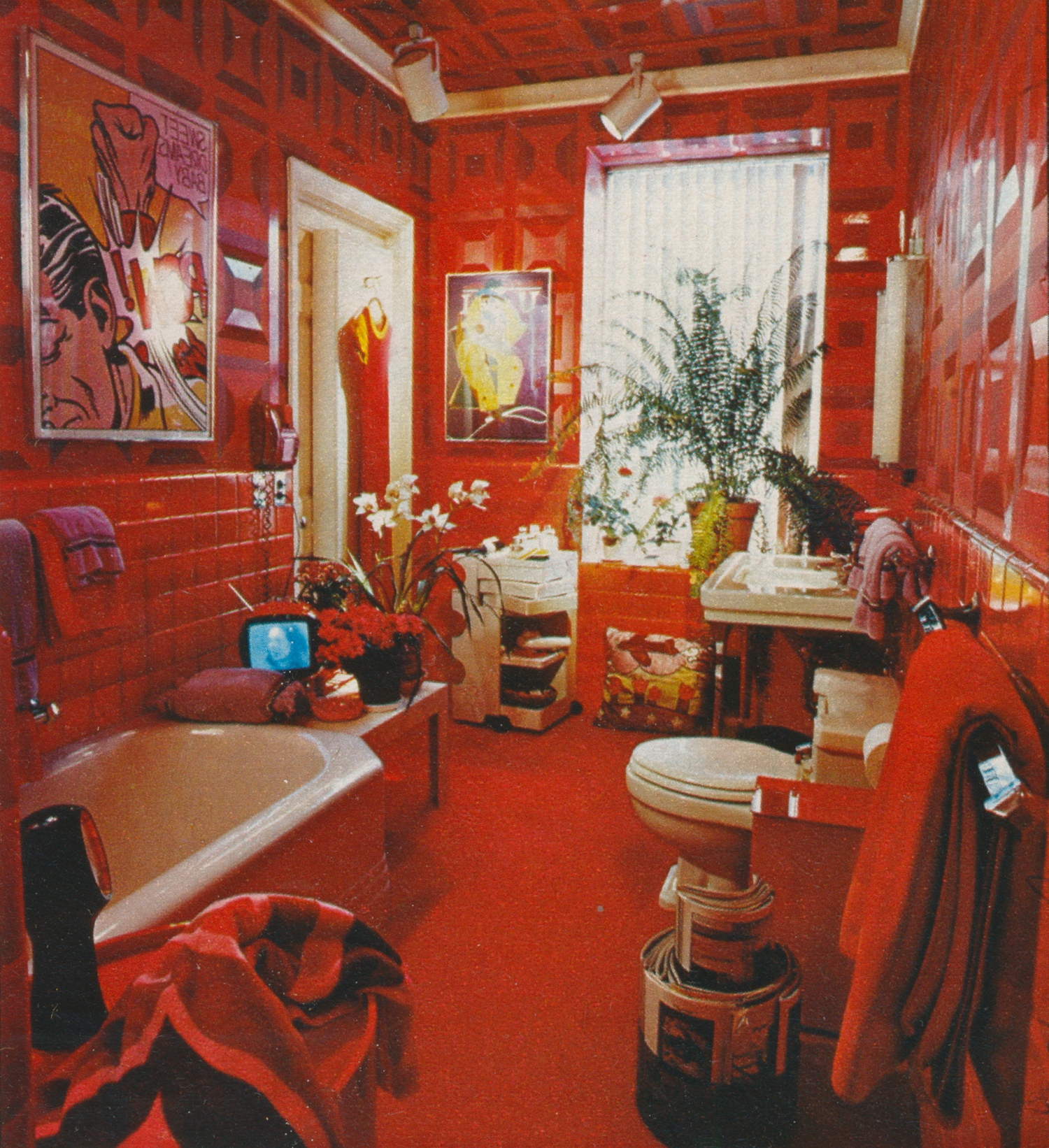
The third is a fiery red hideaway, a fantastic design by Richard Ohrbach for New Yorker Cynthia Peltz. There’s more than a touch of the womb about this room—very comfortable after a hard day at the office …
Text by Joan Prust-Walters.
Photographs by Tim Street Porter.
Scanned from Cosmopolitan, January 1974.
Our model Carole Augustine looks very relaxed in Thea Porter’s bathroom which is just like a Seraglio.
Cynthia PeIlls bathroom is a warm hideaway. (Photographed by Harry Hartman).
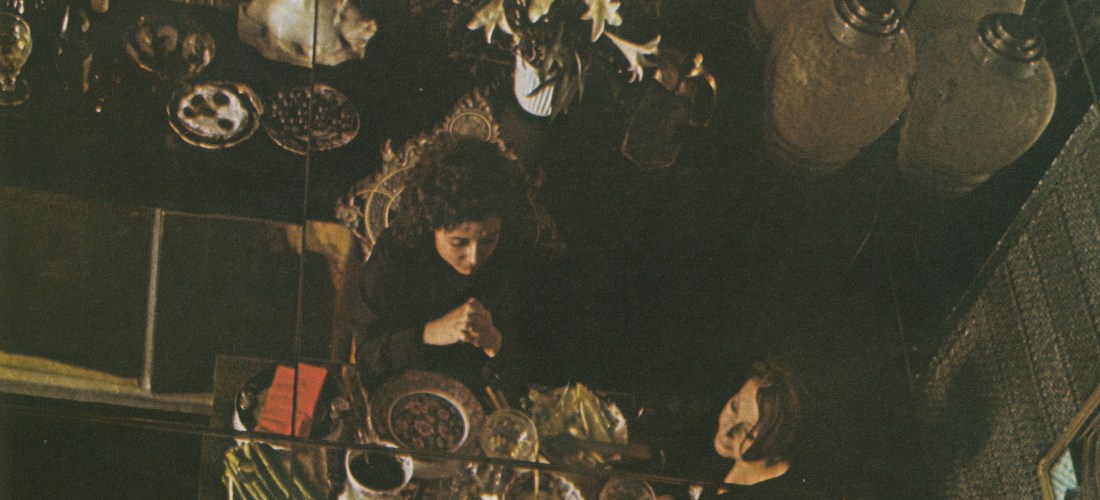
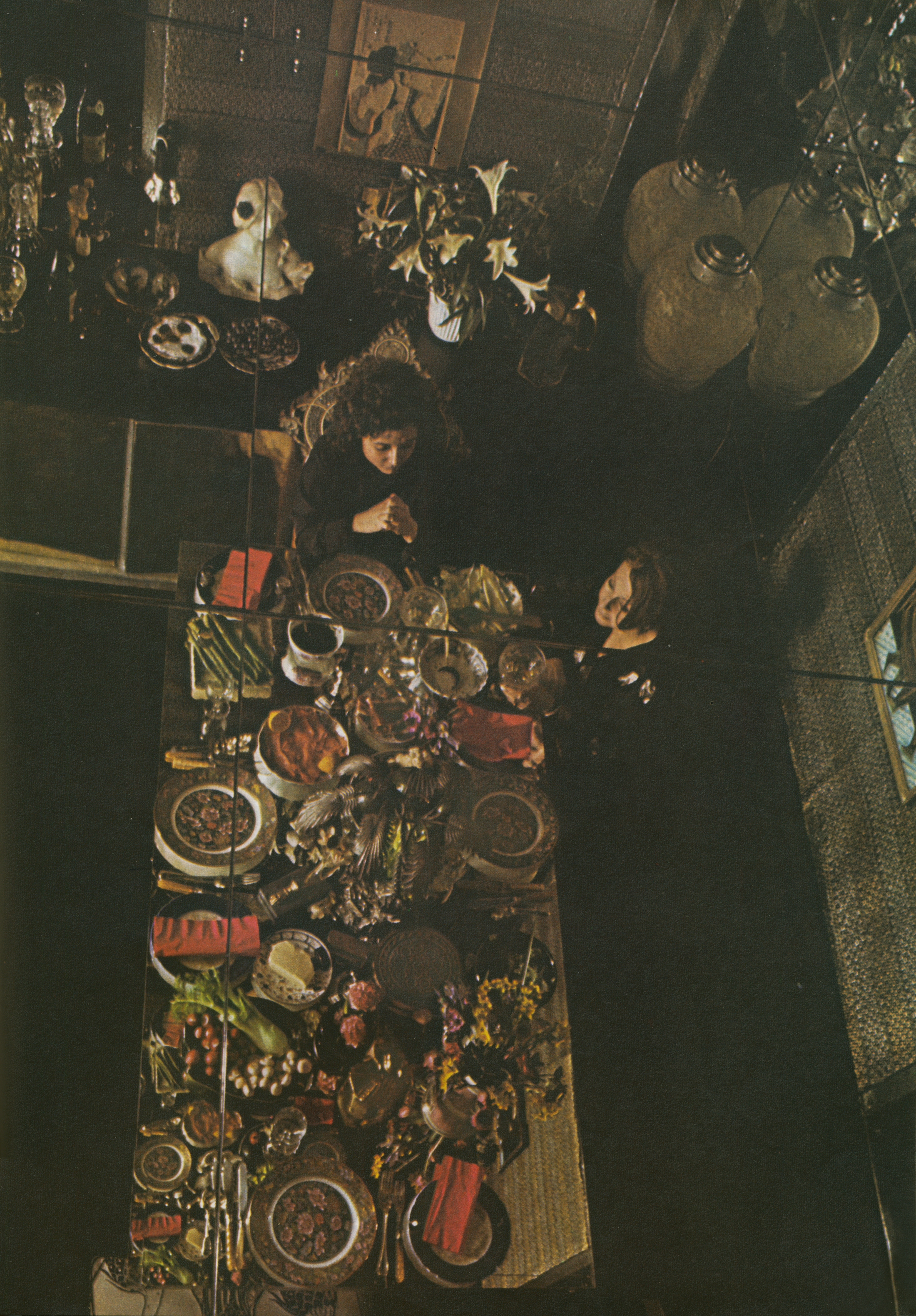
Thea Porter (right) and her daughter Venetia. On the richly decorated table are some of Mrs Porter’s favourite Lebanese dishes.
‘The great thing about an Arab meal is its variety’
Thea Porter, painter and dress designer, whose shop in Soho and flat off Piccadilly are ports of call for the international set, writes about cooking Arab food.
I love my kitchen – from the neatly stacked Margaux (Brane Cantenac is a current favourite) to the painted Louis XIV cherubs smiling innocently from the shiny brown wall into the mirror shelves opposite, lined with Damascus spices and French herbs. Even late at night I enjoy boiling up an anti-hangover drink, and gazing at my cookery books before carrying one up to bed to plan some future meal.
But I also get inspiration in restaurants. Sitting in the ordered splendour of the Orangerie in the Ile Saint Louis (where the waiters all look like jeunes premiers among the flowers) I think of my kitchen, and wonder how to re-create the delicious sauces without bothering the chef. How do people con recipes out of restaurant owners ? I try to guess the ingredients, and then have to keep going back to make sure the proportions are right.
At the Orangerie they have enormous baskets of crudités – like cornucopias by Tiepolo – overflowing with mush-rooms, avocados, grapelike tomatoes and black radishes to go with smoked ham, and two different sauces. One, I think, is made with thin cream cheese (Gervita from Roche, 14 Old Compton Street, W1 will do) mixed with cream or yoghourt and chives. Their vinaigrette is also excellent – the herbs are so finely chopped it breaks my heart. This type of hors d’oeuvres is my favourite start to a meal. I quite often add tarama to go with the avocado, or a mixture of cream, finely chopped shallots and artificial caviar. Smoked salmon is an alternative : it rather depends on what one can find.
I never have time to shop in London, and usually send someone out with a list. This system breaks down when smoked trout instead of fresh trout is discovered sitting in the kitchen -but it is also fun to improvise at the last moment. I always have a supply of tins from Roche to fall back on, and a packet of paper-thin Greek pastry from the Hellenic Provision Stores to make burreks . These can be layered and stuffed with practically anything, then rolled into thin cigars and baked.
The best thing about raw vegetables, apart from their crisp texture with the melting sauces, is that they are so pretty. Nothing is so exquisite as plumed sliced fennel or cauliflower. (Edna O’Brien says she finds even sliced leeks that tendril round her fingers beautiful.) I pile them into a motley collection of Japanese bowls and plates and arrange them with bowls of flowers, although not as ambitiously as they do at Parkes, where roses nestle expensively by the melon. I think I must spend as much on flowers as on food. (If I’m cooking something really smelly, I find even lilies aren’t enough, so I light one of those Rigaud candles on the stairs.)
But if you have crudites for starters, and have to peel mushrooms and clip radishes, there is very little time left for preparing the main course. So it has to be something easy like sirloin, very rare with horseradish, served with tinned flageolets from Roche – either heated up with cream, or cooked the way Arabs cook broad beans, with fried onion and pounded coriander – delicious.
Arab food is ideal for the hard-pressed woman, torn between trying to call New York and attend to her guests, as it is always better the next day. I’m very fond of a Lebanese Lenten dish: spinach leaves stuffed and slowly cooked in oil and water. This is a delicate dish and should melt in the mouth if cooked long enough. Another Lenten dish is artichoke hearts fried in oil with onions and then simmered in water and lemon. Lebanese food has a lot in common with Provençal cooking, which means that I can start with an aioli with cod, potatoes, hard-boiled eggs and salsify, and then go on to sfeeha – a kind of Arab pizza, spread with mincemeat and pome-granate seeds, and served with thick yoghourt and a sharp lemony salad of green tomatoes and cos lettuce. As a child I used to watch black-visored Muslim women on a Friday clustered round a waterfall, greedily stripping and eating cos lettuces the way people here eat chocolates at the theatre.
The great thing about an Arab meal is that there is always a large variety of things to eat – often all plonked on the table at the same time. So you can choose a spoonful of this and a taste of that – excellent when you want to talk and drink in a leisurely way, and easier than coping with a large plateful of the one thing you perhaps can’t stomach. It certainly takes quite a lot longer to prepare ten or fifteen small dishes, but to my mind it makes for a more exciting meal.
I try not to give food that I myself adore (like brandade de morue) to guests who may not happen to enjoy that very earthy taste, unless there’s another choice. Brandade de morue is rather a soothing thing to cook with the music programme full on : you slowly heat oil in one saucepan, and milk in another, then beat minute quantities of each in turn into the desalted and poached salt cod. Some people add mashed potato for instant smoothness.
As I’m extremely greedy, I find cooking soothing and enjoyable after working and thinking all day, and I enjoy every stage – breaking eggs and beating them into a smooth hollandaise to go with a pearly bass cooked with tarragon in champagne dregs, or chopping up cuttlefish and stewing it a la libanaise in its beautiful sepia ink to make a thick, wicked-looking sauce with an intoxicating smell.
French cooking is undeniably far more subtle than anything oriental can ever be, but you do need time the same day. I find the sauce cracks when I try and heat up a poulet en demi deuil , while Circassian chicken is just as good heated up.
These are two extremes of taste, and it’s difficult to find a wine that will stand up to highly flavoured food, but that still goes well with a subtle flavour. I do my wine tasting at the Jardin des Gourmets when I eat there, and can then usually find the same wines at a cut-price wine store, Milroy’s in Greek Street.
There are so many exciting things to eat, it’s difficult to choose – though it’s easier to prepare something you like enormously than to experiment. I sometimes regret not living in France because the matieres premigres are so good there: the first white truffles to make into a salad or to roast on skewers ; fresh, white, shelled and skinned walnuts soaked in salt water ; the endless herbs that are always around and that you do not have to hunt for. Alas, the herbs in my window boxes wither and die regularly, but I shall doubtless go on re-stocking them hopefully until I wither and die too.
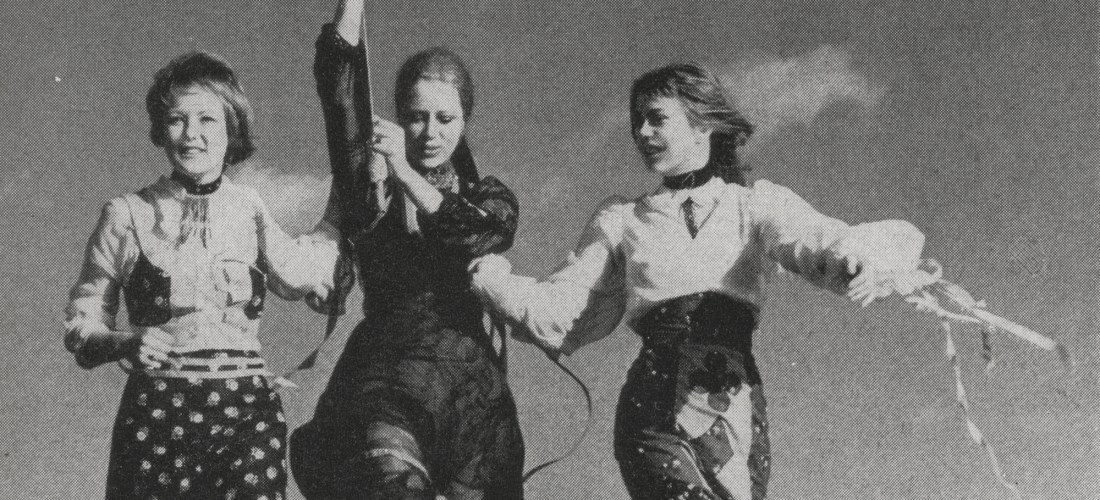
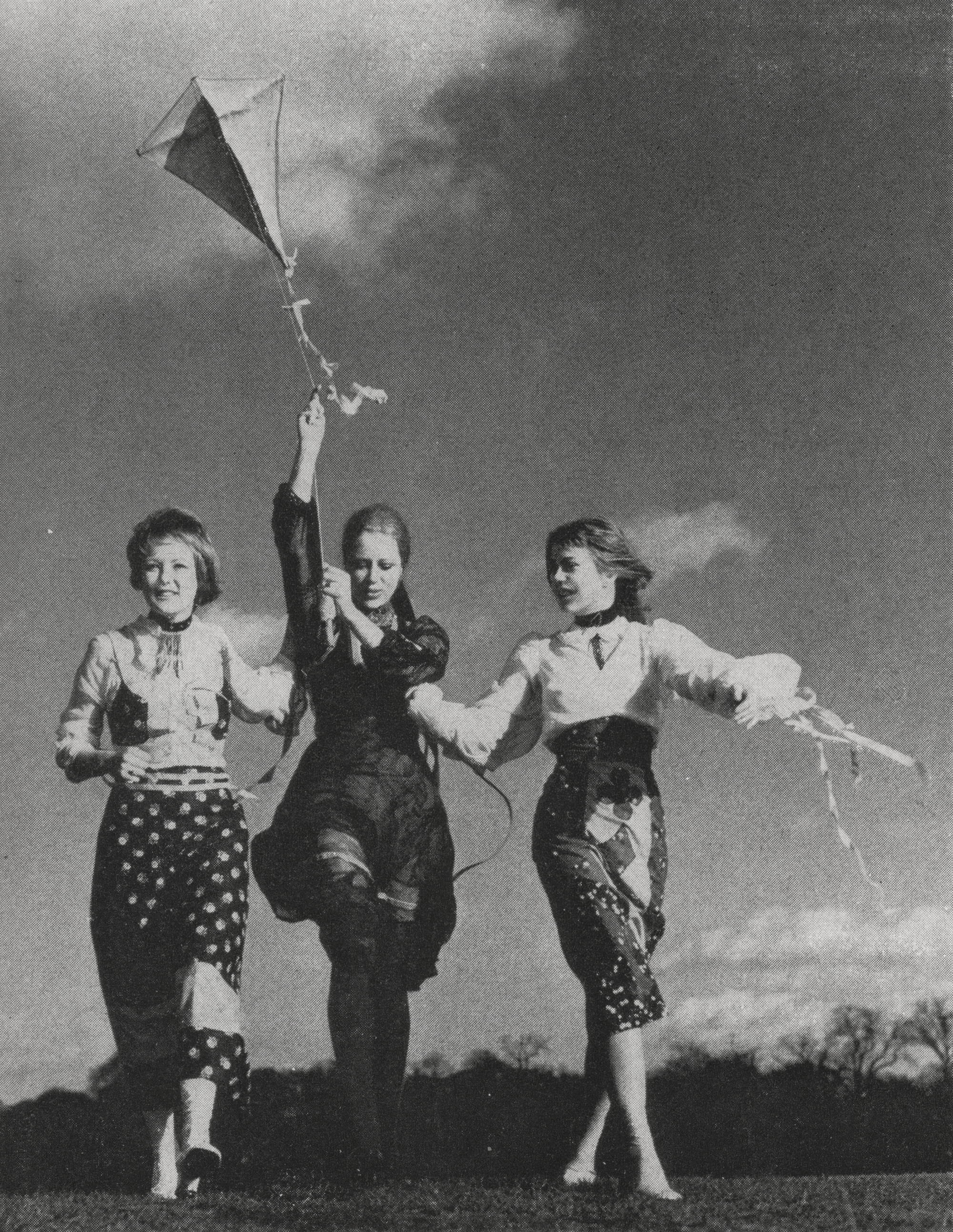
Three Boyds on the wing, above. Three sisters from Devon. Paula, 19, in skirt and jerkin of red and grass green mixed up cotton prints. £15, by Foale & Tuffin, at Feathers. White voile shirt, by Leslie Poole, £5, at Countdown. Thea Porter bead and velvet choker. Patti, 25, Mrs George Harrison, in peasant dress, green butterfly chiffon, £50. Afghan choker, £16. Both at Thea Porter, 8 Greek St, W.1. Jenny, 22, in red and green calico flower appliqué skirt. 110, at The Sweetshop, 28 Blantyre St, S.W.10. Thea Porter white shirt.
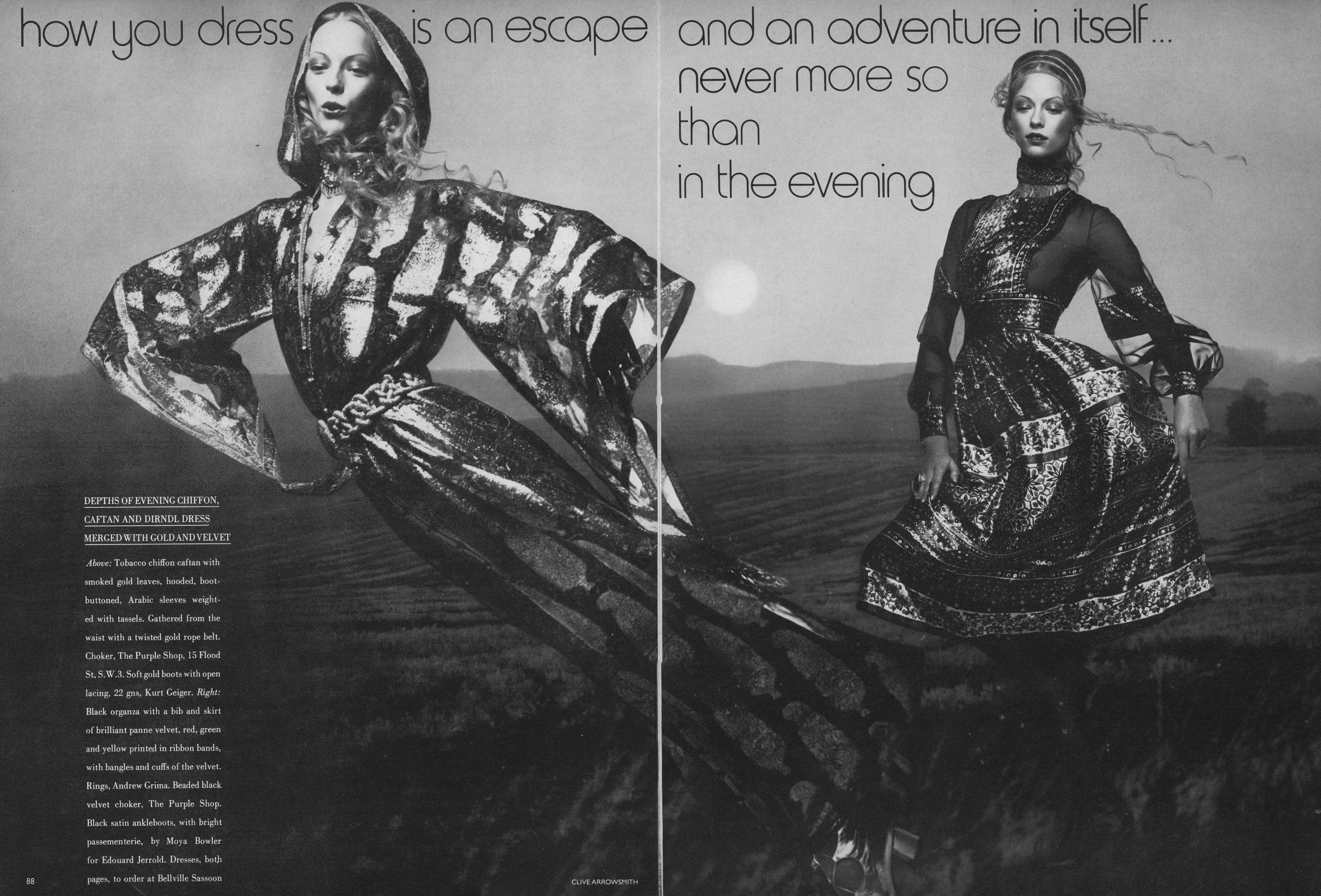
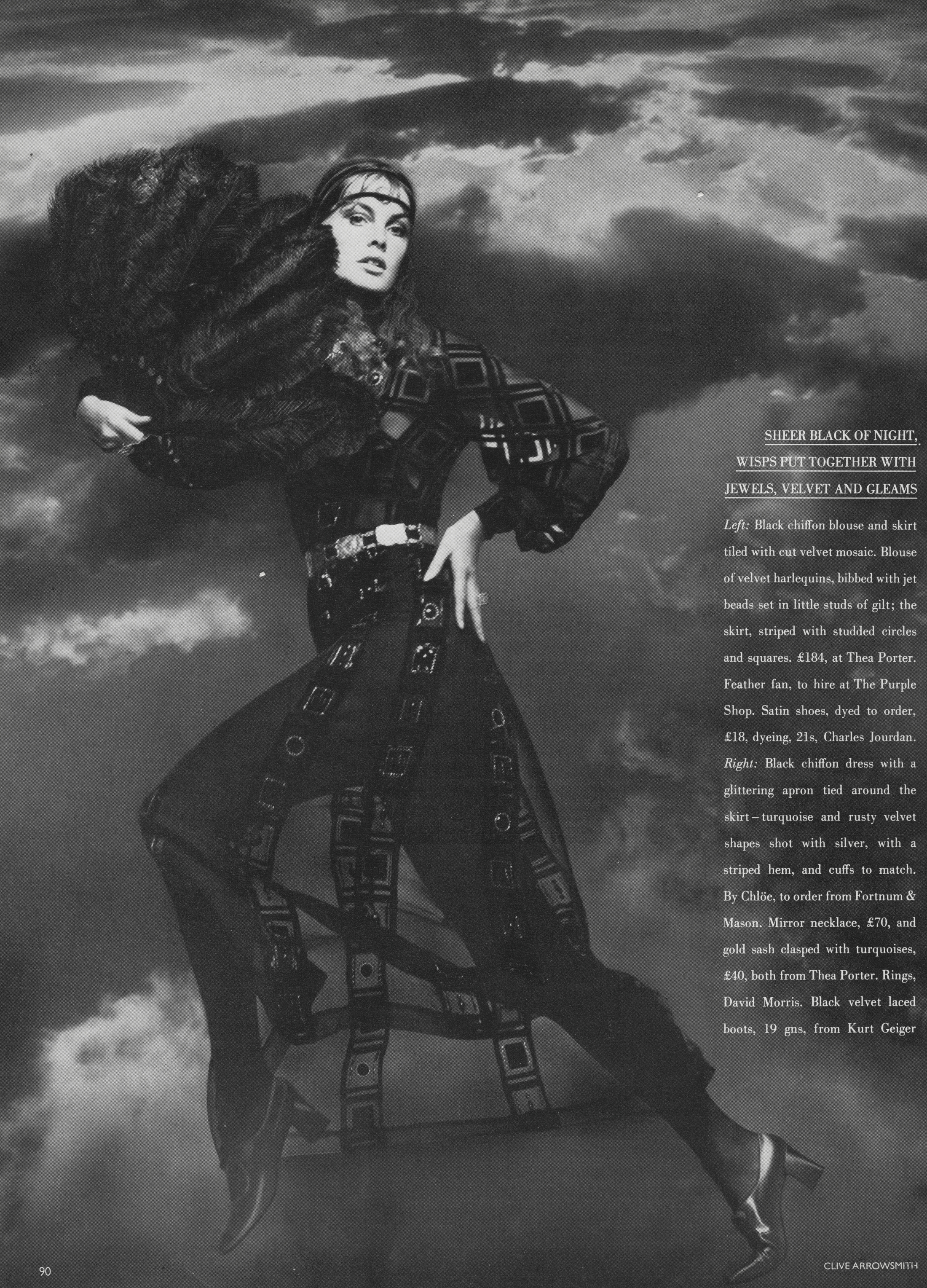
DEPTHS OF EVENING CHIFFON, CAFTAN AND DIRNDL DRESS MERGED WITH GOLD AND VELVET Above: Tobacco chiffon caftan with smoked gold leaves, hooded, boot-buttoned, Arabic sleeves weighted with tassels. Gathered from the waist with a twisted gold rope belt. Choker, The Purple Shop, 15 Flood St, S.W.3. Soft gold boots with open lacing, 22 gns, Kurt Geiger. Right: Black organza with a bib and skirt of brilliant panne velvet, red, green and yellow printed in ribbon bands, with bangles and cuffs of the velvet. Rings, Andrew Grima. Beaded black velvet choker, The Purple Shop. Black satin ankleboots, with bright passementerie, by Moya Bowler for Edouard Jerrold. Dresses, both pages, to order at Bellville Sassoon.
How you dress is an escape and an adventure in itself… never more so than the evening.
Hair by Leonard
Models are Anne Schaufuss and Jean Shrimpton.
Photographed by Clive Arrowsmith.
Scanned from Vogue, December 1970.
SHEER BLACK OF NIGHT, WISPS PUT TOGETHER WITH JEWELS, VELVET AND GLEAMS Black chiffon blouse and skirt tiled with cut velvet mosaic. Blouse of velvet harlequins, bibbed with jet beads set in little studs of gilt; the skirt, striped with studded circles and squares. £184, at Thea Porter. Feather fan, to hire at The Purple Shop. Satin shoes, dyed to order, £18, dyeing, 21s, Charles Jourdan.
Black chiffon dress with a glittering apron tied around the skirt — turquoise and rusty velvet shapes shot with silver, with a striped hem, and cuffs to match. By Chloe, to order from Fortnum & Mason. Mirror necklace, £70, and gold sash clasped with turquoises, 140, both from Thea Porter. Rings, David Morris. Black velvet laced boots, 19 gns, from Kurt Geiger
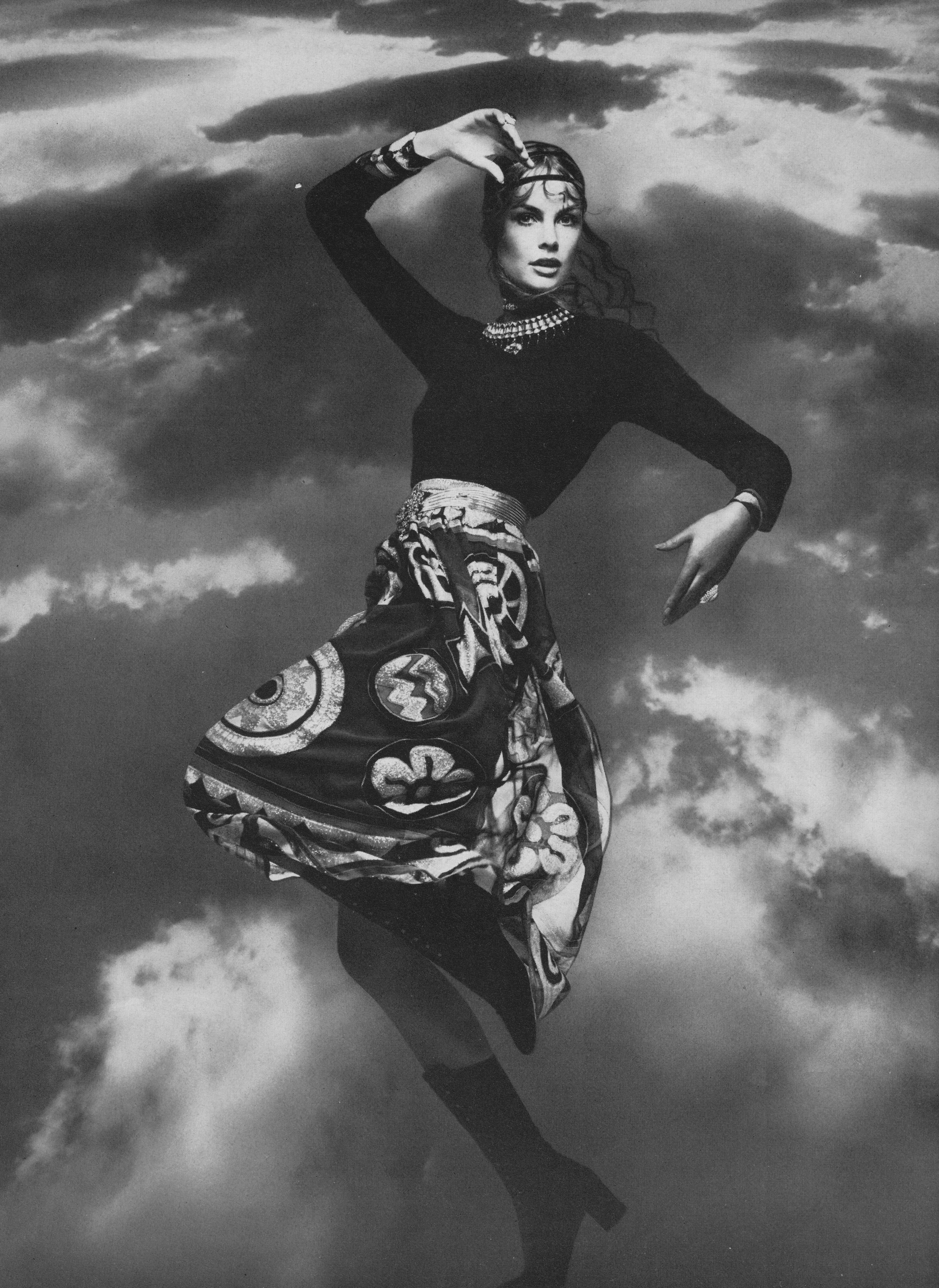
KNICKERBOCKER BALLET ALL SURFACES RIPPLED WITH COLOUR AND SHINE Grass green silk satin glossed with an intricate paisley of red, ink, black, tremendous sleeves and tunic gathered from a yoke over ballooning knee pantaloons. 85 gns; choker 25 gns, and belt, 58 gns, all at Savita. Green moire boots, 18 gns, at The Chelsea Cobbler.
Water markings, waves of colour pooled in a chiffon blouse honeycombed at the shoulders, antique tunic and panne velvet knickers. The tunic has a fitted bodice, full sweeping skirt. Blouse, £59, tunic, £75, knickers £24, heavy silver belt, £100, all Thea Porter. Burgundy velvet boots laced to knee, 19 gns, Kurt Geiger. Rings, Blooms. Chokers, The Purple Shop, 15 Flood St, S.W.3. Make up by Lancome, with Climat scent.
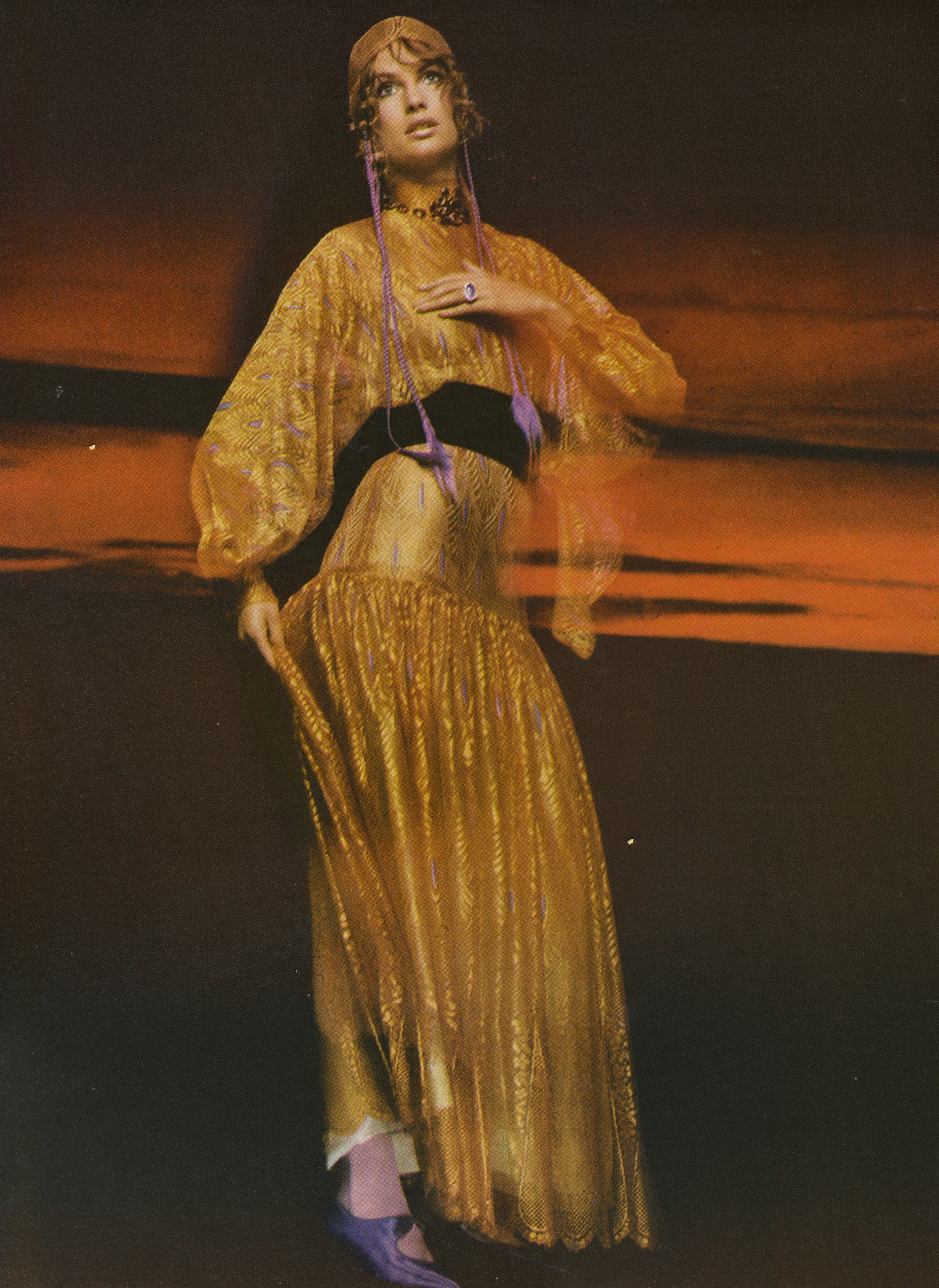
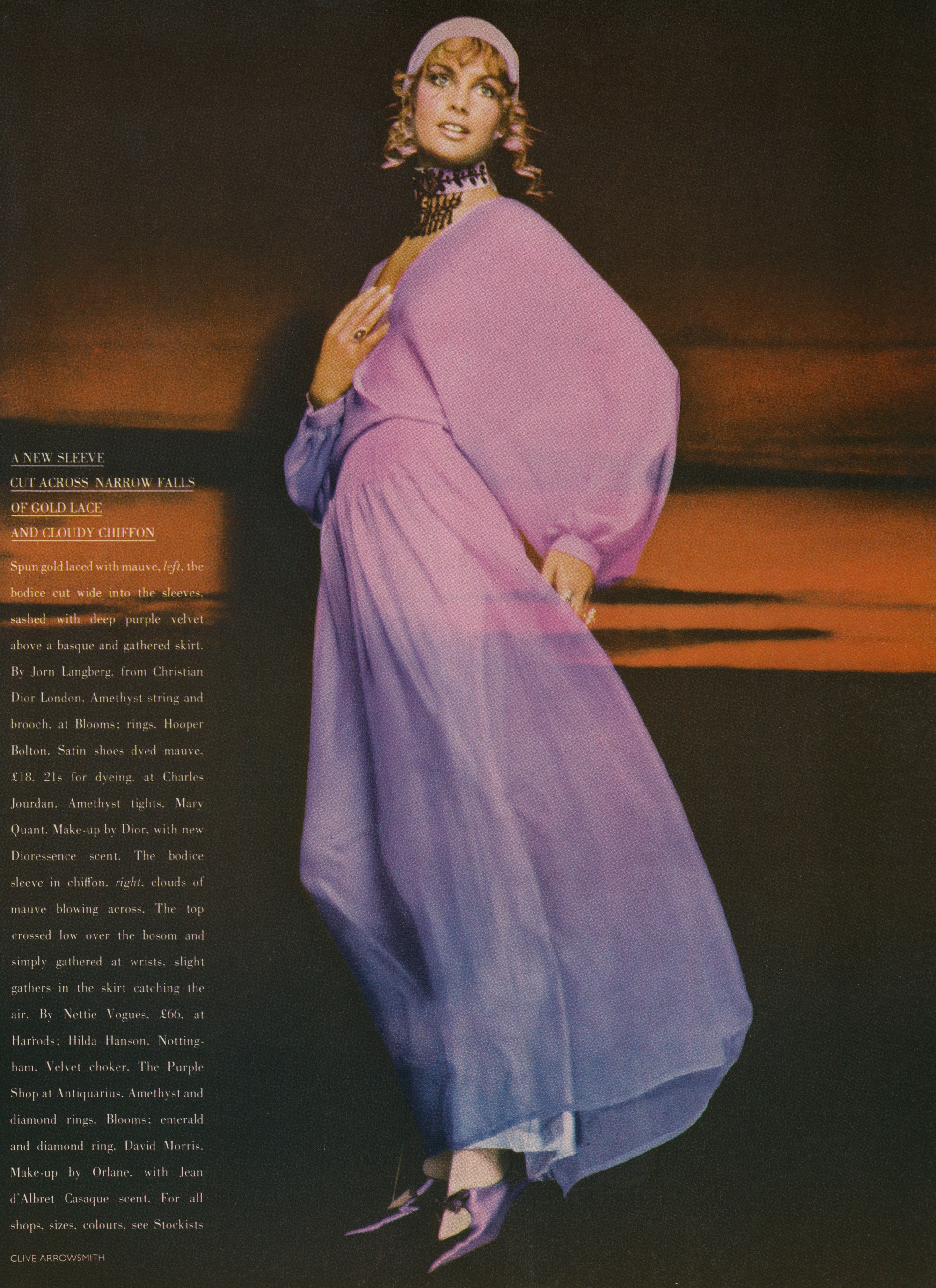
A NEW SLEEVE CUT ACROSS NARROW FALLS OF GOLD LACE AND CLOUDY CHIFFON Spun gold laced with mauve, the bodice cut wide into the sleeves. sashed with deep purple velvet above a basque and a gathered skirt. By Jorn Langberg from Christian Dior London. Amethyst string and brooch, at Blooms: rings. Hooper Bolton. Satin shoes dyed mauve. £18. 21s for dyeing at Charles Jourdan. Amethyst tights. Mary Quant. Make-up by Dior. with new Dioressence scent.
The bodice sleeve in chiffon, clouds of mauve blowing across. The top crossed low over the bosom and simply gathered at wrists. slight gathers in the skirt catchir the air. By Nettie Vogues, at Harrods: Hilda Hanson. Nottingham. Velvet choker. The Purple Shop at Antiquarius. Amethyst and diamond rings. Blooms; emerald and diamond ring. David Morris. Make-up by Orlane, with Jean d’Albret Casaque scent.
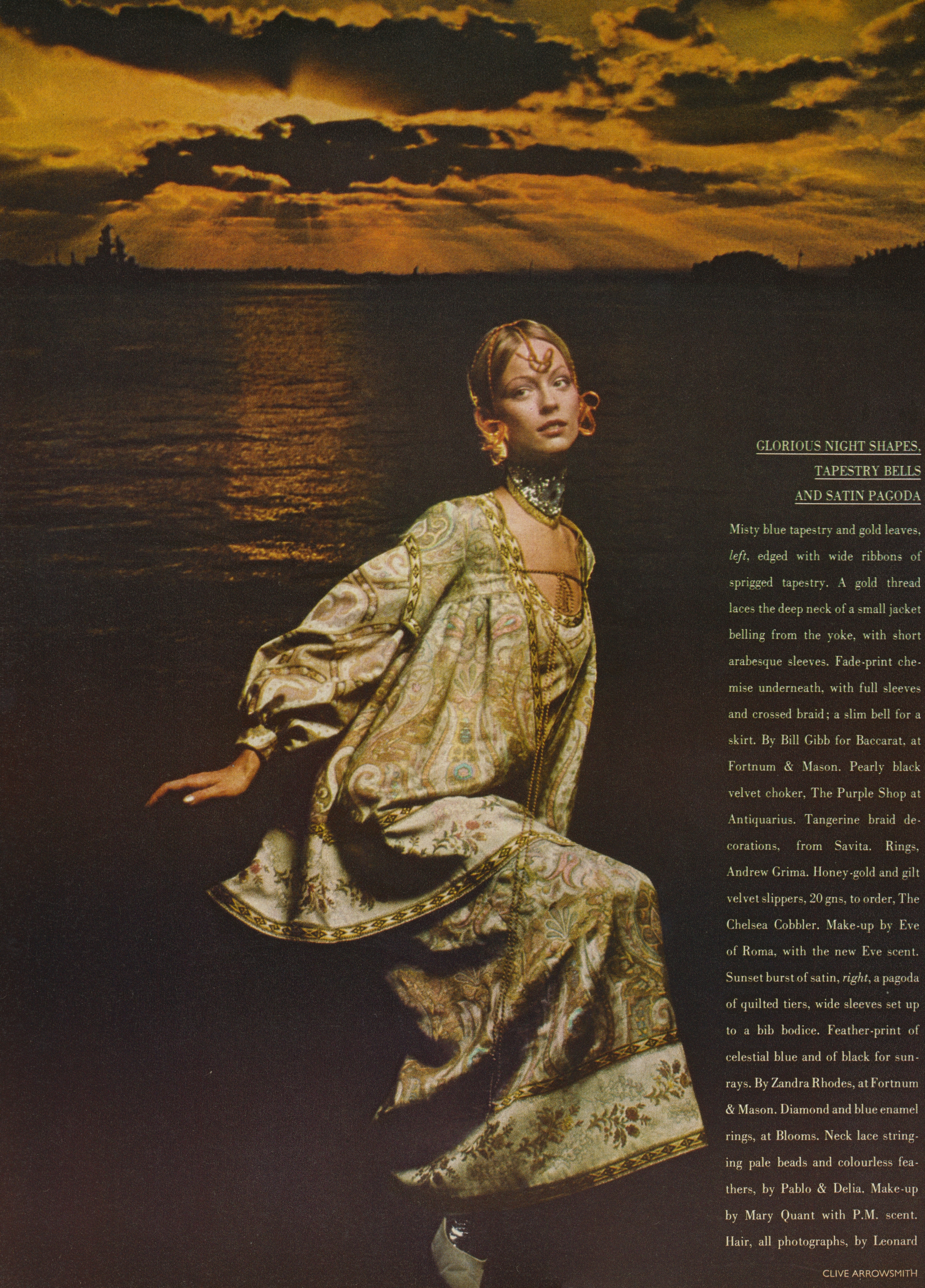
GLORIOUS NIGHT SHAPES. TAPESTRY BELLS AND SATIN PAGODA Misty blue tapestry and gold leaves. left. edged with wide ribbons of sprigged tapestry. A gold thread laces the deep neck of a small jacket belling from the Yoke, with short arabesque sleeves. Fade-print chemise underneath, with full sleeves and crossed braid ; a slim bell for a skirt. By Bill Gibb for Baccarat, at Fortnum & Mason. Pearly black velvet choker, The Purple Shop at Antiquarius. Tangerine braid decorations, from Savita. Rings, Andrew Grima. Honey-gold and gilt velvet slippers, 20 gns, to order, The Chelsea Cobbler. Make-up by Eve of Roma, with the new Eve scent.
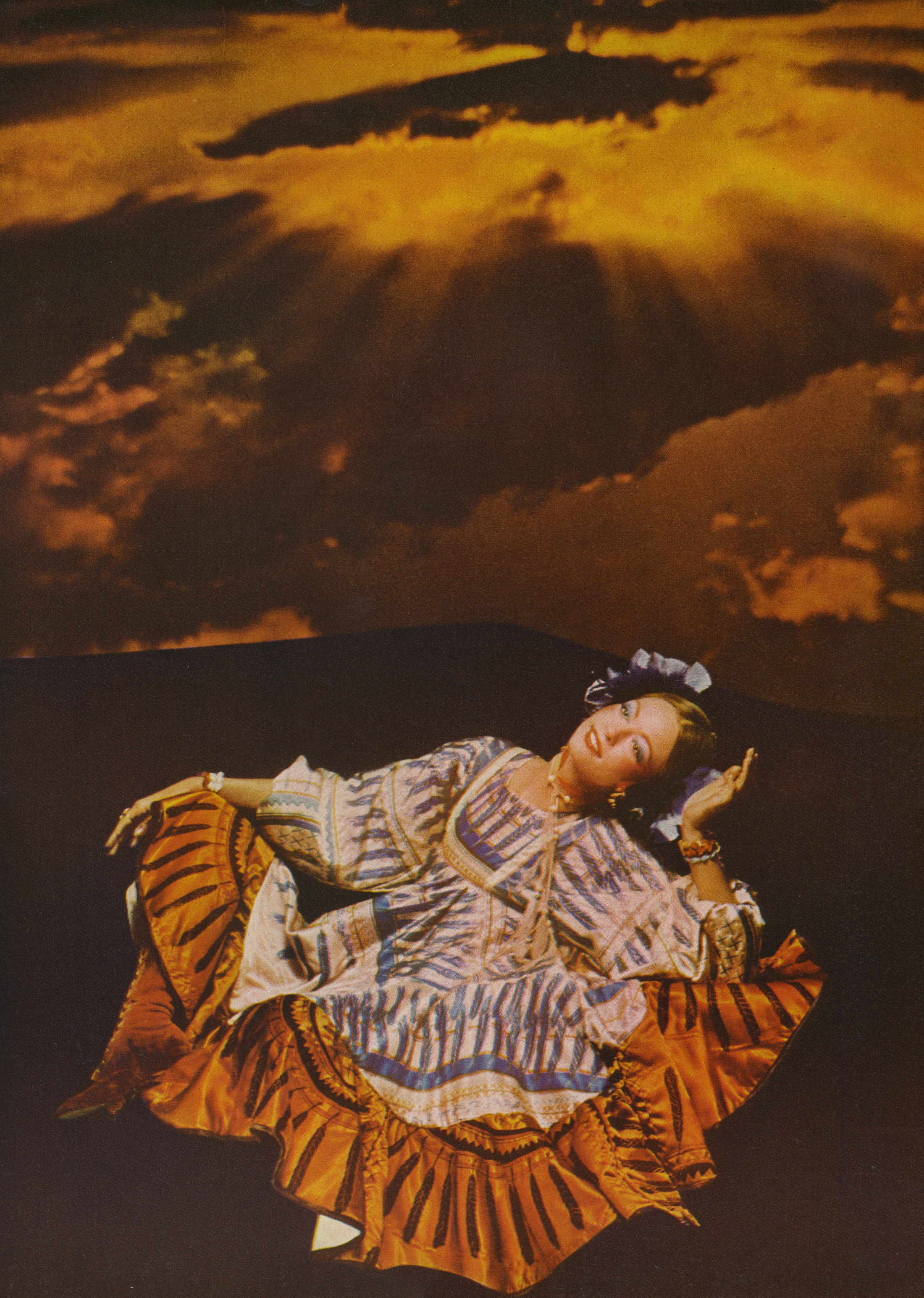
Sunset burst of satin, right, a pagoda of quilted tiers, wide sleeves set up to a bib bodice. Feather-print of celestial blue and of black for sun-rays. By Zandra Rhodes, at Fortnum & Mason. Diamond and blue enamel rings, at Blooms. Neck lace stringing pale beads and colourless feathers, by Pablo & Delia. Make-up by Mary Quant with P.M. scent.
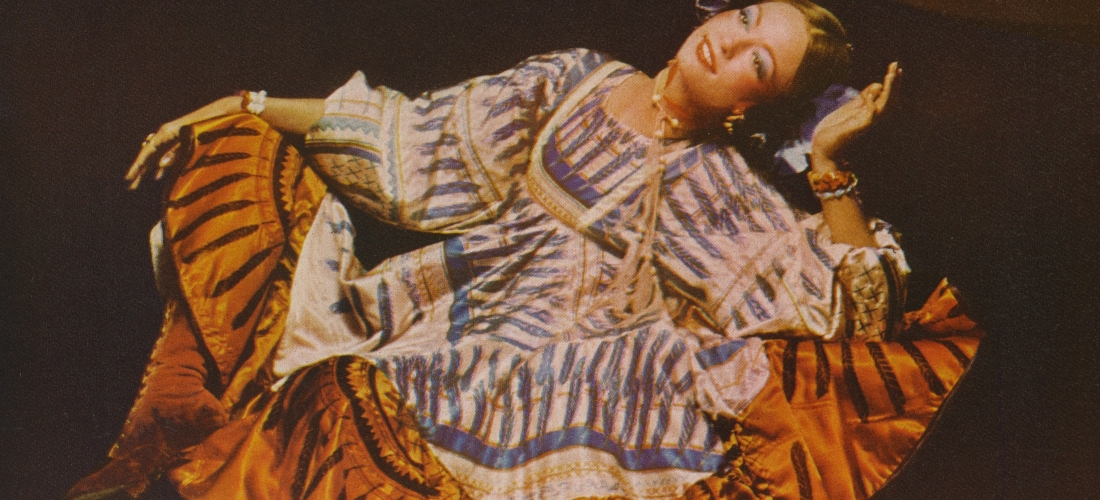
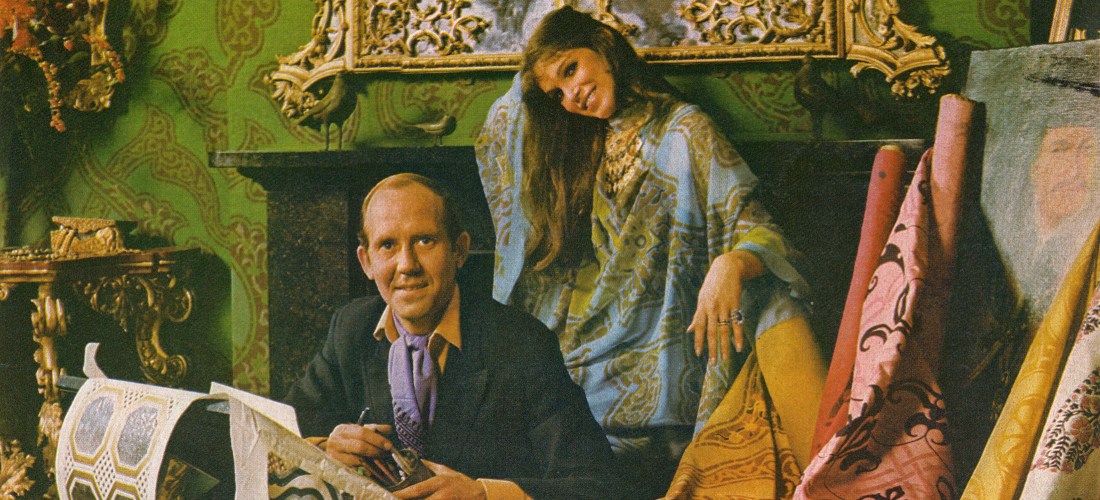
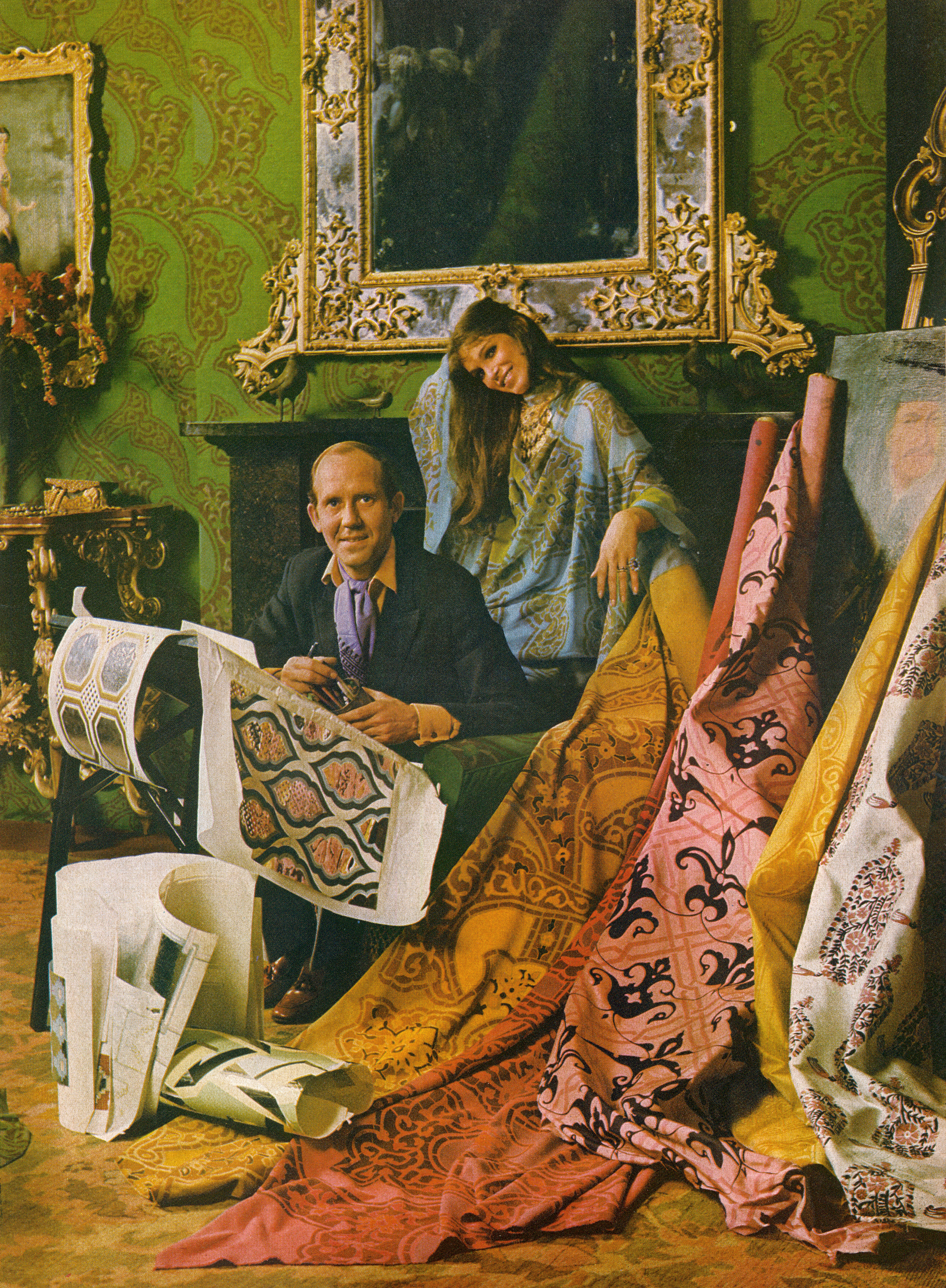
Michael Szell in the bedroom of his London flat. The rolls of fabric, his new collection of Persian prints for Thea Porter. The dress, simply one length from the range worn like a caftan.
Michael Szell is the Hungarian fabric designer who is introducing Iran to London via a new collection of designs, taken up by Thea Porter for her romantic and ravishing evening dresses. His own bedroom, opposite, is in rich emerald, turquoise and brown arabesqued linen, cool and grand by day but rich and warm by electric light, with 18th-century Eng-lish paintings and mirrors. His drawing-room, below, is turquoise with brilliant Persian prayer mats colouring the walls, 18th-century English botanical china, and a mixed forest of hyacinth and growing orchids, later bluebells and orchids. Iran runs through Michael Szell’s life like a thread. He began to visit friends and connections there while he was still a child, used every possible holiday to get there while he studied economics at Aberystwyth University, and later when he worked with Sir Nicholas Sekers. His love for Persian ceramics, buildings and woven carpets developed into a passion for early Islamic art in its formal, random, asymmetric period before it came to represent life in the 19th-century : a passion culminating in his opening his own furnishing fabric showrooms at 47 Sloane Avenue. He began selling silk signature scarves to Henri Bendel of New York in 1969 and has just produced his new Persian collection of fabrics. Thea Porter asked him to print his designs onto silk chiffon for her and made them in flowing evening dresses with yards of floating sleeve and skirt.
For the coronation of the Shahanshah and the Empress of Iran, Michael Szell designed curtains, chair-fabrics and an entire state banquet for the Golestan Palace. He has been asked again to help with the decorations for the great October celebrations—the twenty-fifth centenary of the founding of the Persian Empire. He will contribute designs for the interiors of houses and for some of the 500 tents that are planned, with their own marble bathrooms, for the royal and distinguished guests who will take part in the celebrations at Persepolis, the ruined city and ancient capital.
Mr Szell has also been asked to provide the fabrics for all the palace sets in the new Universal film Mary, Queen of Scots, starring Vanessa Redgrave as Mary and Glenda Jackson as Elizabeth. He has an unrealised ambition to produce an absolutely modern collection of very cheap fabrics “from chair covers to plastic shower curtains”.
Model is Ann Turkel.
Photographed by Henry Clarke.
Scanned from Vogue, July 1971.
Midnight blue Persian curlicues on azure silk chiffon. Sleeves dipping to the ground and gathered at the wrists, the bodice fitted, skirt soft and gathered. £78, at Thea Porter, 8 Greek St. Persian necklaces, both pages, from Michael Szell’s own collection.
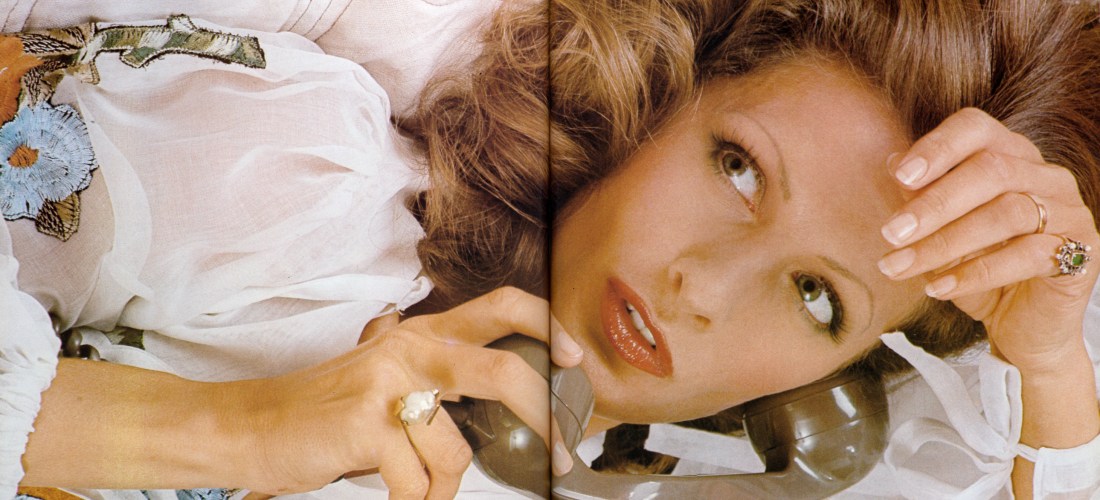
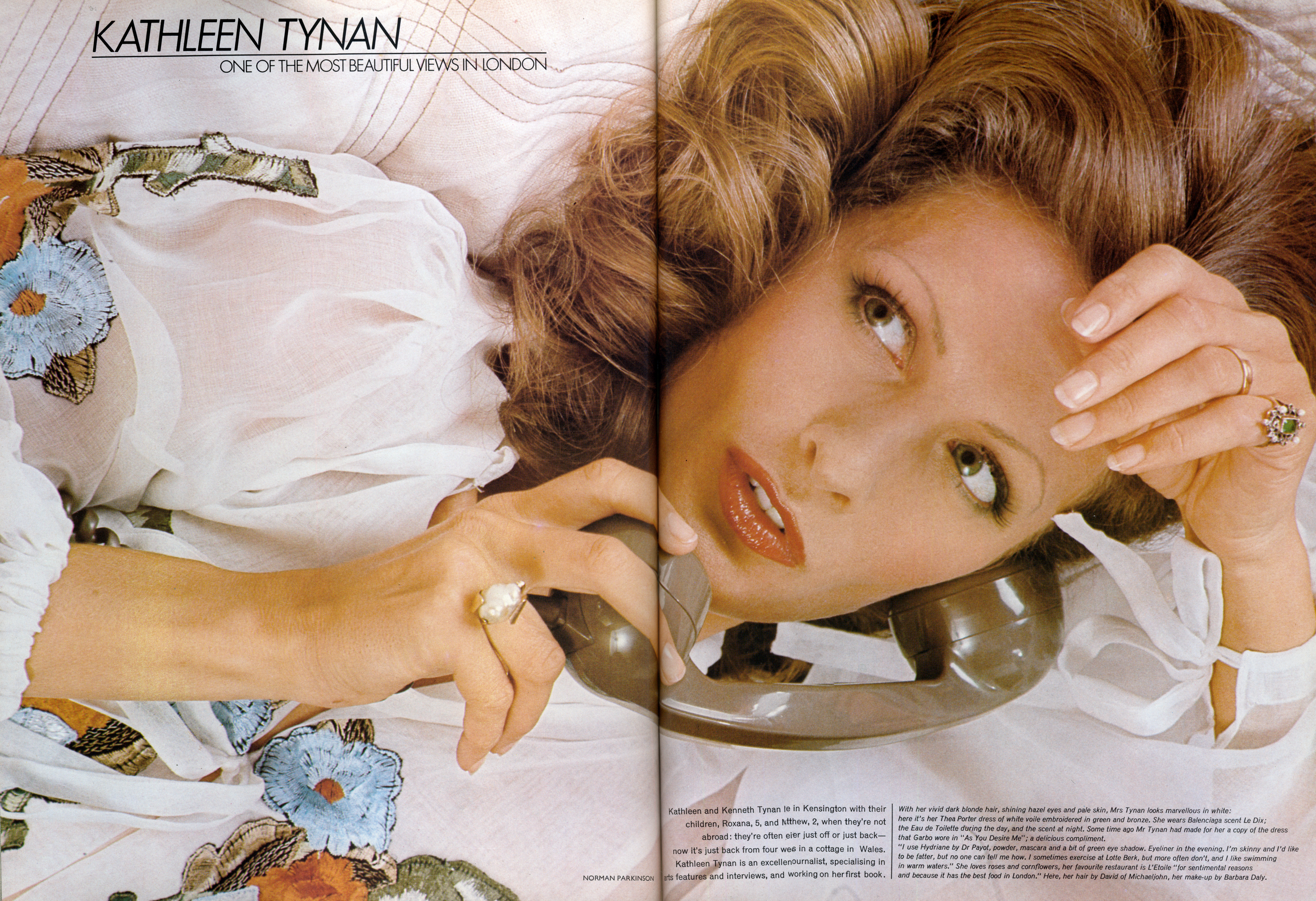
With her vivid dark blonde hair, shining hazel eyes and pale skin, Mrs Tynan looks marvellous in white: here it’s her Thea Porter dress of white voile embroiderpd in green and bronze. She wears Balenciaga scent Le Dix; the Eau de Toilette during the day, and the scent at night. Some time ago Mr Tynan had made for her a copy of the dress that Garbo wore in As You Desire Me”; a delicious compliment. “I use Hydriane by Dr Payot, powder, mascara and a bit of green eye shadow. Eyeliner in the evening. I’m skinny and I’d like to be fatter, but no one can tell me how. I sometimes exercise at Lotte Berk, but more often don’t, and I like swimming in warm waters.” She loves roses and cornflowers, her favourite restaurant is L’Etoile “for sentimental reasons and because it has the best food in London.” Here, her hair by David of Michaeljohn, her make-up by Barbara Daly.
Kathleen and Kenneth Tynan live in Kensington with their children, Roxana, 5, and Matthew, 2, when they’re not abroad: they’re often either just off or just back – now it’s just back from four weeks in a cottage in Wales. Kathleen Tynan is an excellent journalist, specialising in arts features and interviews, and is working on her first book.
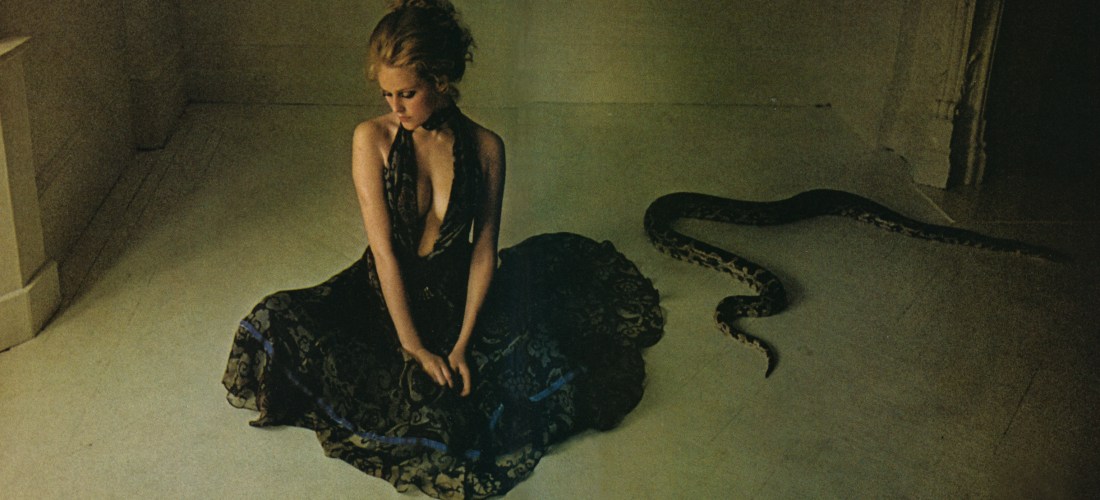
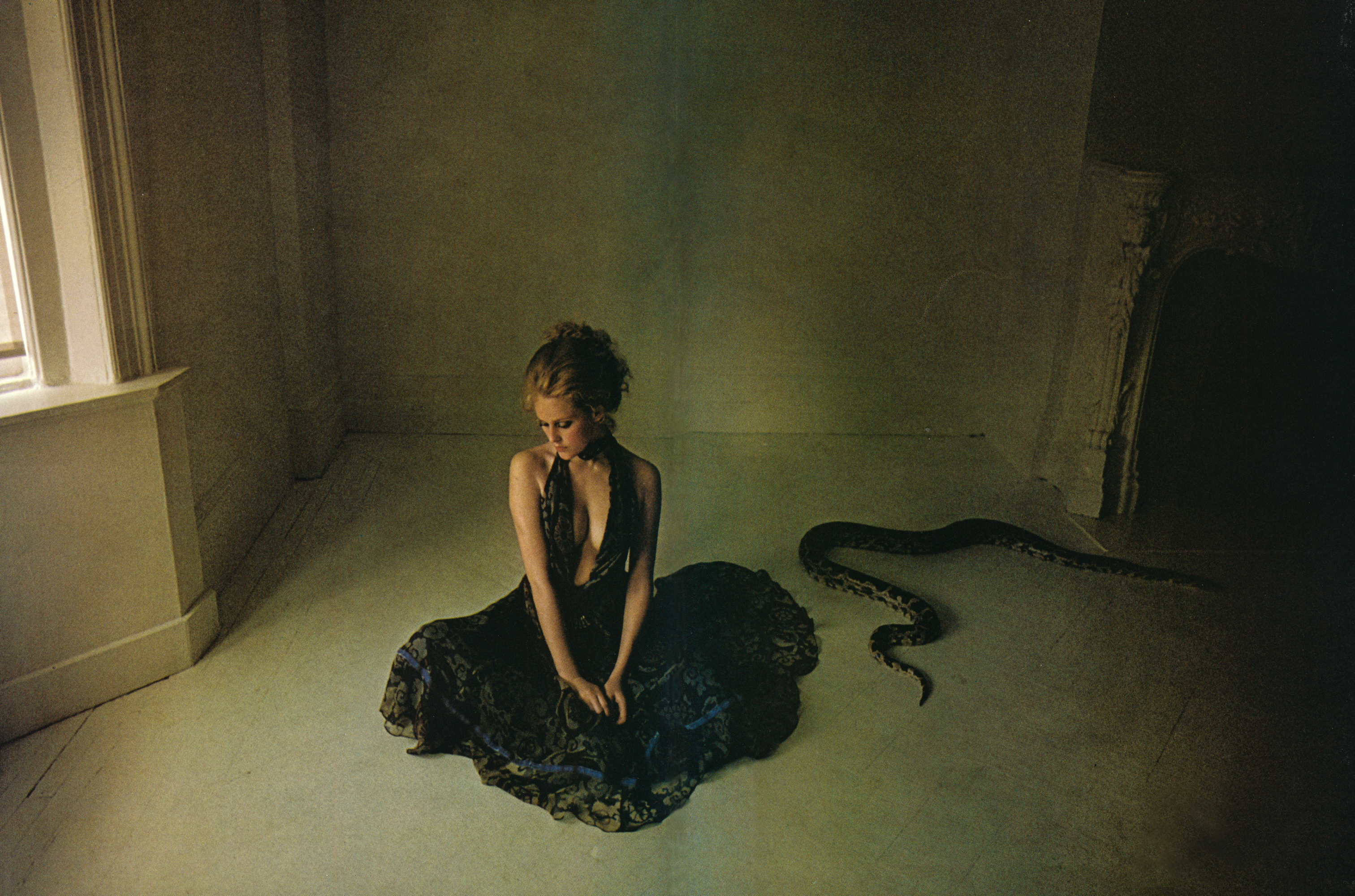
“You love your boyfriend and he’s left you. You’re alone in a big city and an empty apartment.” Kane had not yet picked up his camera, but Margrit Ramme was working on the sadness. She was also scared of the snake. The editors of Queen magazine had asked for an entire issue to be called “Art Kane’s New York,” including fashions, and he had said all right—but don’t expect to see laughing girls running down Fifth Avenue. He had just divorced his second wife, had not yet met Jean Pagliuso or photographed Larry Rivers, and felt fairly bitter.
If you want to call it Art Kane’s New York, he told Queen, you’ll have to accept pictures showing that the place right now is kind of empty for me. Righto, they said.
He left the studio and rummaged around for real-life locations. He had found the apartment on Gramercy Park, and decided to shoot the fashions there before the furniture came in. Truth is, he wasn’t motivated entirely by a desire to display his mood. Not only does training as an art director make him look for a theme when he has space for an essay, as against a bunch of random shots that just present the merchandise; Art Kane loves almost more than anything else to tell a story.
He also loves snakes. The first boy scout in the Bronx to get a Reptile Study merit badge, he kept 32 of them at home despite a mother who tried to make him flush the first one down the toilet.
This story would reflect the dilemma of a lovely woman—always beautifully dressed, of course—searching for a man, for identity, for something. A snake would be not only an obvious male symbol but also a reminder of a Garden of Eden to start it off. Since Kane had given, his collection to the Bronx Zoo when he was drafted, he called All-Tame Animals, a pro-vider of non-human performers in New York. They referred him to a snake owner in one of the city’s residential hotels, asking that he be discreet; she would be evicted if the manage-ment discovered that she kept a boa constrictor and a python in her room. So Kane was Uncle Joe when he called to ask about Cousin Bea: “She must be a really big girl by now. Oh, six feet six, that sounds good.” And Patricia? “Over eight feet tall? My goodness.” He went over to see them. Their owner showed him the boa in her bathtub and pulled the python out of a closet. “Terrific,” he said. “Bring them up to my place at 10 o’clock tomorrow.”
When she arrived with the snakes in a laundry bag, Kane was moving white window shades up and down, studying the way they filtered the natural light he would use all day. Morning light came softly through the west-facing windows of the living room. He arranged the python, then stood back to peer through a Nikon. Moving forward, back, left, right, he kept the model close to the center of the frame. He was using a 24mm lens, not only for depth of field that would keep the picture sharp from front to back but also to make objects near the edges seem to lean away, focusing attention on the center.
“Okay, Margrit, you’re unhappy, unaware, the two of you can never really come together. . . .” Bracketing—one shot at a normal exposure, one above, one below—he redesigned the picture as he moved. “That’s it, keep it, keep it,” he told her when he liked what was happening. “Now, hold every pose for three clicks and then change … Beautiful. Now keep that until I say stop. I want to explore this until we’ve eaten it up.”
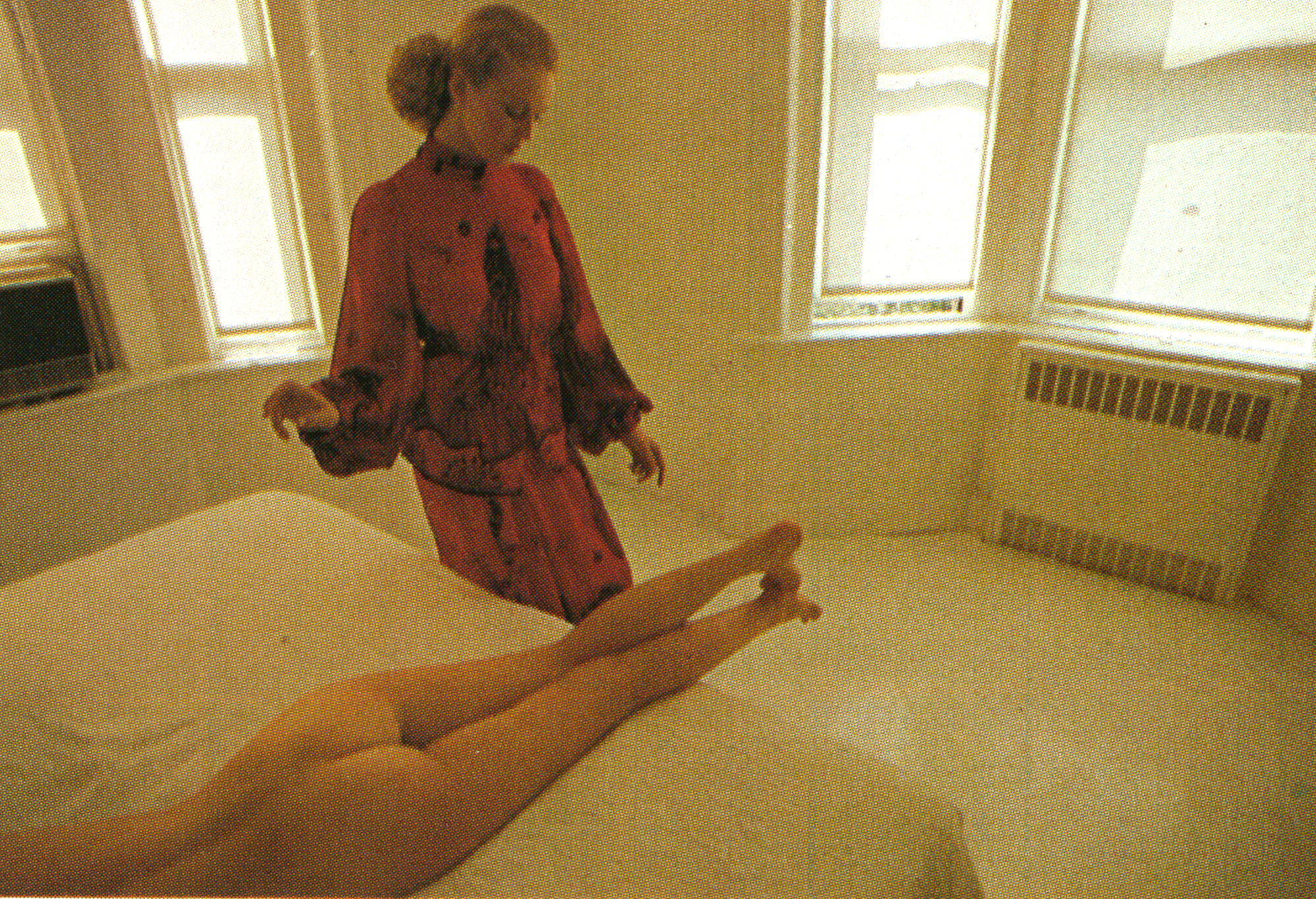
Ninety minutes later he had eaten up the male-female situation (above) and moved to the bedroom (below) to set up an identity problem. A second model had arrived. “You’re clothed and you’re naked,” Kane said, “you’re really the same woman, trying to figure out who you are.” This time he wanted to stretch the image more alarmingly toward the edges, so he put on the 21mm lens that he had used to shock the editors of Vogue on his first fashion assignment.
Images originally published in Queen magazine .
(date not given but looks circa 1969/70 to me, especially given Queen merged with Harpers Bazaar in 1970).
Clothes are uncredited here but both look like Thea Porter to me.
Photographed by Art Kane.
Scanned from Art Kane: The Persuasive Image, 1975.





 Liz Eggleston