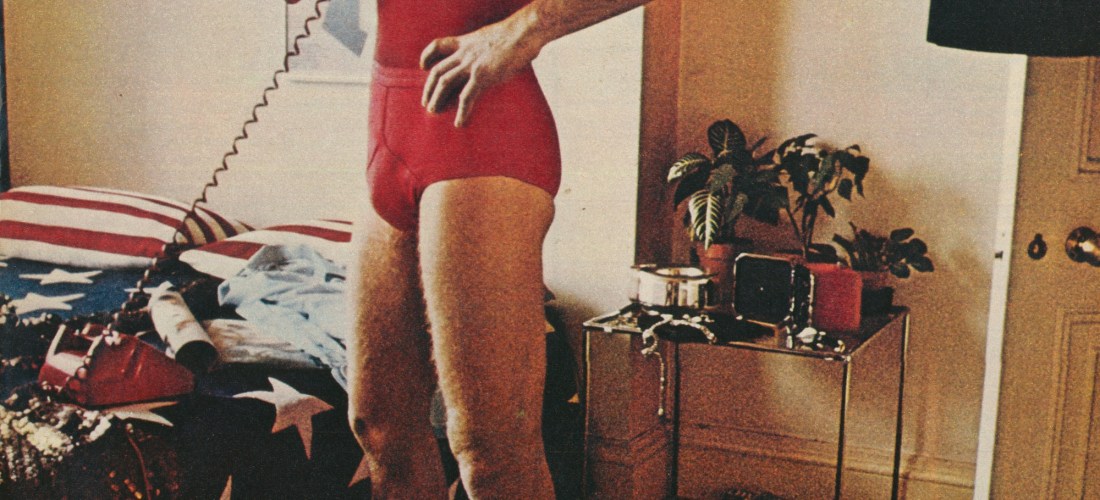
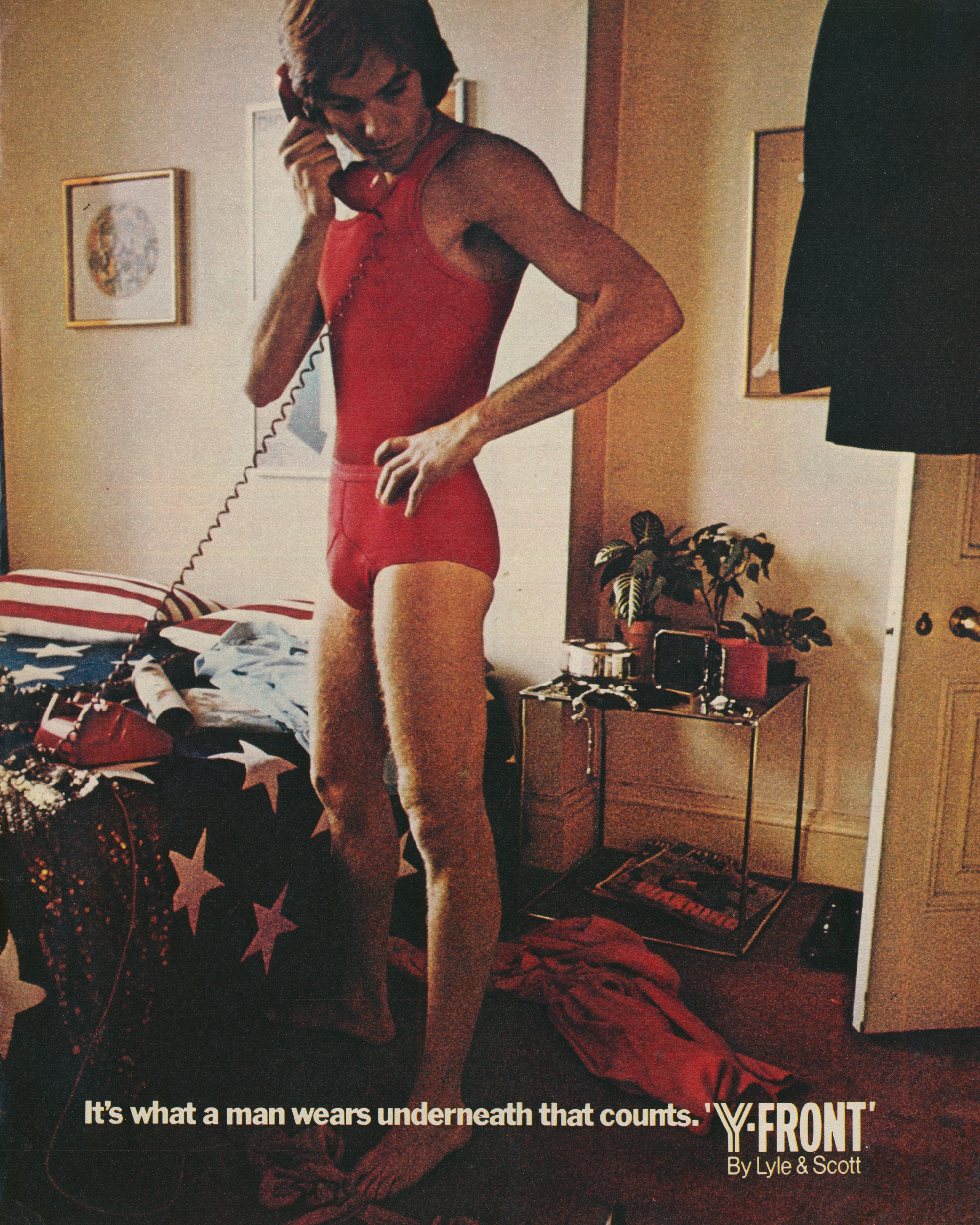
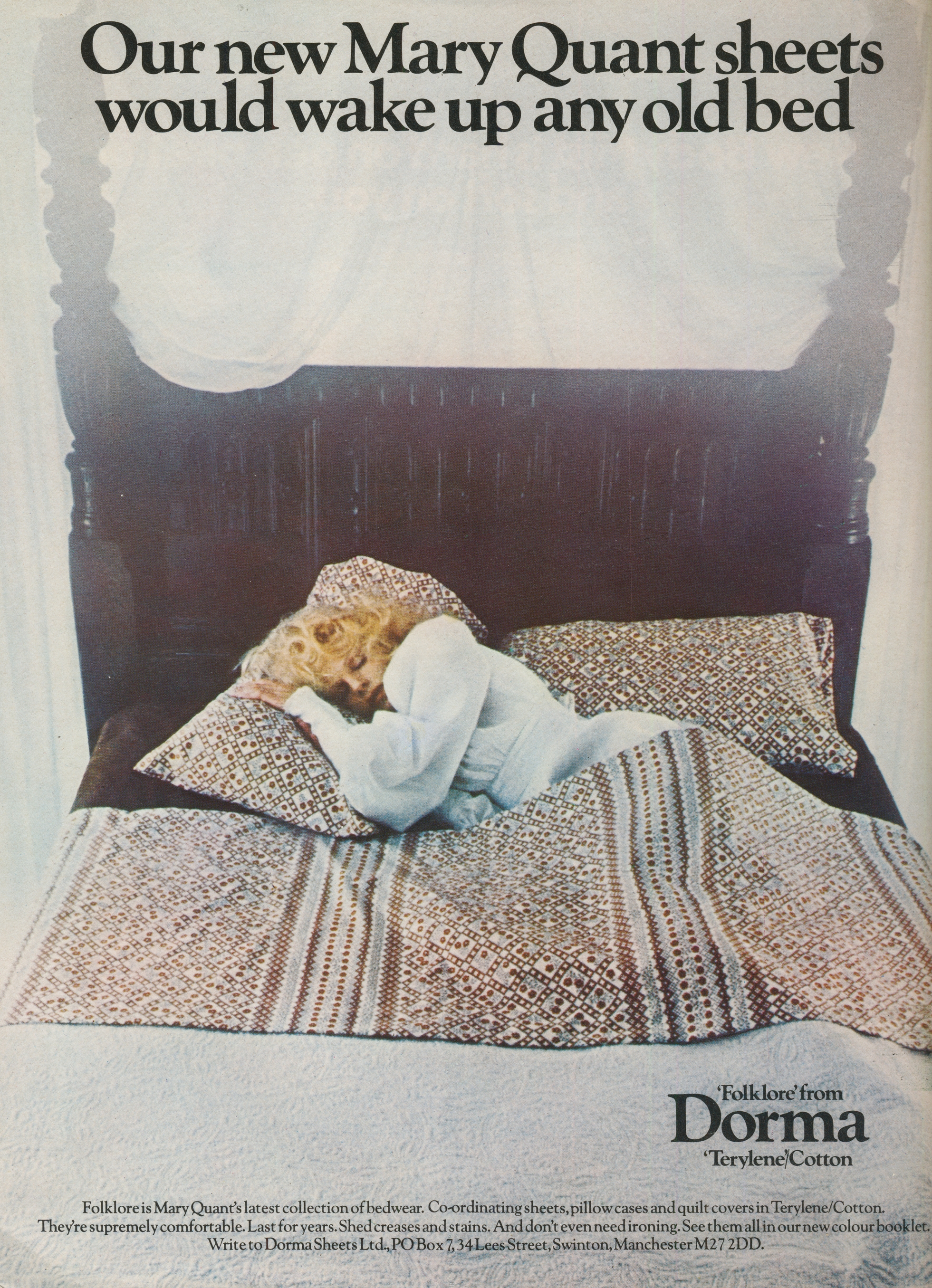
One in my now very, very sporadic ‘Mensday’ series. This one doubles up as an interiors post as well, with Mr Freedom-influenced stars and stripes bedding (it might take you a while to focus properly).
Scanned from The Telegraph Magazine, March 17th 1972.
They say you can’t miss what you’ve never had, but you can. And, you can be very misguided about it. Take the time when you’re on that twilight trudge home from work and you pause, for a fraction of a second, in front of a lighted window to envy a couple immersed in conversation. It’s a moment of exquisite, self-indulgent, single-girl melancholy. A very wise person once said: “Be careful of what you want in life. You may get it.” Living in tandem comes to most of us in the end — but spend the intervening time merely waiting for this state and you’ll miss out on a period of absolutely justifiable, selfish please-yourself that is the unique bonus for being single, when you can choose, unfettered by any taste other than your own. You can paint the bathroom puce or lettuce green and have only your own hangover to tell you you’ve boobed. You can work out your own furnishing priorities — like a good, thick carpet to sit/lie on and some decent sound equipment — and cut down your food consumption drastically for a few weeks, or months, to achieve them. You can use the time you might have spent cooking doing something sensational to jumble sale jetsam. You can be poor in style, because time and energy can make a pretty good substitute for money. None of the single women on these pages has money. What they do share is a strong, single-minded sense of their own individuality .. . It’s something they take for granted, but it shows in their lives and in their homes.
Wonderful to get an insight into the home of the slightly mysterious Rae Spencer Cullen, and what a home! Then again, magpie that I am, I would happily live in any of these beautiful pads.
Interviews by Penny Ragord.
Photographed by Tim Street-Porter.
Scanned from Over 21 Magazine, October 1976.
Rae Mouse
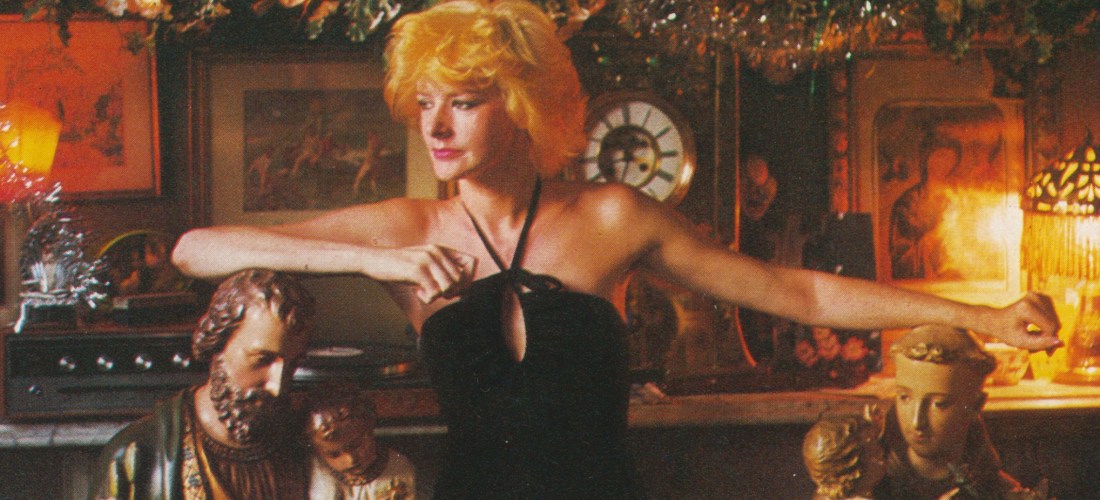
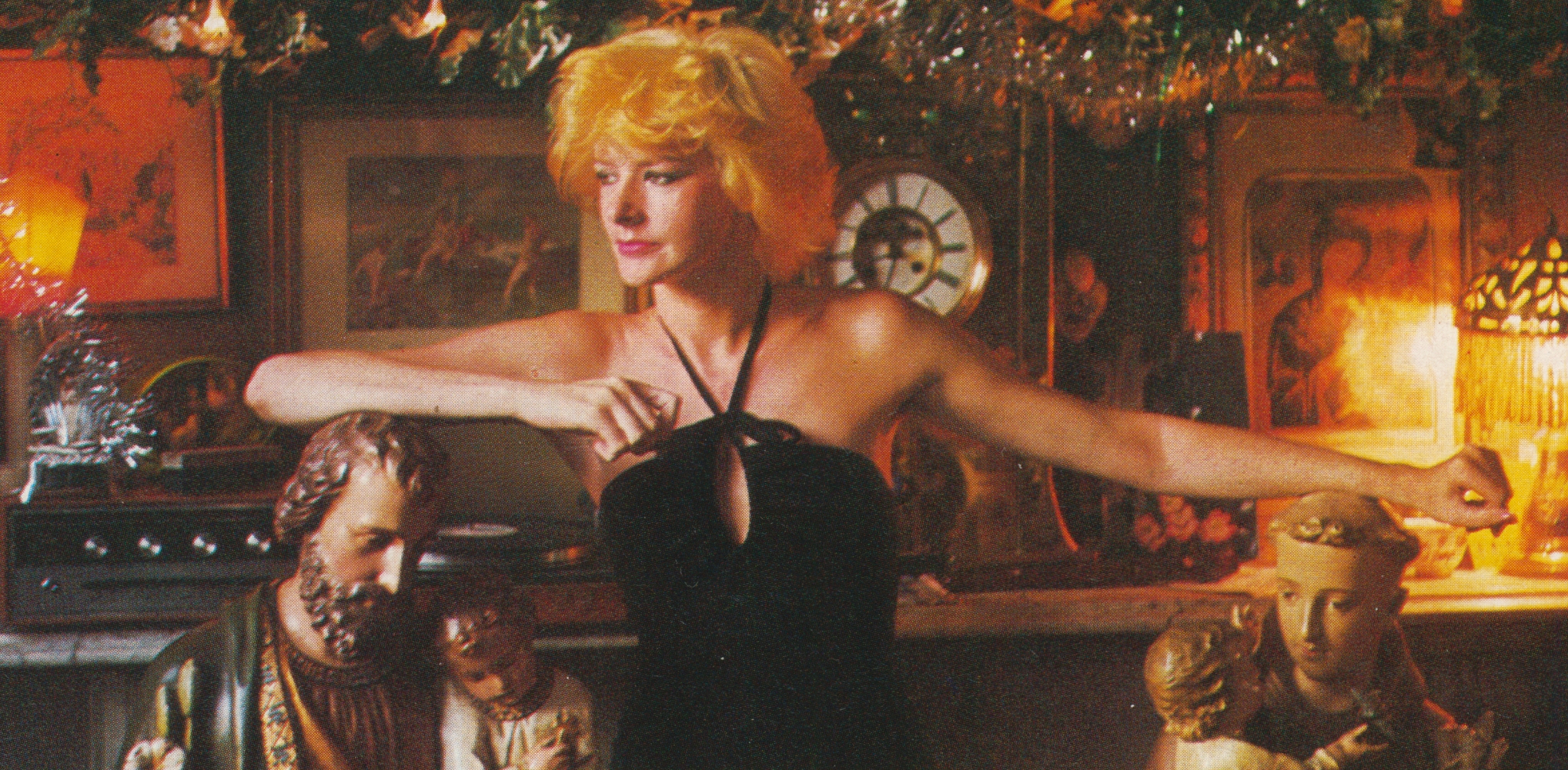
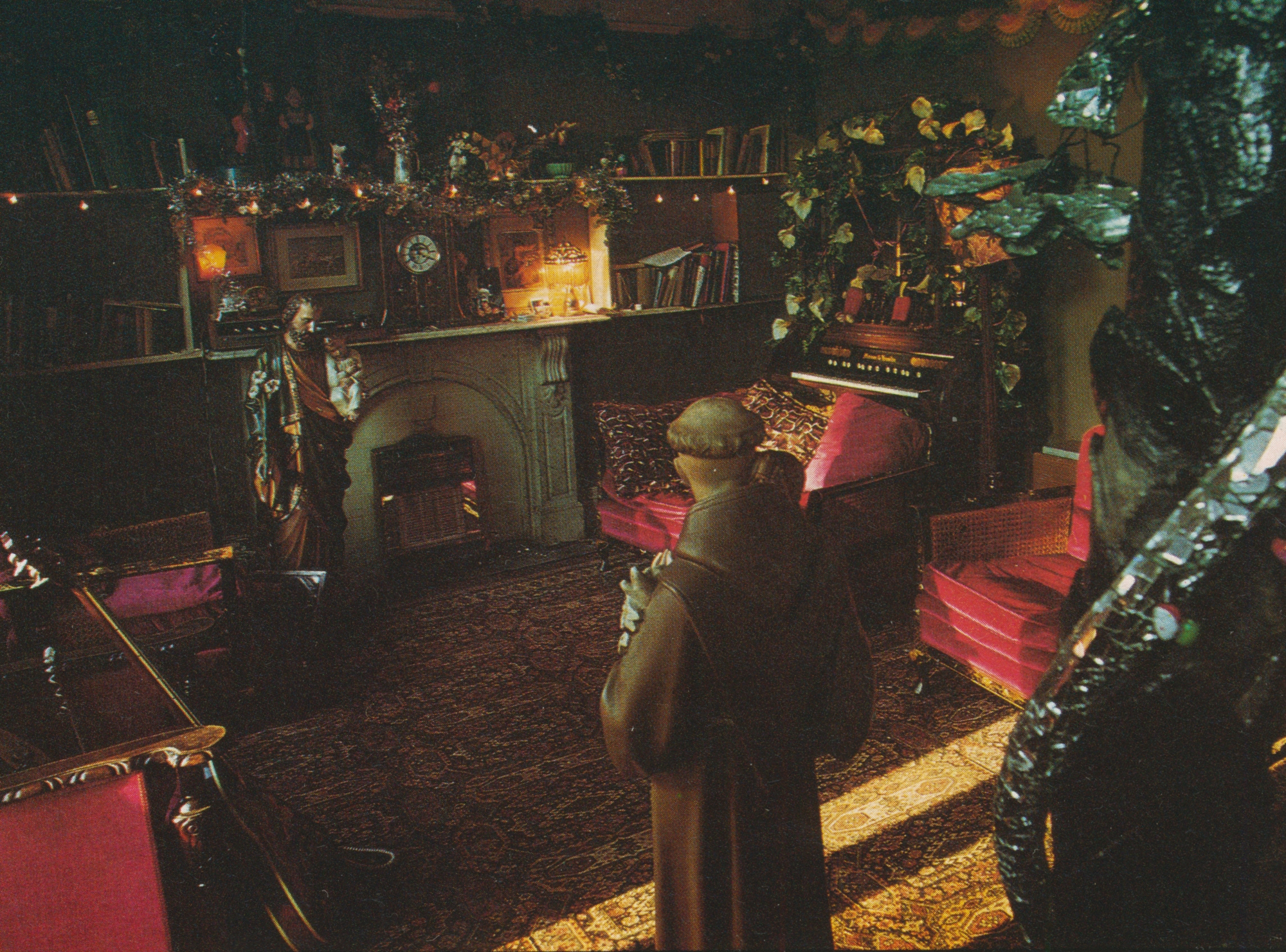
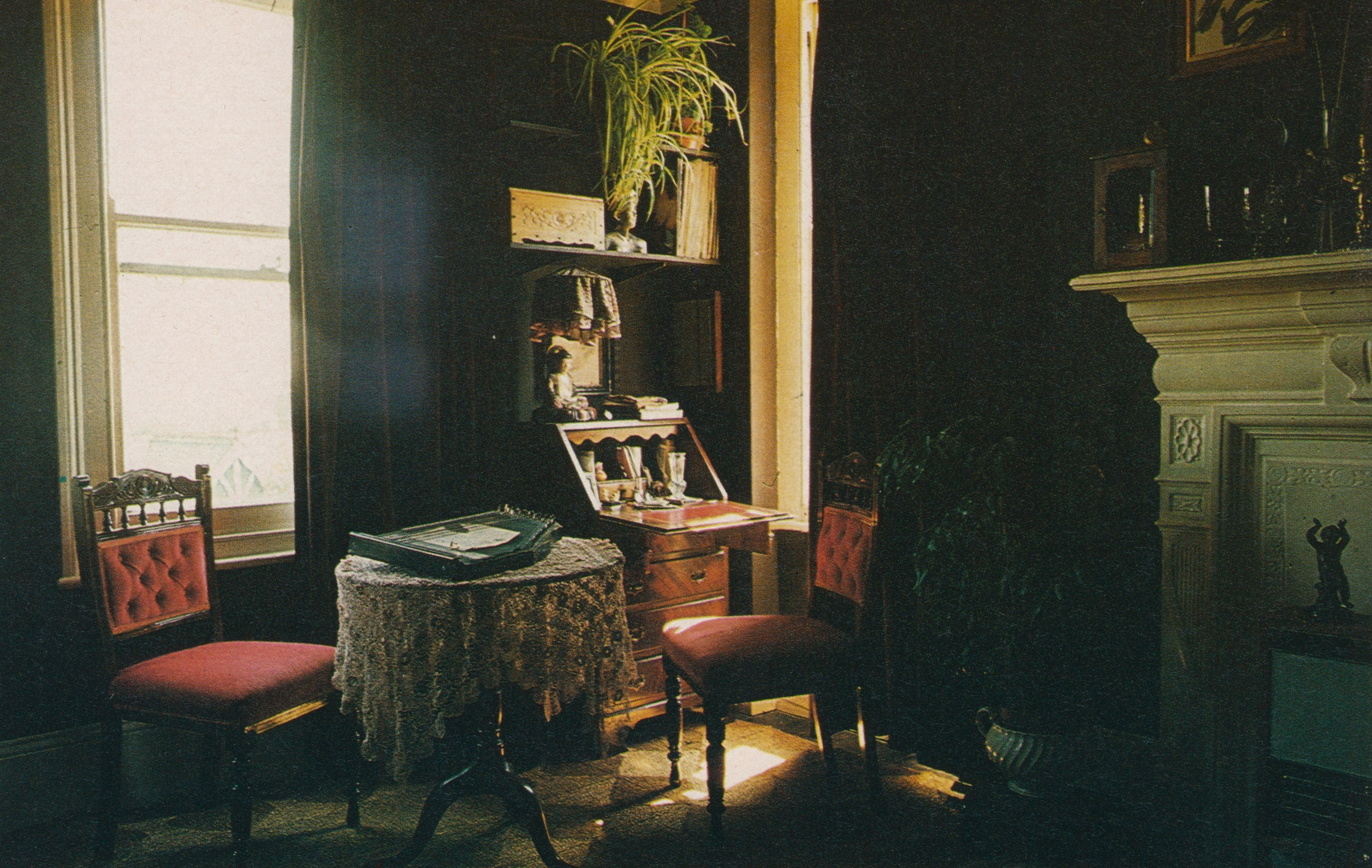
Rae Mouse should be prescribed in small doses to anyone with single-woman blues. Small doses because what she gives out is strong stuff, and it’s not sympathy. “People make far too much fuss about their own per-sonal aggravations,” she says. “And they expect someone else to come along and rescue them. But no man, woman or child can do that, and the sooner they realise this, the sooner they’ll be able to get on with life and stop letting their hang-ups get in the way of having a good time.” This would be hard to take from someone who’d had it easy. Rae hasn’t. She is ‘Miss Mouse’, a fashion designer who, with one colleague, started her own design/ manufacture business from one room in 1970. For four years they managed to keep going, making everything themselves in the early days, and the ‘Miss Mouse’ label became very well known. Then came the slump, the bank manager lost his nerve and the business folded. But Rae didn’t give up. She got herself, and her name, bought up by a big manufacturer and carried on, in a posi-tion of considerably greater security and with her design free-dom very little diminished. But it’s still hard work. When we met, she’d been up since five for the umpteenth morning, working against a deadline to get 60 prototype designs completed. She works from her own home in Putney, just south of the Thames, in an amazing room that is sombre, rich and fantastical. It’s furnished with plum velvet sofa and chairs, dominated by a vast black tulip sculpture by Andrew Logan and crammed with religious statuary and knick-knacks, including an old harmonium hung with macabre, artificial arum lilies. “It’s not that I’m particularly religious,” she explains, “they’re simply beautiful in themselves as objects.” Her taste is obviously and totally individual — “although I’m very influenced by my friends, especially the creative ones. But,” she adds, “I’ve never found that having pretty strong ideas about what one likes causes any conflict. In fact, people rather like it. They know just where they are.”
Luciana Martinez della Rosa
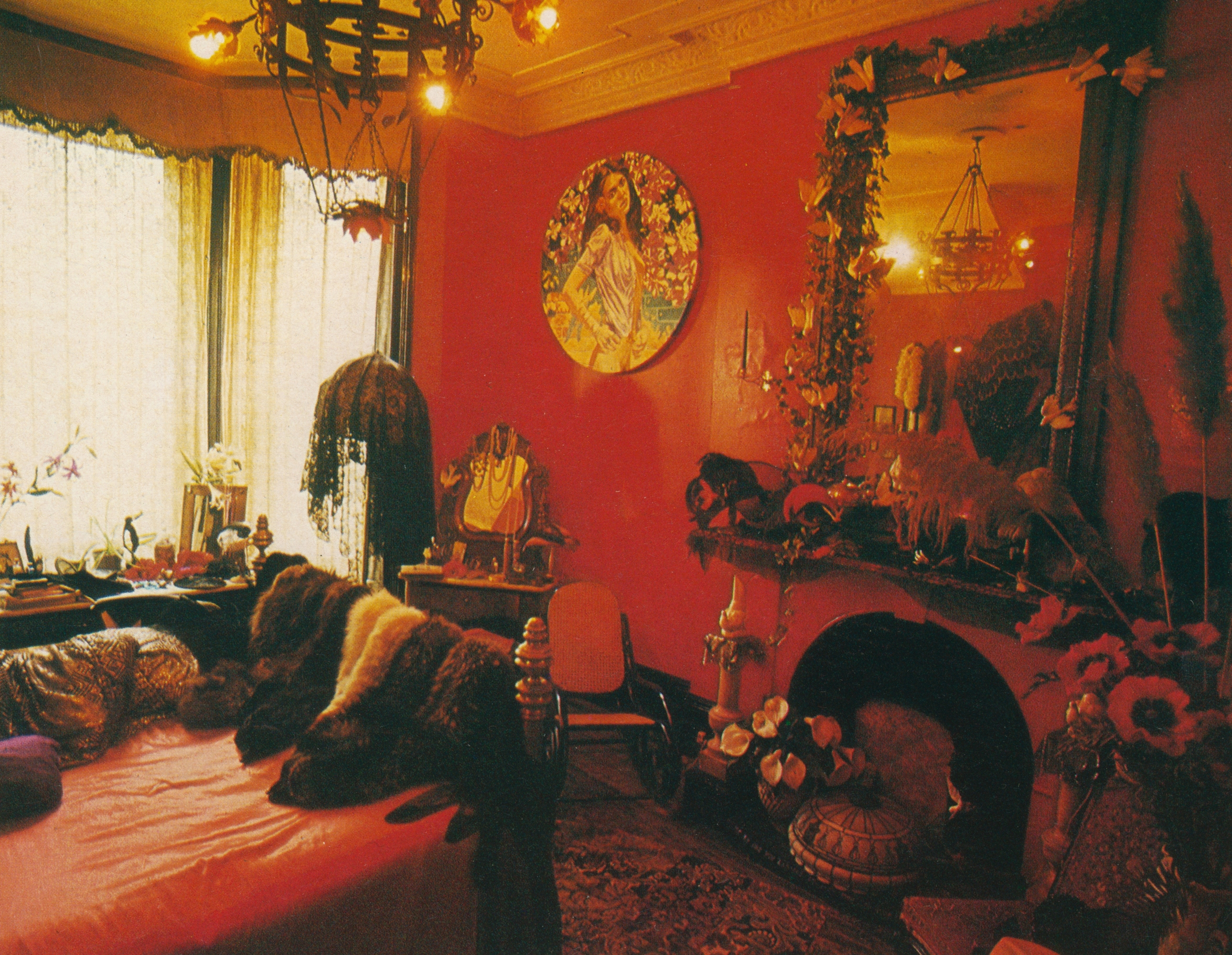
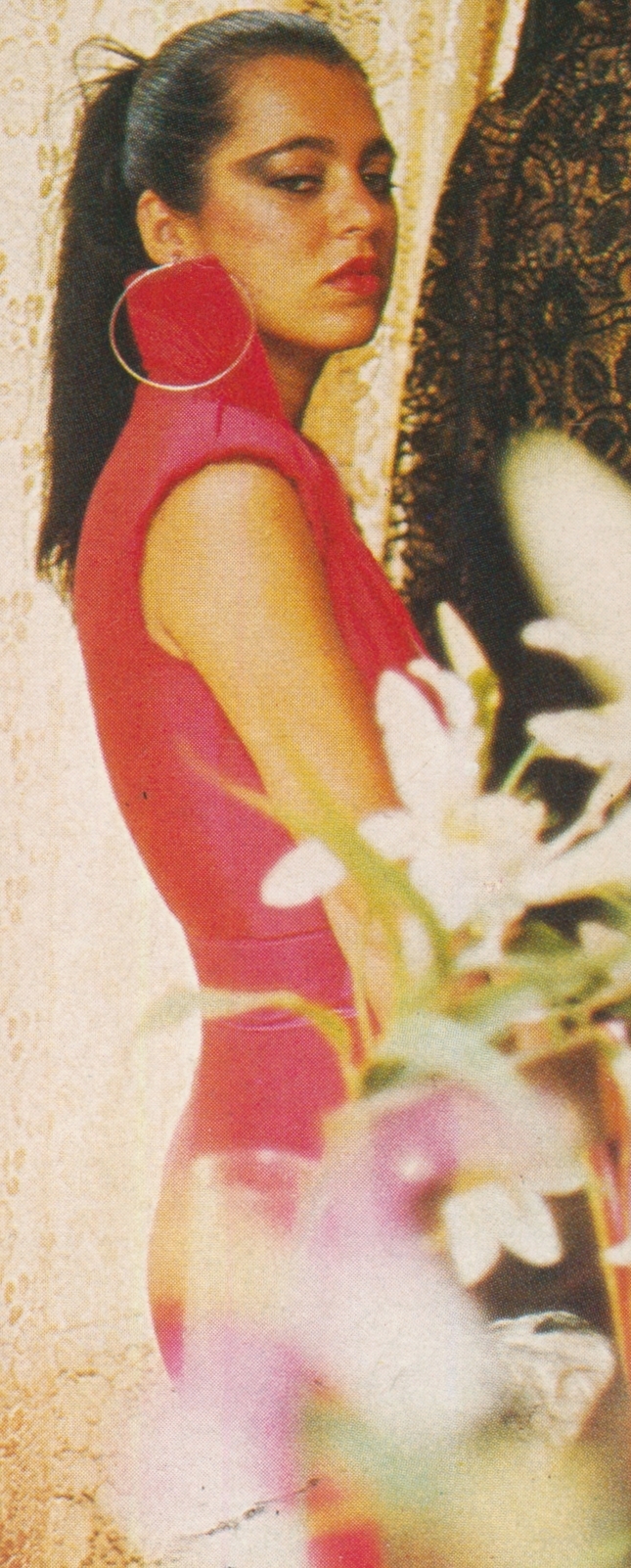
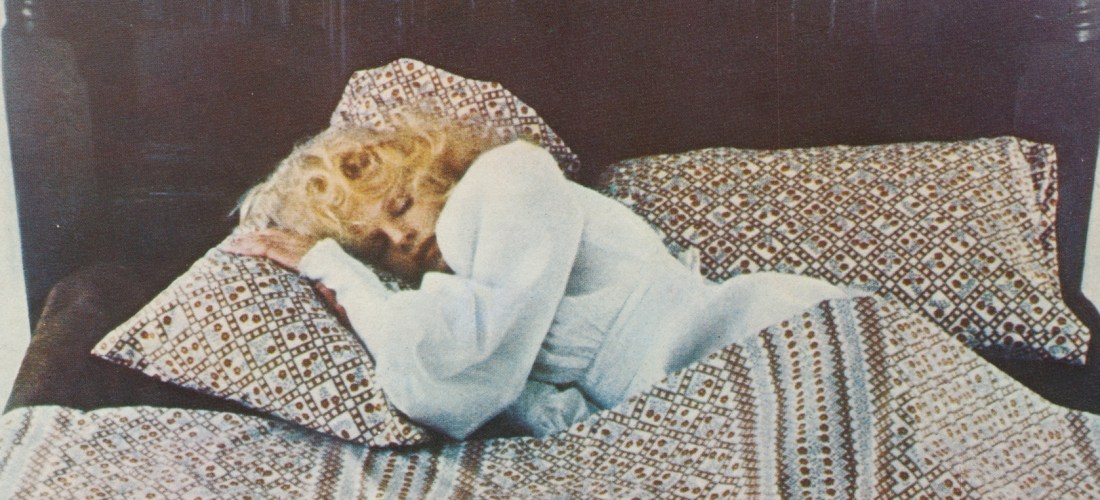
“People who only see me at parties think I do nothing,” says Luciana Martinez della Rosa. This, in a roundabout way, is because she’s an extremist. Predominantly a painter (so far she’s exhibited in mixed shows in New York and Rotterdam), she also makes extraordinary and beauti-ful bead wigs on commission. And the reason people think she’s a very decorative do-nothing is because she buries herself at home, working for days and sometimes weeks on end, and then explodes into the much needed relief of a short, sharp, burst of social life. Her finances tend to be extremist too: long periods of scraping by on an over-draft until she suddenly sells a painting, pays back the bank and the rent — and spends the rest. It’s a very deliberately chosen way of life, and in some ways it’s a lot tougher than a stultifying but secure, nine-to-five job. “I could do things that would earn me a lot more money,” she says, “but then I wouldn’t have time for the most important thing, which is my work. Even a part-time job would break up my day and my concentration.” For the same reasons, anyone with whom she becomes involved, on an emotional level, must be as independent as she is herself. So she shares a house with another painter, Kevin Whitney. And she points out that being single and living alone are two separate concepts: it’s obviously good to have a friend around to sympathise with successes and disasters. But her part of the house has her own character and taste written large and uncom-promisingly across it. “People who work away from home, and then probably go out quite a lot in the evenings, seem to need less personal surroundings. But I spend a lot of time here, so it has to be very me.” Her bedroom says it all: scarlet, and over-flowing with Art Nouveau pieces, old fabrics and furs. She’s been a jumble sale addict since she was 12, and they’re still the major source of her wardrobe. “But they never look like old clothes,” she says. “Because of what I do to them. If I could, I’d have every-thing, clothes and furniture, made specially for me.” It was as a child that she started buying up all the Victoriana that no one else wanted. “My mother thought I was mad.” Not so mad now, because, although she swears that nothing in the room was expensive when she bought it (“Except the bed. That cost £40”), its contents would make a market stallholder weep with avarice. “I suppose some people might find it all a bit overpowering,” she says. “Especially a guy. Not too good for his ego. But I think you tend to gravitate towards people who like the same sort of things as you do. And anyway, I get a lot of pleasure from seeing other people’s places. I hope that it works both ways.”
Luciana Martinez della Rosa
Prudence Walters
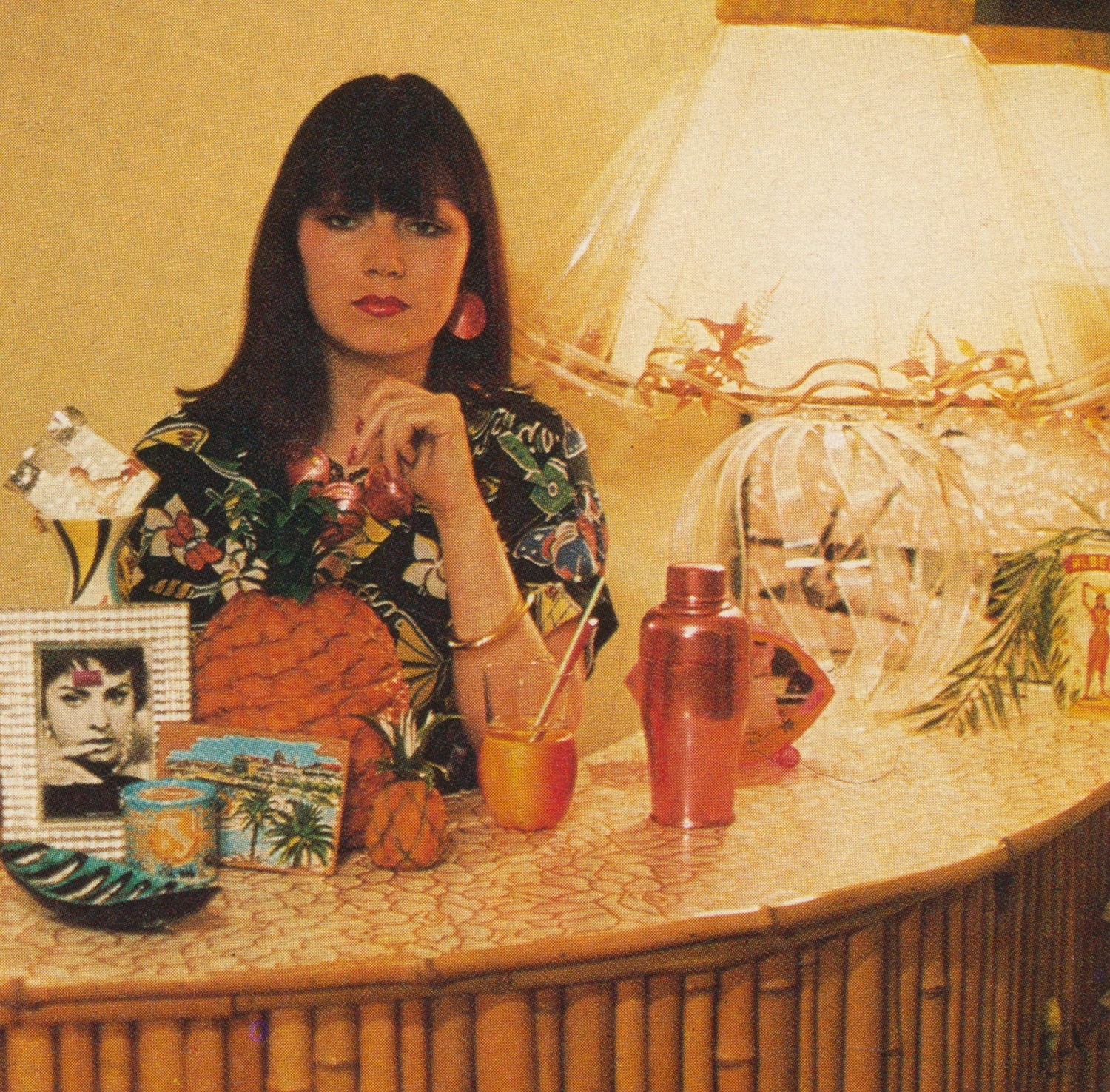
Prudence Walters is Welsh, an only child with a convent up-bringing. At 18, she left home for art college in London, and she hasn’t really looked back since. In her time, she’s been a magazine fashion editor. Currently, she works as a stylist, freelancing for photographers who need the right look for a session. It’s hard work, and quite well paid — if and when people get round to paying. The big advantage is the free-dom, finance permitting, to organise your own working life: deciding to work every day for four months and then take two months off. Prudence lives in a basement flat, complete with cocktail bar, that is uncomprisingly set in the 1950s, a style that she genuinely loves. She obviously treasures her independence, seems to know exactly what she wants in life and to be very contented with what she’s got. This doesn’t preclude men, but they have to accept that her way of life is as important as their own. “I’m a bit ruthless,” she admits. “I have lived with people and I do like it. But I tend to get bored with people quickly and I don’t really like getting to know anyone too well.” The bit that gives her the real horrors is the extra housework that dual domesticity inevitably brings with it. “I probably wouldn’t mind doing it all if there were compensations, such as someone else keeping me in the standard of living I’ve been able to achieve for myself.” But since she can, if she chooses, earn as much as most of the men she meets, or more, the idea of being breadwinner, cook and bottle-washer doesn’t appeal to Prudence Walters at all.
Prudence Walters
Ursula Yeardye
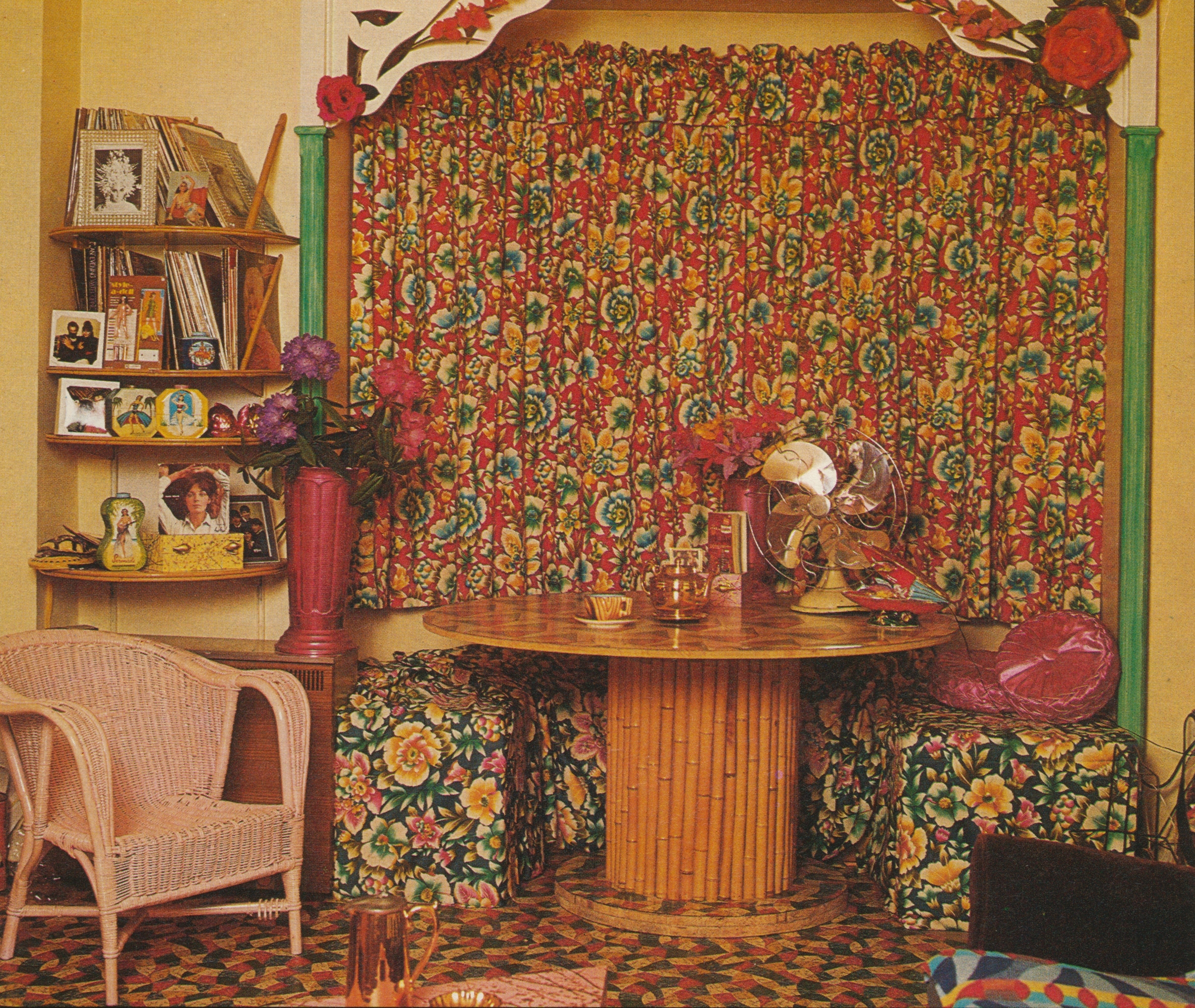
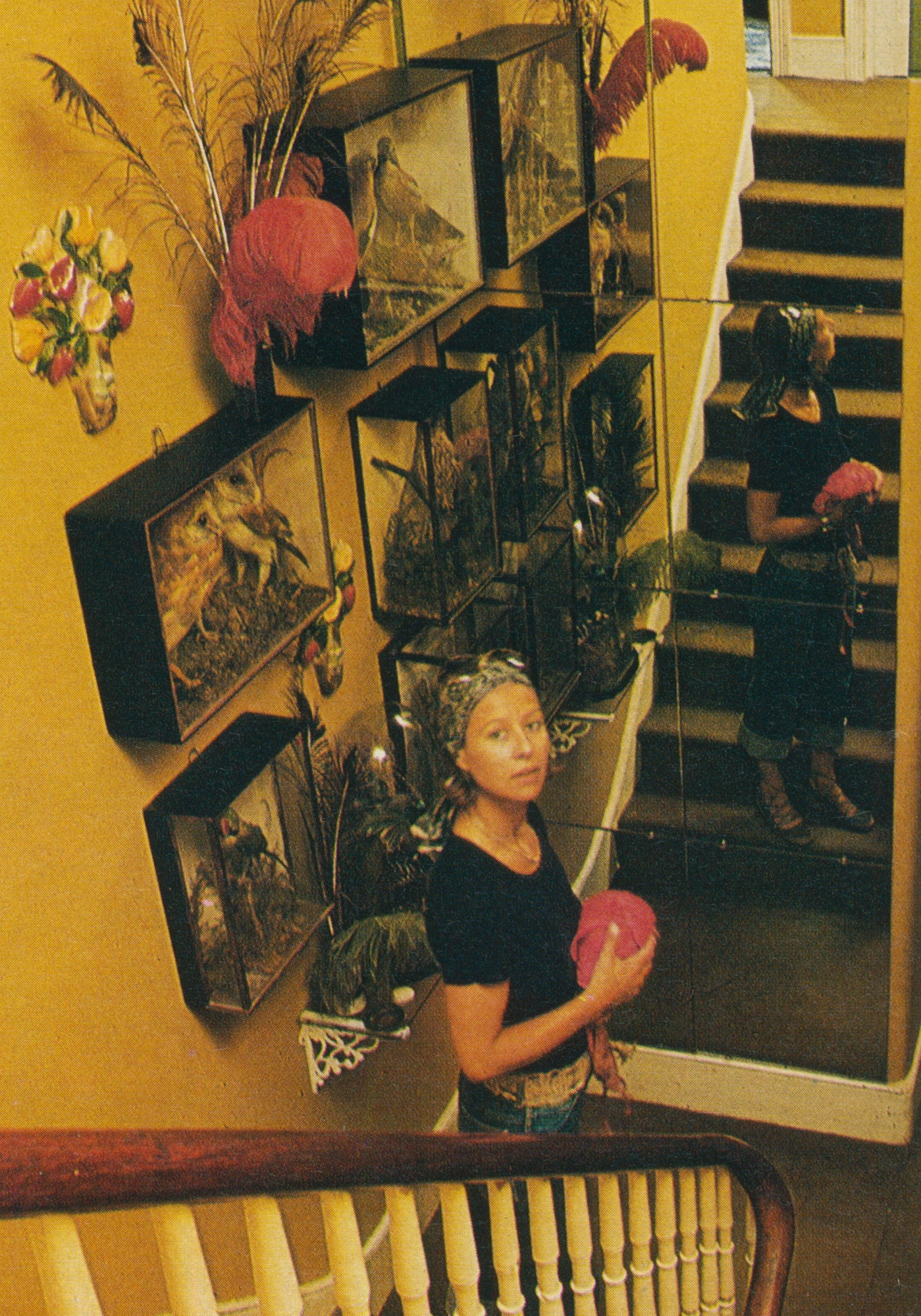
Ursula Yeardye has been through two marriages and out the other side. At the moment, she’s very much biased towards the single life. “Somewhere,” she says, “there may be a man who doesn’t simply want to be looked after, and it would be nice to find one, but both my husbands merely wanted mothers. I tried to fulfil that role, modelling myself on my own mother. But it’s no good to either of you if you become a martyr. I’ve always needed my independence and there simply wasn’t enough of it. I had to get my conditioning about marriage through my system and then get out before I got too damaged and lost sight of my own potential.” Before her first marriage, she studied mime with Marcel Marceau in Paris and toured the States for two years with the company. Now she’s running a small commercial firm in London, but she’s started retraining as a keep-fit leader, studying modern movement and yoga, with the aim of teaching some time in the future. She knows the disadvantages of single life: “I like going to places by myself, but people still look at you strangely if you’re on your own in a restaurant or a cinema. They either steer clear of you or approach you, and both for the wrong reasons. The social structure is still against you. You’re swimming against the stream!” But the advantages are there too: “You have complete freedom. You go home, sit down and think, ‘What do I want to do next?’ And if you don’t want to go home, you don’t have to. There’s no one sitting in front of the ‘fridge, waiting for you to cook them a meal.” Since she’s been single, she cooks far less —except for entertaining, “and that’s cooking for fun, it’s really great”. She lives mostly on fruit and vegetables, and the money she used to spend on what she calls `man’s food’, she spends mostly on her home, which has become something of a symbol of independence. After rent, her salary leaves her enough to do a little more each week. She paints, sews, upholsters, renovates, and what she’s done to the top two floors of a rather dilapidated terraced building is quite remarkable. “It took me a long time,” she says, “to learn that it’s no good living for the past, or the future —always hoping that it’s going to get better. You must live for the present, and enjoy it as much as you can.”
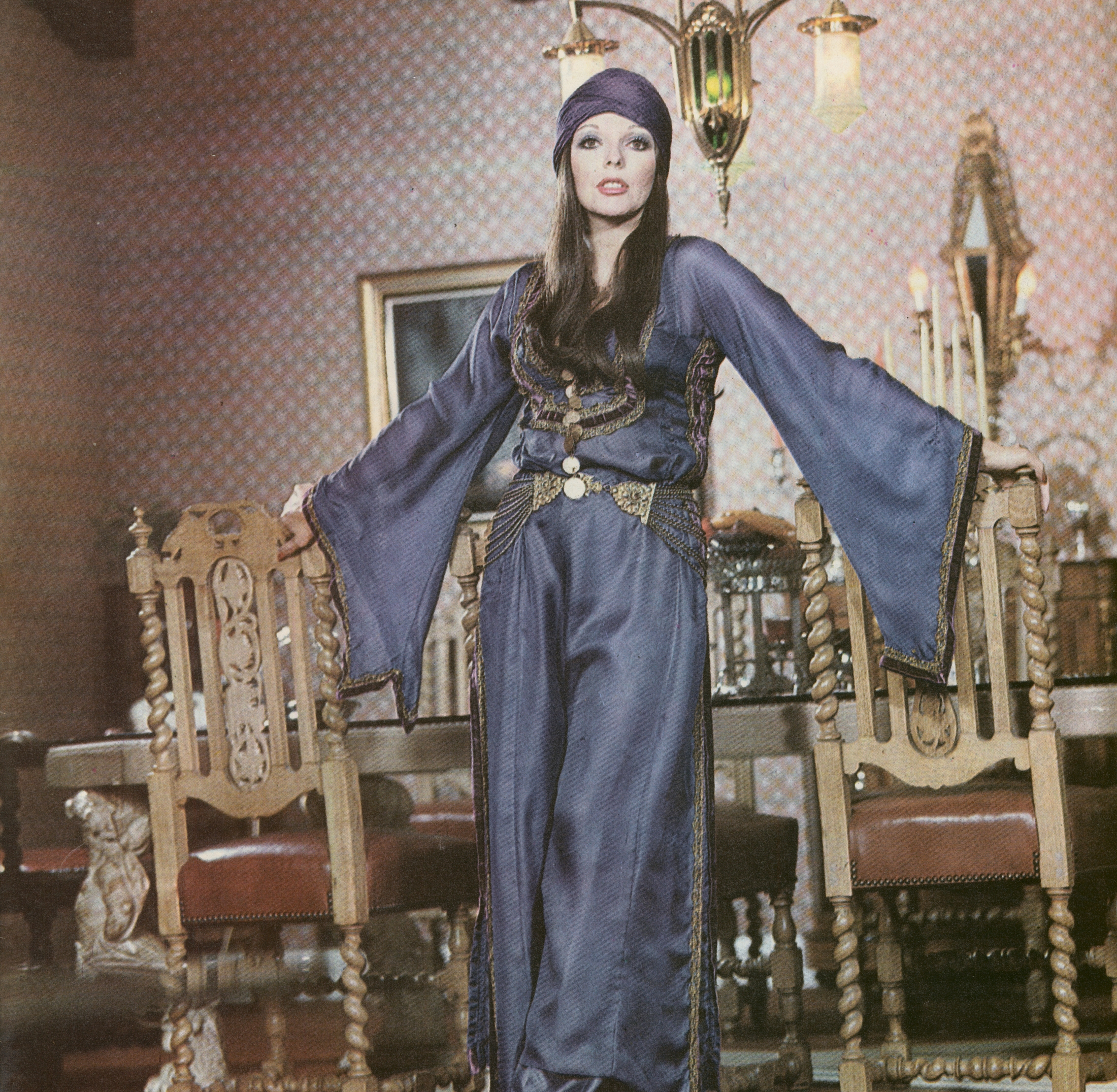
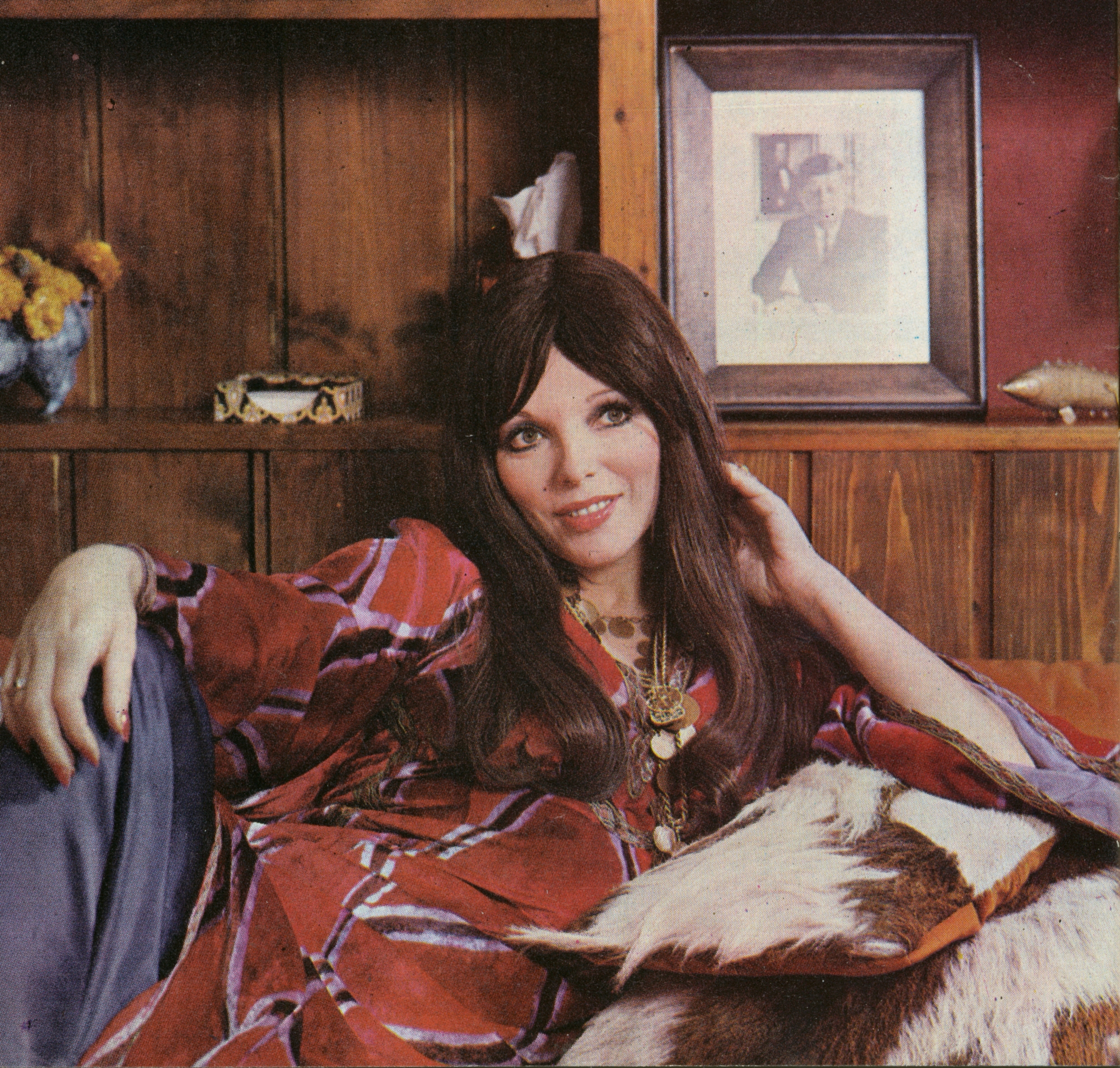
Joan is pictured in her dining room standing in front of an impressive table which she had specially made in Los Angeles.
I couldn’t help but share these amazing images of Joan Collins, in what is definitely the best era of her style. Interview text is underneath the images.
Photographer is uncredited.
Scanned from Photoplay, July 1972.
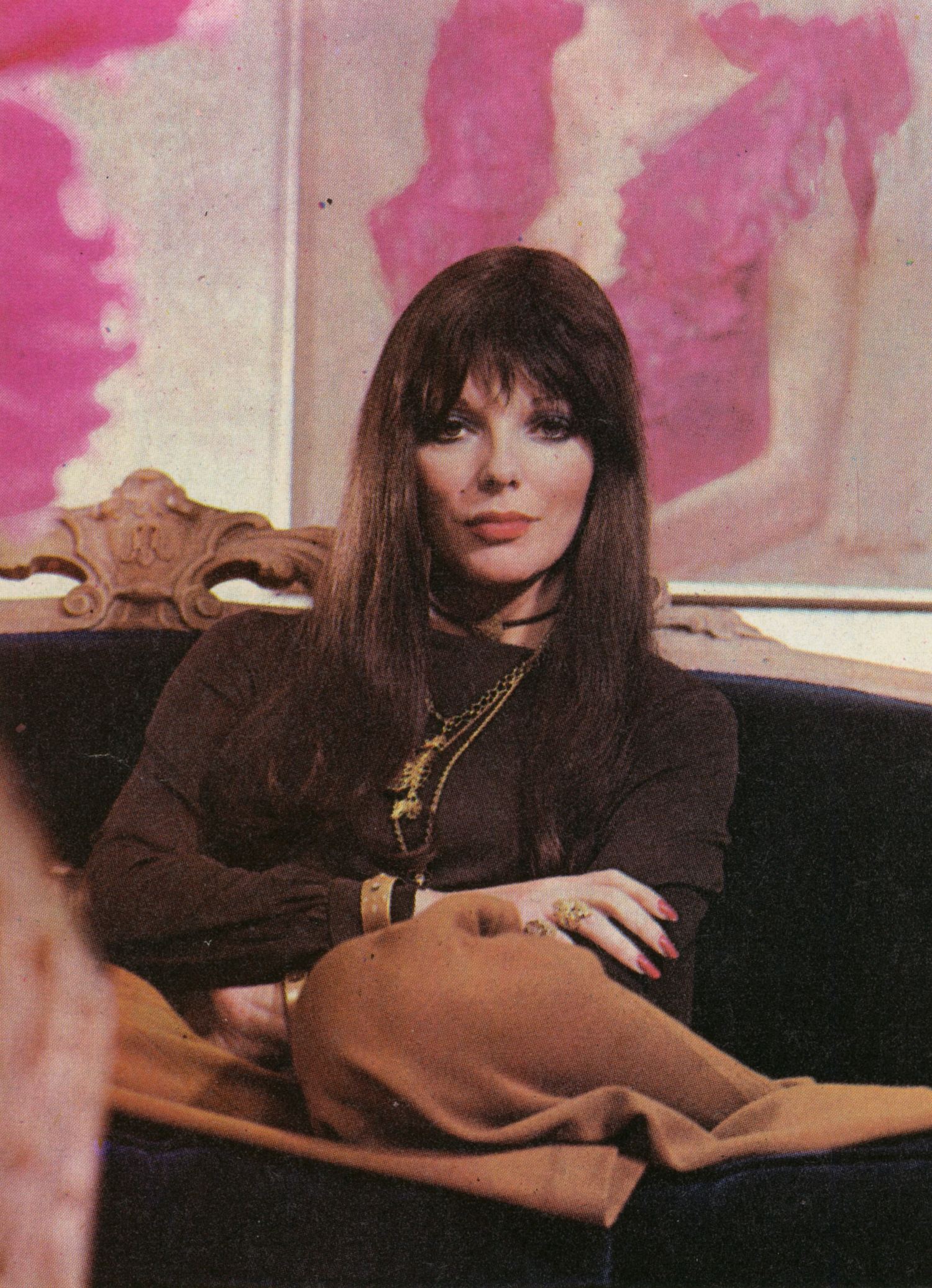
In beige trousers and chocolate coloured tunic Joan poses before a portrait of herself in her lavishly-furnished Hampstead home.
Joan makes herself comfortable.
JOAN COLLINS AND HER SECRET WEDDING
Joan Collins is now Mrs. Ron Kass. The American music producer became Joan’s third husband in a wedding, kept secret by the couple, which took place in Ocho Rios in Jamaica some weeks ago.
Why such a quiet wedding?
“We didn’t want a lot of people mak-ing a fuss, so no one was there except for the hotel staff,” explained Joan. “We all drank champagne and afterwards they all left. It was marvellous. Then we went walking on the beach.”
Joan however, did make one telephone call to announce the marriage. She rang her daughter Tara and son Sacha in London.
“I talked to Tara and she said she was very happy,” said Joan. “Sacha was watching television, but Tara said she would tell him. It’s terribly difficult talking to children long-distance on the telephone.”
The children’s father is Anthony Newley, Joan’s former husband. Her first husband was Maxwell Reed, whom she divorced back in the Fifties.
Ron Kass has been a close friend of hers for over two years. Joan admitted that she and Ron had been planning to marry for a long time. “But there were complications,” she added. “He had to wait for his divorce. And we were in no hurry.” Ron Kass has three sons by his first wife. They live with their mother.
It seems hard to believe that Joan started making movies twenty years ago. She made her debut in I Believe In You back in 1952.
Shortly after her marriage to Ron Kass, she was in New York helping to publicise one of her latest movies, Tales From The Crypt, her first horror movie. In one of the film’s five episodes, narrated by Sir Ralph Richardson, she plays a woman who has just murdered her husband in their own home and while she’s disposing of the body, a homicidal man-iac comes rapping at the window.
“It seems dreadful to say I’ve done a ‘horror’ film. It sounds like one of those things where one woman sinks her teeth into another’s breast. But it isn’t like that at all,” she told writer David Dugas. “It is frightening, though. I saw a bit of it and it scared the hell out of me.”
In the past two years, Joan has worked busily on several movie projects which have included Revenge, Quest For Love, Fear In The Night and Tales From The Crypt.
“I’ve worked a lot lately, but I’m going to take it easy for a while,” she smiled. “I’d just like to be a wife for a bit.”
She lives in a splendid house in Highgate, near London which she has decorated. She and Ron have also furnished a holiday house at Marbella on Spain’s south coast. She has sold her house in Hollywood.
“I lived in Hollywood for quite a while and the worst part was that it was so far away from everywhere else I wanted to go — Switzerland, France, Italy, Germany, wherever. I do love to travel, especially in Europe. I love get-ting on a plane and being in a different culture an hour or two later. I don’t feel especially British. More European. Of course it will all be the same soon.”
Joan is also a compulsive shopper. “I love to buy things — antiques and such. I’m always buying things when I travel.” She is also an excellent designer. The white fringed caftan she wore, an unusual print of white blurred into mauve, was designed by her. “I can’t sew, but I love designing my own clothes. I designed this and had it made,” she said. “I almost became a designer once before I decided on acting.”
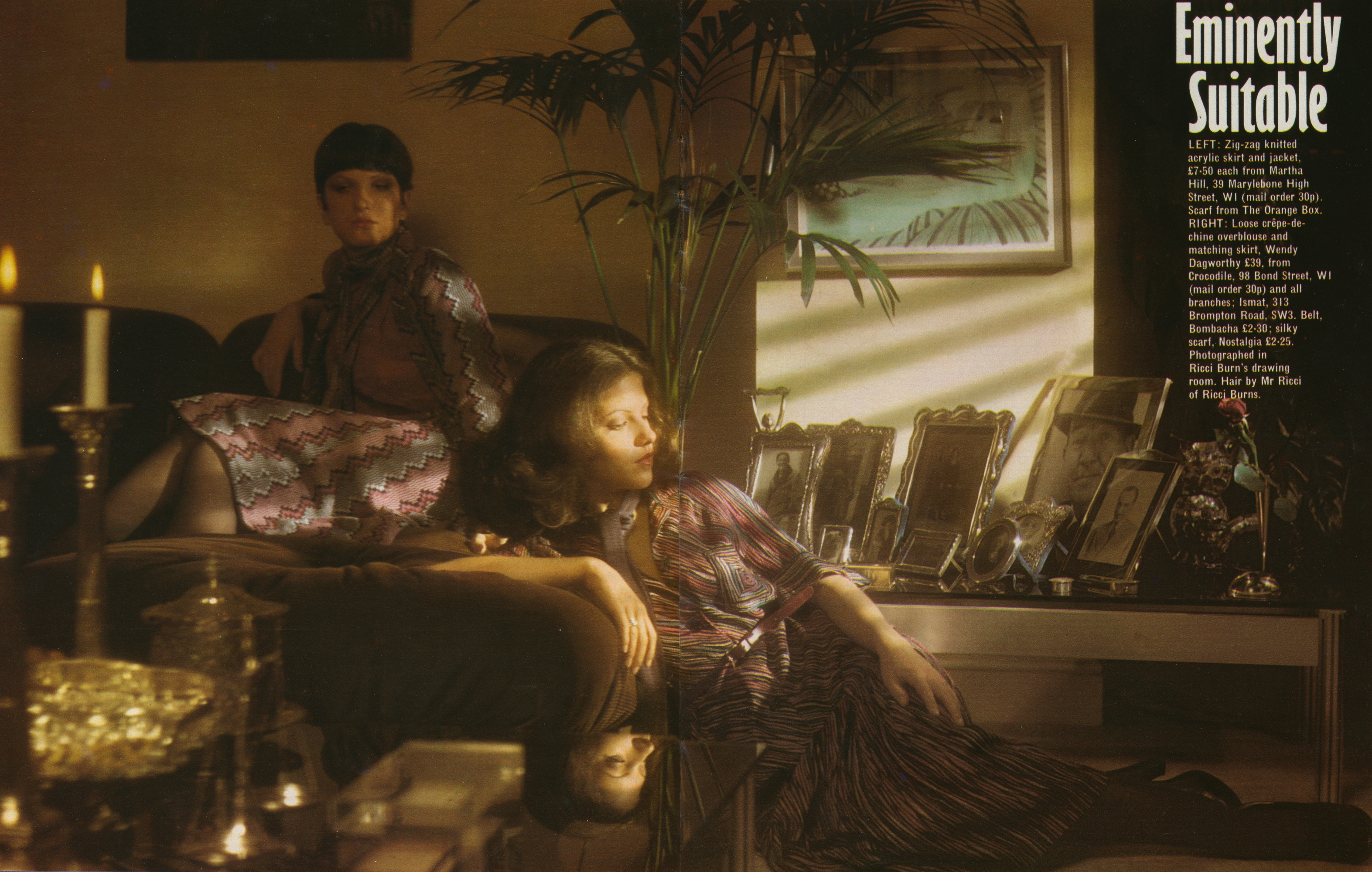
LEFT: Zig-zag knitted acrylic skirt and jacket. £7.50 each from Martha Hill, 39 Marylebone High Street, WI (mail order 30p). Scarf from The Orange Box. RIGHT: Loose crêpe-de-chine overblouse and matching skirt. Wendy Dagworthy £39. from Crocodile. 98 Bond Street. WI (mail order 30p and all branches: lsmat, 313 Brompton Road, SW3. Belt, Bombacha £2.30: silky scarf. Nostalgia £2.25.
Photographed in Ricci Burns’s drawing room. Hair by Mr Ricci of Ricci Burns.
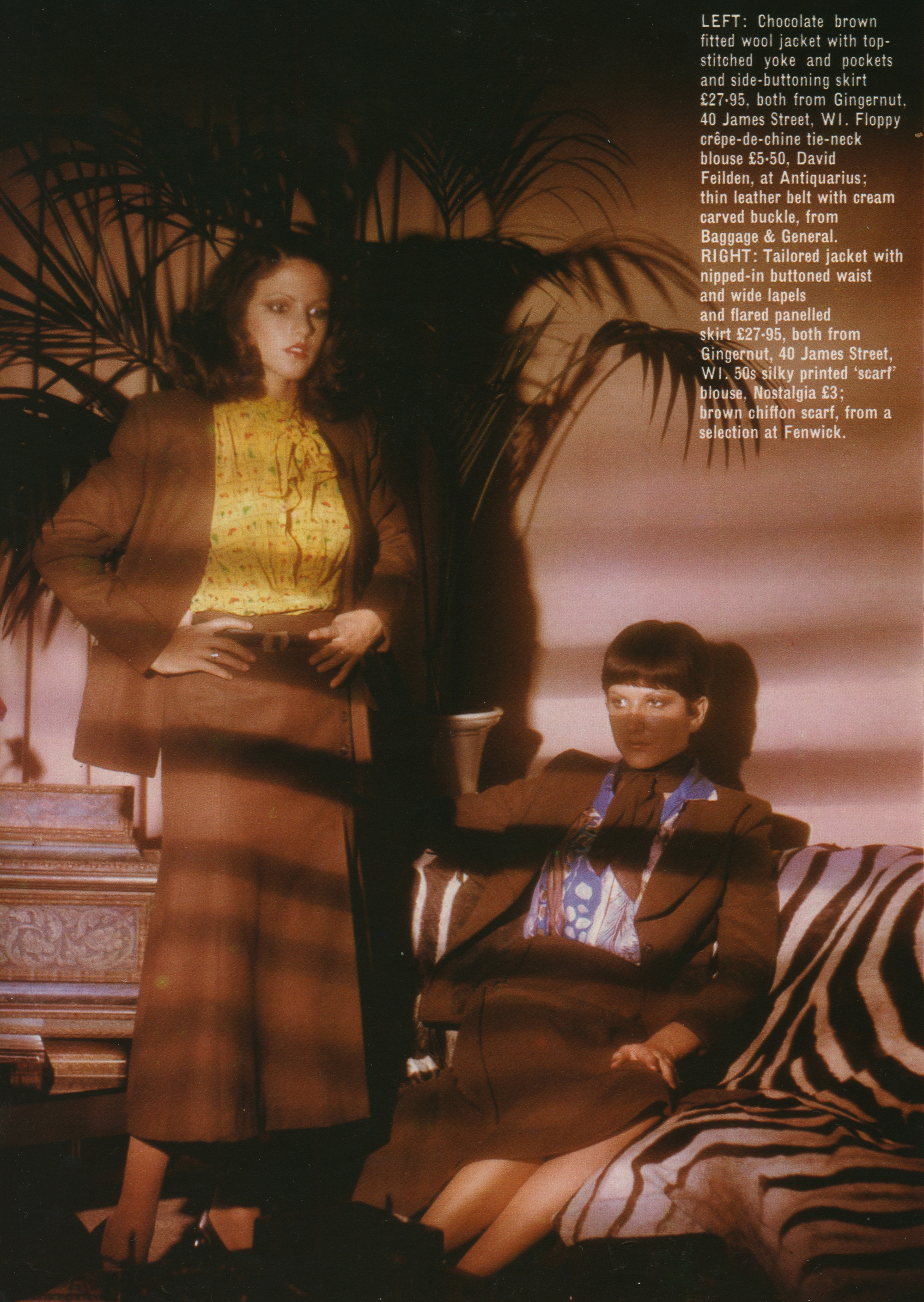
Photographed by Mike Berkofsky.
Scanned from Honey, January 1975.
LEFT: Chocolate brown fitted wool jacket with top-stitched yoke and pockets and side-buttoning skirt £27.95. both from Gingernut. 40 James Street. W1. Floppy crepe-de-chine tie-neck blouse £5.50. David Fielden, at Antiquarius: thin leather belt with cream carved buckle, from Baggage & General. RIGHT: Tailored jacket with nipped-in buttoned waist and wide lapels and flared panelled skirt £27.95, both from Gingernut, 40 James Street, W1. 50s silky printed `scarf’ blouse. Nostalgia £3: brown chiffon scarf, from a selection at Fenwick.
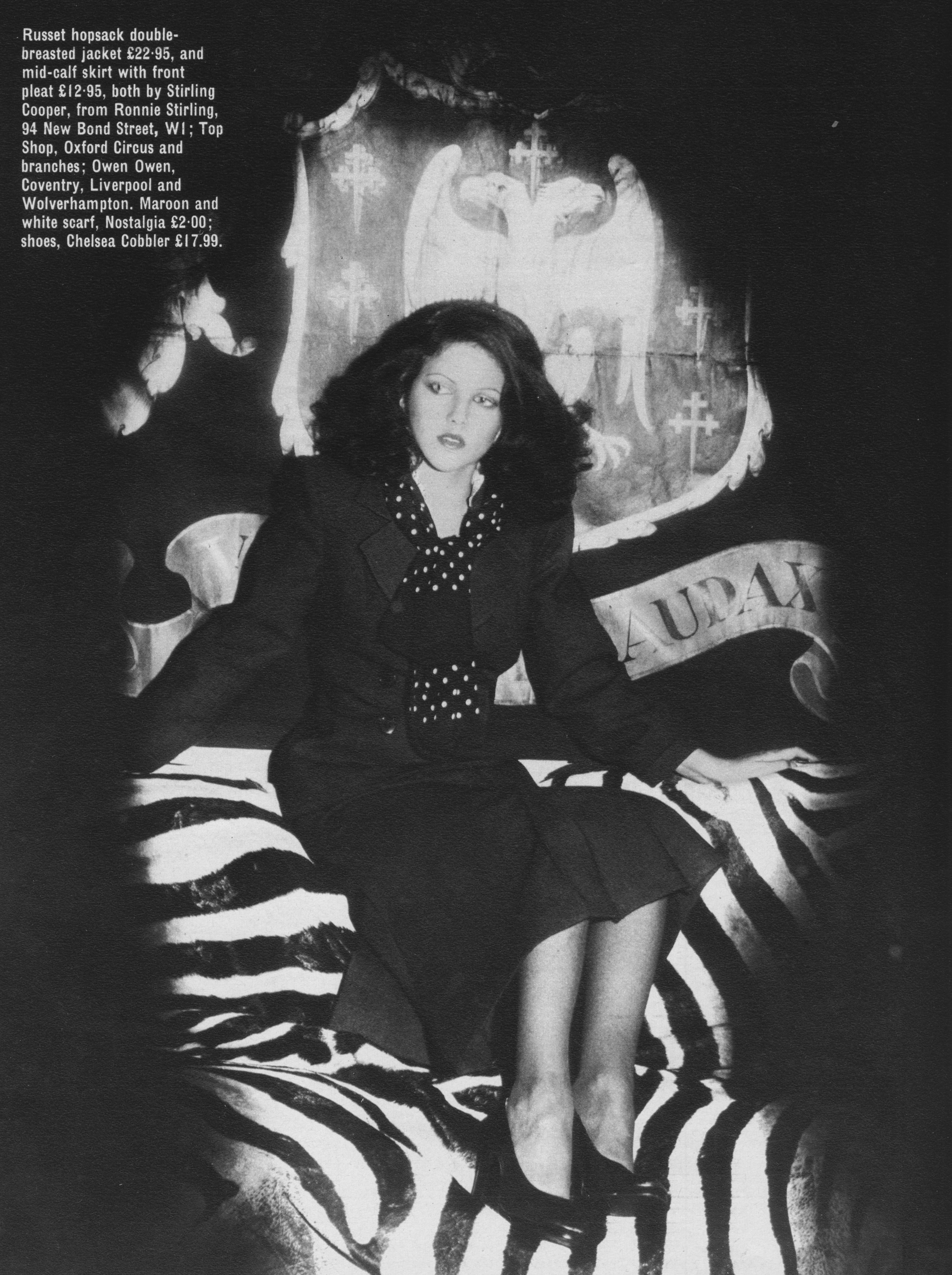
Russet hopsack double-breasted jacket £22.95, and mid-calf skirt with front pleat £12.95, both by Stirling Cooper, from Ronnie Stirling, 94 New Bond Street, W1 ; Top Shop, Oxford Circus and branches; Owen Owen, Coventry, Liverpool and Wolverhampton. Maroon and white scarf, Nostalgia £2.00; shoes, Chelsea Cobbler £17.99.
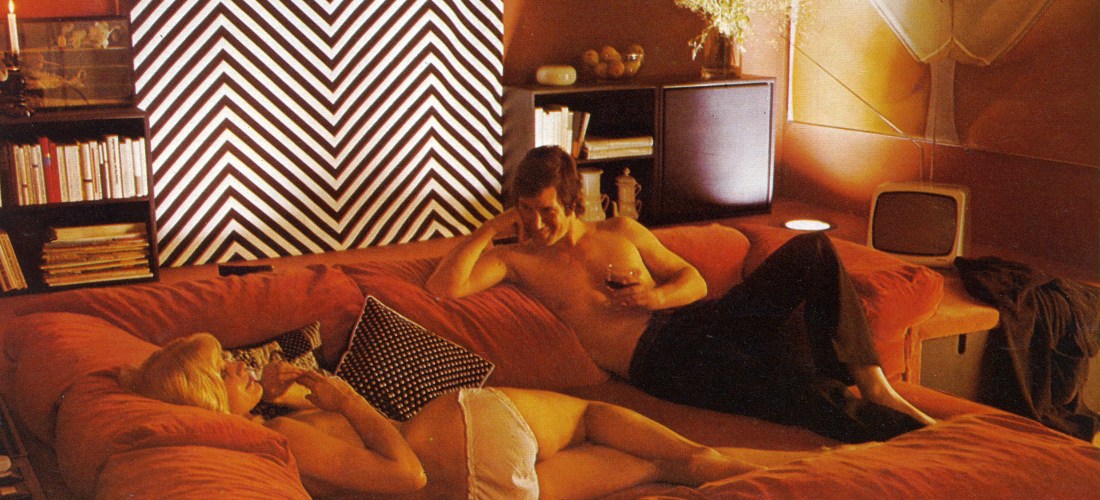
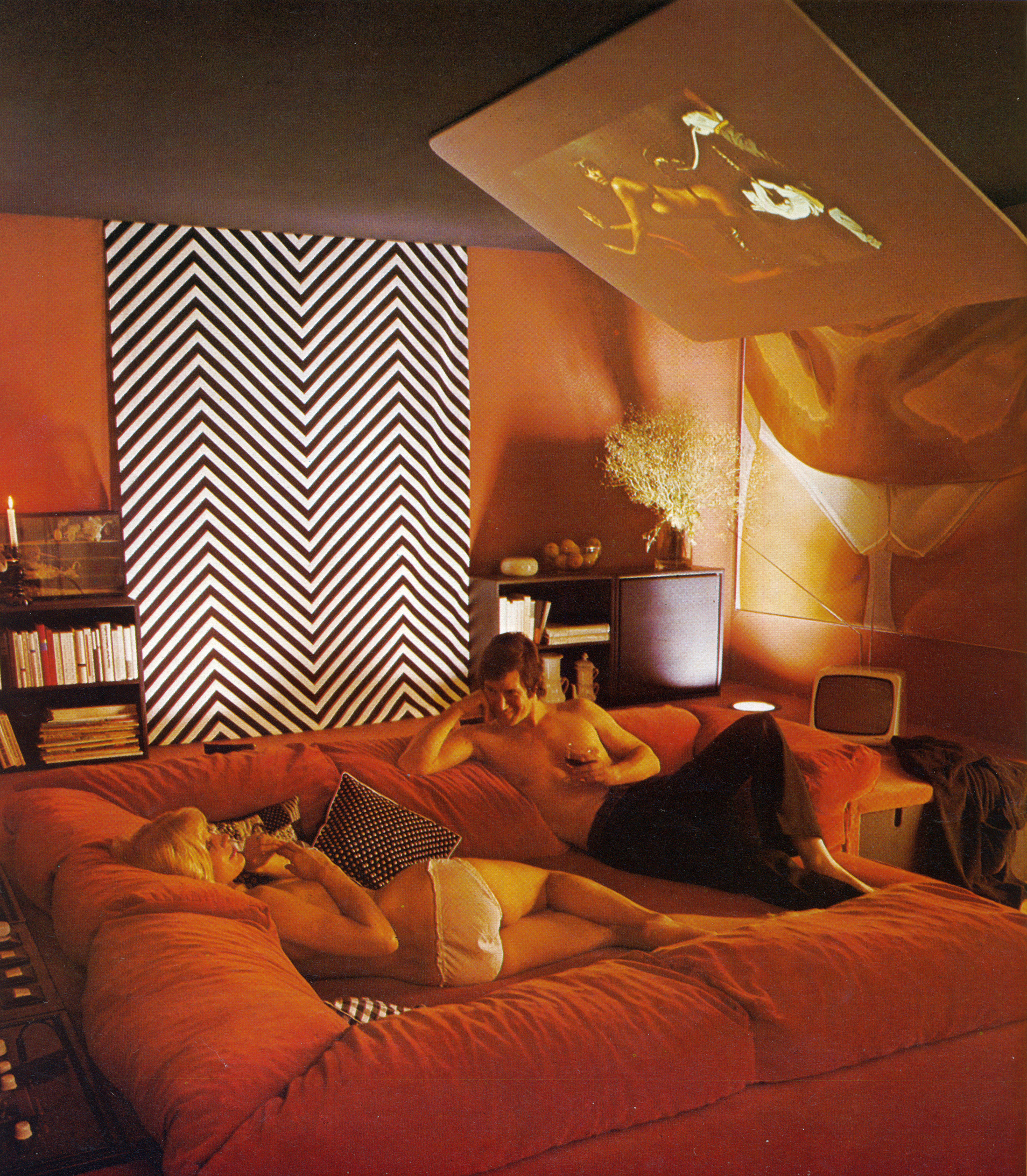
Just because we spend around one-third of our lives asleep there’s no reason to design a bedroom principally for this purpose — after all, you can’t see, feel or appreciate your decorating skill while you’re dead to the world. I under-stand people do still use their bedrooms to love in — all the propaganda promoting white sand beaches, railway carriages or kitchen tables as suitable venues can’t entirely finish the bedroom as an erotic play area; at times it’s too cold for the beach, the trains are on strike and the kitchen table is littered with Meccano.
So this is a room to love in —whether you care to sleep in it as well is your own affair. The alternative methods of post-coital entertainment are well catered for — the stereo and tape deck are built in, as is a projector for blue movies or slide-shows. Food and drink can be stored within handy grabbing distance of the orgy-size velvet-upholstered bed which incorporates the practical features of an oriental divan — ie it’s low, large, firm and on two levels.
Lighting is from below — two ordinary recessed ceiling lights are recessed into the floor instead to give a flattering and romantic effect. How you’re supposed to read those book-cases full of erotic literature in the resulting gloom is not explained but perhaps that’s what the candles are for. If you ever need pure daylight the window is hidden behind that black-and-white chevroned blind. I can only think of two changes I personally would make to this perfect love environment — and they would be a lock on the door and the absence of the telephone.
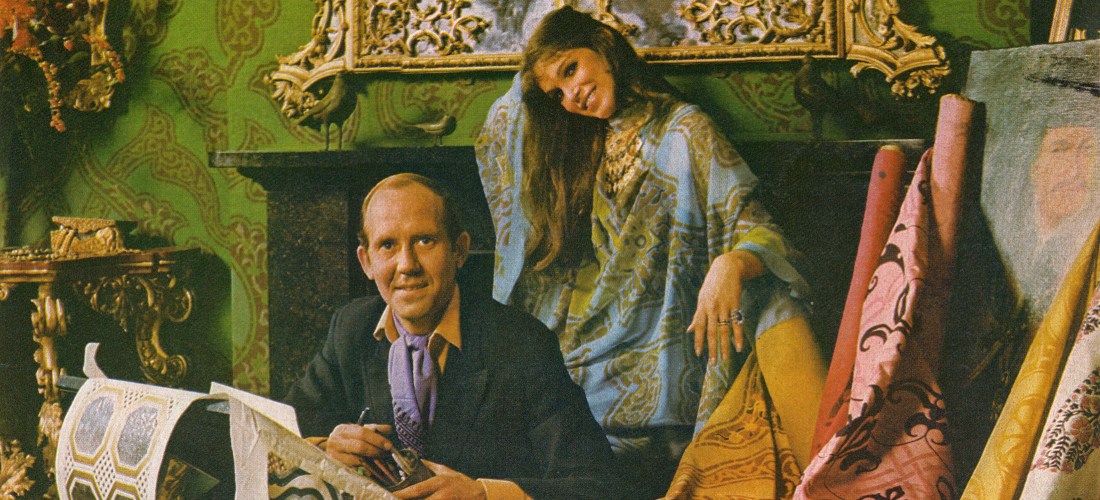
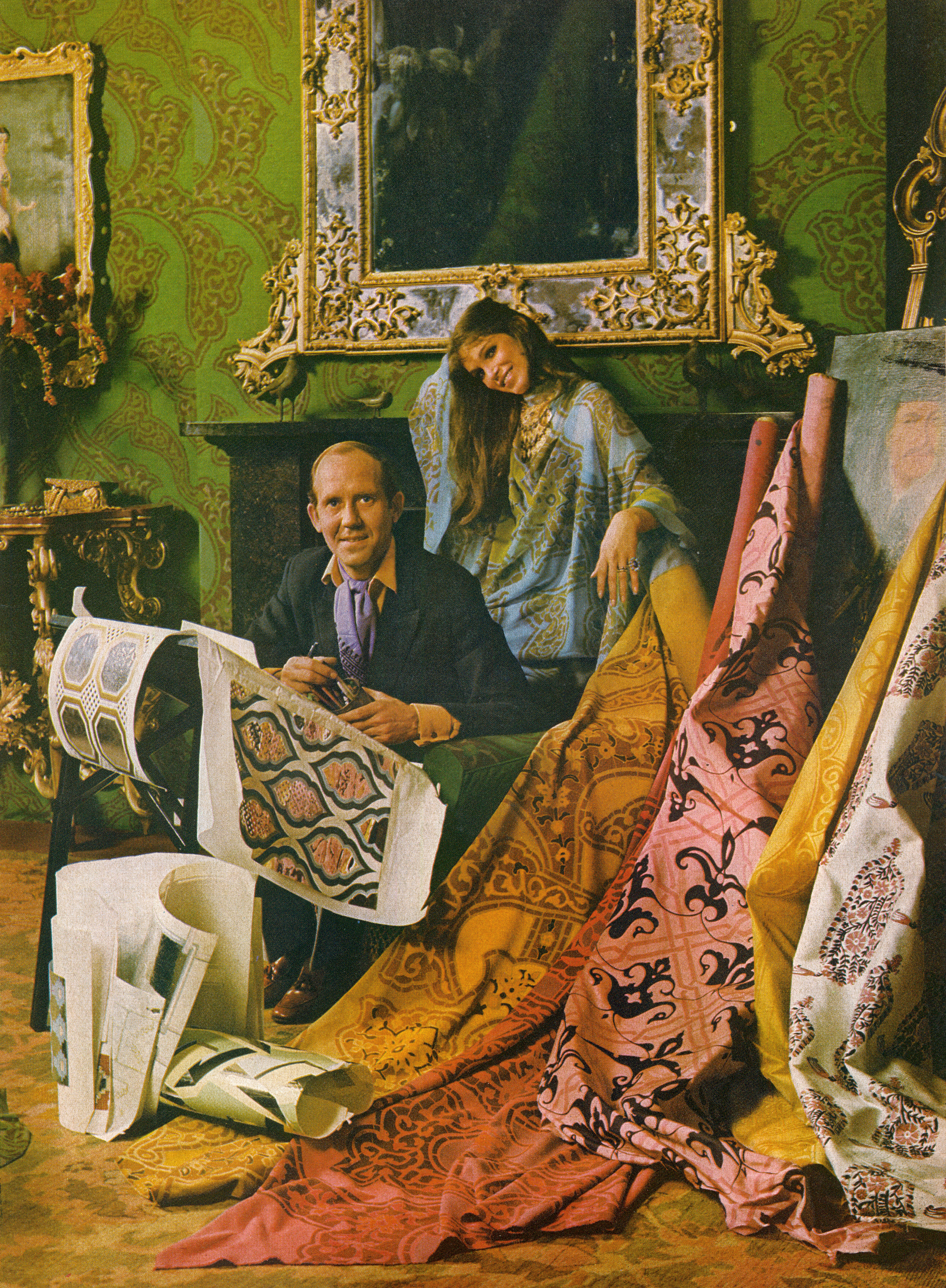
Michael Szell in the bedroom of his London flat. The rolls of fabric, his new collection of Persian prints for Thea Porter. The dress, simply one length from the range worn like a caftan.
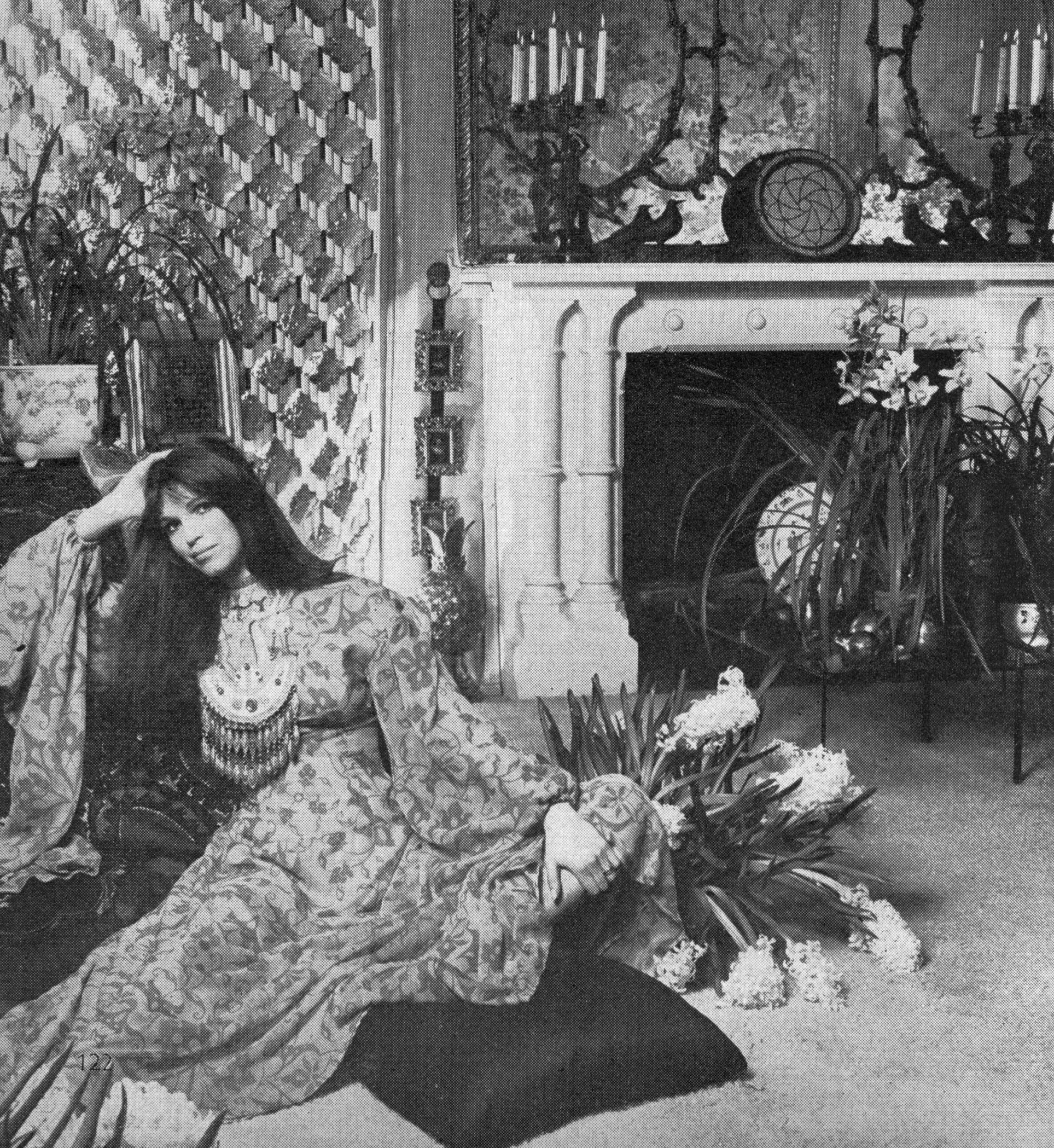
Michael Szell is the Hungarian fabric designer who is introducing Iran to London via a new collection of designs, taken up by Thea Porter for her romantic and ravishing evening dresses. His own bedroom, opposite, is in rich emerald, turquoise and brown arabesqued linen, cool and grand by day but rich and warm by electric light, with 18th-century Eng-lish paintings and mirrors. His drawing-room, below, is turquoise with brilliant Persian prayer mats colouring the walls, 18th-century English botanical china, and a mixed forest of hyacinth and growing orchids, later bluebells and orchids. Iran runs through Michael Szell’s life like a thread. He began to visit friends and connections there while he was still a child, used every possible holiday to get there while he studied economics at Aberystwyth University, and later when he worked with Sir Nicholas Sekers. His love for Persian ceramics, buildings and woven carpets developed into a passion for early Islamic art in its formal, random, asymmetric period before it came to represent life in the 19th-century : a passion culminating in his opening his own furnishing fabric showrooms at 47 Sloane Avenue. He began selling silk signature scarves to Henri Bendel of New York in 1969 and has just produced his new Persian collection of fabrics. Thea Porter asked him to print his designs onto silk chiffon for her and made them in flowing evening dresses with yards of floating sleeve and skirt.
For the coronation of the Shahanshah and the Empress of Iran, Michael Szell designed curtains, chair-fabrics and an entire state banquet for the Golestan Palace. He has been asked again to help with the decorations for the great October celebrations—the twenty-fifth centenary of the founding of the Persian Empire. He will contribute designs for the interiors of houses and for some of the 500 tents that are planned, with their own marble bathrooms, for the royal and distinguished guests who will take part in the celebrations at Persepolis, the ruined city and ancient capital.
Mr Szell has also been asked to provide the fabrics for all the palace sets in the new Universal film Mary, Queen of Scots, starring Vanessa Redgrave as Mary and Glenda Jackson as Elizabeth. He has an unrealised ambition to produce an absolutely modern collection of very cheap fabrics “from chair covers to plastic shower curtains”.
Model is Ann Turkel.
Photographed by Henry Clarke.
Scanned from Vogue, July 1971.
Midnight blue Persian curlicues on azure silk chiffon. Sleeves dipping to the ground and gathered at the wrists, the bodice fitted, skirt soft and gathered. £78, at Thea Porter, 8 Greek St. Persian necklaces, both pages, from Michael Szell’s own collection.
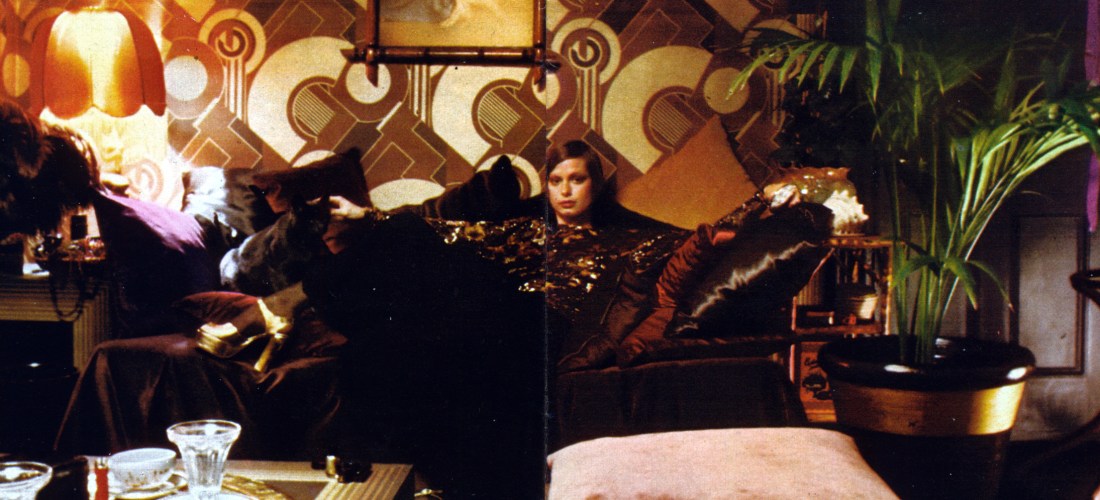
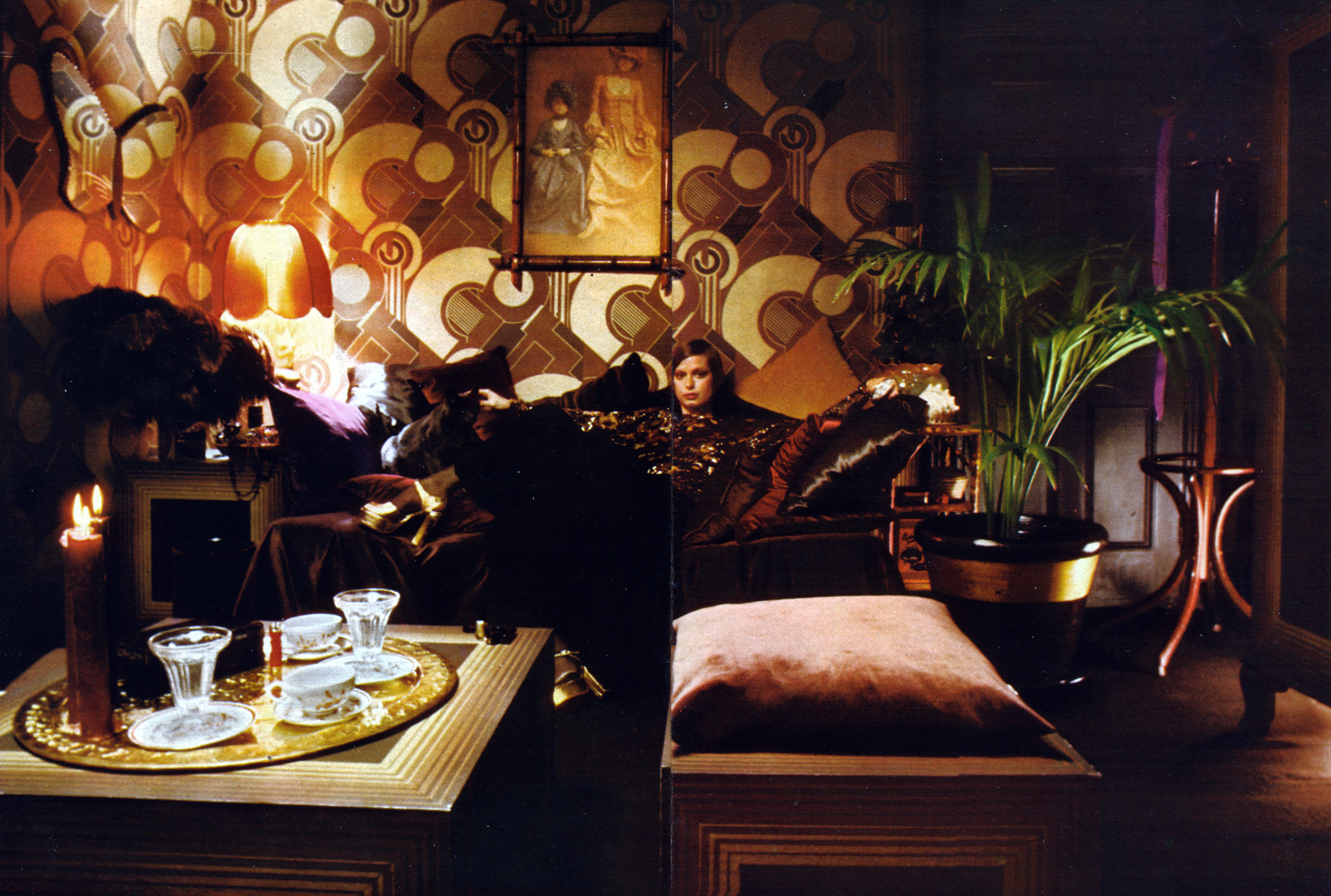
Wallpaper, 10p. a 2ft. x 3ft. sheet. Each sheet has a border which can be trimmed off with a Stanley knife and steel rule and used for edging. Butterfly mirror from a junk Shop. Plywood boxes, painted with Biba Brown Flat Oil Paint, £1-80 per litre, and edged with wallpaper border, used as table. On table: feathers, 65p. each. Brown velvet shade, with gold bead fringe, £7-50. Gilt lady lamp, £5-05. Lacquered basket, full of beads, from 55p. Brown velvet wastepaper basket, £3-60. Satin and velvet cushions: small £2.10 each, large £2.95 each. Brown velvet used as bed-cover, £2.35 per square yard. Huge terracotta plant pot and dish from any good nursery. Both painted with Biba Brown Flat Oil and Biba Gold, £1.25 a litre, and varnished with clear polyurethane, from hardware stores. Old wardrobe was given a coat of Biba Brown Flat Oil Paint and edged with wallpaper border. Foreground: table and seat both made out of plywood, as before. On table: brass mirror tray, £4-50. Long-lasting candles, 60p. each. Brown mirror glass cigarette box, £5.50. Sundae glasses, £1.15 each. Crockery: cups 35p. each, saucers, 20p. each. Brown felt on floor, 95p. per yard.
How do you turn your bed-sitter into a cosy, welcoming den, with a seductive hint to it, so that a friend would love to come back with you after an evening out on the town? 19 asked Barbara Hulanicki of Biba for her expert advice on this and here are some of her easily imitated ideas to jazz up your pad.
Choice of colour schemes is very much a question of taste, but we chose Biba’s beautiful brown and gold paper and brown paint because they’re warm and intimate to live with and neutral enough to display favourite bits and pieces. Brown floor felt is a cheap alternative to carpet, but it is difficult to keep clean. If you can stand doing it, sanding tt-e floor gives a beautiful surface. pywood pieces, cut to size by your frendly local do-it-yourself shop and glued or nailed together, form excellent boxes for tables and seats. If yoire clever with a screwdriver, you night even manage to hinge one side and use the boxes for storage.
Painted and edged with wallpaper border and then varnished with clear polyurethane. they make effective and decorative furniture, which will tie in beautifully with your room scheme. An alternative to expensive antique plant pots is to buy terracotta ones and again paint with colour and seal with clear polyurethane.
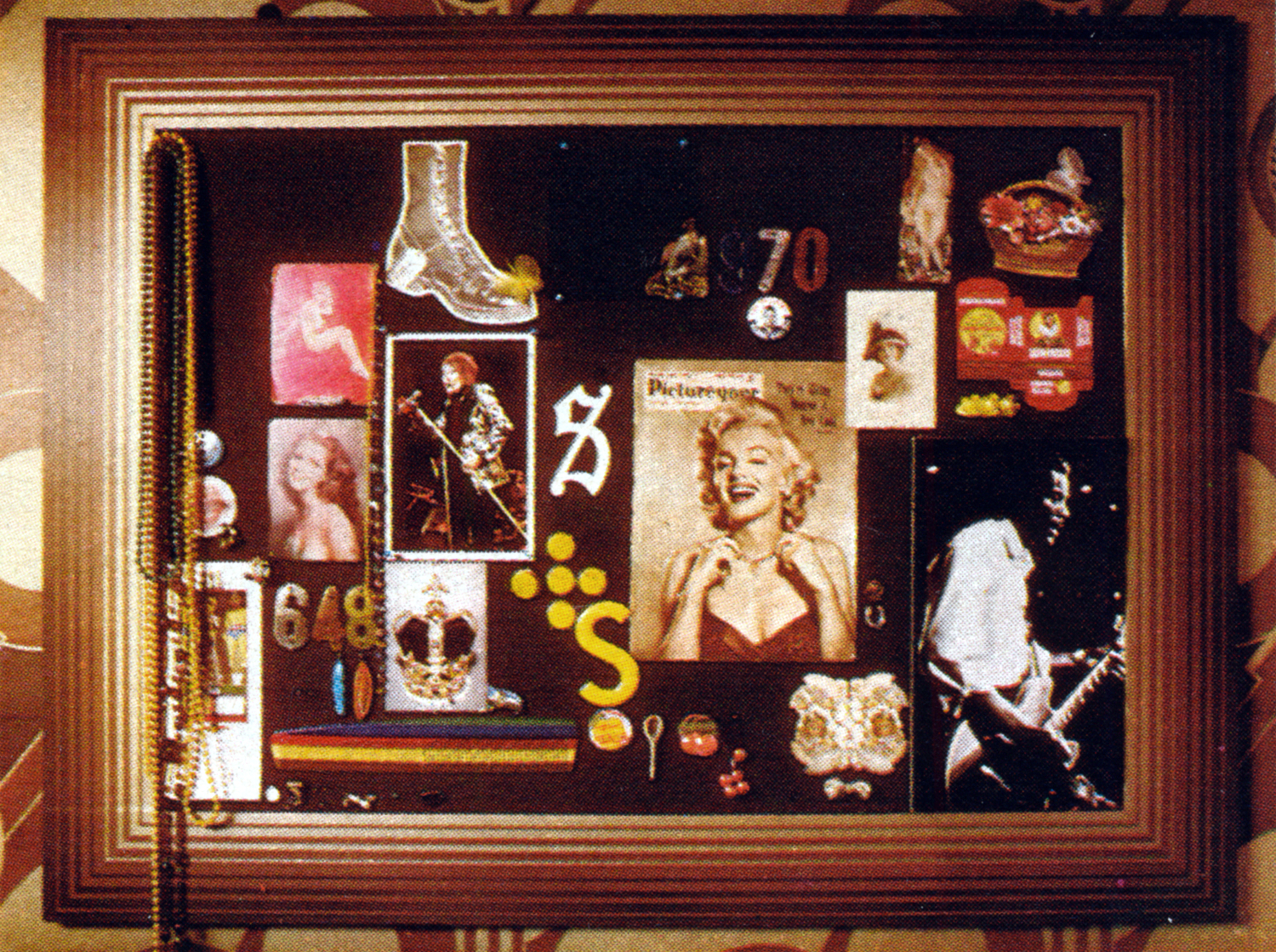
A pegboard livens up a dull wall and when painted and bordered with paper looks as if it’s meant to be there. Half-inch thick insulating board—again cut to required size— is super stuff for pinning notices on.
The bed is covered in brown velvet and scatter cushions. Everyone knows it’s a bed, but it doesn’t have to look like one and this way successfully forms an integral part of the room. An ugly wardrobe can dominate a bed-sitter, but is usually a necessary evil. Given the same treatment —paint, wallpaper trim — it actually looks pleasant and merges effectively with the wall.
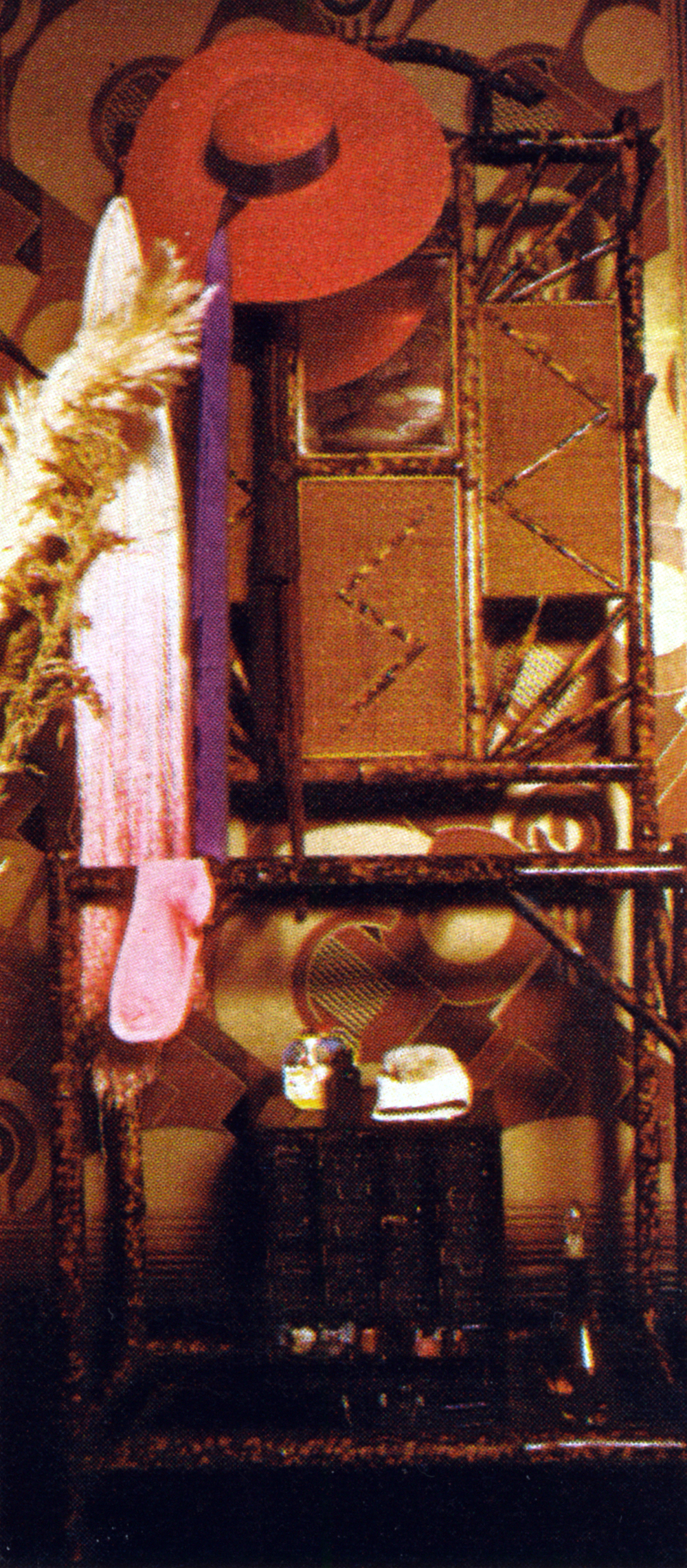
Judging by the jumble of sticks and pots in most girls’ bedrooms, storage space for jewellery and make-up is also a problem. Barbara’s cheap, chic and neat answer to this is a tin tool-box, stocked by most hardware shops. Painted and varnished, it looks really effective.
Text by Gwenda Saar.
All items from Biba, unless otherwise stated. Model’s clothes from Biba.
Photographs by Manfred Vogelsanger.
Scanned from 19 Magazine, February 1973.
Bamboo hat-stand from a junk shop. Dried grasses from a selection at Harrods. Tin tool chest, with plastic drawers, from Woolworth or Biba, £1.75, painted with Biba Brown Flat Oil, £1.80 per litre, and coated with clear varnish.
Noticeboard made from half-inch thick insulating board, cut to size, painted with Biba Brown Flat Oil, £1.80 per litre, edged with wallpaper border.

 Liz Eggleston