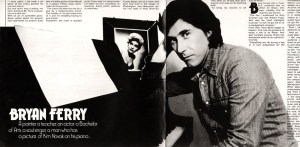
 This is Bryan Ferry of the dead-pan face and the doomy, recorded-some-where-out-in-space voice. One minute he and Roxy Music did not exist. The next minute they had arrived. An immediate hit with Virginia Plain, a best-selling album, then another hit single and album.
Then Bryan went and made a solo smash with a shockingly electronic version of Bob Dylan’s classic Hard Rain’s Gonna Fall. How sacrilegious!
Even worse, thought all the critics, was the way his voice went to work on some pristine standards, such as It’s My Party, The Tracks Of My Tears, and the almost unmentionable sin, a rolling version of a ‘Thirties’ evergreen, These Foolish Things.
”I must admit, I did freak a bit when all the critics panned my first solo album.”
But that didn’t stop it selling, nor fail to enhance Mr. Ferry’s reputation as a solo star.
With an air of controlled panic, Bryan paced about his ground-floor apartment in London’s Earls Court. He had two hours to go out, get his hair cut, pack enough clothes for a month-and-a-half tour of Europe, and leap on a plane for Sweden.
The phone rang fairly frequently. ”Sorry. wrong number,” Bryan answered in a disguised voice.
”My number’s still in the book—I haven’t had time to become ex-directory. And people keep ringing up and asking for Rod Stewart. It’s very mystifying.”
Despite some nice touches around his flat, such as ‘Fifties’ ashtray stands, and curious picture frames. Bryan insists he’d like a more pleasing home.
”The trouble is. I only sleep here and I don’t have the time to create the sort of environment I really want.”
A large grand piano, adorned with a framed photo of Kim Novak in a classic ‘Fifties’ pose, dominates the living room.
”The piano has been lent me for a year by a harpsichordist friend. The trouble is I’ve got really fond of it and I’m dreading having to give it back.”
Elswhere, the room is stacked with records. Mostly old numbers.
”My inspiration, in a lot of cases, for the things I’ve written,” Bryan explained, and put on a Staple Singers album. But one can learn more about Mr. Ferry from his books than his records. Cole Porter, Shakespeare, tomes of art history, Edna O’Brien, The Carpetbaggers, Portnoy’s Complaint—funny books, beautiful books and old books.
As one might expect, the urbane Mr. Ferry is clearly no helpless bachelor, surrounded with empty tins and overflowing ashtrays. His home is immaculate to the point of being unlived in.
”Probably what I didn’t realise when I got involved with Roxy was that rock music means total commitment. You just do not have any home life or any social life at all. That’s why I’m never home. I’m either on tour, recording, rehearsing, doing photo sessions or interviews.
”For me to organise just going to the pictures is a major or event and practically impossible. Probably the only social thing I ever do is to go out to dinner—but that’s often to talk business. I’m not complaining about it, but I like to think that the time I’m putting in now will earn me a bit more time later in life.
“As it is at the moment, I m missing things such as exhibitions at art galleries, which I’d like to see, but I’ve resigned myself to the fact that my life is not my own any more.”
The paintings on Bryan’s walls, his desire to see exhibitions, his art books, give some clue to his rather unusual background.
“At school, I decided I was to be a great artist! But somehow I got side-tracked into music.”
Young Bryan, son of a miner and born and bred in the village of Washington, near Newcastle, got his first taste of what show-biz was like at the age of eleven.
”I won a Radio Luxembourg competition where you had to place Bill Haley’s hits in order of merit. The prize was an LP and a ticket to see the band in action. I’ll never forget those ridiculous tartan jackets they wore and the way they jumped about on stage, playing rock ‘n’ roll.
”I went to university still determined to be an artist. But I’d joined a soul band and, ultimately, I had to take the decision whether to concentrate on music or try to get a degree in fine arts.” For the time being, fine arts won. Bryan gave up music, and worked hard for three years to gain his Bachelor of Arts degree while attending Newcastle University.
”Although that set me back perhaps three years in terms of music, I don’t regret it. The people I met at university influenced me, established a life-style. I wouldn’t be what I am today if I hadn’t been there. And yet, still I felt more involved in music. I’d had to drop out of the band I was in when I decided to work for my degree, so that didn’t exist once I’d left university.”
Much to the bewilderment of his parents, Bryan decided not to pursue a future as an artist.
“I found I could write songs, so I decided I’d have to come to London— and so I did, but nothing happened for three years. “I did all sorts of things to keep myself going. I taught art at a girls’ school, which was quite nice. They were all 16-year-olds and I was the only male on the teaching staff!
”I’d bring my records to art classes and they’d bring their reggae records. It was more like a disco. I don’t know if I was a good teacher or not. I did other jobs, such as working in antique shops and delivering goods.”
But with time passing, he wasn’t established as a singer.
I was twenty-five and beginning to think it was too late, and that I was getting too old.”
Then a reunion with a member of his old soul band led him to success with Roxy Music.
‘We rehearsed for a year and then I started trudging round the record companies with tapes. None of them wanted to know. They looked really puzzled when I played them our music, and was told to come back in three months’ time. They always asked to keep the tapes, though, and I wouldn’t ever let them!”
Being forced into a ‘hustler’s’ existence was an effort for Bryan, who says, credibly, that he is quite a shy person. “One day I auditioned for King Crimson and met Robert Fripp, who was the most intelligent musician I’d met. He put me on to a management company.”
From then, Roxy Music began to happen. And now the pressure of being a star is on Bryan. And with constant touring, Bryan has discovered what life as a performer is like.
“Everything you do during a day is, in fact, preparation for the one hour spent on stage that evening. It’s a ritual of building up towards a climax. I do get nervous before ! go on stage. I need to, and I work myself up to it. To such an extent that with each performance—which seems to pass very quickly—it takes me at least two or three hours to come down afterwards.
“There is so much tension inside when you finish performing that I can well understand why some rock people find it necessary to smash up hotel rooms.
”The problem is that when we’ve finished playing there is never anywhere, except an hotel, where we can go and unwind. Everything is always shut down by then.”
Bryan remembered that he should have been at the fashionable hairdressers Smile half-an-hour before—jumped into his small beaten-up car and drove there.
At Smile, he removed a long Navy surplus-type raincoat and velvet jacket. (The off-stage Bryan Ferry is certainly a different proposition to the glamorous, space-suited figure he cuts with Roxy!) He got the kind of reception any regular customer expects.
“Shall I take your jacket, sir?” asked the receptionist.
“Hold on,” he replied, “I’ve already taken two coats off!”
“I feel one must appeal to an audience on as many different levels as possible. It’s not enough to give people music to listen to. They need something to look at, as well. That’s why we’ve worked so hard on the visual image of Roxy Music.”
Along with David Bowie, Roxy Music certainly helped bring glamour back to rock music. But as the Top-Ten glitter pop groups cheapened the idea, it’s been noticeable that Bryan Ferry has taken to wearing black suits and white shirts, or vice versa. Whatever his apparel, there’s still the melodramatic stare and the gaunt, distant blue eyes which distinguish him.
When asked about his, as yet, unexpressed ambitions, he admits that films hold a great deal of fascination for him.
”I did quite a lot of acting at school, and I was quite actively encouraged to pursue it—but music and art were foremost. But I’m still interested and I’d like the idea of co-directing.”
For now, though, his immediate aim was to get his hair dried, pay the bill, get packing and catch that plane.
Across the road from where I live, someone has written in white paint: Roxy Rule, OK. A phrase Bryan Ferry popularised himself. After the successful conquest of Europe and a tour of America, it seems, somehow, a rather fitting tribute. ANNE NIGHTINGALE
19 Magazine, March 1974
Oh! to have had Bryan Ferry as my art teacher!





 Liz Eggleston
