

The dress is uncredited but it looks like a Bill Gibb to me.
Photographed by Justin de Villeneuve.
Scanned from Petticoat, 16th October 1971.


The dress is uncredited but it looks like a Bill Gibb to me.
Photographed by Justin de Villeneuve.
Scanned from Petticoat, 16th October 1971.


Fashion constantly starts afresh and now it has travelled far back into the imagination, retuned to the basics of craft and design. Grass roots is the mood for this summer and the look is handwoven, hand painted, handknitted, handstitched. Here is how appliqué was recreated and a shepherd’s smock came in from the fields. How lace came to be painted with butterflies and sewn onto tartan, how knitting grew into something remarkably new.
Illustrations by Antonio
Scanned from Vogue, July 1970.


Originally published in Vogue, 1973.
Photographed by Norman Parkinson.
Scanned from Lingerie in Vogue, 1981.


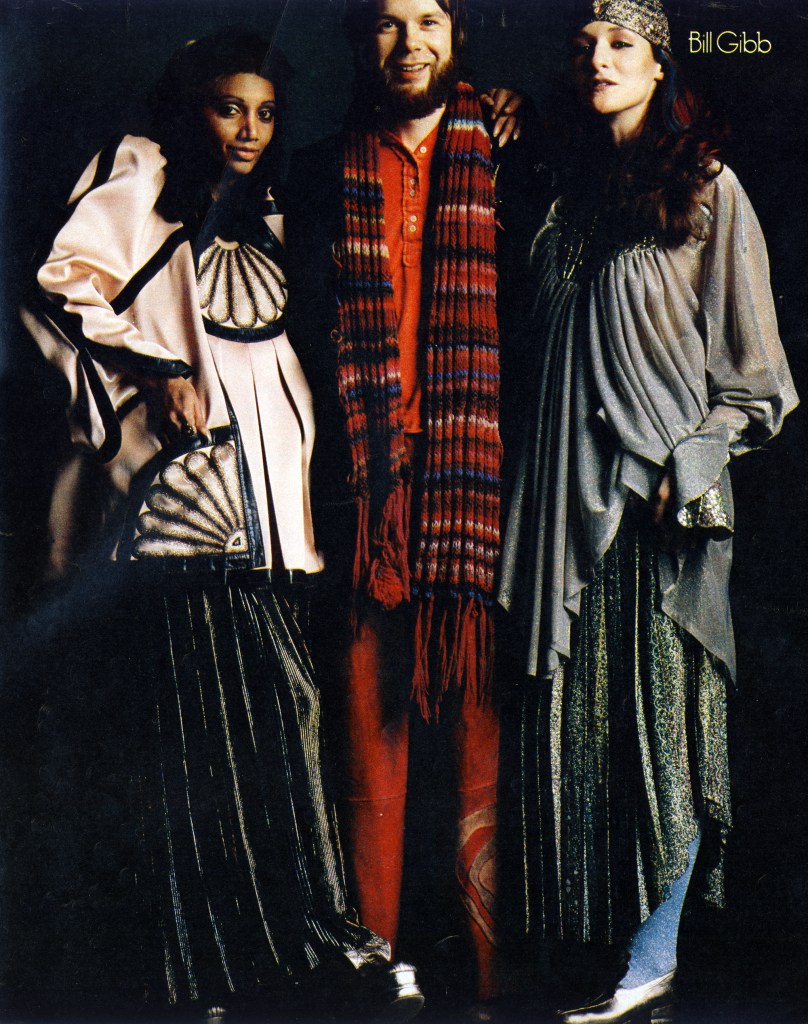
I was mainly scanning this spread because I’ve just listed a Zandra Rhodes dress which I think must be from the same collection over on Etsy, but thought I might as well put them here too – especially because of that iconic Bill Gibb photo (used for the cover of Iain R. Webb’s definitive book about Gibb, seemingly fetching a pretty penny on Amazon these days). These top-stitched jerseys were a signature look for her in this period and mine also has the Piero de Monzi label. Marc Bolan had a top version in various colours and levels of frilly extravagance.
(If you’re interested in the Zandra Rhodes dress, click here to view it on Etsy.)
Photographed by Clive Arrowsmith.
Scanned from Vogue, September 15th 1972.


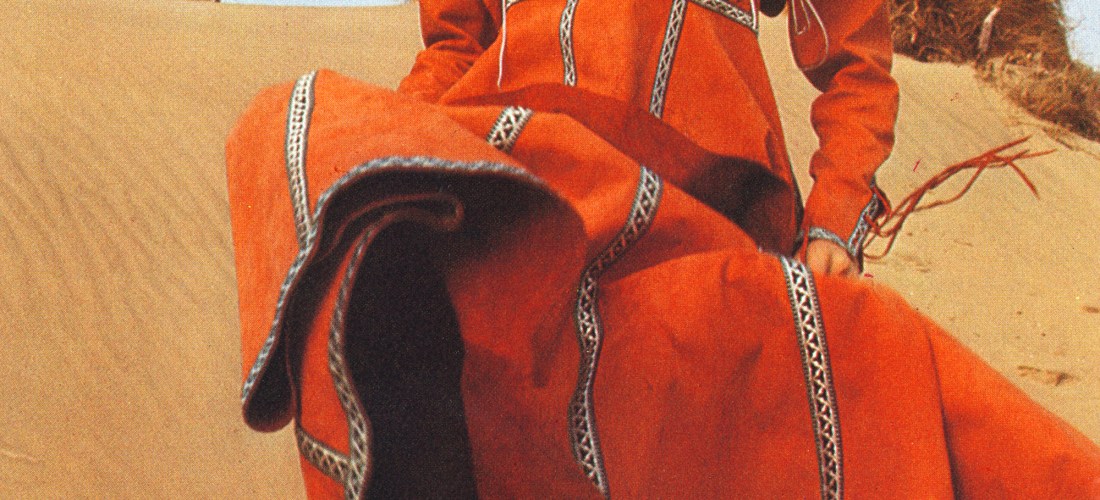
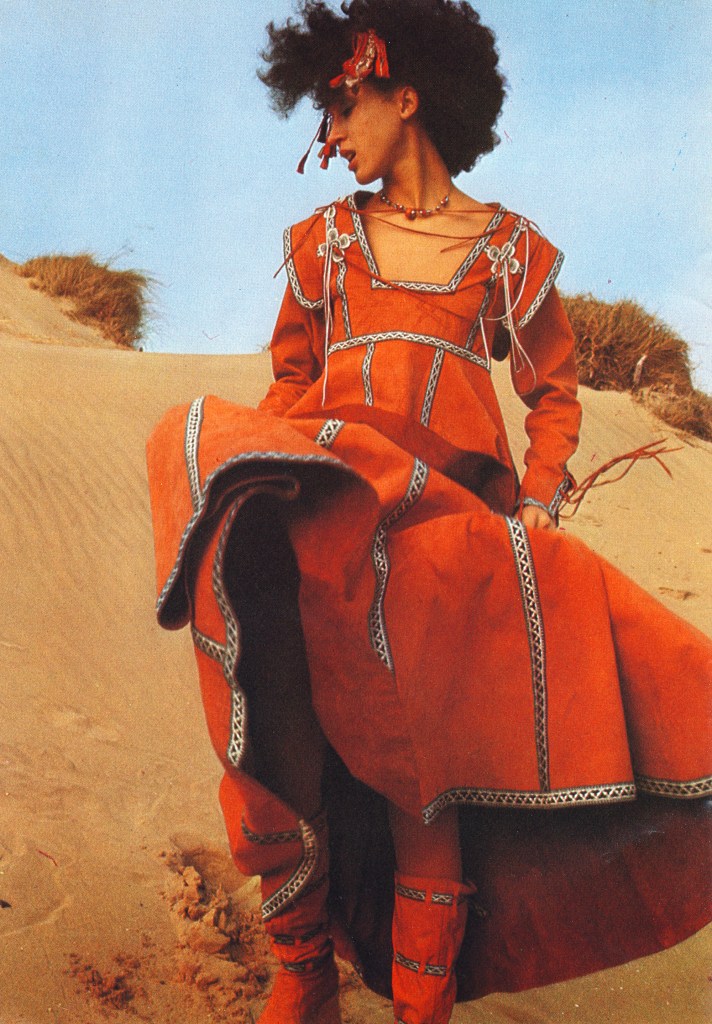
Scanned from Suede and Leather Wear by H. Dorothy Organ for Dryad, 1972.
Photographer and clothes are uncredited (“intended to provide the reader with ideas for their own designs”). The model is Pat Cleveland and the clothes are by Bill Gibb.
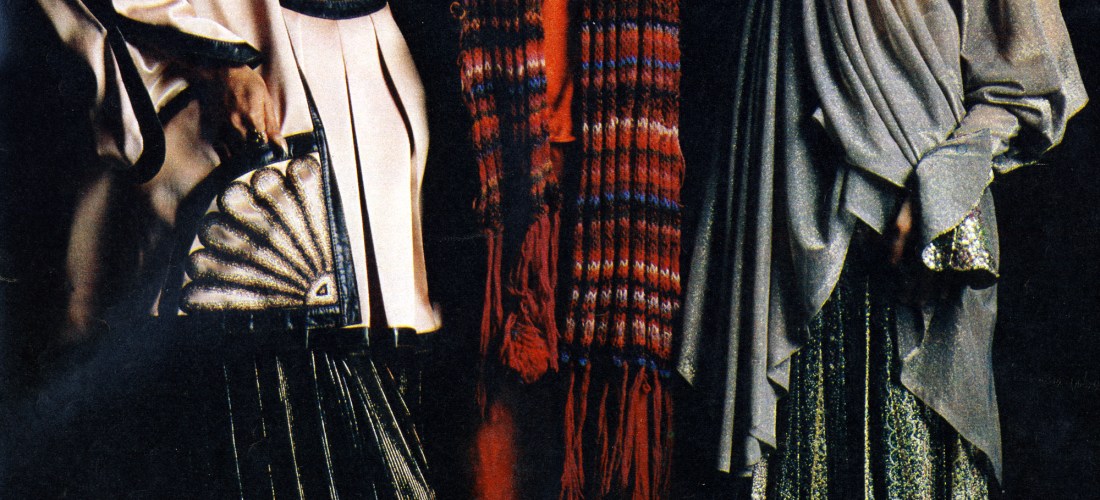
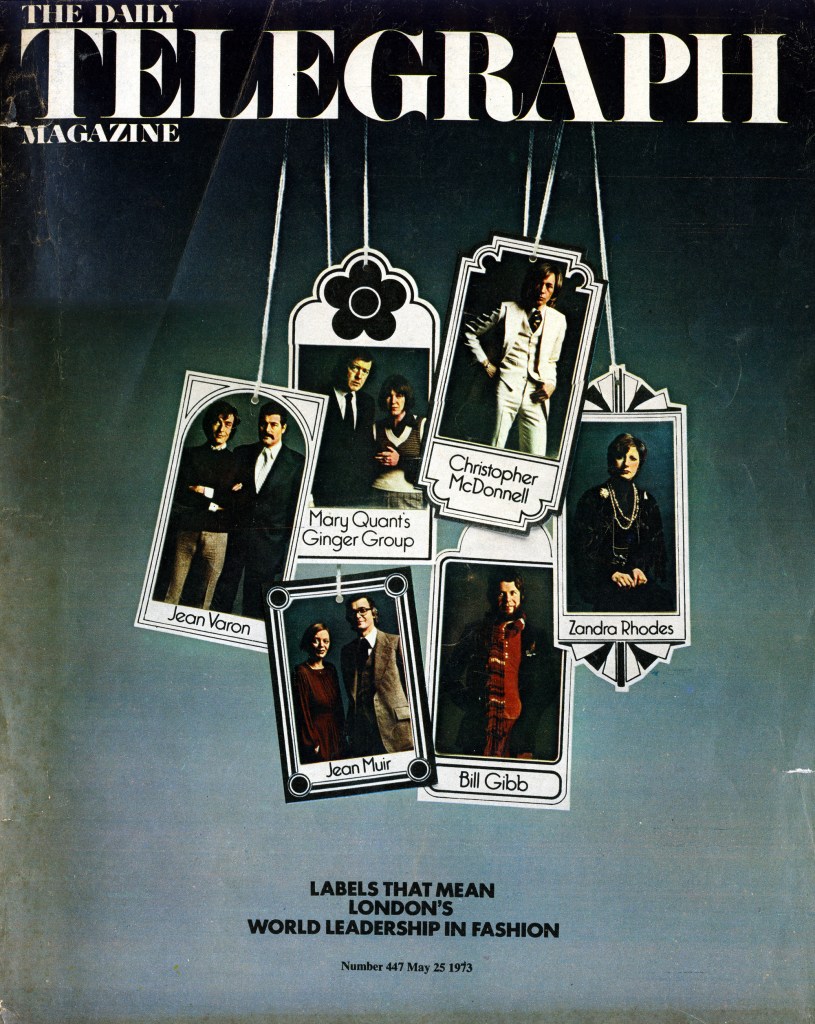
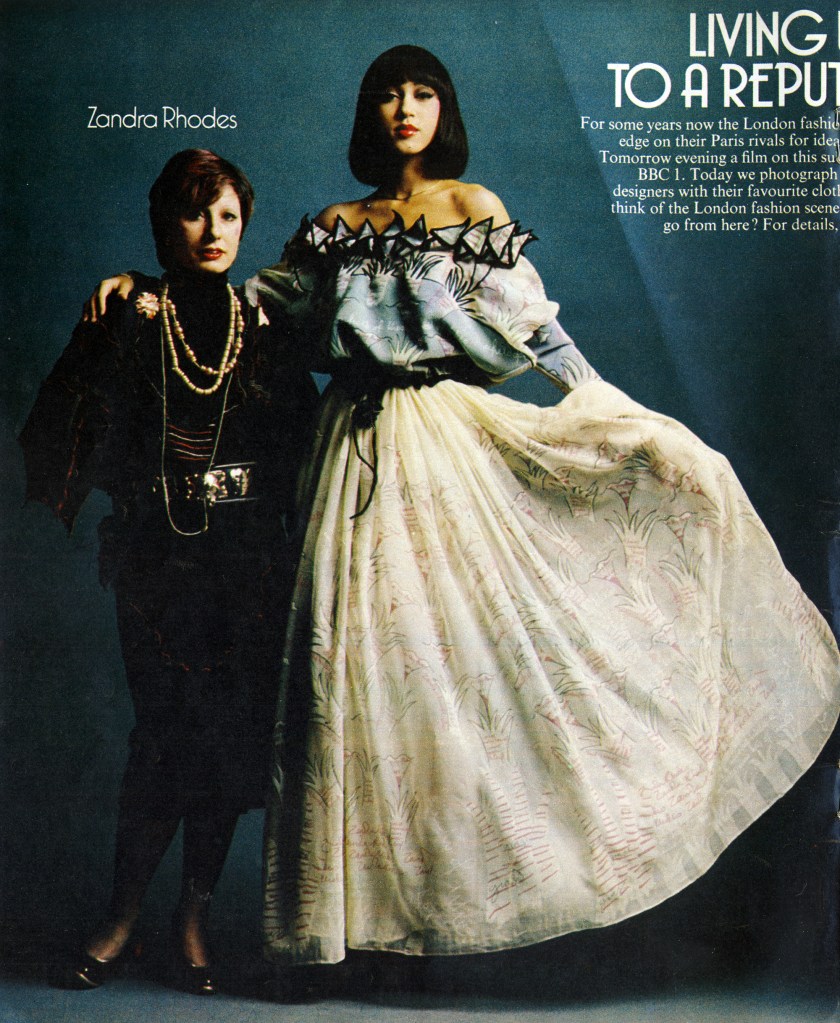
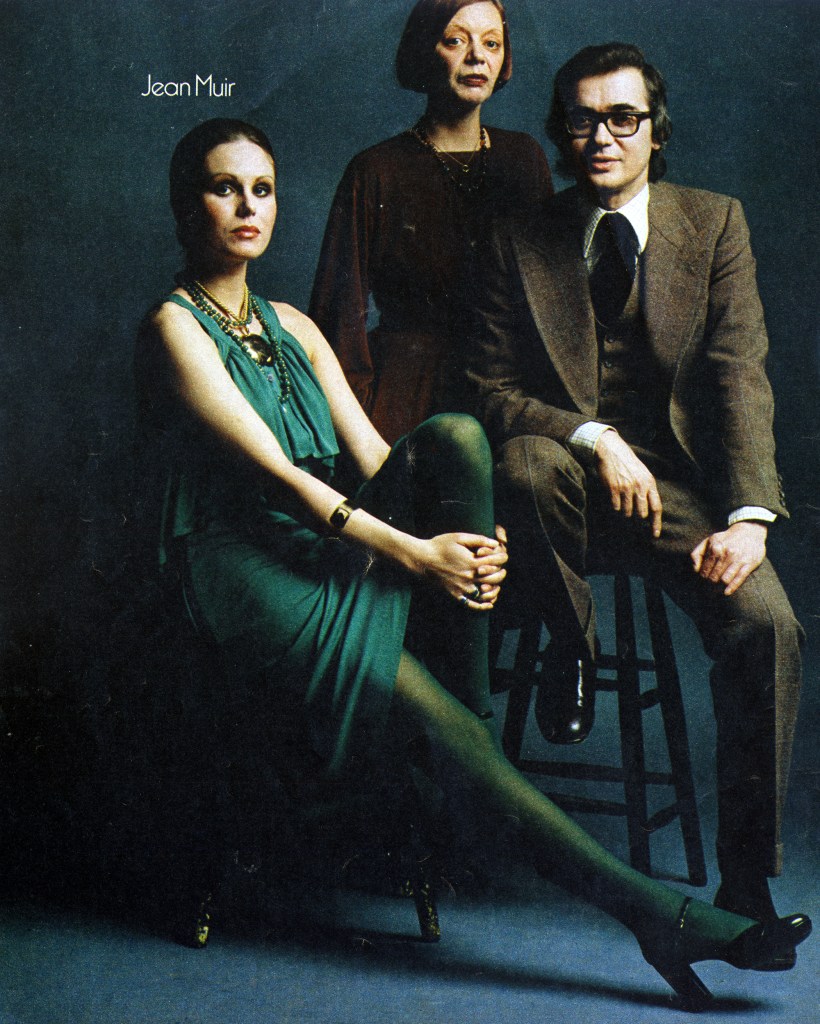
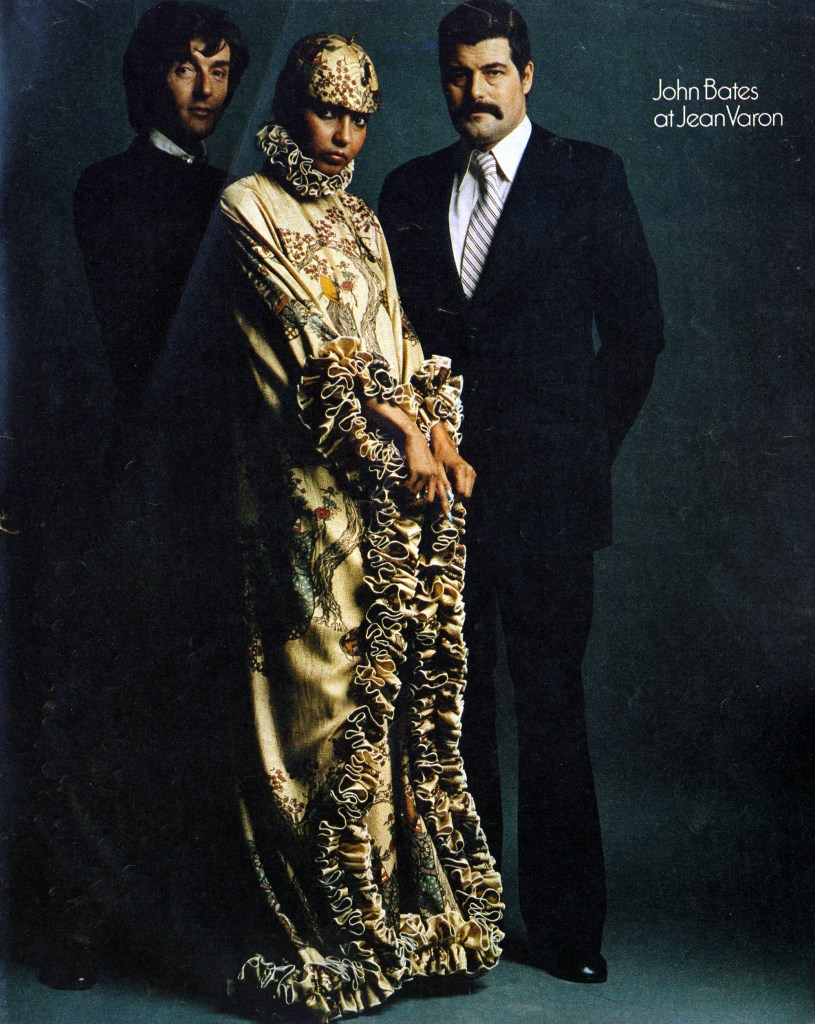
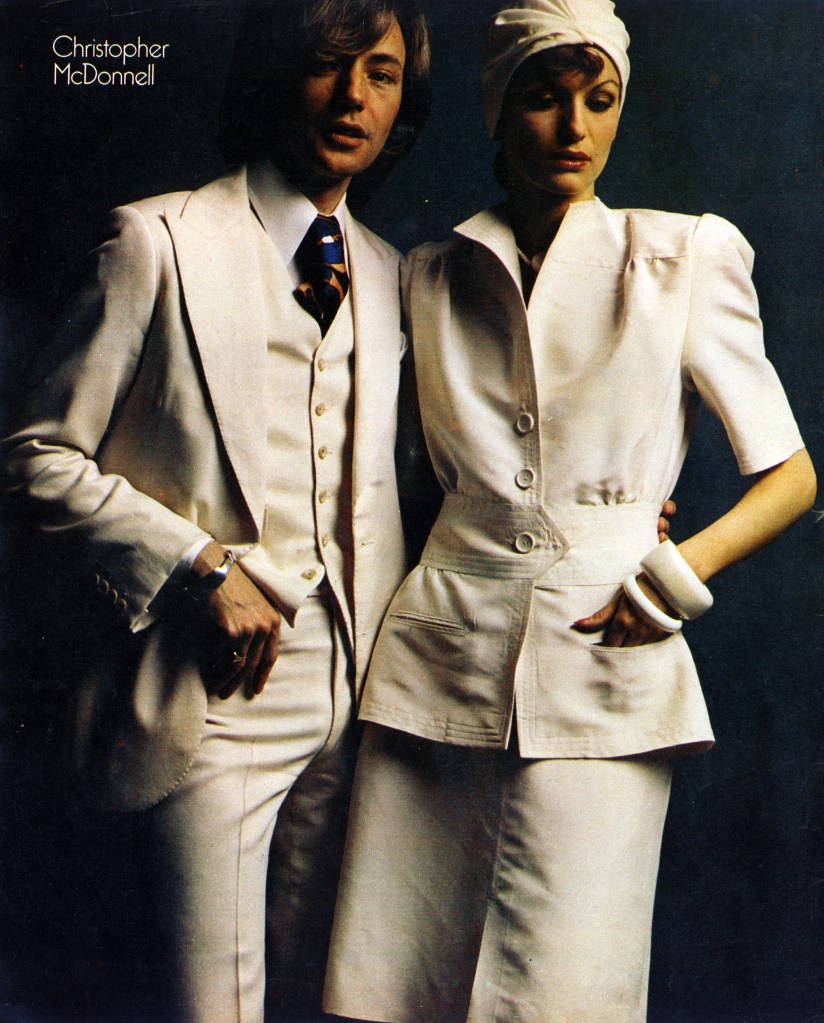
For some years now the London fashion designers have had the edge on their Paris rivals for ideas and innovations. Tomorrow evening a film on this subject will be shown on BBC1. Today we photograph the key London designers with their favourite clothes. What do they think of the London fashion scene? Where do we go from here?
Photographed by Terence Donovan. Fashion by Cherry Twiss.
Scanned from The Telegraph Magazine, May 25th 1973.

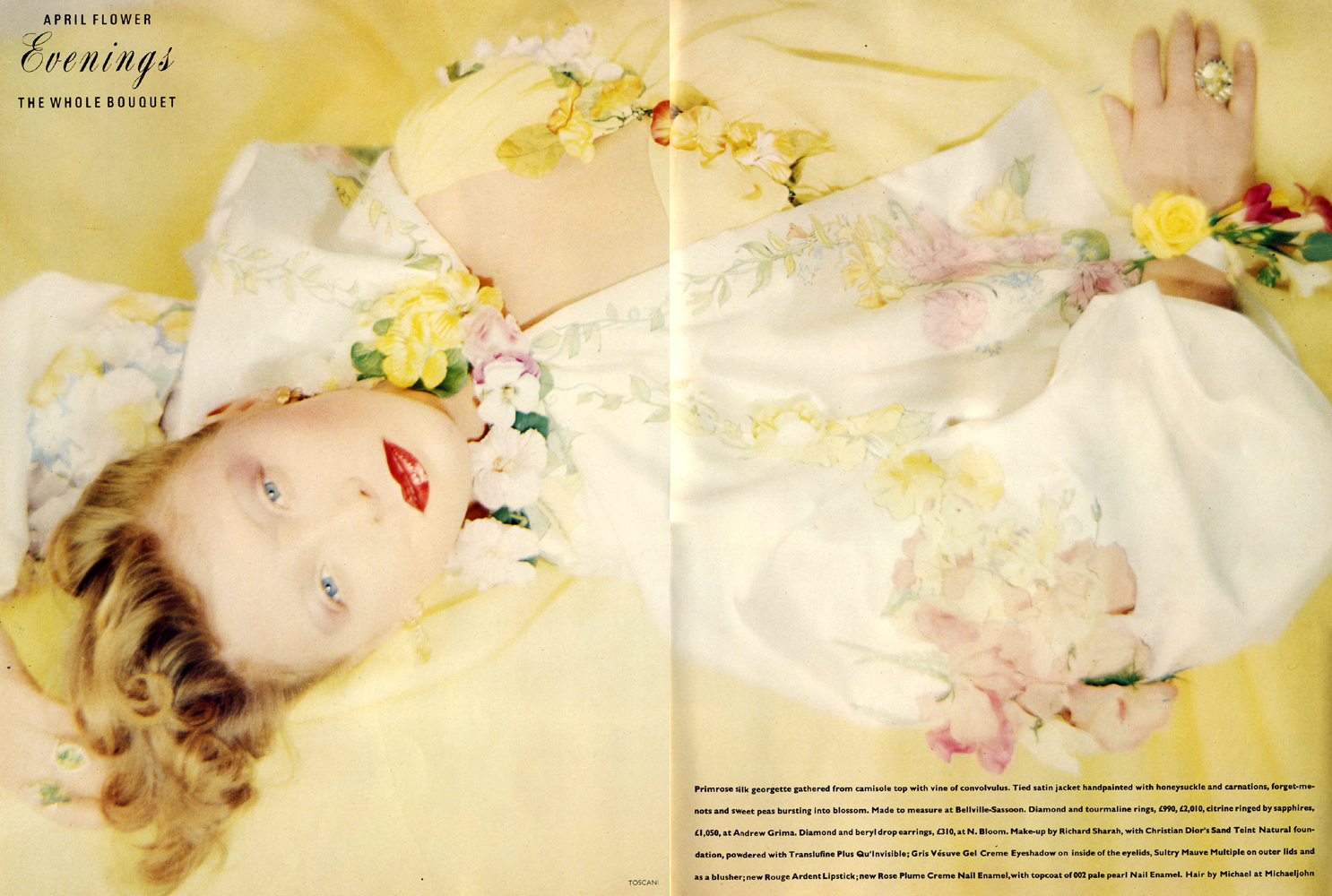
Primrose silk georgette camisole top and handpainted satin jacket by Bellville-Sassoon.
Delicate flower evening dresses, in silks and chiffons… Beauty far beyond the English flower garden…
Photographed by Toscani. Make-up by Richard Sharah.
Scanned from Vogue, April 1975.
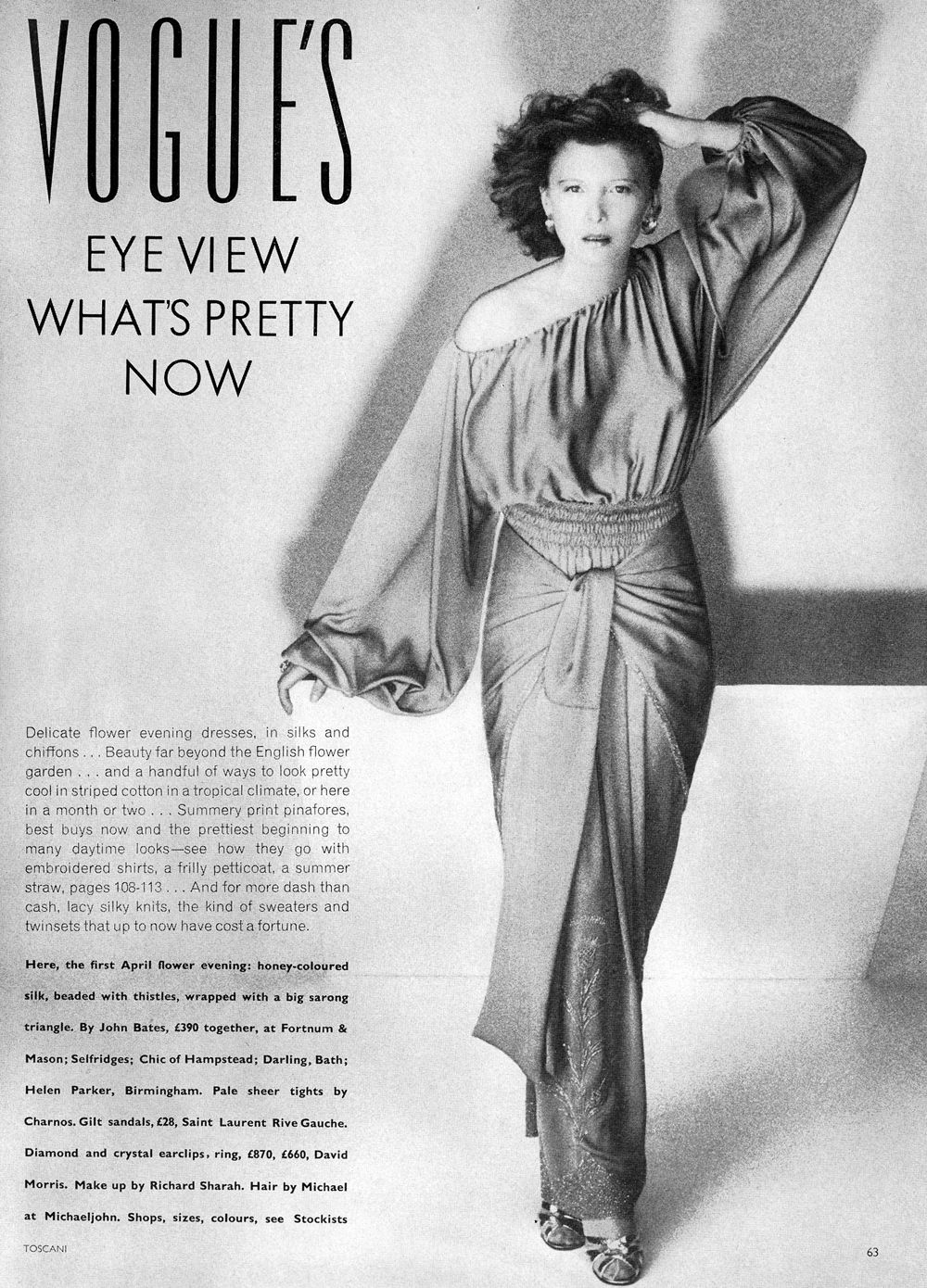
Honey coloured silk dress by John Bates. Sandals by Saint Laurent Rive Gauche.
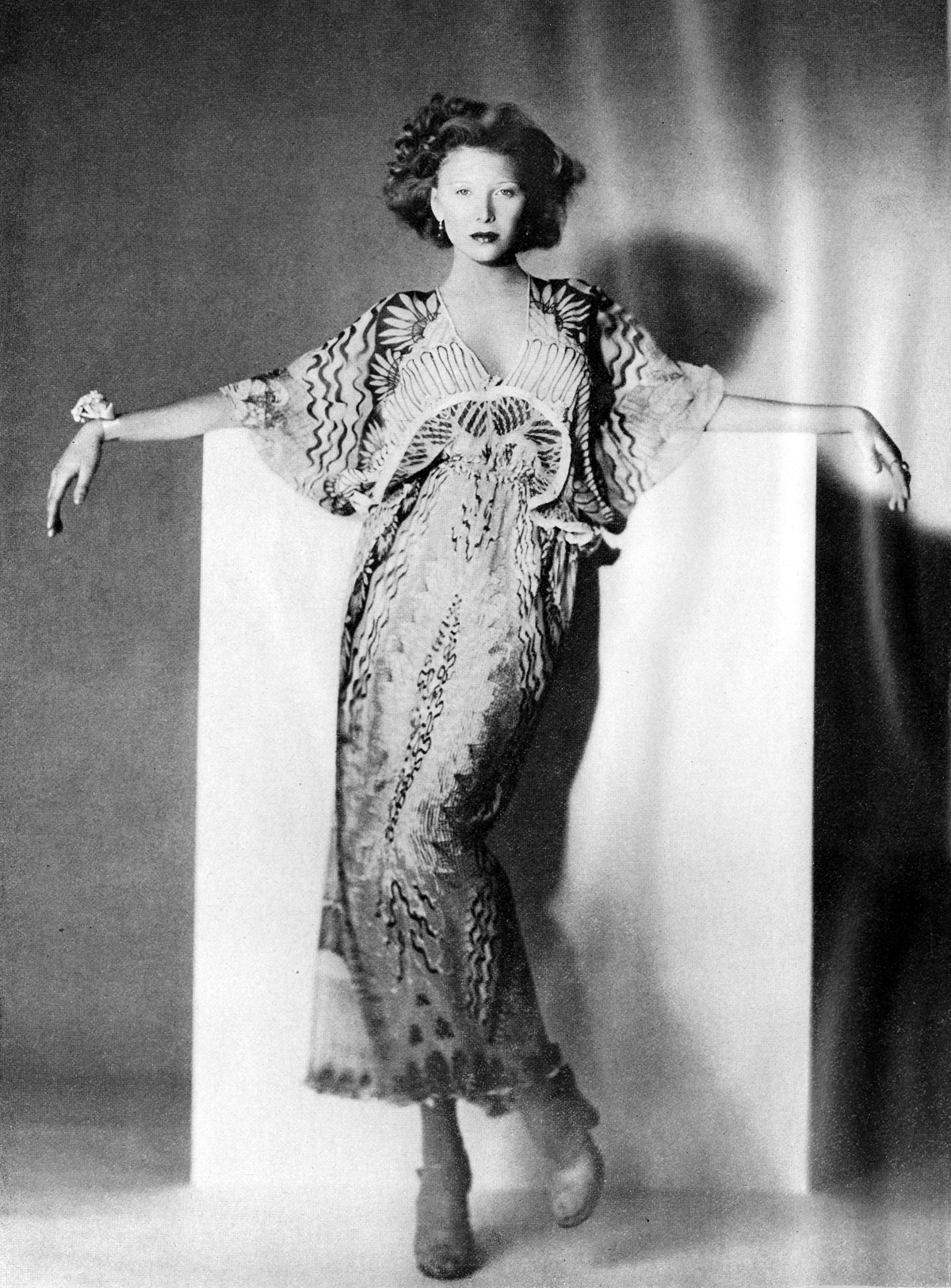
Silk chiffon by Zandra Rhodes. Pink sandals by Rayne.
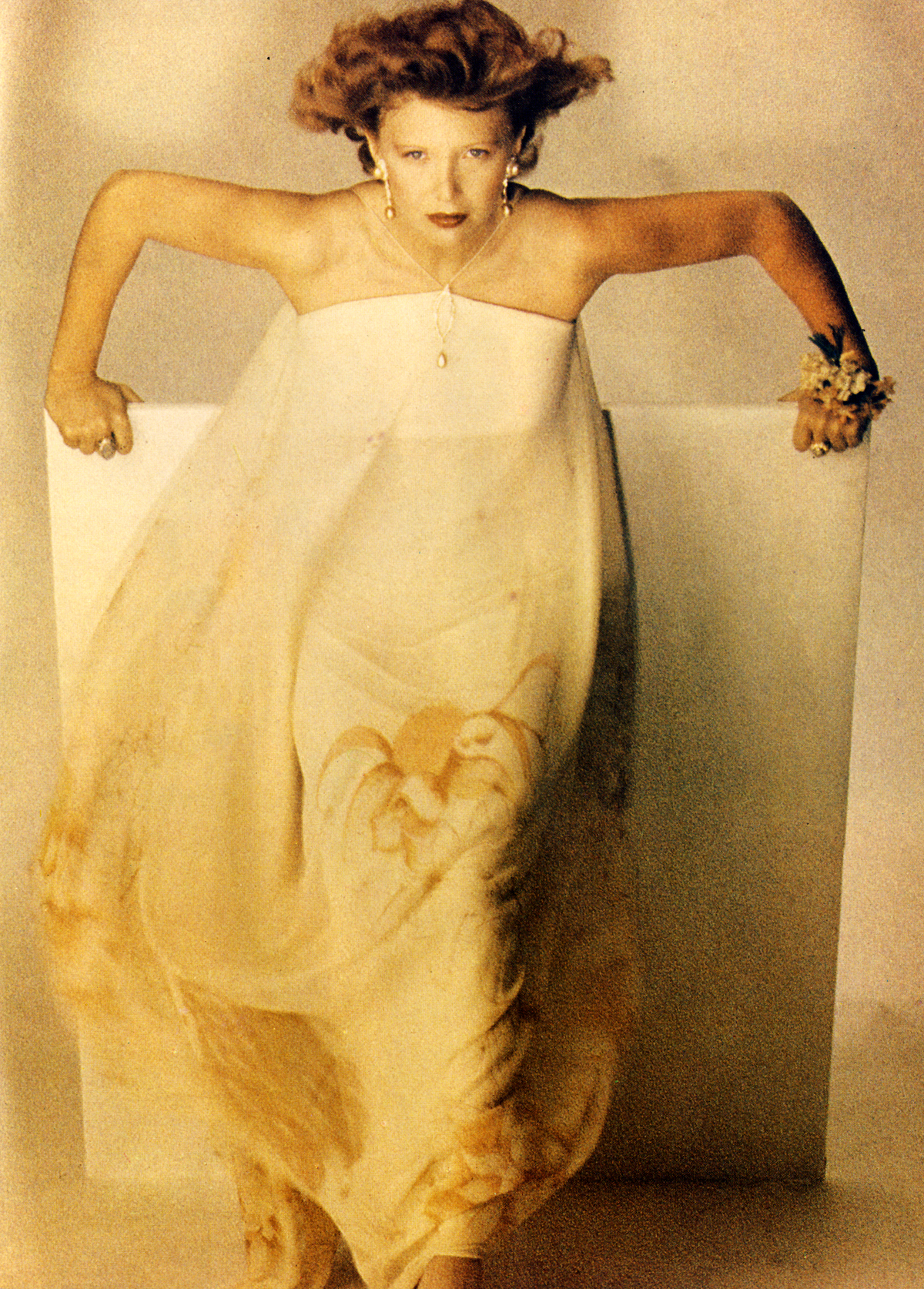
Banana silk georgette printed with apricot flowers by Yuki.
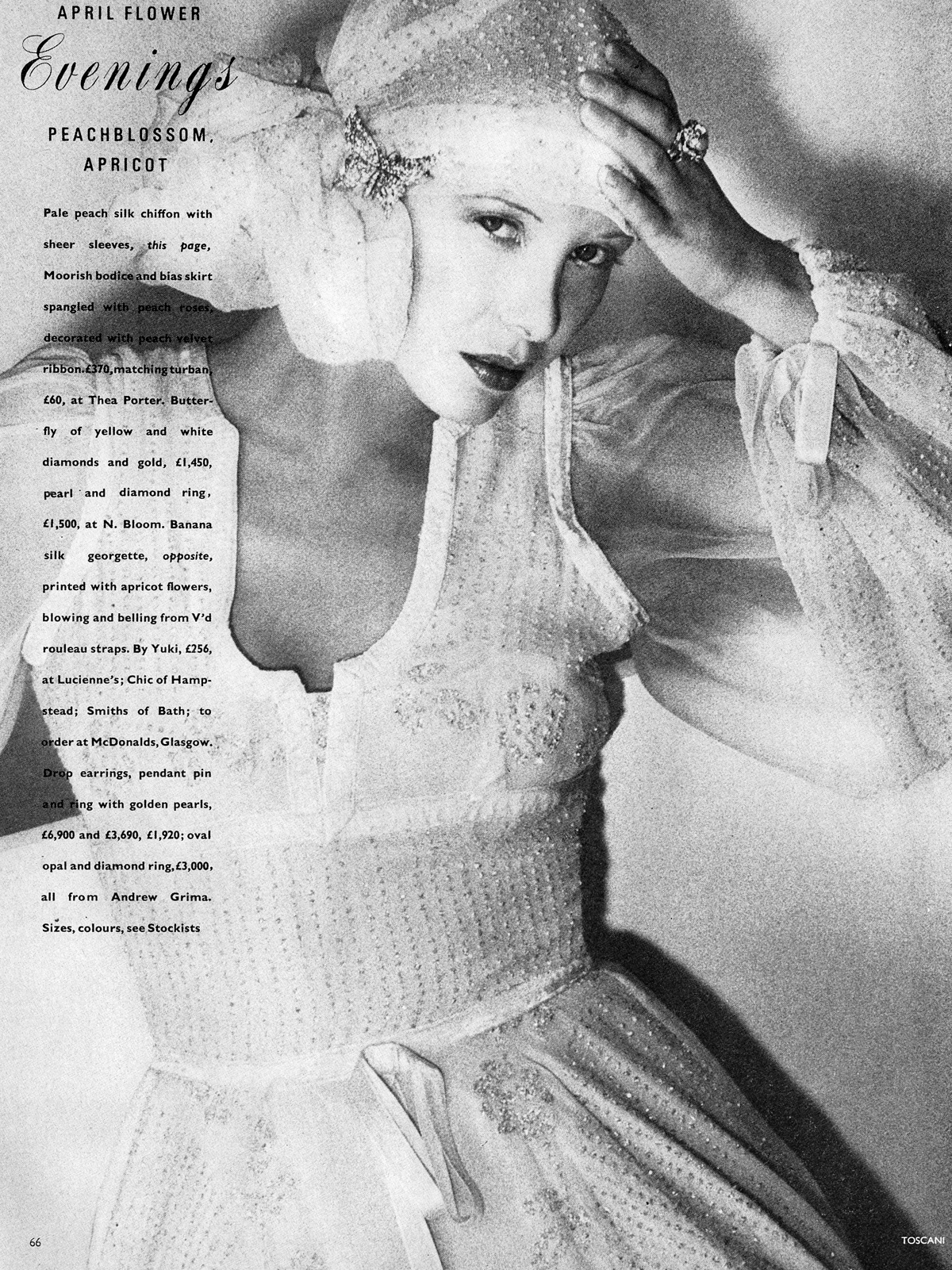
Pale peach silk chiffon with sheer sleeves by Thea Porter.
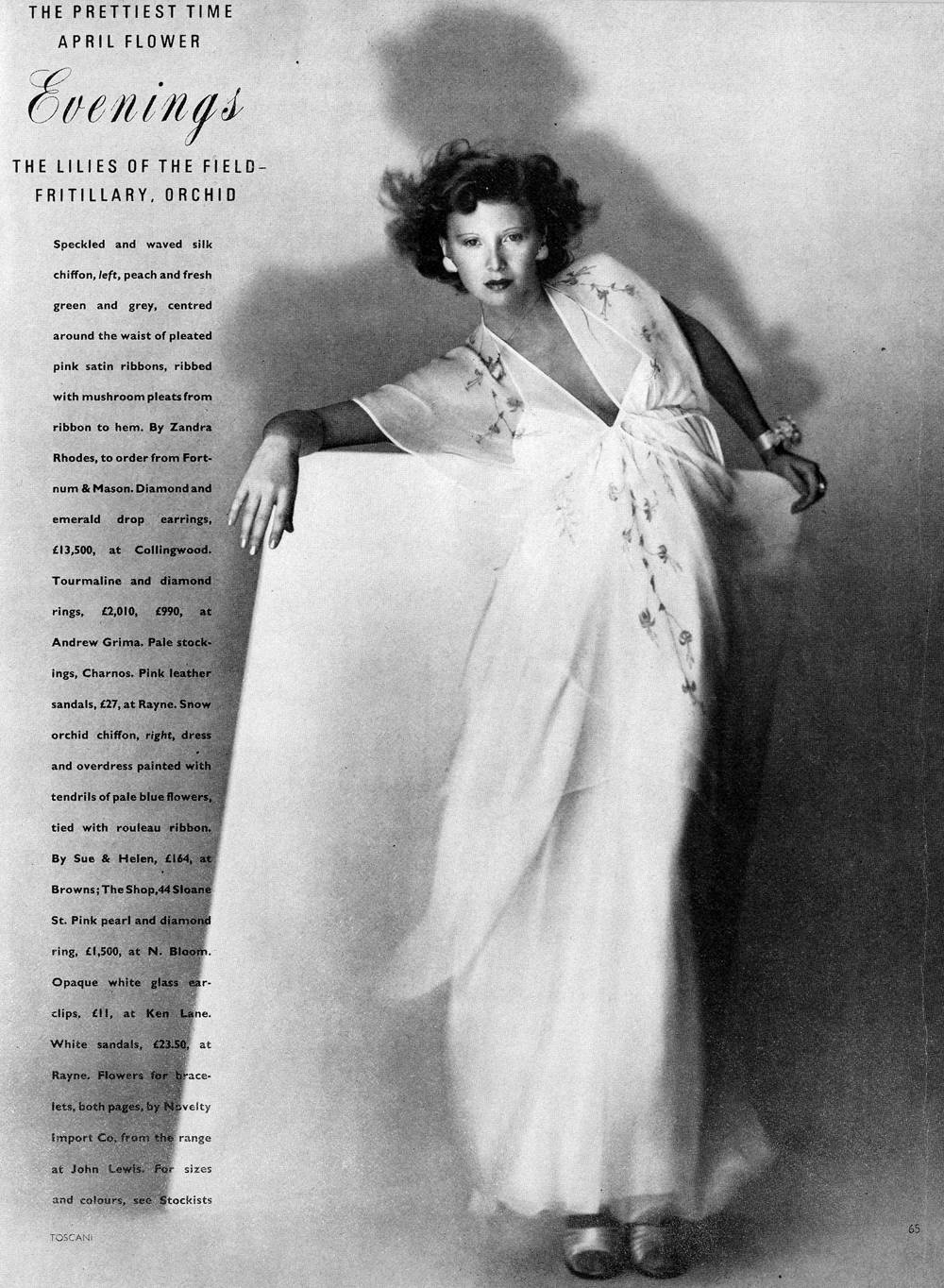
Snow orchid chiffon by Sue & Helen. White sandals by Rayne.
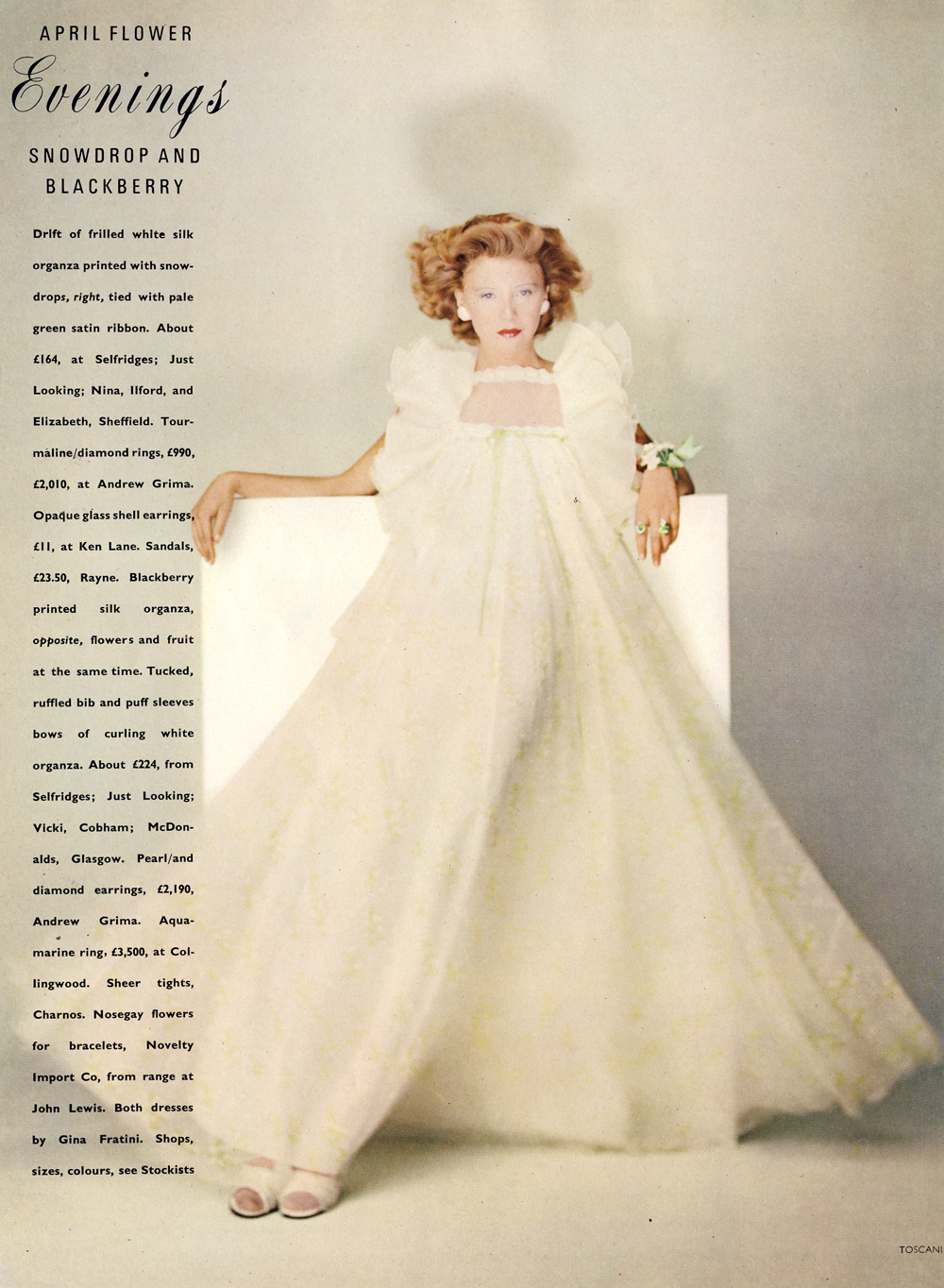
Drift of frilled white silk organza printed with snowdrops by Gina Fratini. Sandals by Rayne.
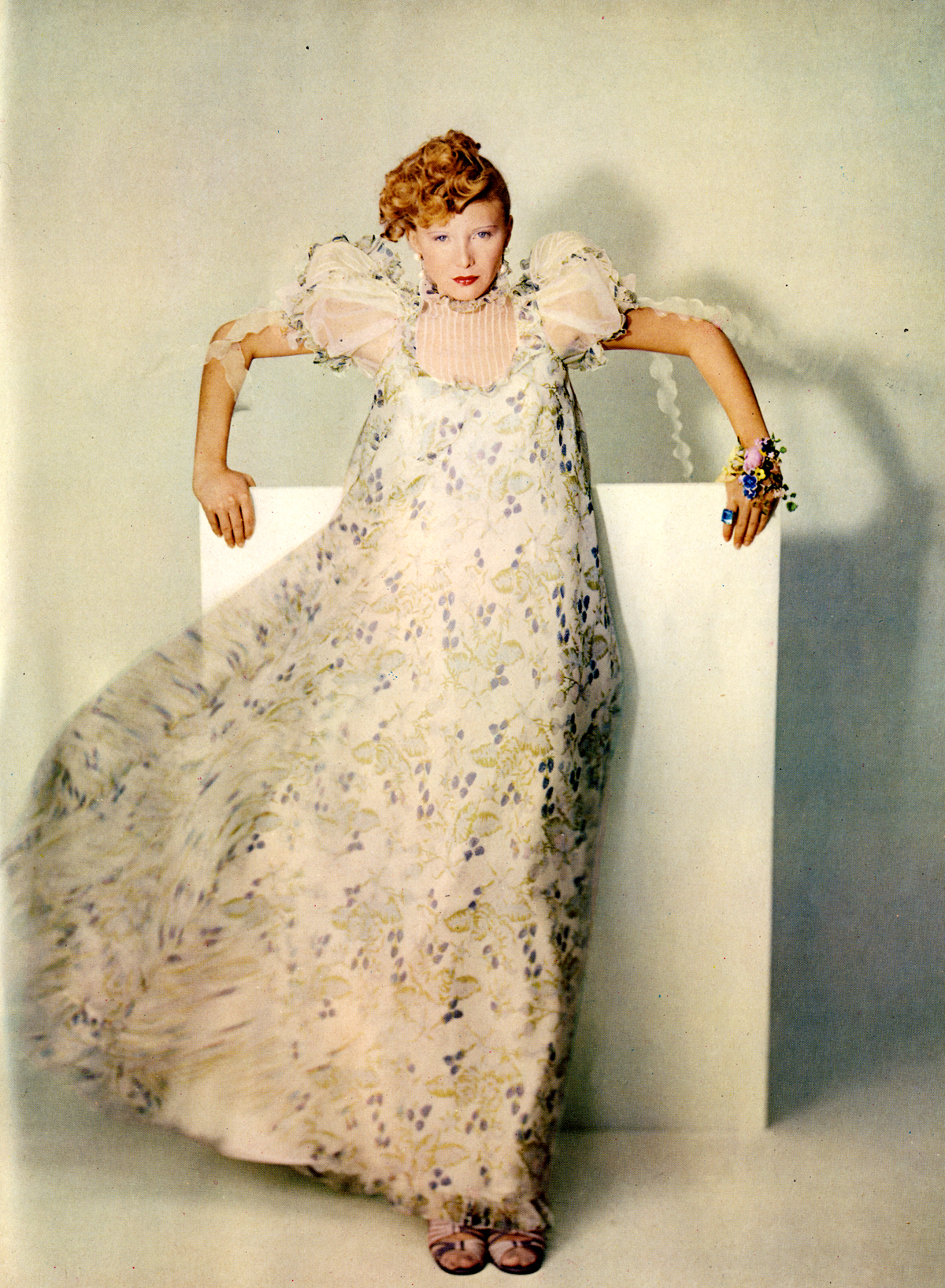
Blackberry printed organza by Gina Fratini.
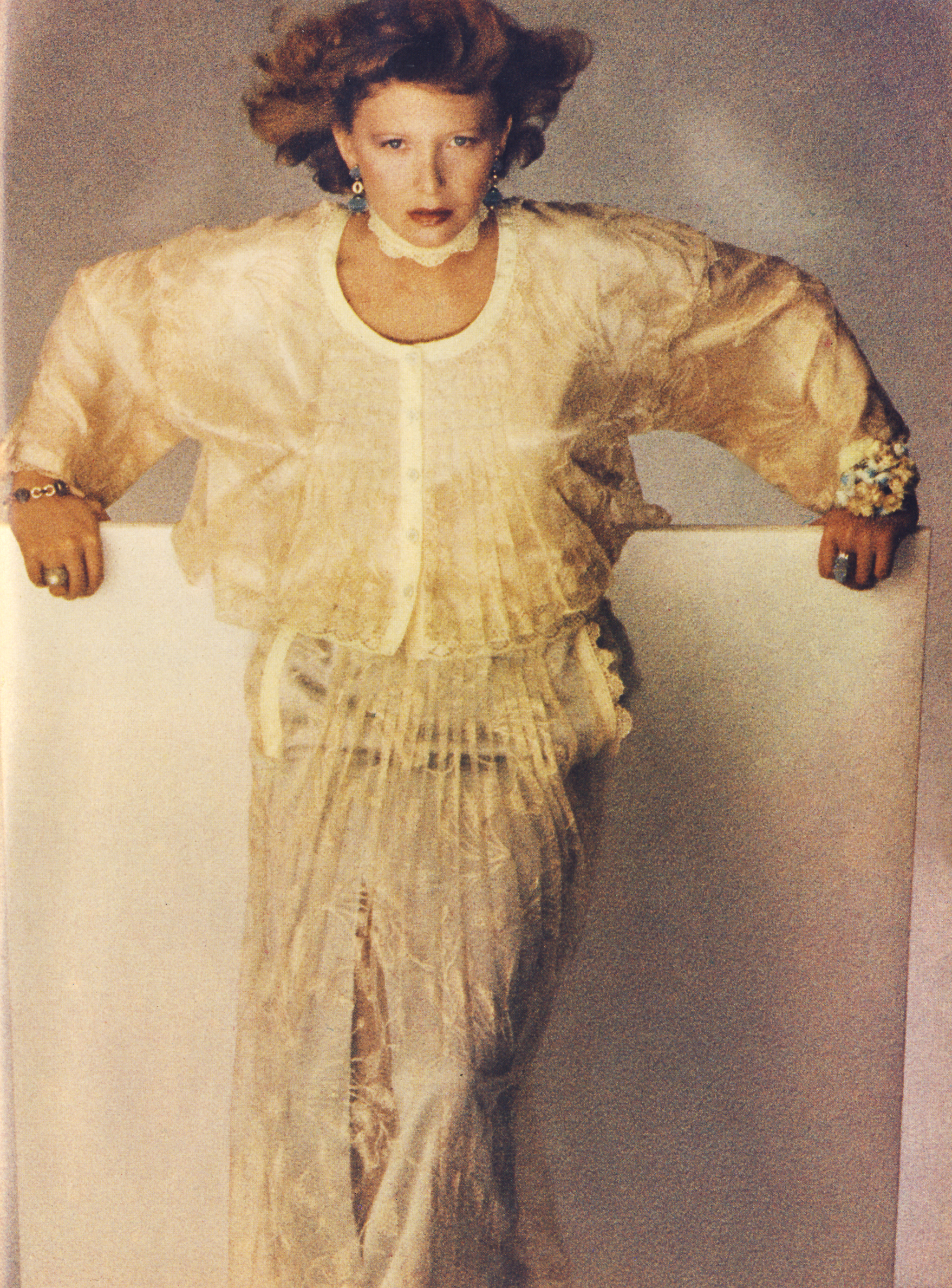
Cream lace jacket and skirt by Bill Gibb.
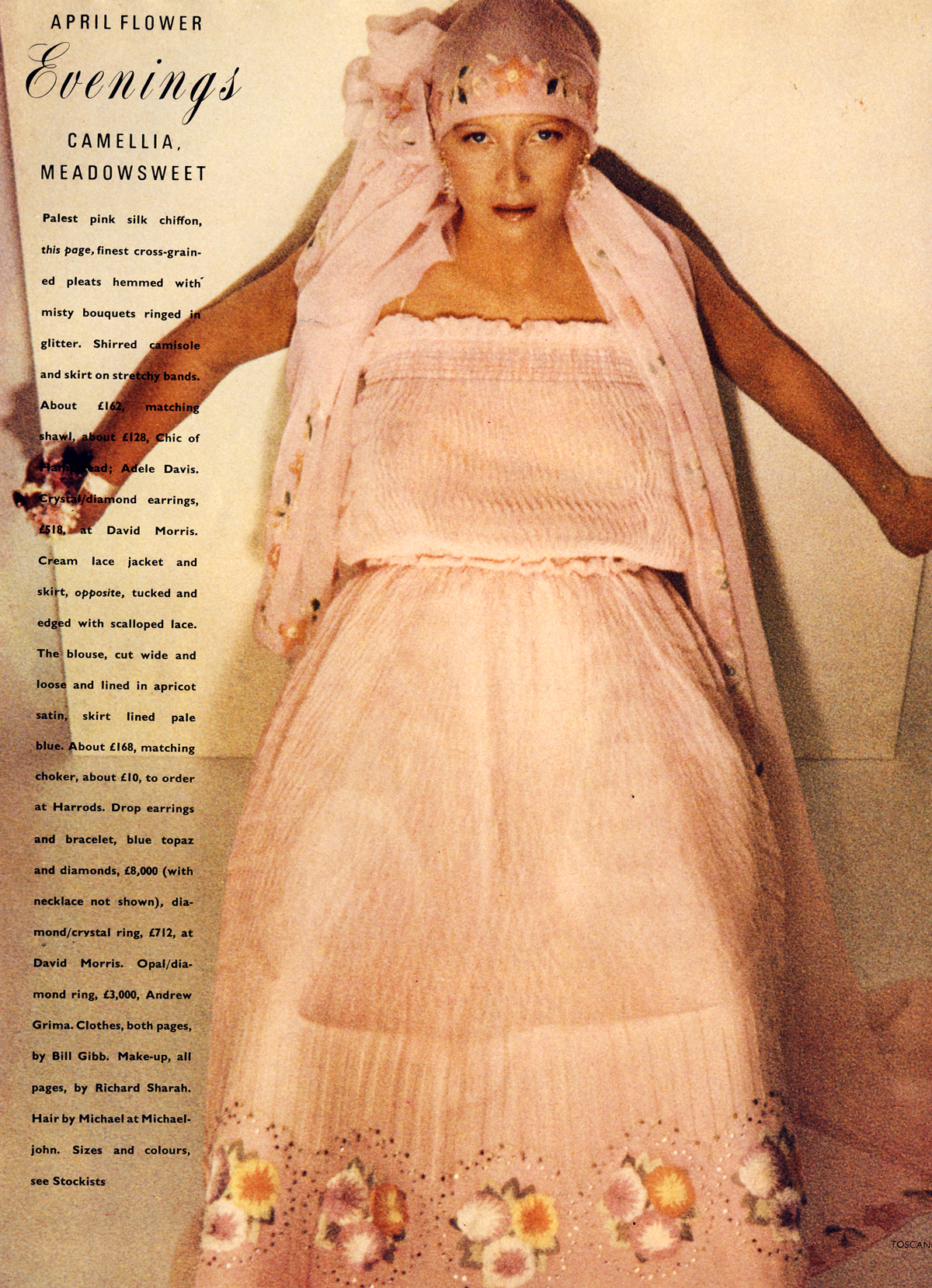
Palest pink silk chiffon by Bill Gibb.
Photographed by Carin Simon.
Scanned by Miss Peelpants from Cosmopolitan, March 1975.
Sarah Drummond talks to six talented people about their highly original hang-ups.
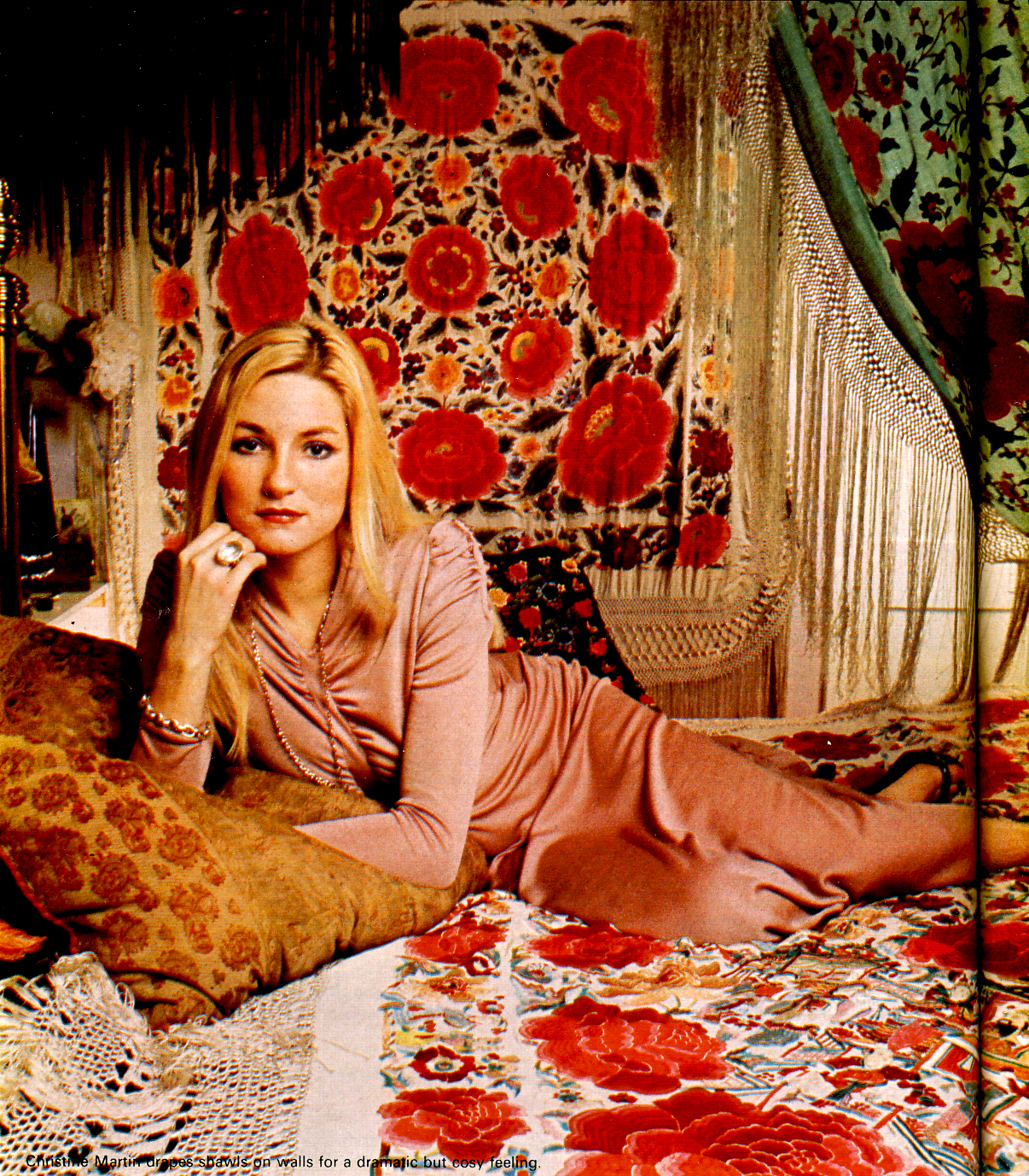
CHRISTINE MARTIN hangs shawls in her shop Razzmatazz (12 North End Rd, London W14, 01-603 0514) where she sells ‘Twenties and ‘Forties clothes, and also in her home. Both places are diminutive, but that doesn’t stop Christine from fanning shawls on walls, canopying them over lamp-shades, draping them as bed curtains. “I like shawls because they’re dramatic —but they can be overpowering, too; you must be careful. I like variety, which is why I change them about all the time. I like to make different moods. If someone comes to dinner for the second time, I’ll certainly swop the shawls about for them. I’ve never hung pictures—they’re too expensive. and too many other people hang them. My husband Christopher is an antique dealer specialising in icons so, of course. I hang them. I hang handbags sometimes. too.” Most of Christine’s shawl collection is nineteenth-century oriental, heavily embroidered, made in the East specifically for the European market, not to wear, but to cover pianos and tables. Christine also buys cut velvet shawls. “… and I’m just reaching the stage where if I really like something I don’t want to sell it.” Where do the Martins pick up their stock? “Oh anywhere, everywhere … we’re always tooting about in junk shops. I’ll pay up to £40 for a good shawl now I’ve got the bread.”
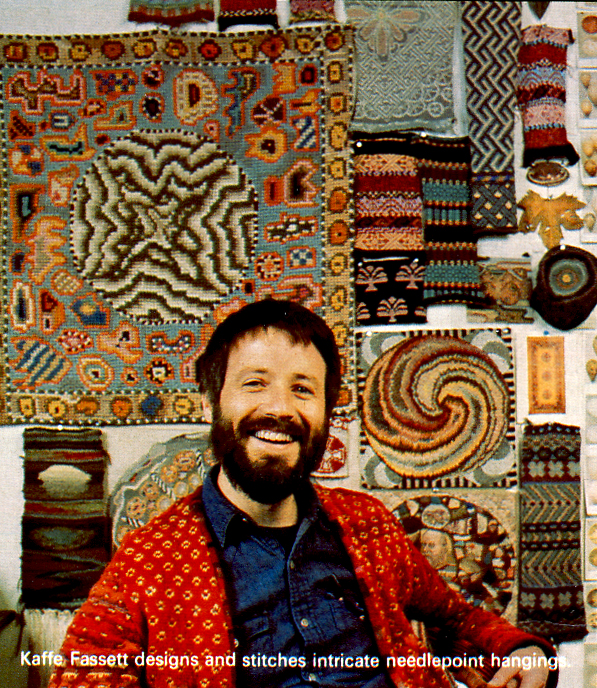
KAFFE FASSETT makes needlepoint hangings of magical intricacy and originality. If you see a handsome bearded young man doing petit point on the tube. it’s bound to be Kaffe. His creative energy is astonishing: currently he is working on an exhibition of his paintings to be held in New York, designing knits for Bill Gibb (a job he’s ‘done gloriously for the last six years) and for Ritva. And he’s doing knitting and tapestry designs and patterns for Women’s Home Industries and Tapestry Bazaar—and designing the needlepoint hangings which are made at Weatherall Workshops (Coleford 2102) in Gloucestershire. The day I saw Kaffe. a half-finished jacket was hanging pinned to his studio wall, chrome pins keeping an outstretched arm in place next to the body of the jacket, the pattern infinitely more complex than any piece of marbled paper, all plummy earthy tones. “I’m working it on fourteen needles: it’s good to see the balance of the design, feel how it’s going, and seeing it unfinished spurs me on to continue.” Kaffe is relatively new to actual needlework, though he’s been designing tapestries for some time. “Pamela Harlech who writes for Vogue asked me to design some slippers for her, and they looked great stitched up. Suddenly I thought I’d have a go. I’d always imagined those tapestry chairs you see took a lifetime —I was amazed how easy and how quick needlework can be.” To prove his point, he designed and worked backs and seats for a set of three winged chairs. marvellously mysterious in misty shades of grey, blue and green, based on forests and corals. As we talked Kaffe was stitching a doll’s-house chair, another exquisite forest design, which would set you back £10. whereas a big scale wallhanging could cost up to £2,000. “I’ve always been terribly influenced by the Orient,” Kaffe says. “I can look at patterns on some rugs for hours. Scotland has influenced me, too: there’s an affinity between Scotland and the Orient somewhere.”
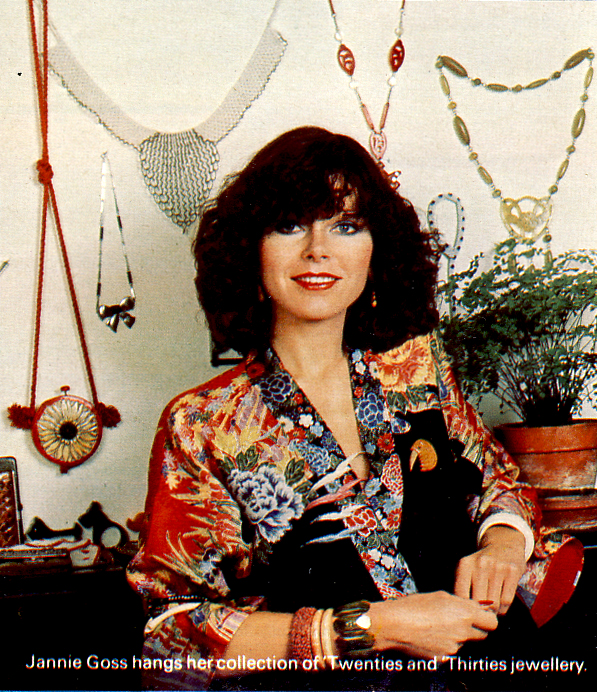
JANNIE GOSS is an Australian model, who has lived for the last eight years in London with her architect husband, Ian, their eleven year old daughter. Mini, and a cat. Their flat in Camden Town is big and airy, with white walls. high ceilings and potted geraniums twelve feet tall. Jannie hangs her jewellery on the walls: the effect is bold and beautiful. It’s also highly practical. “The great thing about pinning up jewellery is that I can find it so easily—it’s not just for show: of course I wear the stuff, too. I used to keep my necklaces around a mirror, hopeless because everything became knotted. and you couldn’t get at it in a hurry …I like organised clutter—great areas of space, then areas of things; it makes dusting easier, too. And Ian and I are both keen on a functional as well as decorative environment. I move my jewellery about, to change the shapes and patterns they make, which is fun. I just use ordinary pins. the very long dressmaking ones—anything heavier, like a nail, would mark the walls. I’m a collector by nature, I was buying up Art Deco jewellery before it became fashionable, when it only cost a few bob. I’ve never bought from the antique market, but sometimes at Portobello Road and Oxfam shops; mostly I just nose about in junk shops and jumble sales. People say I’m clever at finding things but for every four looks, only once will You find a piece you really like and want to buy.
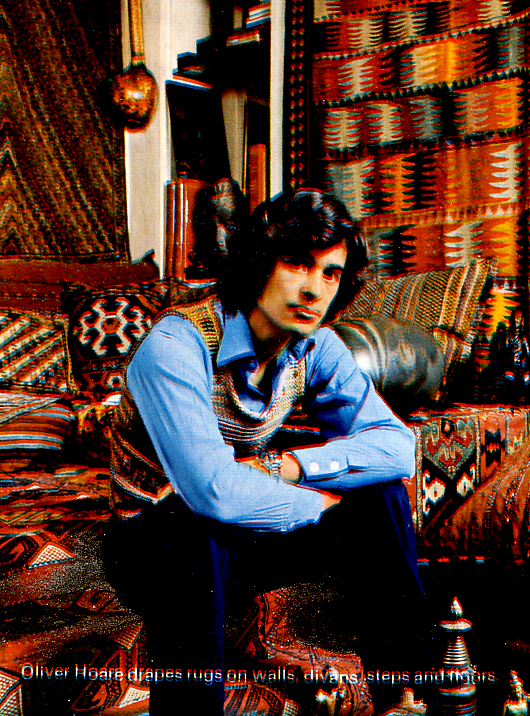
OLIVER HOARE‘s house gives you the feeling you’re in the Middle East. You are surrounded by carpets—kelims, to be precise—a dazzling juxtaposition of highly organised patterns and colours. Divans, steps, floors, cushions and wall are all covered with oriental rugs. When people hear about it, they imagine that so many patterns and colours clash. They don’t,” says Oliver. He’s right: the rugs harmonise, like music, and one of the reasons is that all the kelims’ colours are vegetable dyes, so the tones are constant—lots of brick and all the earthy colours. Oliver used to work at Christie’s where he ran the carpet department, but this summer set up on his own to sell Islamic works of art to the Middle East. and Far Eastern objets to Europe and America. “I was brought up with carpets, my father bought masses in Constantinople in the ‘Twenties, and always hung them up. Although I wasn’t terribly interested, something about them had rubbed off on me, and when I went to Christie’s I was immediately put into the carpet department. I became fascinated. I like kelims best of all. These are flat woven rugs, which have always been made by tribes, and it’s a tradition that hasn’t been interfered with or commercialised.” Buying carpets of any kind in the Middle East is an immensely ritualistic business: potential buyers sit for hours in carpet shops sipping tiny cups of Turkish coffee and tea endlessly. Bargaining goes on all day. Although Oliver enjoys this ritual. his business methods are Western. His dealing life means he must travel constantly though he spends as much time as he can in Iran where his caravanserai, on the old silk route, has just been nationalised by the government. Kelim prices have shot up, particularly now that so many are going back to their countries of origin. “Five years ago. you used to buy the really good kelims for £30 or £40. Nowadays, the best are £1,000 or £2,000 —but you can find decorative kelims for between two and three hundred pounds.”
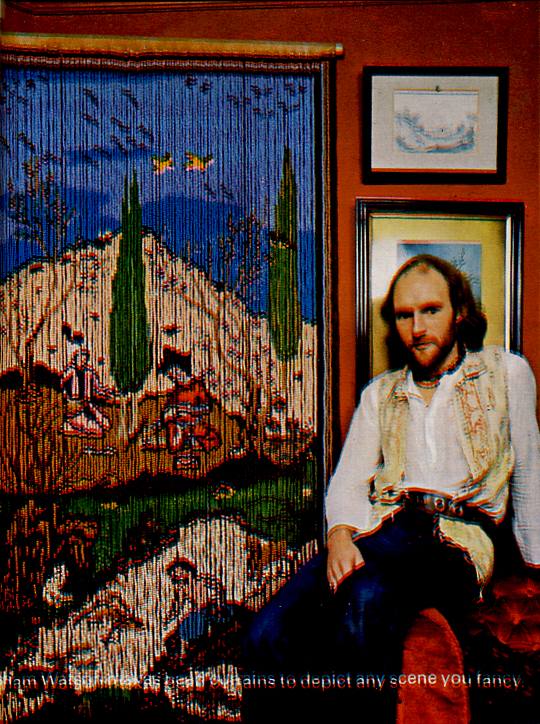
GRAHAM WATSON makes bead curtains that swish exotic-ally as you pass through, like a ‘Twenties shimmy dress, beaded strands trailing in your hair and on your shoulders. His beads can depict your portrait. a fantasy landscape, cinema curtains, an old poster—whatever you want. The curtains are hung in doorways. on walls, around baths. Graham’s clients in-clude Chris Squire of the rock group Yes, photographer David Bailey, and film director Joe Losey. “I started off bead-work when I was at drama school . . . act-ing’s an overcrowded profession, and I found it demoralising,” Graham explains. “I saw a play on television one night, and in the background there was a beaded curtain that looked as though it had some-thing painted on it, I couldn’t quite see. But it intrigued me.” . . . To the extent that the very next day Graham started threading beads him-self. But beads are hard to find in England. and Graham traced the best bead sources to Germany (for wood) and Czechoslovakia (for glass). He declared himself a registered company, and went to work three years ago. “I still import the beads, but we dye most of the colours our-selves, otherwise you’re landed with all the shades you don’t want. I often mix glass and wooden beads, because glass alone is too heavy.” Currently, Graham is working on a huge black and silver portrait of Buster Keaton, and he’s planning a three-dimensional number. If you want a curtain made, and they cost around £120 (door size), you can reach Graham Watson at 13c Cunningham Place. London NW8 (01-286 0891).
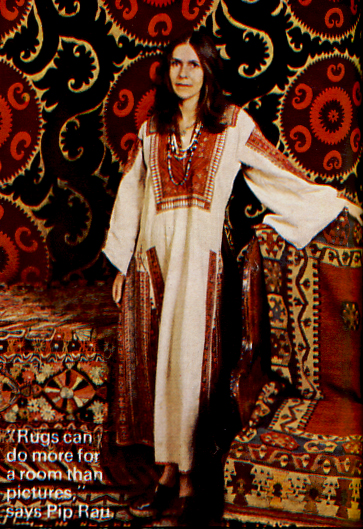
PIP RAU is hooked on folk tradition, on the embroideries, colours, prints and patterns of Central Asia and the Middle East. Home is like a bazaar, her shop like a souk where she sells dresses, waist-coats, robes, great pieces of faded cloth, incredibly bright embroideries. Her walls are jam-packed with treasures. and Pip’s body is covered with clothes of tribal designs, too. “I’d never put up pictures.” she says, “hangings do so much more for a room. They’re vibrant and vast and warm. Infinitely cheaper, too. I’ve been collecting ever since I can remember. I love markets. I lived in Israel for ten years. I was married to an Israeli. and travelled all over the Middle East. and now we’re separated I’ve come back to live in London.” So it seemed a natural move to open a shop (Rau Gallery, 36 Islington Green, London N1, 01-359 5337) selling all the things she loves, and it means she can justify her passion for travel. “I plan to go away three or four times a year to find stock,” she says. “My last trip took six weeks; I drove all through Eastern Europe, buying in Romania and Yugoslavia, and on to Turkey and Iran. and then Afghanistan. There are always difficulties at frontiers—you need all the invoices and endless bits of paper. Prices are going up and up. sources are drying up, too, as increasing numbers of people get interested. My customers are very mixed—specialist collectors, or people who fall in love with something. I don’t think clothes like these should ever be altered. Just buy what fits.” Pip hangs dresses and the lighter hangings with drawing pins, and uses tacks for anything heavier. Dresses can cost as much as £50 —an antique, hand-woven heavily embroidered Palestinian wedding dress, for example—and wallhangings vary enormously from small Persian cottons at £4 to kelims and Bokharas (large-scale embroideries on silk) at £230, or kelims for £400.
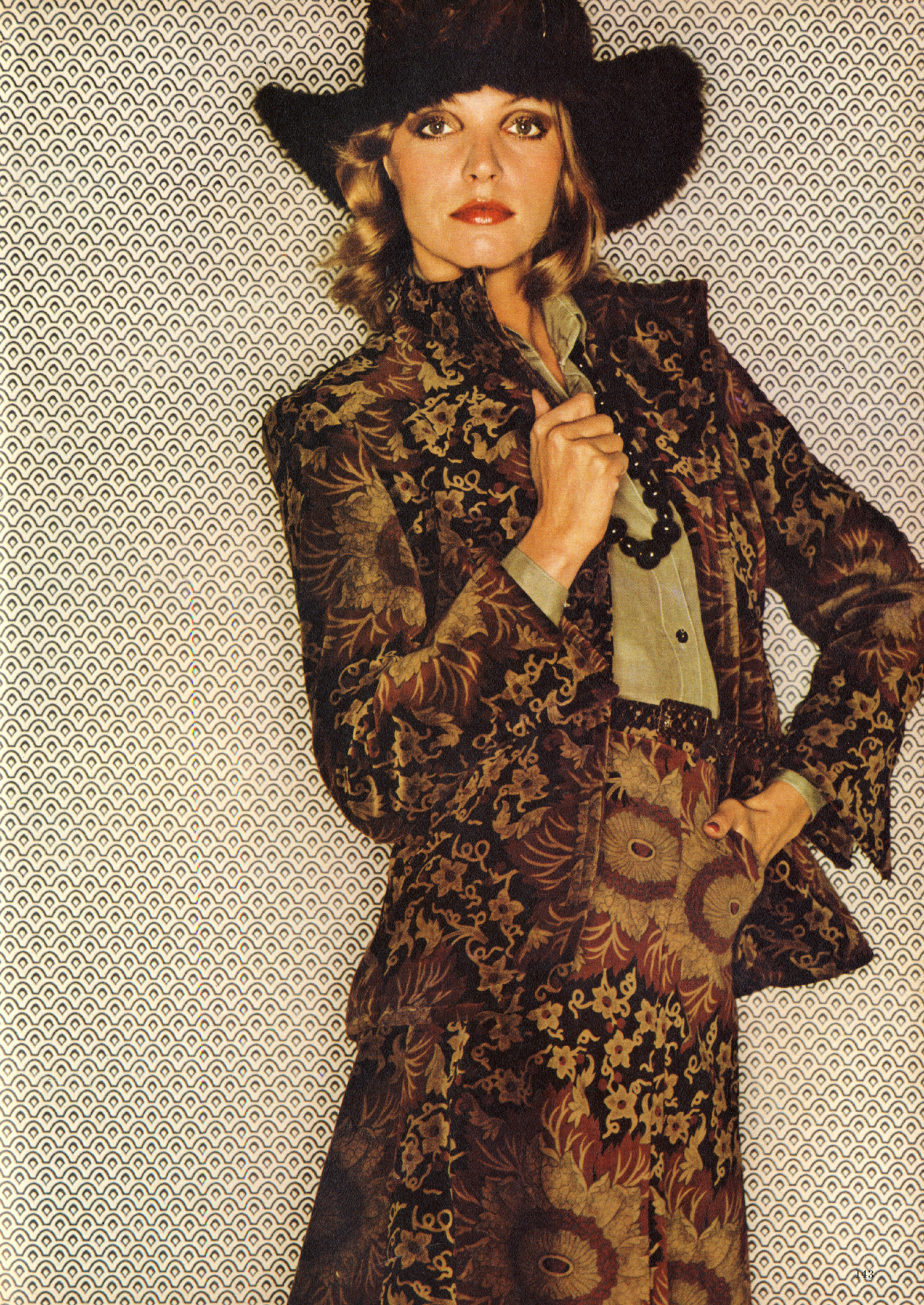
Velvet jacket and matching skirt by Christopher McDonnell. Hat by Laura Ashley. Wallpaper by Laura Ashley.
Velvets have gone into print this winter. Dashing suits and jackets come in all the mutations of the earth, sea and sky and are designed to be worn before rather than after dark. They look a million dollars and sometimes don’t even cost that much.
Photographed by Terence Donovan.
Scanned by Miss Peelpants from Harpers and Queen, November 1974.
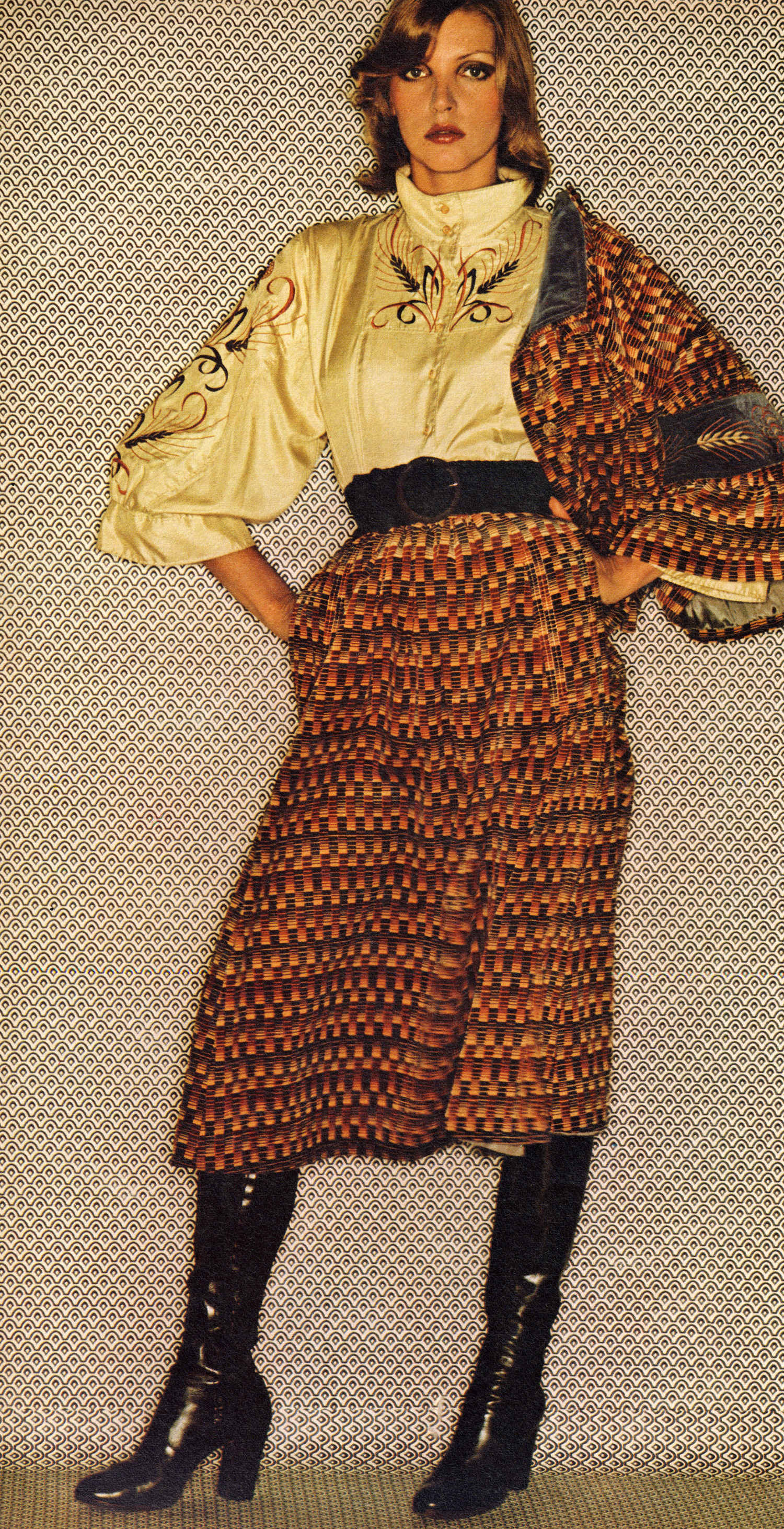
Jacket and cream shirt embroidered with corn ears and matching skirt, all by Bill Gibb. Navy leather boots from Russell & Bromley.
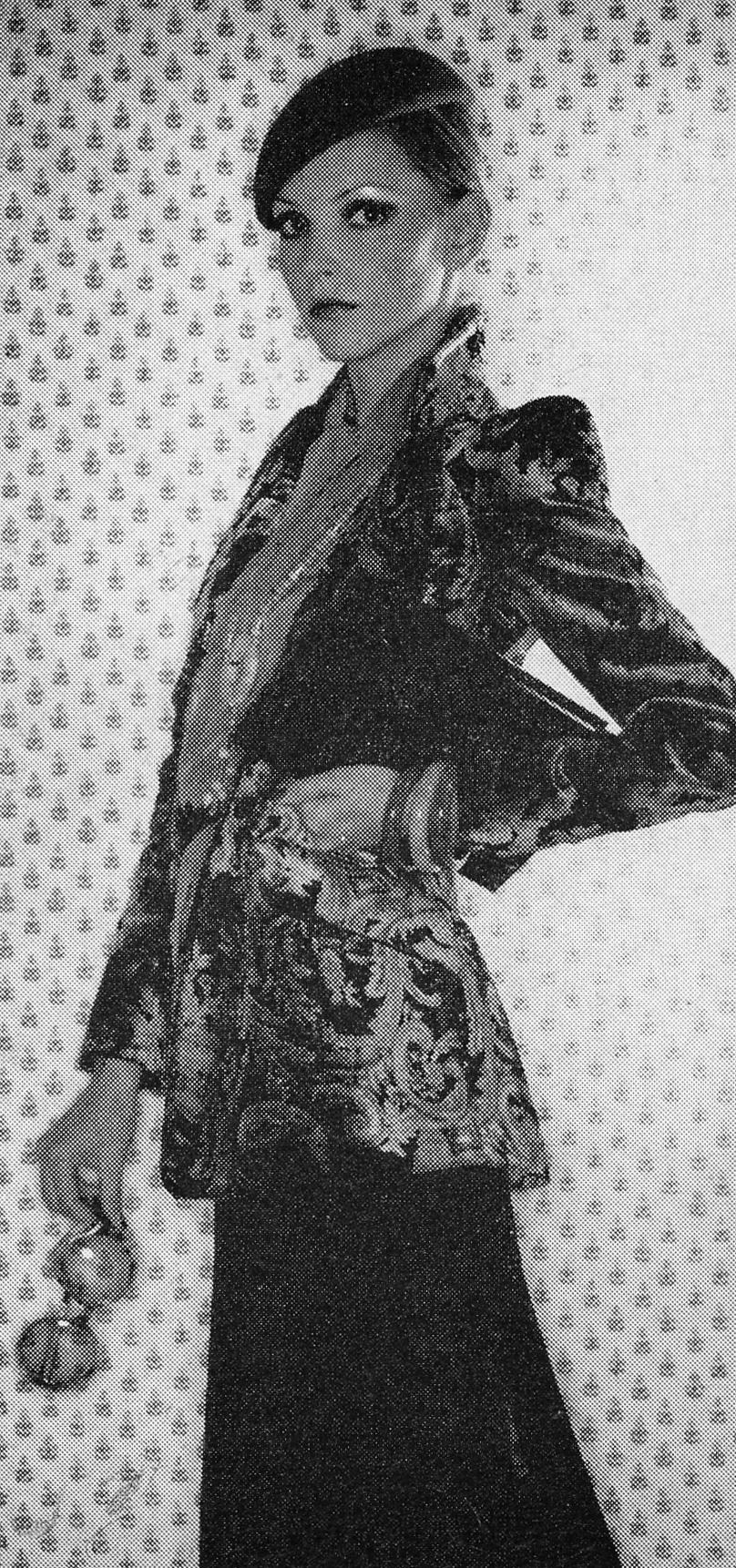
Rayon velvet jacket in Persian print and black rayon velvet skirt, both by Biba. Rust crepe de chine shirt by Otto. Sunglasses by Oliver Goldsmith. Beret by Marida. Wallpaper from Laura Ashley.
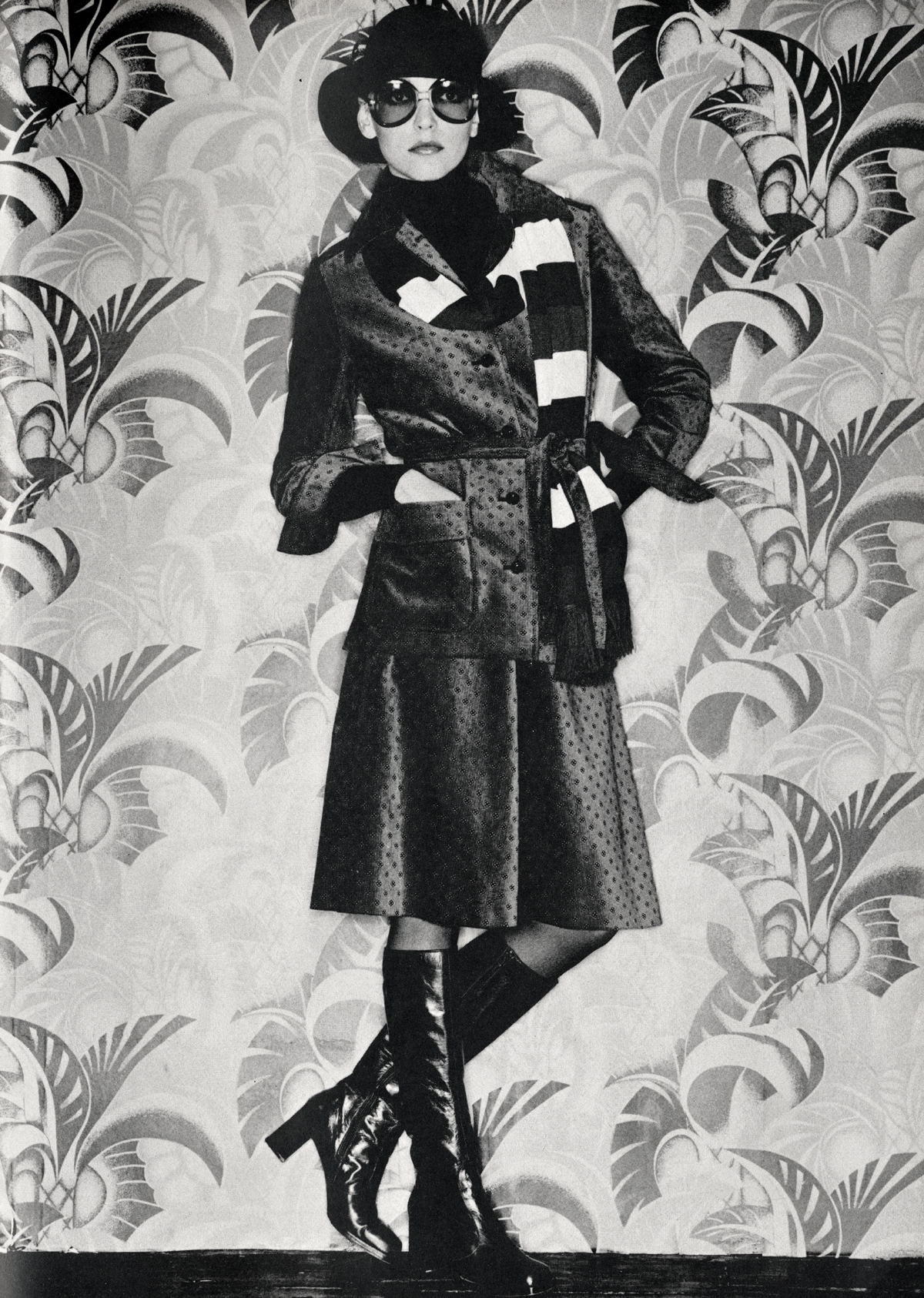
Velvet jacket and matching skirt by Jaeger. Scarf by Rodier. Hat by Marida. Sunglasses by Oliver Goldmith. Boots by Charles Jourdan. Wallpaper by Biba.
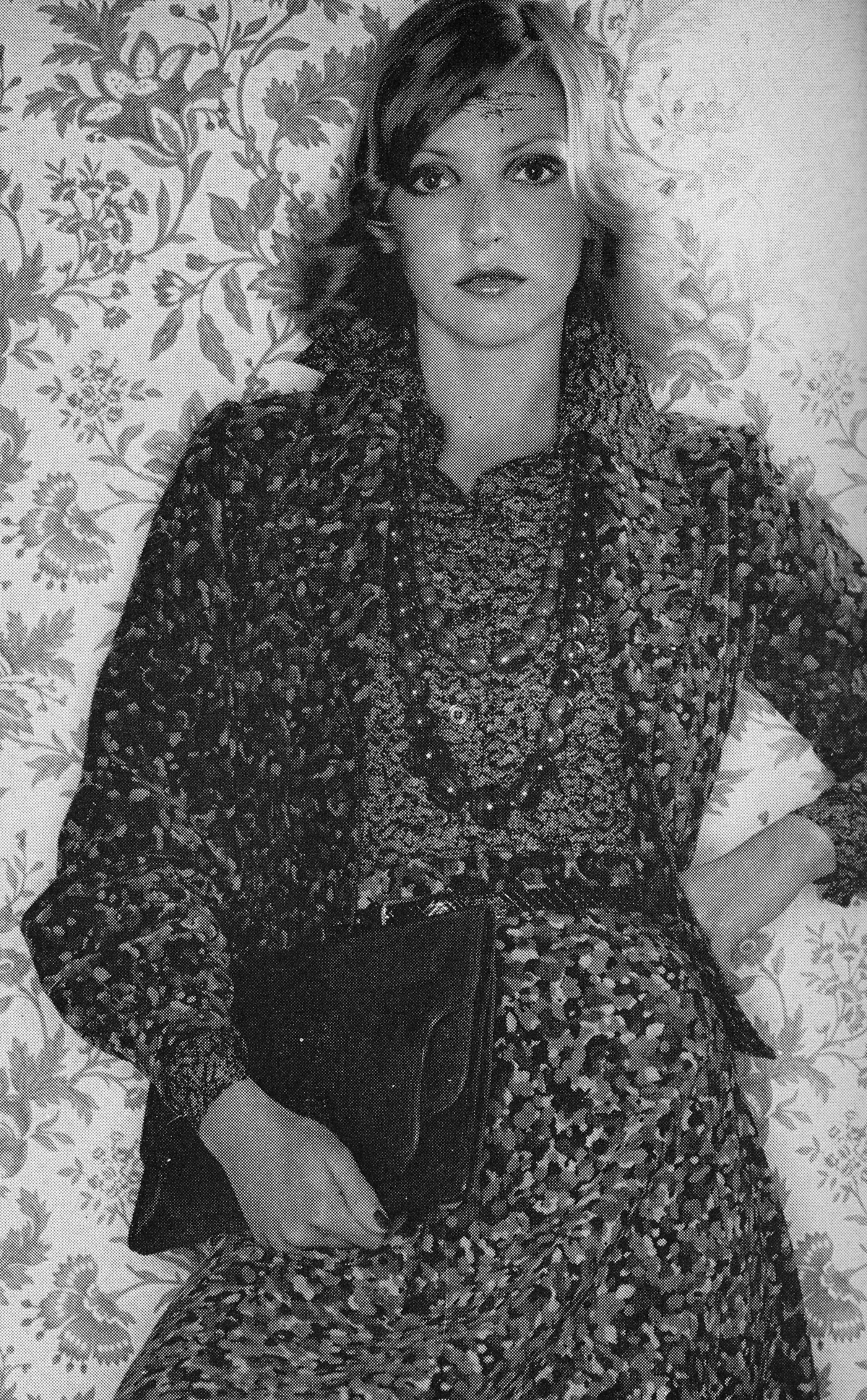
Velvet jacket in splodgy print with matching skirt and Viyella blouse, all by Janice Wainwright.

Bill Gibb takes lots of exquisite fabrics – silks from China, English embroidered nets, exclusive Liberty prints – and turns them into glamorous, witty clothes. For day, his new look recalls the Fifties. It’s a subtle, feminine nostalgia – not the garish decade revived by the Kings Road – and one to be worn with style.
Illustrated by Richard Ely.
Scanned by Miss Peelpants from Harpers and Queen, February 1974.
Harpers and Queen not at all snobbish in their dismissal of wild Kings Road boutique Rock’n’Roll revivers there. Still, pretty Bill Gibb clothes stunningly illustrated means I’ll forgive them just this once.


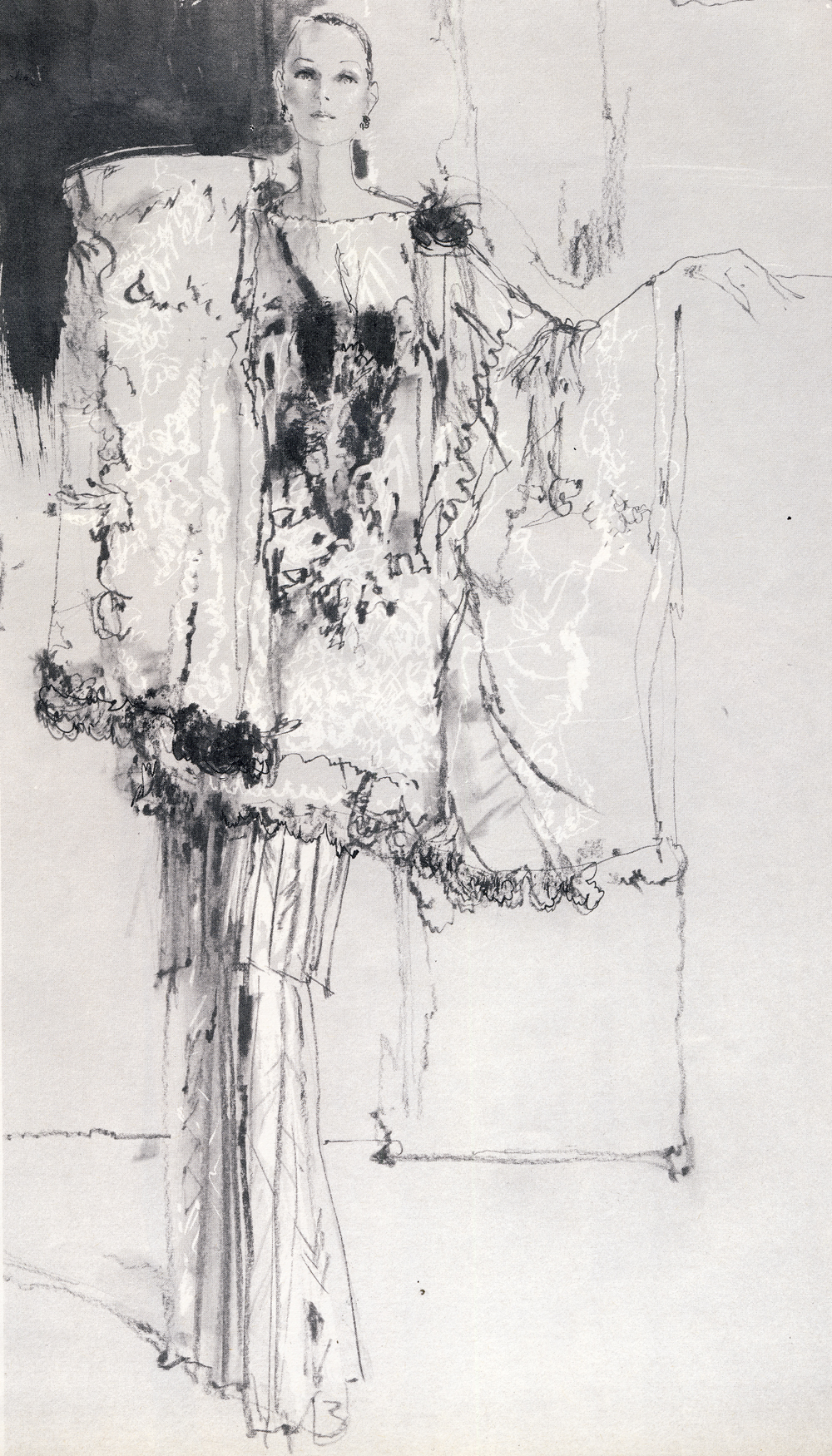
 Liz Eggleston