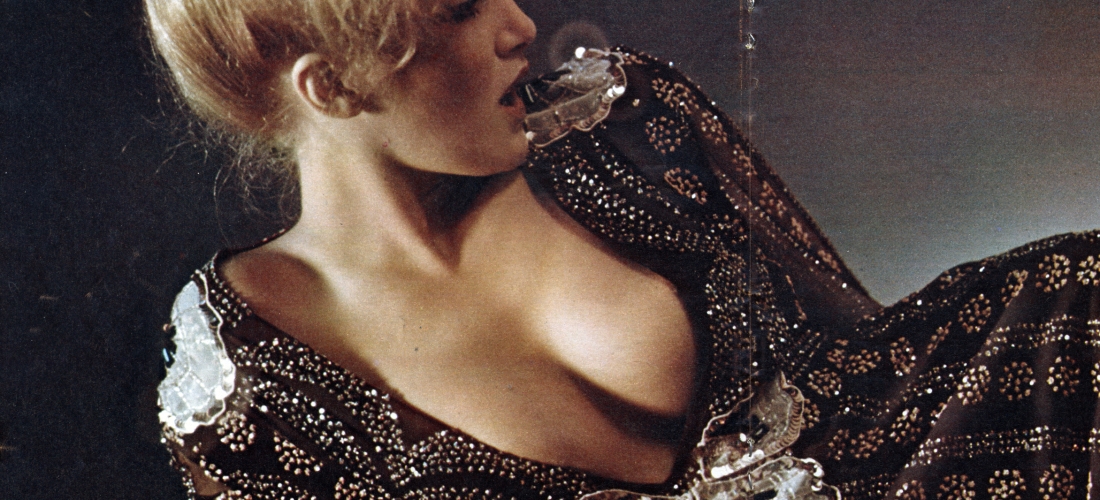
Sparkling black chiffon dress with plunging neckline and diamante embroidery, £250 from Thea Porter, 8 Greek Street, London W1
Japanese men are peculiarly affected by a glimpse of the naked nape of a Japanese neck. In Western cultures such excitement is generated by a panorama of bosom (as in this black chiffon dress by Thea Porter), or a smooth swathe of thigh. Here we show some revelations from the London autumn collections… hot numbers for the coolest of winter evenings.
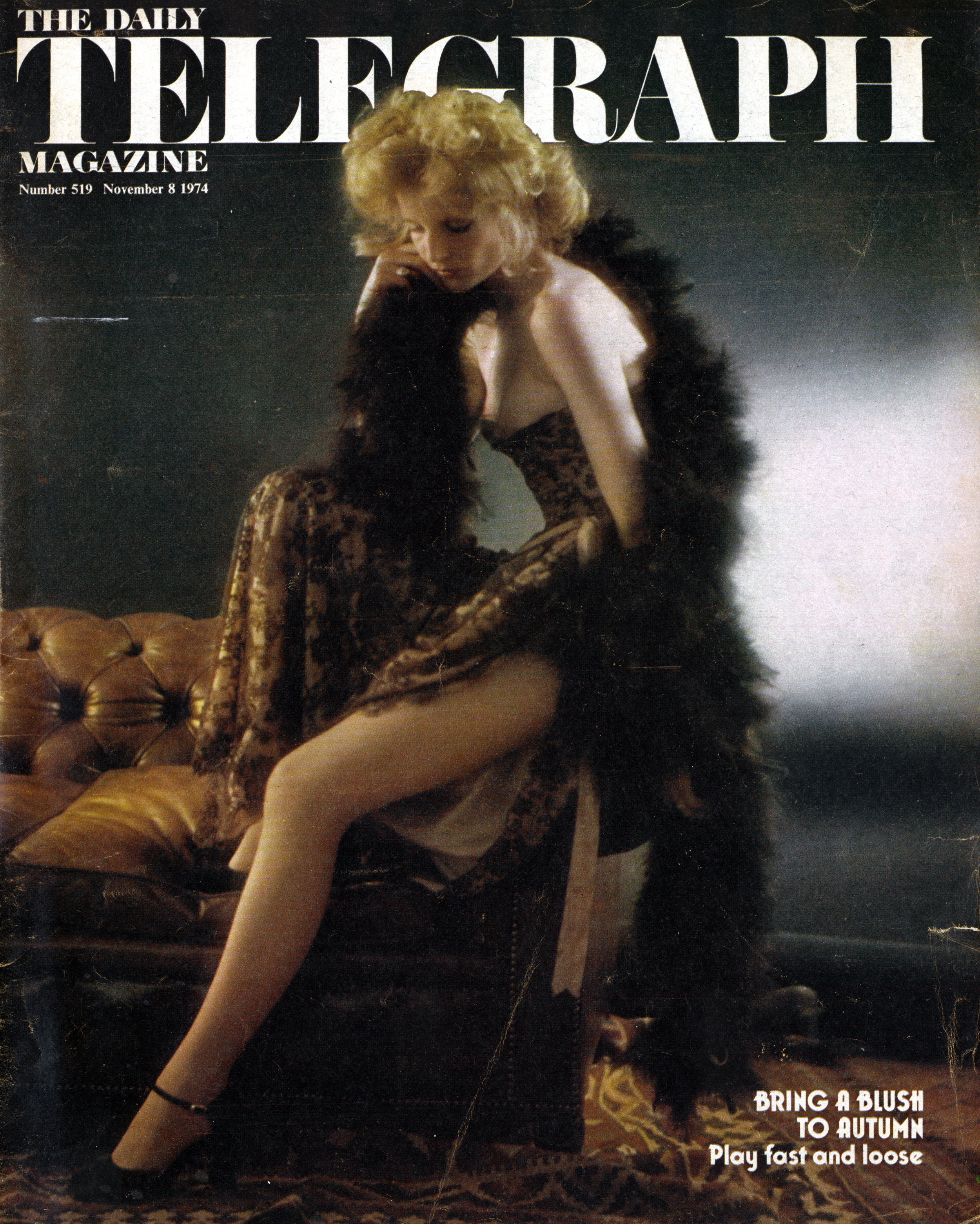
All perfect for lockdowns, I’m sure you’ll agree! It’s also nice to be surprised by Ossie Clark every once in a while – with a corset being so vastly different in tone from what we would usually expect.
Photographed by Sam Haskins.
Fashion Editor: Cherry Twiss.
Hair by Paulene at Michaeljohn.
Scanned from The Telegraph Magazine, 8th November 1974.
Cream and brown two piece with lace split skirt and boned top by Ossie Clark. Shoes by Charles Jourdan, 47/49 Brompton Road, SW3
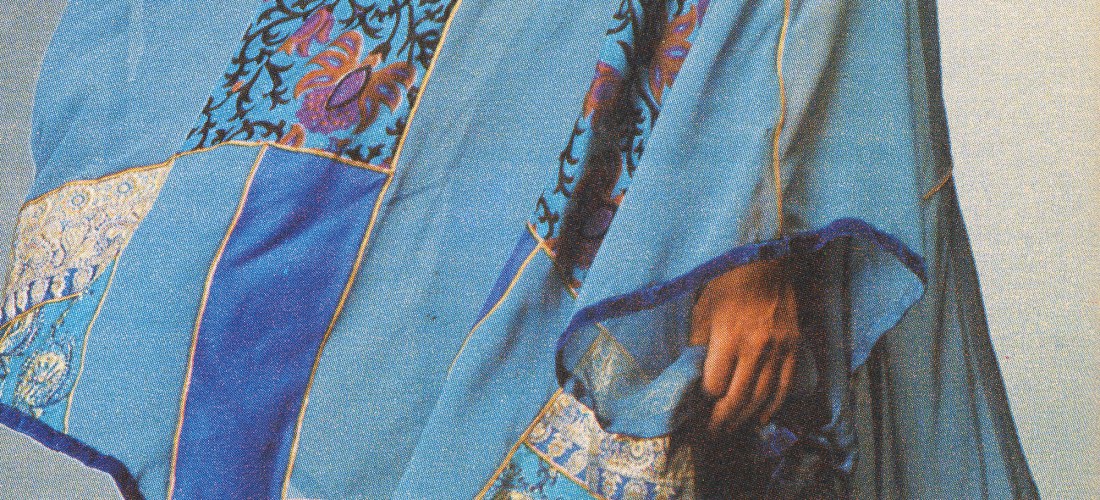
Slate blue dress by Yuki. Approximately £,165 from Fortnum and Mason, Chic of Hampstead, Heath Street, London NW3 or Lucienne’s, 89 Knightsbridge, London SW1. Gold and jade bangles from Jones, 52 Beauchamp Place, London SW3.
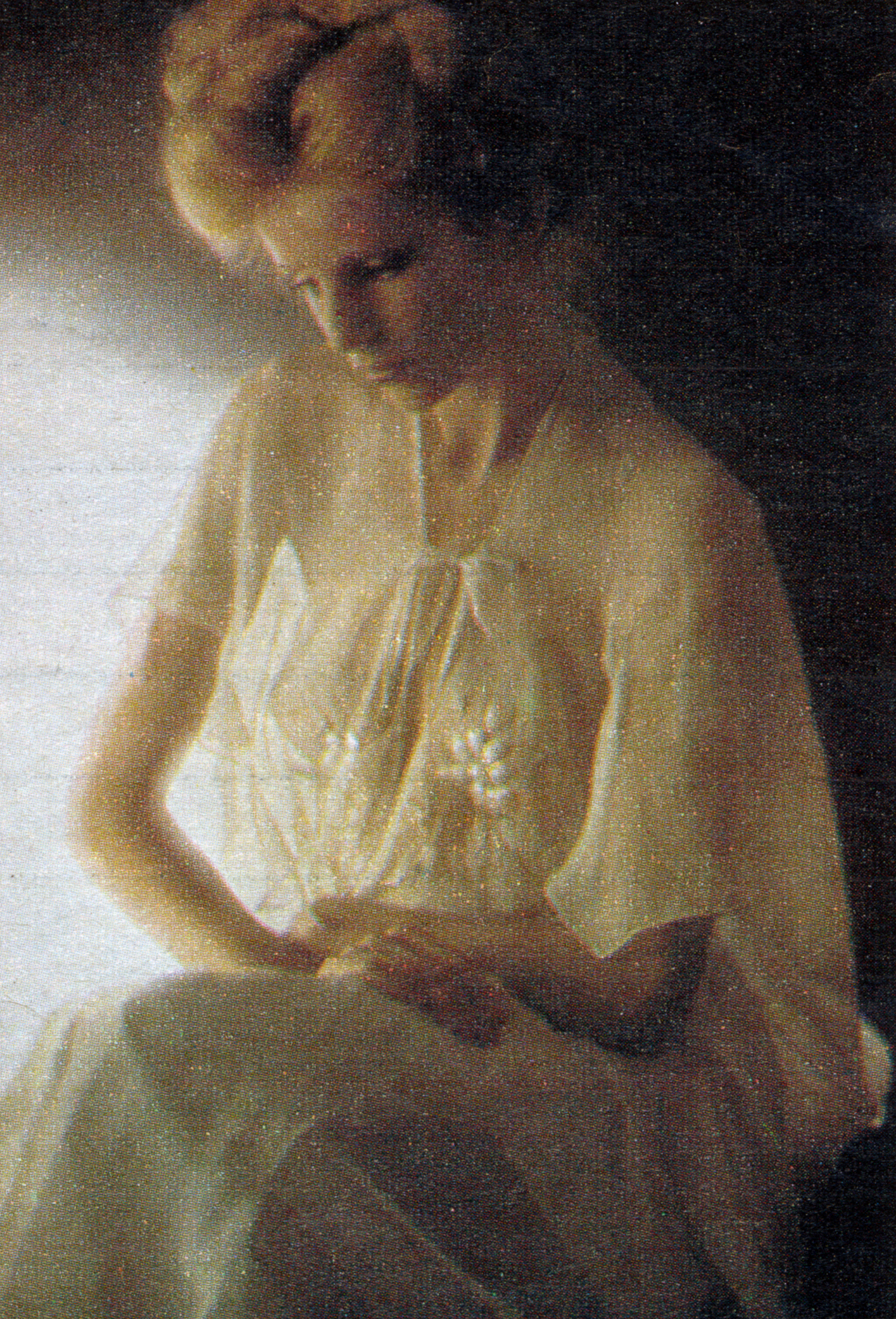
White silk chiffon and net full skirt and sheer top by Zandra Rhodes, to order from Fortnum and Mason.
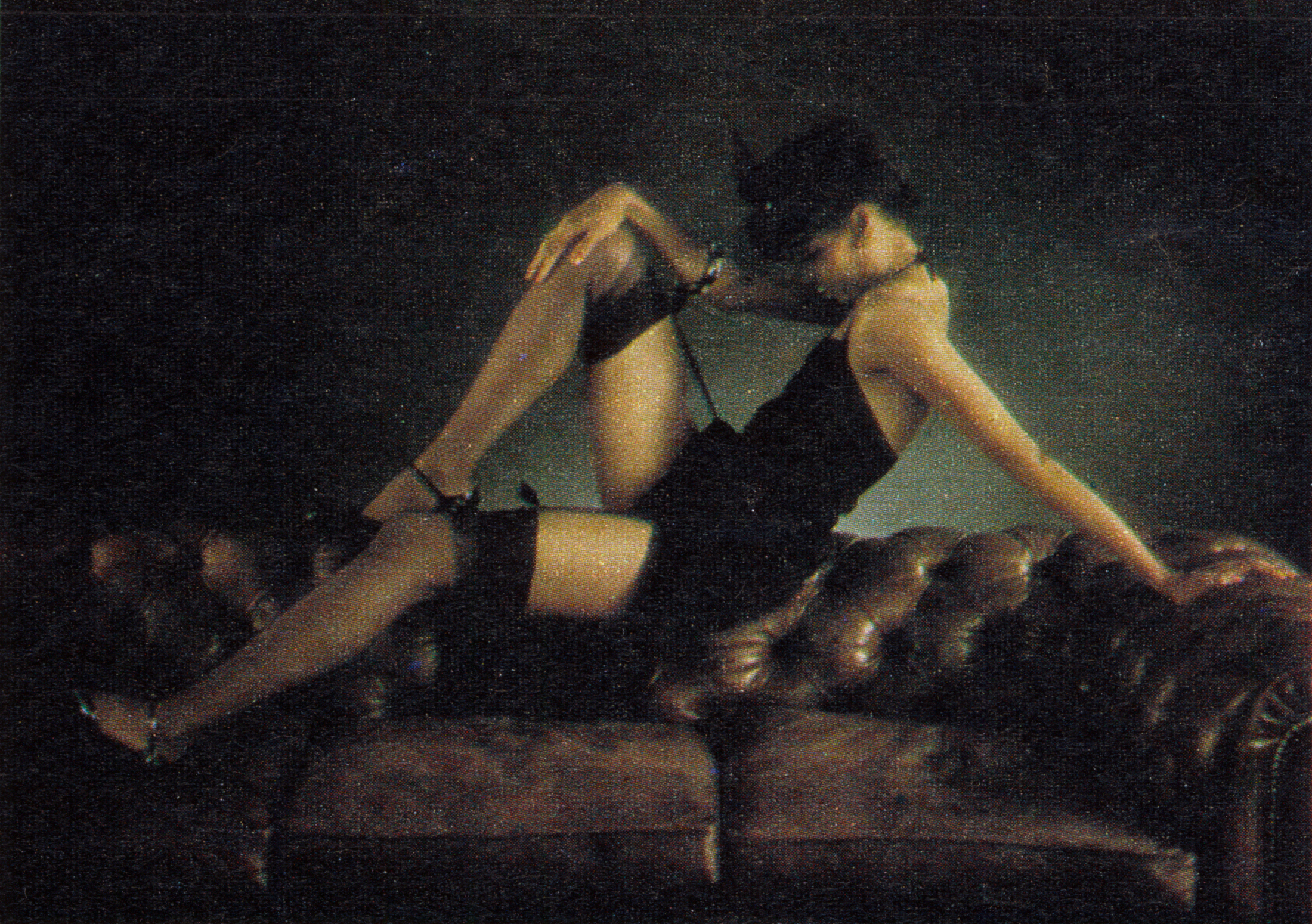
Black jersey skirt with split front by Yuki obtainable from Fortnum and Mason or Chic of Hampstead. Sheer silk chiffon halter top by Sheilagh Browne, £14 from Quorum. Black suspender belt from Janet Reger, Bottom Drawer, 33 Southwick Street, London W2. Black stockings from Biba, Kensington High Street, W8. Shoes from Yves St Laurent, 113 New Bond Street, W1 .
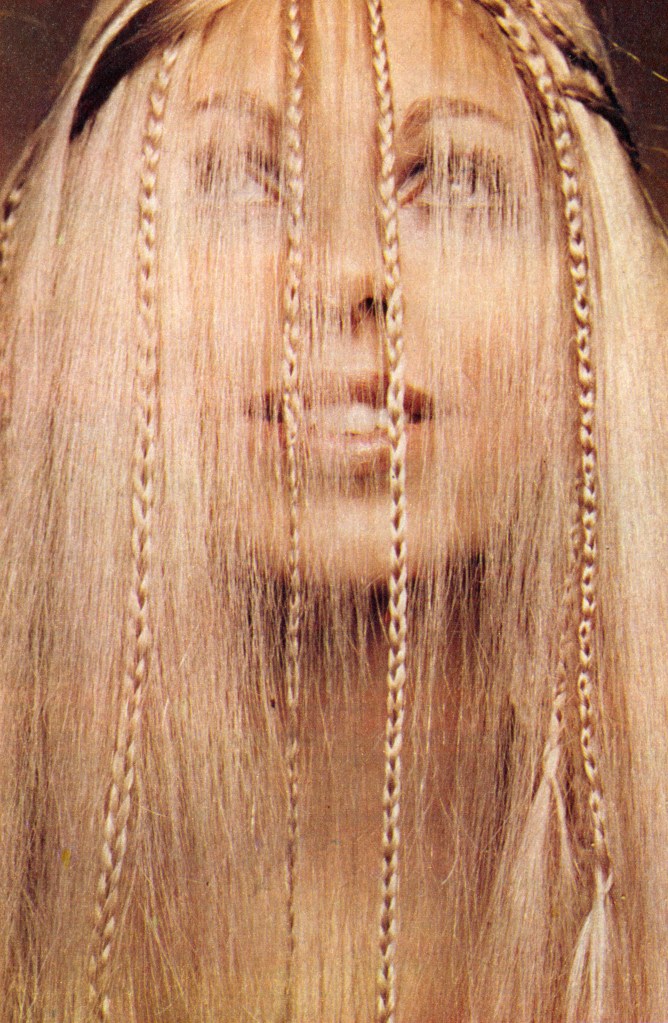
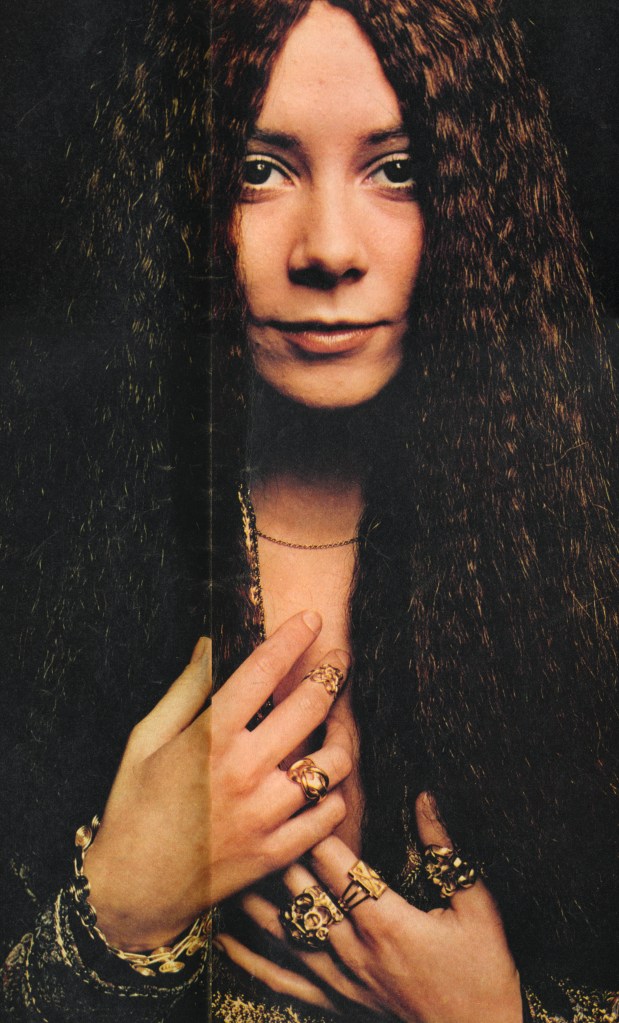
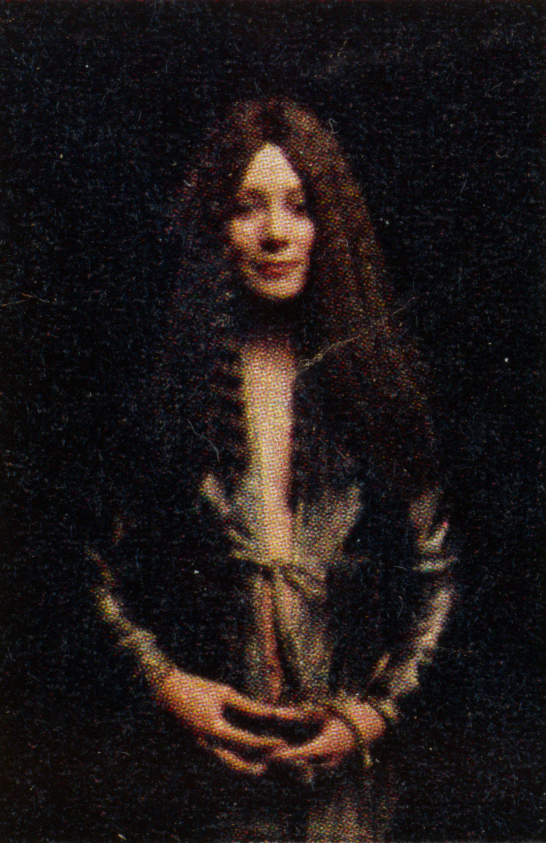
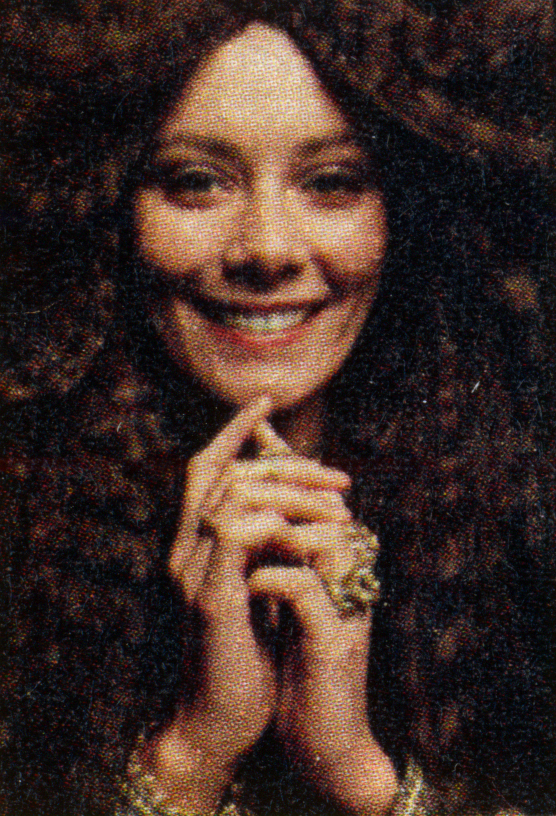
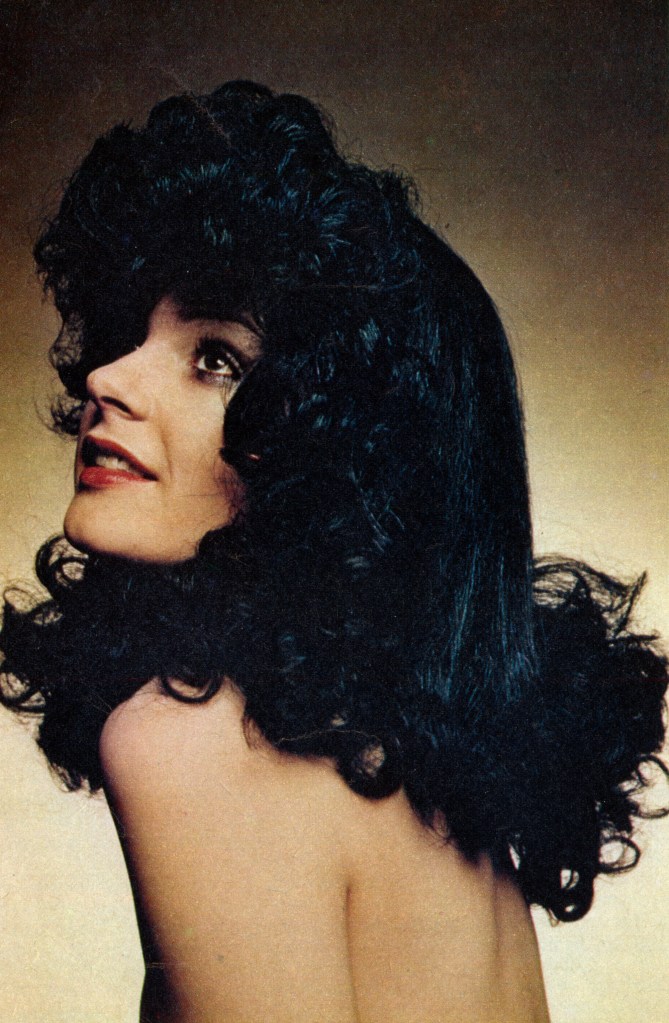
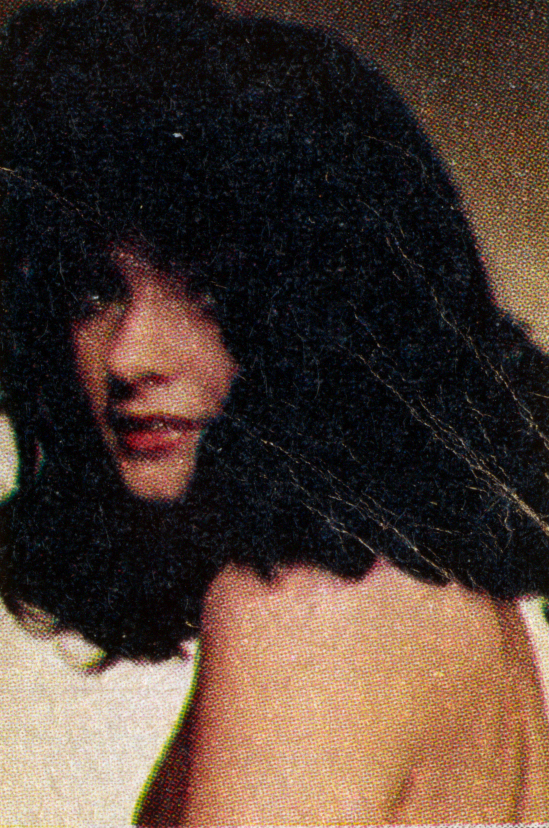
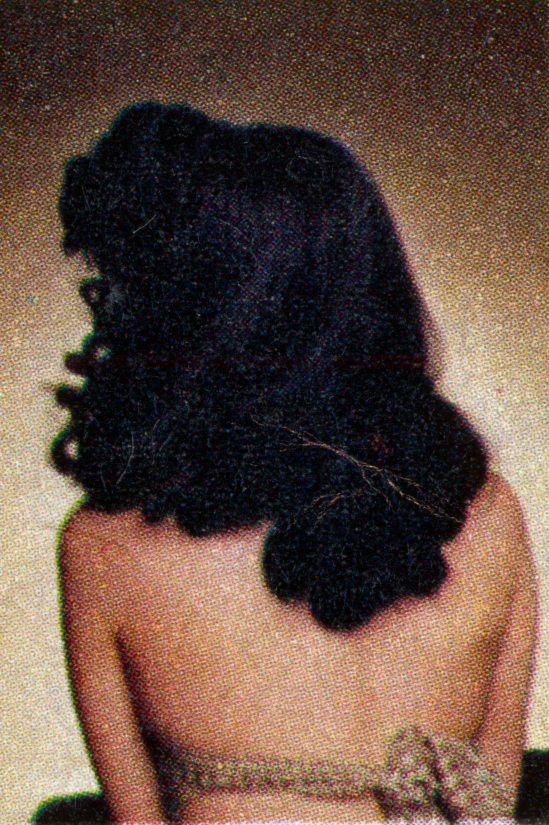
MADONNA soft and delicate with baby hair separated into silken strands – gossamer fine with tiny plaits.
Hairdressers are laying down their scissors saying: “We want to feel hair again – short hair is out”. If you’re growing your hair, you’re in ‘cos long hair is romantic and flattering. These styles show you what we mean.
Photographed by Chris Holland.
Scanned from Petticoat, 9th May 1970
THE GOTHIC LOOK is very much here to stay. It’s a sensational change from the shiny tanned skin and short hair which is rapidly becoming dated. Tunic by Thea Porter. Jewellery from Booty, 14-18 High Holborn.
THE BUANITA. In other words the gypsy look. This style needs a lot of hair with lots of body and bounce.
Savita’s orange and red printed muslin hot skirt and balloon sleeved midi top. The latticed rust suede hat and scarf are from Suliman.
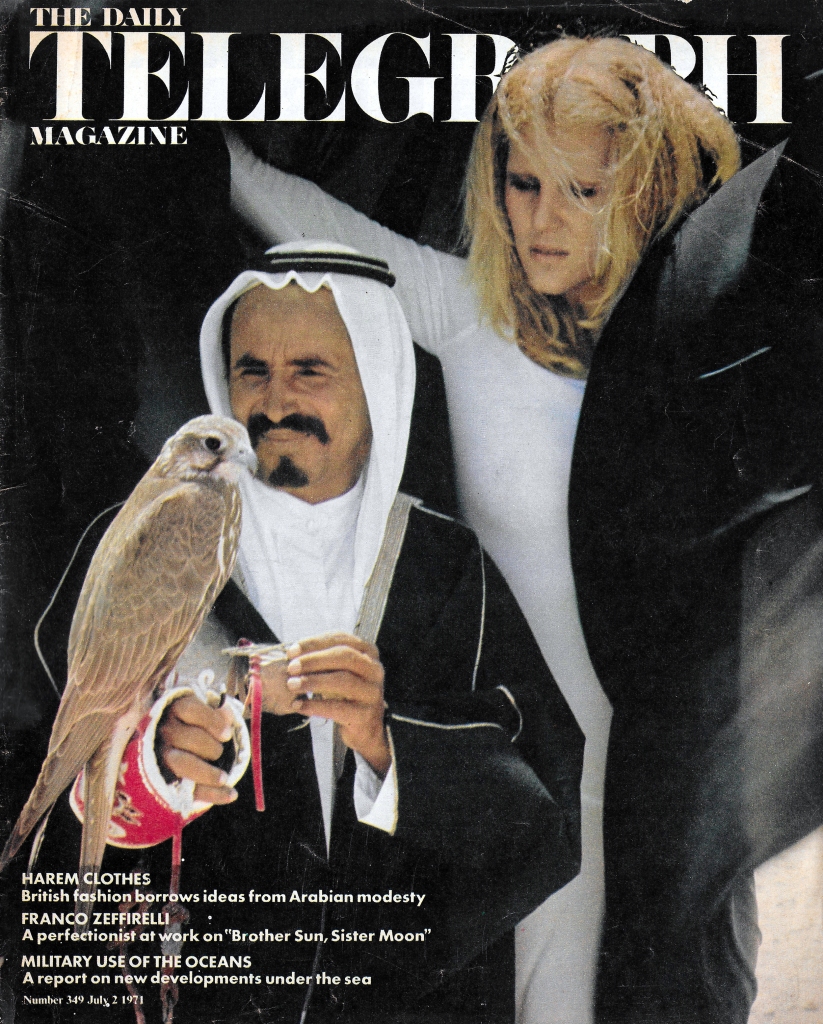
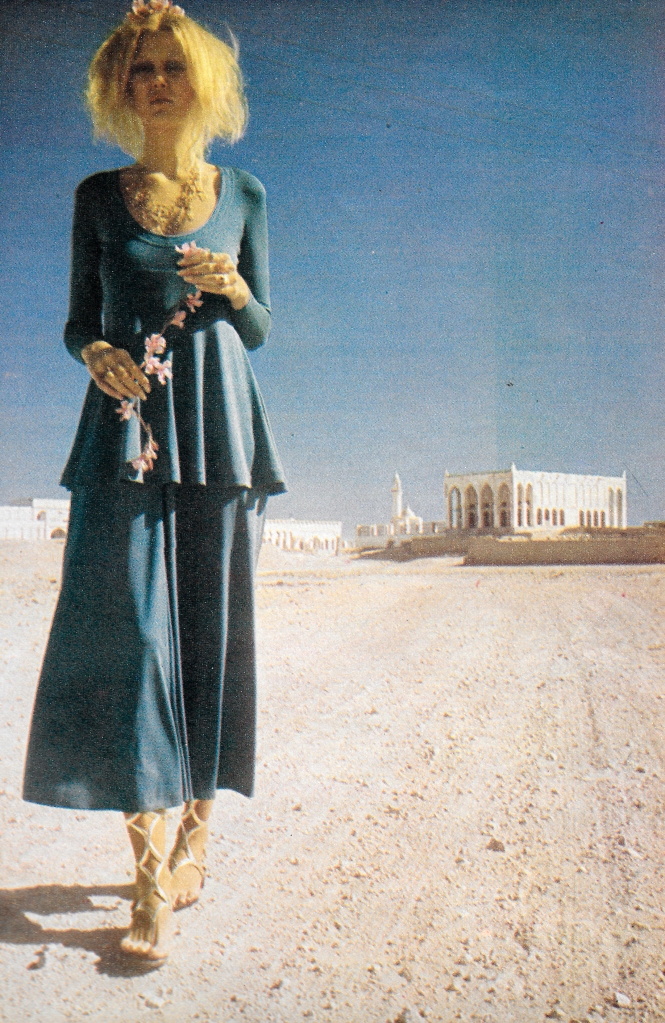
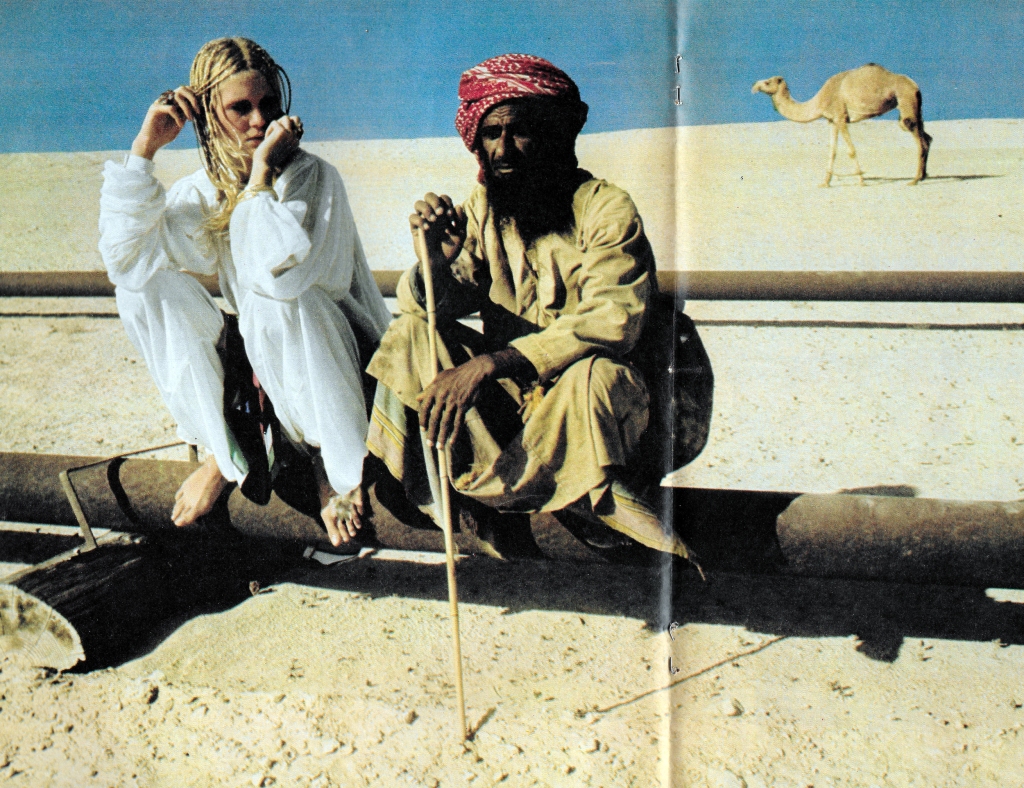
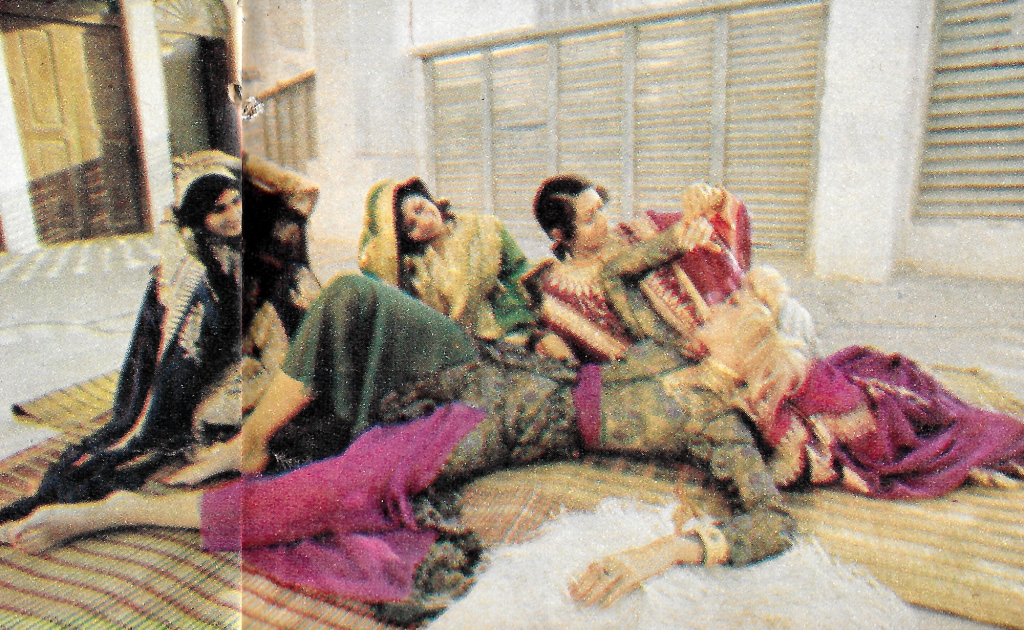
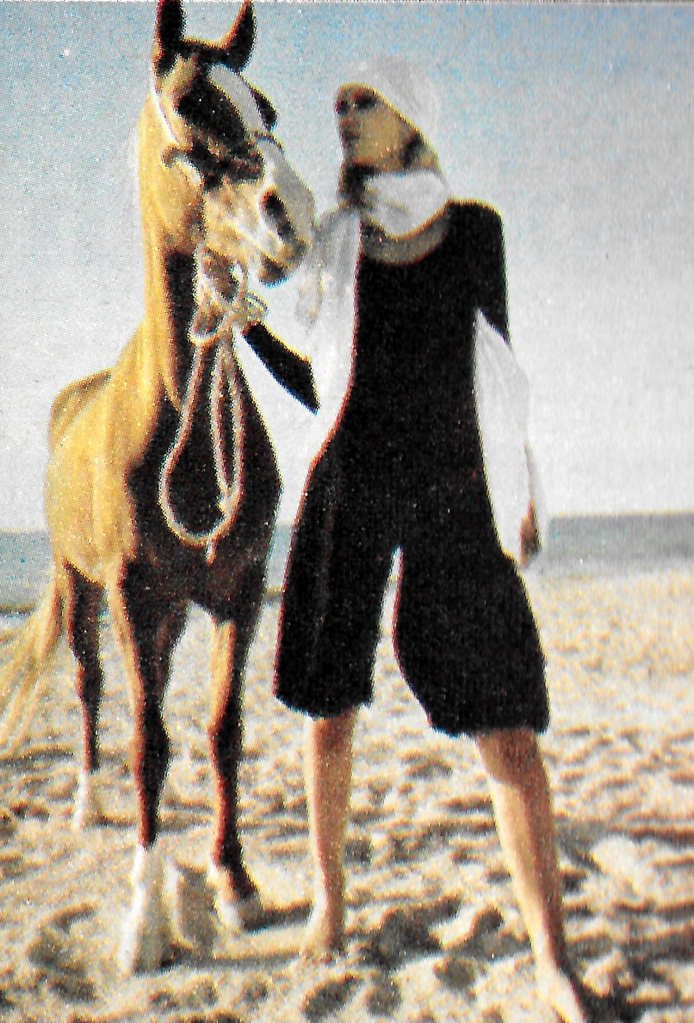
After the systemic strip of the West’s liberated women comes a longing for the romance and mystery of the East. The newest clothes reflect this mood with suggestive gauzes and clinging crepes. We took some to Bahrain, where the women are still heavily veiled and pass secluded lives in the harem.
A textbook example of the trend towards ‘exotic’ inspiration in the fashion world of the late Sixties/early Seventies. Most famously by Thea Porter, of course, but also with lesser known labels such as Suliman and Savita. Another strand of the post-Sixties backlash against the minimal and the space-age, along with the period romanticism of Laura Ashley and the more kitschy retro Rock’n’Roll stylings of Glam Rock.
As an aside, I always feel a little uncomfortable posting these ‘location’ shoots when they involve local characters, because it can feel a little exploitative. But at the same time, I don’t want to censor the past and think it’s important to remind ourselves of how fashion needs to be less exploitative and culturally ‘acquisitional’, even now.
I was also very entertained to note that a variation on the first image was used as part of the hilarious series of Smirnoff adverts and that I scanned back in 2015. There are only a few months between the two and I’m fascinated to know whose decision that was!
Fashion by Cherry Twiss.
Photographed by Sacha.
Scanned from The Daily Telegraph Magazine, 2nd July 1971.
White banlon dress by Simon Massey.
Flawless blue silk crepe jersey dress by Jean Muir. Gold sandals by Kurt Geiger.
Butter muslin shirt from Deborah and Clare. Striped satin skirt from The Universal Witness. The harem pants were made in the local souk.
Lace skirt and jacket by Thea Porter. Sequin cap from Crocodile.
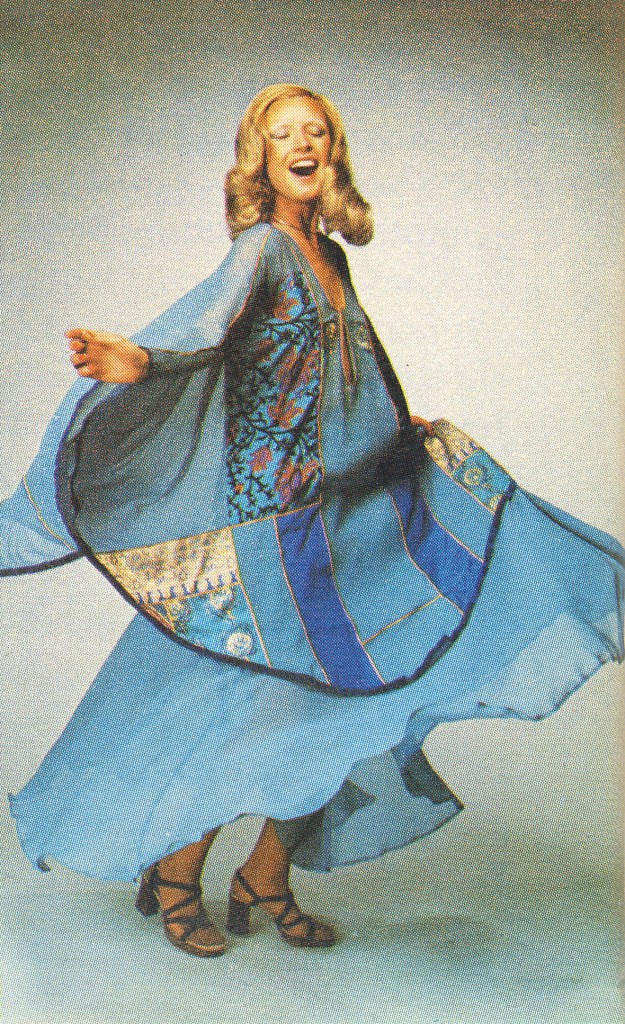
Thea Porter describes the women she designs for as “thirtyish, tall and slim,” but she laughingly adds that “I design clothes that I know will suit me too, so they do just as well for short, fat people.” Whatever their shape, Thea Porter’s customers live a high-society, jet-set life. Their clothes must be dramatic, brilliant and packable, and Thea Porter designs are exactly what they need; the clothes are among the most coveted in the world. How did Thea break into the rarefied atmosphere of high-fashion design?
In 1965, Thea and a couple of friends launched an interior decorating service. “we started the fashion for enormous cushions, and we were just beginning to make a name for ourselves,”‘ Thea reminisced, “when I happened to bring back an antique caftan from overseas. I wanted to use the material in a decorat-ing scheme. Suddenly caftans came in to vogue but the only ones you could get from abroad were either minute or voluminous. So, with the help of a dressmaker, I started making caftans from lovely old fabrics. Then a photo-graph of Fenella Fielding wearing one of my caftans appeared in the Daily Express. More people began wanting them and eventually I decided to bring out a collection which I showed in a Kensington restaurant. I was still mainly a decorator but from then on things started snowballing. I had designed some jackets with masses and masses of braid which the Beatles bought, for instance. At the end of 1967, I took the plunge and started the shop in Greek Street.”
Without any formal training, Thea Porter became a dress designer. She knows nothing of cutting and sewing, and recalls her only attempt at dress-making as a child when she succeeded in cutting through her own skirt! An assistant takes all her designs to the pattern and cutting stage. The import-ant thing, to Thea, is the designing. She describes her philosophy quite simply. Using her hands to emphasise, she explains “you know how a line of poetry sounds right, as if it has been waiting for someone to write it down. That’s how it must be with a dress. It must be a complete entity and nothing must jar —unless clashing colours are an intrinsic part of the design. The shape, colour and fabric should be in perfect harmony. I put together every detail of the dress myself — down to the last button.”
Thea finds that she designs best away from her Soho shop, and works in spurts according to her mood, but she finds it difficult to describe the sources of her inspiration. “My two absolute standards are that I must like the dress myself, and every season I try to bring out five good shape’s. The collections are different every time. It can take me three weeks to do a collection — or three months. Some-times I get my inspiration from a fabric. Sometimes I do a sketch and then choose a fabric. I often buy fabrics without having the least idea of what I shall do with them.”
“I don’t use a method that you could describe”, she continues thoughtfully. “There are so many influences. For example I got the idea for a nautical theme when I was leafing through a book on Victorian painters. To be a designer I think you need a broad culture — certainly my knowledge of the East has shaped my creative thinking. A conventional art course would have been a waste of time for me.”
Thea Porter specialises in glamorous evening clothes and if there is a theme running through her creations, it is that the materials are almost invariably soft, flimsy and graceful and chosen to reveal the contours of the body. She buys them from all over the world: from India, Italy, Switzerland, France and England. She designs some fabrics herself. “I do a sketch, give it to a textile designer to translate, we work out the colours and we have it made up.” Expensive? “Very,” she agrees.
The tiny Thea Porter shop in Greek Street, London, is full of the exotic feeling she translates so expertly into her clothes. Amid the display of dia-phanous dresses, rolls of richly coloured fabrics are heaped on shelves and piled several deep against the wall in glorious disarray. From a battered cardboard box, a profusion of braids and ribbons tumble like wild flowers. A litter of photos, sketches and other paraphernalia are pinned around her desk. The casual atmosphere is typical of Thea Porter’s spontaneous approach to designing. There is, however, nothing at all naive about her ideas and plans for the future.
Until recently, Thea, was thinking on two planes, Britain and America. “The main difference between the two markets is that American women have such perfect figures and they like waisted clothes with plunging necklines.” Now she is working in yet another dimension — ready-to-wear. Not content with this, she is already planning new outlets. “I would like to do wedding clothes, children’s wear and lingerie. But there would always have to be lots of evening dresses. A woman feels different in the evening, more relaxed and prettier.”
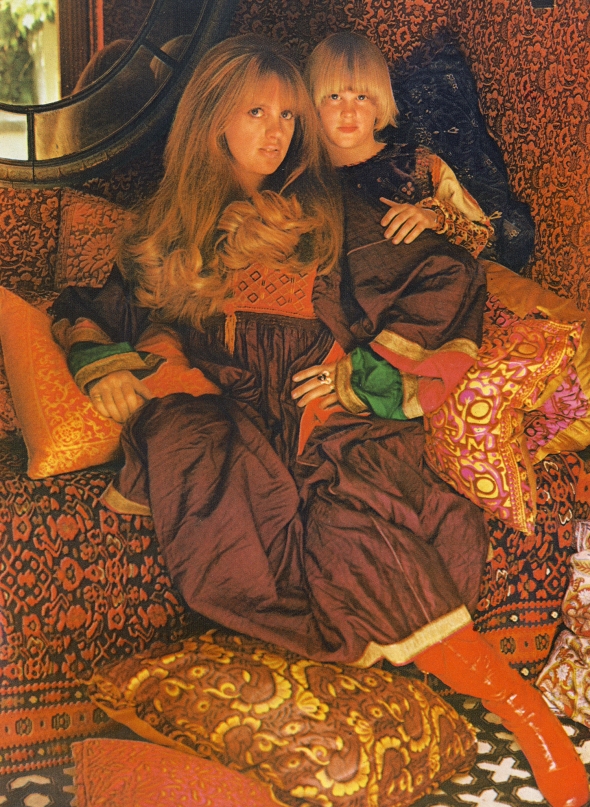
Tessa and Cary wearing antique Afghanistani caftans in the garden room, a patterned passage really, where Cassian sleeps. A Kelim rug covers the bed, the cushions are sewn from Indian silk scarves. Caftans from Oxus, 490 Kings Road.
Tessa Kennedy lives down amongst trees and flowers on the Bayswater edge of Hyde Park; on a broiling blue July day it seemed more like the South of France with mimosa yellow awnings over the windows, white iron table and chairs set up on the terrace. On the corner of a great white classical block of houses, it’s a garden flat — no agent’s euphemism — knocked together from two; in the centre are a pair of tiny courtyards Tessa is changing into conservatories so that flowers can flower all year round: her sons can also wheel their bicycles straight out of doors to play. They are Cassian, Damian and Cary Elwes., 11, 10 and 7, and there’s Dylan, the baby, 7 months old.
Inside, a dramatic maze of rooms opens off the central chocolate-varnished corridor; everywhere carpets, tapestries, tartan and Indian silks make endless patterns. The old wine cellars have turned into great scarlet felt lined storage cupboards like the ones she designed for the Donald Davies shop, no dust can creep in. The drawing-room converts to a cinema built when Stanley Donen lived there; Tessa has hardly changed this at all. The projection room has mighty machines like the Marble Arch Odeon, she has registered herself as Kennedy Previews and has a projectionist hired full time—to show films to friends after dinner once or twice a week, or a couple of James Bond epics for the boys: “They love it of course and get absolutely boss-eyed.” Her fascination with gadgetry extends to video tapes, high-powered headphones for the stereo, intercom and a splendid American push-button dial telephone you can ring in on but not out. With the push-button stuff are clumps of fresh flowers, dog roses, daisies, piles of cushions in antique fabrics or in the flame stitch tapestry she sews on plane journeys, her collection of walnut shell sewing boxes, photograph, paintings—including a quartet of Louis XIV’s wife and mistresses—and carpet in a different colour but the same pattern as the one she designed for Burke’s restaurant. Burke’s is one of her decorating jobs she likes the best—along with Sir George and Lady Weidenfeld’s house and the flat she made for John Barry in an office block overlooking the Thames: “We installed such powerful sound that it moves right across the river and people coming out of the Tate look quite dazed.” Now she is working on a couple of country houses, one is for John Aspinall, and offices for Polydor records, and several new ideas, like a sauna in a storage cupboard, to build into this family and garden flat.
Yes, that’s little Cary Elwes at the tender age of seven. And of course it goes without saying that I would kill for those Theas…
Photographed by Norman Parkinson.
Scanned from Vogue, September 1970.
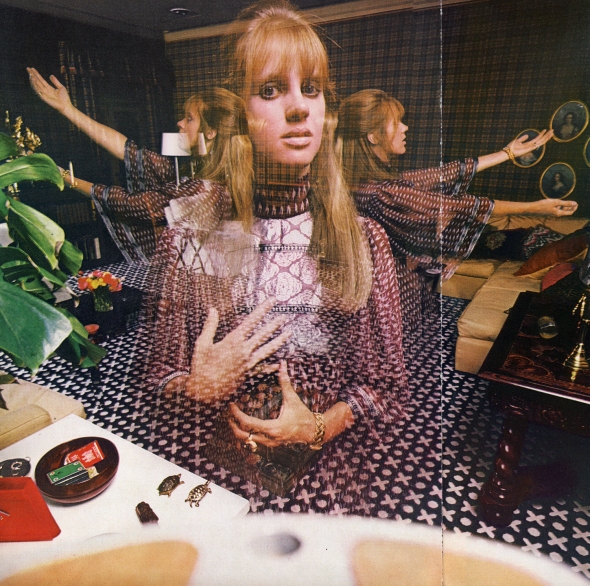
Patterns of carpet, tartan and voile in the drawing room cinema. The carpet is similar to the one Tessa designed for Burke’s; her voile dress with bib of rare oriental fabric comes from Thea Porter, £68.Tessa in the hall, a varnished chocolate box hung with brown and white cottons. The gothic chairs are part of her collection. Her long scarlet chiffon robe, £35, from Thea Porter.
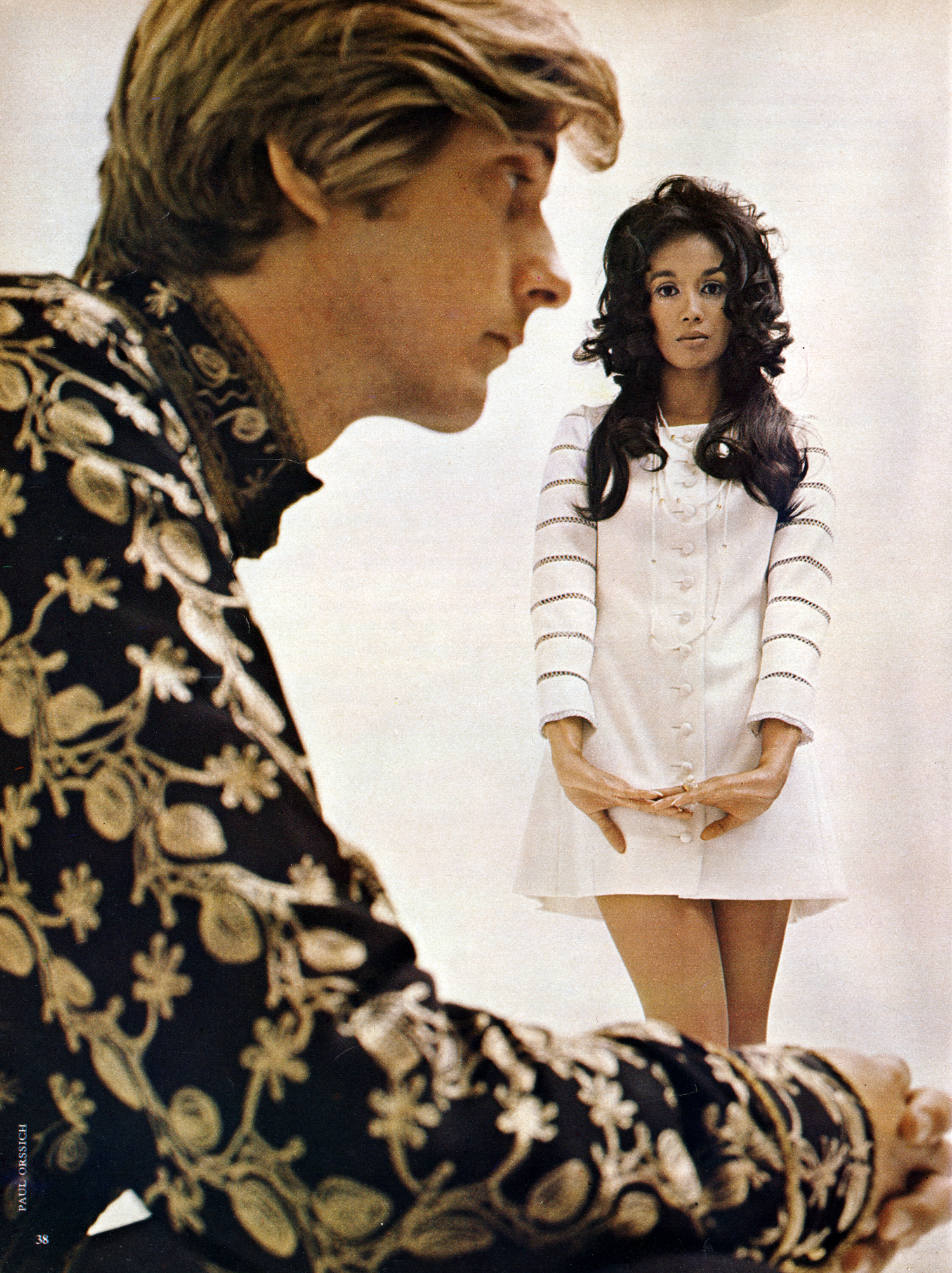
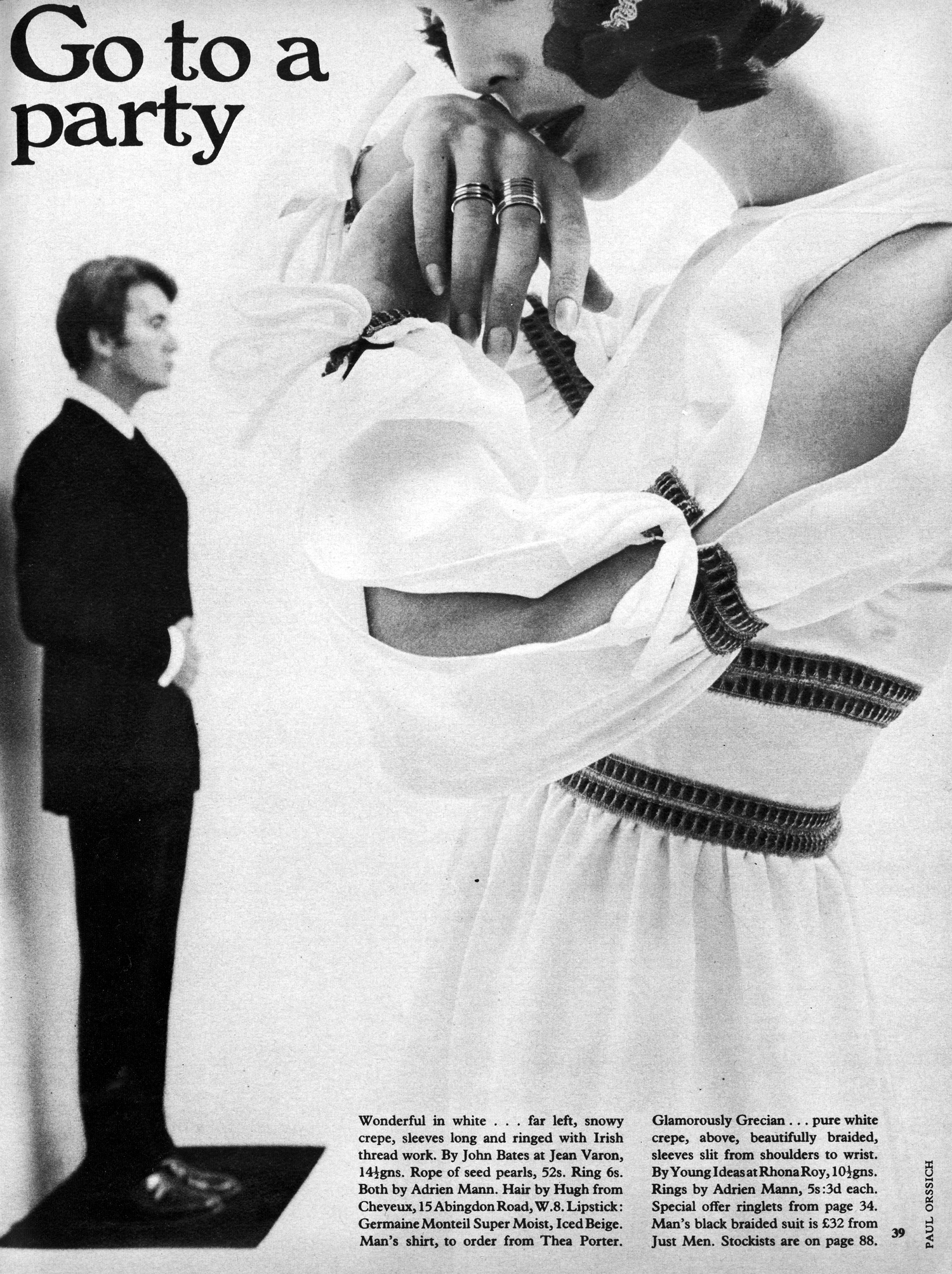
Wonderful in white… snowy crepe, sleeves long and ringed with Irish thread work. By John Bates at Jean Varon. Jewellery by Adrien Mann. Man’s shirt to order from Thea Porter.
Photographed by Paul Orssich.
Scanned from Vanity Fair, November 1968.
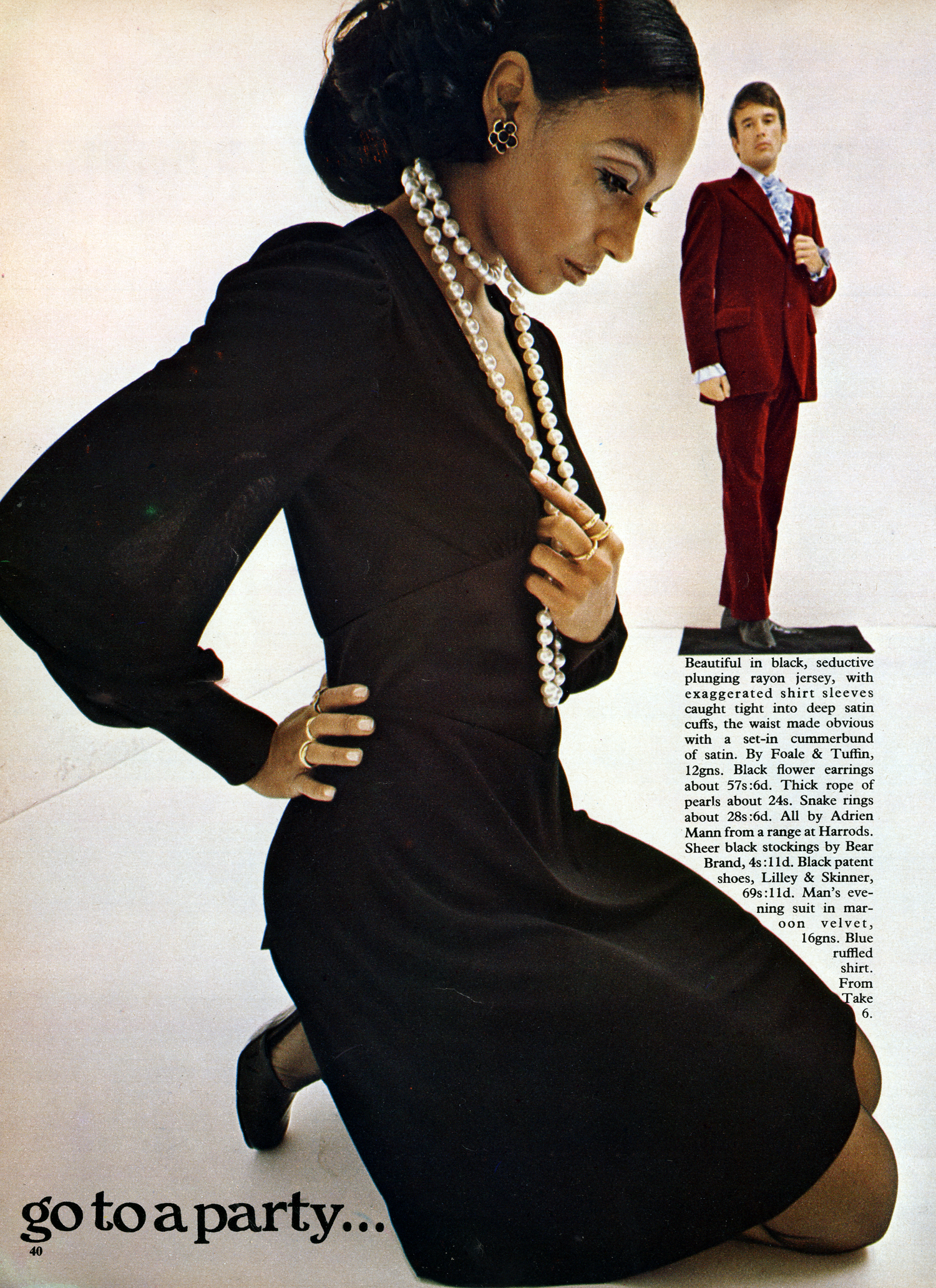
Glamorously Grecian… pure white crepe, beautifully braided. By Young Ideas at Rhona Roy. Jewellery by Adrien Mann. Man’s black braided suit is from Just Men.
Beautiful in black seductive plunging rayon jersey. By Foale and Tuffin. Jewellery by Adrien Mann. Shoes by Lilley and Skinner. Man’s evening suit and shirt all from Take 6.
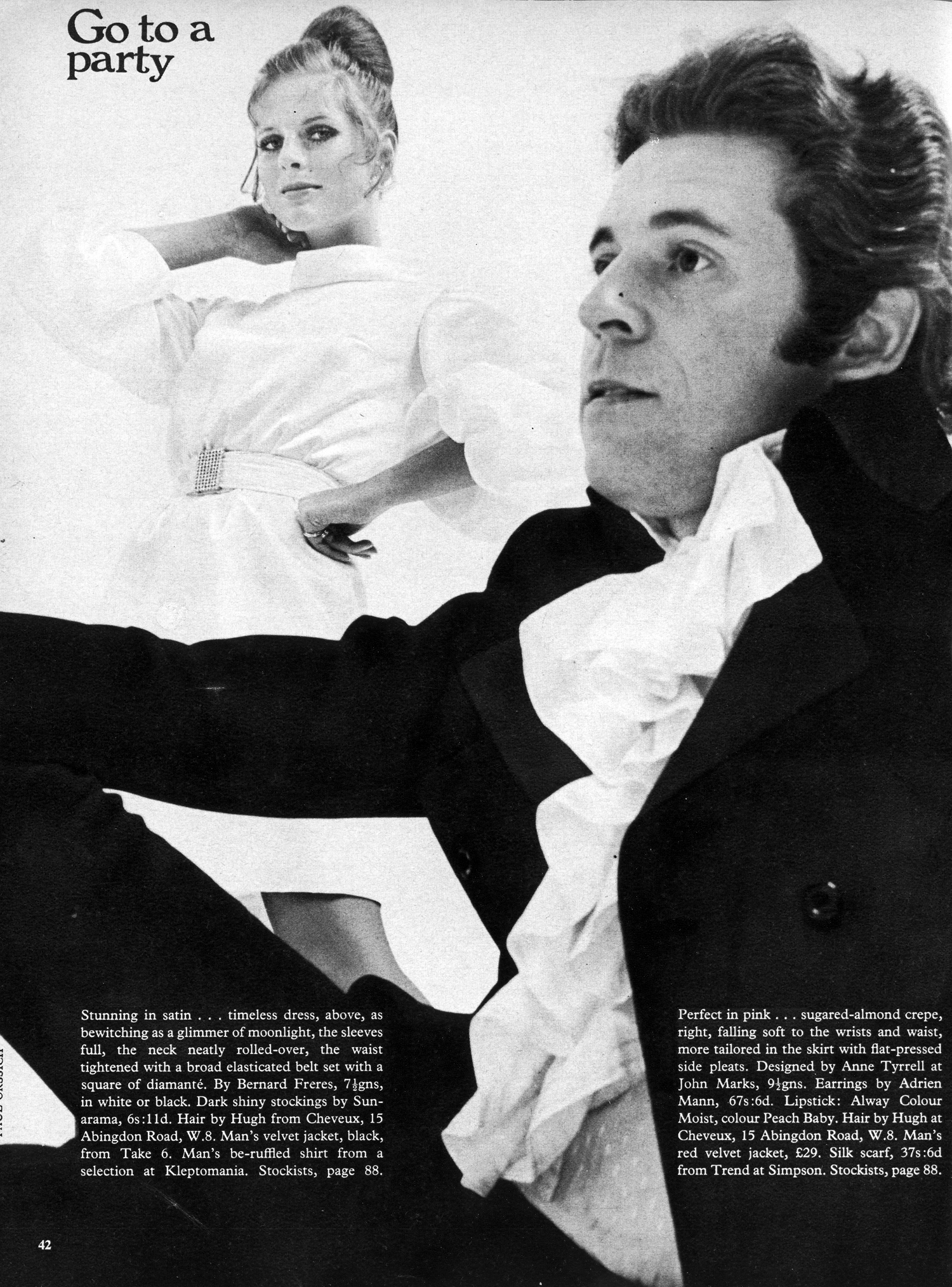
Stunning in satin… timeless dress as bewitching as a glimmer of midnight. By Bernard Freres. Man’s velvet jacket from Take 6. Man’s be-ruffled shirt from Kleptomania.
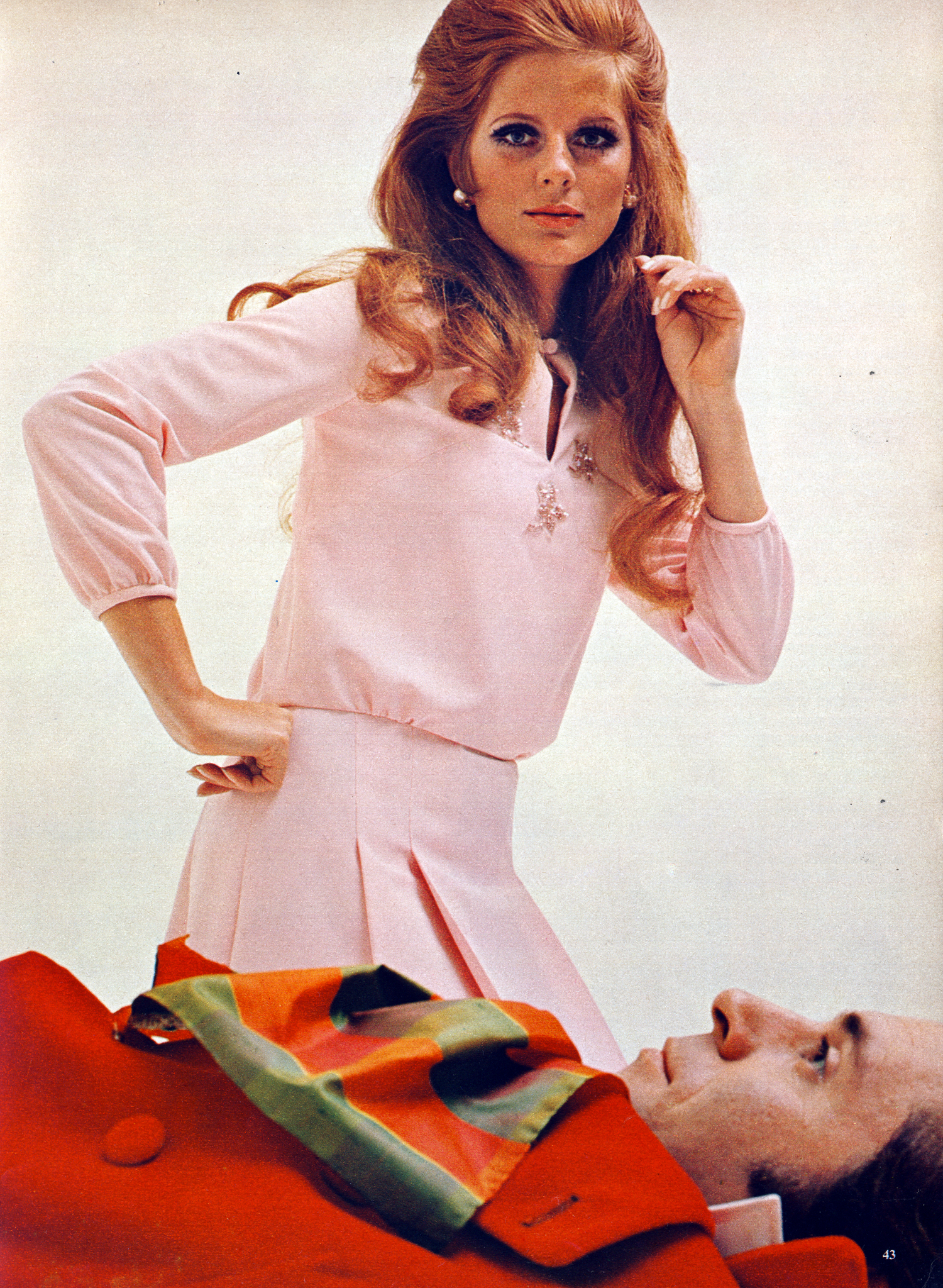
Perfect in pink… sugared almond crepe falling soft to the wrist and waist. Designed by Anne Tyrrell at John Marks. Jewellery by Adrien Mann. Man’s red velvet jacket and silk scarf from Trend at Simpson.
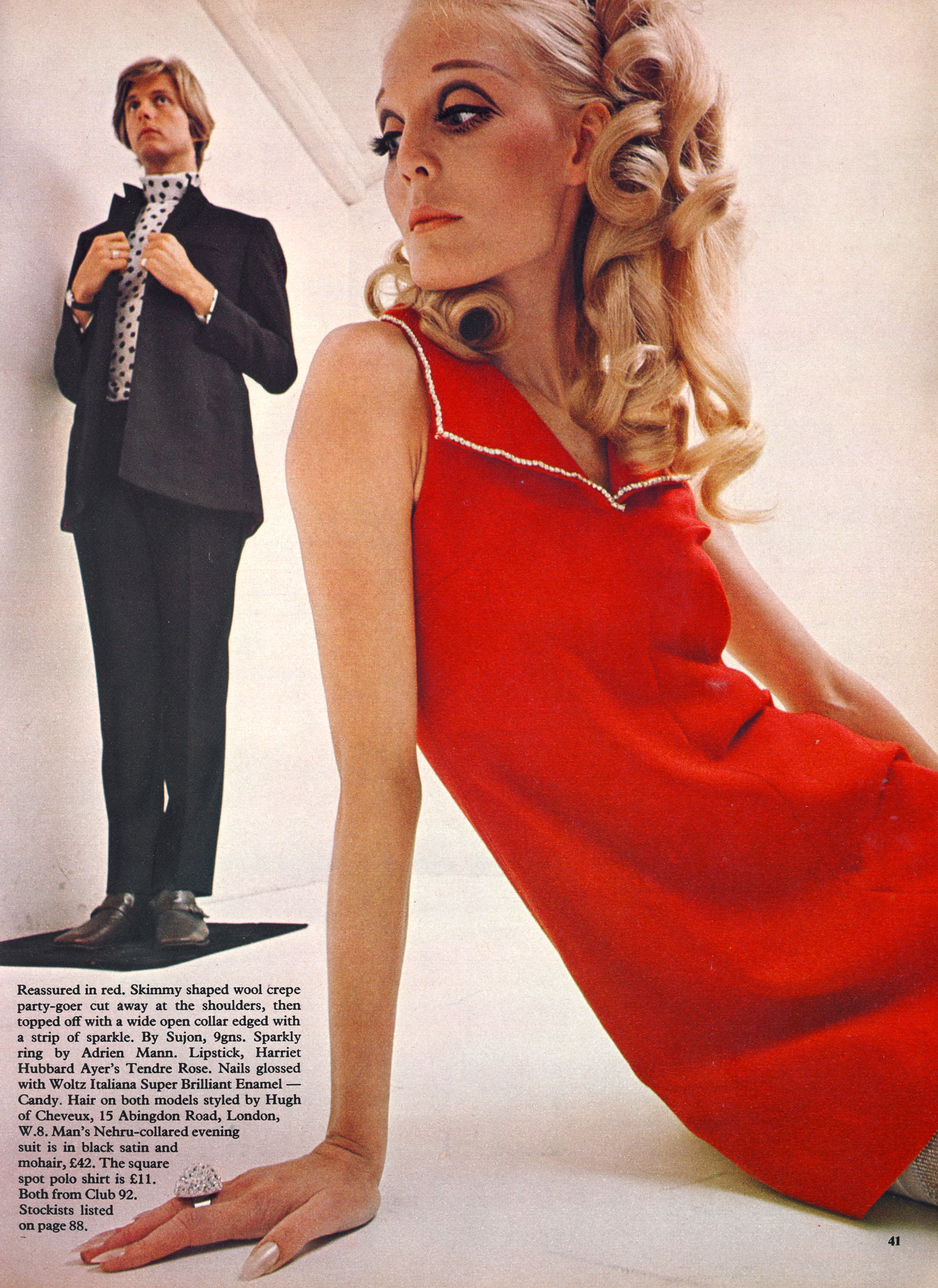
Reassured in red. Skimmy shaped wool crepe party-goer cut away at the shoulders. By Sujon. Jewellery by Adrien Mann. Man’s evening suit and polo shirt both from Club 92.
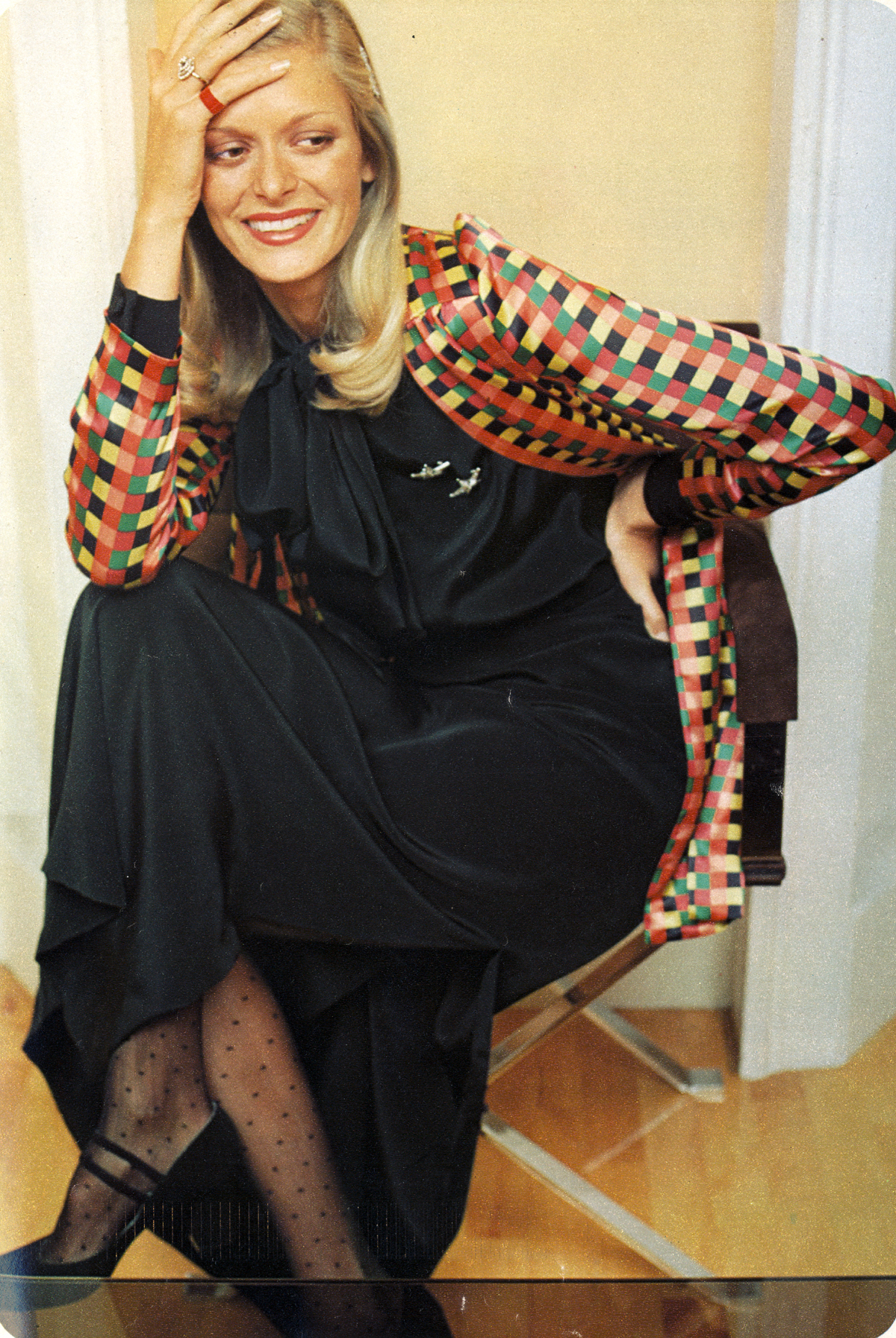
Satin crepe de chine tie neck dress and chequered over jacket by Anne Tyrrell at John Marks. Suede shoes by Mondaine.
When it comes to dressing up tonight there’s no such thing as a party line. Redheads come into their own with sleek Garboesque hairdos to set off shiny battledress tops and trousers. Jazzily printed crepe de chine dresses and jackets mix with jersey and velvet, softly innocent or dangerously backless and halternecked. Diamante remains the vital accessory – shining in the hair as well as sprinkled on bodices. The choice is yours and glamour the mood.
Photographed by John Carter.
Scanned by Miss Peelpants from Flair, December 1971
Cream jersey top and matching skirt by Mary Quant
Both dresses by Harriet
Liberty print cotton blouses and skirts, both by Courchevel. Choker by Ken Lane. Suede bar shoes by Russell & Bromley.
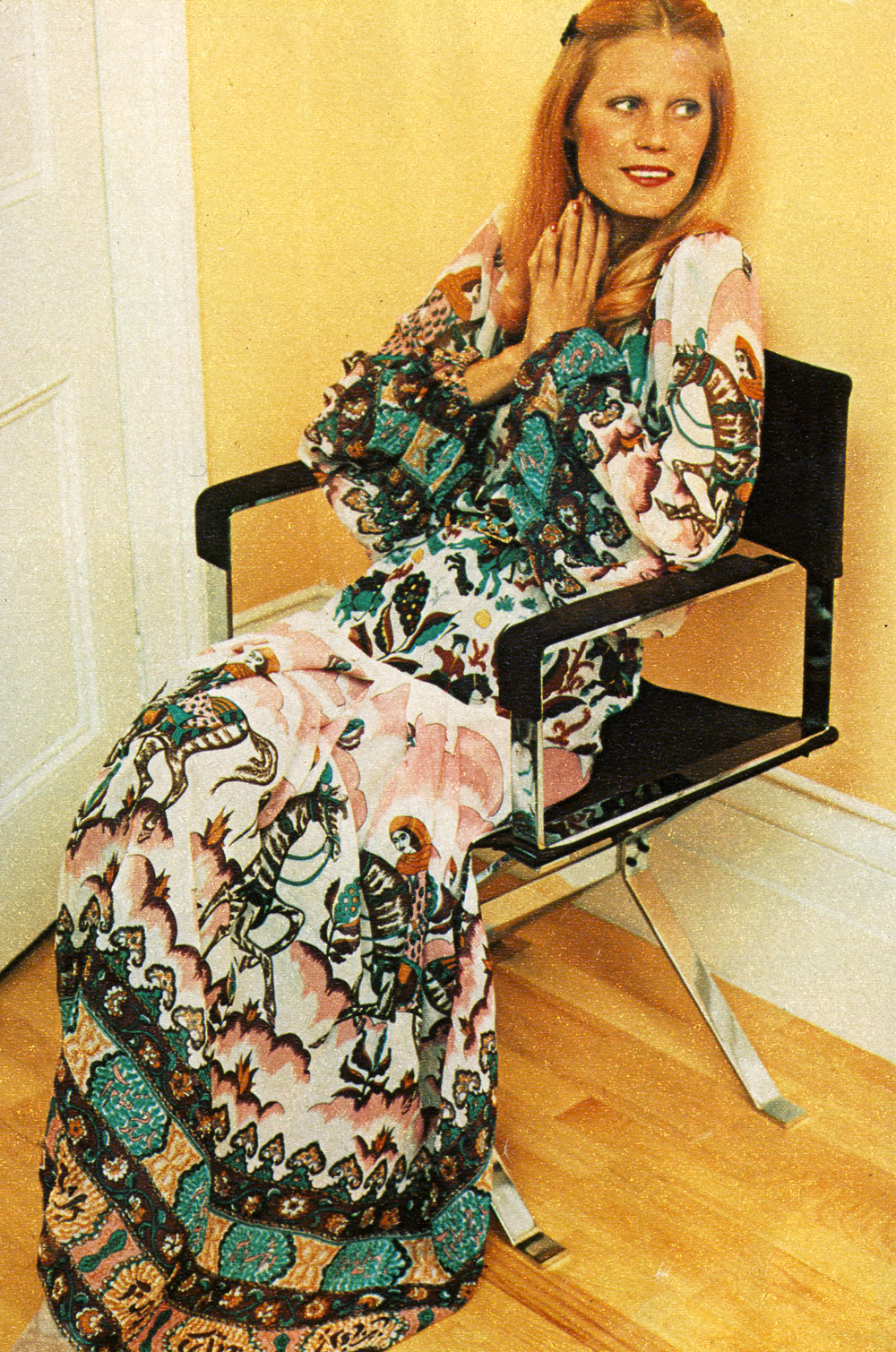
Pleated cotton voile horseman print dress by Thea Porter. Gilt and mock turquoise belt by Ken Lane.
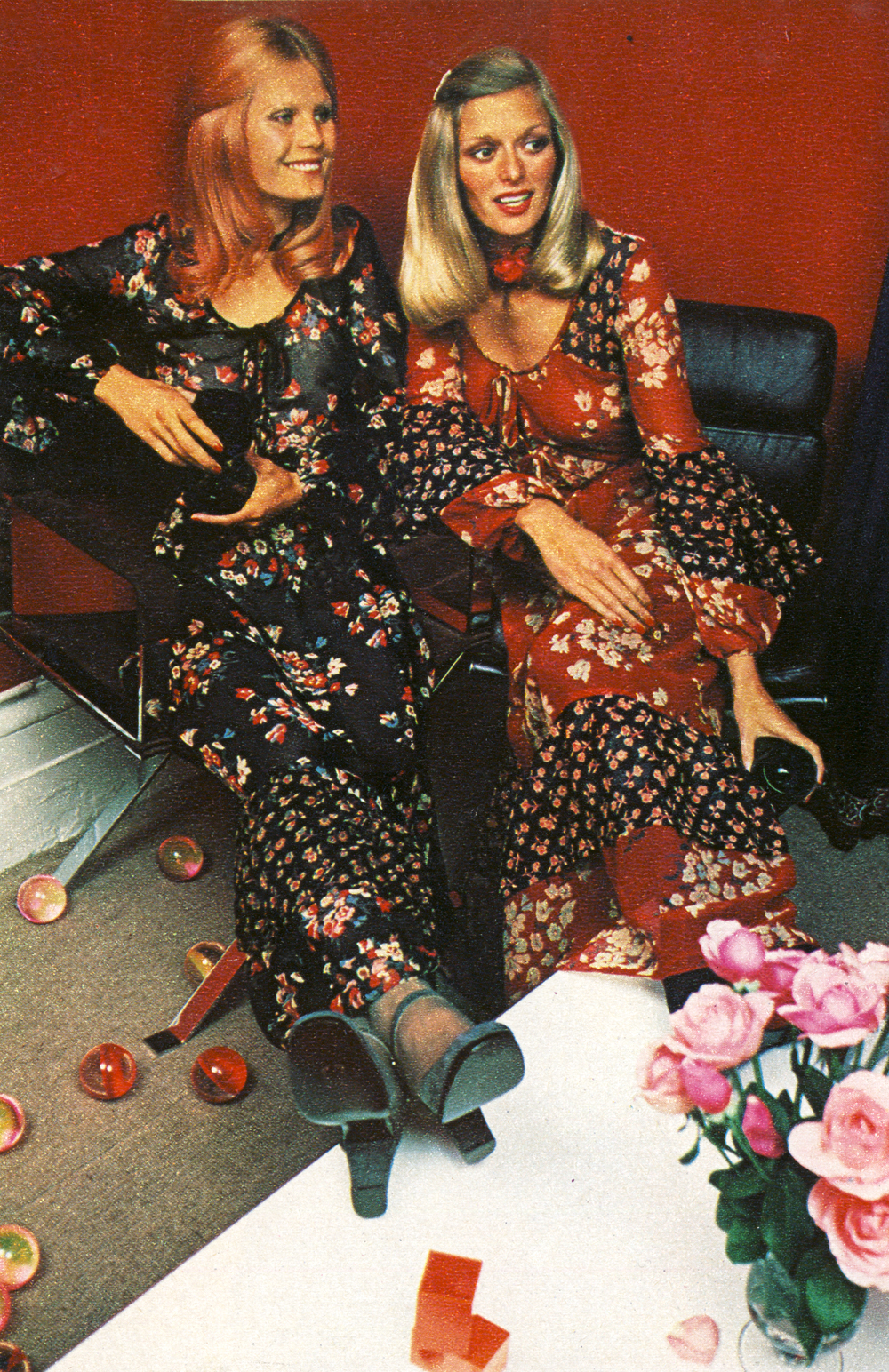
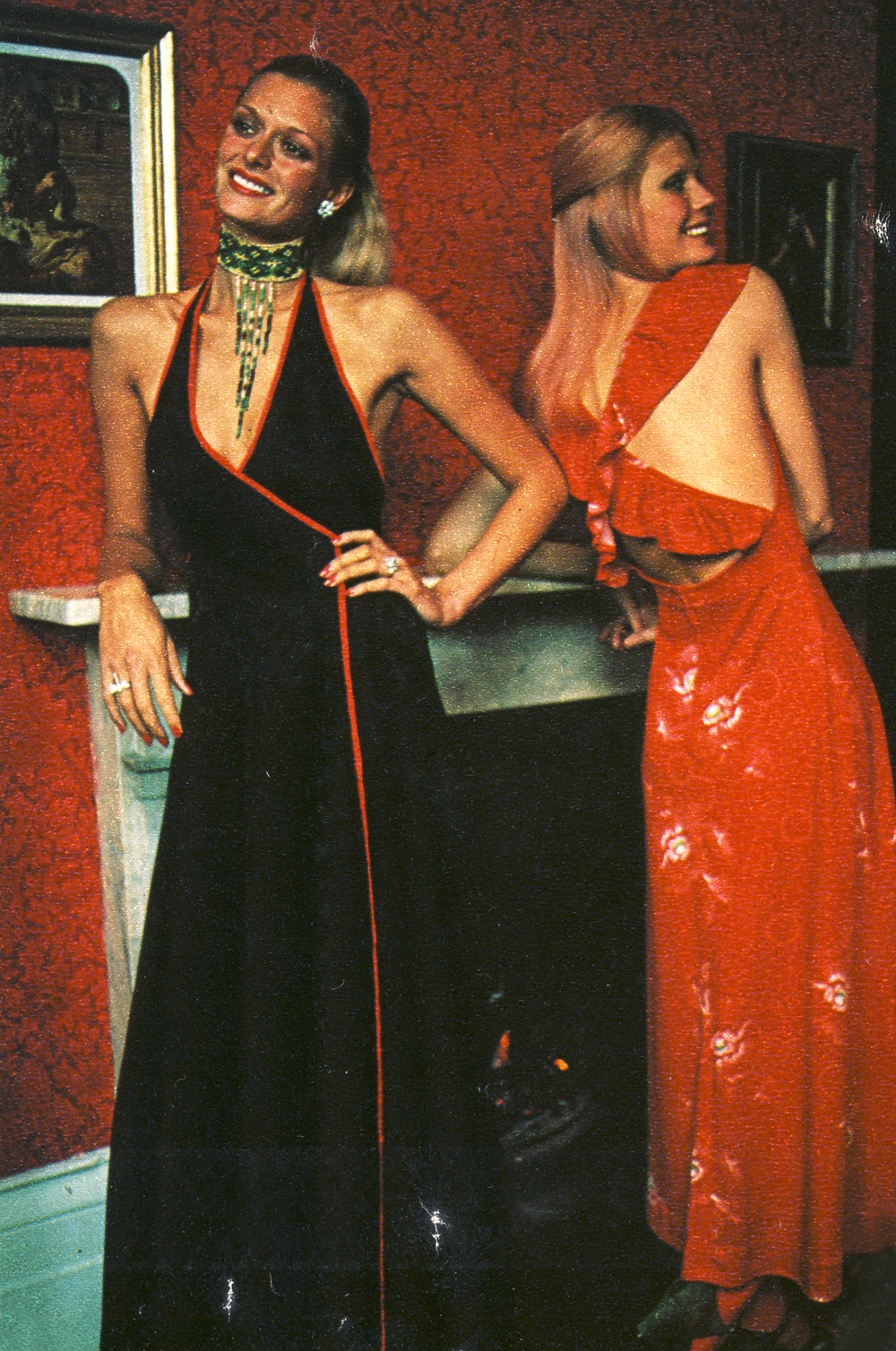
Left: Dress by Reflections at Reldan. Right: Jersey dress by Baltrik.
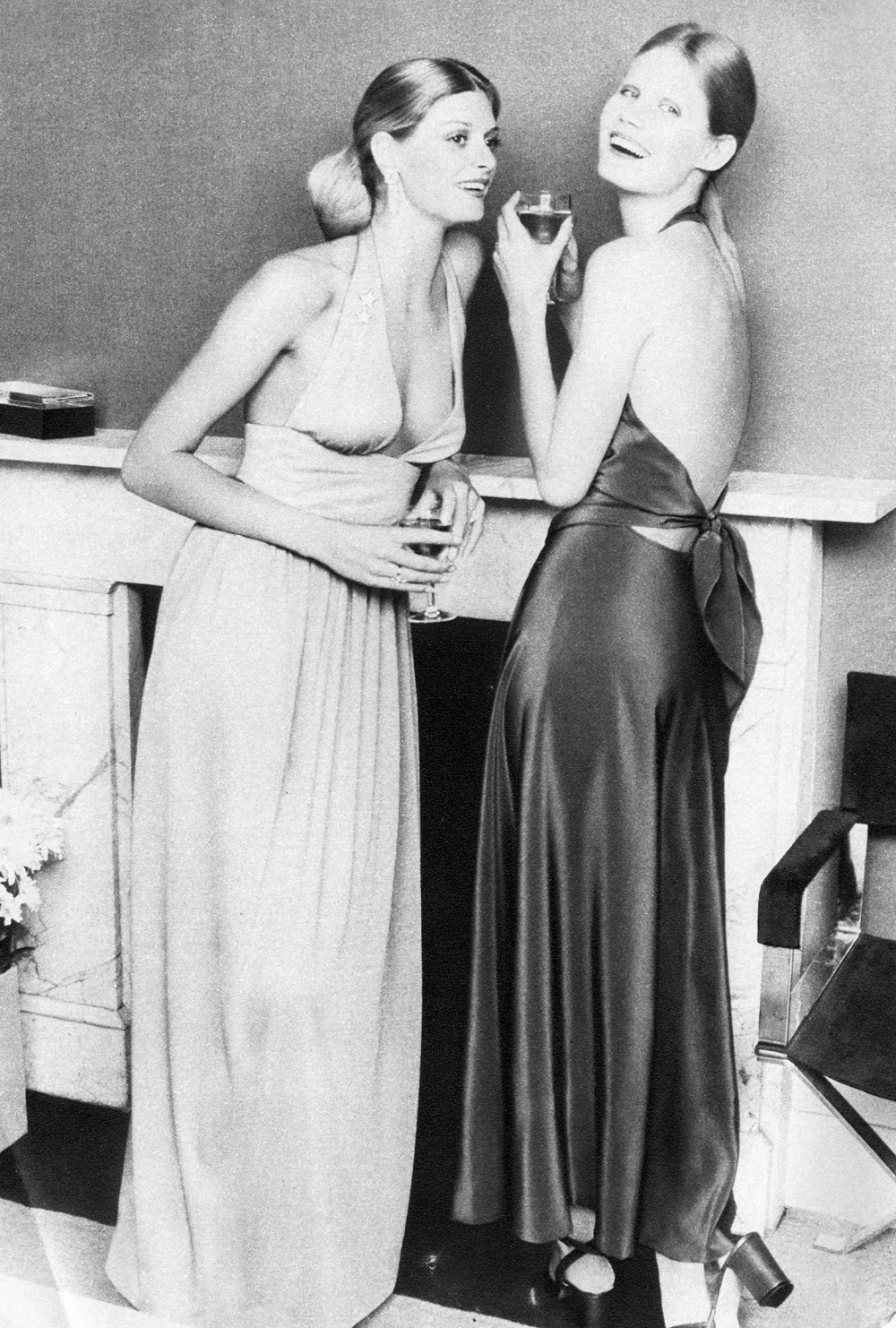
Left: Ban-lon halterneck dress by Wallis. Right: Brown crepe de chine dress by Annacat.
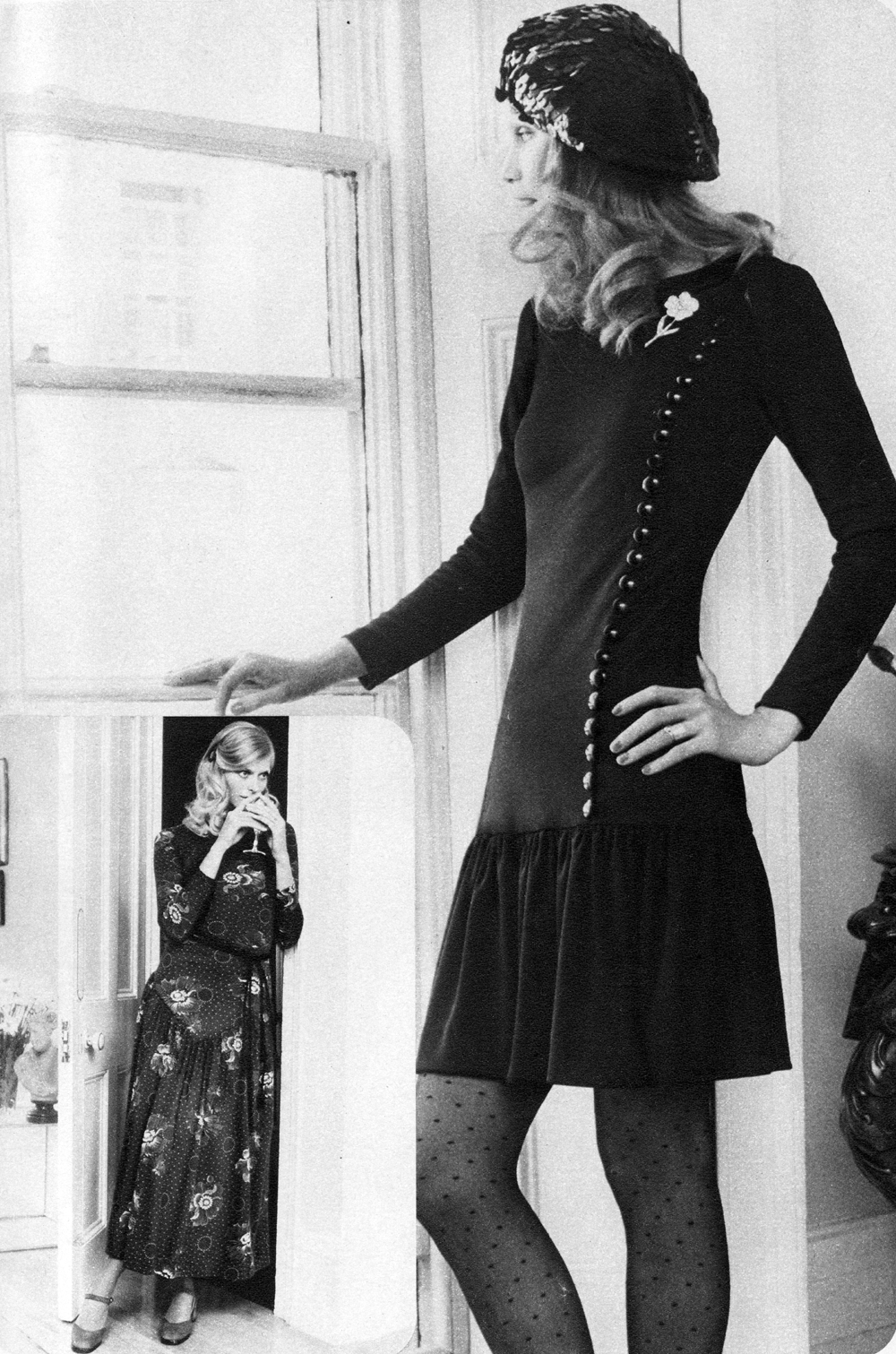
Black jersey dress by Polly Peck. Inset: Jersey dress by Baltrik. Shoes by Russell & Bromley.
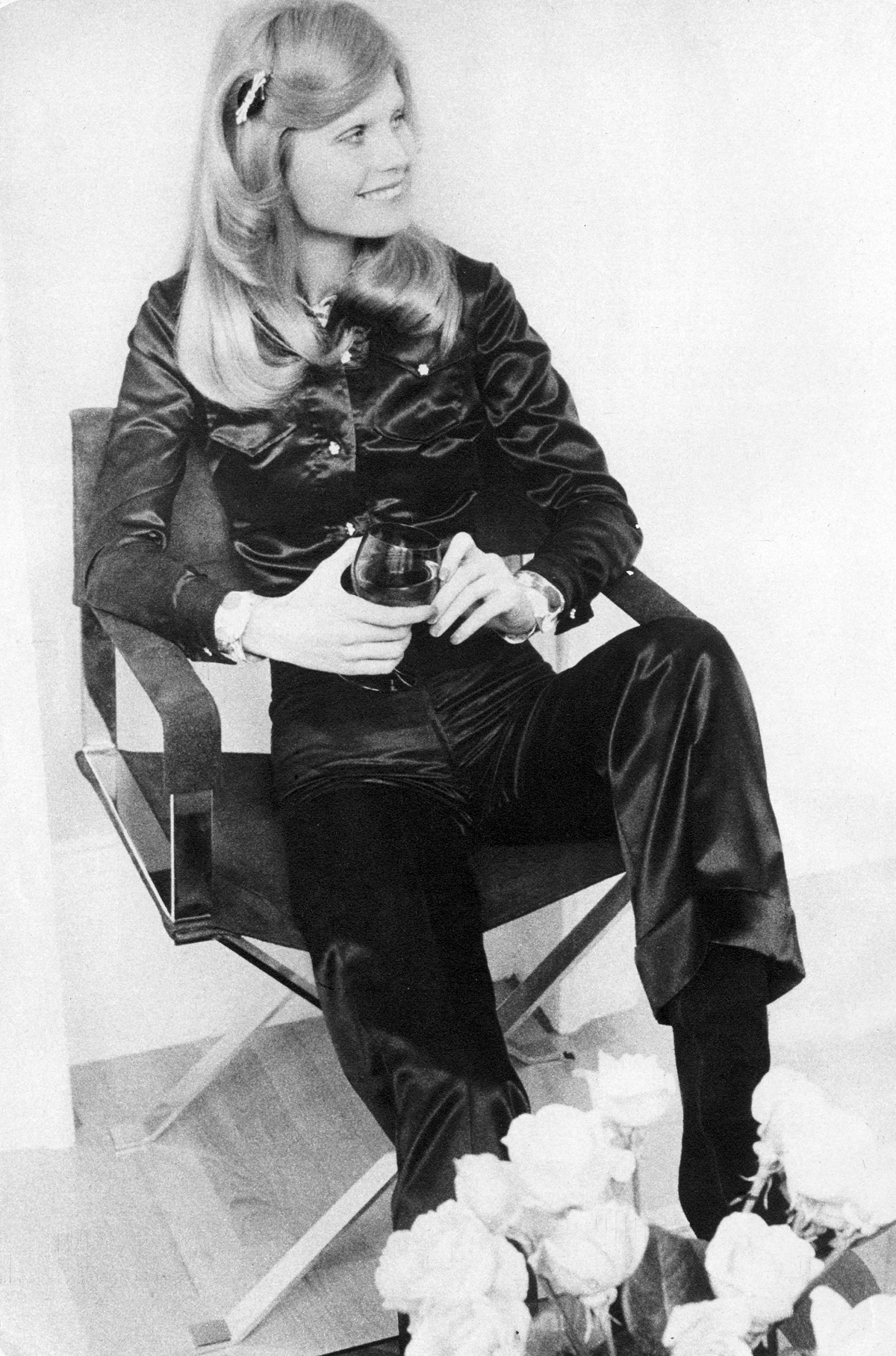
Black satin battledress jacket and trousers by Juliet Dunn.
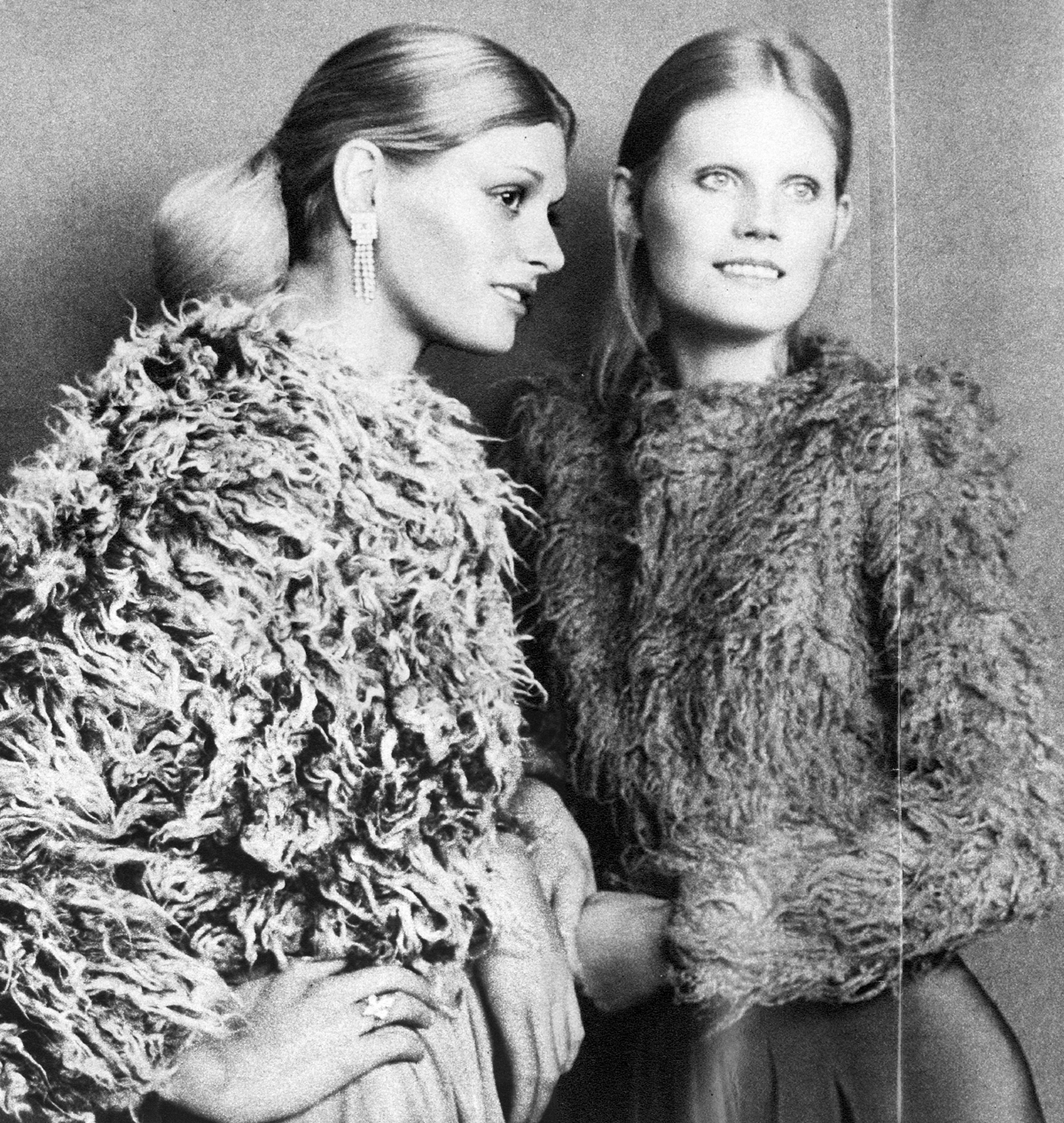
Grey and red short wooly jackets by Elgee.
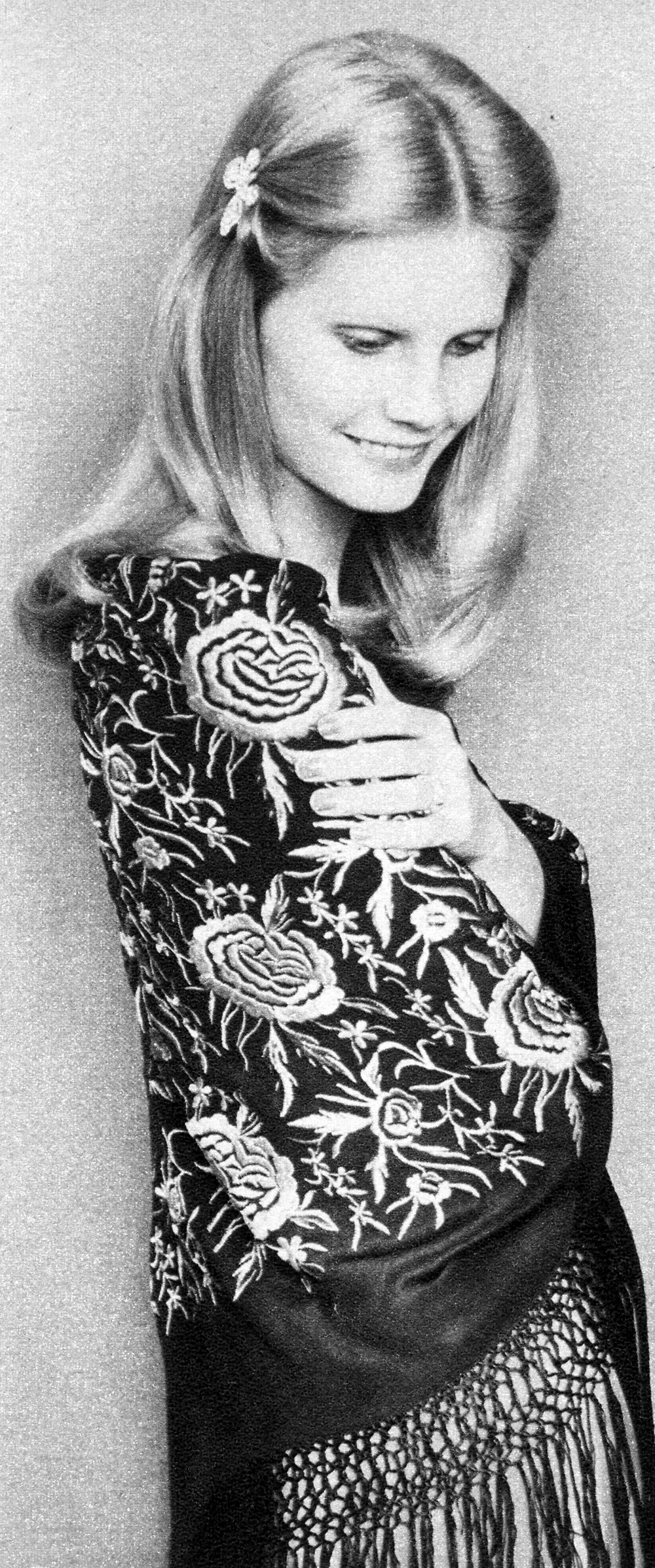
Fringed black shawl from Emmerton and Lambert.
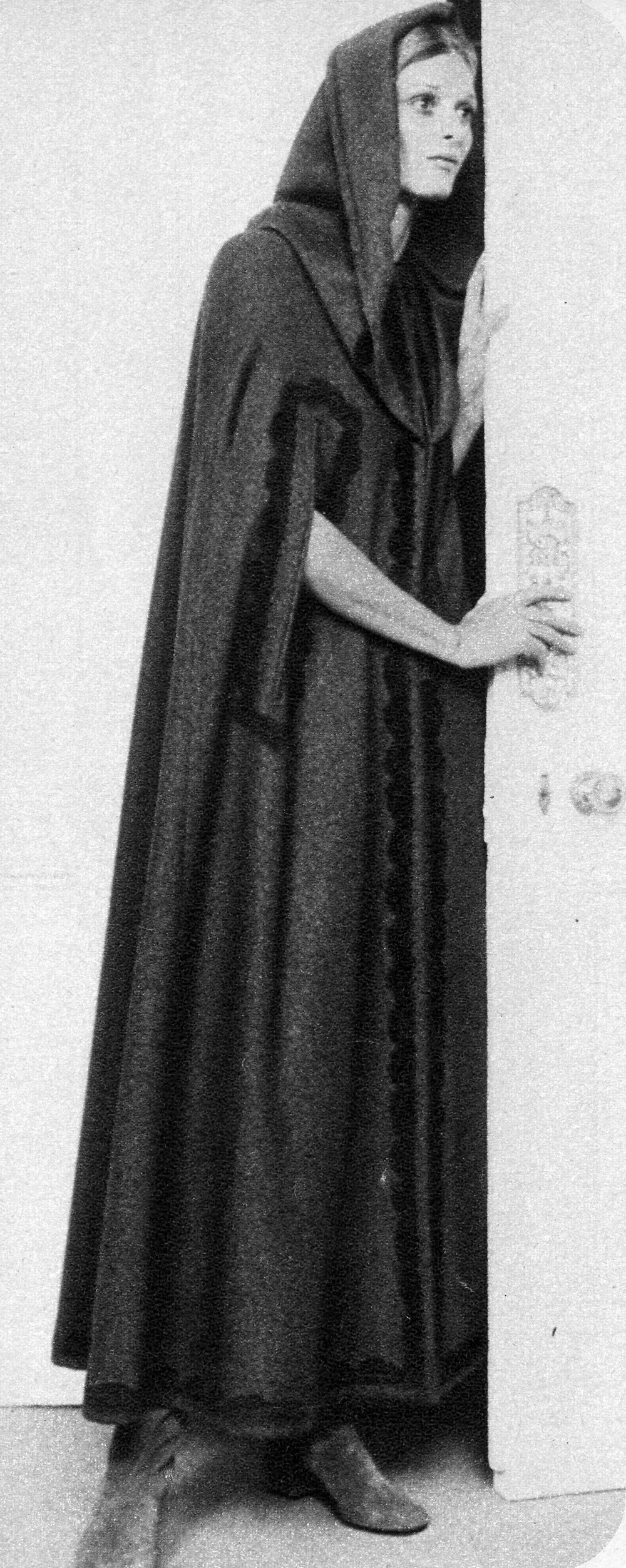
Grey wool flannel full length cape by Christopher McDonnell for Marrian-McDonnell.









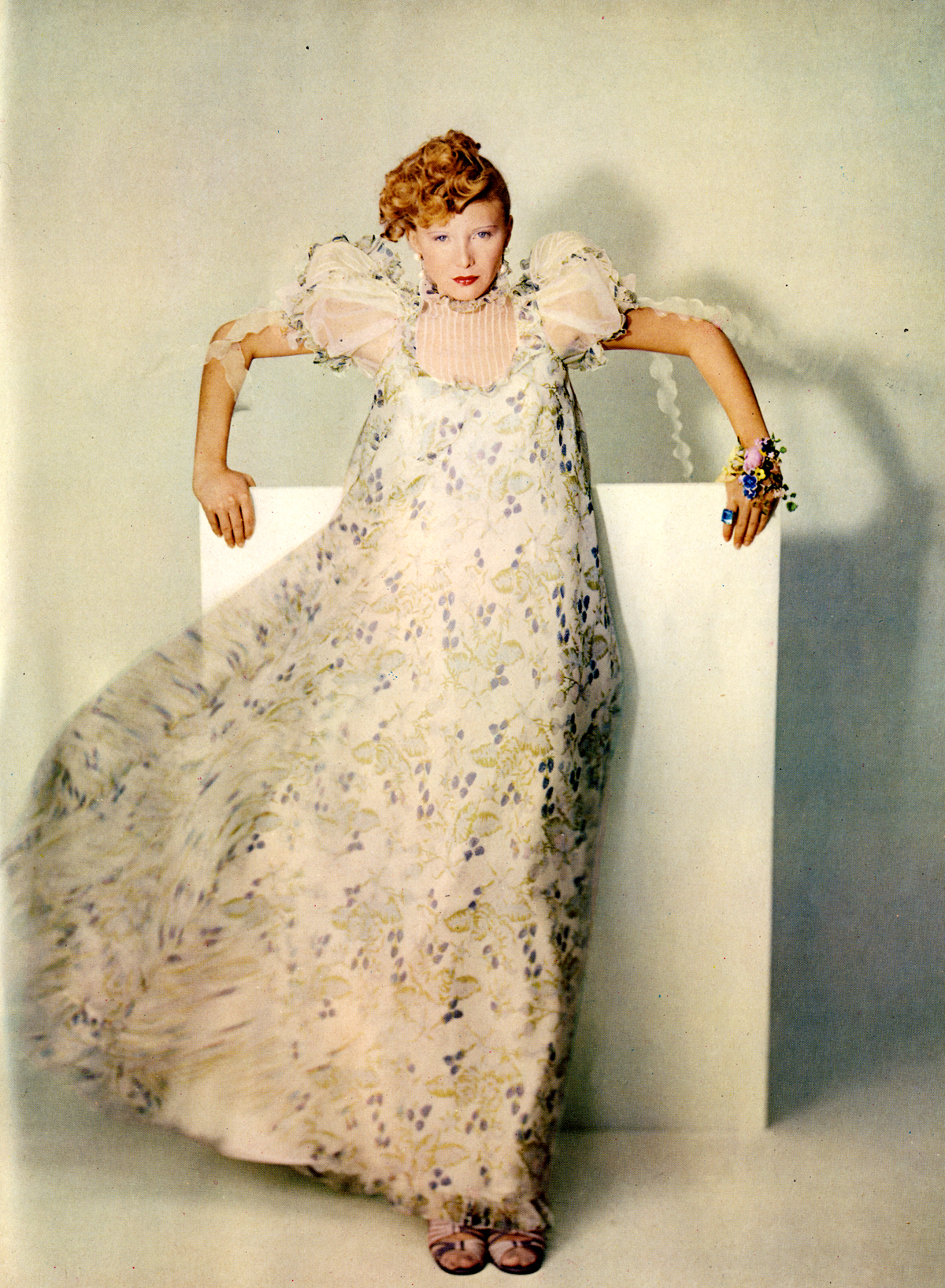
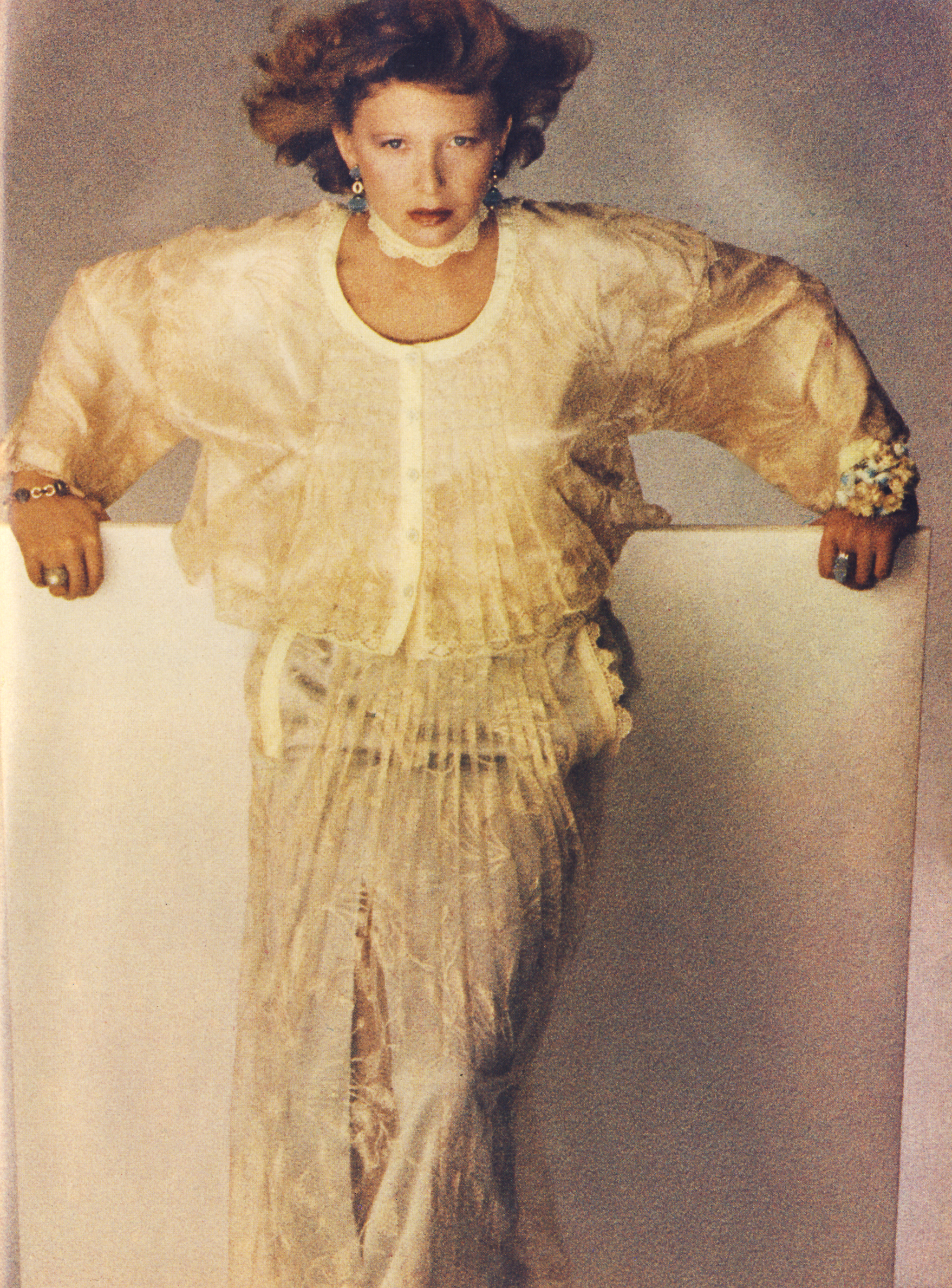
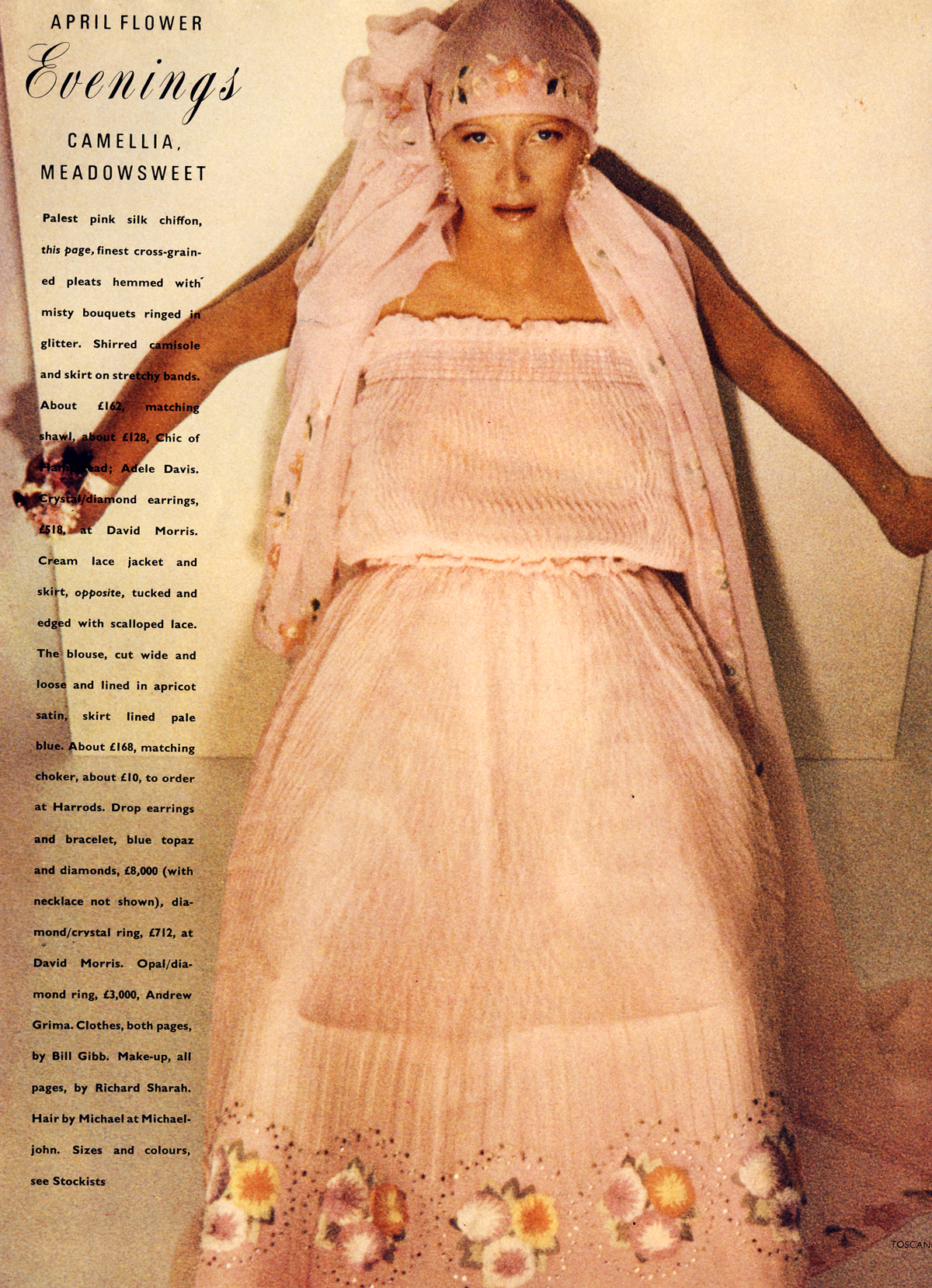
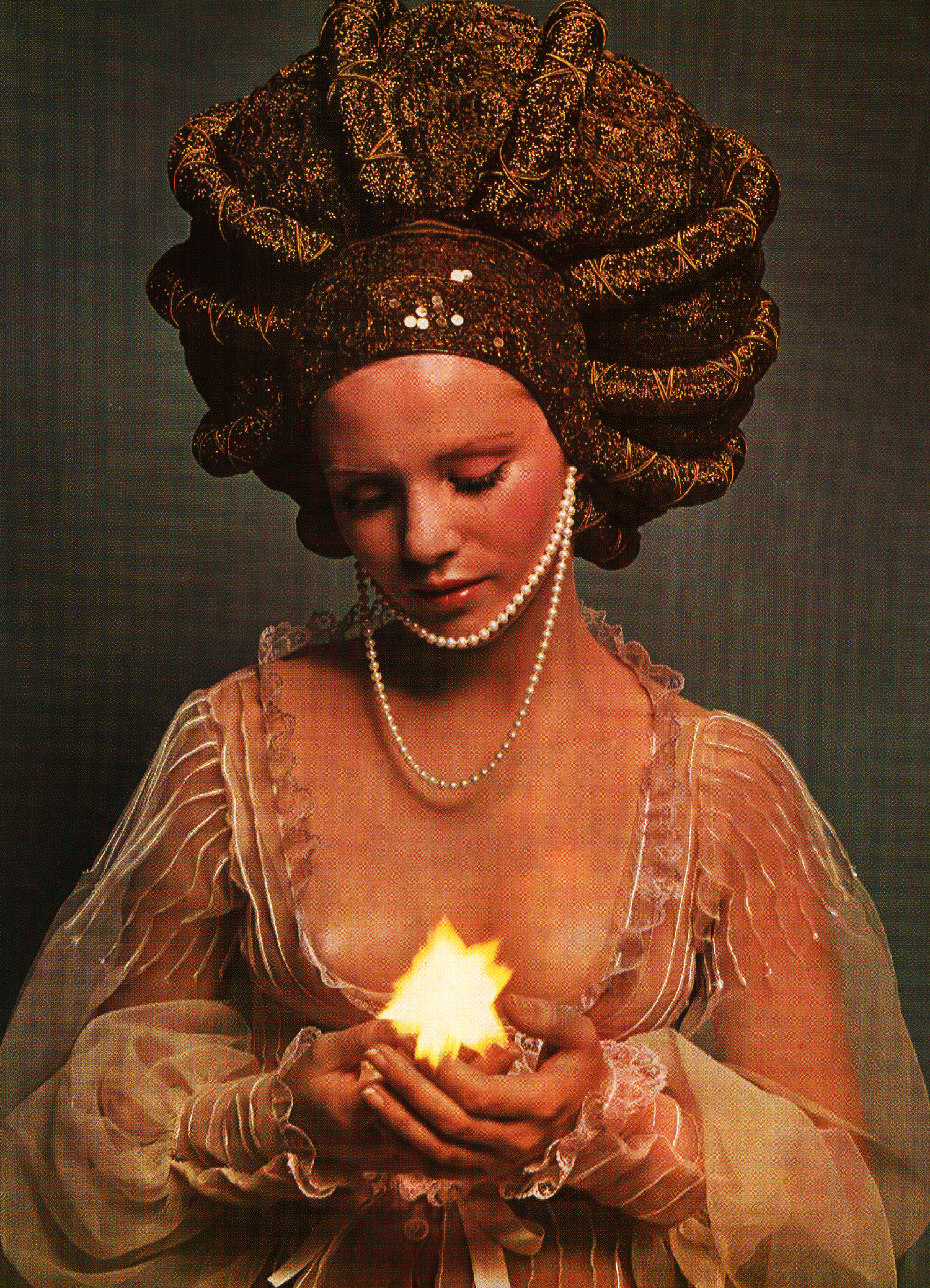
 Liz Eggleston