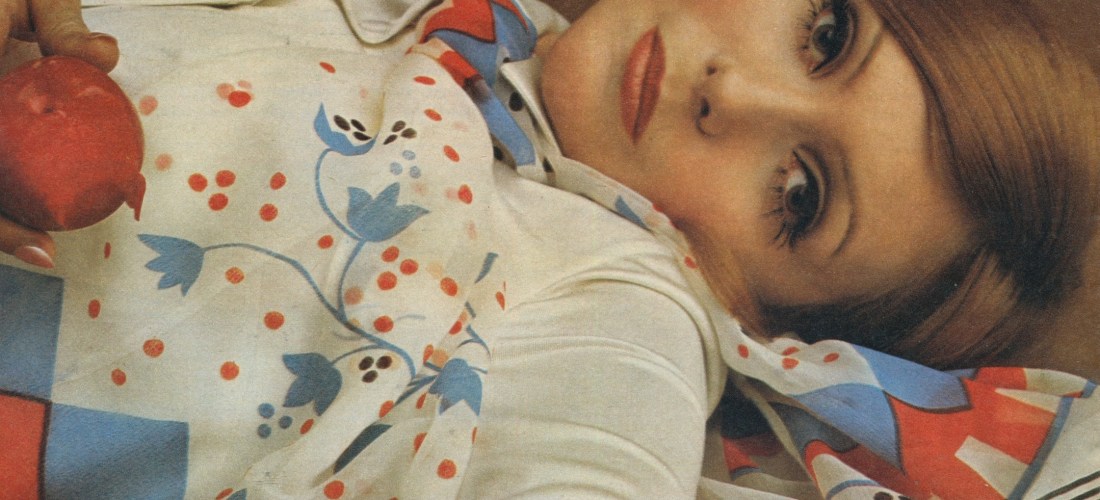
Long chiffon scarf designed by Celia Birtwell, 2 gn., from the Vidal Sassoon Shop, 44 Sloane Street, W1; Quorum, 52 Radnor Walk, SW3. White Tricel tricot blouse, part of set, by Mary Quant’s Ginger Group, 13 gn., with contrast trousers and jerkin, from Bazaar, Knightsbridge, SW1.
Scarves, instead of being dismissed as last year’s fashion gimmick, are being perpetuated as this year’s most important accessory. Still the simplest way to wear a scarf is to flip a long one casually college-style around the neck. As long as it’s not literally a college scarf this somehow adds enough chic to whatever you wear, without making you look fussily overdressed. There are dozens of different ways to tie a scarf. Smart French girls are tying scarves around their waists, twisted in with chain belts or beads. Marc Bohan at Dior makes headscarves tied pirate-style look young and chic, and shows scarves tied like a man’s tie. Although large squares will still be in demand to wear on the head or folded up as cravats, the big fashion in scarves is still for long ones, preferably fringed. Men will have to accept with a good grace that they have lost their long-established monopoly of fringed silk scarves. Until now almost the only places to find them were men’s departments, antique market stalls or somebody’s attic. (Shawls are the latest craze from jumble sales.) But shopping for scarves is easier this spring, with stocks at last in every shape and size. Hair by Valerie at Cheveux, 15 Abingdon Road, London W8.
Fashion by Liz Smith.
Photographed by Steve Hiett.
Scanned from The Observer Magazine, March 1969.
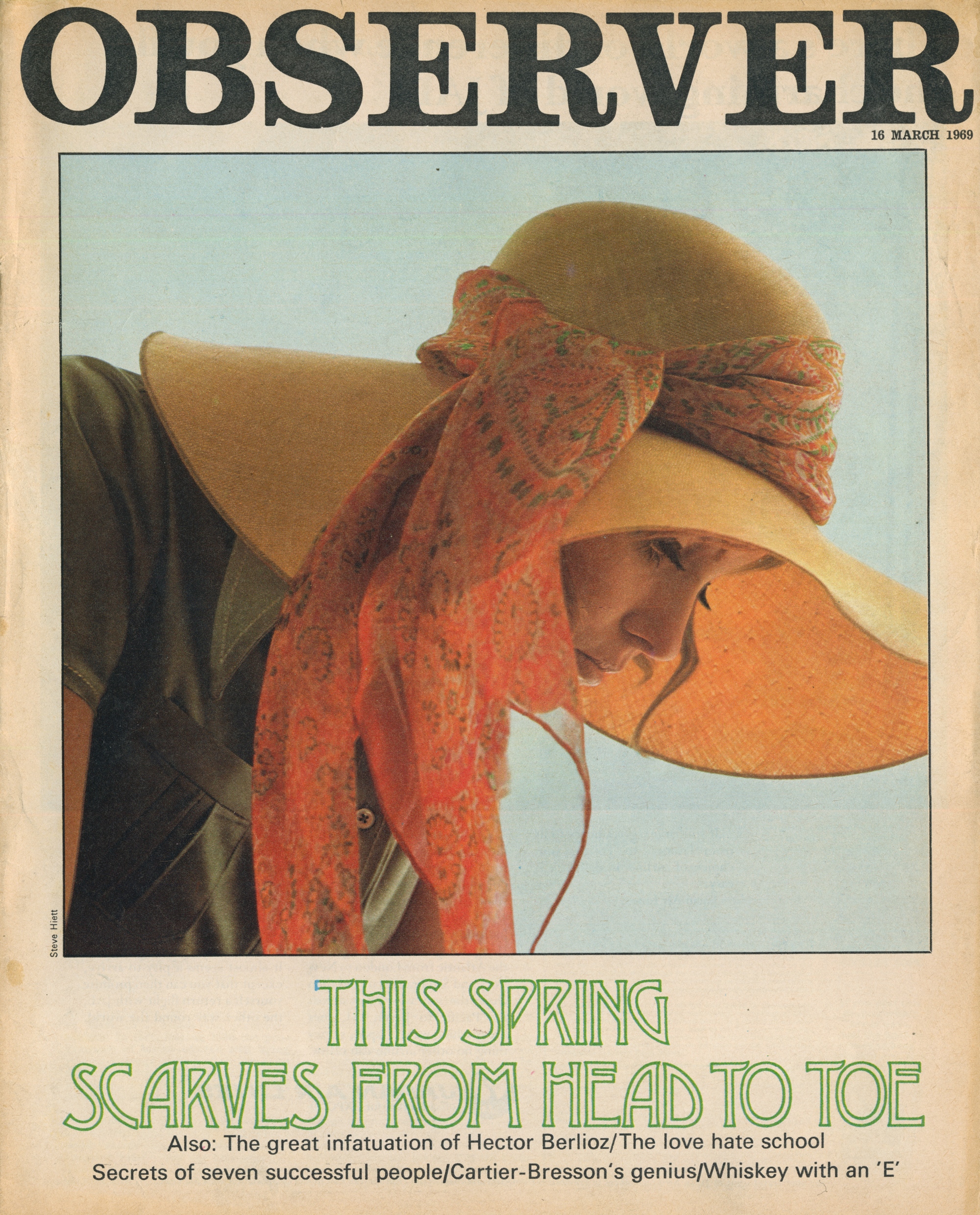
Paisley printed chiffon square, 63s., from Liberty, Regent Street, W1. Hat by Edward Mann, 49s. 11d., in a variety of colours. Tricel jersey tunic shirt (with trousers), by Jinty, 8 gn.
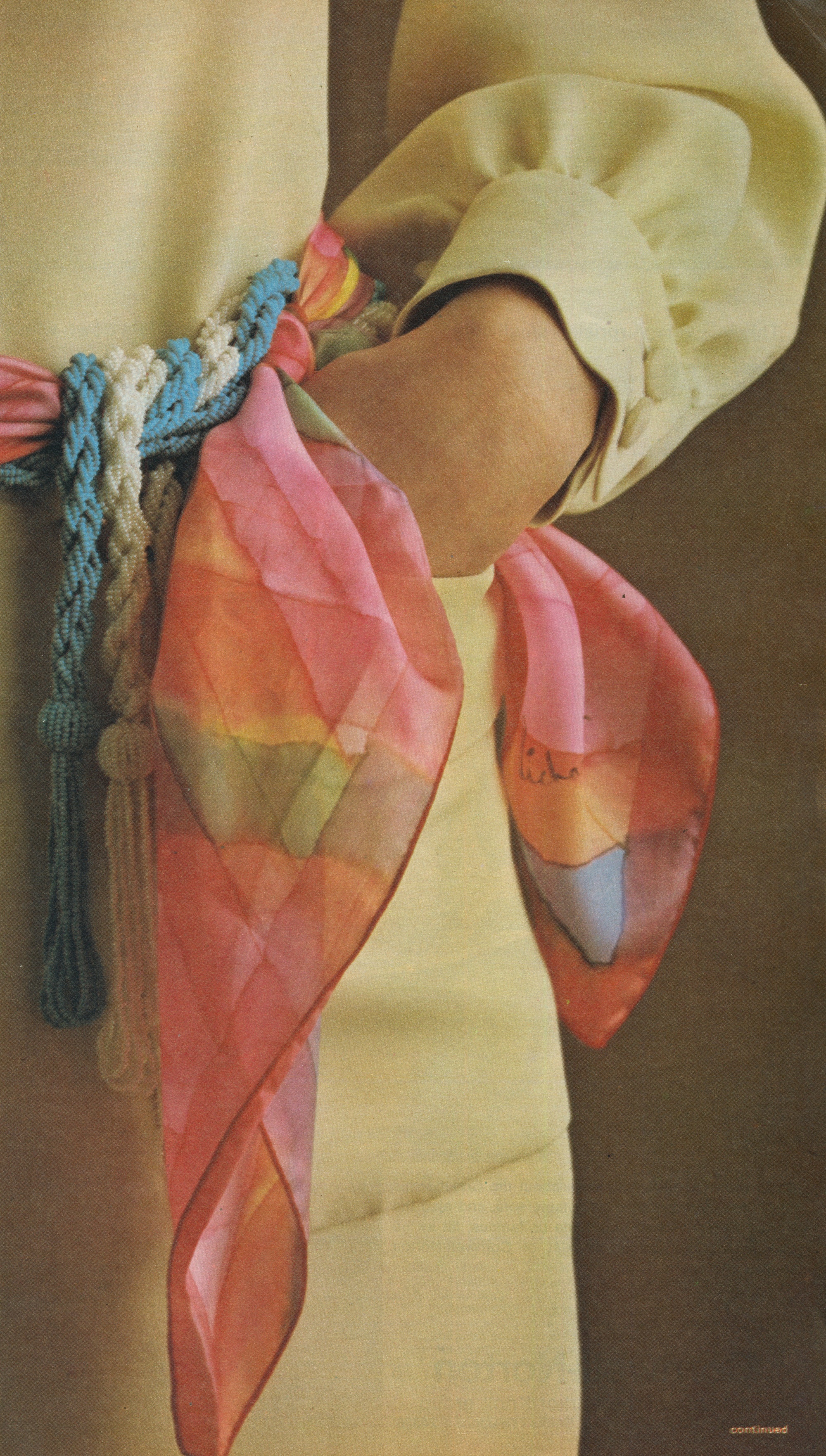
Tied around the waist a filmy silk square by Richard Allen, 75s., from Fenwick, 63 New Bond Street, WI. Pearl and turquoise twisted bead belts with tassel ends, by Adrien Mann, 30s. each, from Harrods; Kendal Milne, Manchester. Beige crepe shirtsleeved jumpsuit £41 10s., from Jaeger, Brompton Road, Sloane Street, Baker Street and a number of provincial branches.
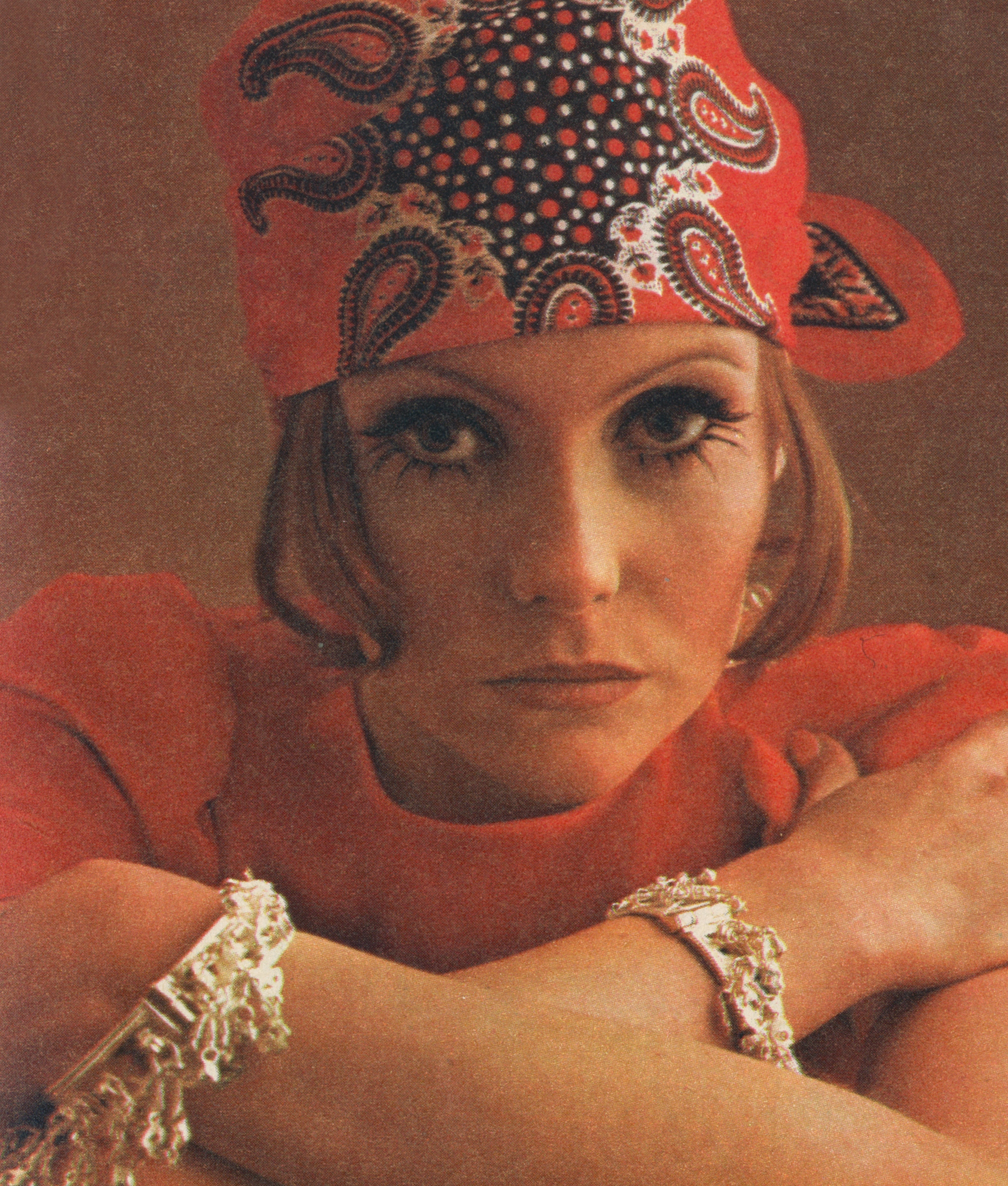
Pirate-style cotton handker-chief, 17s. 6d. from Liberty. Silver brooch on shoulder, 30s., silver bracelets, £1 7s. 6d. each; all from Indiacraft, Marble Arch, W1. Tricel jersey dress by Mary Quant’s Ginger Group, £5 19s. 6d., from Bazaar.
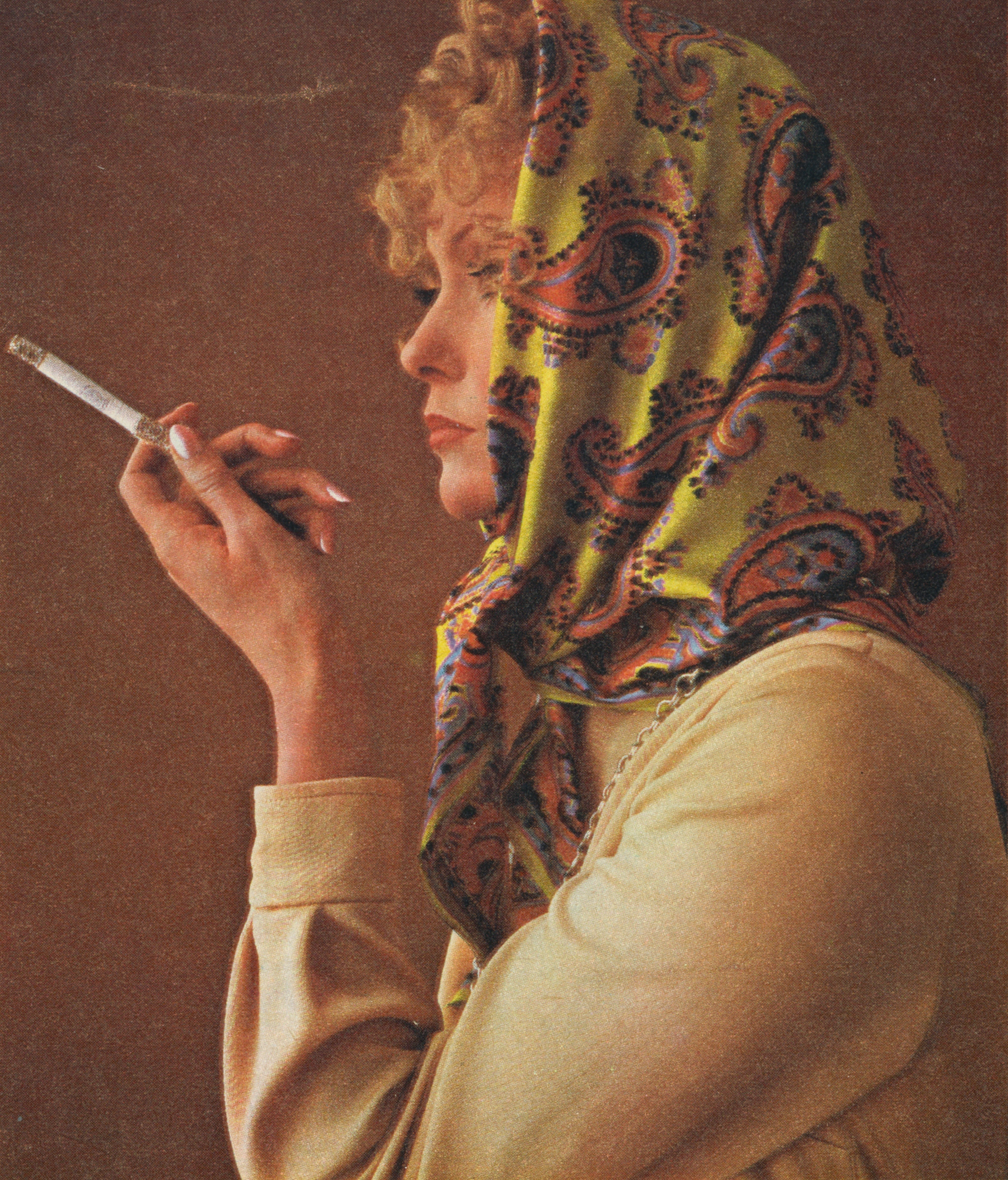
Indian silk scarf, 36 in. square, £1 11s. 6d., from Indiacraft, Silver chain, 18s. 6d. from Fenwick. Cigarette holder from Tunisia. Tunic dress in Lancola jersey by Marlborough, 11 gn., with trousers, from Peter Robinson.
Extra long silk scarf looks good tied as a sash, also in black, £2 2s. 6d., from Biba, 19-22 Kensington Church Street, W8, and by post. Rayon chiffon smock dress, by Polly Peck, 13 gn.
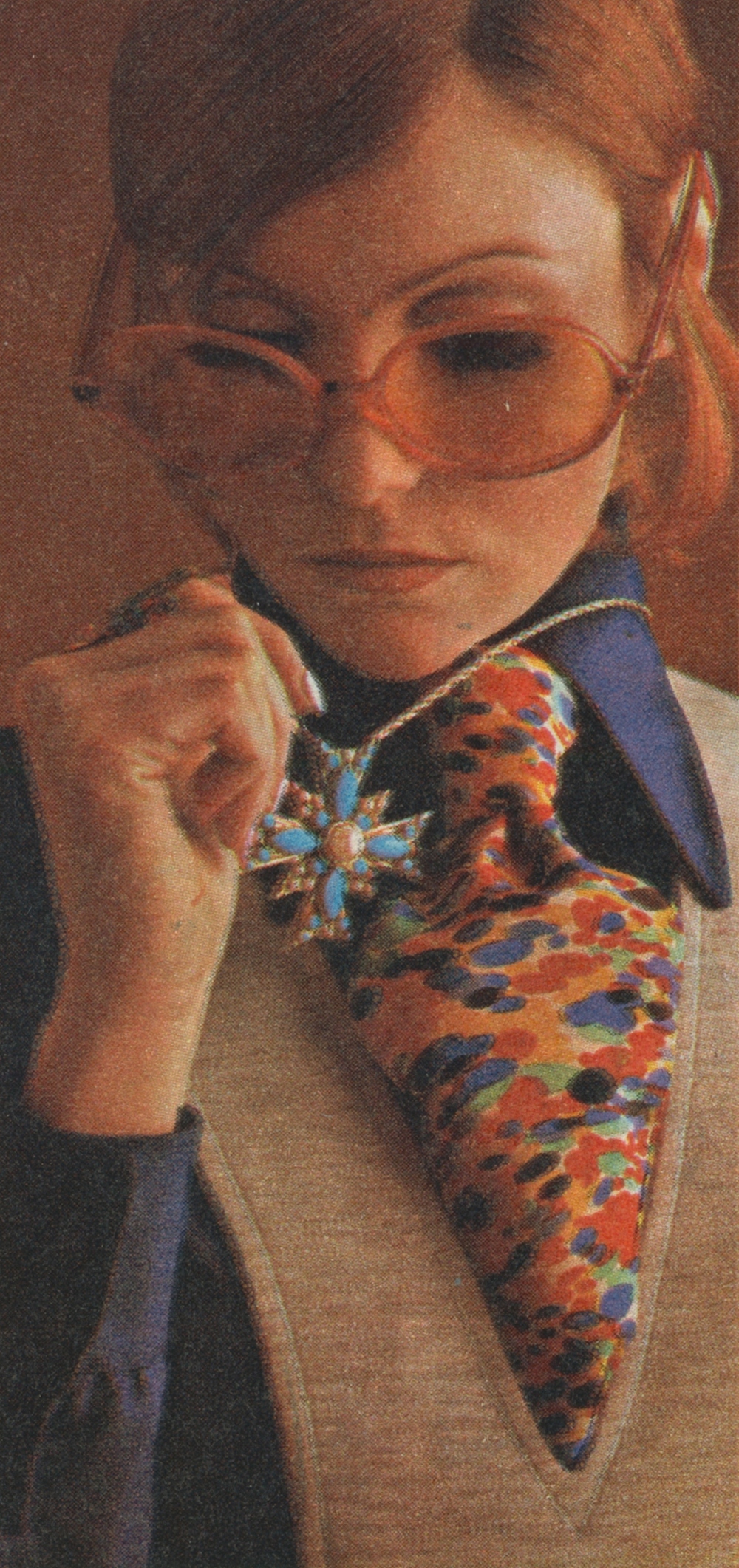
Square scarf tied like a tie, silk crepe de chine, 7 gn. yard, 36 in. wide, from Liberty. Dacron and cotton blouse, also in white, pale blue, brown, lagoon and pink, £5, from all Young Jaeger branches. Courtelle Neospun jersey pinafore-topped trousers designed by Janice Wainwright for Simon Massey, £8 18s. 6d. Maltese cross on chain by Adrien Mann, 25s. Tibetan bird ring £1 10s. from Indiacraft. Sunglasses by Corocraft, 25s.
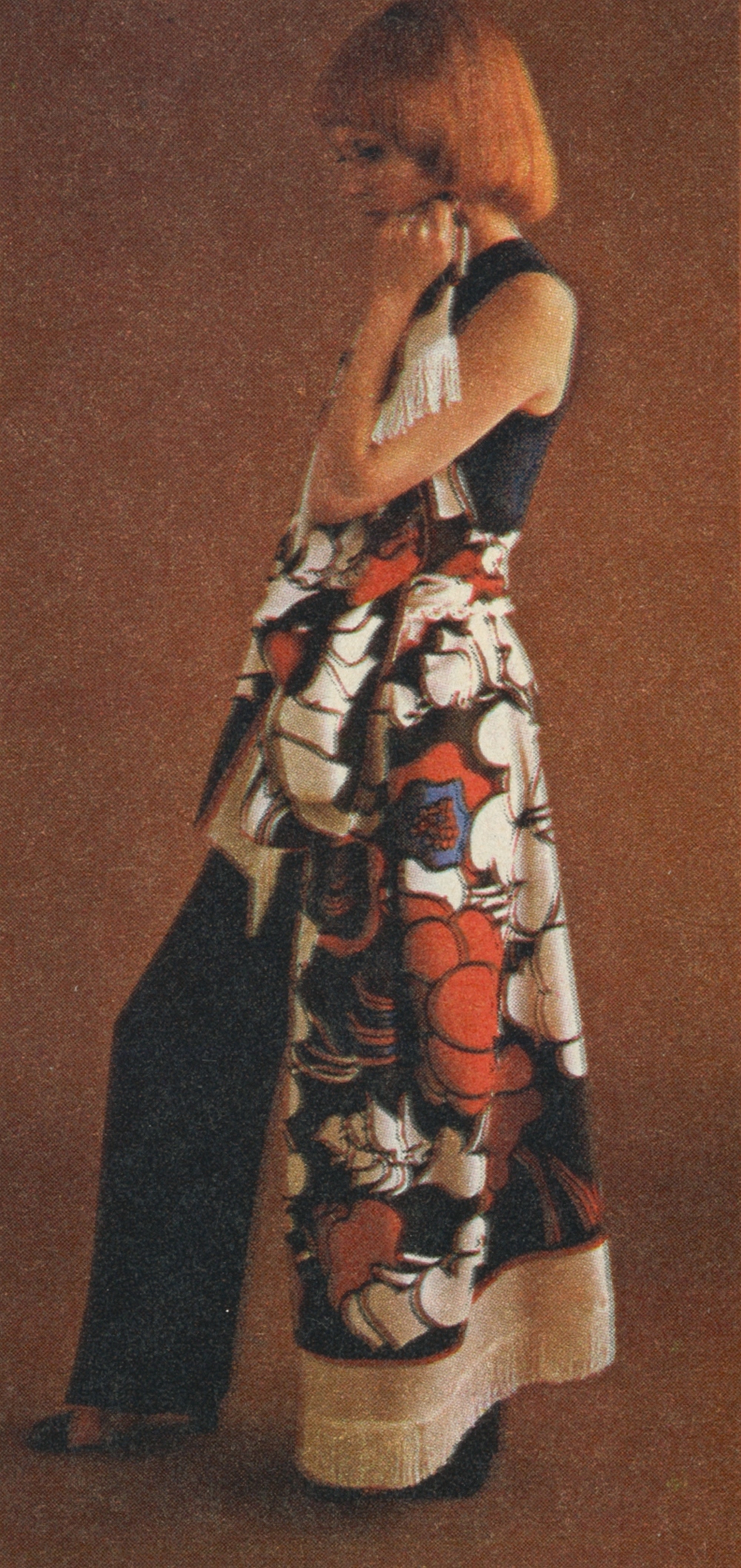
Silk stole to wear as a sash, by Richard Allen, £7 17s. 6d., from Fenwick. Simple round-necked sleeve-less jumpsuit zipping up the back, in linen-look rayon, navy, beige, thyme or caramel, £14 10s., from Jaeger, London, and all provincial shops. Red and navy slingback shoes, 79s. 11d., from Dolcis. White plastic chain belt by Adrien Mann, £1. Page-boy wig, £21 15s., from Beyond The Fringe, 59 Brook Street, London
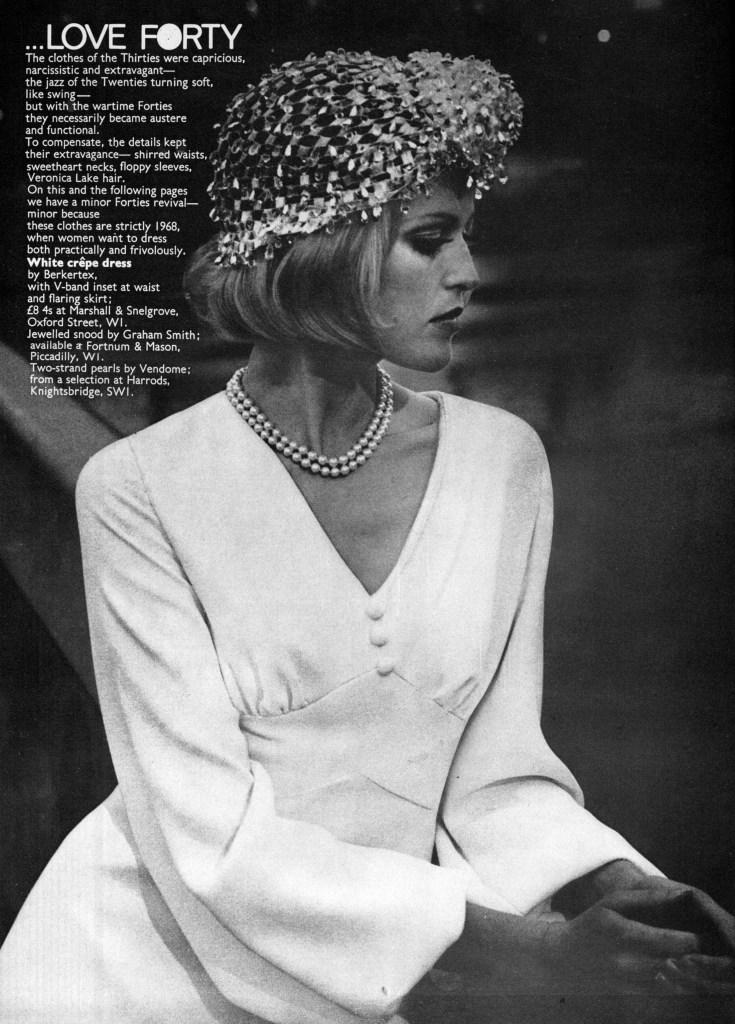
White crepe dress by Berkertex. Jewelled snood by Graham Smith.
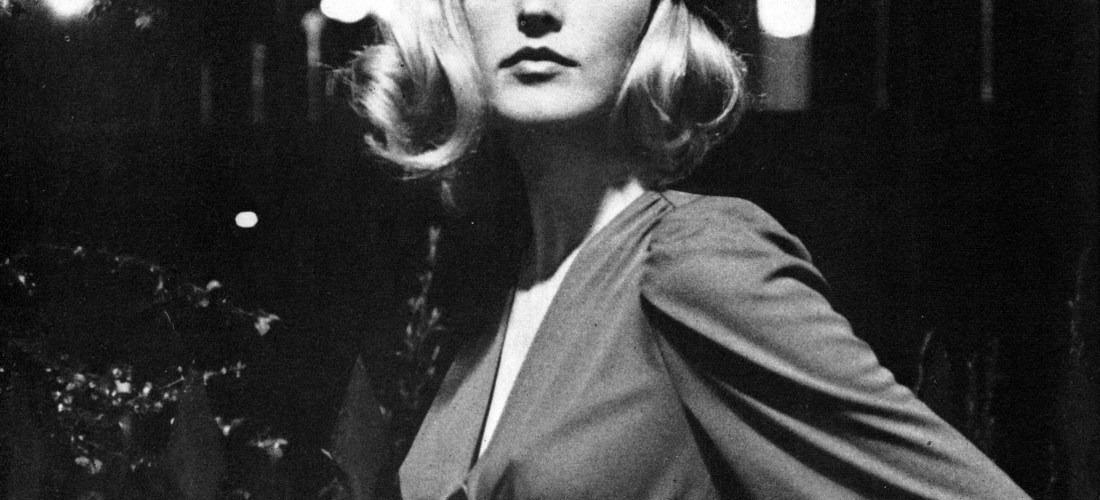
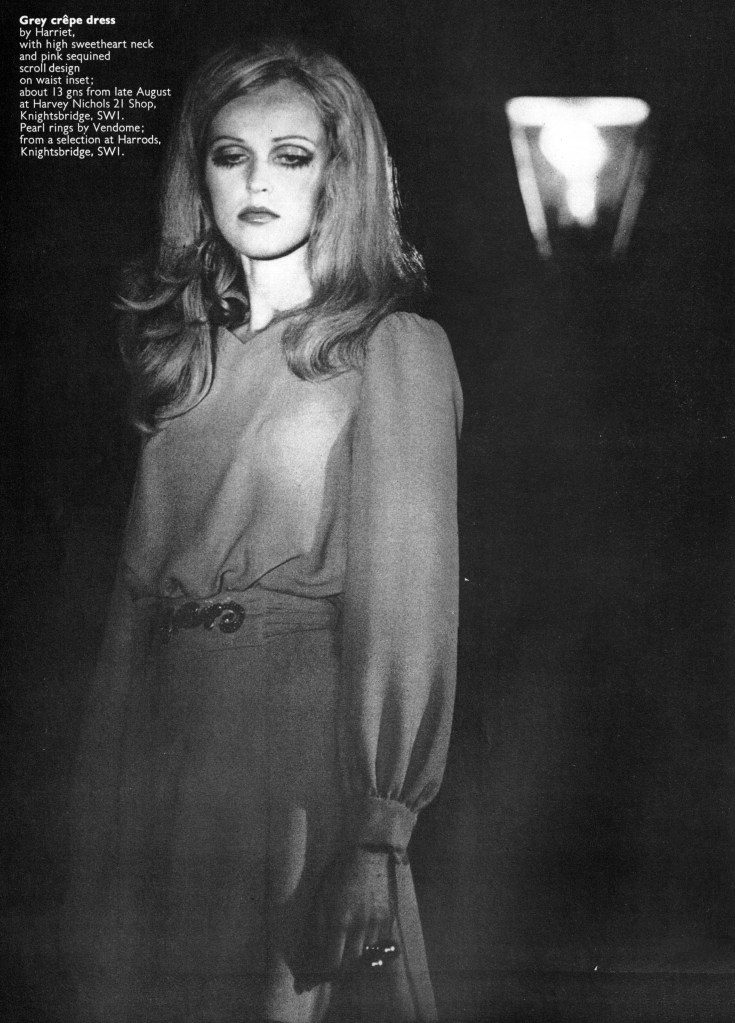
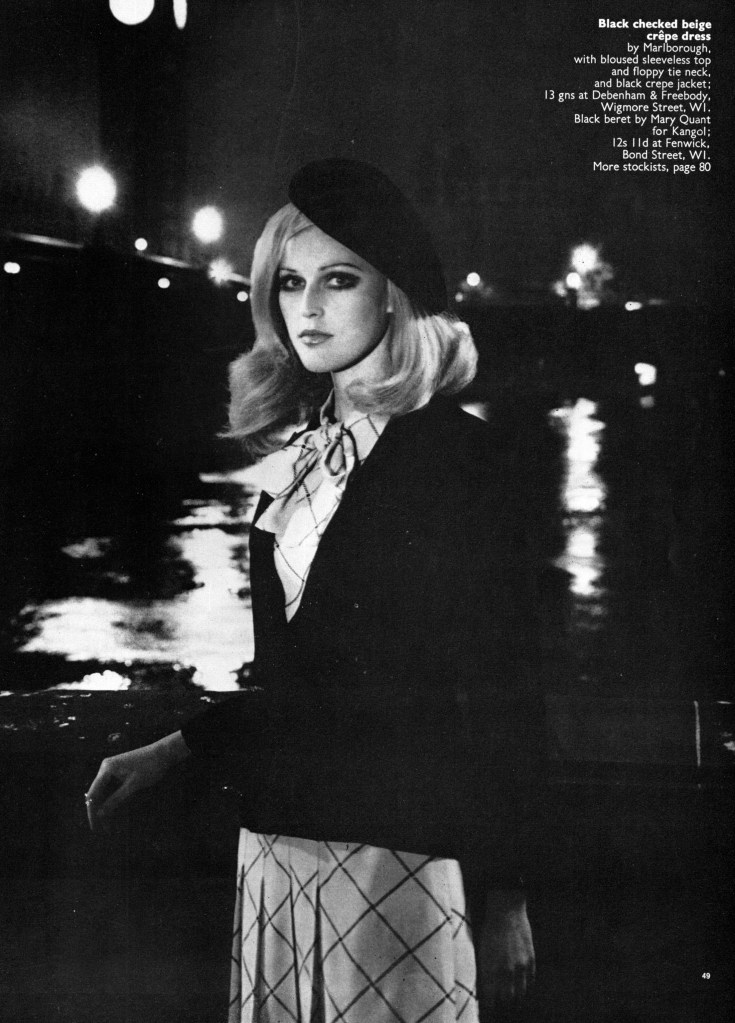
The clothes of the Thirties were capricious, narcissistic and extravagant — the jazz of the Twenties turning soft, like swing – but with the wartime Forties they necessarily became austere and functional.
To compensate, the details kept their extravagance – shirred waists, sweetheart necks, floppy sleeves, Veronica Lake hair.
On this and the following pages we have a minor Forties revival – minor because these clothes are strictly 1968, when women want to dress both practically and frivolously.
I do not endorse this copy, because I would not agree about the clothes of the Thirties being ‘narcissistic’, but I do endorse the photos and the clothes.
Photographed by Helmut Newton.
Scanned from Queen, July 31st 1968.
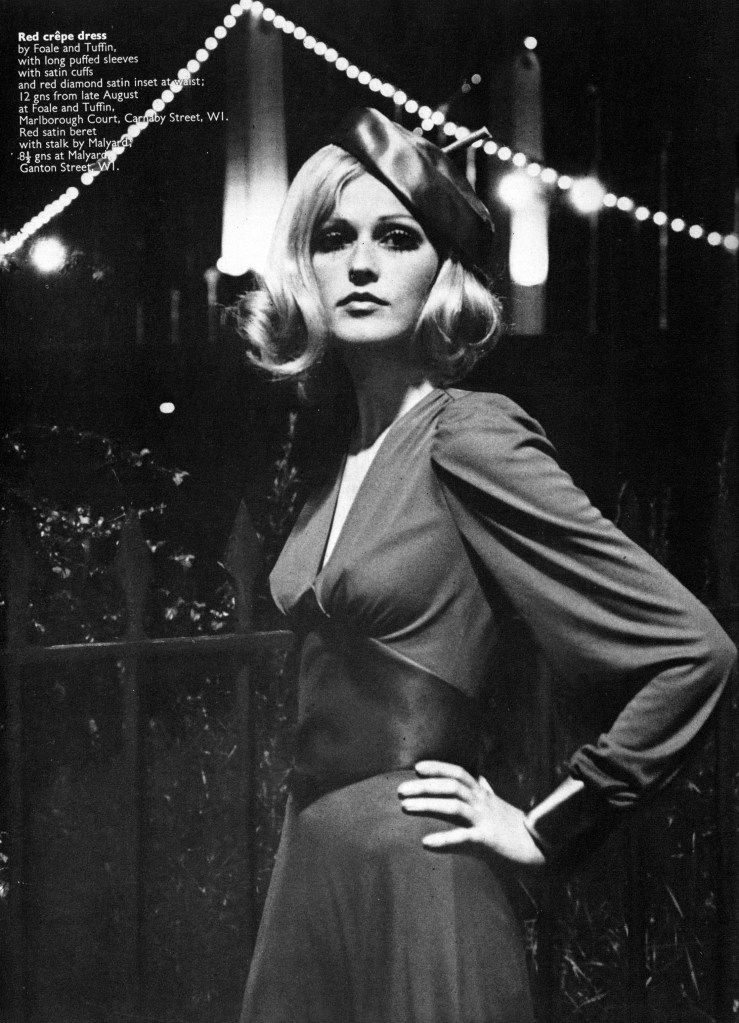
Red crepe dress by Foale and Tuffin. Hat by Malyard.
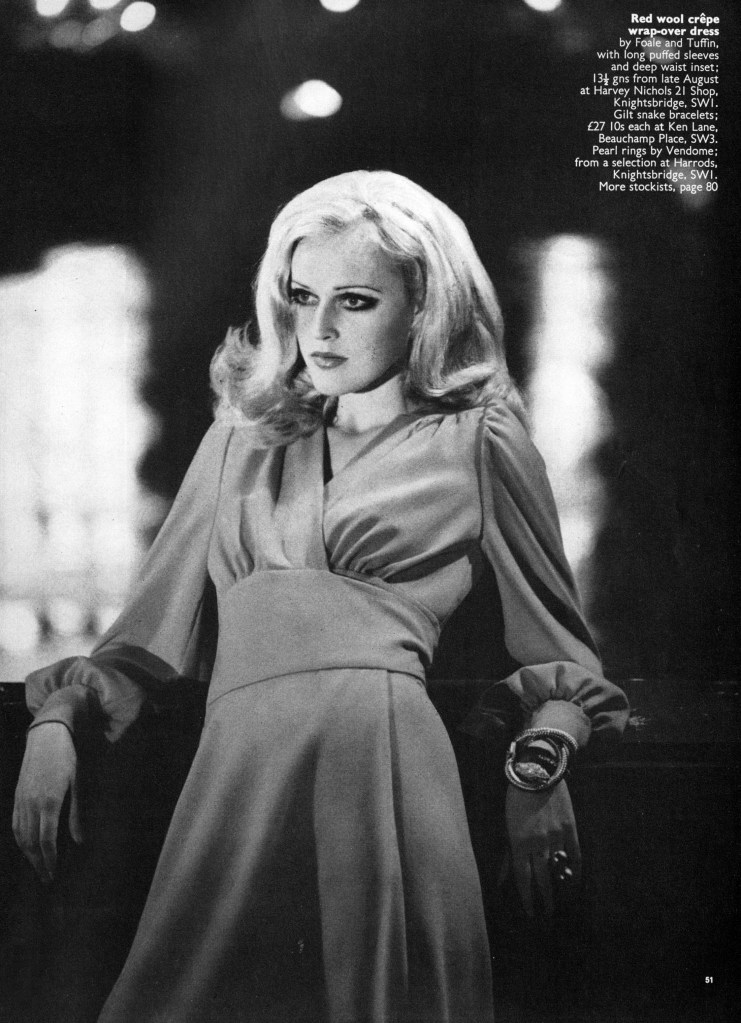
Red wool crepe dress by Foale and Tuffin. Gilt snake bracelets by Ken Lane.
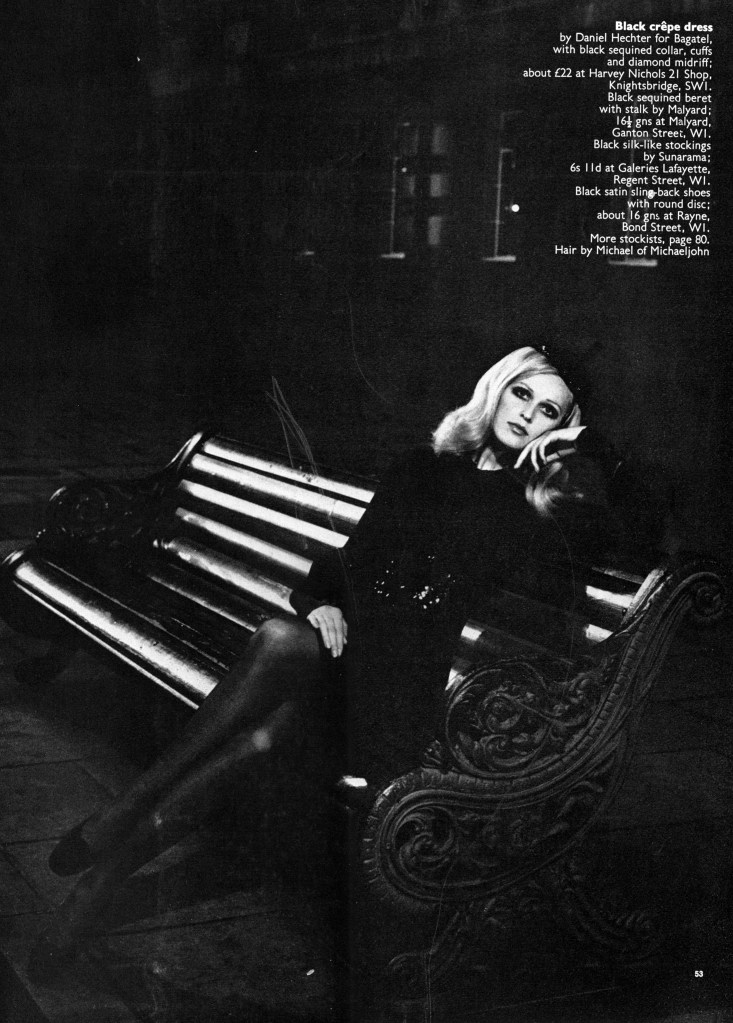
Black crepe dress by Daniel Hechter for Bagatel. Beret by Malyard. Shoes by Rayne.
Grey crepe dress by Harriet.
Black checked beige crepe dress with bloused sleeveless top, by Marlborough. Black beret by Mary Quant for Kangol.
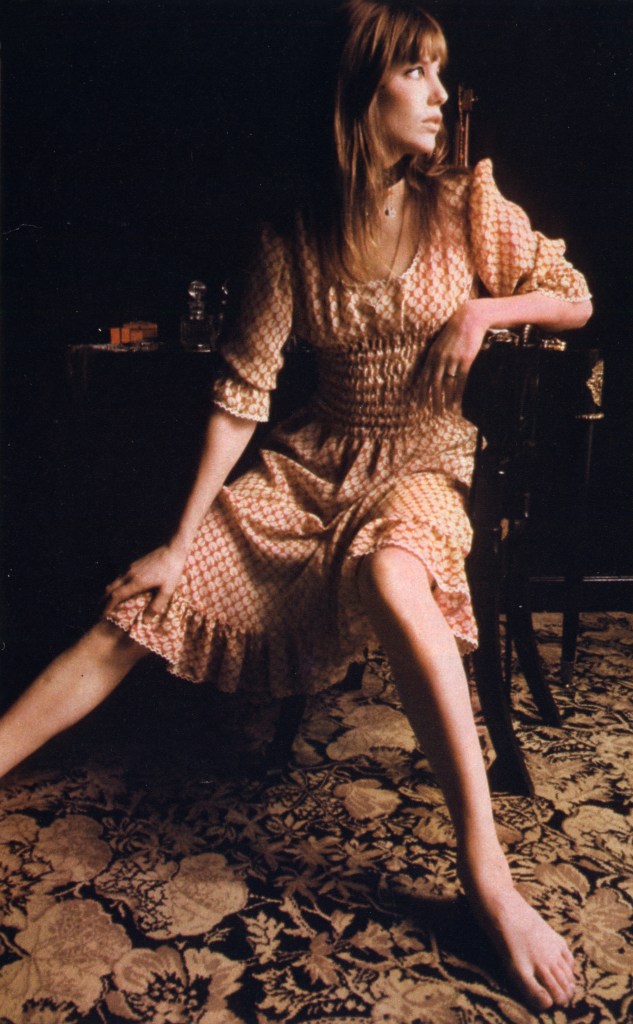
Peasant-style dress in a multi-coloured patchwork print has a gathered elasticised waistline and short full sleeves, by Marlborough, £9.
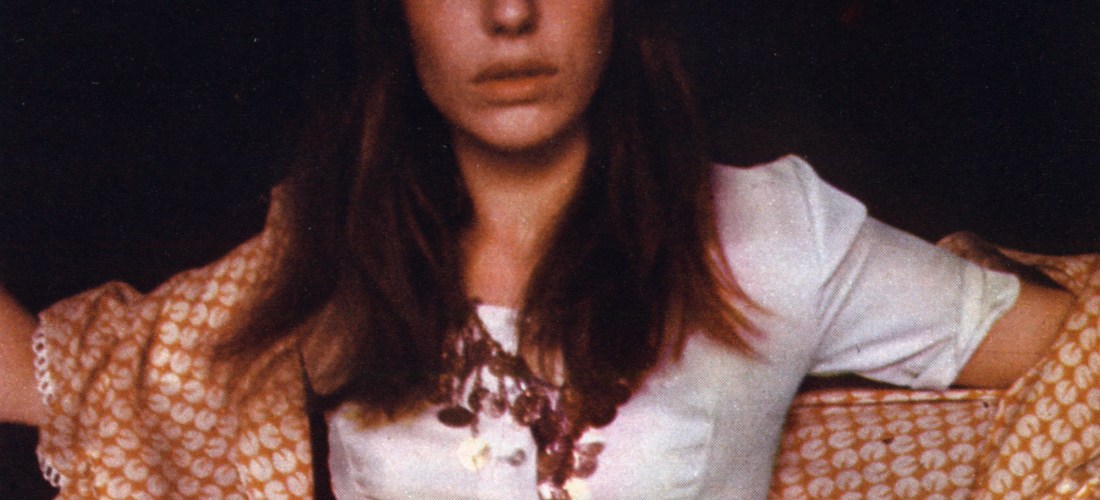
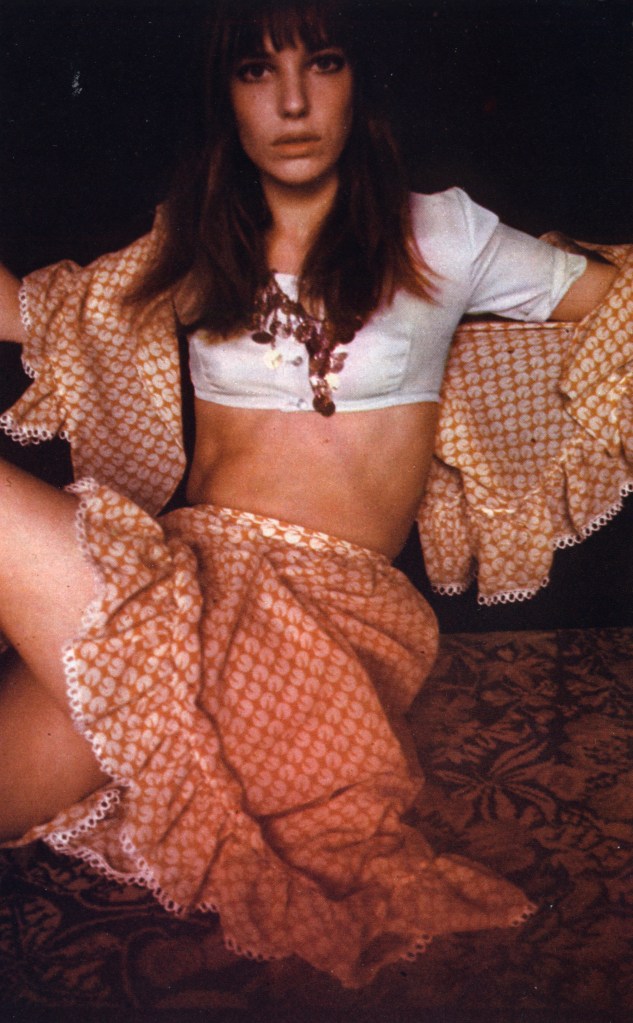
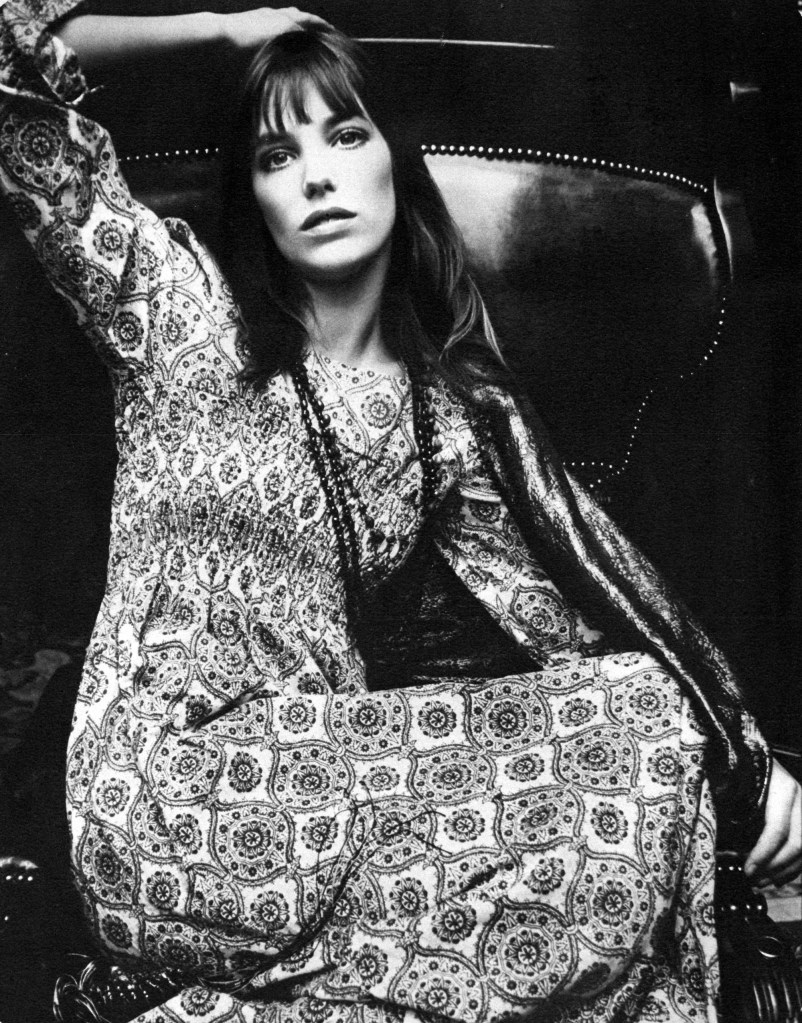
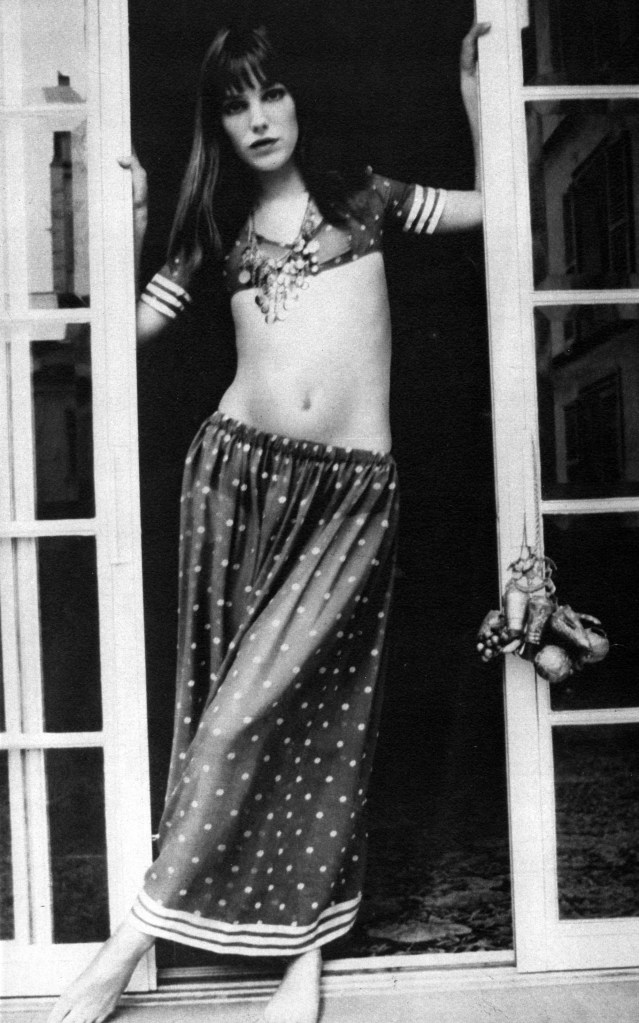
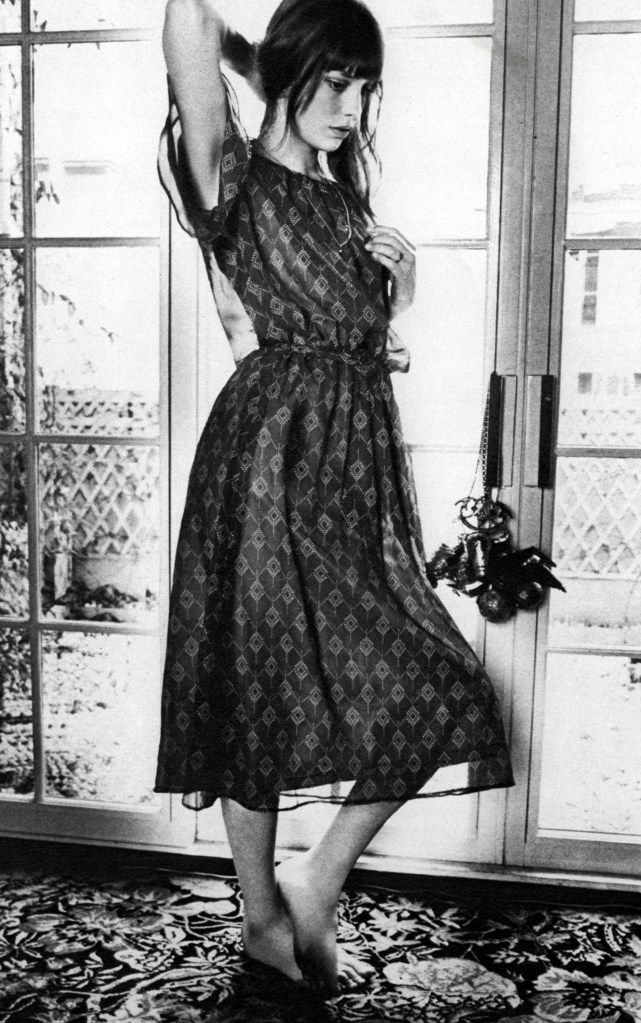
It looks as if England has lost Jane Birkin forever … she is firmly entrenched in Paris with baby Kate, nanny and the lovely Serge Gainsbourg, living in sombre luxury in their newly acquired house. The interior is stark and dramatic, every room is decorated in black and white, with white doors and black marble floors or carpet. The furniture is also black and white—there’s a big black shiny piano in the lounge, and a black mink cover adorns the bed which is raised off the floor on a black perspex dais. Weekends are usually spent at a quiet retreat in the country, making a sharp contrast to the busy social life that they lead during the week. Since Jane landed in France she has never stopped working. Film after film has been completed and the success of the record she made with Serge, which was also written and composed by him, Je T’Aime … Moi Non Plus, has led to an LP also written by Serge. Her life is chaotic and busy, it seems as if the telephone never stops ringing. People phone her every day with offers of interviews and films, the next of which is still a closely guarded secret. It was whilst she was making her first film in France, Slogan, that she met and fell in lovewith Serge, an event which seems to have altered her life but through it all she remains the same—a waif of a girl, tall and lanky, in pullover and jeans, serving tea out of her treasured English teapot. Her wardrobe is noticeably small, consisting mainly of casual clothes like pullovers, T-shirts and jeans; with the occasional gipsy-type dress reserved for the evening and worn with gold chains, loop earrings and gipsy belts. She acquires most of her clothes by chance buying, rarely by intentionally setting out on a spending spree. Usually she just spots something she likes in a shop window and ends up by going in and buying it. In London she shops mainly at Countdown, Foale and Tuffin, and Quorum. She buys her jewellery from the Chelsea Antique Market. In Paris she favours the more trendy designers like Mia and Vicky or Jean Bourquin. Jane is perfectly happy spending hours hunting about in antique shops for interesting little knick-knacks, like the 18th-century doll’s house which she gave to her Serge for Christmas.
Photographed by Michael Berkofsky.
Scanned from 19 Magazine, May 1970.
Yellow ochre and beige printed full skirt has matching shawl and a crêpe bolero top, by Marlborough, £9 10s.
Ankle-length dress in brown and white printed cotton has a shirred bodice and sleeves gathered into a cuff, by Laura Ashley, approx. £5.
Long brown and white printed cotton voile skirt is prettily trimmed with white satin ribbon and has a matching bolero top, by Sujon, 11 gns.
Sheer rayon chiffon midi-length dress in a lovely muted purple has a bloused top and a flesh-coloured half slip, by Jinty, £8 15s.
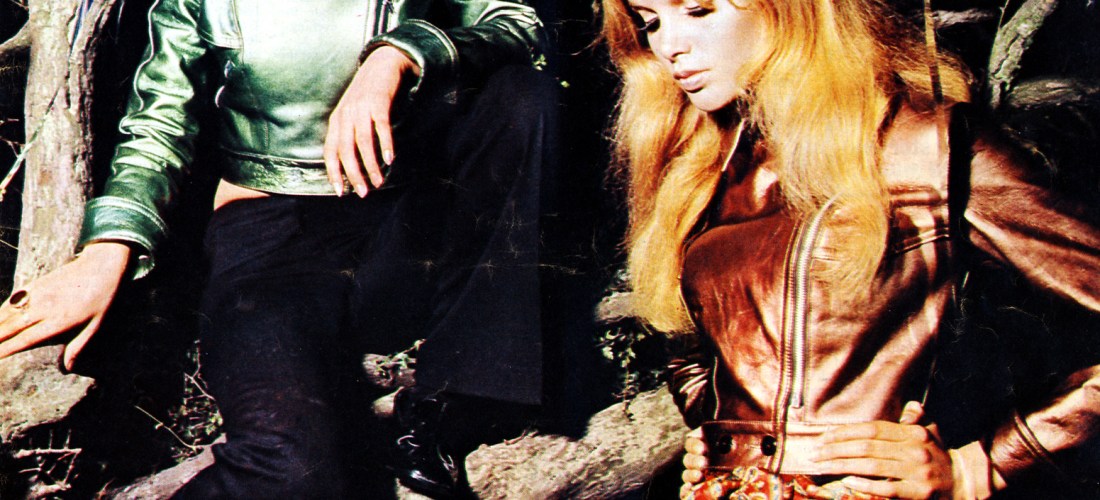
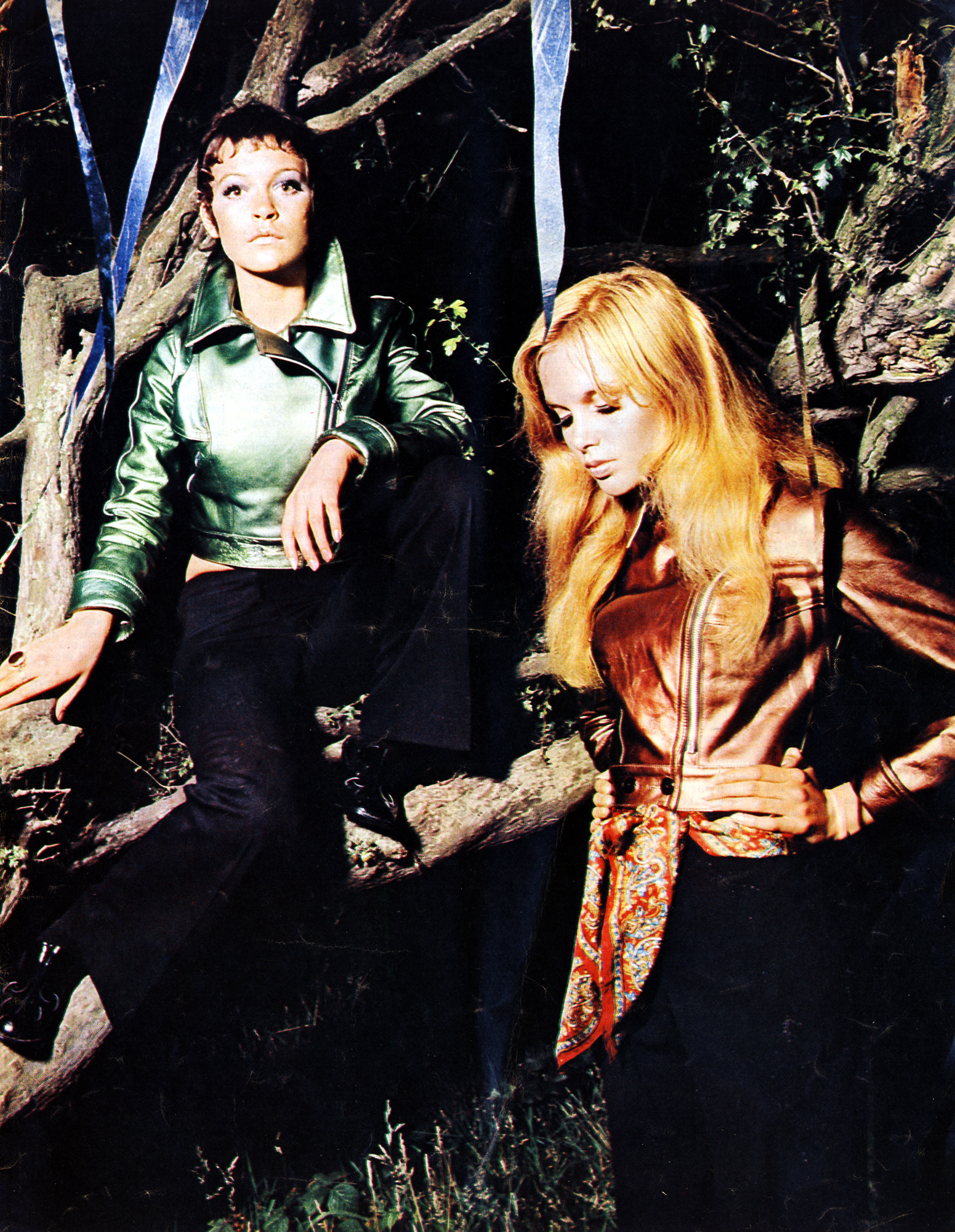
Metallic leather battle jackets by Fifth Avenue. Green jacket worn with black crepe trousers by Gordon King. Lilac jacket worn with black crepe trousers by Highlight. Aldbrook scarf.
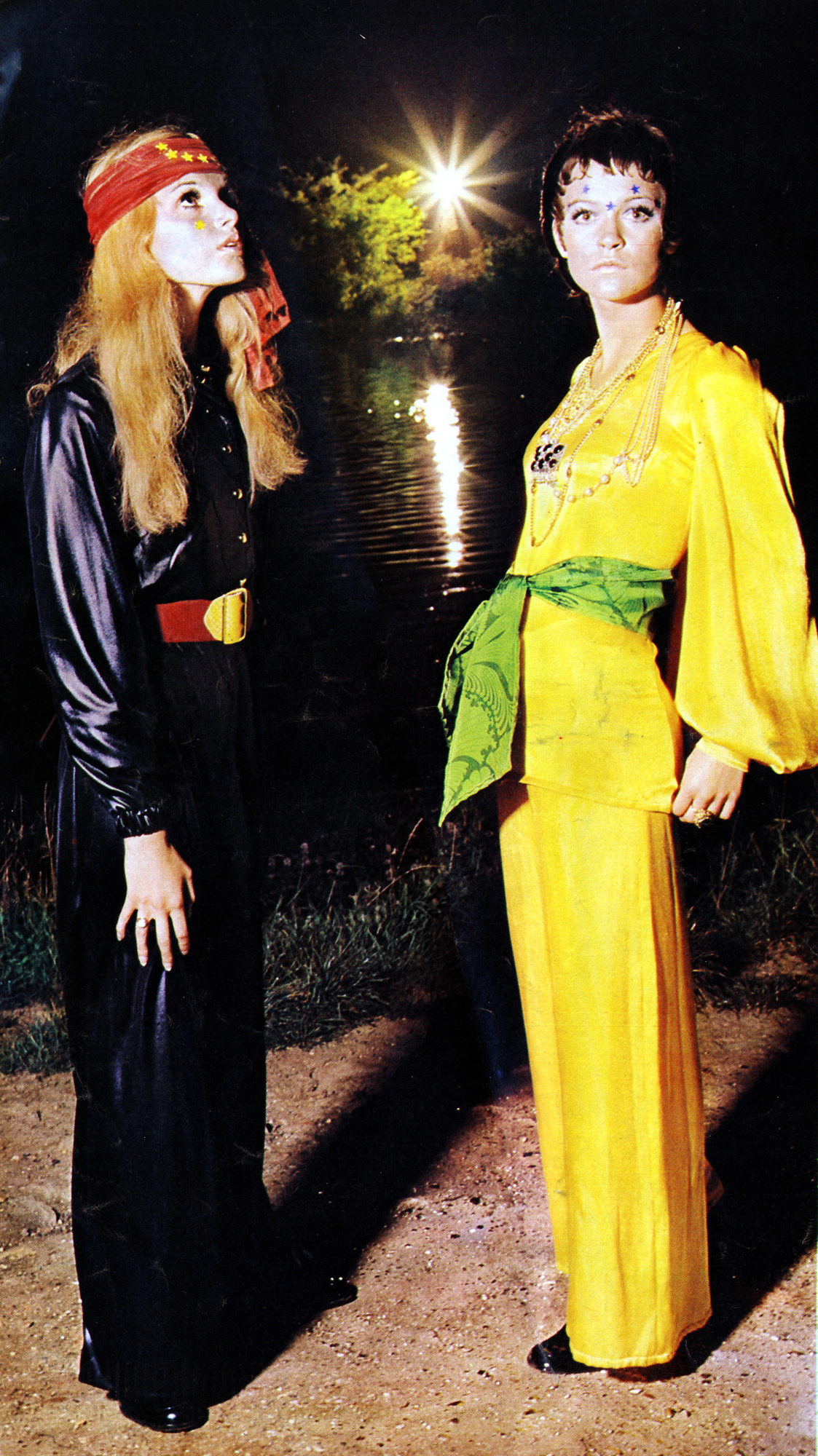
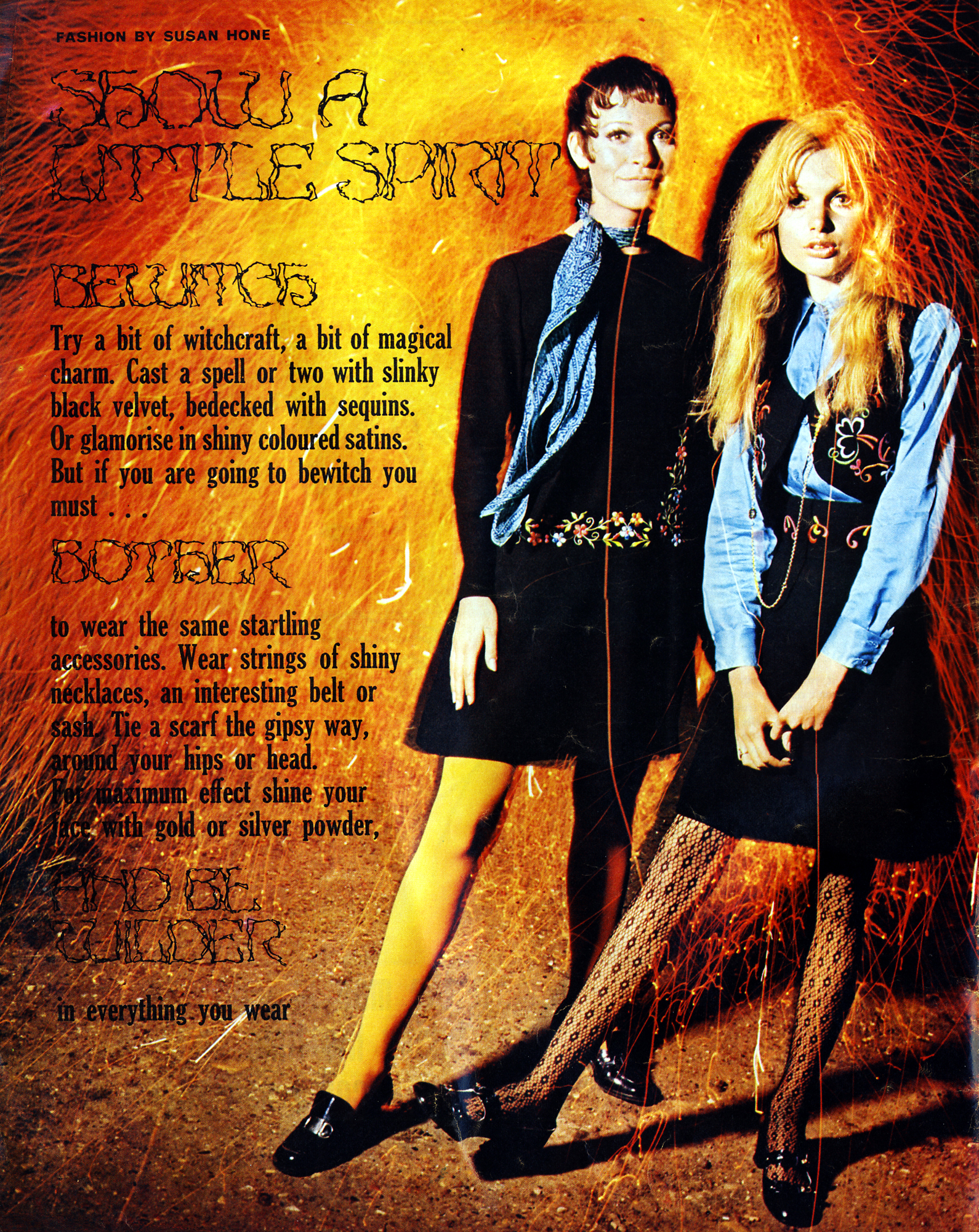
Bewitch: Try a bit of witchcraft, a bit of magical charm. Cast a spell or two with slinky black velvet, bedecked with sequins. Or glamorise in shiny coloured satins. But if you are going to bewitch you must…
Bother: to wear the same startling accessories. Wear strings of shiny necklaces, an interesting belt or sash. Tie a scarf the gipsy way, around your hips or head. For maximum effect shine your face with gold or silver powder.
And be wilder: in everything you wear.
Fashion by Sue Hone. Modelled by Madeline Smith and unknown model.
Photographed by Vic Singh
Scanned from Petticoat, November 2nd 1968.
Bright yellow satin trouser suit by Kleptomania. Ronald Keith patent shoes. Shimmering black battle-dress jacket and trousers by Bus Stop. Mauve and yellow belt by Martha Hill. Mauve lace scarf by Browns. Lilley and Skinner shoes.
Spooky black outfit by Bus Stop. Red crepe shirt and silk scarf by Biba.
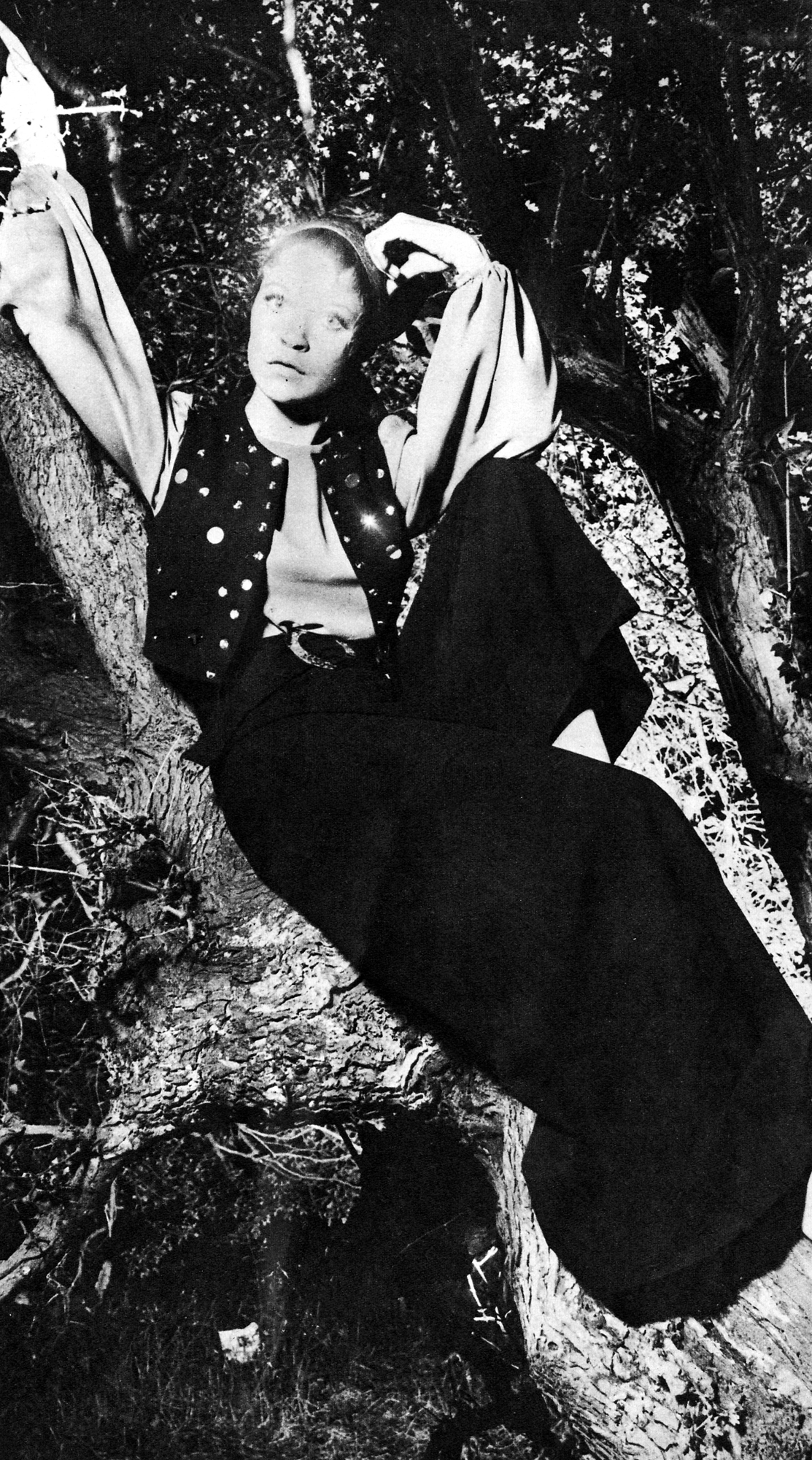
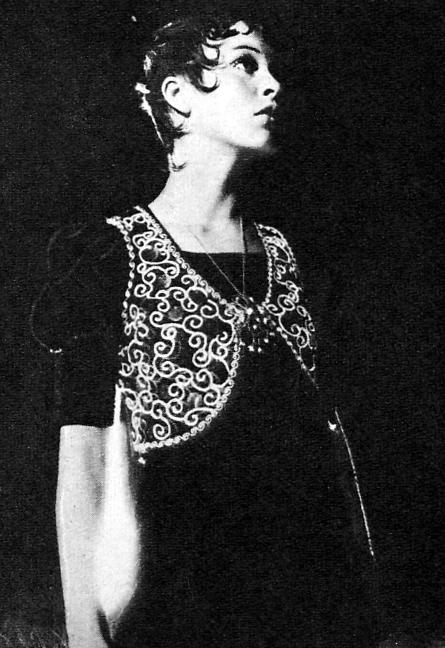
Little black velvet dress by Biba. Sequined waistcoat by Gordon King. Indian pendant by Kleptomania.
Black crepe dress by Marlborough. Indian silk scarf by Aldbrook. Black waistcoat and skirt by Shelana. Blue shirt by Ivor Wahl.
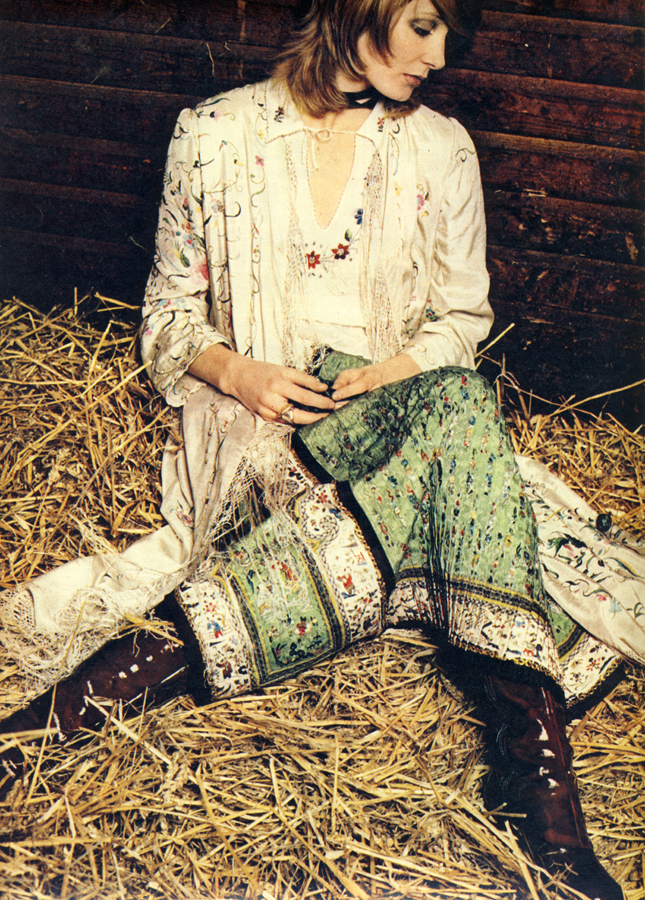
Blouse, waistcoat and skirt from Emmerton Lambert, Chelsea Antique Market. Boots by Sacha.
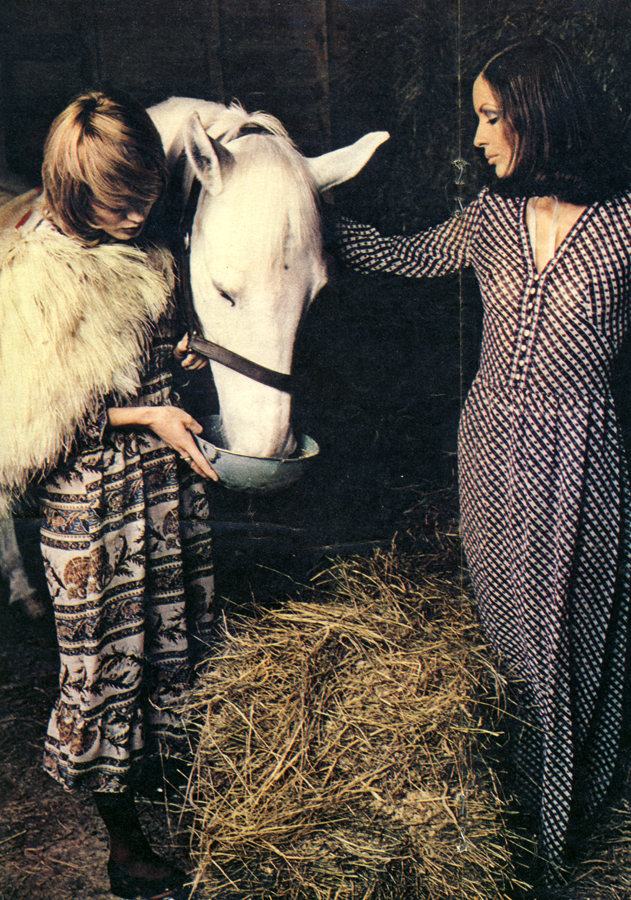
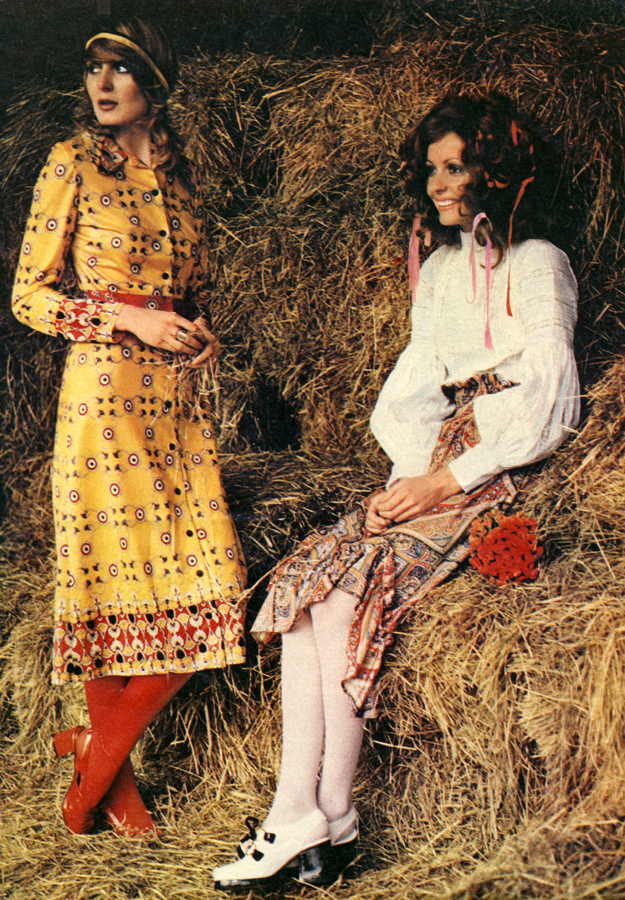
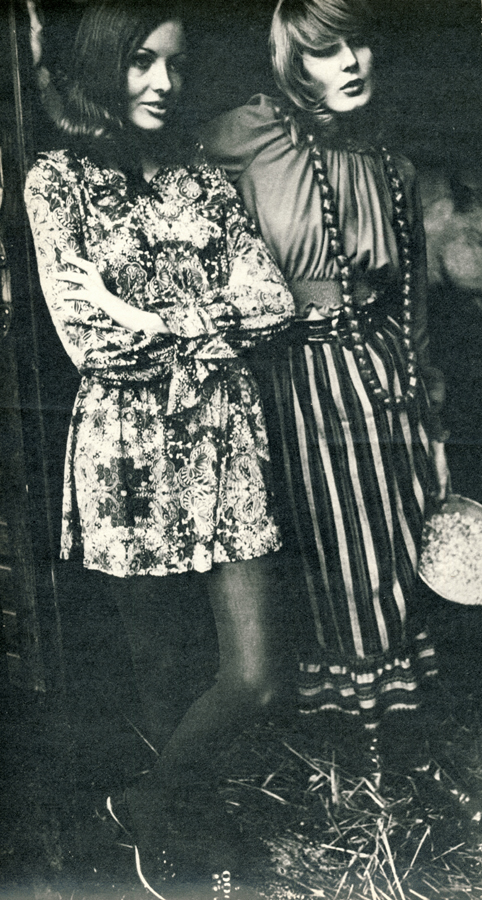
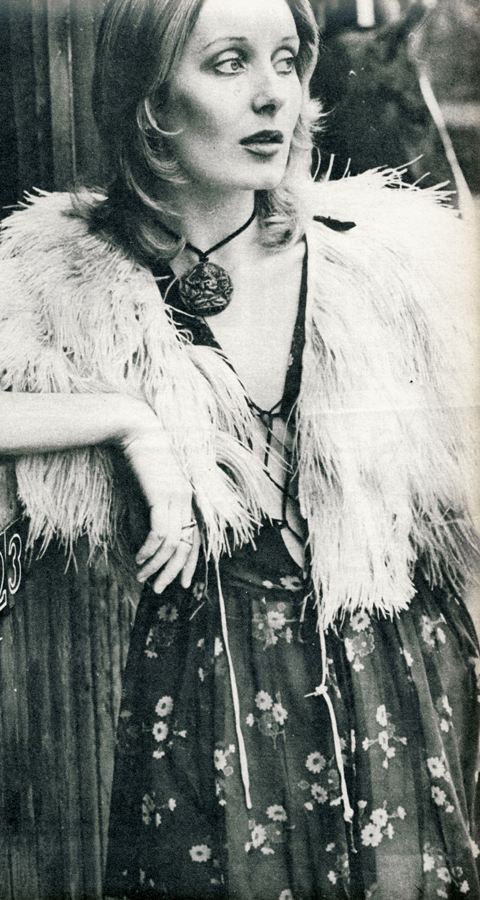
Welcome to my fashion brain as it is at the moment, particularly the first and last images. This spread is everything I love about late Sixties/early Seventies style, and more. No change is permanent, I still wake up in a different mood each day, but for the most part I am feeling the need to cover up, tune out and drift around…
“Take the whirl of lace petticoats and the swirl of countrified prints. Add gypsy flowers, baubles, bangles and beads. Find yourself a long, lazy spring afternoon, relax – and think nothing but beautiful…”
Photographed by John Carter. Scanned by Miss Peelpants from Petticoat, March 1970
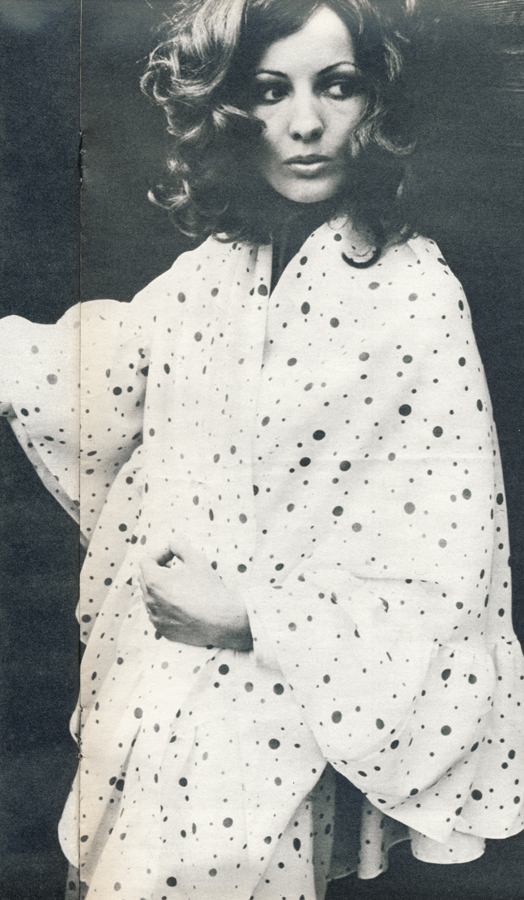
Spotted crepe dress and shawl by Mary Quant’s Ginger Group
Dress by Clobber. Feather cape from Chelsea Antique Market. Printed chiffon dress by Pourelle.
Dress by Clobber. Slingbacks by Ravel. Shirt by Mexicana. Skirt by Alan Rodin. Shoes by Ravel.
Dress by Clobber. Shoes by Modaine. Blouse by Stirling Cooper. Skirt by Bernshaw. Boots by Sacha.
Dress by Marlborough. Feather cape from Chelsea Antique Market.



 Liz Eggleston