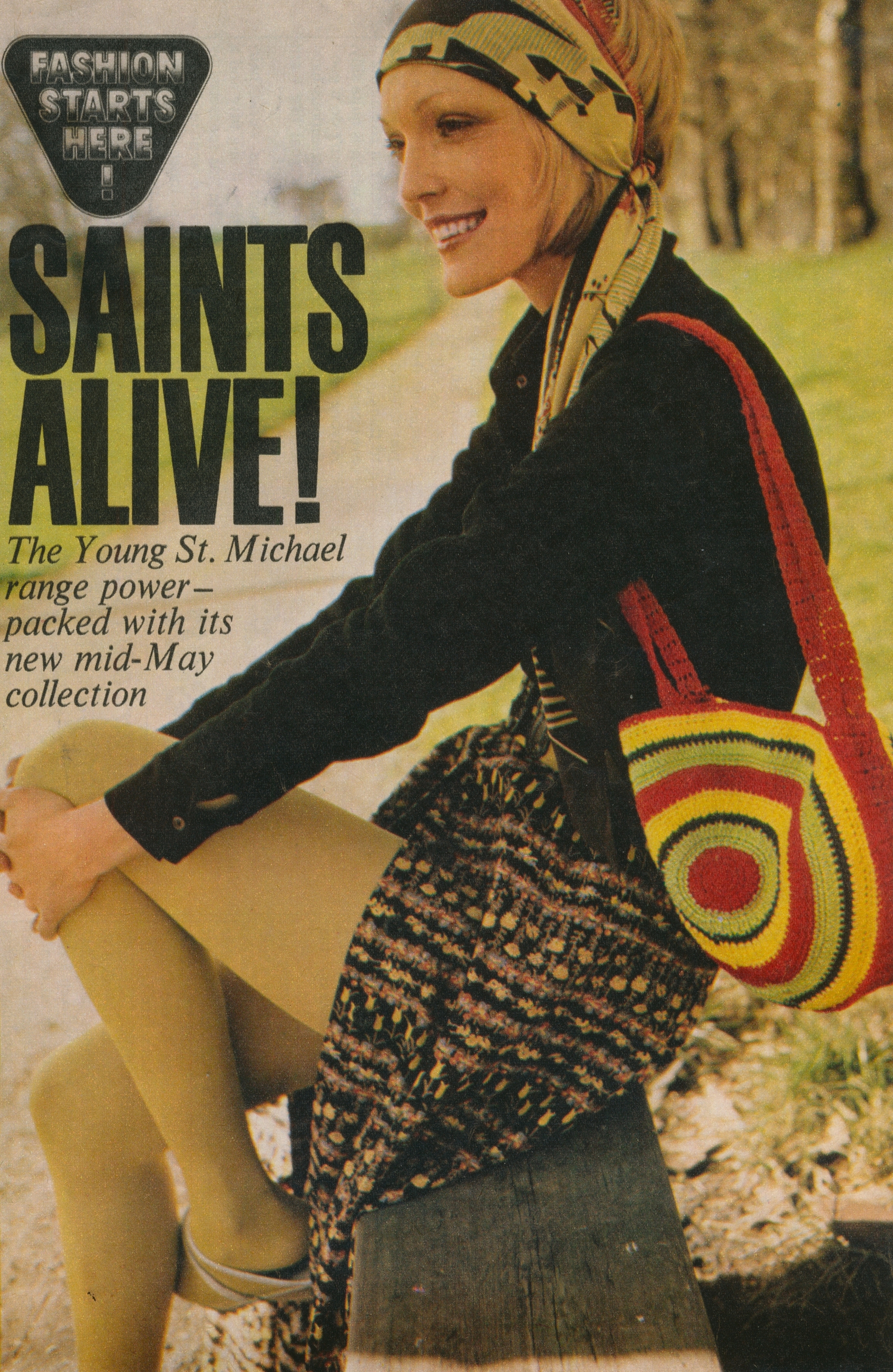
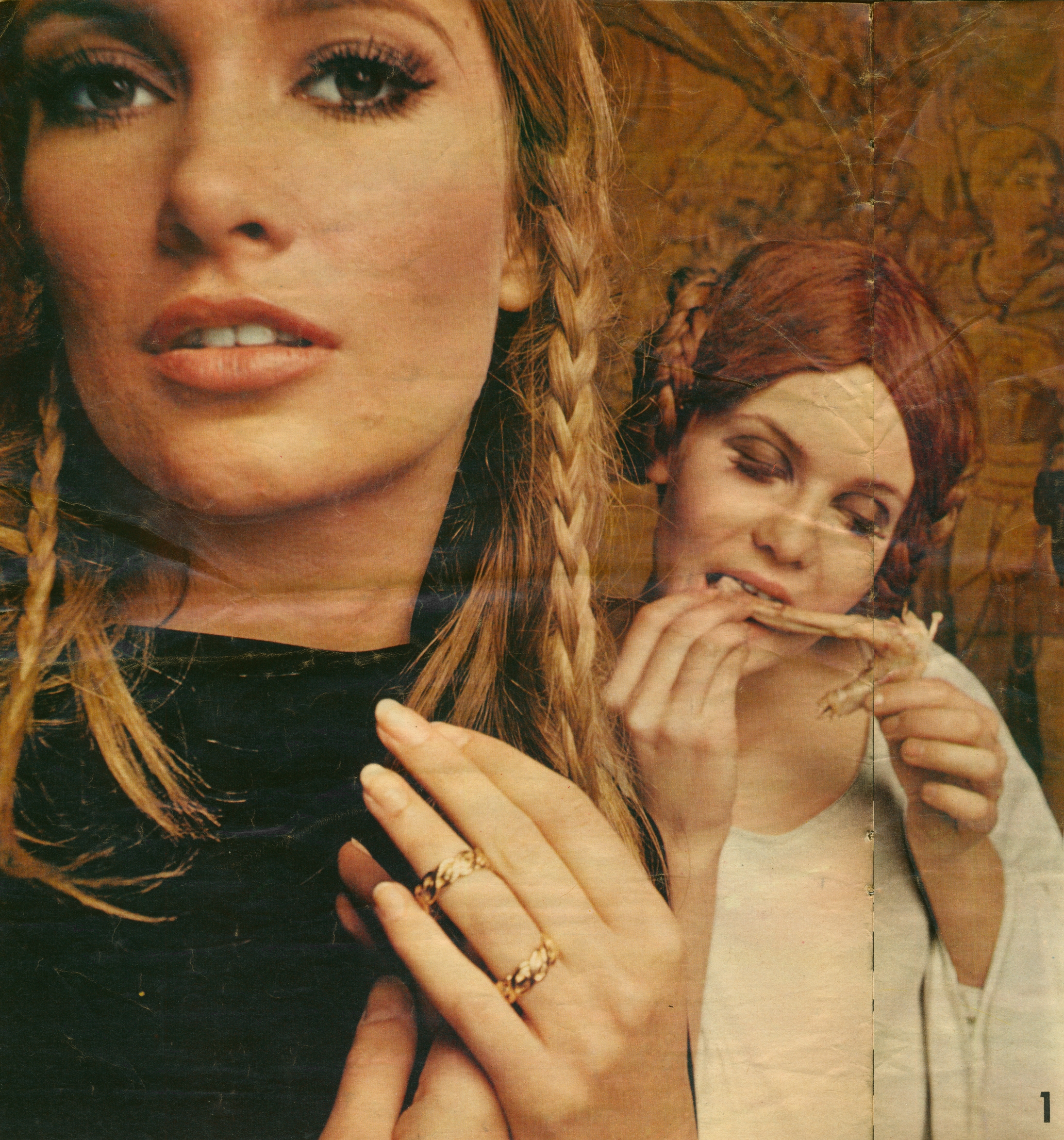
Herbert Johnson belt, £2.10. Cotton skirt, £3.50 and shorts, £1.99. Chester Martin scarf, £3.50. Crepe shirt, £1.99½ from Girl branches and Chelsea Girl. Quant tights, 75p. Crochet bag, Diane Logan, £6.
The Young St. Michael range power-packed with its new mid-May collection.
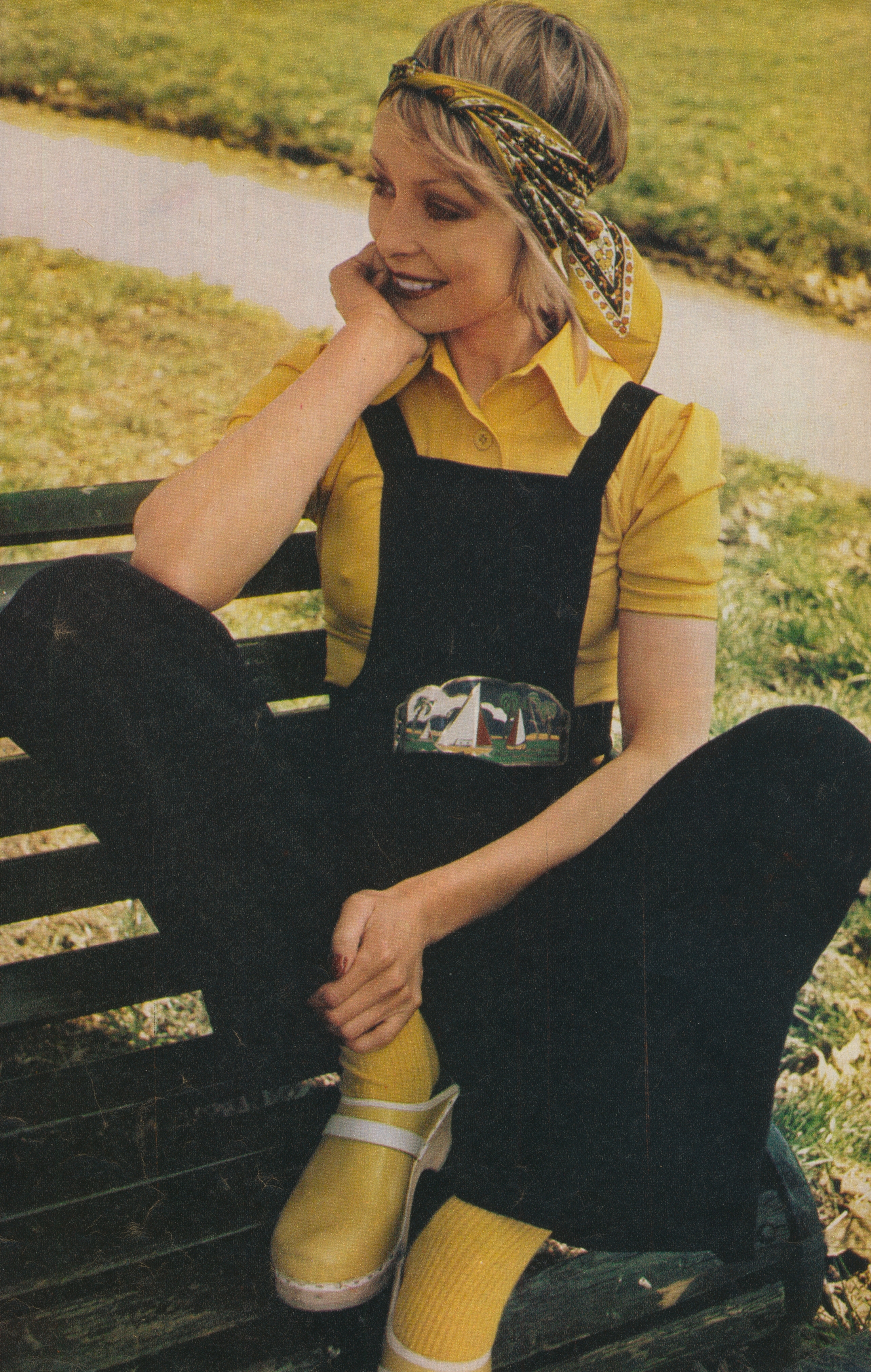
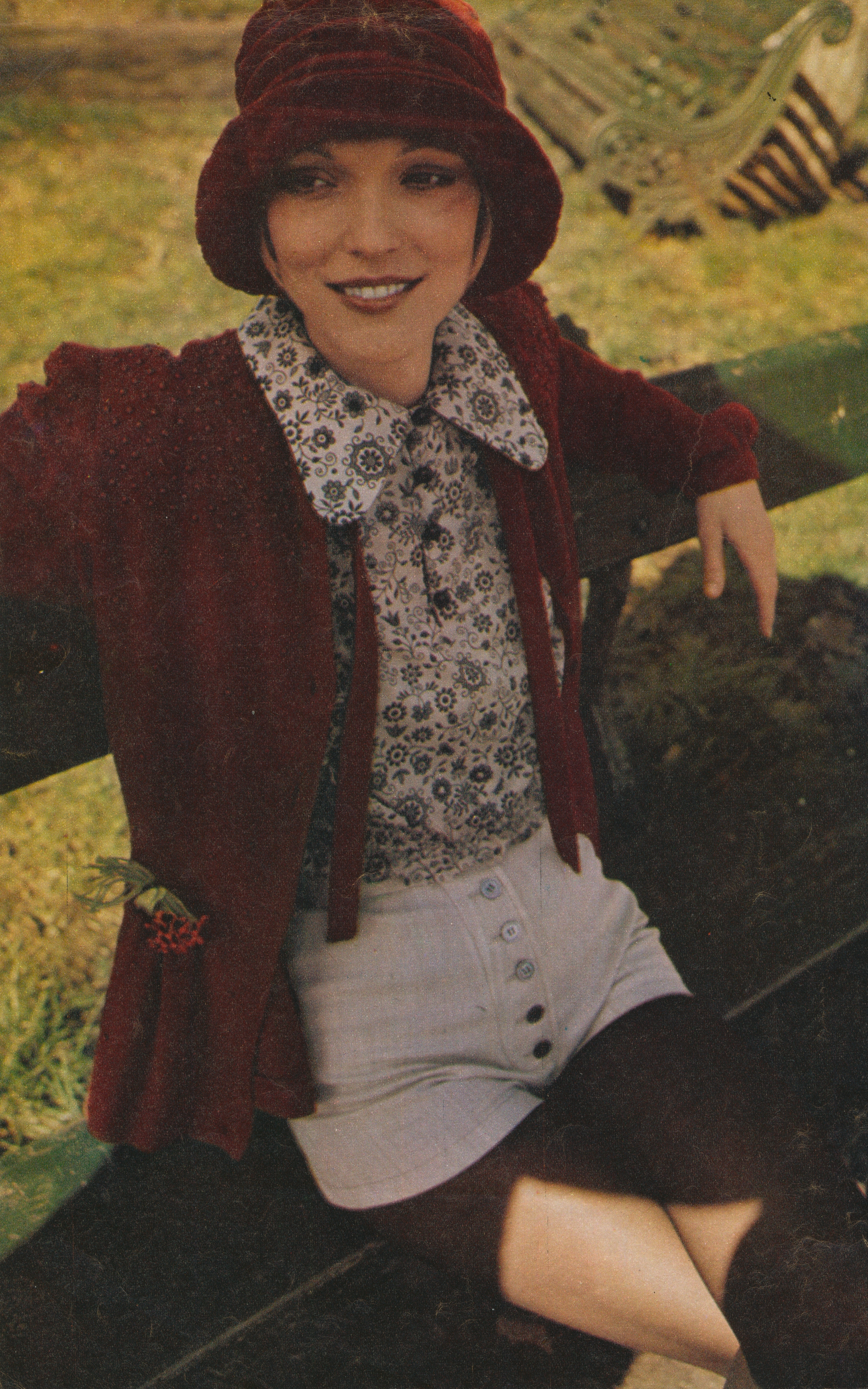
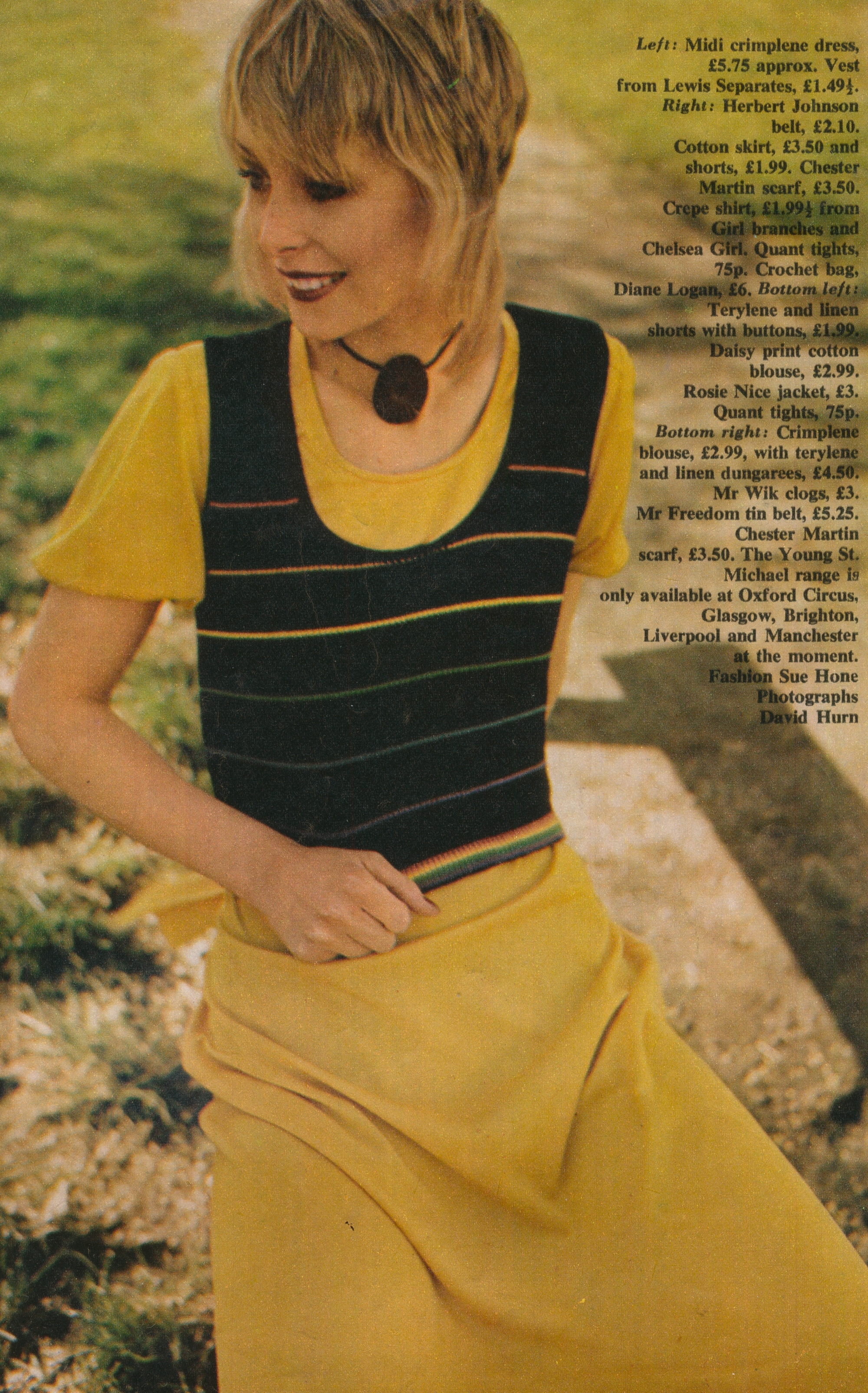
The Young St. Michael range is only available at Oxford Circus. Glasgow, Brighton, Liverpool and Manchester at the moment.
Curiously, I have the scarf she’s wearing in the top photo and I had always assumed it was authentic 1930s – as it was sold to me. Now I look closer, I can see the faded signature of Chester Martin. Whilst I’m disappointed that it’s not actually as old as I thought, I can’t resist a documented bit of vintage!
Fashion by Sue Hone.
Photographed by David Hurn.
Scanned from Petticoat, 22nd May 1971.
Crimplene blouse, £2.99, with terylene and linen dungarees, £4.50. Mr Wik clogs, £3. Mr Freedom tin belt, £5.25. Chester Martin scarf, £3.50.
Terylene and linen shorts with buttons, £1.99. Daisy print cotton blouse, £2.99. Rosie Nice jacket, £3. Quant tights, 75p.
Midi crimplene dress, £5.75 approx. Vest from Lewis Separates, £1.49½.
OUT OF THIS WORLD. Mary Quant put her soft pinks and blues together as they’ve never been seen before and created this brand-new Face in the Clouds look. She then offered this paintbox exclusively to Honey. In it is everything you need to get the look. If you went out and bought each individual item separately, you’d get a bit more make-up, but it would cost you over £4. Our paintbox is yours for only £1.70. So write off for it now. Once it’s yours you can do what you like. We tell you above how to get the look Maria has in the picture and, if you feel daring, colour the blue right over the bridge of your nose. Or juggle around with the colours as much as you like for a totally different effect—blue out your eyebrows and put lots of pink round your eye. Or just wear each colour separately. They’re beautifully angelic colours that reflect the summer sky. You can wear them anytime—sunrise to sunset. With this look, it’s back to the deliciously dreamy, hazy days of time past when colours were vivid, days were long and nights were romantic. Don’t miss out or you’ll regret it. You’ll never see this paintbox at this price again.
If you can’t buy it anywhere else, you’ll probably stumble on it in a craft shop — from the most punctiliously-made tapestry, reeking with tradition and the skills of centuries, to crazy little things like corn-dollies and earth mothers. The name Women’s Home Industries’ conjures up all the right kind of pre-Women’s Lib craftsmanship. The work still goes on, and every type of hand-knitted clothing is still sold from their re-christened shop, Beatrice Bellini Handknits, 11 West Halkin St, SW1.
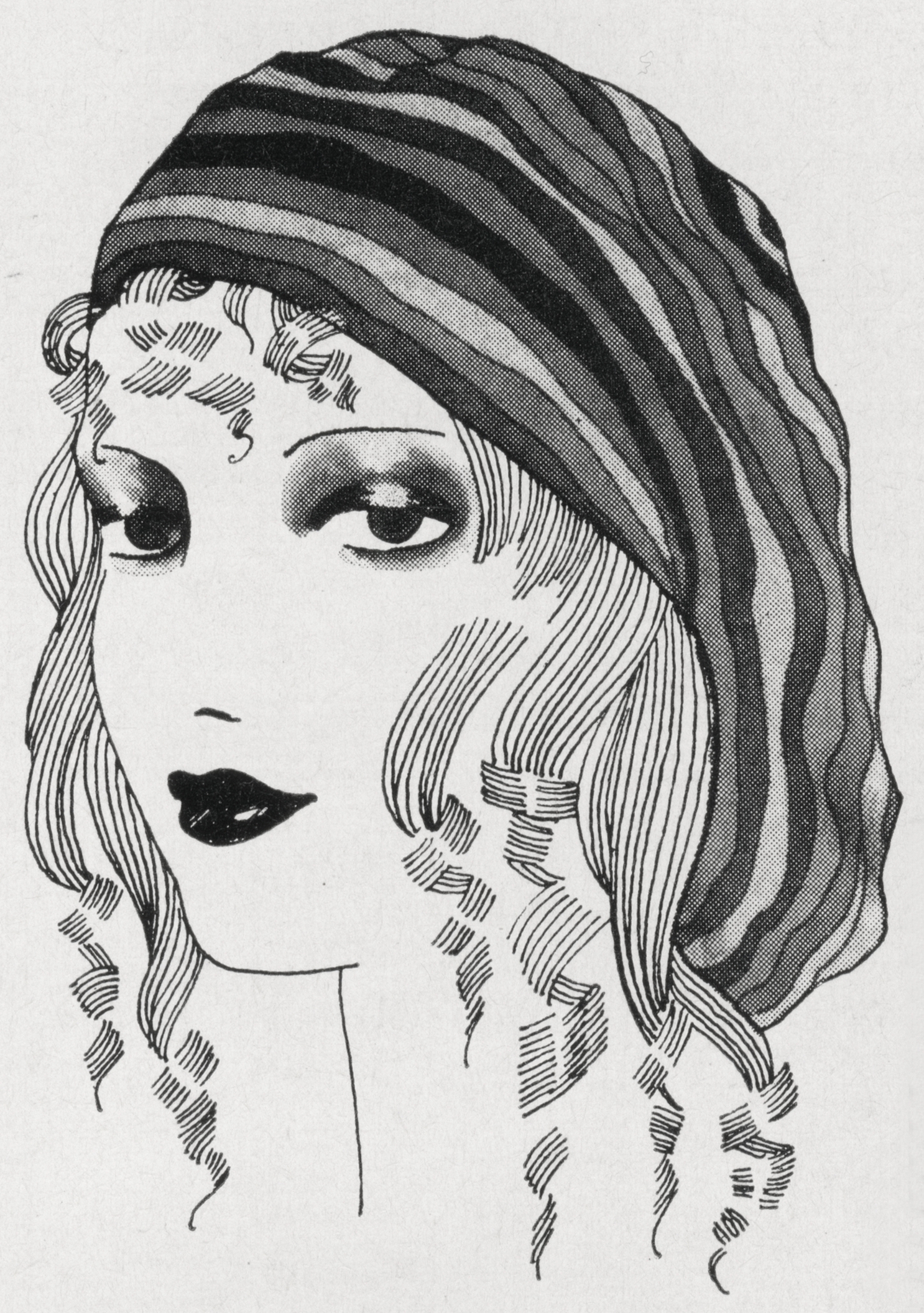
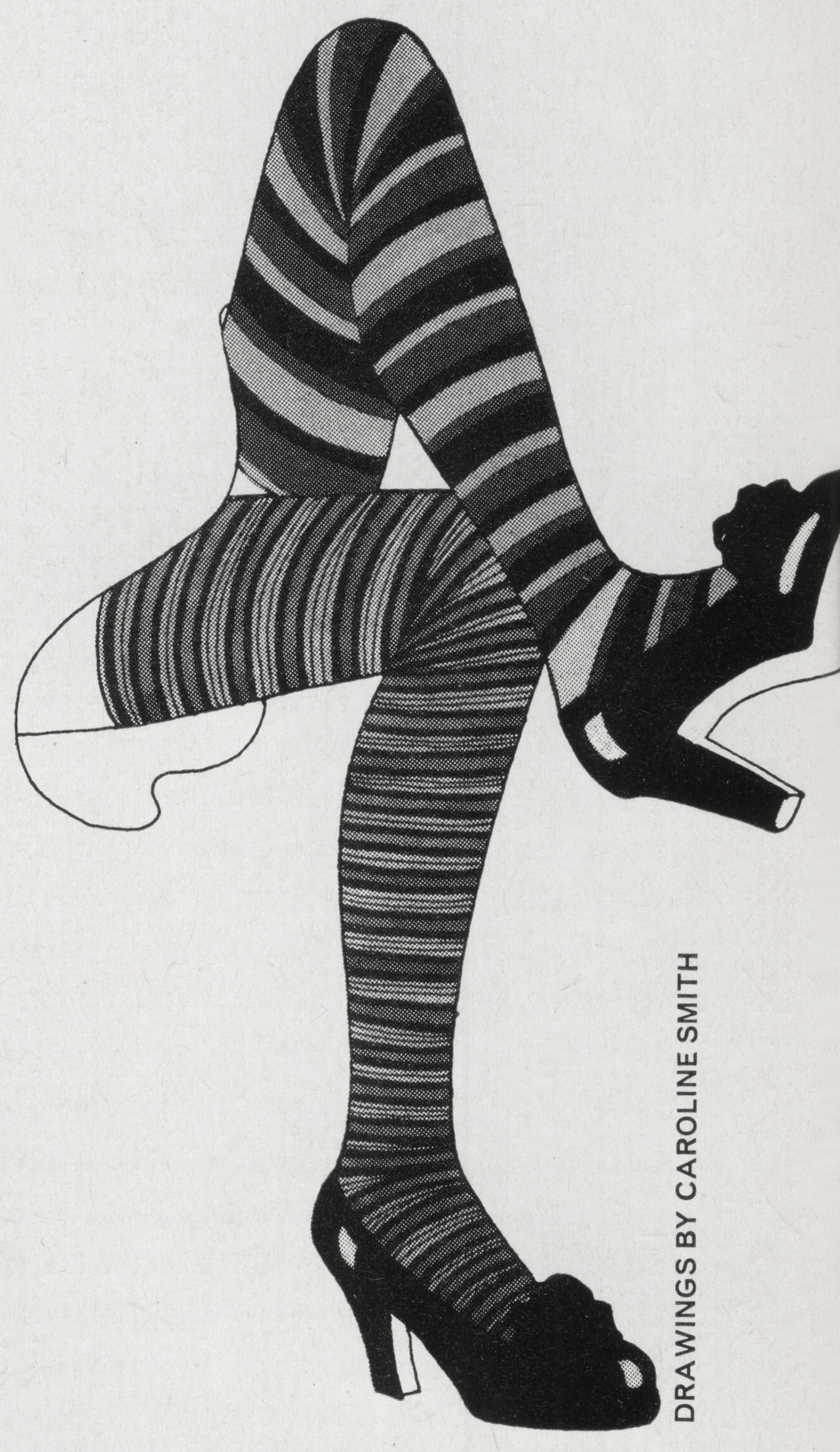
Their bright, stripy, over-the-knee socks in various colours, or to order; £5.50. The lovely floppy beret comes in matching colours, and costs £3.50. The WHI Tapestry Shop, 85 Pimlico Road, SW1 sells hand-painted canvases for anything from a specs case to a large rug, and will copy your sketches on to canvas.
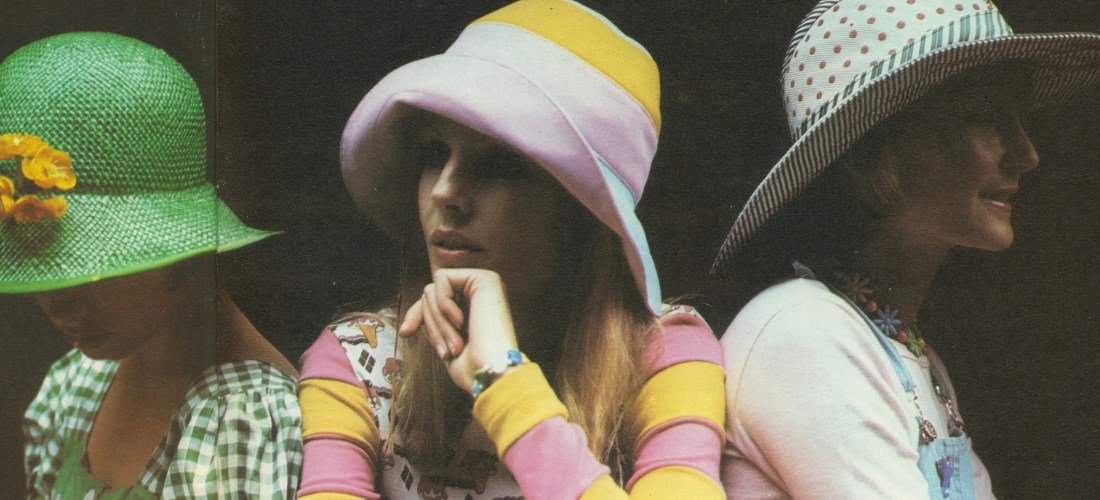
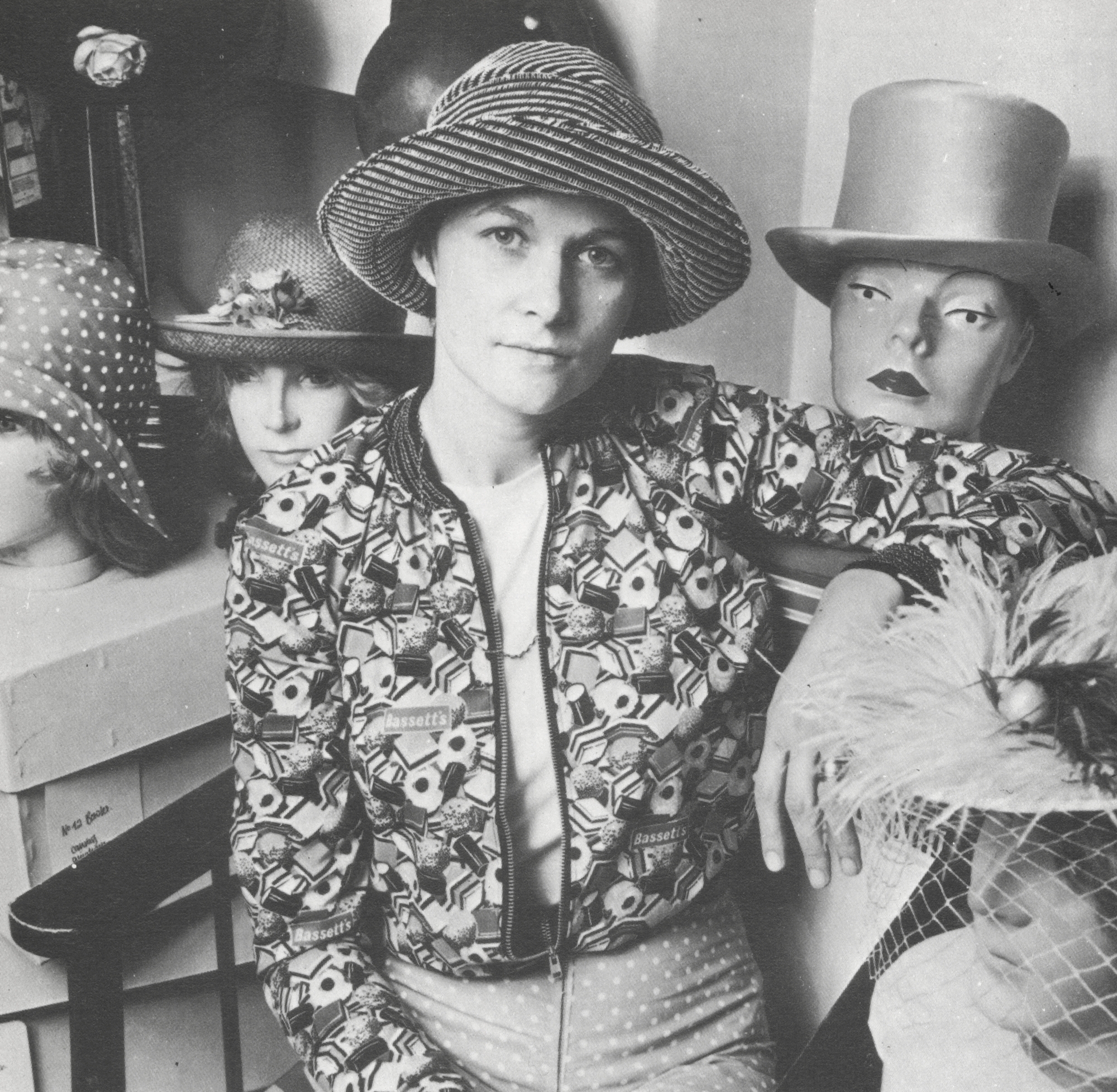
Ten years ago hats stopped being obligatory outdoor wear even for country’ matrons. A whole generation has ignored them since then, but the signs are that times are changing. A minute spent watching the crowds in any major city and one can see that hats are definitely back. Last year there were big mushroom berets. Before that there were costermonger caps and huge stetsons. All three styles were initiated by Diane Logan.
Diane Logan’s original ambition was to become a textile designer. Part of her training for this, at Camberwell Art College in London, included a week at the London College of Fashion where George Malyard, who makes hats for London’s theatreland, was visiting tutor. Diane took some of her printed felts along with her and spent the week making them up into dotty hats. She finished six fast work when the usual student output was one hat a term.
When Diane left art college and discovered that she hated the solitude of being a freelance textile designer, this experience in hat making gave her something to fall back on.
Small beginnings
She began by making big peaked costermonger caps. The first batch shown to the boutiques in London’s King’s Road produced orders for dozens more. She and her husband turned their flat into a work room and Diane did the cutting and stitching at a big table which let down over their bed. For two and a half years they lived in this way and Diane meanwhile built up an enthusiastic clientele. Buyers from New York stores wanted her creations and in the autumn of 1970 she was able to branch out into new premises with a shop and her own work room.
The shop, just behind London’s Baker Street, is also her showroom. Enormous candy pink hat boxes are stacked waist-high along one wall. Hanging on the walls and in the window are her hats, all shapes and colours and sizes. At first sight, it looks as if everything in Diane Logan’s shop has been individually confected. In fact the reverse is true. Diane works with only a few at shapes at a time, but makes them up in an enormous variety of different fabrics.
Fabrics and trims
She is interested first and foremost in shape, often buying up old hats in jumble sales and taking them to pieces. Using rolls and rolls of old millinery materials, some of them made before the war, she puts together her hats, often accentuating the separate sections by mixing different fabrics. A beautiful example is a desert hat with the crown in six sections and a wide brim: one variation incorporated a flocked spot, dapple and leopard smudges on variously coloured grosgrain, with a stitched and colour sprayed brim.
Last year’s floppy beret which she made in poodle pile fabric and big blanket checks is still being reworked. The shape is basically the same, but the construction is altered so that the hat sits a little flatter on the head with a pom pom on the top. Diane Logan has altered the concept of the bowler hat too, by cutting the crown concentrically, enlarging the brim and making it in soft fabrics and gay colours, multi-coloured gingham, plain unbleached canvas which gives it a classic air, and ice cream sundae shades of pink, blue and yellow with an emerald brim. This shape is in her next collection too, the brim slightly enlarged and this time made in soft pigskin, velvet and fine velour.
Diane’s passion for unusual fabrics extends to trimmings. The search for new ones is constant and she quite casually mixes old and new as she does with her fabrics. On top of a stack of blocked straw shapes, waiting to go to the little old lady who does the flower trims is a sample hat, trimmed by Diane herself with exquisite faded silk anemones, at least 40 years old, and with tiny rose buds just arrived from Hong Kong. This was the pattern the outworker was to follow for trimming this style, but Diane was quite prepared to accept that, by the time the hats were finished, the lady’s own modifications would have crept in and no two hats would be alike. In this way, Diane Logan’s customers can buy hats with a distinctive look, but each with their own touch of individuality.
As an arbiter rather than a follower of fashion, Diane’s designs are widely copied: the cheeky costermonger cap was taken up by almost every wholesale manufacturer. With great delight she recounts the story of a fabric salesman who tried to sell her the very poodle cloth she used and introduced for hats, two years ago. As he was shown the door he was still protesting ‘But it’s going to be all the rage…’.
Actress and singer Marsha Hunt, paying homage to Tutankhamun, London’s most distinguished visitor this year. Her make-up is by Biba. Make-up applied by Bryan Perrow. Hair by Trevor at Leonard. Gilt Egyptian fish necklace, £11, The Purple Shop, 15 Flood Street, SW3. Gilt fish earrings, £10, Cameo Corner, 26 Museum Street, WC1.
I don’t often scan covers unless they are part of an editorial inside, but occasionally I’ll be so moved by one that I have to share. Magnificent!
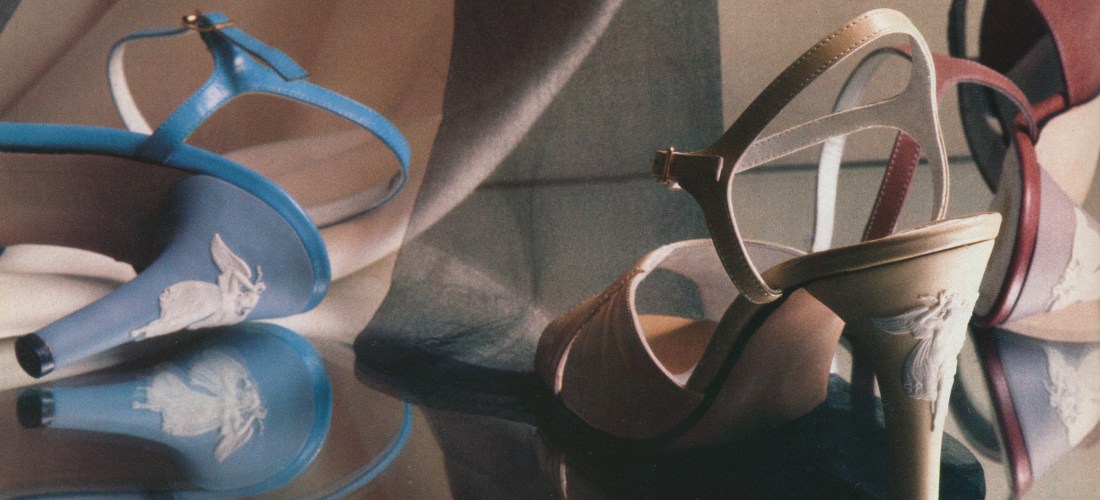
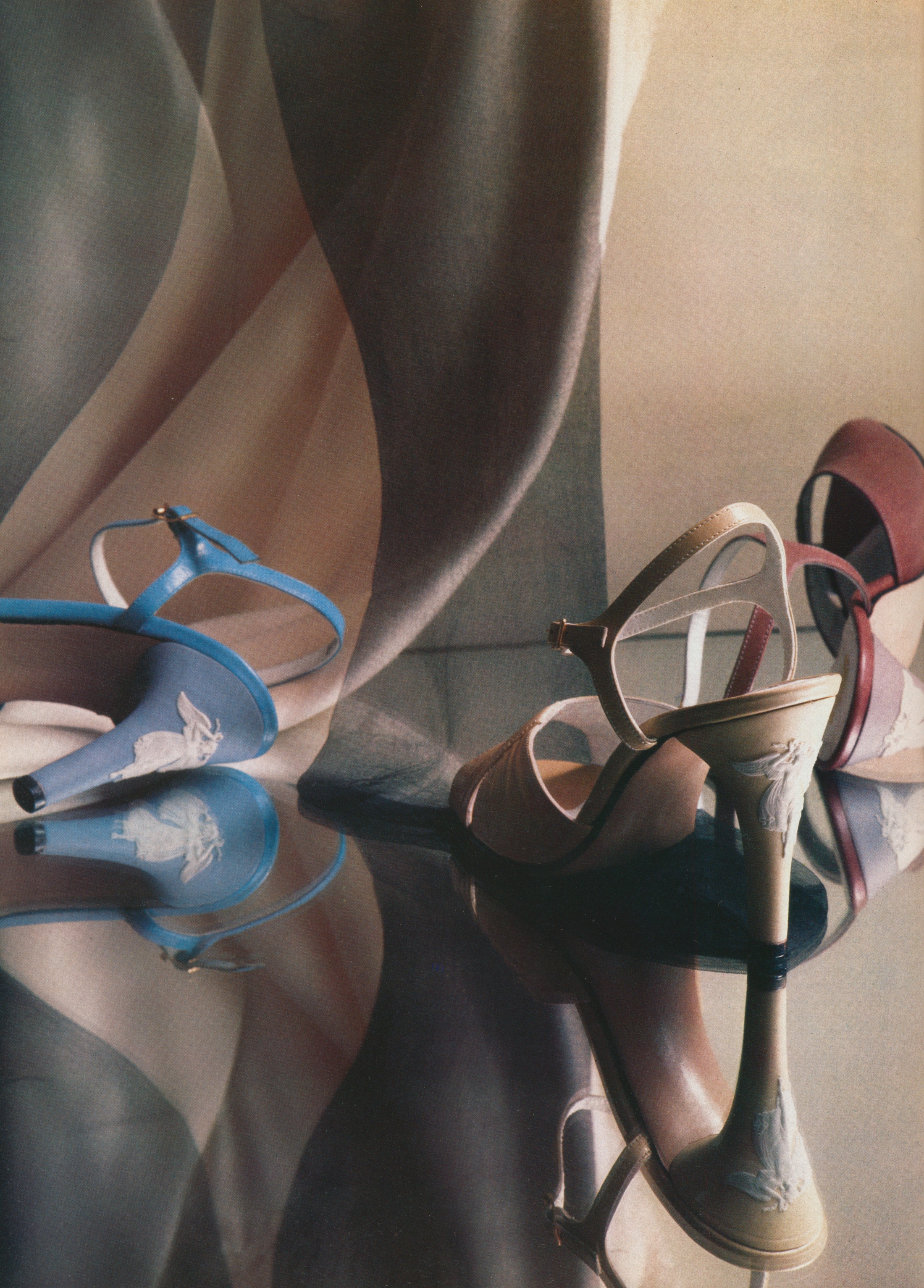
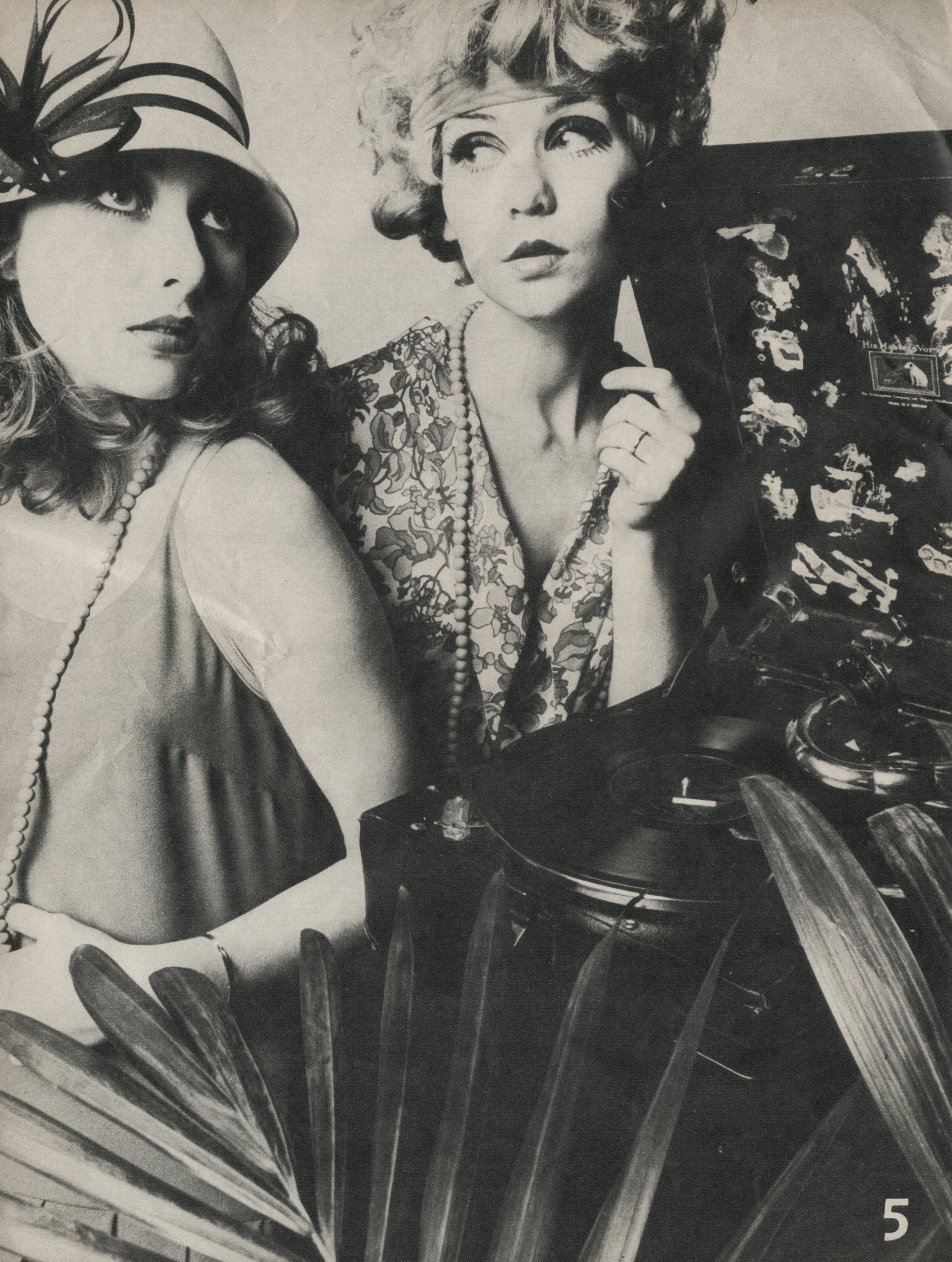
The famous names of Rayne and Wedgwood come together for one prestigious pair of shoes. Rayne’s high-heel sandals, heels decorated by Wedgwood, about £59.50, Rayne branches. Stockings, Christian Dior; satin nightdress, Courtenay.
White dress from a selection at the Antique Supermarket, Kings Road London. Seventh Avenue dress with pointed sleeves, 7½ gns. Paul Stephens twisted rings, 4s.
Props by Miss Joanna Brett.
Fashion by Susan Hone.
Photographed by Laurence Sackman.
Scanned from Petticoat, January 20th 1968.
THOROUGHLY MODERN MILLIE
Roger Nelson floral dress, 8½ gns. John Hamilton wooden beads ,10s. 6d. / Mary Quant Ginger Group green crepe dress trimmed with yellow, £7 19s. 6d. (This dress will not be in the shops until March).
BONNIE AND CLYDE
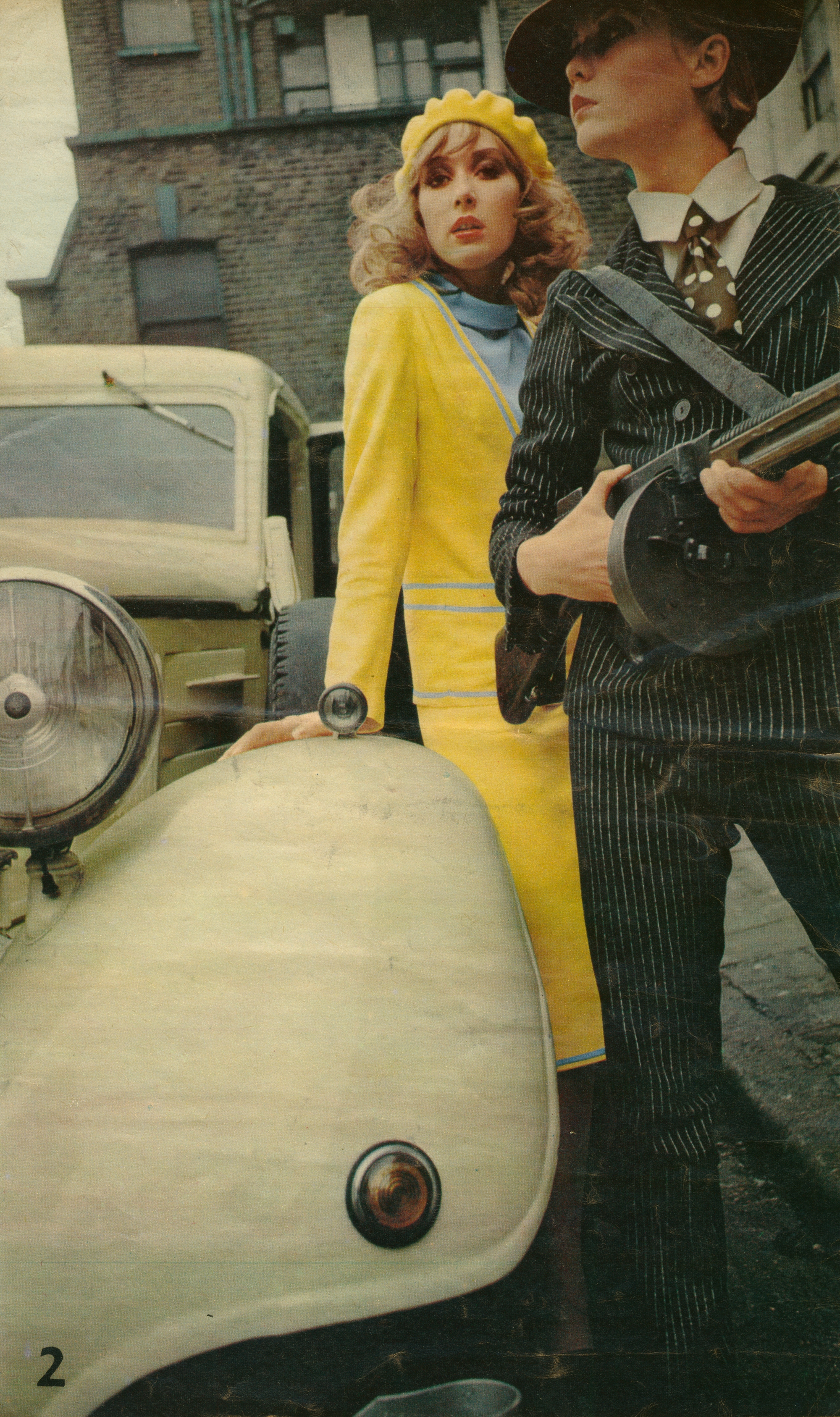
John Stephen brown gangster hat, 45s. Spotted tie from a selection at Solid Gold, 15s. 6d. Mary Quant beret, 12s. 6d. Gay Girl yellow crepe maxi-skirt and top, 6½gns. & Gay Girl by Marion Maid pin striped trouser suit, £7 19s. 6d. Car lent by David Chester.
GONE WITH THE WIND
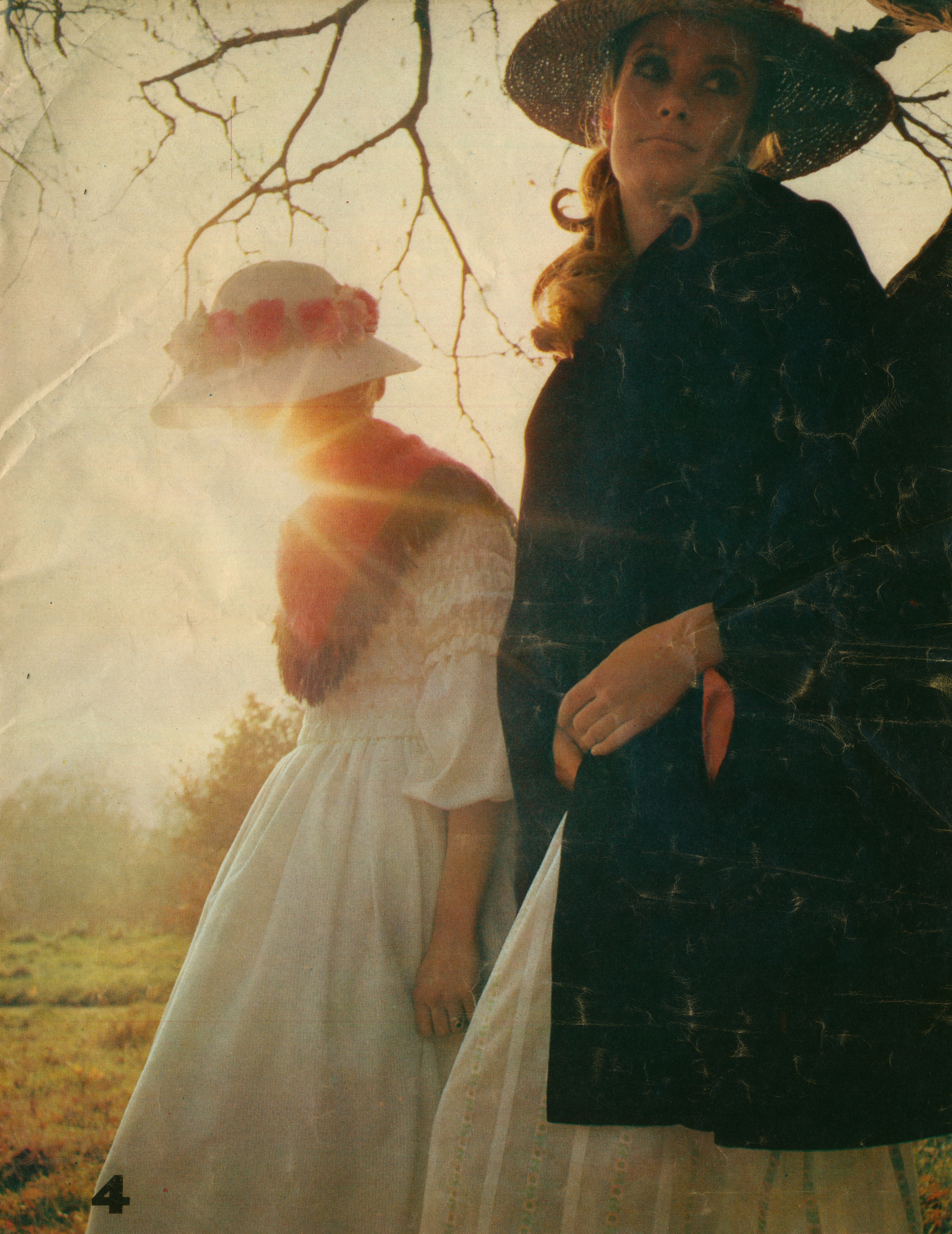
Edward Mann straw hat, 45s. 11d. Raymond velvet cape, 17gns. Rodger Bass “Long Snow Queen” dress, 8gns. Youngs Dress Hire white dress and matching hat, 12gns to hire. Andrew Stewart pink fringed shawl.
BLUE
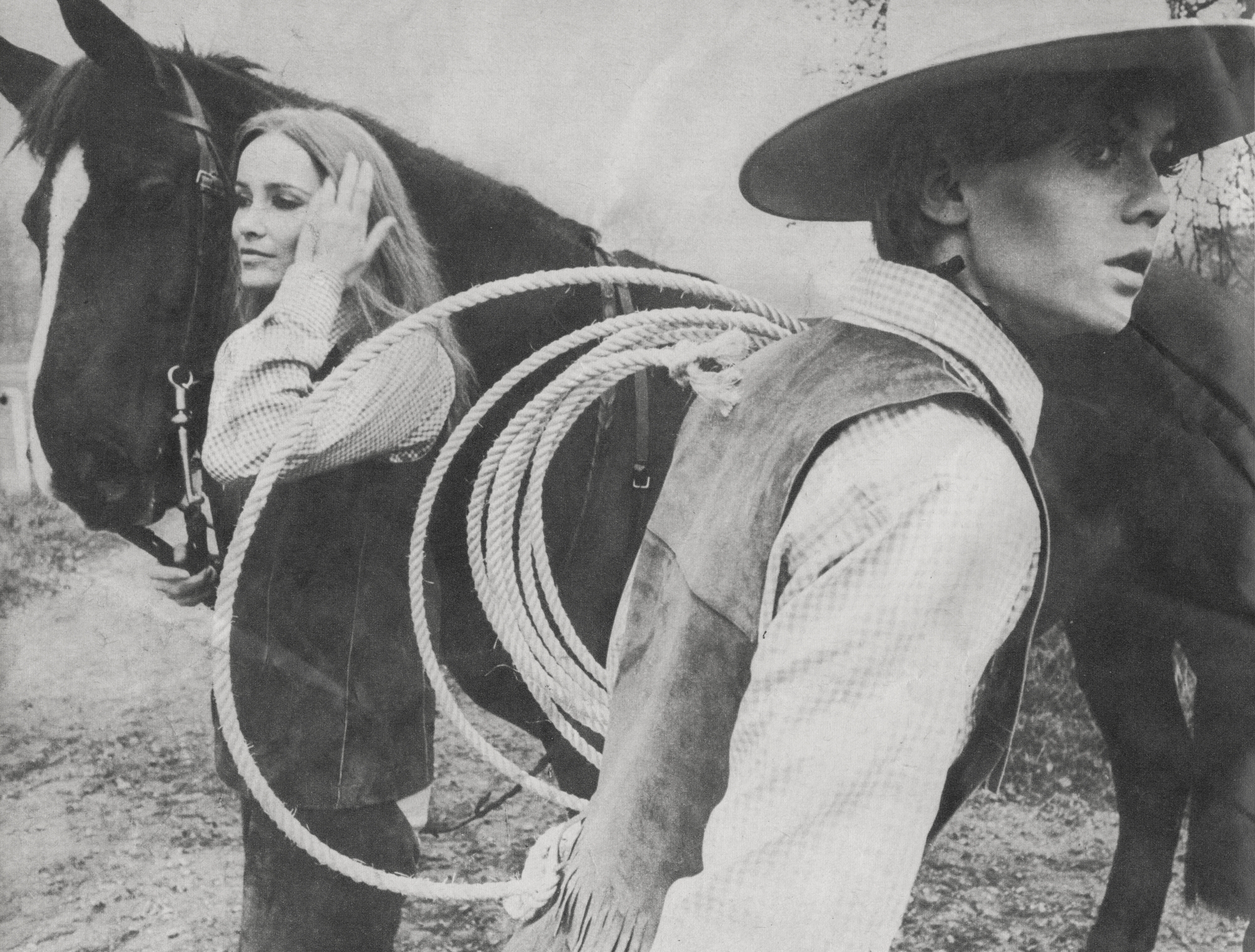
Cowboy hat, £7 17s. 6d., shirts, 79s. 6d., squaw set, 19gns., suede jerkin, 5gns., and trousers at 19gns. from Westerner, 469 Oxford Street. Morel of London riding chaps £10 5s., jerkin 8½gns. Photographed at Lester School of Equitation, Roehampton.
As with everything Biba creates, its newly opened Beauty Parlour in the Kensington store hits that striking note of sparkling originality.
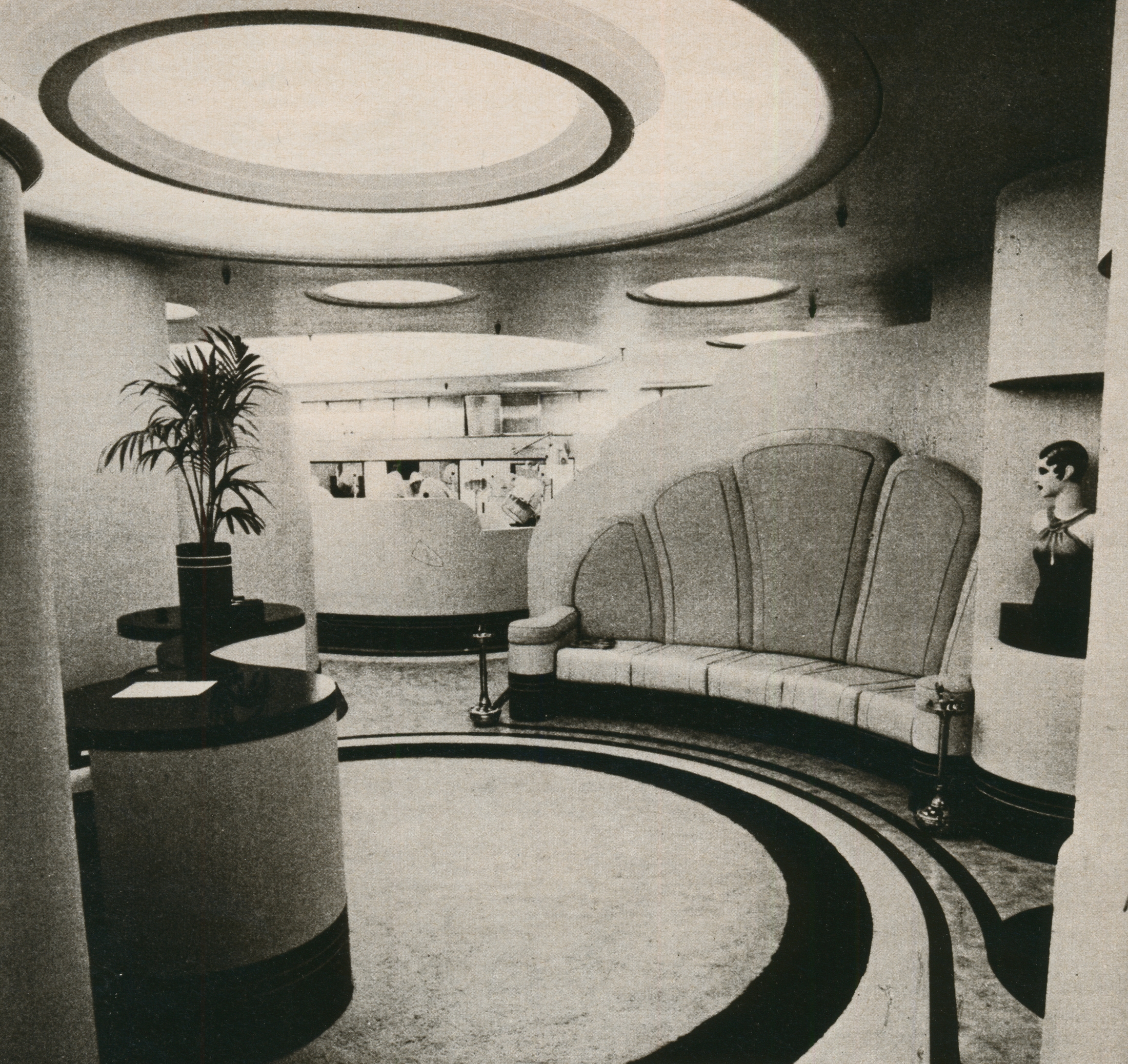
It has 19’s stamp of approval. because it is a genuine beauty parlour, in the true, old-fashioned sense of the word. The Parlour welcomes you into a relaxed, spacious and luxurious, ‘Thirties’ world of cream and black decor, bedecked with dark green palms. It is the brain-child of Barbara Hulaniki— Biba’s creator—and Regis, a brilliant and inventive make-up artist and hairdresser.
Before Regis showed us around, we asked him to tell us about his past.
Looking every bit as dashing as Valentino himself. he said: “Call me a man with no past. Although I trained and worked in many leading salons, I don’t want to be attached to anything I’ve done before or The Parlour to be compared with others.”
The Parlour offers the services of a modern establishment (from haircutting to leg waxing) which it executes in a novel way. Here you are not a number with a gown—you are treated as an individual with individual needs. In true Biba tradition, on arrival, you are fitted out with a fabulous gown—either a long black satin one (if you are having your hair done), a black velour robe (for the guys) or a super black towelling robe (if you are going into the beauty room). Even the hair nets are pretty— black and silky.
The seating is so cleverly designed in the curved and pillared room that one client hardly sees another and, although each hairdresser—and there are three, plus Regis— has his own ‘corner’, all the involved treatments, such as tinting, bleaching, high-lighting and perming. are done in private cubicles.
Biba carries every conceivable shade of hair colouring and hasn’t just confined The Parlour to all the well-known branded names. Regis virtually combed the earth to find special formulas and effects.
Henna treatments are very popular and Biba uses several varieties—Black Henna, for dark heads; Neutral Henna, for blondes; Henna Wax for dry, split hair; ordinary henna, for a rich, red glow and a special henna, which can be used with a perm—normally you cannot perm hair which has henna on it. (Henna treatment costs from £6: tinting from £6.50; perming from £10.) Regis has fixed ideas concerning shampoo.
“A good shampoo is the most important step in the whole process. because if you use a bad one. then you can forget about doing an original style. Dull, horrible hair can never look good, however hard you try.”
Biba has 17 kinds of shampoo to choose from, ranging from ‘Almond’ and ‘Strawberry’ to ‘Henna Gloss’ shampoo, which doesn’t actually colour the hair but, with constant use, produces marvellous red lights. There are also three biological shampoos: one for greasy hair, one for dry and one for dandruff sufferers. (A shampoo and set costs £3, no matter which shampoo you need to use.)
Other Biba specialities are the after-washing, pre-setting goodies. Regis’ favourite is the Champagne Rinse, which gives a remarkable gloss and softness. The Henna Conditioner is good and there are Frictions, too, which are spirit-based hair perfumes, to make your hair smell beautiful, as well as look good. (Frictions are something mothers and grandmothers know all about. but which had disappeared from our lives—until now.) These cost 50p. each, and you can choose from ‘Orchid’, `Fougere., ‘Eau de Cologne’, ‘Passionate’ and ‘Gardenia’.
Blow-drying is virtually non-existent at Biba.
“We want girls to look truly groomed and feminine again.” said Regis. He believes in the old-style training and he and his staff use rollers (but not heated ones), Marcel Wave tongs, wave clips. small tongs and irons, and do lots of exacting pin-curling.
The Beauty Room is run by a very efficient lady and practically anything is done. There are treatments to help acne problems; waxing to remove unwanted hair; massage including a deep-back massage. with an infra-red lamp; spot reducing with Slendertone and eye treatments, which include eyebrow shaping, eyelash dyeing and the application of Permanent lashes. (This costs £4. and replacements later on cost 10p. a lash.)
The manicures and pedicures are superb. If it is just a plain one you want, then, of course, they will oblige. But if you want something for a special occasion then they can do fantastic combinations of colours, patterns and designs on nails and toes, too, if required. (Ordinary manicures cost £1: the special kind. £2.50.)
As far as make-up is concerned. Regis will create a fantastic new look for you and will advise on form-ulas, colours and applica-tion. (Cost £5.)
The Parlour opens at 11am., on weekdays, and last appointments are at 6.30pm. On Saturdays. opening time is 9.30am. and last appointments are at 4pm.
It’s sobering to remember that about seven months after this article appeared, Biba was closed forever.
They say you can’t miss what you’ve never had, but you can. And, you can be very misguided about it. Take the time when you’re on that twilight trudge home from work and you pause, for a fraction of a second, in front of a lighted window to envy a couple immersed in conversation. It’s a moment of exquisite, self-indulgent, single-girl melancholy. A very wise person once said: “Be careful of what you want in life. You may get it.” Living in tandem comes to most of us in the end — but spend the intervening time merely waiting for this state and you’ll miss out on a period of absolutely justifiable, selfish please-yourself that is the unique bonus for being single, when you can choose, unfettered by any taste other than your own. You can paint the bathroom puce or lettuce green and have only your own hangover to tell you you’ve boobed. You can work out your own furnishing priorities — like a good, thick carpet to sit/lie on and some decent sound equipment — and cut down your food consumption drastically for a few weeks, or months, to achieve them. You can use the time you might have spent cooking doing something sensational to jumble sale jetsam. You can be poor in style, because time and energy can make a pretty good substitute for money. None of the single women on these pages has money. What they do share is a strong, single-minded sense of their own individuality .. . It’s something they take for granted, but it shows in their lives and in their homes.
Wonderful to get an insight into the home of the slightly mysterious Rae Spencer Cullen, and what a home! Then again, magpie that I am, I would happily live in any of these beautiful pads.
Interviews by Penny Ragord.
Photographed by Tim Street-Porter.
Scanned from Over 21 Magazine, October 1976.
Rae Mouse
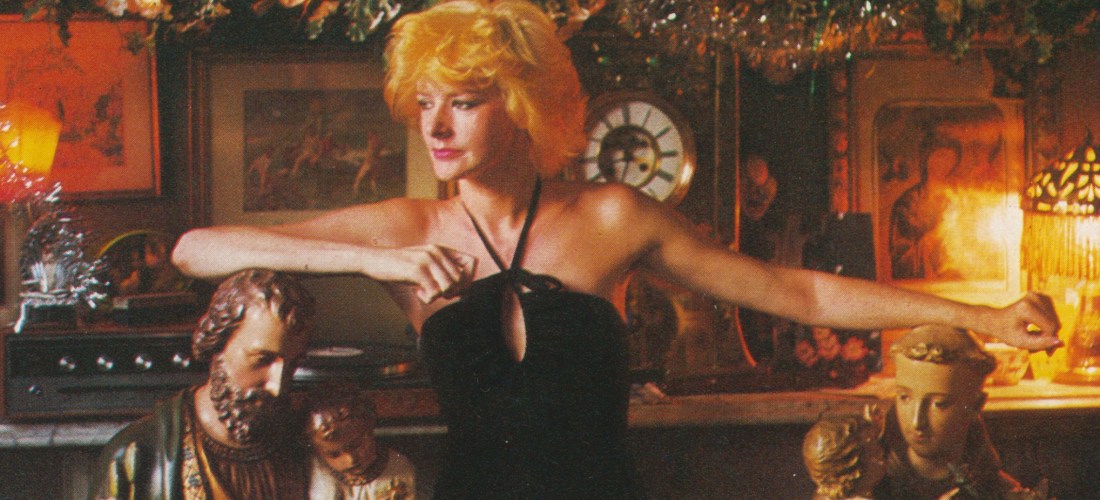
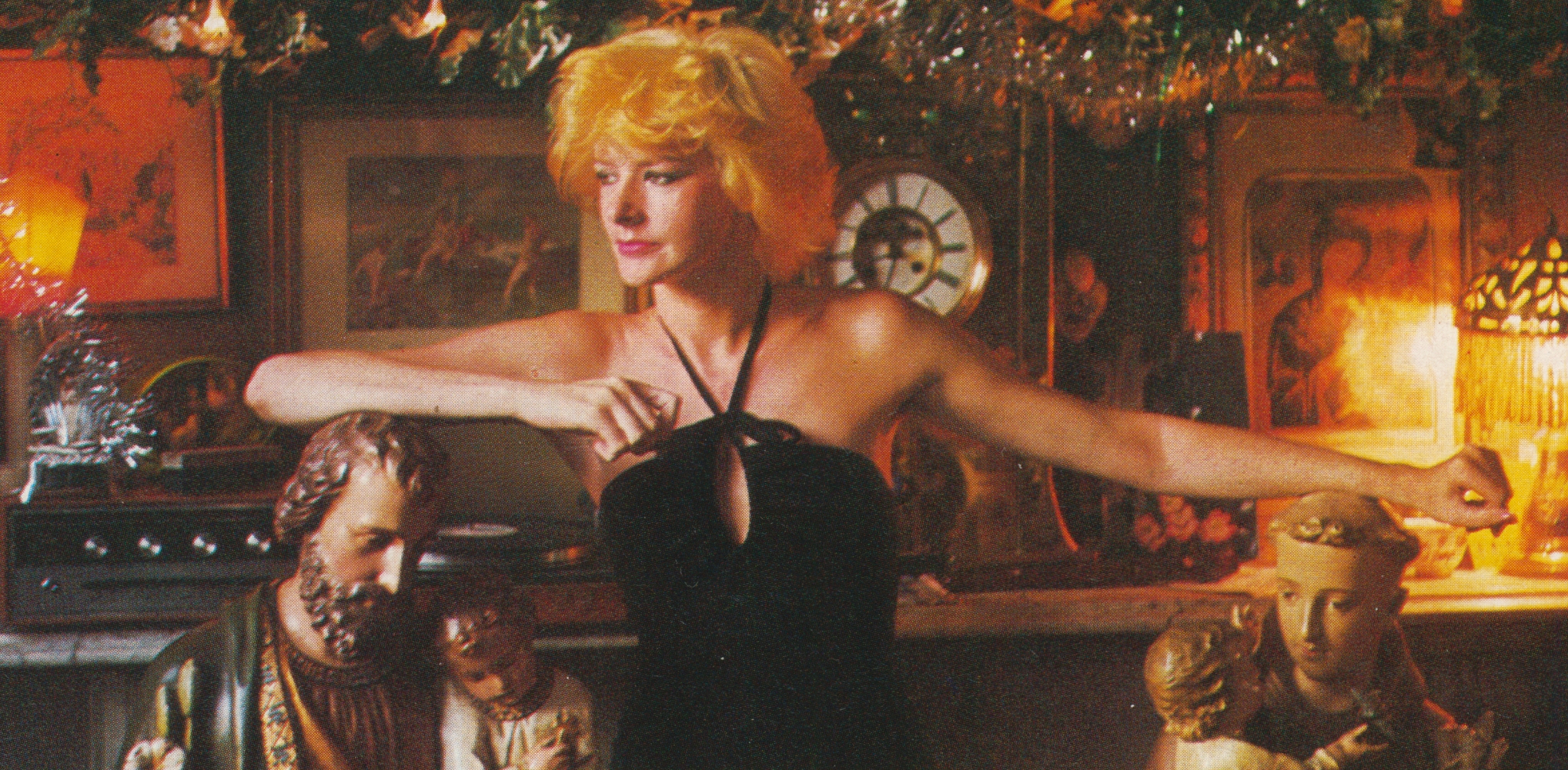
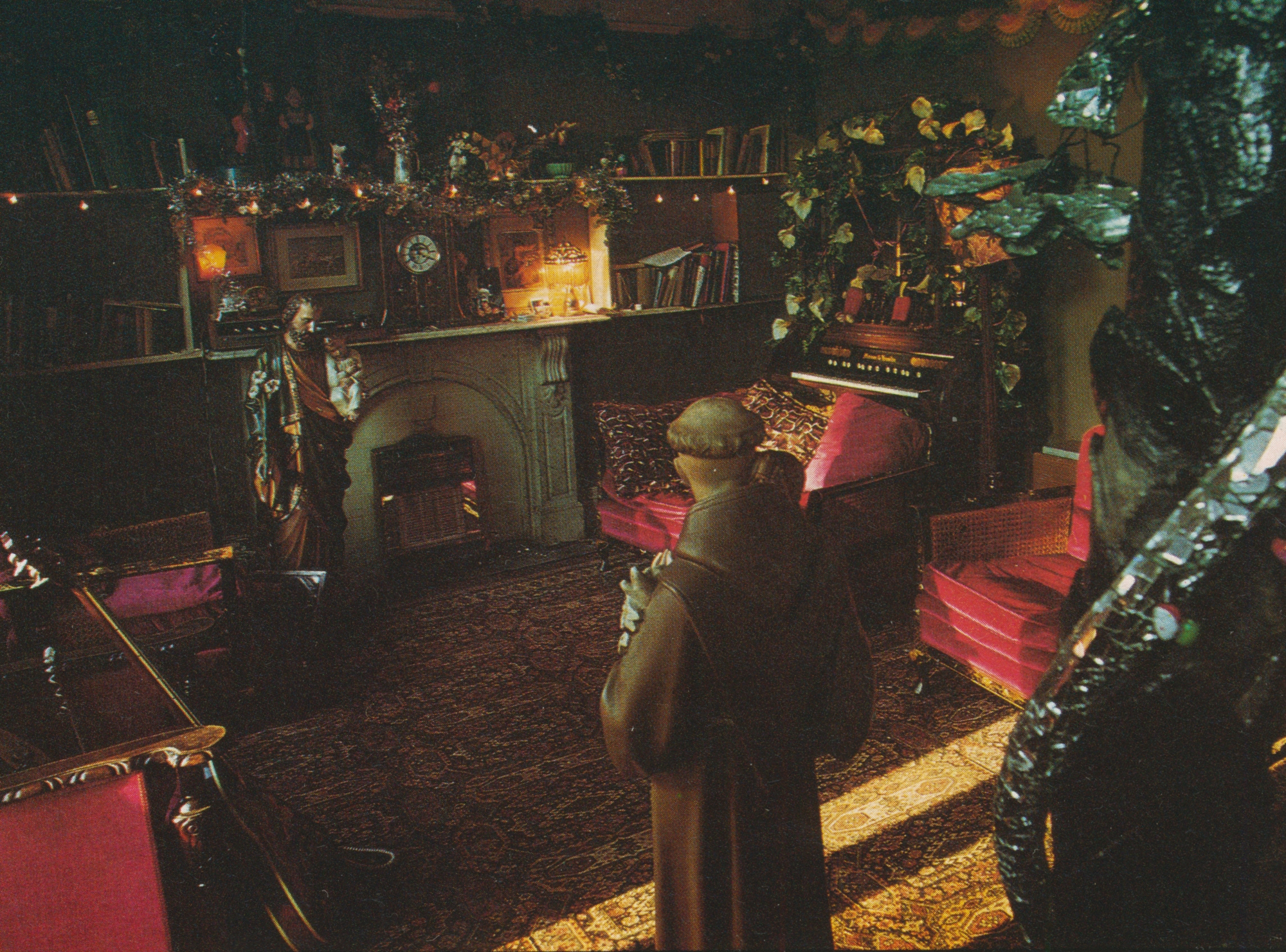
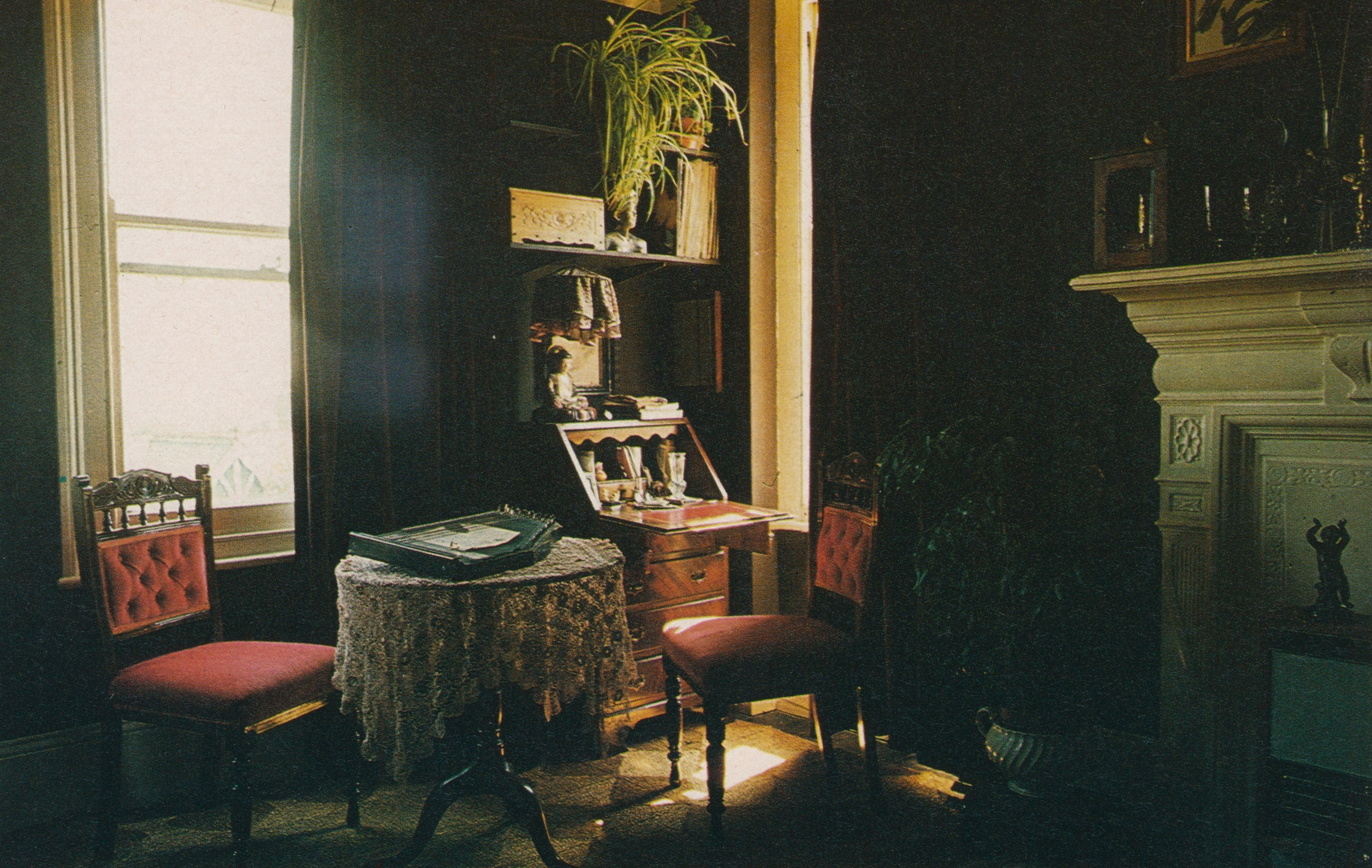
Rae Mouse should be prescribed in small doses to anyone with single-woman blues. Small doses because what she gives out is strong stuff, and it’s not sympathy. “People make far too much fuss about their own per-sonal aggravations,” she says. “And they expect someone else to come along and rescue them. But no man, woman or child can do that, and the sooner they realise this, the sooner they’ll be able to get on with life and stop letting their hang-ups get in the way of having a good time.” This would be hard to take from someone who’d had it easy. Rae hasn’t. She is ‘Miss Mouse’, a fashion designer who, with one colleague, started her own design/ manufacture business from one room in 1970. For four years they managed to keep going, making everything themselves in the early days, and the ‘Miss Mouse’ label became very well known. Then came the slump, the bank manager lost his nerve and the business folded. But Rae didn’t give up. She got herself, and her name, bought up by a big manufacturer and carried on, in a posi-tion of considerably greater security and with her design free-dom very little diminished. But it’s still hard work. When we met, she’d been up since five for the umpteenth morning, working against a deadline to get 60 prototype designs completed. She works from her own home in Putney, just south of the Thames, in an amazing room that is sombre, rich and fantastical. It’s furnished with plum velvet sofa and chairs, dominated by a vast black tulip sculpture by Andrew Logan and crammed with religious statuary and knick-knacks, including an old harmonium hung with macabre, artificial arum lilies. “It’s not that I’m particularly religious,” she explains, “they’re simply beautiful in themselves as objects.” Her taste is obviously and totally individual — “although I’m very influenced by my friends, especially the creative ones. But,” she adds, “I’ve never found that having pretty strong ideas about what one likes causes any conflict. In fact, people rather like it. They know just where they are.”
Luciana Martinez della Rosa
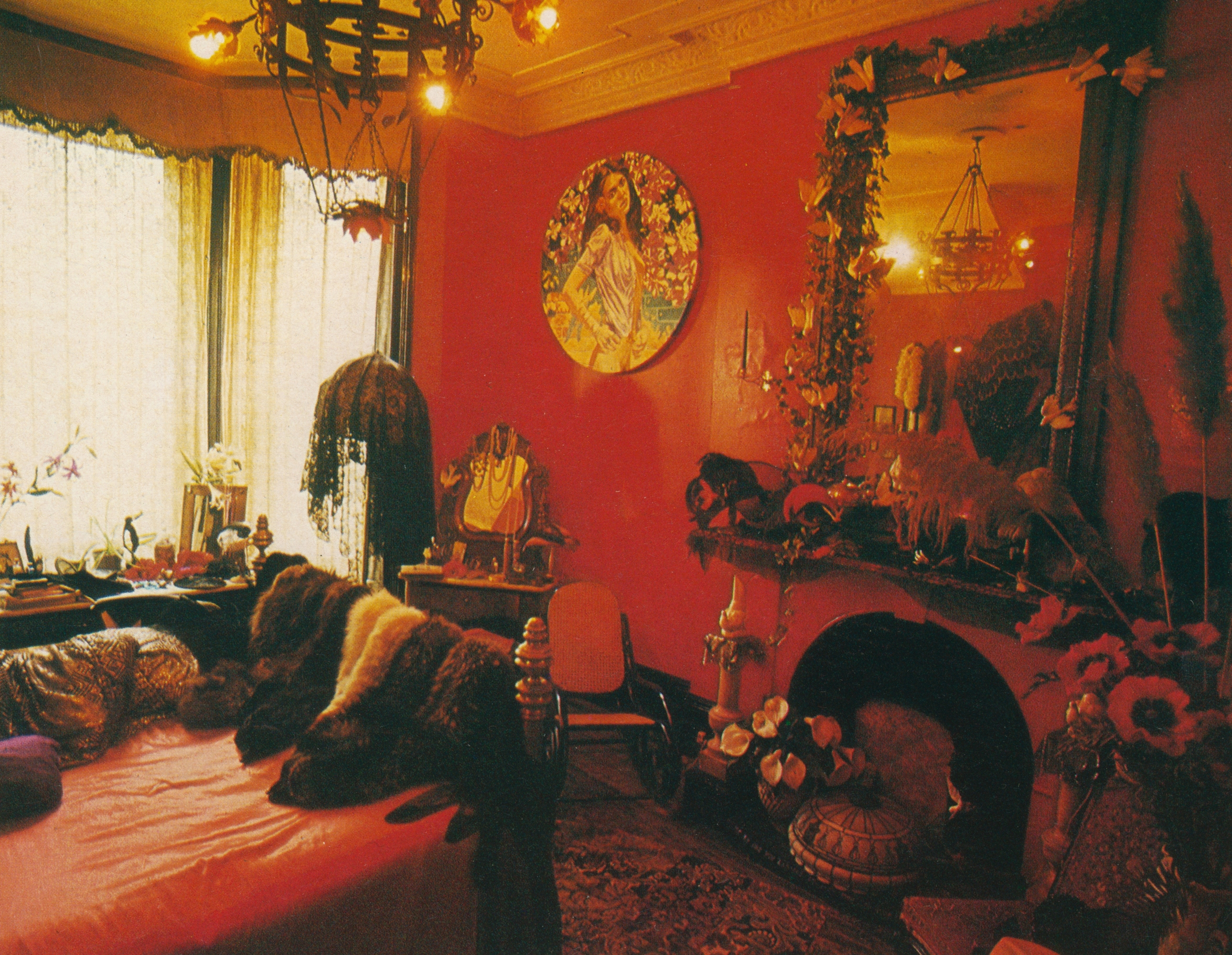
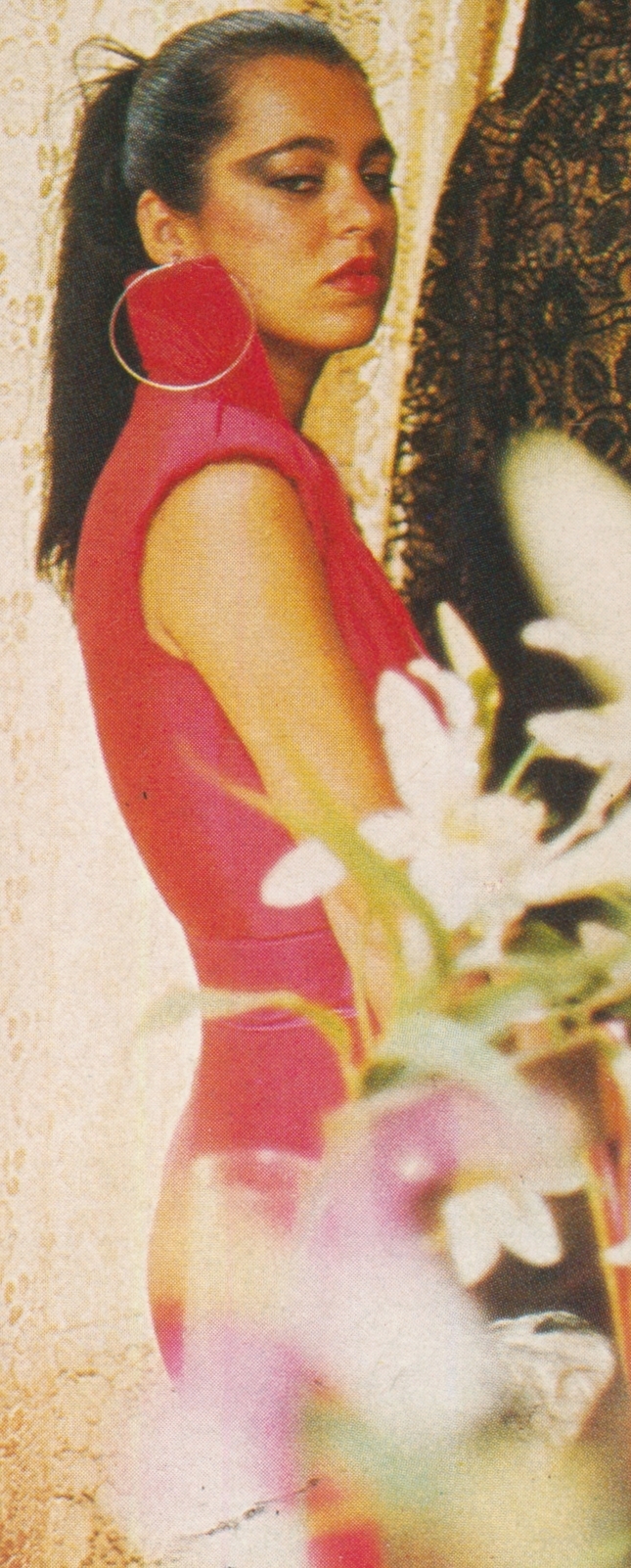
“People who only see me at parties think I do nothing,” says Luciana Martinez della Rosa. This, in a roundabout way, is because she’s an extremist. Predominantly a painter (so far she’s exhibited in mixed shows in New York and Rotterdam), she also makes extraordinary and beauti-ful bead wigs on commission. And the reason people think she’s a very decorative do-nothing is because she buries herself at home, working for days and sometimes weeks on end, and then explodes into the much needed relief of a short, sharp, burst of social life. Her finances tend to be extremist too: long periods of scraping by on an over-draft until she suddenly sells a painting, pays back the bank and the rent — and spends the rest. It’s a very deliberately chosen way of life, and in some ways it’s a lot tougher than a stultifying but secure, nine-to-five job. “I could do things that would earn me a lot more money,” she says, “but then I wouldn’t have time for the most important thing, which is my work. Even a part-time job would break up my day and my concentration.” For the same reasons, anyone with whom she becomes involved, on an emotional level, must be as independent as she is herself. So she shares a house with another painter, Kevin Whitney. And she points out that being single and living alone are two separate concepts: it’s obviously good to have a friend around to sympathise with successes and disasters. But her part of the house has her own character and taste written large and uncom-promisingly across it. “People who work away from home, and then probably go out quite a lot in the evenings, seem to need less personal surroundings. But I spend a lot of time here, so it has to be very me.” Her bedroom says it all: scarlet, and over-flowing with Art Nouveau pieces, old fabrics and furs. She’s been a jumble sale addict since she was 12, and they’re still the major source of her wardrobe. “But they never look like old clothes,” she says. “Because of what I do to them. If I could, I’d have every-thing, clothes and furniture, made specially for me.” It was as a child that she started buying up all the Victoriana that no one else wanted. “My mother thought I was mad.” Not so mad now, because, although she swears that nothing in the room was expensive when she bought it (“Except the bed. That cost £40”), its contents would make a market stallholder weep with avarice. “I suppose some people might find it all a bit overpowering,” she says. “Especially a guy. Not too good for his ego. But I think you tend to gravitate towards people who like the same sort of things as you do. And anyway, I get a lot of pleasure from seeing other people’s places. I hope that it works both ways.”
Luciana Martinez della Rosa
Prudence Walters
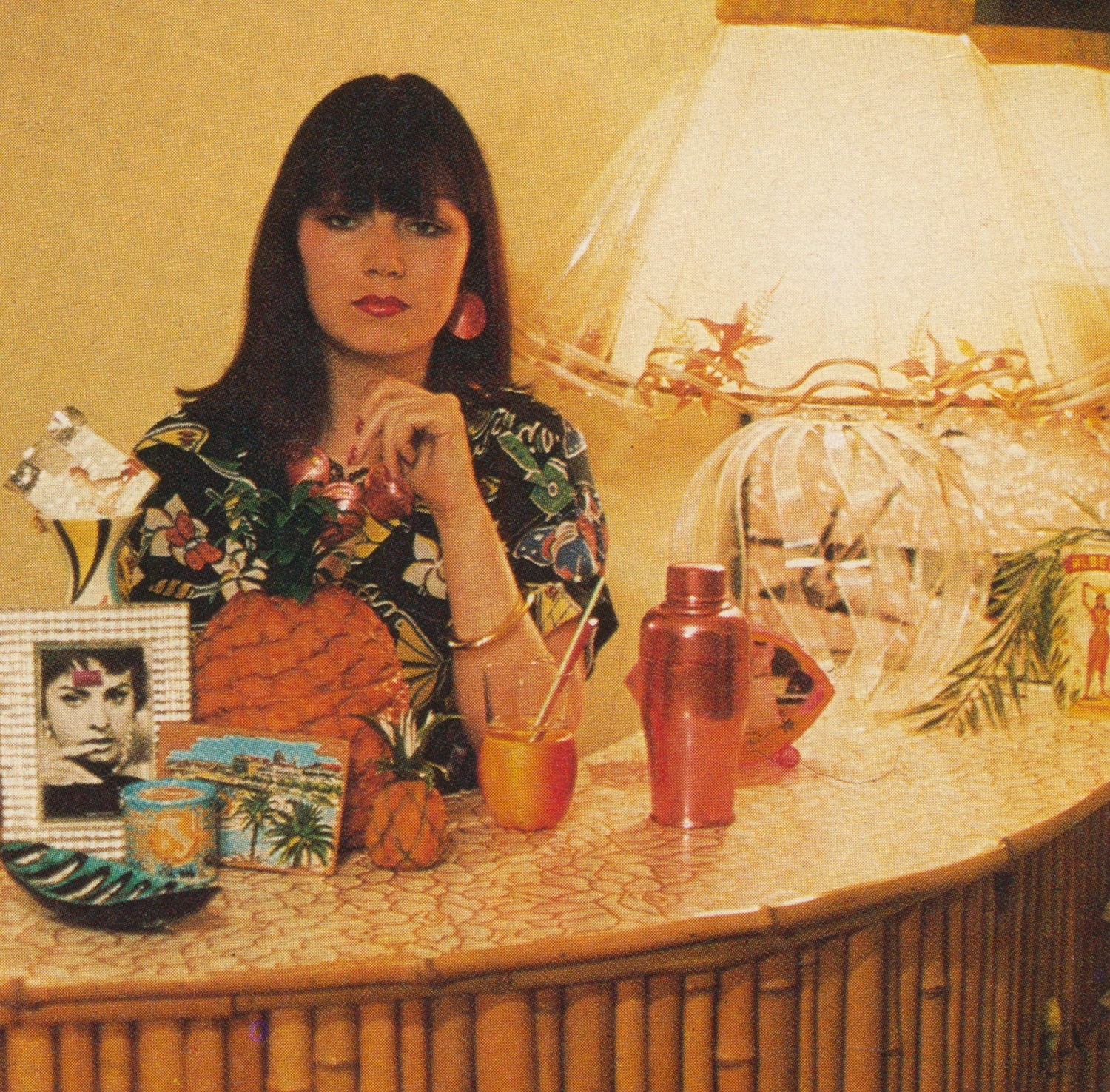
Prudence Walters is Welsh, an only child with a convent up-bringing. At 18, she left home for art college in London, and she hasn’t really looked back since. In her time, she’s been a magazine fashion editor. Currently, she works as a stylist, freelancing for photographers who need the right look for a session. It’s hard work, and quite well paid — if and when people get round to paying. The big advantage is the free-dom, finance permitting, to organise your own working life: deciding to work every day for four months and then take two months off. Prudence lives in a basement flat, complete with cocktail bar, that is uncomprisingly set in the 1950s, a style that she genuinely loves. She obviously treasures her independence, seems to know exactly what she wants in life and to be very contented with what she’s got. This doesn’t preclude men, but they have to accept that her way of life is as important as their own. “I’m a bit ruthless,” she admits. “I have lived with people and I do like it. But I tend to get bored with people quickly and I don’t really like getting to know anyone too well.” The bit that gives her the real horrors is the extra housework that dual domesticity inevitably brings with it. “I probably wouldn’t mind doing it all if there were compensations, such as someone else keeping me in the standard of living I’ve been able to achieve for myself.” But since she can, if she chooses, earn as much as most of the men she meets, or more, the idea of being breadwinner, cook and bottle-washer doesn’t appeal to Prudence Walters at all.
Prudence Walters
Ursula Yeardye
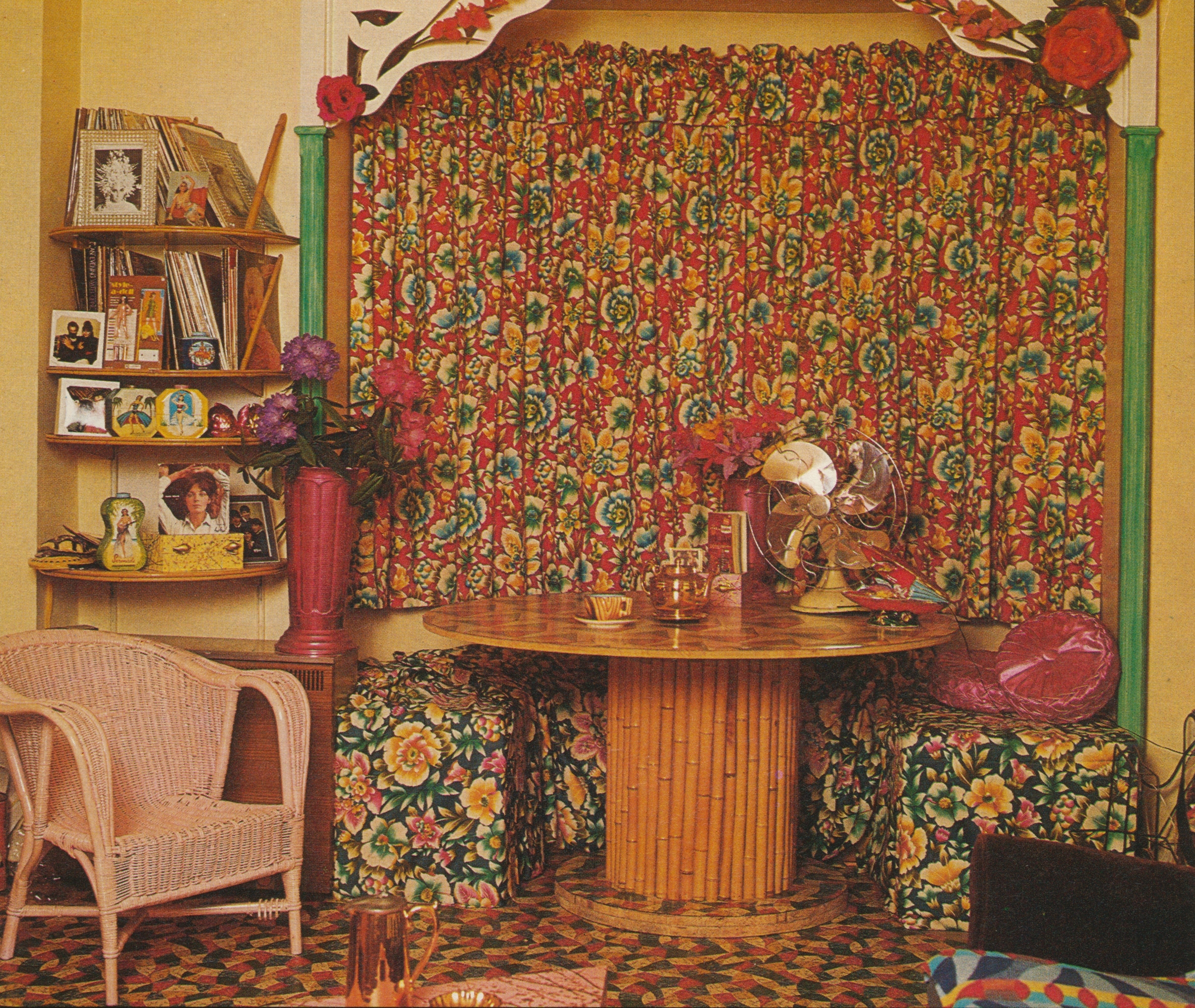
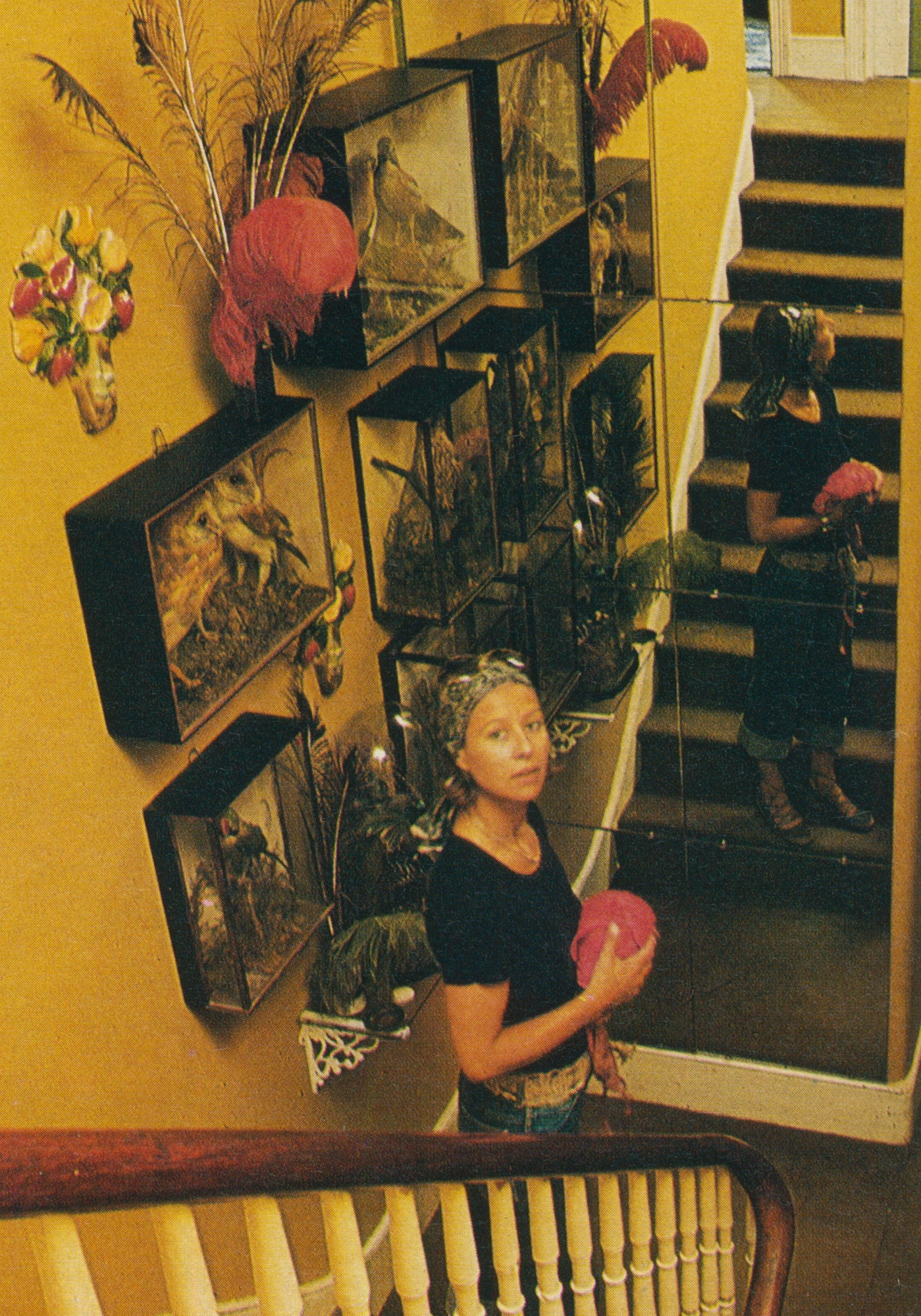
Ursula Yeardye has been through two marriages and out the other side. At the moment, she’s very much biased towards the single life. “Somewhere,” she says, “there may be a man who doesn’t simply want to be looked after, and it would be nice to find one, but both my husbands merely wanted mothers. I tried to fulfil that role, modelling myself on my own mother. But it’s no good to either of you if you become a martyr. I’ve always needed my independence and there simply wasn’t enough of it. I had to get my conditioning about marriage through my system and then get out before I got too damaged and lost sight of my own potential.” Before her first marriage, she studied mime with Marcel Marceau in Paris and toured the States for two years with the company. Now she’s running a small commercial firm in London, but she’s started retraining as a keep-fit leader, studying modern movement and yoga, with the aim of teaching some time in the future. She knows the disadvantages of single life: “I like going to places by myself, but people still look at you strangely if you’re on your own in a restaurant or a cinema. They either steer clear of you or approach you, and both for the wrong reasons. The social structure is still against you. You’re swimming against the stream!” But the advantages are there too: “You have complete freedom. You go home, sit down and think, ‘What do I want to do next?’ And if you don’t want to go home, you don’t have to. There’s no one sitting in front of the ‘fridge, waiting for you to cook them a meal.” Since she’s been single, she cooks far less —except for entertaining, “and that’s cooking for fun, it’s really great”. She lives mostly on fruit and vegetables, and the money she used to spend on what she calls `man’s food’, she spends mostly on her home, which has become something of a symbol of independence. After rent, her salary leaves her enough to do a little more each week. She paints, sews, upholsters, renovates, and what she’s done to the top two floors of a rather dilapidated terraced building is quite remarkable. “It took me a long time,” she says, “to learn that it’s no good living for the past, or the future —always hoping that it’s going to get better. You must live for the present, and enjoy it as much as you can.”












 Liz Eggleston