Cream Borg fake fur caftan with a square yoke and cuffs in white-stitched navy wet look plastic. By John Bates at Jean Varon, £56.95. Fine knitted triangular shawl wound round the head, £8; fine silk, fringed scarf used as dog’s lead, £4. Both from a range at Bombacha. Ankle boots,. £16.99, Richard Smith at The Chelsea Cobbler.
Assured in films since playing Roberta in The Railway Children, Jenny Agutter “has been in the theatre since the beginning of the year, lately in The Tempest, opposite Sir John Gielgud and Spring Awakening at the National Theatre.
Photographed at Eastnor Castle, Herefordshire, by kind permission of Major and The Honourable Mrs Hervey – Bathurst.
Photographed by Norman Parkinson.
Scanned from Vogue, December 1974.
Violet wool smock to mid calf, flaring and gathered from X. a round yoke, cuffs and hem finished with narrow black braid. By Dorothee Bis, £34.50, at branches of Elle. Tartan muffler in red and green, scarf sold with matching skirt not shown, £35 together, at main branches of Jaeger. Multi-coloured beads, from range, The Purple Shop.
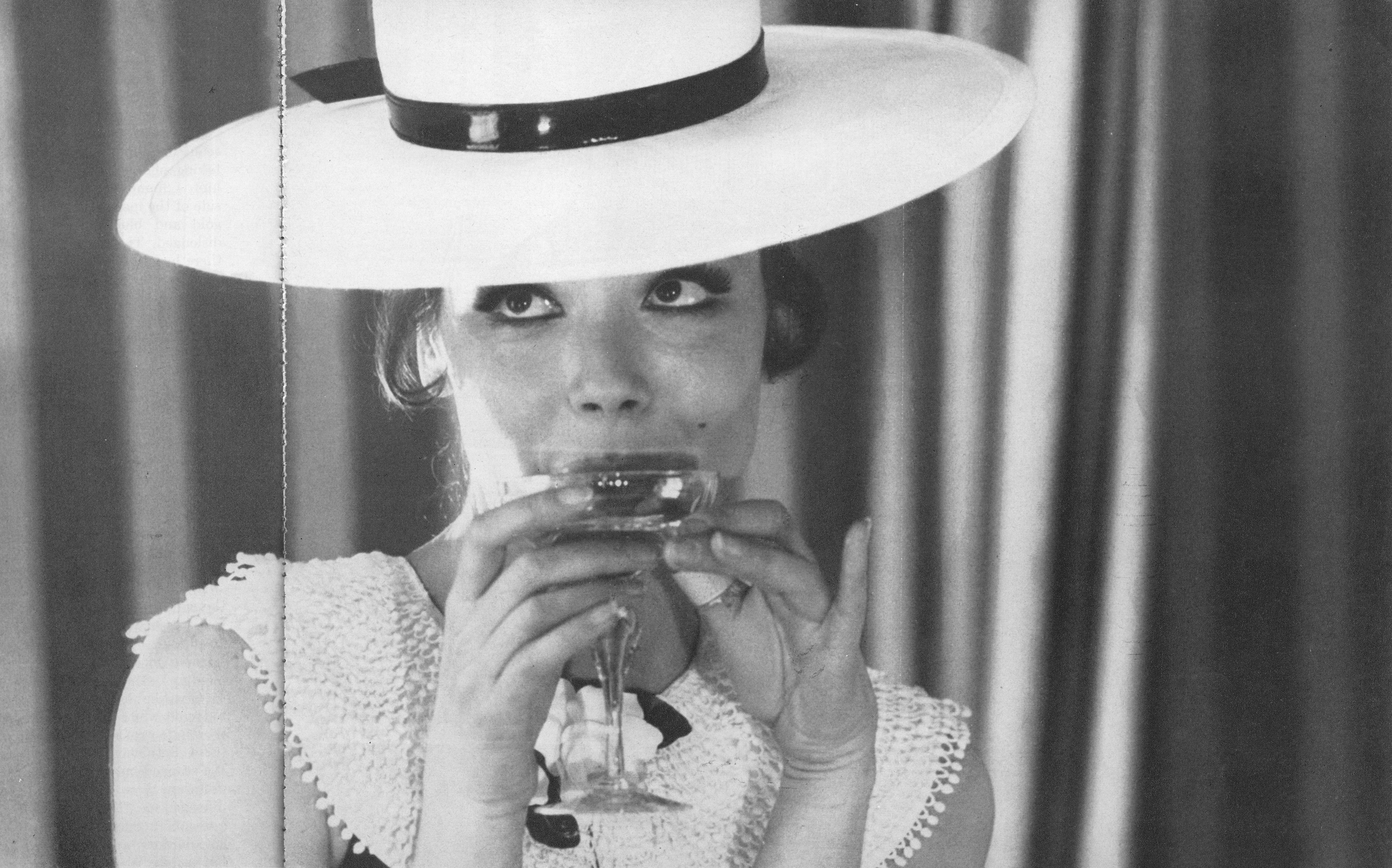
The Flirt: She has a flower-like quality, fair and pretty with an innocent air. Without regard to her maturing years, she plays the part of a child. Her dresses are innocent and fluffy. She wears bows in her hair and her man sees her as his good angel. He feels she is his pure heroine. He wants to shelter her. She smiles a lot. She smiles mostly at important and rich men. She be-guiles them into givirig her compli-ments — also the spotlight. Bewitched, her man doesn’t realise his friends find her dull. Her education is nil, her contribution to conversation non-existent. Her knowledge has been limited to an intense study of her personal appearance. Her important man has an important engagement. She does everything to delay him. She is maddeningly self-centred. She cries a lot if rebuffed, or if she doesn’t get her way. She wants all the attention. Skilfully, she keeps him unaware of a lack of reality in their love-making. She is too tender for passion. Her real interest lies elsewhere. Her desire and satisfaction is bound up, not in tender concern for him, but for his bank account. Hat by Simone Mirman.
Masques are not new. The Greeks used them in their classical theatre to represent various stereotyped parts such as ‘The Happy Lover’, ‘The Jealous Wife’ and ‘The Benign Father’. Today, most people assume personae to hide their real personalities, though the very characteristics they try to keep hidden, are often quite obvious to others. What is more, it is easy for people to become identified with their masque to the point that it is difficult for them to discard it. The basic reason for assuming a masque is to play a role and, hopefully, to make oneself more attractive than one actually is. It doesn’t always work.
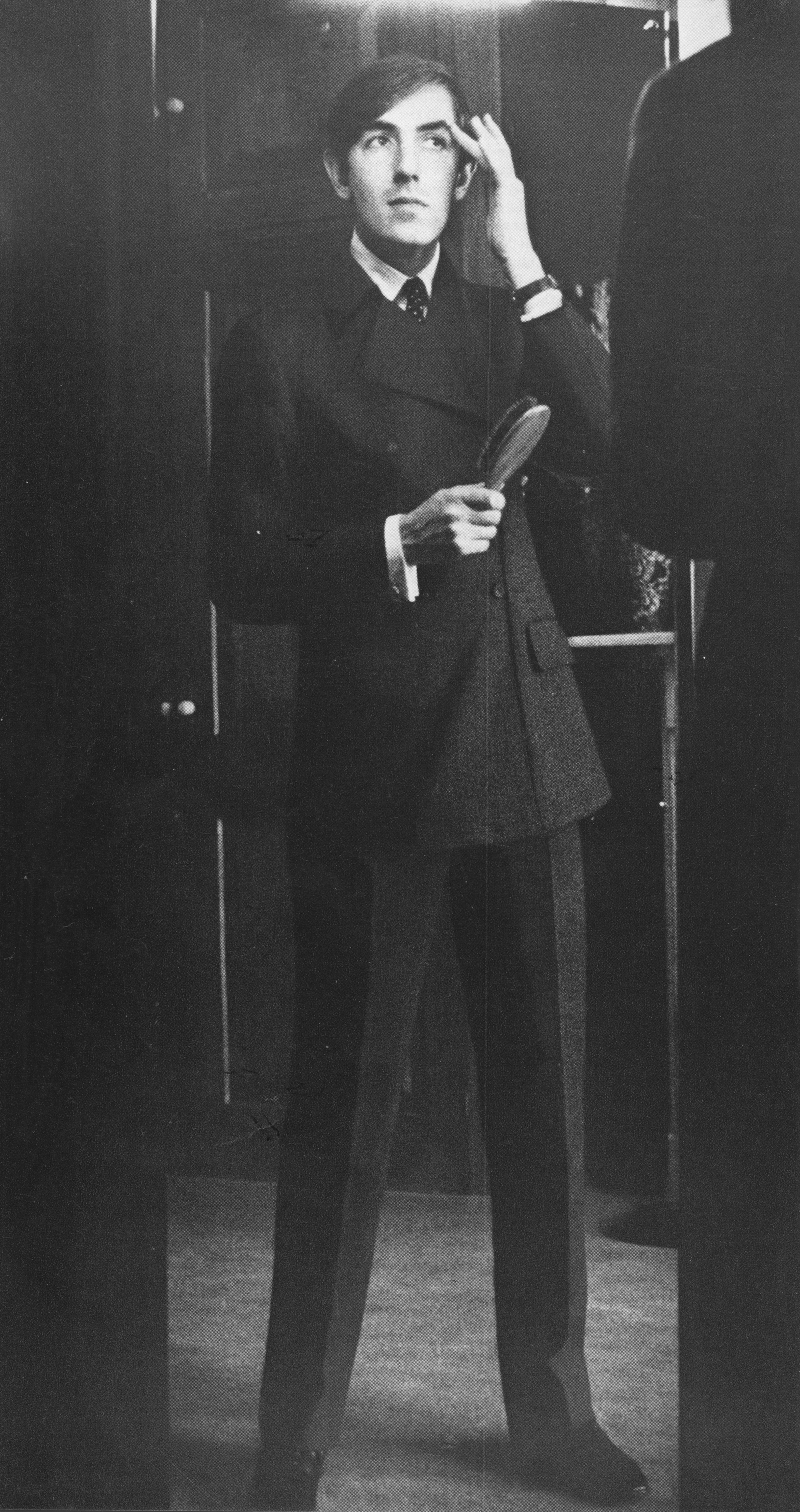
Played by Diana Rigg and Peter Cook
Written by Adelle Donen
Photographed by Stanley Donen
Scanned from Queen, 5th July 1967.
I have been on something of a break from here and social media recently, for personal reasons, but had always planned to post this on Diana Rigg’s birthday so here I am, back a little earlier than intended.
When I found this copy of Queen magazine, appropriate because Diana was and will always be my Queen, I couldn’t believe that I hadn’t seen most of the images before – especially as they were taken by one of my favourite film directors. There’s always a part of me that wants to keep things like this to myself, but the bigger part wants to share the beauty with everyone. So I hope you enjoy!
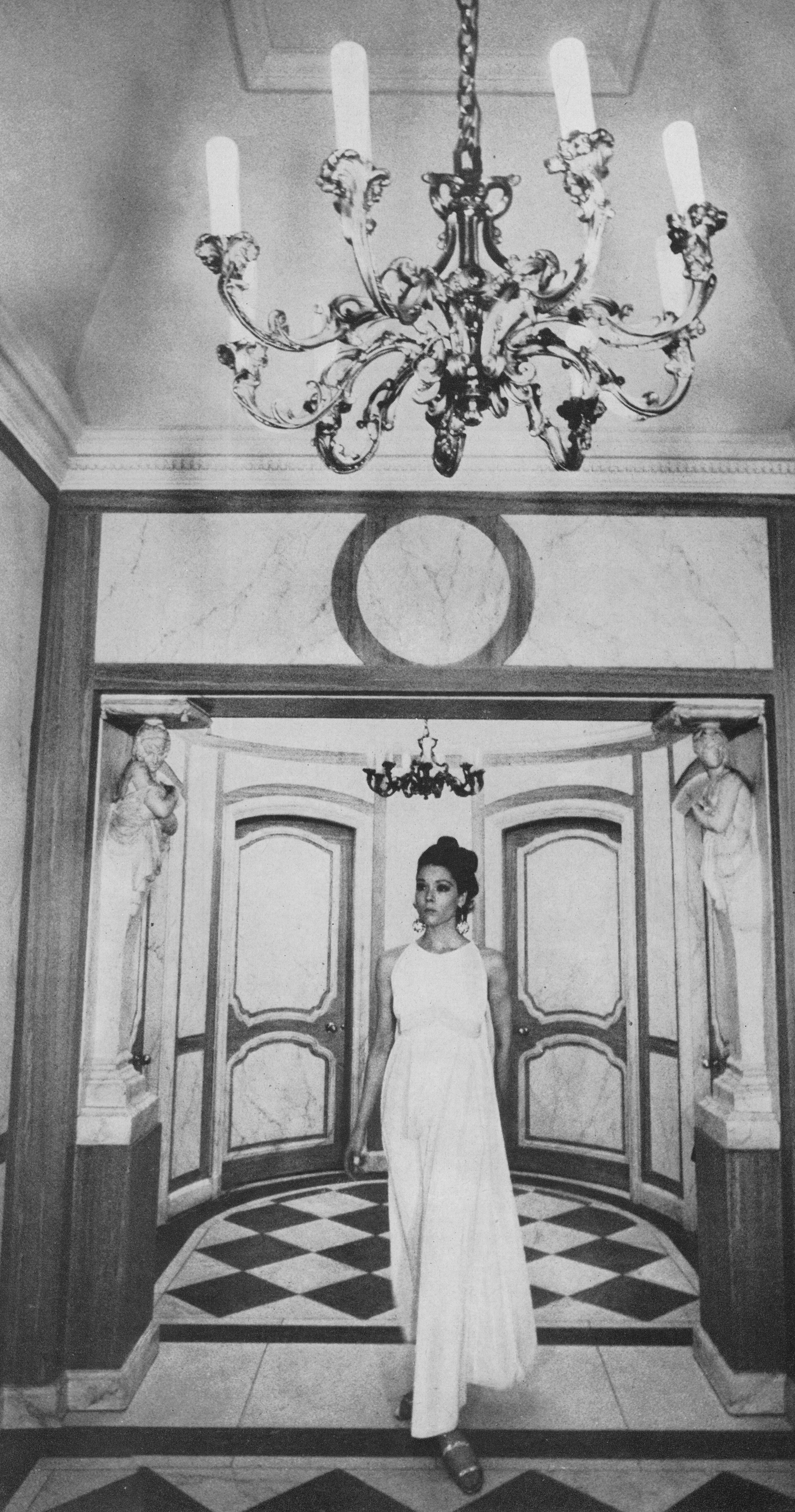
The Goddess: Her beauty captures the admiration of men. She is aloof, which captures their imaginations as well. Stripped of ancient gods, men long to find modern symbols. For some she is Aphrodite, the sexiest of them all. Others see her as purity. She is mysterious. The poor girl has to keep quiet. She does not dare expose her pedestrian qualities. She retreats be-hind a nondescript personality. She may or may not have much in the upper storey, but she has twigged the fact that she will always get in free, as long as she does nothing but exist. Gorgeous girls do not have to do much to enhance their looks, so they have to learn little about style, unlike their less fortunate sisters. She dare not change, and remains locked up behind her lovely iron mask. She uses what judgement she has to choose the plushiest suitor. He is swindled. He has married a statue. She has learned how to get what she wants and not give anything. She is frightened and frigid. Dress by Jean Varon.
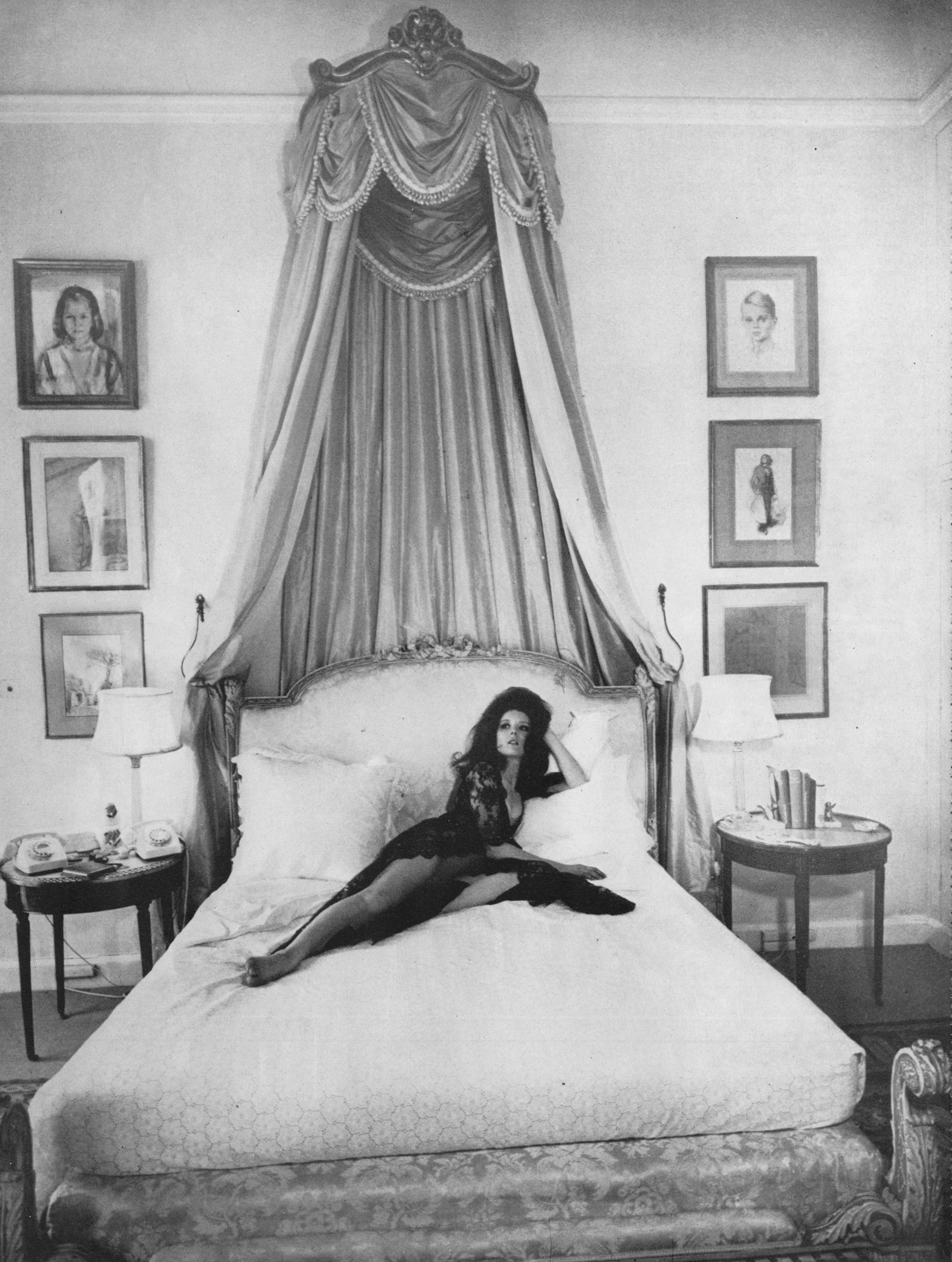
The Femme Fatale: She is dark, full-blooded and passionate. When she enters a room she has a brooding air. She is convinced she is irresistible to men; that she alone among women can experience real love (be it ever so exhausting). It is easy to see her idea of herself behind her slinky siren ap-pearance, but this can be agonising to the plain matron who would be ridiculous acting this part. She has an air of assurance with men, snaky and confidential. She doesn’t bother with women. Surprisingly, a man may accept her idea of herself and find her dramatisation agreeable. It flatters him. Then the fun begins. With all stops out, she throws her emotions at him. She is emotion itself — hysterical, furious, desperate. There is no moderation. She is devouring, unremitting. If the man survives, he may feel relief at having such a torrential release of his feeling. Or he may be frightened — and run. The whole play is usually brief and limited because of its intensity. The amount of unreality is prddigious. It is of these women that Kipling said: ‘The female of the species is deadlier than the male’. Dress by Jean Varon.
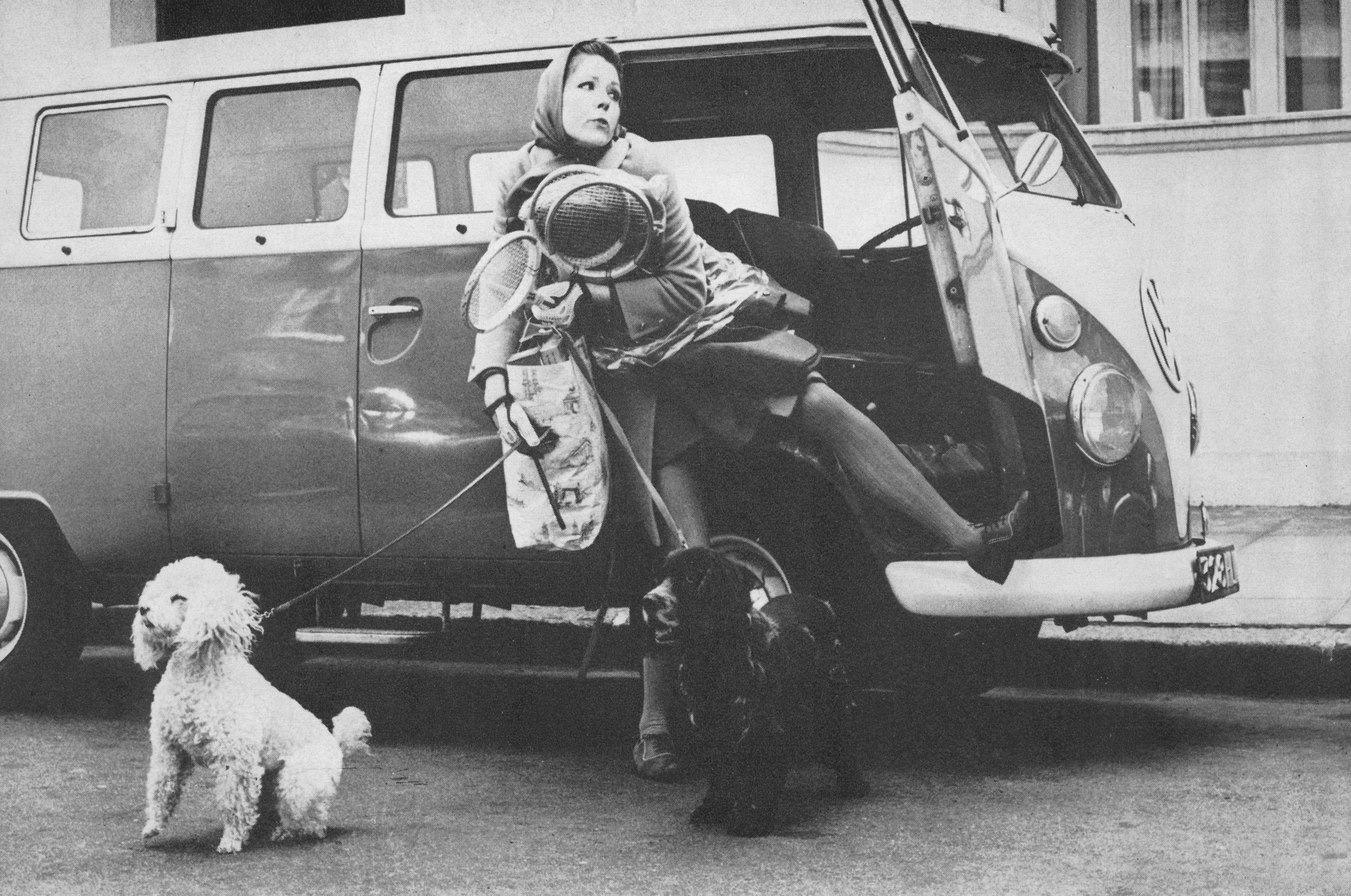
The Perfect Mother Awash with sentimentality, she is all concern and sacrifice for her children. She is a good sport. She is athletic with her sons, and like a big sister to her daughters. She has become one of the children — with corresponding loss of adult objectivity. There is no nonsense in her clothes.They are classic and tailored, with no frills. Having abdicated, she has given up competing with attractive women and denigrates their frivolousness. Her desires and ambitions are fastened onto her offspring — whether suitable or not. She enjoys every vicarious mo-ment of their successes. She is very busy — ali those duties to fulfil and amusements to organize for the family. Her husband has found that his business keeps him away from home a lot. He does not much enjoy going to bed with his ‘Girl Guide’ wife. She blames him vituperatively for his defection. She is jealous and possessive. He is trapped by her tricky appeals to his loyalty. What he and the children need is a woman around the house.
The No-Good Guy: He is attractive and sexy. Women by the dozen have found him so. That makes him irresistible. He is cool, a little sinister and . . . dan-gerous. A sharp dresser on the far-out side. He probably has an eye-catching car. He gets his kicks from furore and anything that adds to it is welcome. He has a fine understanding of his own problems, and says that he is ‘walled-up inside himself’. He tells you: `It’s a challenge to you to break through.’ He is misunderstood and lonely. He has had a tough time (he means to keep it that way). He says he wants to find the right woman. He warns you that no woman alive can love him. You mean to try and he means you to try. As soon as you are hooked, he tortures you. He is unreliable. He double-deals. He exploits your feelings. In any situation possible, he grabs the centre of the stage. He creates a lot of drama over everything. You wonder if there is anyone behind that wall. And what’s more you finally have the audacity to complain. He then points out to you how true it is that no one can love him. He’s sad. He’s sadistic.
The Intellectual Stands on a pedestal. He is admired for his ‘dedication and self-sacrifice’ to the good of mankind. Vague about details and delightfully unaware of his appearance — although seeming to follow a curious fashion of his own which he refers to as ‘comfort-able’ — the intellectual usually wears stained pullovers, corduroys and jackets with worn elbows. His eyes have that middle-distance look, of mere practical matters having yielded to things of the spirit. He is, of course, unaware of problems near to home. In his zeal and tireless work to improve the human condition, the intellectual is inspiring, provided no one comes close enough to him to expect an im-provement in himself. For all his intelligence, he is disarmingly vulnerable. Women long to devote themselves to him — look after him and see that he eats his meals. . . Fuzzy thinking flatters them that they too are pur-suing lofty ideals. They yearn to serve faithfully at the altar of truth, and are satisfied just to admire his high-minded goings on. But the intellectual is blind about females. His occasional dash for a curvy, but empty-headed blonde is humiliating to the would-be intellectual soul mate, especially when she sees him being led around by the nose. Basically he belongs in his ivory tower … without women.
The Charming Boy: He is neat, well-mannered and lovable, playing the perennial juvenile lead. He oozes good fellowship. He picks up the bill. He ex-pands in his own popularity. He is modest about himself, but never lets an opportunity pass to further his career, social or professional. He is impeccable in his appearance — on the conservative side. He sends flowers and thank-you notes. He is sweet. He ap-preciates you more than anyone ever has. You believe in him. Before you know it, you are working for him. He is Chairman of the Board to promote himself. You are pressed into service. He looks after himself like a baby. Why shouldn’t you? Behind that coy, guileless exterior is ruthless ambition. You are an accessory in his search for power. Things run smoothly as long as you donate your all. If you have needs — forget them. The perfection of his image, and his rise to eminence, cannot be interrupted. This boy is, in short, a fraud.
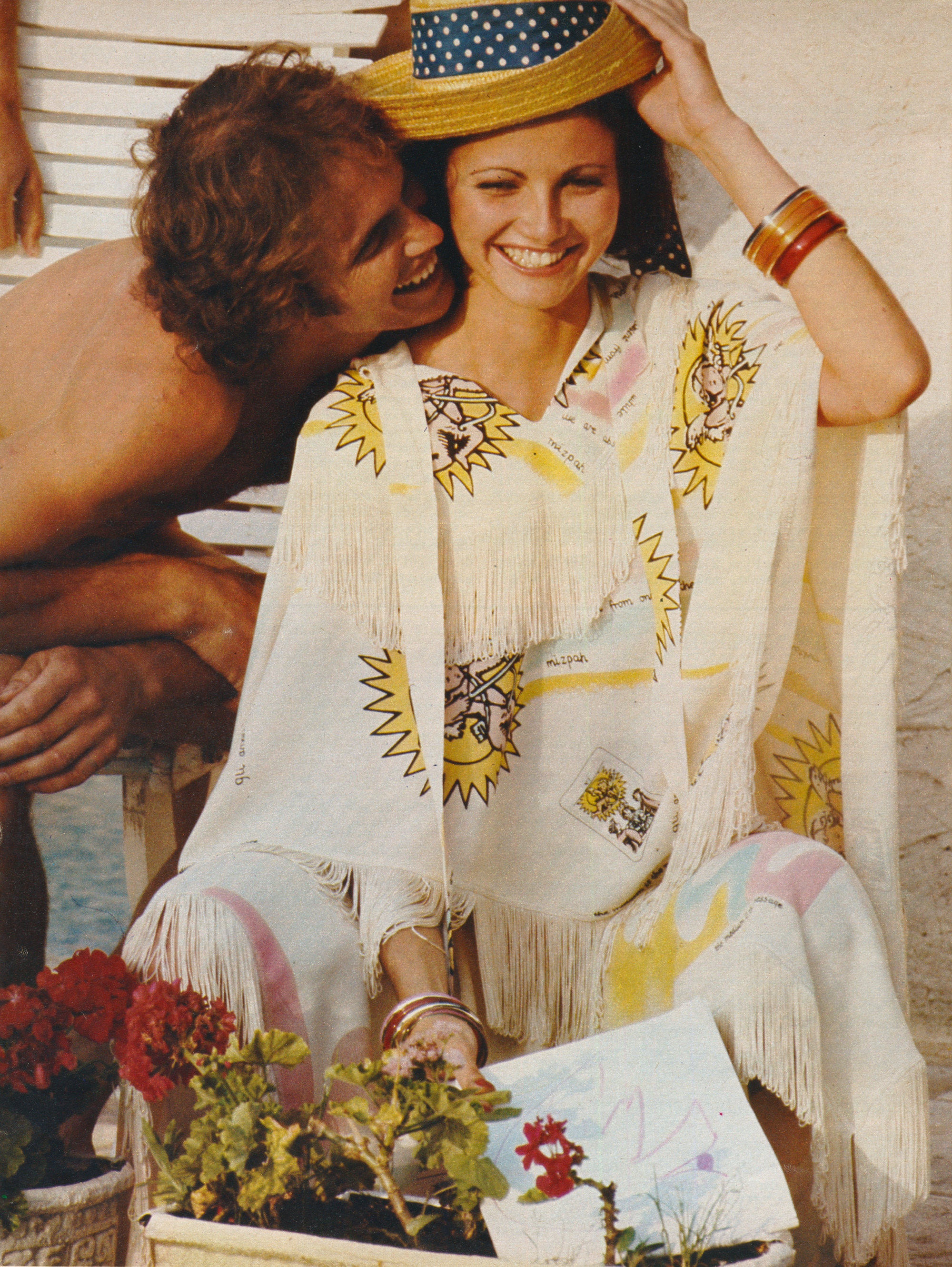
Despite the distractions, Chichi hangs on to her hat and her colouring book, wears a lucky tarot card print poncho top, £25, and mid-calf skirt, £20, by Alice Pollock at Quorum. Bangles chosen from a selection at Adrien Mann.
In clothes we dare you to wear!
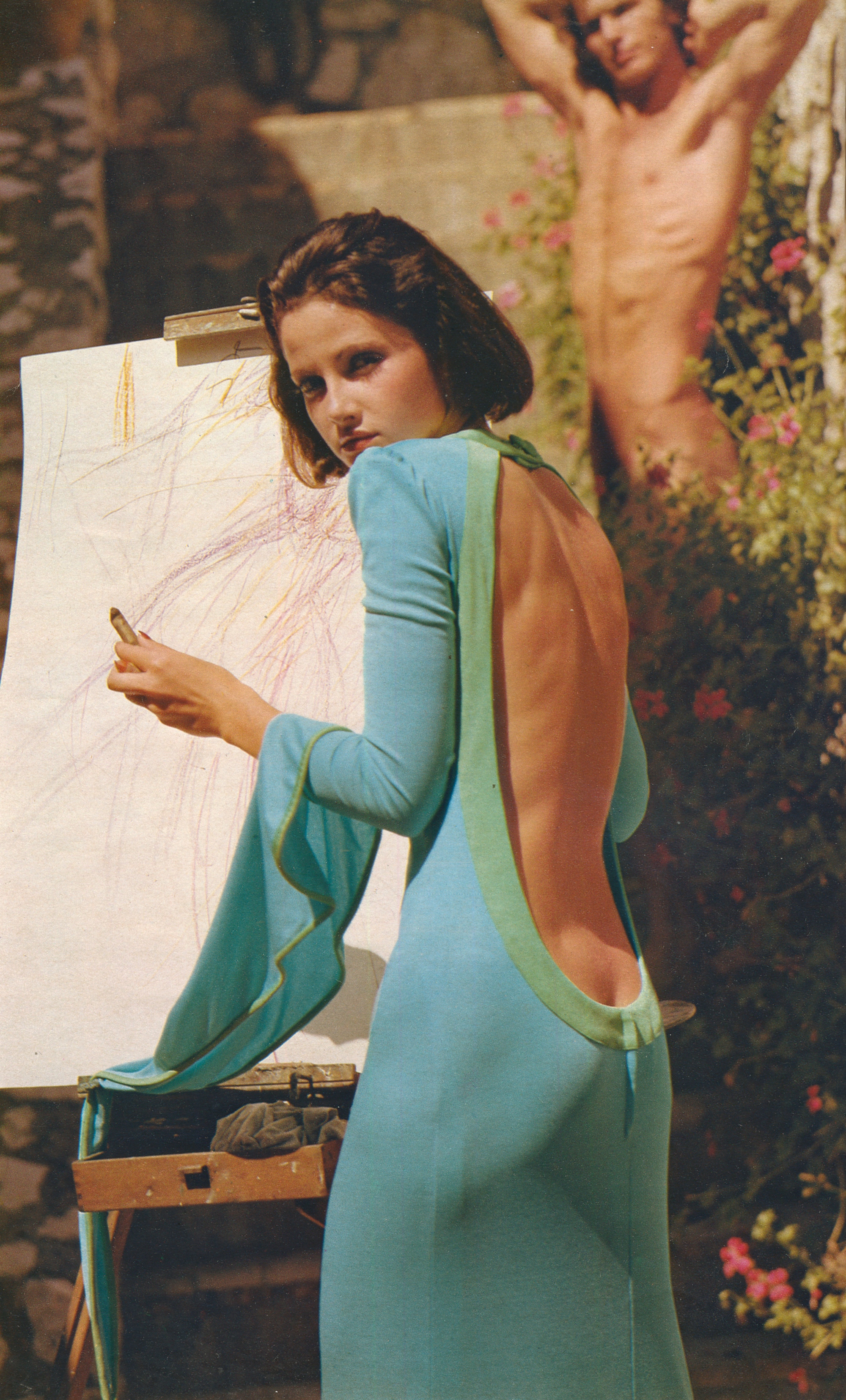
Make a name for yourself in 1974. Be an inspiration, a focal point, an innovator. Paint a positive future and make January a beautiful time. Experiment with colours. Branch out and try some totally different styles. Don’t go along with the rest of the girls—start up your own school, you’ll soon have plenty of followers. Begin by studying your best points, then set about accentuating them. If your skin gleams, show it off; if your waist is small, cinch it; if your legs are great, make certain that they are seen. The clothes here are not cheap, but like every good artist it’s vital to invest in good materials for long-lasting results. They will be appreciated for a long time to come ...
Styling by Penny Graham.
Photographs by Bill King.
Scanned from Cosmopolitan, January 1974.
I do love some equal opportunities Mild Sauce. These clothes are amongst some of my most coveted pieces, especially that outrageously plunging back John Bates dress. If you thought that McQueen invented the ‘bumsters’, remember that someone else has always got there first!
Make a strong statement. Frame your back with this year’s most dramatic scoop. Chichi in a clinging dress with pointed mediaeval sleeves—by John Bates for Jean Varon, £62.95.
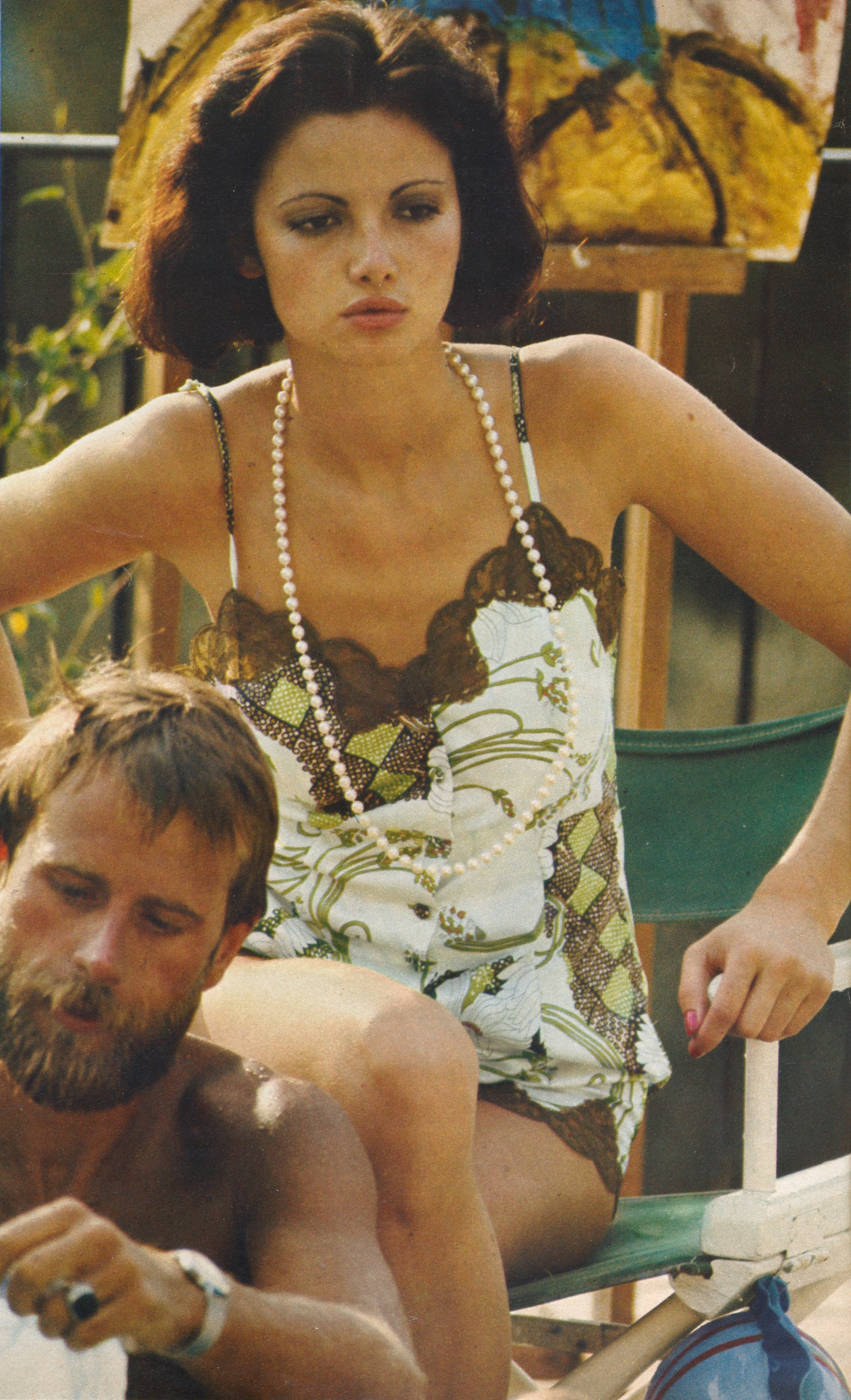
Between sittings is no time to collapse. Chichi slips into something small and adds a rope of pearls for that Ritz- y finish. Camiknickers by Janet Reger, £15; pearls from Ciro.
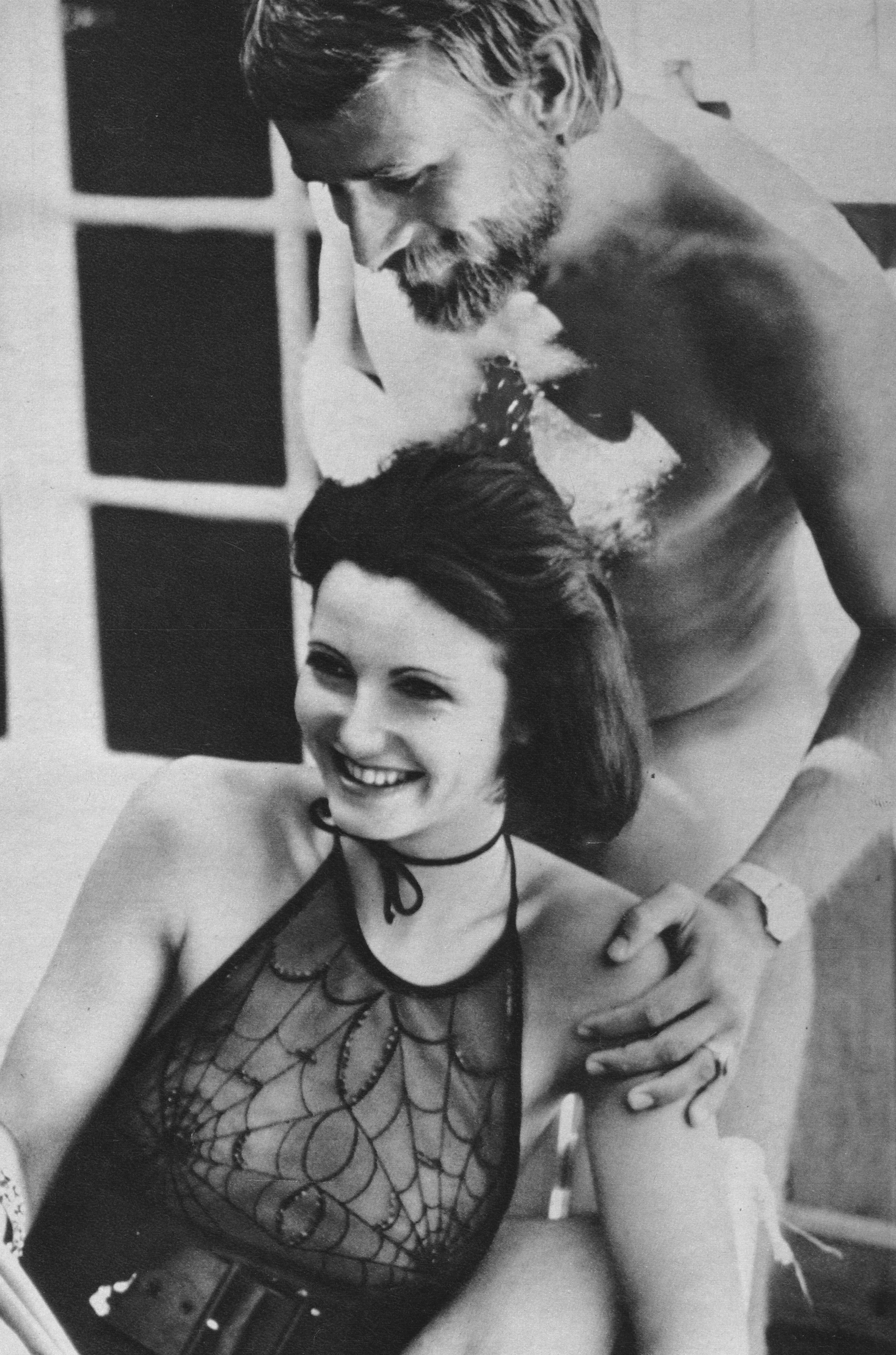
Chichi makes the perfect portrait in a spider’s web dress dangerous enough to trap any hot-blooded male. Dress by John Bates for Jean Varon, £39.
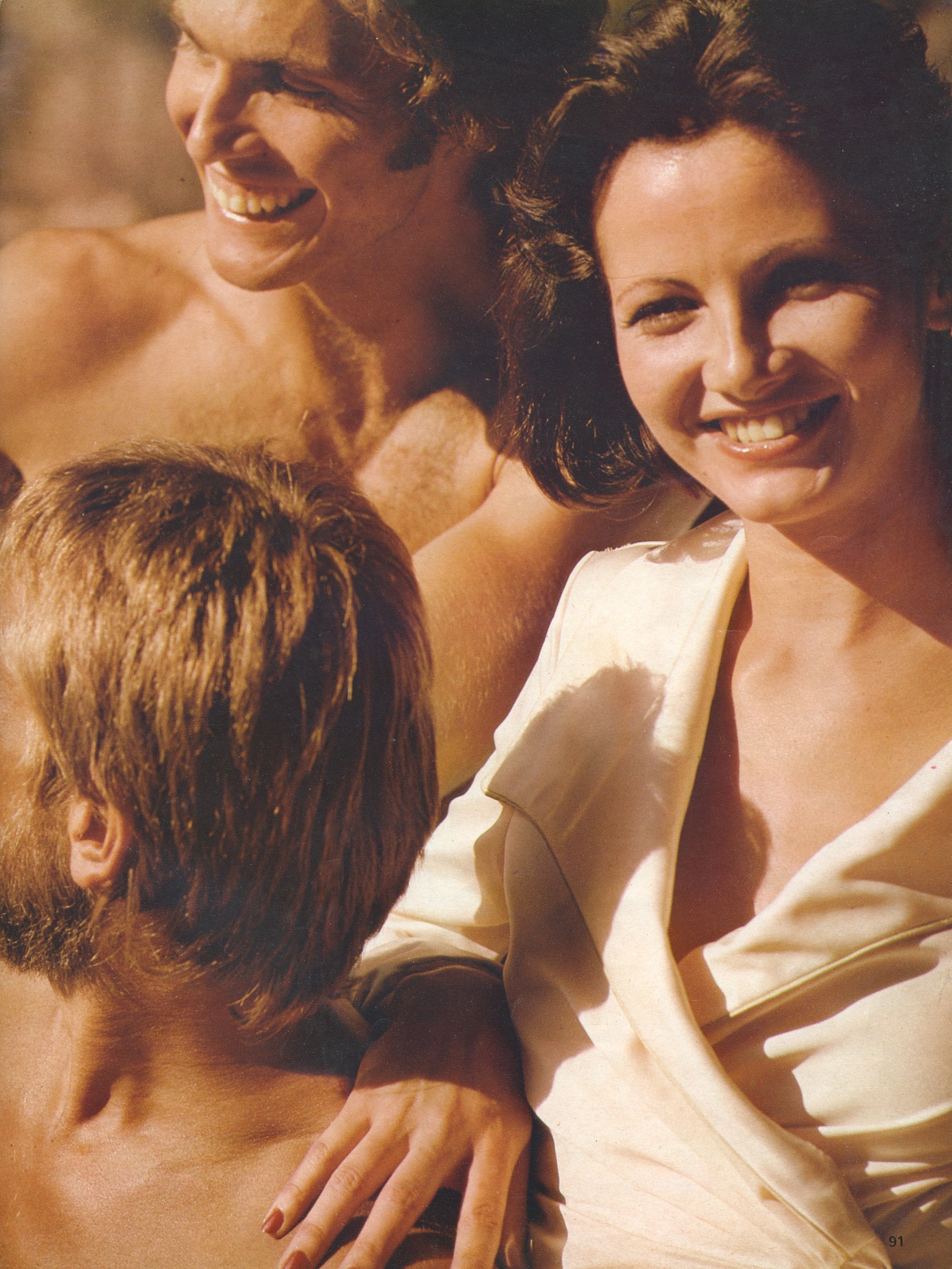
A switch of scenery, a new source of inspiration. Chichi wrapped romantically in a glamorous film star dressing gown by Janet Reger, £48.
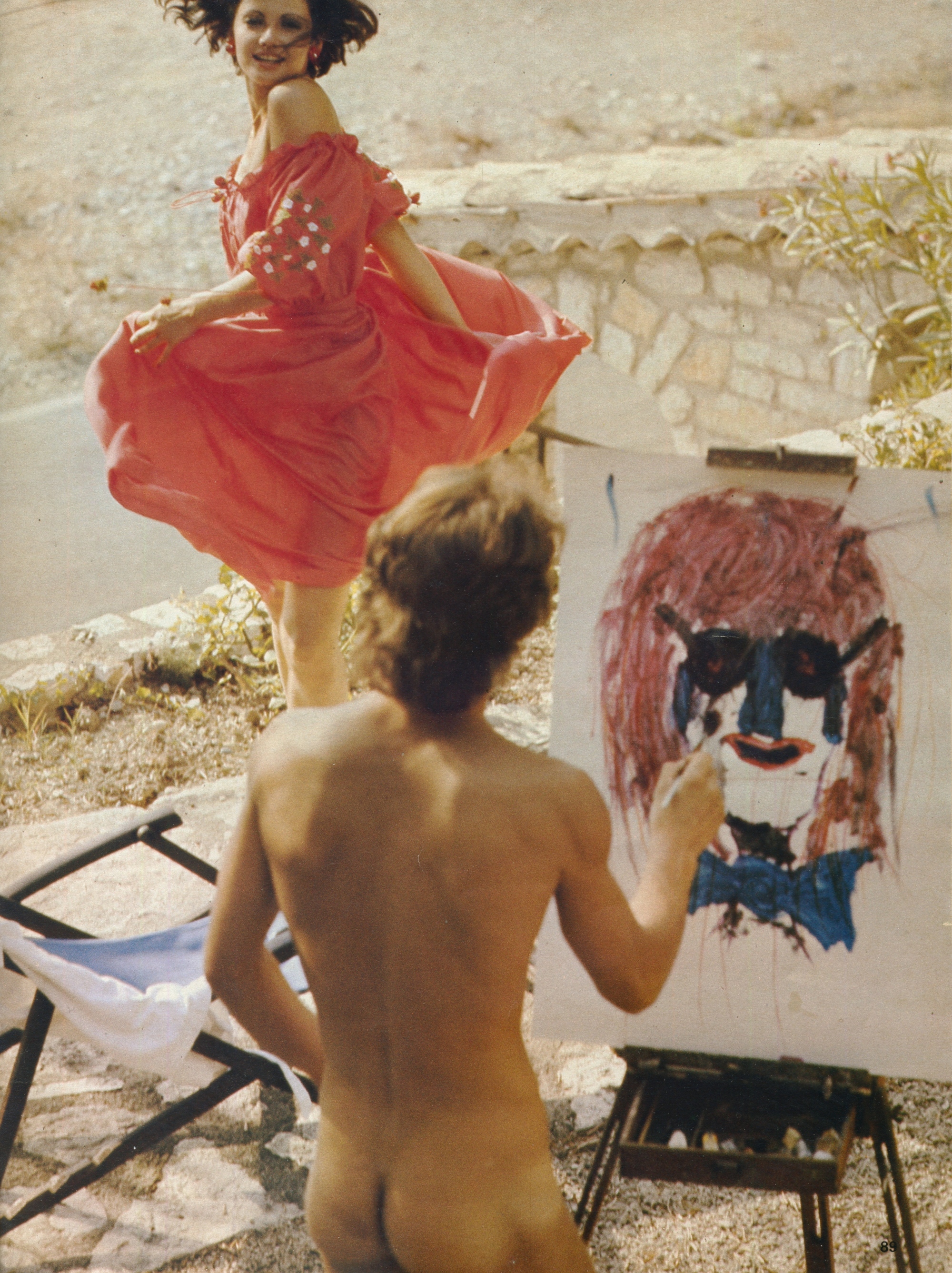
The painted lady. Chichi switches roles and dances a wild tarantella. The sleeves are pulled off the shoulders for an abandoned gipsy look. Silk dress by Angela Salmon for The Prop Shop, £85.
Pink and wild coat is hooded and all set to trap the unwary male. Borg coat by Henry Lehr, £17.50, trousers by Sujon, £9.50. His coat by C & A in suedette, £13.95. Hat by Locke, £5.25.
. . . or how to wear furs this winter without hurting your pet’s feelings.
There is nothing, absolute nothing quite like wrapping yourself in fur. As a sensuous experience, it is in the same class as a new love, old champagne or fresh truffles. But even the most hedonistic of women are relieved that the threatened species are no longer imported. Snow leopards, tigers and other cats can go their own way and sensibly sybaritic female will look for furs that are farmed, such as fox and mink. This winter, too, the fakes are so wayout and wildly coloured that only a girl without a heart could resist their charms, albeit synthetic. Perhaps that’s why the fur trade have taken the hint and dipped their favourite fox pelts in the dye pot, Furrier Maxwell Croft offers his explanation of the female urge to wear and the male urge to bestow furs: “For many men it is a primitive desire to see his woman in furs.”. Very nice,too.
Plenty to scoff at the end of the copy there, but oh goodness the clothes – the clothes! And the glorious photography of Alice Springs, whose work doesn’t turn up nearly enough for my liking.
Fashion by Deirdre McSharry.
Photographed by Alice Springs.
Scanned from Cosmopolitan, November 1972.
Kissin’ cousin to a polar bear, but lots slimmer, is this smashing white shaggy coat. Wear it with white flannel bags, an angora sweater and an even shaggier hat. Well-cut coat in Borg with stitched suede edges. By Marie France for Quorum, £36, Ossie Clark trousers £14, sweater £4. Hat by Diane Logan, £5, shoes from Sacha £7.99. Beads by Butler and Wilson. Mike’s coat from Just Men, £70. Trousers from Aquascutum, £14.50.
The shaggiest coat story of the season-outrageous powder pink number, worn over pink striped sweater and pleated skirt. The dog is also fake, Chi Chi’s own and christened Fifi by Mike. Borg coat by Biba, £15, sweater by Reldan £3.33, skirt by Crowthers £5.75. Beads by Loewe.
Chi Chi turns her back on the world in scooped dress by John Bates for Jean Varon, £22. White shaggy jacket in Lister’s synthetic, £13.75 by Weathergay. Photographed at Julie’s Restaurant, 135 Portland Rd, London W11 (01-22) 8331).
How to have that movie-star feeling. If you want the big star treatment – breakfast at Tiffany’s, diamonds as big as the Ritz – dress like a star in electric blue fox. Dress by Elle, £15. Fox coat by Dinni for Femina Furs, £295. Moonstone necklace at Butler and Wilson. His outfit by Aquascutum. Velvet jacket £38.50, shirt £10.50, cuff links from £3 50, trousers £12.50
Tea for two. Mike makes up to Chi Chi (that’s the model girl, not the coat) in her shaggy yellow number, worn with shiny striped shirt and mustard bags. Borg coat by Marie France for Quorum £23.50, shirt by Medusa £5.50, trousers by Sujon £9.50. Beads by Butler and Wilson. Photographed at The Royal Garden Hotel, London.
Enough to drive a man wild-a nutty fake fur, above right, with Fifties shoulders and swing back. Wear it nicely over mustard crêpe de chine shirt and peg-top trousers. Both by Sujon, shirt £13, trousers £9.50. Borg coat by Biba £25, beret, Diane Logan, £4.50, shoes, Sacha, £7.99. His coat, Aquascutum, £70, trousers C & A £3 95.
Enough to make Morgan the gorilla, jealous. (Remember A Suitable Case For Treatment?) Emerald green gorilla jacket in real-life Borg by Weathergay, £9.50 (right). Worn over slinky knit sweater and skirt from Ritva, £27 for the outfit. Blue shaggy beret by Diane Logan, £4.50. Mike’s sweater in blue and silver by Ritva, £18.50. Trousers from C & A £5.50.
Jealous cats show their ruffled furs. Chi Chi and Belinda act out the classic movie-star confrontation in their sequins and furs, Chi Chi in pleated taffeta with sequin bodice by Anne Tyrell for John Marks, £23.95; her boa is silver fox, ranch bred, price £70. Belinda’s fox is red, also from the ranch, price £45, both by Barbara Warner for Fab Furs. Strapless top and trousers by Miss Mouse, £20. Beads by Loewe.
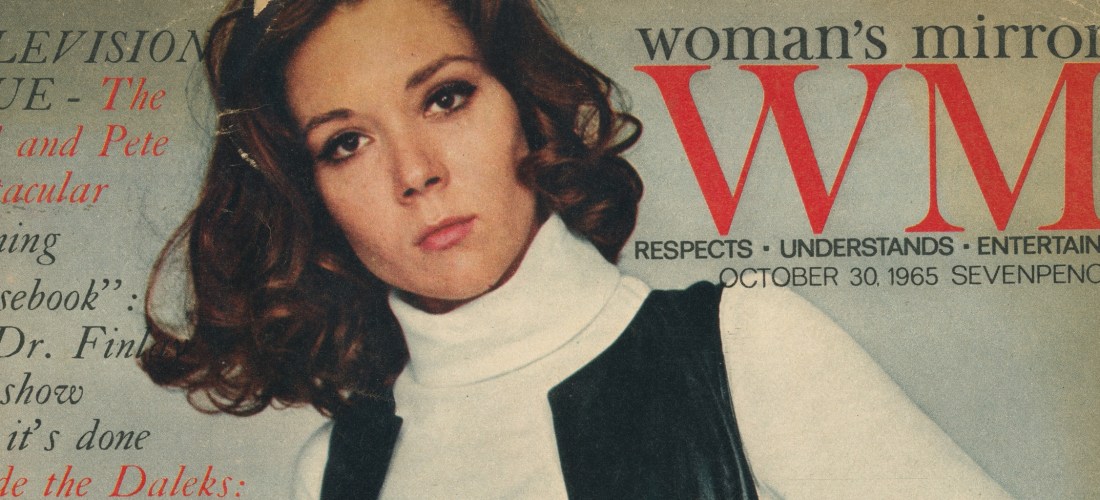
Scanned from Woman’s Mirror October 30th 1965. Photographed by Norman Eales.
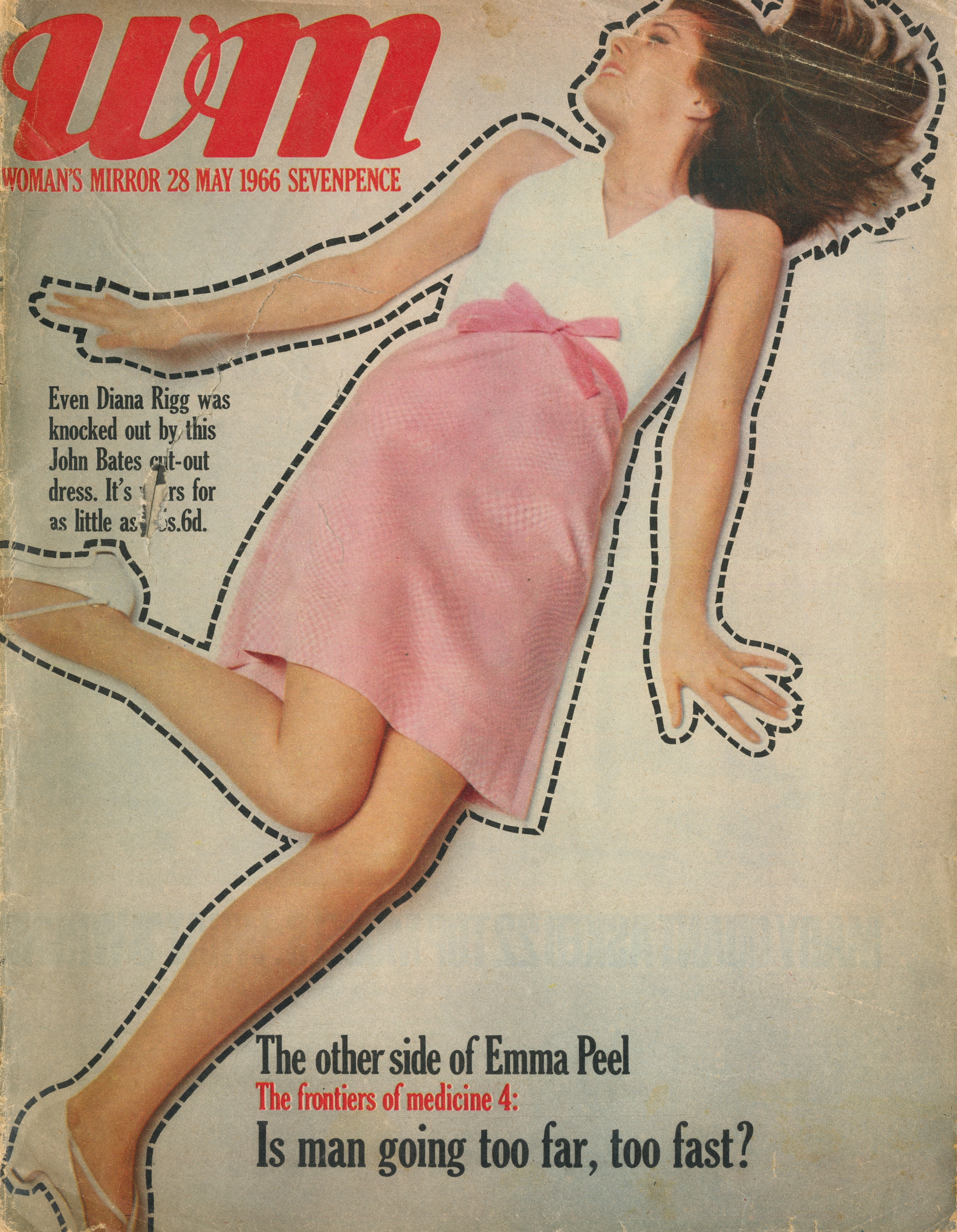
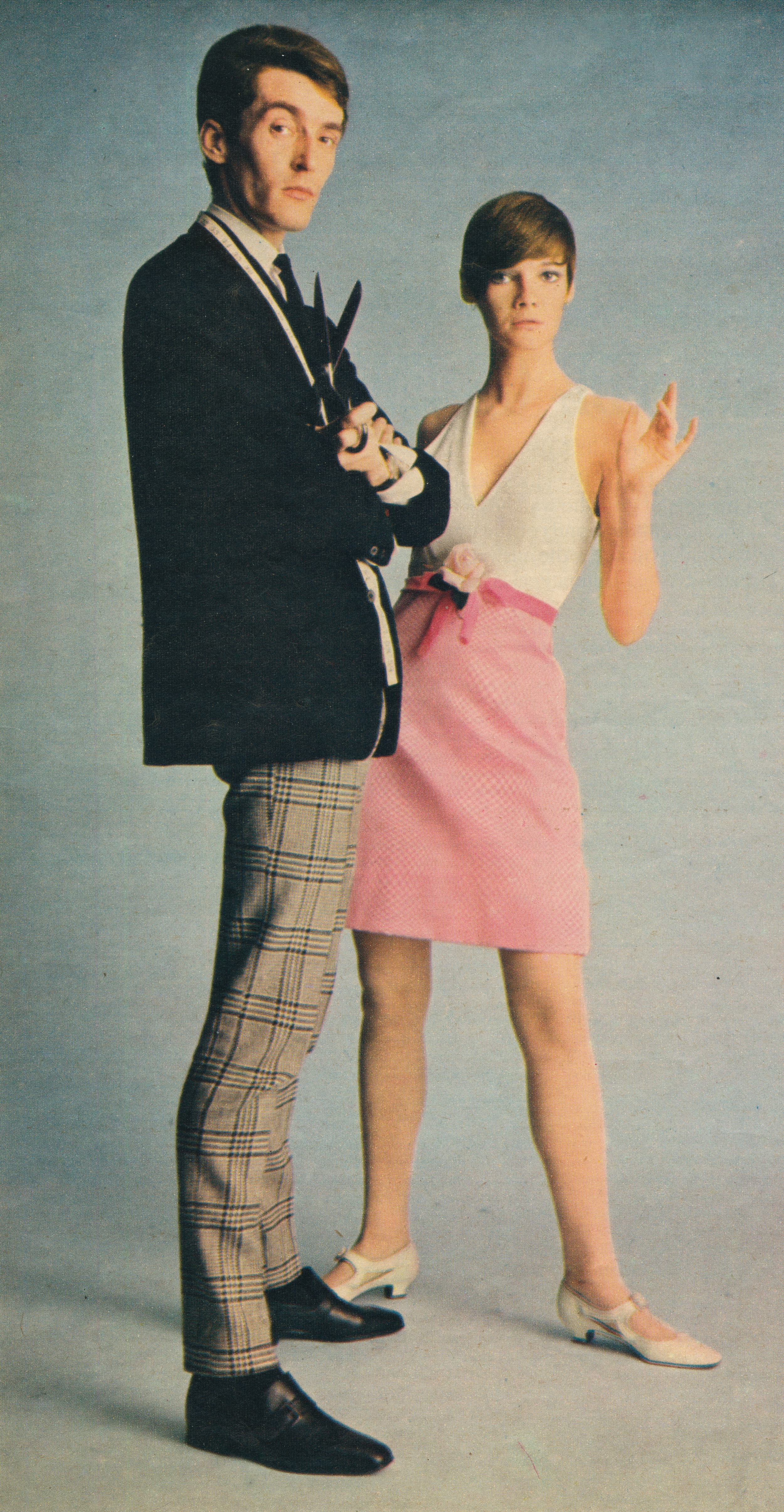
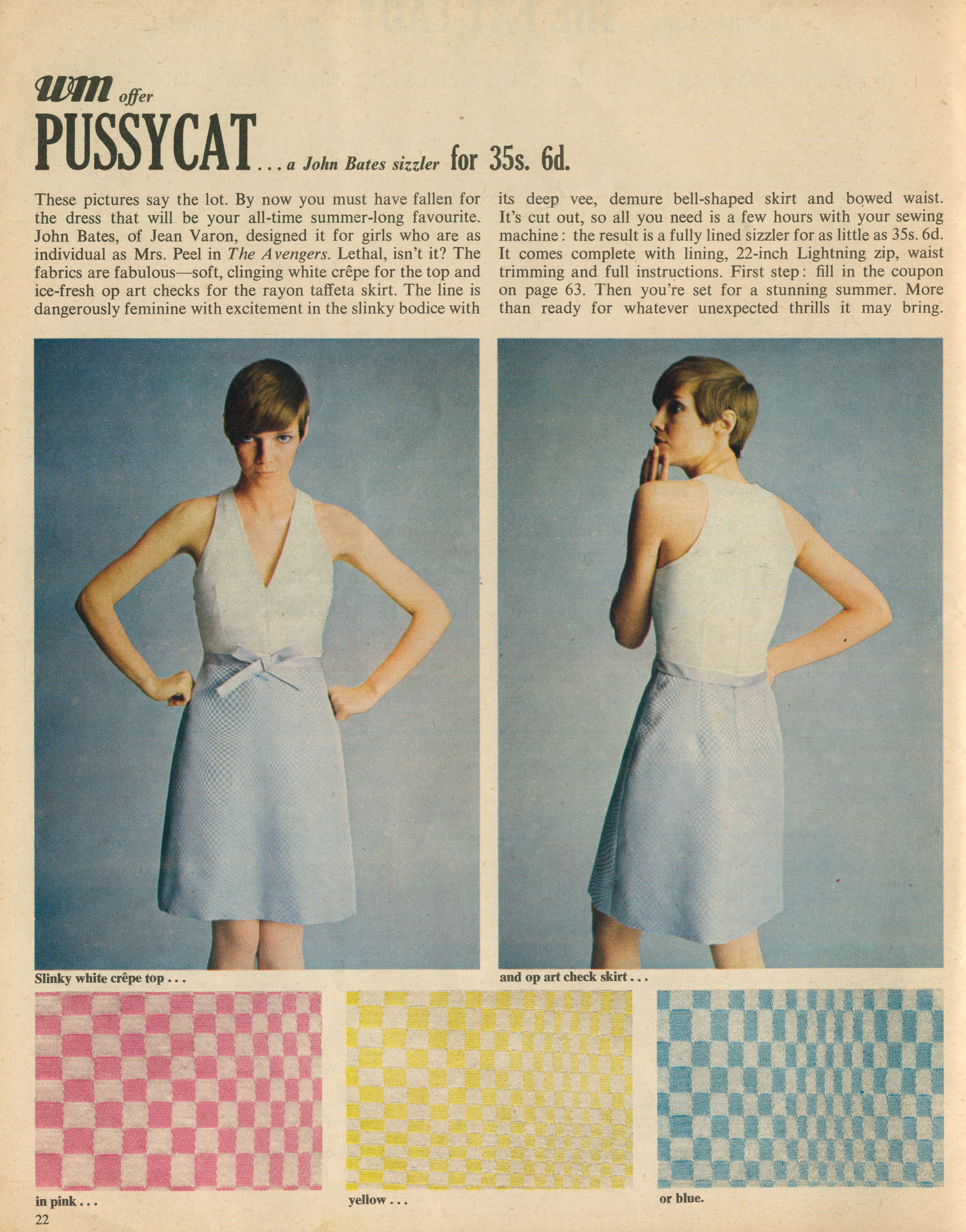
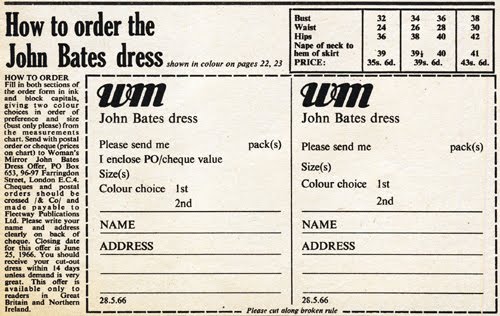
If you follow me on Instagram, you will already have read my tribute to the amazing John Bates, who died on the 5th of June aged 83. Here I have collated a few images of his work designing costumes for Diana Rigg as Emma Peel in her first season in The Avengers, and an accompanying article from Woman’s Mirror, October 1965. I have also updated an earlier post with clearer scans from Woman’s Mirror, May 1966 of a dress which wasn’t officially Avengerswear but being offered as a pattern for readers with a cover photo of Diana in the dress.
“WHEN people say, ‘Oh, she’s the new Avengers girl’ I know that’s not all I am,” says 27-year-old Diana Rigg. “I had a career in the theatre before this and I know I can always go back to it. I hate talking about The Avengers and what I’m like in it and how I differ from Honor Blackman. I would much rather people drew their own conclusions.
“I dread the prospect of all the attachments to being famous. I work here at the studios from seven in the morning until six at night and I feel that should be enough. The thought of being a public personality, opening shops, and not being able to answer the door in my curlers, horrifies me.”
But being the Avengers girl has its advantages. Not the least of them being the prospect of wearing a sizz-ling new wardrobe, designed specially for the series by John Bates of Jean Varon.
“John’s been absolutely smashing,” says Diana. “Like most actresses, I spend a lot of time studying myself for the stage, and so off-stage I tend to the casual. I really have no set ideas about clothes. First of all, John studied my figure, discovered myfaults, used them, and made a virtue out of them.
“He’s emphasised my broad shoulders with cutaway necklines. He’s drawn attention to my big hips with hipsters and huge broad belts. I think that this is a far more realistic attitude than designing for some impossible ideal model figure.
“There’s a kind of swinginess about John’s clothes which really makes me move in a special kind of way. And they’re all interchangeable. In different episodes there will be different permutations of the same clothes and ideally, of course, this is just how a woman’s wardrobe should be.
In deference to the American market, which still thinks that leather is the sexiest thing out, Diana has one leather fighting suit. “Of course, leather isn’t sexy at all,” she says, “It’s far too rigid. My other fighting suit is in black, clingy jersey which is far sexier.”
Clingy jersey fighting suits are all very well, but they have to stand up to pretty stiff competition in the shape of some snazzy interchangeables.
In this week’s instalment set in a gloomy Scottish castle, Diana will wear ice-blue lace ensemble with ankle boots, hipster trousers, bare midriff, bra top and modesty jacket. For exploring dungeon and torture chambers, flesh lace catsuit under white chiffon negligee.
There’s no doubt about it. If the clothes are anything to go by, this ABC series of The Avengers is certainly living up to the boast of its associate producer . . “It’s still a kinky show.”
Scanned from John Bates: Fashion Designer by Richard Lester.
Scanned from Television Stars Annual.
Scanned from Woman’s Mirror, 28th May 1966. Photographed by Rolf van Brandtzage.
Scanned from John Bates: Fashion Designer by Richard Lester. Photogrphed by David Gittings.
Scanned from Fashion in the 60s by Barbara Bernard.
Scanned from John Bates: Fashion Designer by Richard Lester. Photogrphed by David Gittings.
Scanned from Fashion in the 60s by Barbara Bernard.
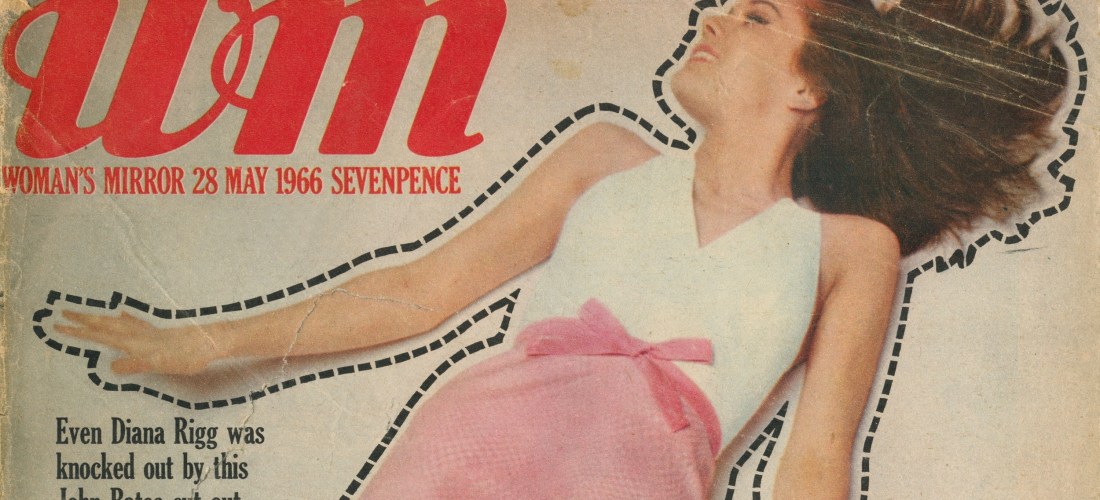
Even Diana Rigg was knocked out by this John Bates cut-out dress.
(This post was originally from 2011. I have updated it with better quality scans.)
John Bates loves short skirts, money, false eyelashes and Cilla Black. Hates English bras, big busts and any sort of foundation garment.
“Women are funny,” he says. “They heave their breasts up and out with tight padded bras and by the time they’ve finished squeezing everything in or pushing it out, they can look quite terrifying when they take their clothes off. Bras should just lightly cup the breast and tights are better than any girdle. Even the lightest suspender belt marks the skin. It’s muscles that matter – women ought to learn to use them properly.”
John, who is 29, created fashion dynamite with his sizzling clothes for Diana Rigg in The Avengers. He believes that skirts are going to get even shorter and that everyone under 40 should be pinning up hems. He says clothes look best on slim girls, but furnishes his flat with curvaceous statues and pictures of rotund Rubenesque beauties. He makes a lot of his own clothes, thinks that hipsters suit both sexes and most sizes, and always wears them himself. He’s now designing shoes, stockings and planning his new collection as well as designing clothes for men.
“And I always design something special for my mother at Christmas. Last year she set her heart on an Avenger op art fur coat. She’s well over 60 and I said, ‘Honestly love, it won’t suit you,’ but she said, ‘What’s good enough for Diana Rigg is good enough for me.’
“Usually I don’t listen to anybody. I’ve had my years of being told what to do. Now I don’t accept advice from anybody.”
Born in Newcastle, the son of a miner, John started at the bottom. “I’m no art school protégé. I picked up pins, embroidered, did the cleaning and had every rotten job that was going flung at me. I came to London because it’s the only place to work in the rag trade. I got on the train with a Newcastle accent and when I got off at London I’d lost it. I spoke very slowly for a long time, but it’s really the only way to do it.”
John Bates and model photogrphed by John Carter.
Diana Rigg cover photographed by Don Silverstein.
Scanned from Woman’s Mirror, 28th May 1966.
And joy! The magazine’s owner never sent off for the dress (which is sad), but this means that the form is still in tact (which is rather fabulous). Now where’s that time-travelling postbox I keep requesting?
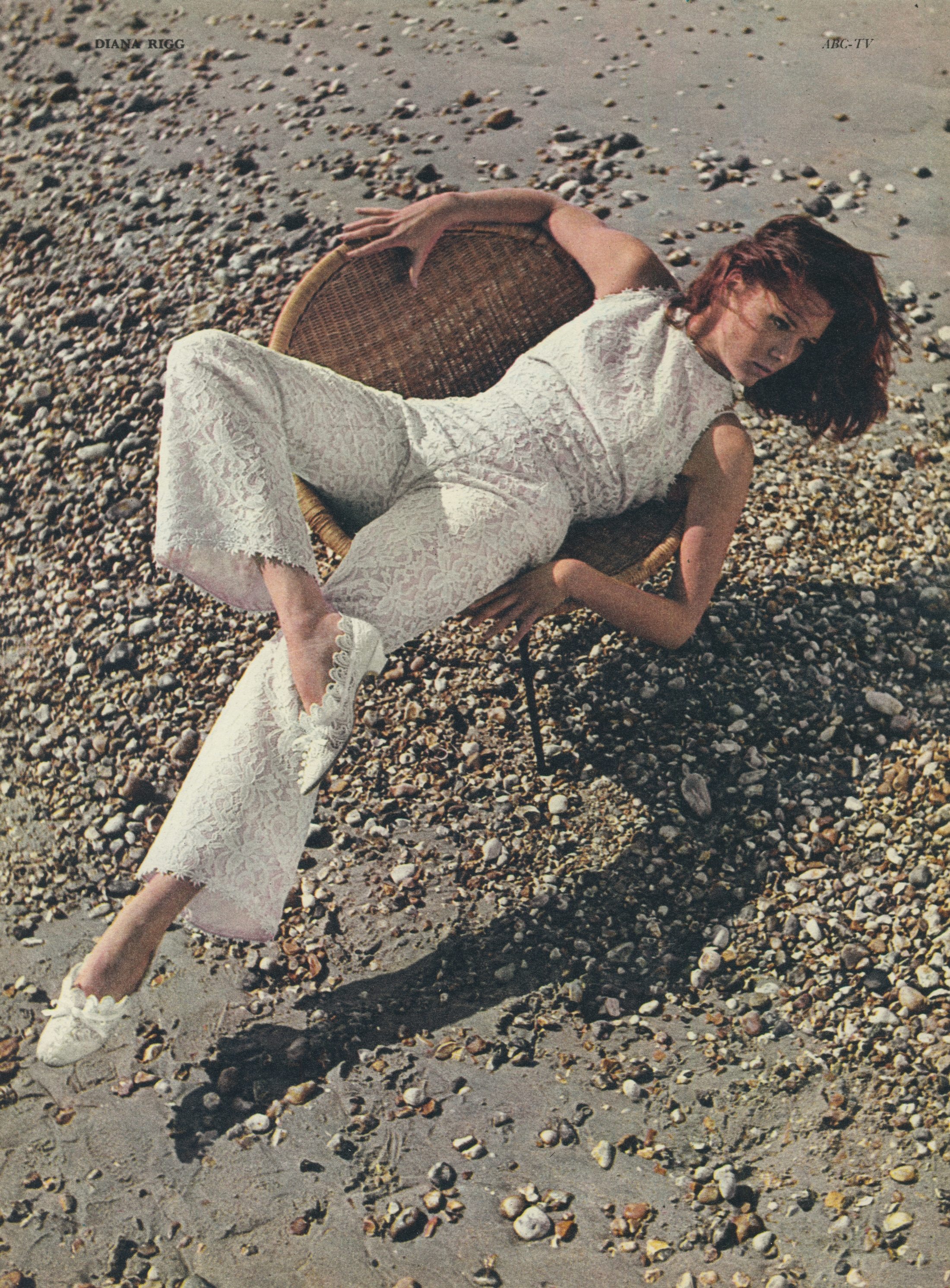
Silk chiffon with shadow lilies in white and iced green, washed over with a few pearly shells. Big full skirt over petticoat, a sash of Edwardian peach satin. Zandra Rhodes , £160, petticoat, £26, at Fortnum & Mason. Opal choker, £210, N. Bloom. Long opaline rope, £12, drop mother-of-pearl earrings, £15, from range, The Purple Shop. Opal/diamond ring, £550, at Andrew Grima. Snakeskin sandals, £29.50, Charles Jourdan. Scent, Vivre by Molyneux. Hair by Michael at Michaeljohn.
Model is Jane Goddard.
Photographed by David Bailey.
Scanned from Vogue, April 1st 1974.
Quatrefoil layers of silk chiffon in melon, apricot, candy pink, frilling over the arms. By Gina Fratini, £244 , at Selfridges ; Lucienne Phillips ; Diagonal, Guildford and Lucinda Byre, Liverpool. Carnelian and silver gilt ring, £30, silver and gunstone ring, £18.50, Bakelite drop earrings, £3, all from range at The Purple Shop.
Crossover bodice of black silk crepe framed in lipstick red a full Liberty print silk skirt and enormous gathered pockets edged in stripes. By Bill Gibb, about £140, at ZigZag ; Chic of Hampstead ; Vicki, Cobham ; Julie Fitzmaurice, Harrogate. Scarlet high heels, £28 to order, at The Chelsea Cobbler. Pale sheer tights, Charnos. Scent, Audace by Marcel Rochas.
Polyamide georgette rainbow gathered from small brassiere top, one strap going straight over shoulder, the other angled to centre. By John Bates at Jean Varon, £49.95, Fenwick ; Earkers ; Kendal Milne, Manchester ; Campus, Oxford. Green hoop earrings, £2, from range at The Purple Shop. Scent, Fidji by Laroche.
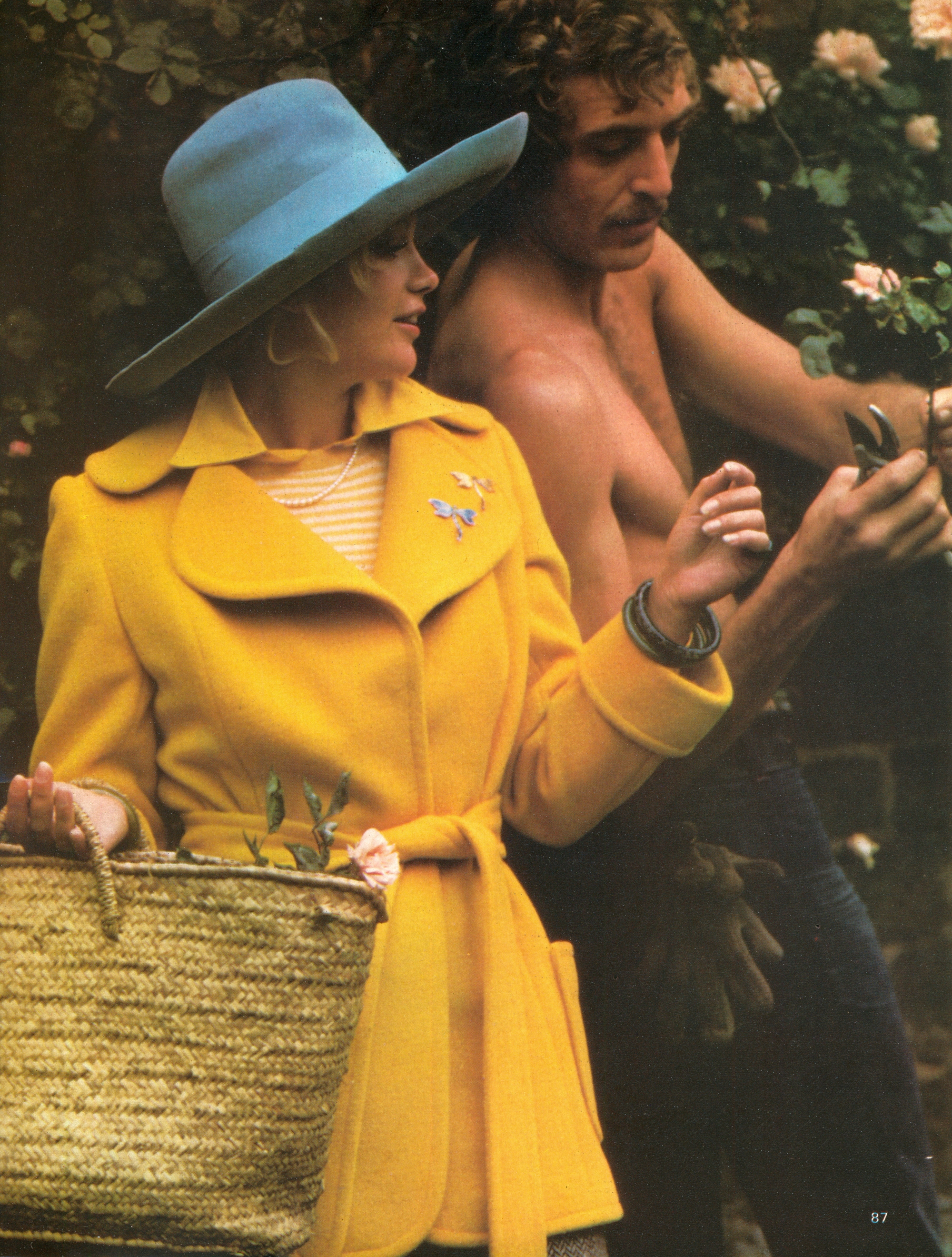
Just the jacket, for interviewing the gardener… if he’s as handsome as Ian Knipe. Trille does the Lady Bountiful bit in yellow and a romantic hat. Jacket C&A £9.95, felt hat by Herbert Johnson, pearls by Ciro. Yellow angora sweater by John Craig, £2.10.
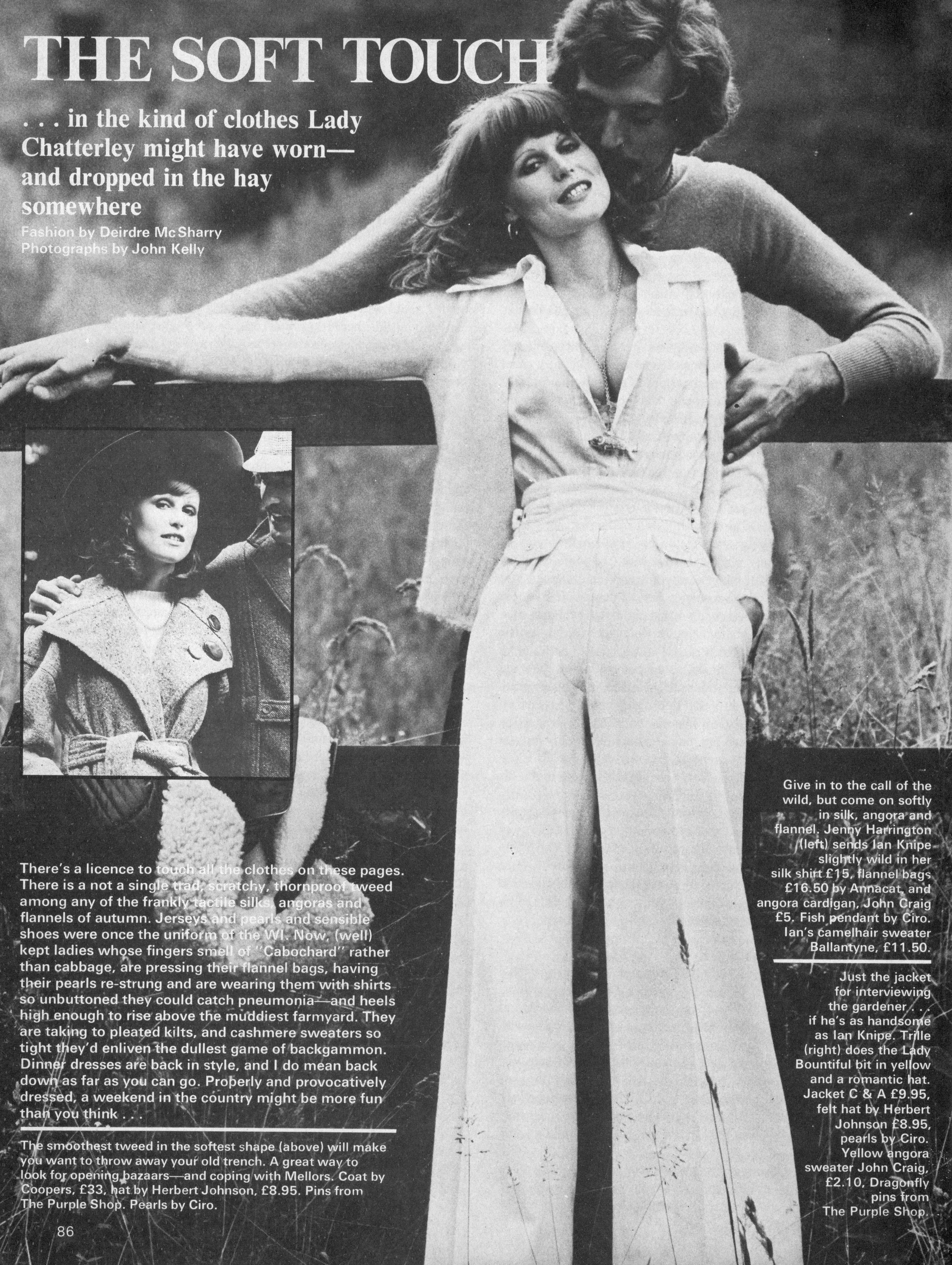
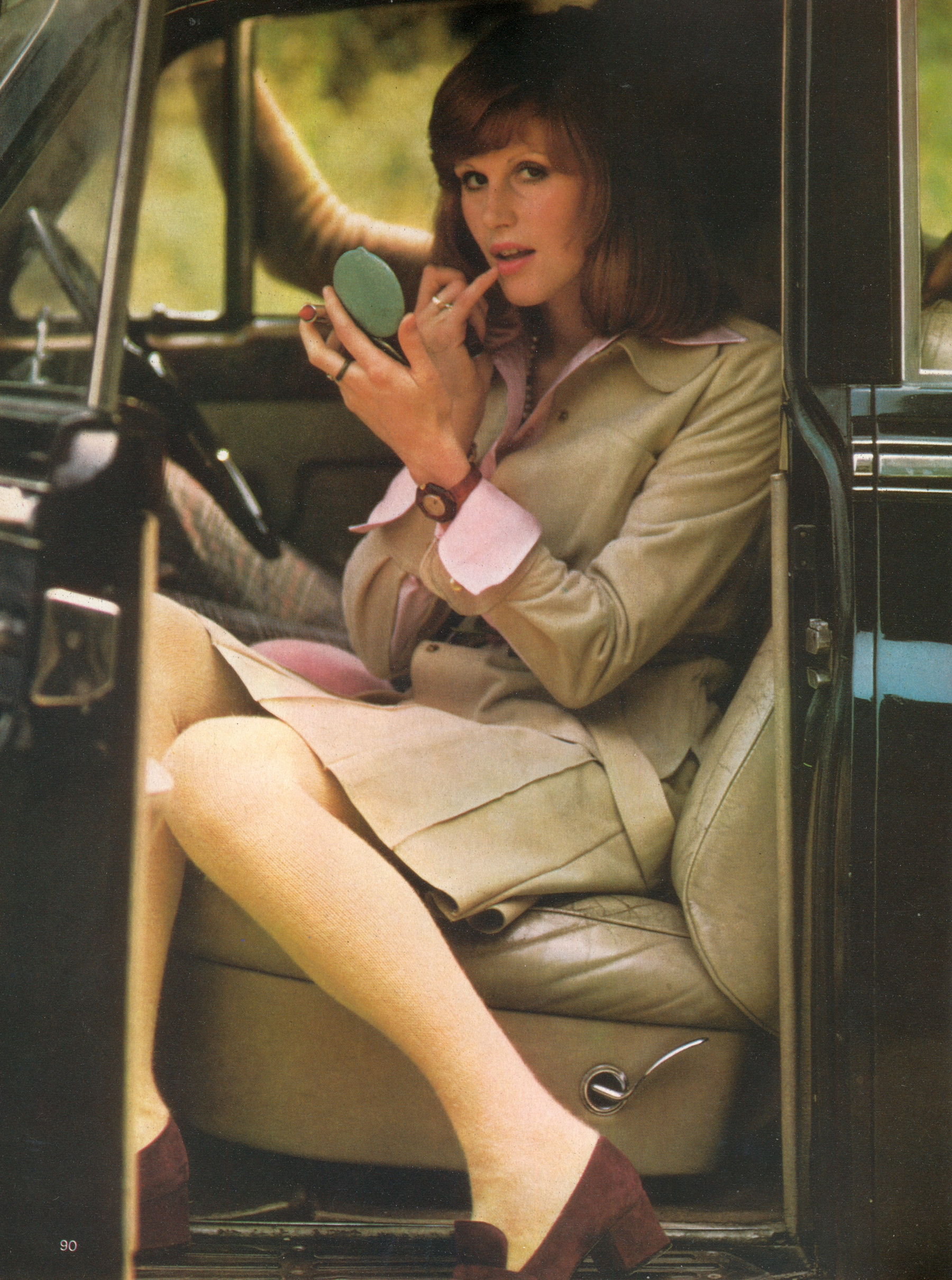
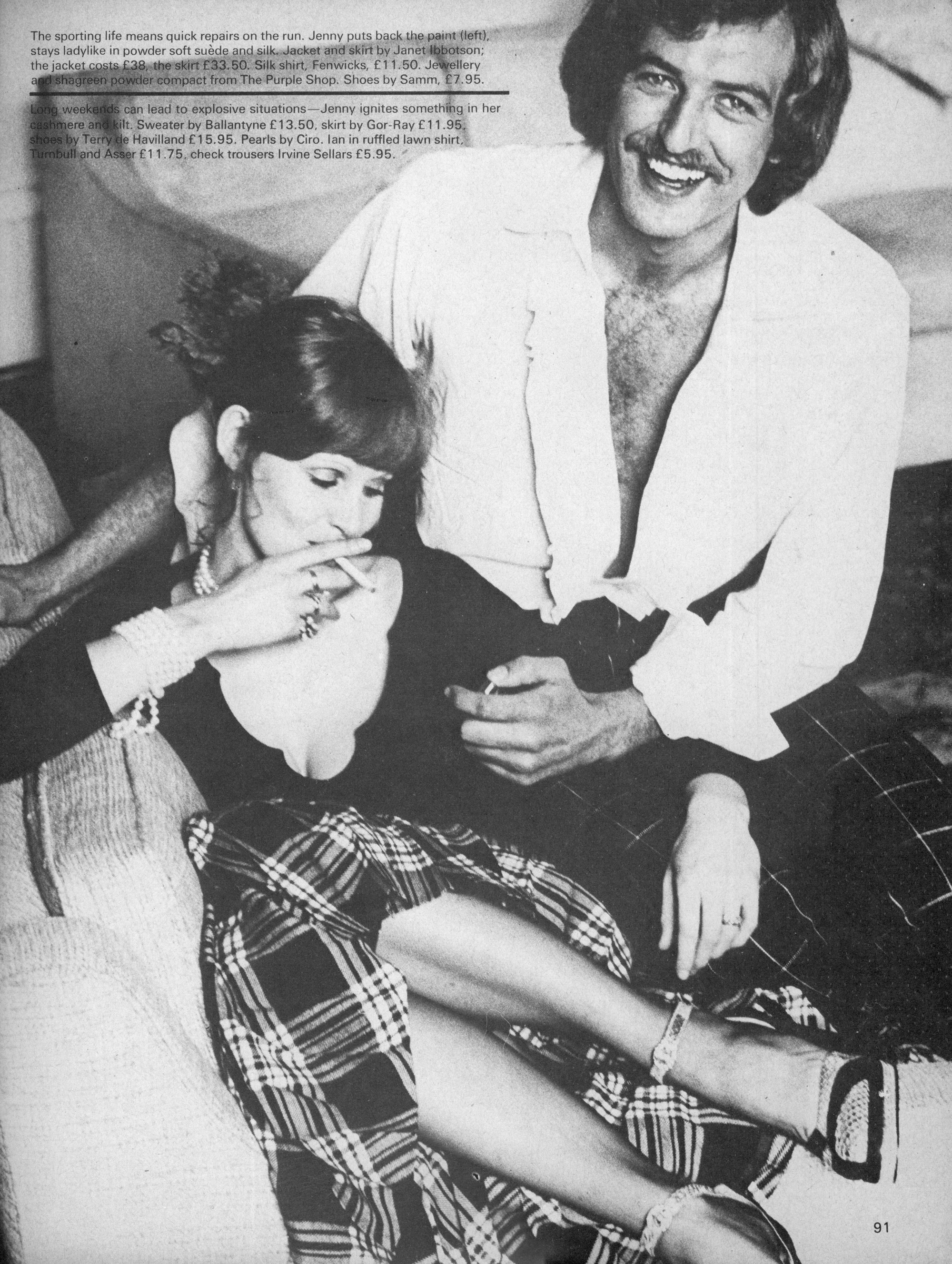
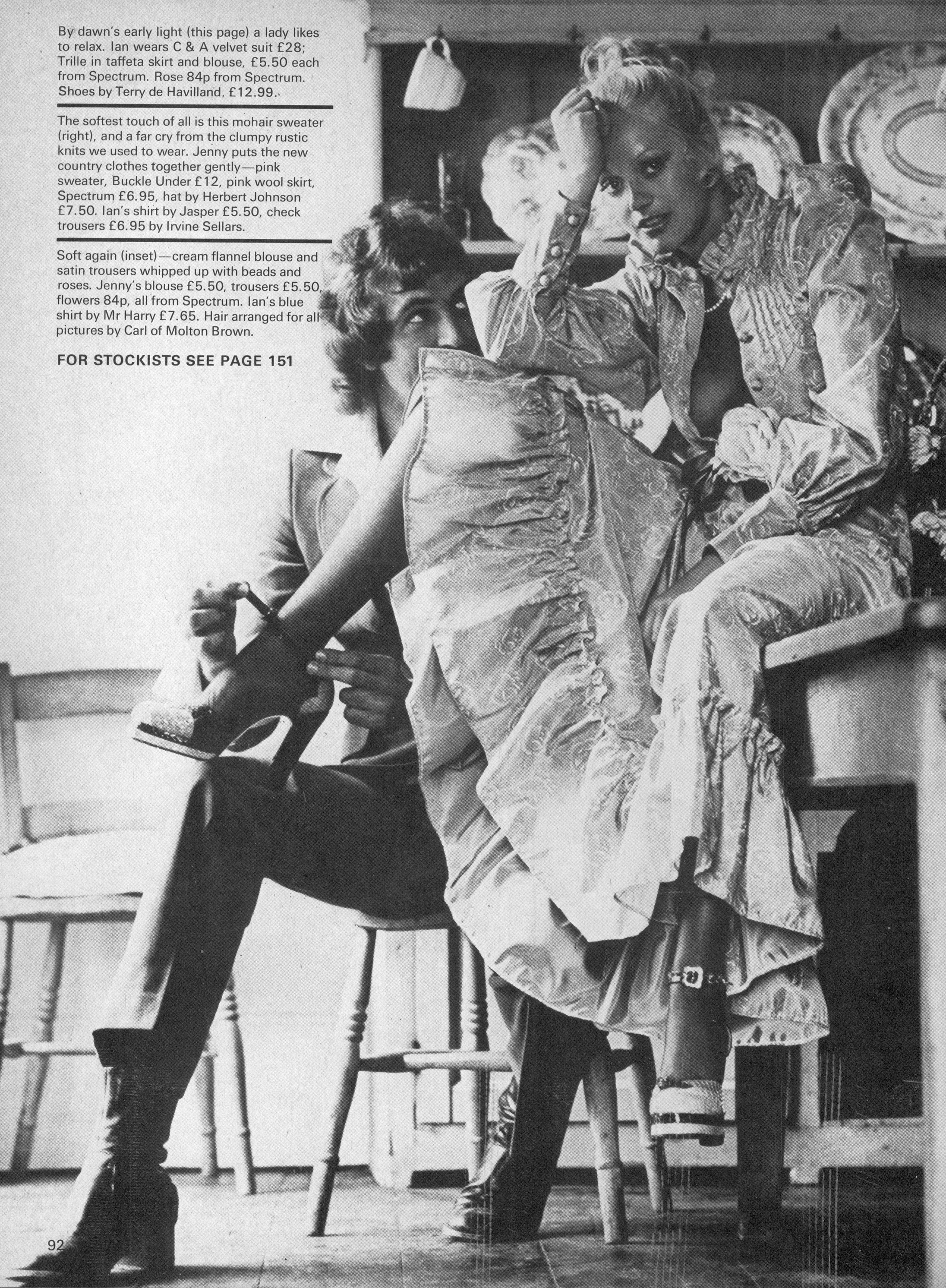
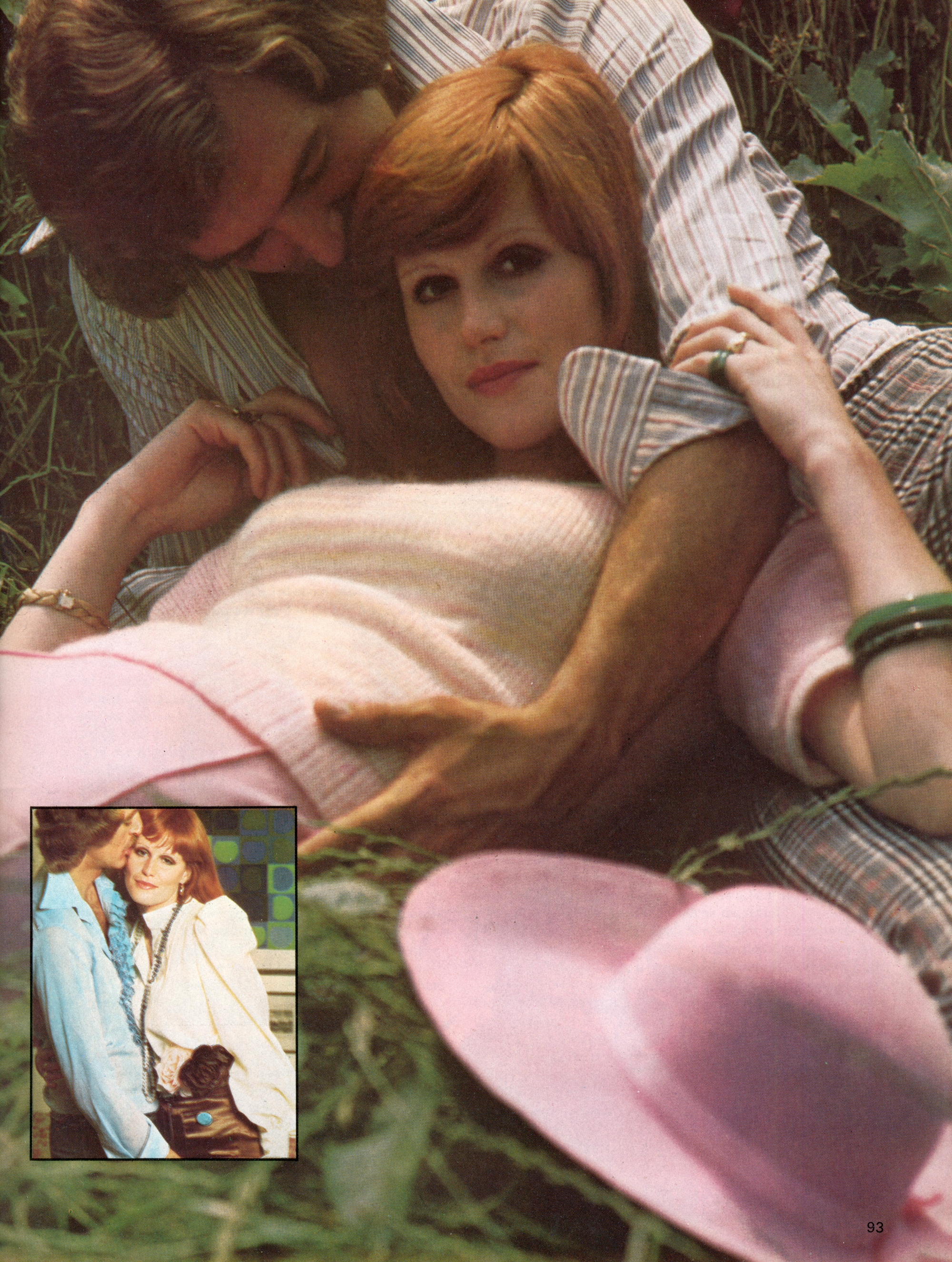
There is a licence to touch all the clothes on these pages. There is not a single trad, scratchy, thornproof tweed among any of the frankly tactile silks, angoras and flannels of autumn. Jerseys and pearls and sensible shoes were once the uniform of the WI. Now, (well) kept ladies whose fingers smell of “Cabochard” rather than cabbage, are pressing their flannel bags, having their pearls restrung and are wearing them with shirts so unbuttoned they could catch pneumonia – and heels high enough to rise above the muddiest farmyard. They are taking to pleated kilts, and cashmere sweaters so tight they’d enliven the dullest game of backgammon. Dinner dresses are back in style, and I do mean back down as far as you can go. Properly and provocatively dressed, a weekend in the country might be more fun than you think.
Hair arranged for all pictures by Carl of Molton Brown.
Fashion by Deirdre McSharry.
Photographed by John Kelly.
Scanned from Cosmopolitan, October 1972.
Give into the call of the wild, but come on softly in silk, angora and flannel. Jenny Harrington sends Ian Knipe slightly wild in her silk shirt, £15, flannel bags £16.50 by Annacat, and angora cardigan, John Craig £5. Fish pendant by Ciro. Ian’s camelhair sweater Ballantyne, £11.50. (Inset: The smoothest tweed in the softest shape will make you want to throw away your old trench. A great way to look for opening bazaars – and coping with Mellors. Coat by Coopers £33, hat by Herbert Johnson, £8.95.)
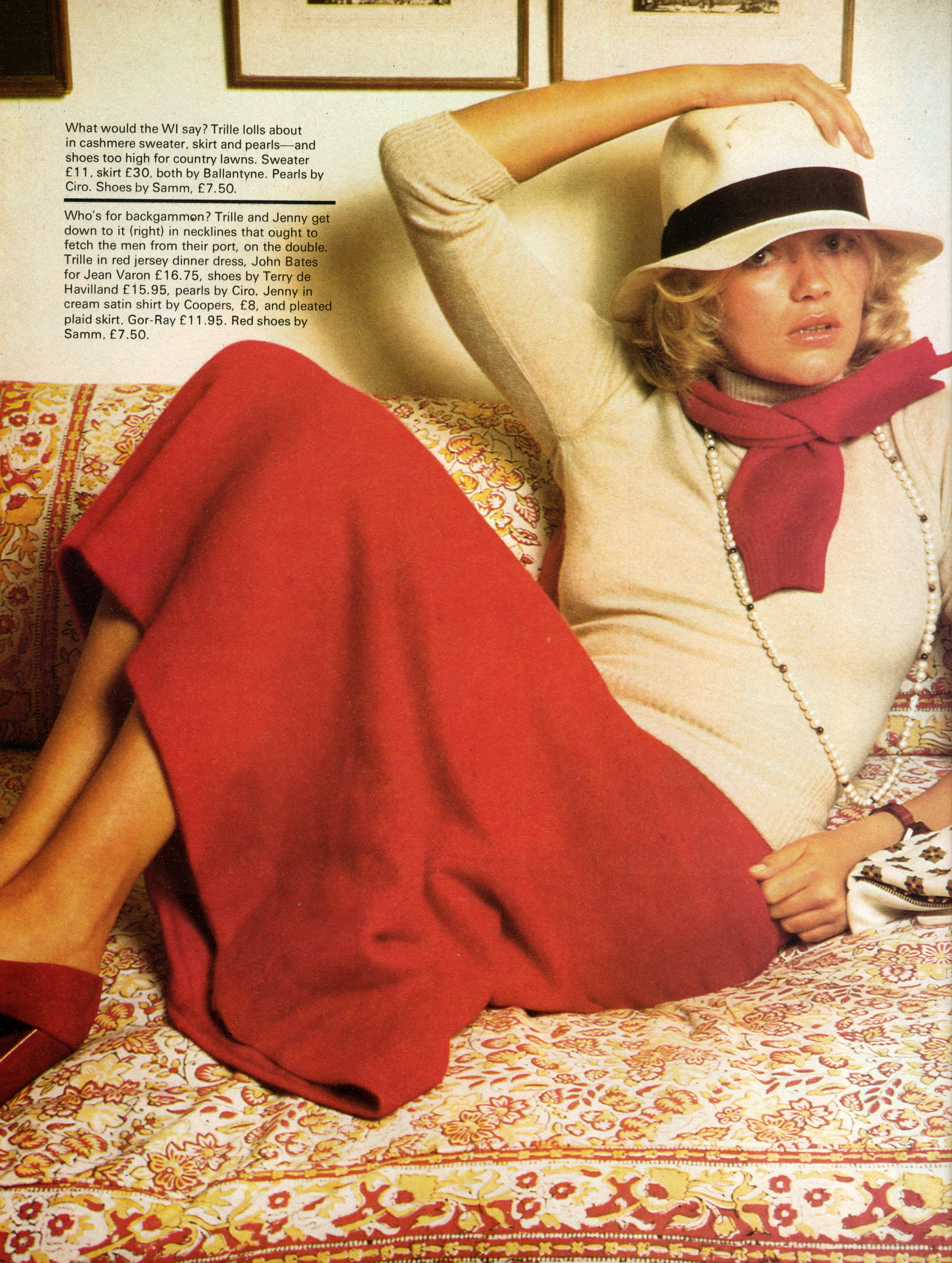
What would the WI say? Trille lolls about in cashmere sweater, skirt and pearls- -and shoes too high for country lawns. Sweater £11, skirt £30, both by Ballantyne. Pearls by Ciro. Shoes by Samm, £7.50.
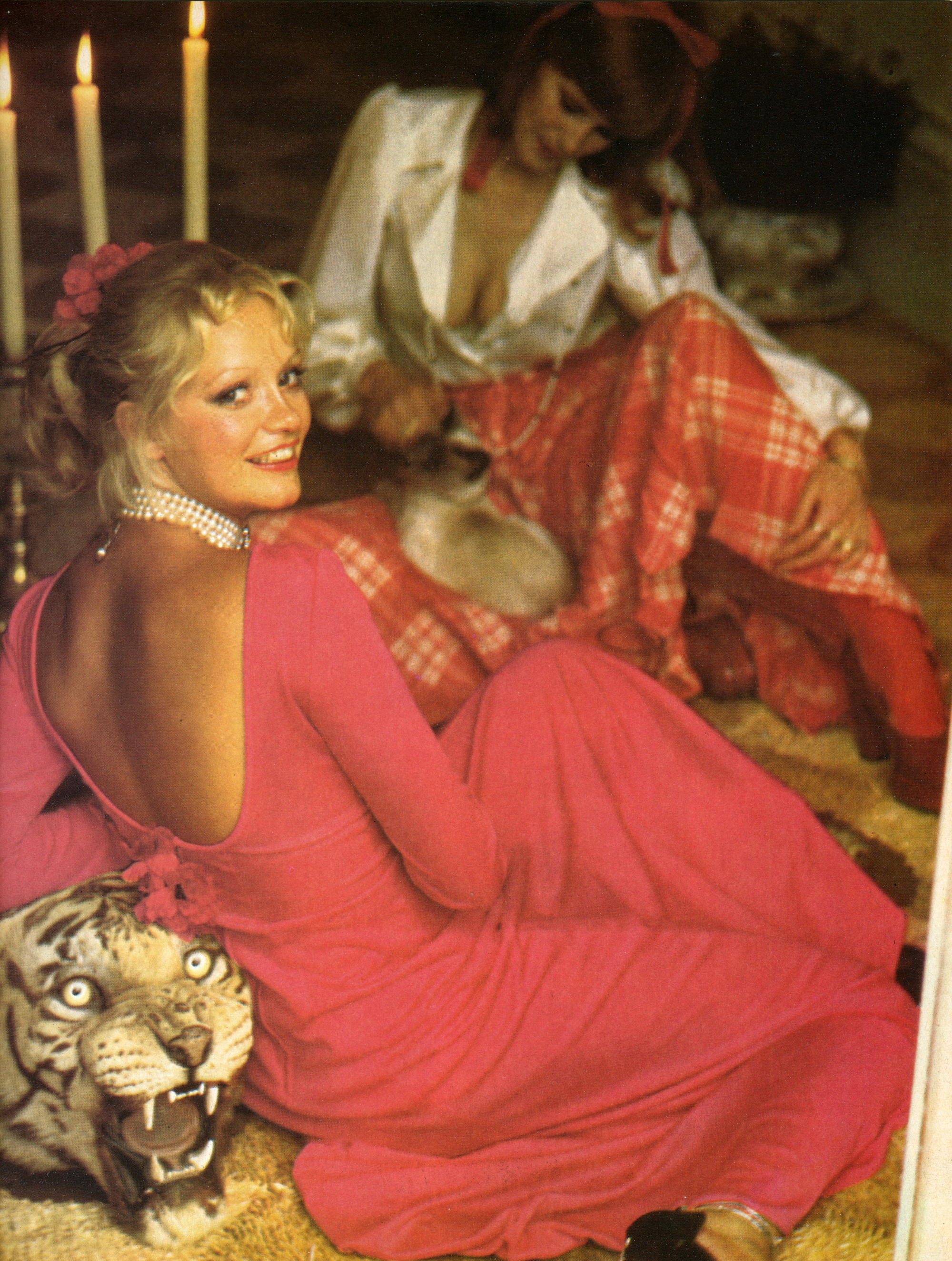
Who’s for backgammon? Trille and Jenny get down to it (right) in necklines that ought to fetch the men from their port, on the double. Trille in red jersey dinner dress, John Bates for Jean Varon £16.75, shoes by Terry de Havilland £15.95, pearls by Ciro. Jenny in cream satin shirt by Coopers, £8, and pleated plaid skirt, Gor-Ray f11.95. Red shoes by Samm, £7.50.
The sporting life means quick repairs on the run. Jenny puts back the paint, stays ladylike in powder soft suede and silk. Jacket and skirt by Janet Ibbotson; the jacket costs £38, the skirt £33.50. Silk shirt Fenwicks, £11.50. Jewellery and shagreen compact from The Purple Shop. Shoes by Samm, £7.95.
Long weekends can lead to explosive situations – Jenny ignites something in her cashmere and kilt. Sweater by Ballantyne £13.50, skirt by Gor-Ray £11.95, shoes by Terry de Havilland £15.95. Pearls by Ciro. Ian in ruffled lawn shirt, Turnbull and Asser £11.75, check trousers Irvine Sellars £5.95.
By dawn’s early light a lady likes to relax. Ian wears C & A velvet suit £28; Trille in taffeta skirt and blouse, £5.50 each from Spectrum. Rose 84p from Spectrum. Shoes by Terry de Havilland, £12.99.
The softest touch of all is this mohair sweater (right), and a far cry from the clumpy rustic knits we used to wear. Jenny puts the new country clothes together gently—pink sweater, Buckle Under £12, pink wool skirt, Spectrum £6.95, hat by Herbert Johnson £7.50. Ian’s shirt by Jasper £5.50, check trousers £6.95 by Irvine Sellars. (Inset: Soft again —cream flannel blouse and satin trousers whipped up with beads and roses. Jenny’s blouse £5.50, trousers £5.50, flowers 84p, all from Spectrum. Ian’s blue shirt by Mr Harry £7.65.)
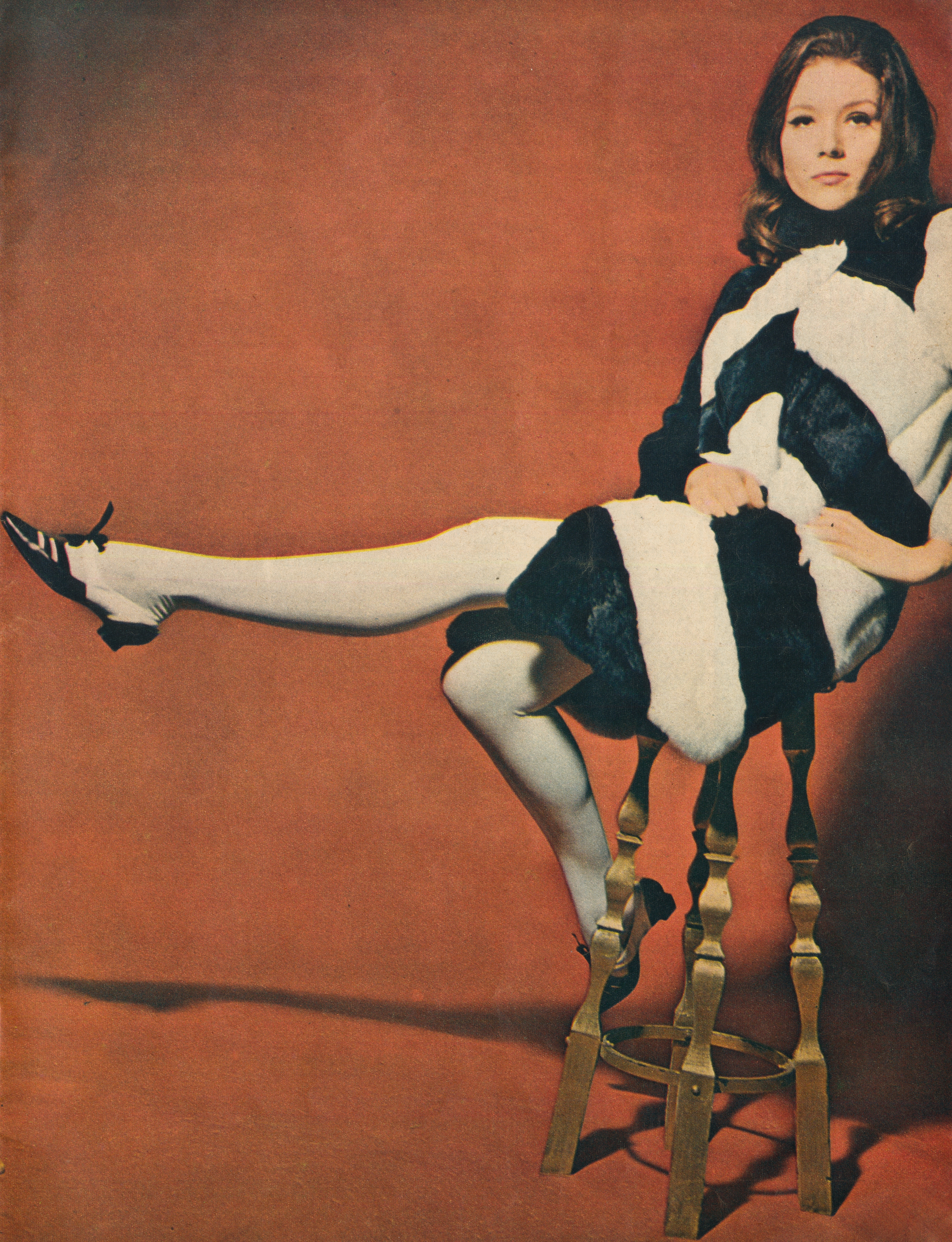
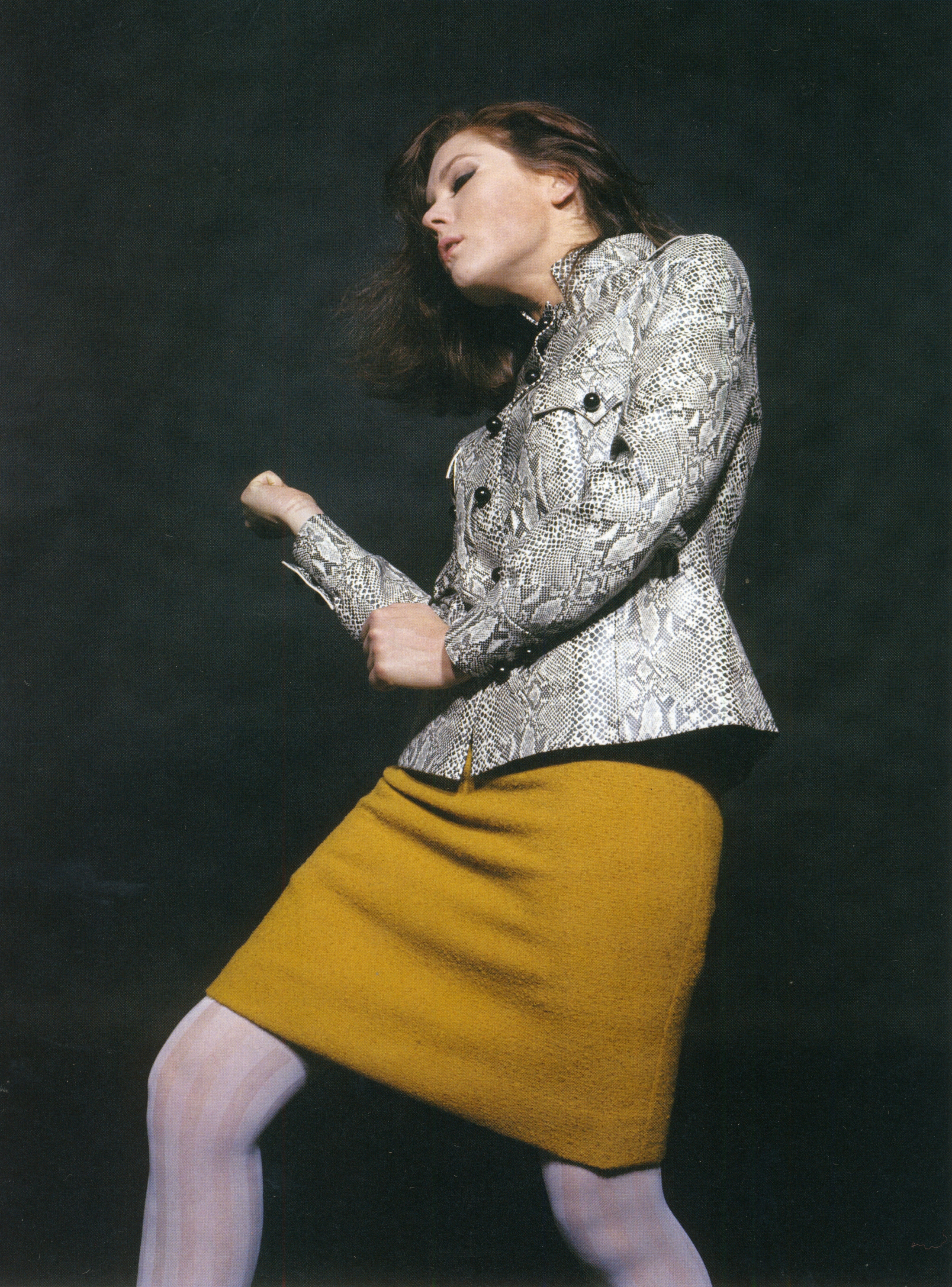
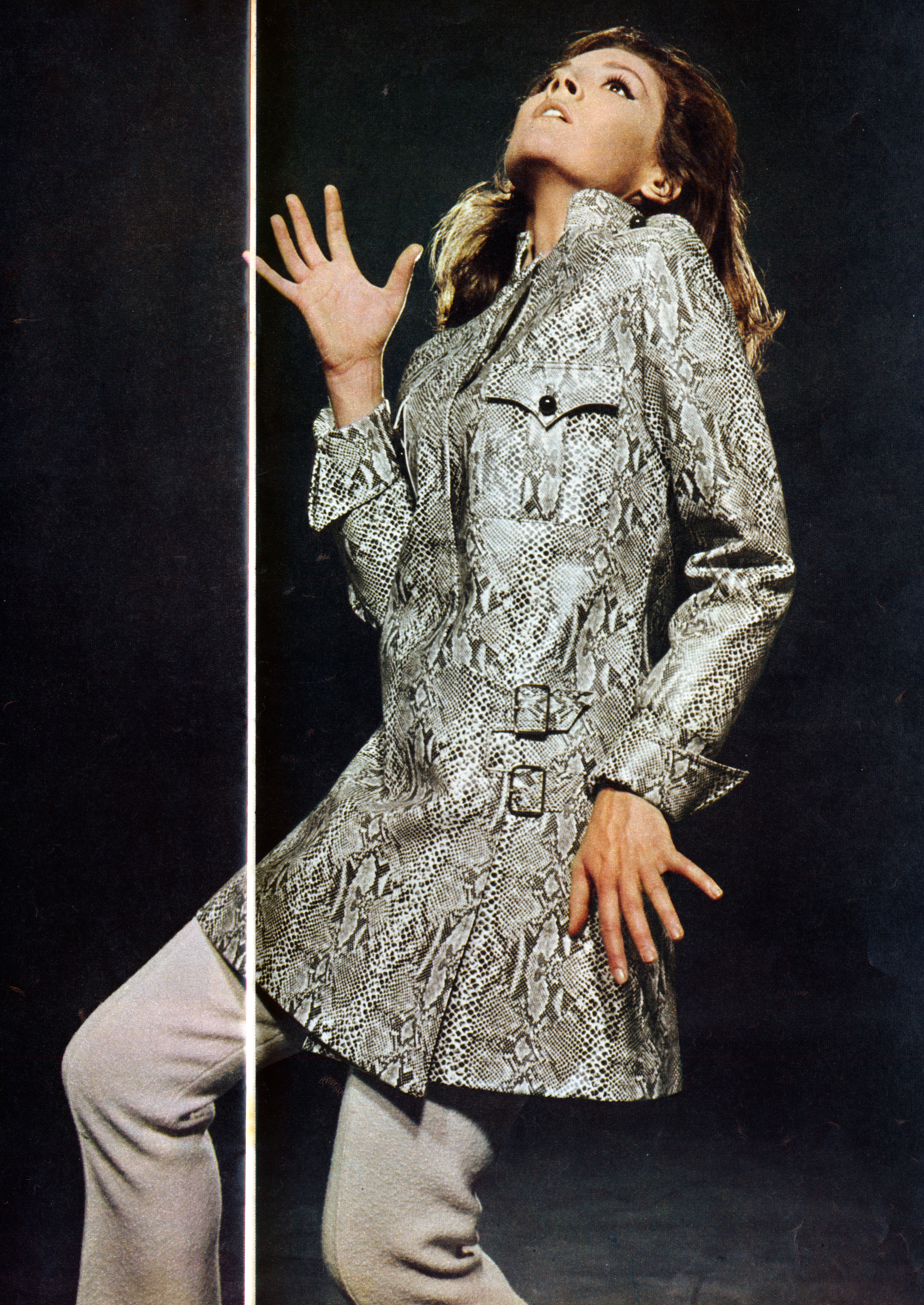
Diana Rigg in buckled snakeskin coat made by Paul Blanche.
On Thursday evening at 8 o’clock The Avengers comes back. Viewers in London, Scotland and the South will see it, other channels will have to wait until October 2. The new show lacks one vital element. Honor Blackman, who played Cathy Gale, that female gauleiter with a heart of gold, has left television for films and the arms of James Bond.
She is replaced by rangy, redheaded Diana Rigg, an actress already blooded for knock-about violence in shows like King Lear and The Devils with the Royal Shakespeare Company. She plays the new Avenger woman Emma Peel, who is described by A.B.C. television as “the youthful widow of an ace test pilot, daughter of a wealthy shipowner, and an internationally educated symbol of the jet-age female”.
A strong-arm widow, born with such disadvantages, couldn’t fail to be an interesting autumn draw, but the new girl will find it hard work to oust the memory of Cathy Gale from the spot she kicked out for herself in these shows. For, as Cathy Gale, Honor Blackman was mesmeric. Male viewers turned to pulp in their armchairs as she hurled opponent after opponent through plate glass windows, and their TV dinners turned to dust as she half-nelsoned men twice her size.
Women were fascinated too, but for different reasons. They sat glued to their sets wondering what it was she had, that they hadn’t. Her slightly sinister but wholly fathomable allure had little to do with her natural assets ; her toughness, the purring reassurance of her voice, her earthiness ; her blonde hair and wide mouth. Cathy Gale’s real appeal was firmly laced into the shiny black leather of her fighting suits.
The black leather fighting suits she wore, now generally referred to as ‘kinky clothes’ were designed by Frederick Starke. They proved such a success both here and in the U.S.A., where the last series was sold, that the American business men controlling the sales insisted that these clothes should be retained for the next series. This was a mistake. Fashion moves much faster than most business men, and the feeling for black leather was on the wane, long before the last episode was off the screen. But A.B.C. agreed to the American conditions, and Emma was togged up in black leather and boots, looking just like Cathy Gale in a long red wig.
Before the new series was half-way through, the planners realised that some fairly startling changes were taking place in the fashion world. Skirts were getting shorter and women appeared to be crossing their thighs, not their knees. Leather was out. All sorts of animal skins, from snakes to zebras, were in. And op and pop art were having an explosive effect on textile design.
This series is the first to be made on film instead of videotape, which means it could be running in different countries all over the world for the next five to ten years. It would be pushed to keep its con-temporary smack with a limping gimmick like black leather. At this point, with half their film in the bag, A.B.C. called in fashion co-ordinator Anne Trehearne, an ex-fashion editor of Queen magazine, and asked designer John Bates of Jean Varon to plan a new wardrobe for Emma Peel to wear during the last 14 episodes. John Bates is the man who made the now famous daisy dress which 25 red-faced debutantes wore to the same ball.
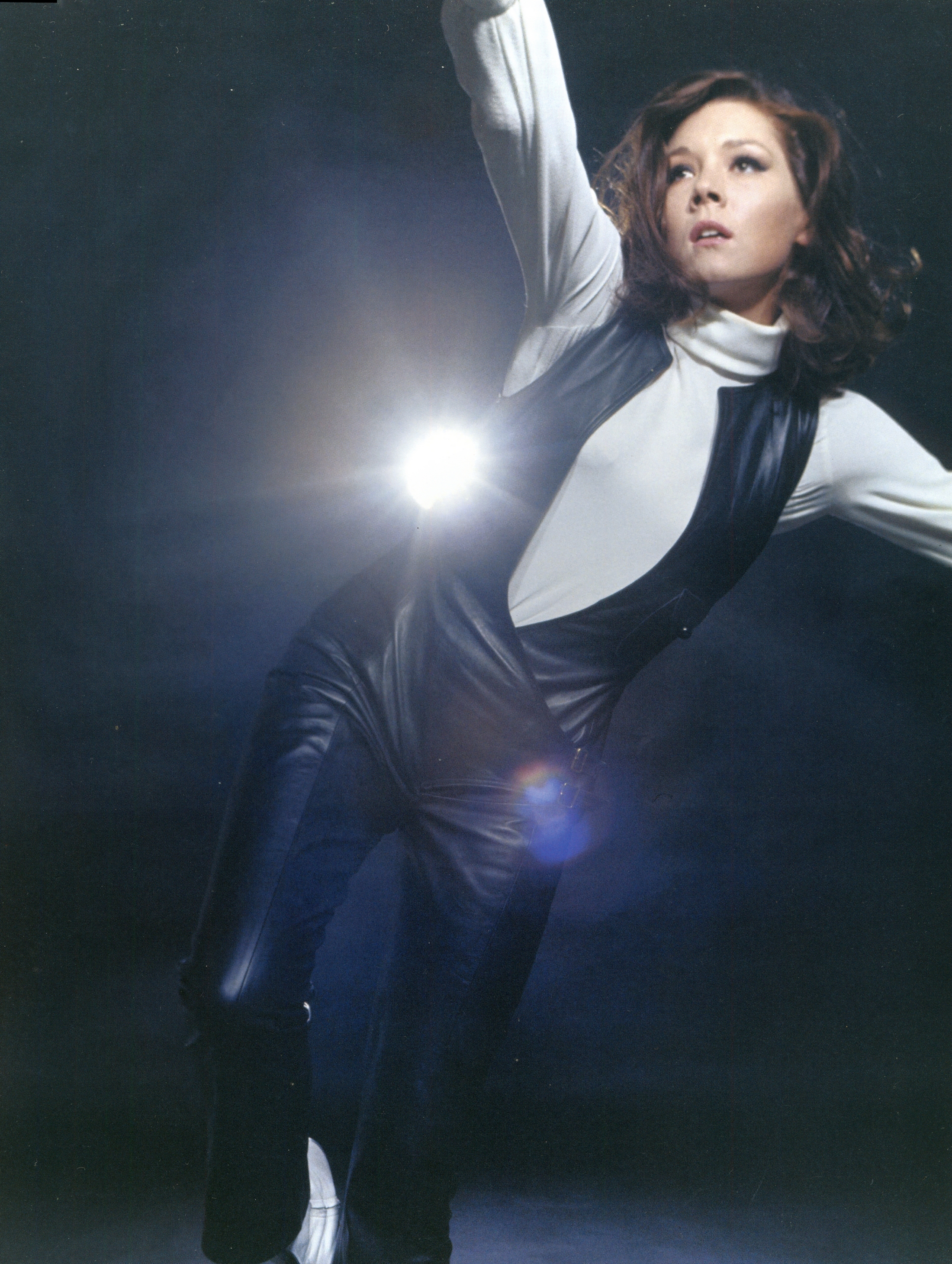
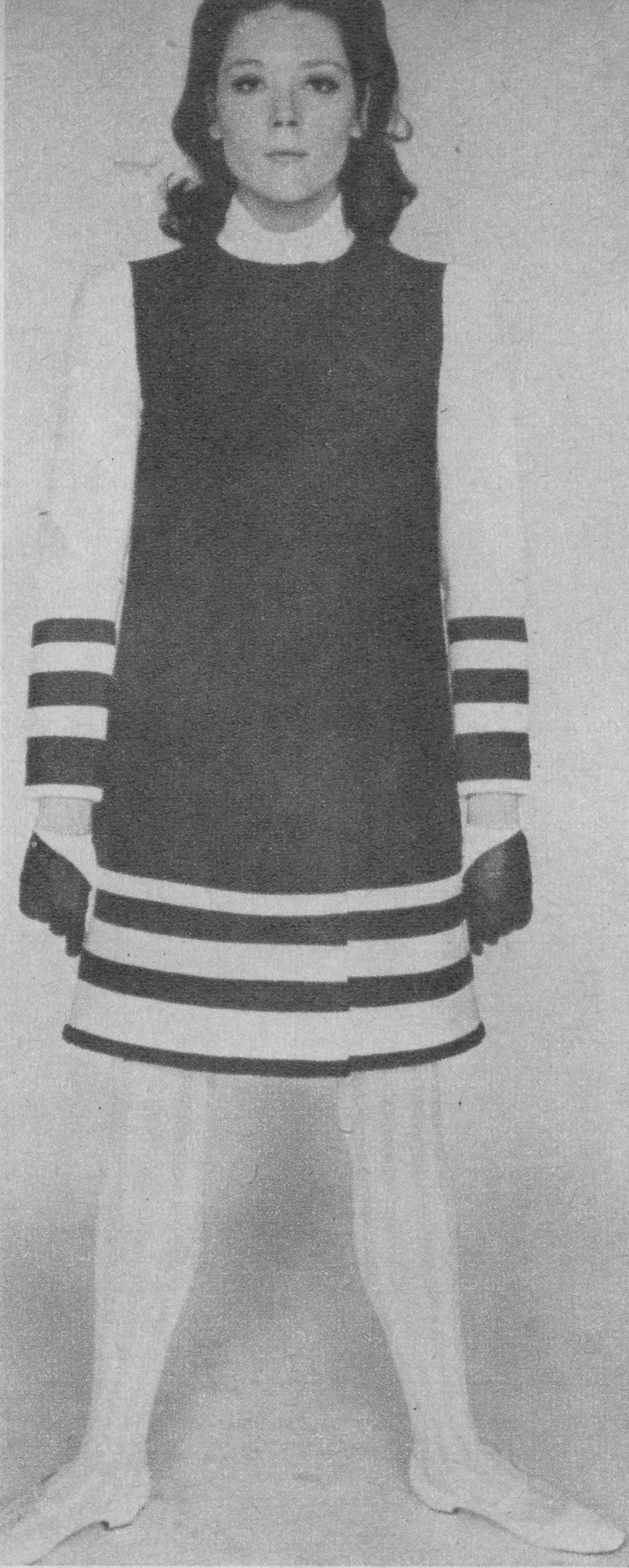
Designing a wardrobe for a preconceived image is no easy task, but he succeeded in doing this and more besides. His clothes are 100 per cent. modern. He has shortened the skirts (in spite of tough opposition in certain quarters at A.B.C.), re-designed the black leather fighting outfits into modern, one-piece jump-suits, introduced tailored snakeskin and a whole range of op art furs.
In all there are 35 garments with complementary accessories. And for the first time the whole collection will be sold in the shops. (Frederick Starke did sell some of Cathy Gale’s wardrobe, but only selected items.) Over 12 well-known manufacturers, like Edward Rayne, Paul Blanche and Kangol, are co-operating with John Bates at Jean Varon and are making the shoes, the skin coats and the berets under licence; Echo are even making the amusing ribbed sheer nylon stockings. They will all be in the shops in October.
Both the clothes and the series are now saleable properties. It will be interesting to see which proves the biggest draw to interested buyers the striking new clothes or the shiny new girl.
Photographed by David Gittings.
Story by Meriel McCooey.
Scanned from The Sunday Times Magazine, September 26th 1965.
In short snakeskin blazer made by Paul Blanche and ribbed sheer nylon stockings.
Leather jumpsuit with clasps made by Paul Blanche.
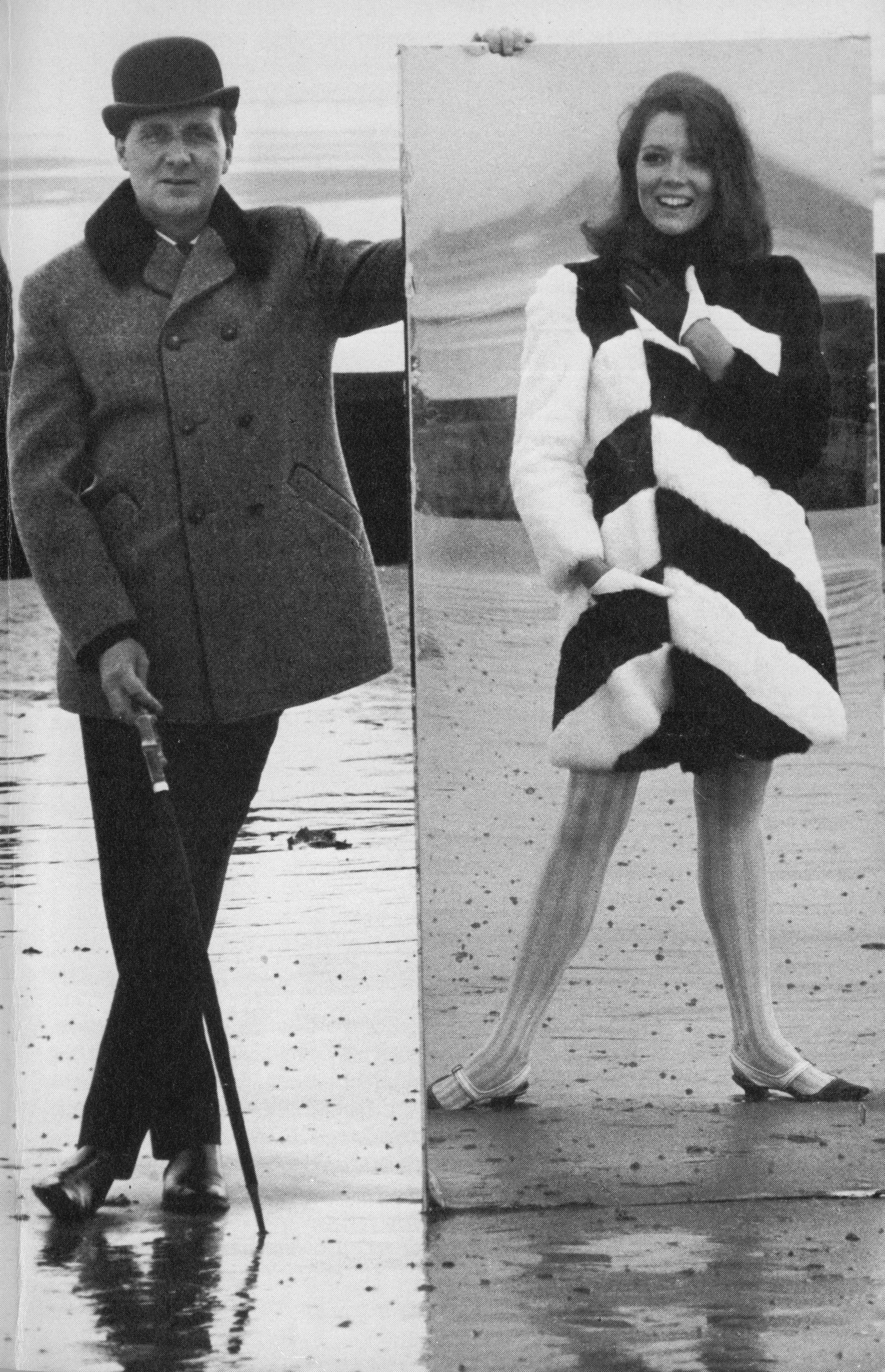
Black and white bunny coat made by Selincourt. All designed by John Bates.
Lime knit jacket by Outlander. White crêpe trousers by Ara. Ascher cotton scarf.
Oh to be out of England now that April’s here, and whether you are planning on Majorca, the far-flung Bahamas or the Isle of Wight this year, now is the best time to shop for holiday clothes. And having just stepped out of a QANTAS jet that took Cosmo island-hopping via Bermuda to the Bahamas, I have a slight tan and a strong feeling that summer’s fashions will be as refreshing, bittersweet and highly coloured as that tropical drink, Planter’s Punch.
Oh to be anywhere but home, quite frankly. I shall have to recreate these styles on the balcony and dream of even going as far as the Isle of Wight…
All jewellery by Adrien Mann. Fashion by Deirdre McSharry.
Photographed by Norman Eales.
Scanned from Cosmopolitan, April 1973.
Sundress by Mic Mac. Scarf by Ascher.
Vest from Dorothy Perkins. Trousers by Alkasura. Sunglasses by Oliver Goldsmith.
Striped cotton outfit by Buckle Under. Shoes from Sacha. / Cotton separates by Baltrik.











 Liz Eggleston