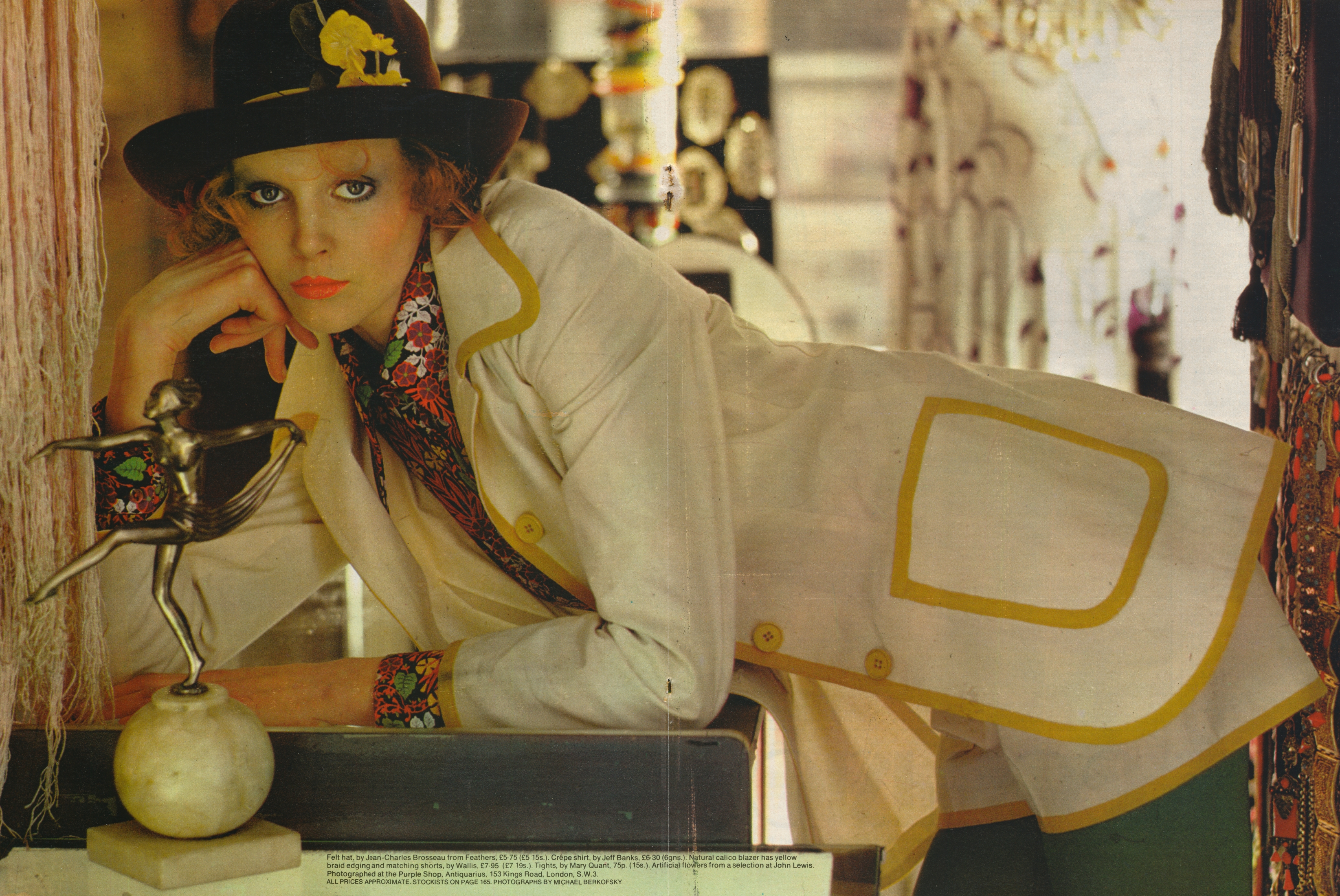
Felt hat. by Jean-Charles Brosseau from Feathers, £5.75 (£5 15s.). Crêpe shirt. by Jeff Banks. £6.30 (6gns.). Natural calico blazer has yellow braid edging and matching shorts, by Wallis, £7.95 (£7 19s.). Tights, by Mary Quant, 75p. (15s.). Artificial flowers from a selection at John Lewis. Photographed at the Purple Shop, Antiquarius, 153 Kings Road, London, S.W.3.
Yves St. Laurent’s ‘Blast From The Past’ award is taken by the blazer. Fashioned a la Dietrich, casual but smart, it looks especially good with shorts, hot-coloured tights and long knee-socks, or pleated skirts. The best choice is plain white, black or red; or hot checks and stripes.
A superb editorial, giving us an insight into the short-lived but legendary Hollywood Clothes Shop and The Purple Shop in Antiquarius (which I feel like I’m regularly crediting in other posts on here) and also designer David Mellor’s shop. It also has the unusual element of every price being given in new and old money – with decimalisation having been introduced in February of the same year. I’m surprised I don’t see this a lot more in editorials from 1971.
Modelled by Sue Baloo
Styled by Norma Moriceau.
Photographed by Michael Berkofsky.
Scanned from 19 Magazine, May 1971.
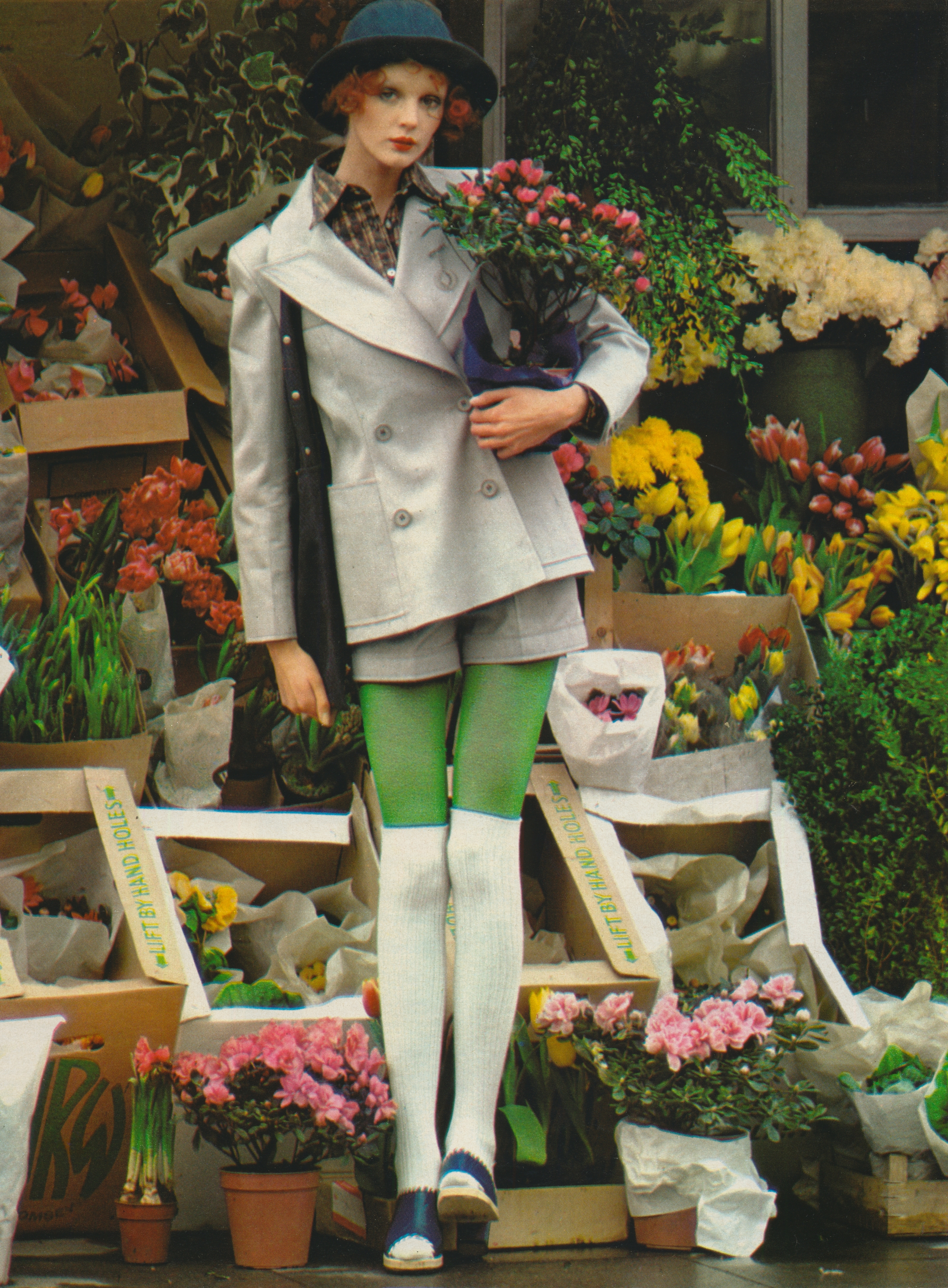
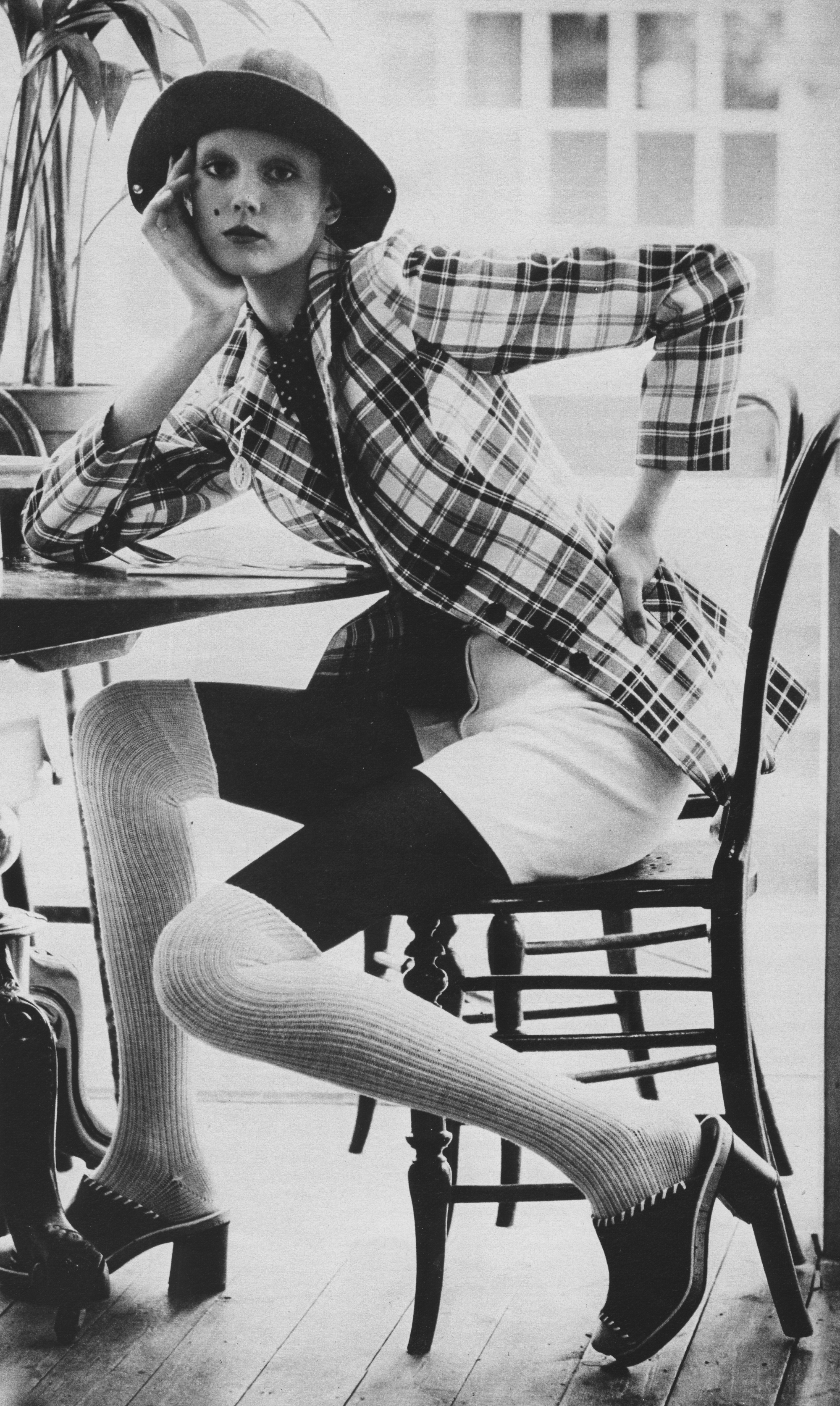
Denim hat, by Jean-Charles Brosseau from Feathers, £6. Cotton shirt in browns and blues, by Jasper, £4.48 (89s.7d.). ‘Forties’ rayon hopsack blazer, double-breasted with Square padded shoulders and two large pockets, matching shorts with turn-ups (sold as a three-piece with trousers), by Shubette, £13.95 (£13 19s.). Green tights, by Mary Quant, 75p. (15s.). White Orlon socks, by Sunarama, 59p. (11s.10d.). Blue mules with white thonging, by Ravel, £3.75 (75s.). Pretend watch-brooch from Universal Witness, 50p. (10s.). Photographed outside Green’s of Chelsea, fruiterer and florist.
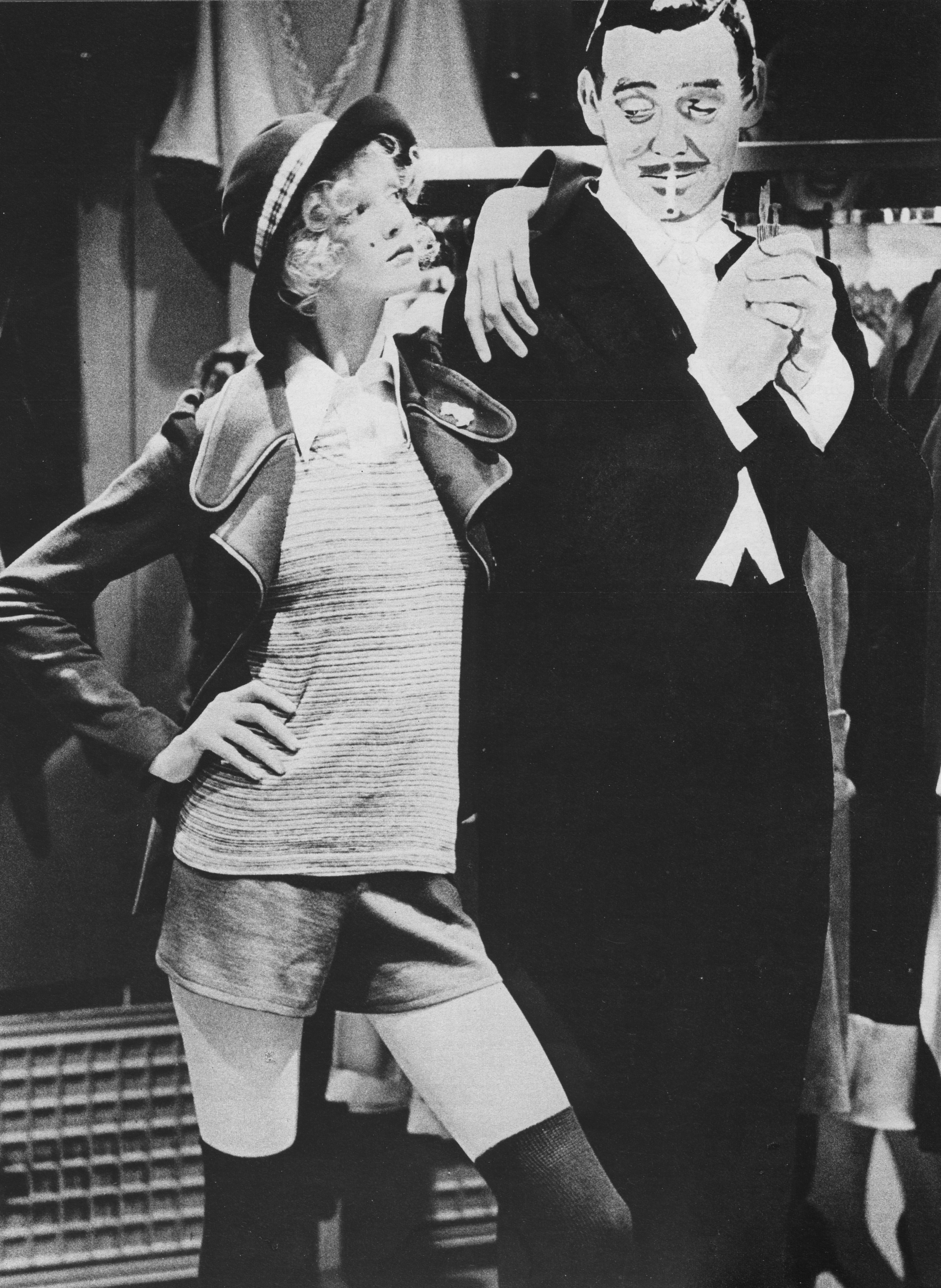
Brown felt hat, by Jean-Charles Brosseau from Feathers, £5.75 (£5 15s.). Canary yellow cotton jersey shirt, £3.20 (64s.). Multi-coloured random striped cotton jersey vest, £1.38 (27s.7d.). Both by Erica Budd. Wine jersey blazer edged in turquoise, with turquoise shorts, by Clobber, £10. Blue over-the-knee socks, from Fenwicks, 50p. (10s.). Doggie brooch, from Universal Witness, 50p. (10s.). Ribbon on hat, from a selection at John Lewis. Photographed at the Hollywood Clothes Shop.
Felt hat by Feathers, £5.75 (£5 15s) Red jersey shirt with elasticised waist, £5.95 (£5 19s). Navy knitted cotton vest with red trim, £1.75 (35s). Madras cotton blazer, £9.50 (£9 10s). Shorts, £4.45 (£4 9s). All by Lee Bender for Bus Stop. Tights by Mary Quant, 75p (15s). Peep-toes by Ravel, £5.99 (£5 19s 10d).
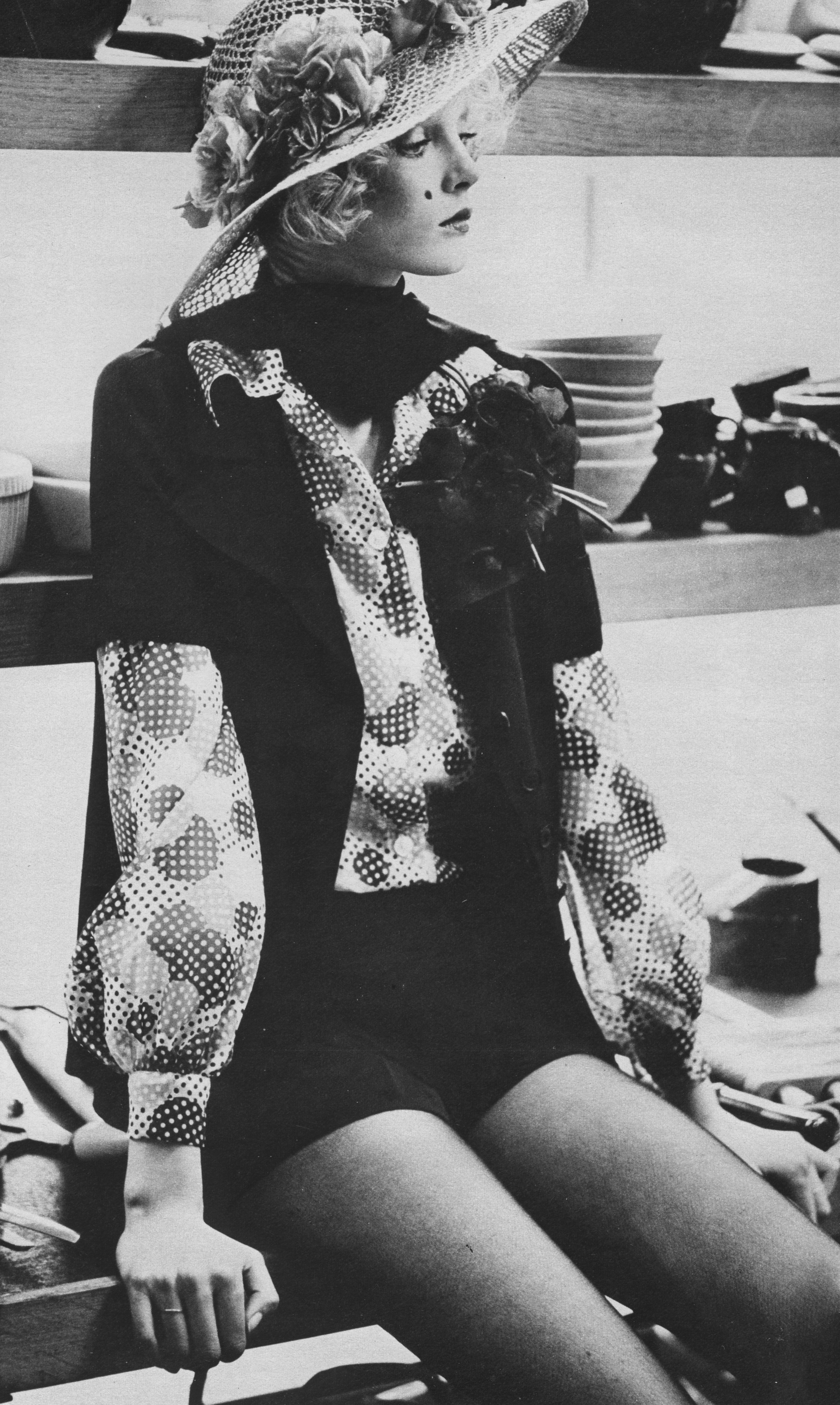
Straw hat, from Biba, £1.25 (25s.). Spotted cotton voile shirt in red, yellow, blue and green, by Simon Ellis, £4.25 (85s.). Single-breasted blazer and shorts suit in black givreine, from Biba, £9.75 (£9 15s.). Sheer black tights, from Biba, 54 ½p. (10s.11d.). Crêpe scarf, from Biba, £2. Artificial flowers, from Biba, £1.05 (1gn.). Photographed at David Mellor, Ironmonger, London, S.W.1.
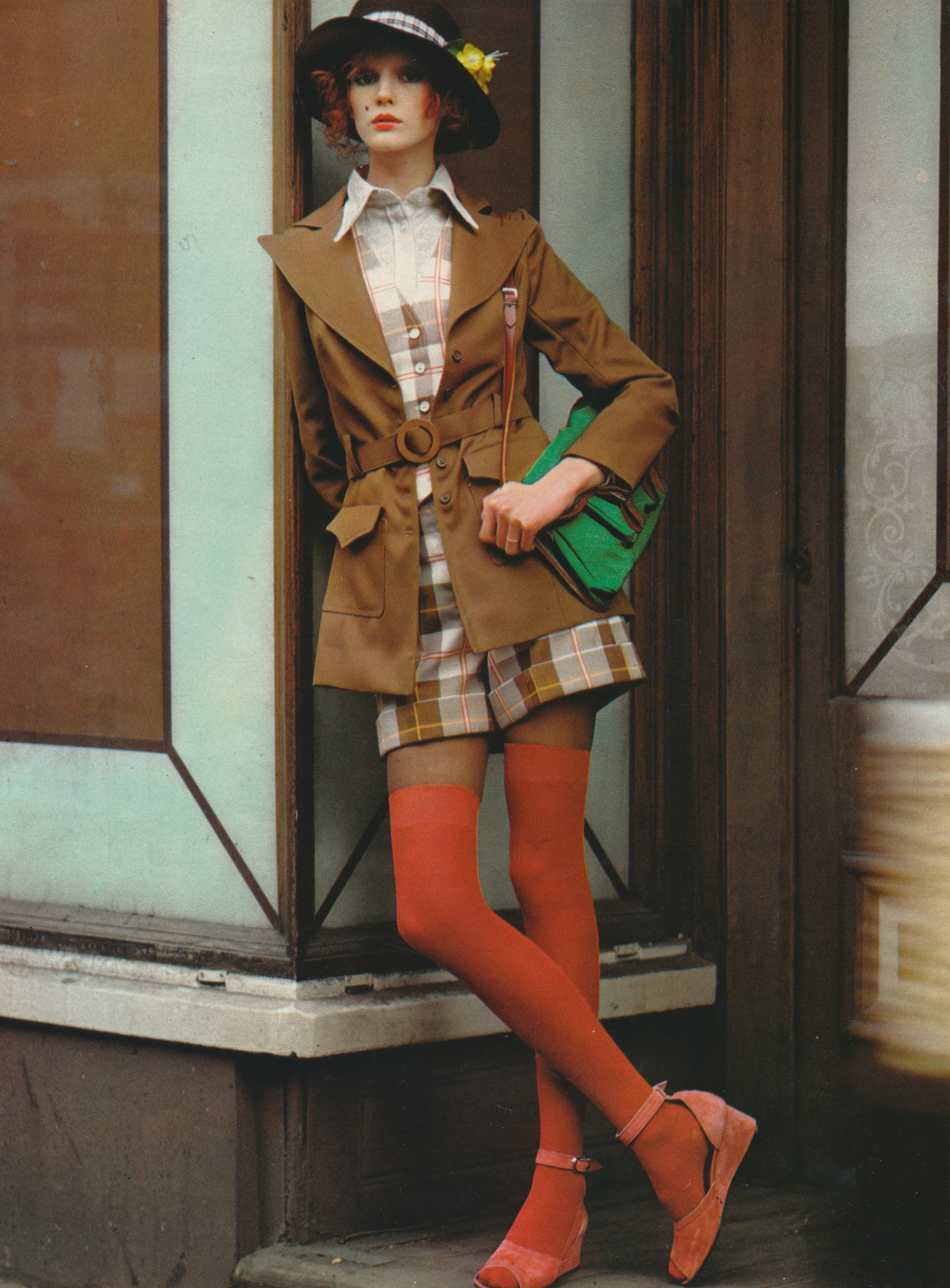
Brown felt hat, from Feathers, £5.75 (£5 15s.). Cotton oatmeal shirt, by Jasper, £3.98 (79s.7d.). Checked waistcoat in shades of tan with rust stripes, £5.25 (5gns.). Shorts, £5.25 (5gns.). Matching single-breasted tan blazer in washable Telenka with flap patch-pockets and belt, £10. All by Gladrags. Brown tights, by Mary Quant, 75p. (15s.). Long rust socks, from Feathers, £1.50 (30s.). Suede wedge shoes, by Ravel, £4.50 (90s.). Bright green satchel, by Baggage and General Holding Co. Ltd., £1.50 (30s.).
Denim hat, by Jean-Charles Brosseau from Feathers, £6. Spotted blouse, from a selec-tion at Van Der Fransen. Single-breasted rayon blazer suit by Elgee, jacket in blue and beige checks on white has padded shoulders and flap pockets, and comes with either plain white or matching shorts, 2_15.75 (15anq Navy tights, by Mary Quant, 75p. (15s.). White Orlon over-the-knee socks, by Sunarama, 59p. (11s.10d.). Navy mules, from Ravel, £3.75 (75s.). Pretend watch-brooch from Universal Witness, 50p. (10s.). Photographed at Parsons, Fulham Road, London, S.W.10.
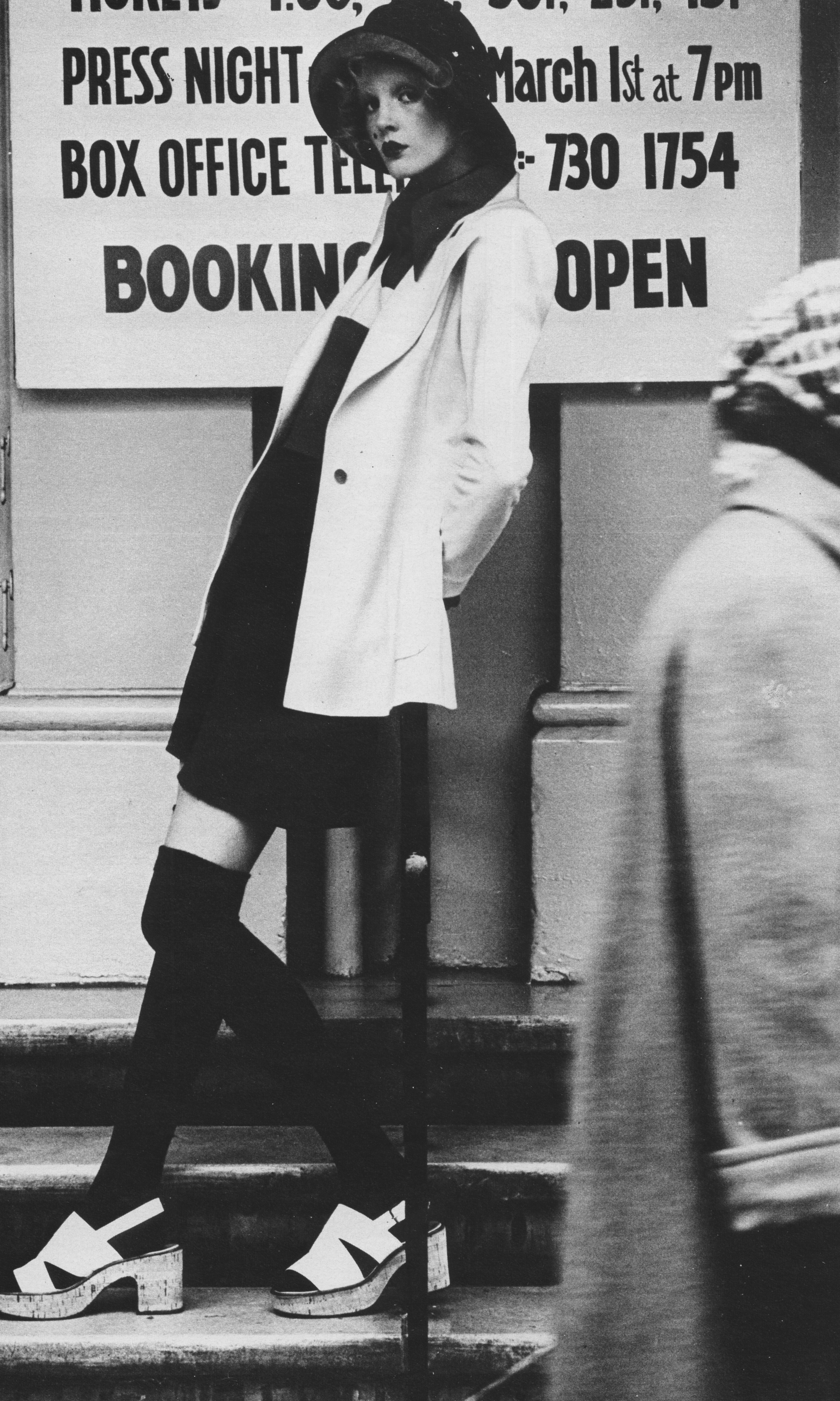
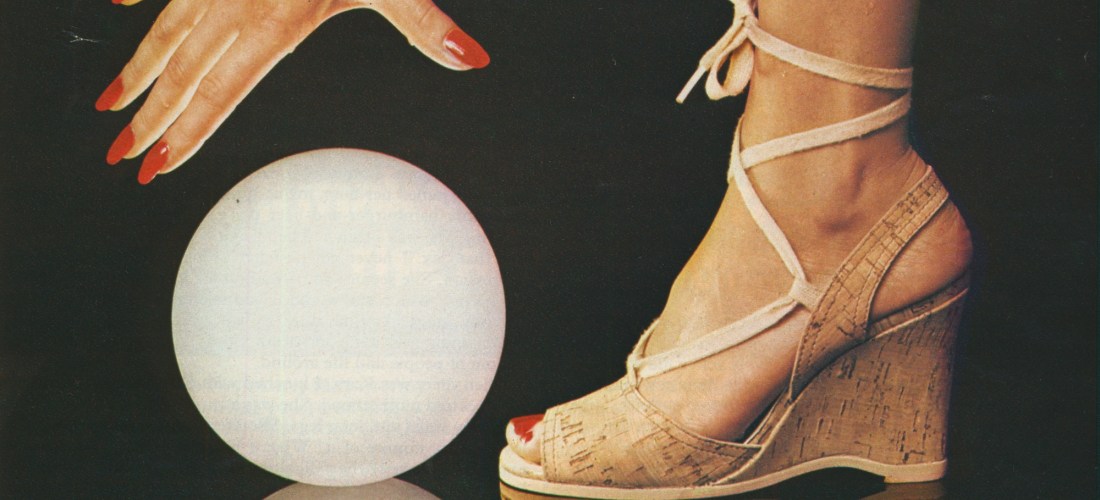
Navy denim hat, by Jean-Charles Brosseau from Feathers, £5.75 (£5 15s.). Red cotton jersey shirt, £5.95 (£5 19s.). Red, navy and white jersey vest with side button fastening, £2.50 (50s.). White bonded jersey blazer, £7. Navy jersey shorts, £3.75 (75s.). All by Lee Bender for Bus Stop. Navy socks, from Fenwicks, 50p. (10s.). White sandals with cork soles from Ravel, £4.50 (90s.).
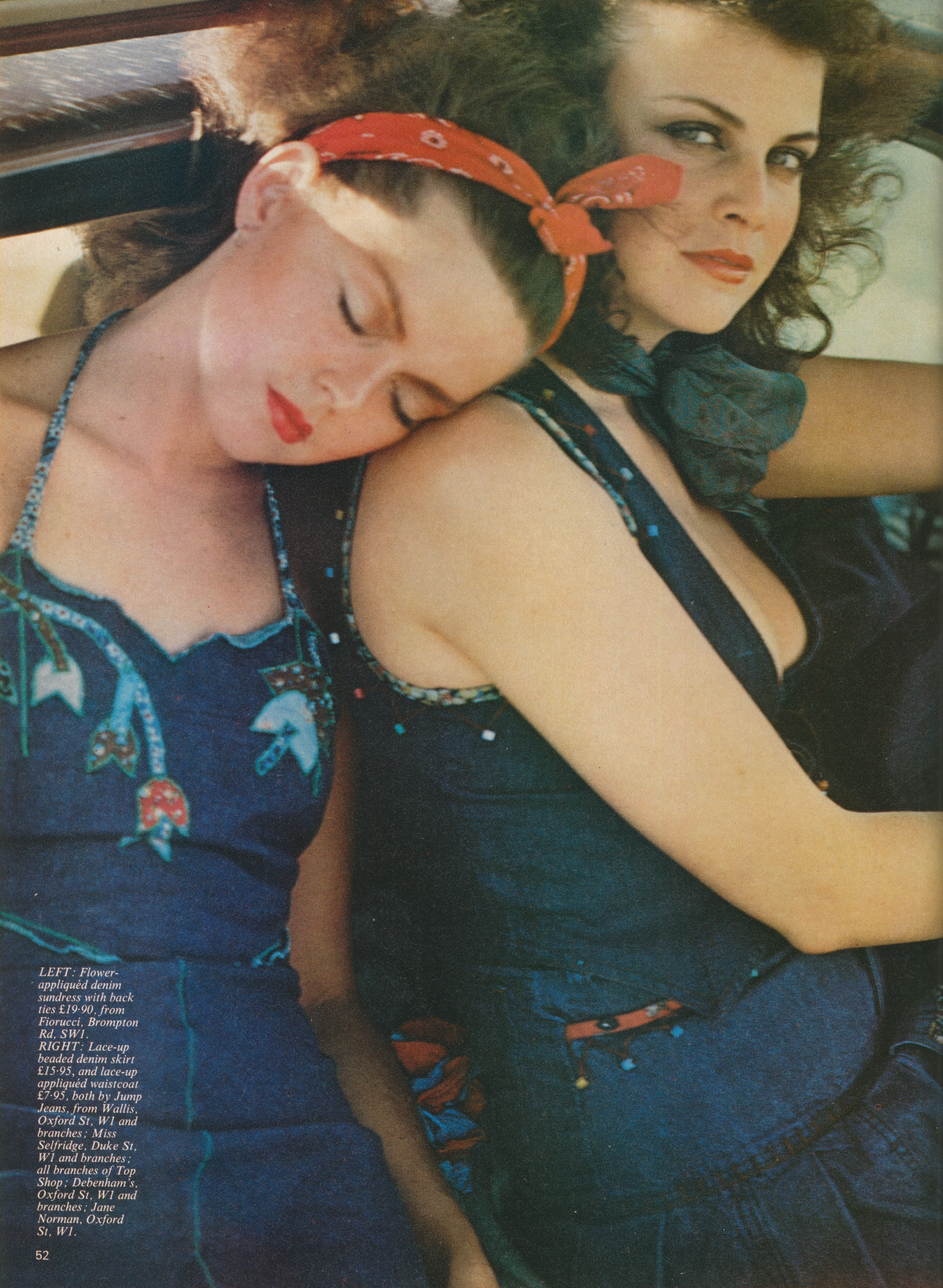
LEFT: Flower-appliqued denim sundress with back ties £19.90, from Fiorucci, Brompton Rd, SW1. RIGHT: Lace, beaded denim skirt £15.95, and lace-up appliqued waistcoat £7.95, both by Jump Jeans, from Wallis, Oxford St, W1 and branches; Miss Selfridge, Duke St, W1 and branches; all branches of Top Shop Debenham’s, Oxford St, W1 and branches; Jane Norman, Oxford St, W1.
Summers may come and summers may go but denim never fails us.
Modelled by Joanna Jacobs and unknown model.
Photographed in Florida by Roelof Wennink.
Scanned from Honey, April 1976.
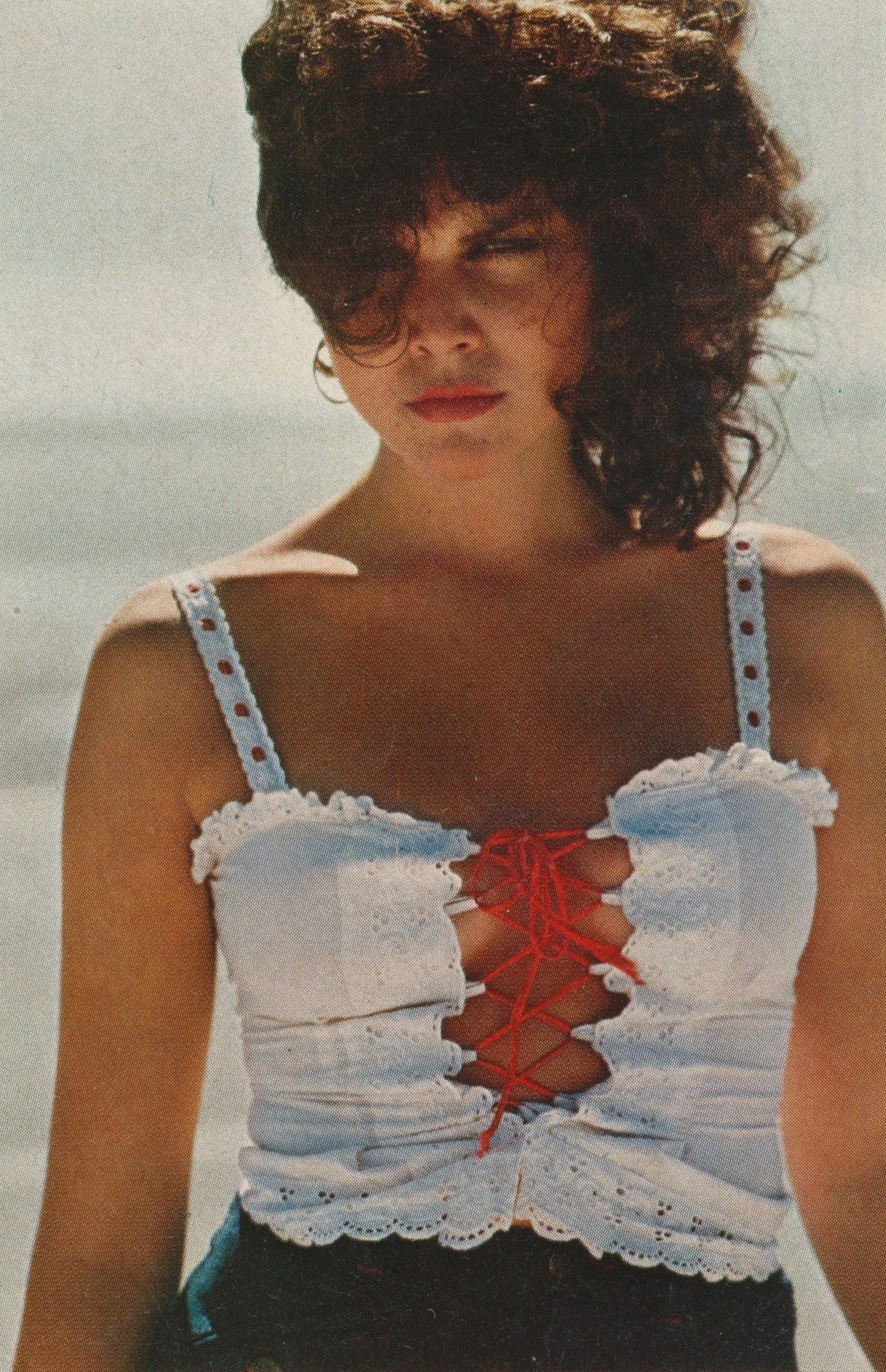
White cotton broderie anglaise lace-up camisole top with ribbon trim, Charles Grahame £6, from Bombacha, 104 Fulham Rd, SW3.
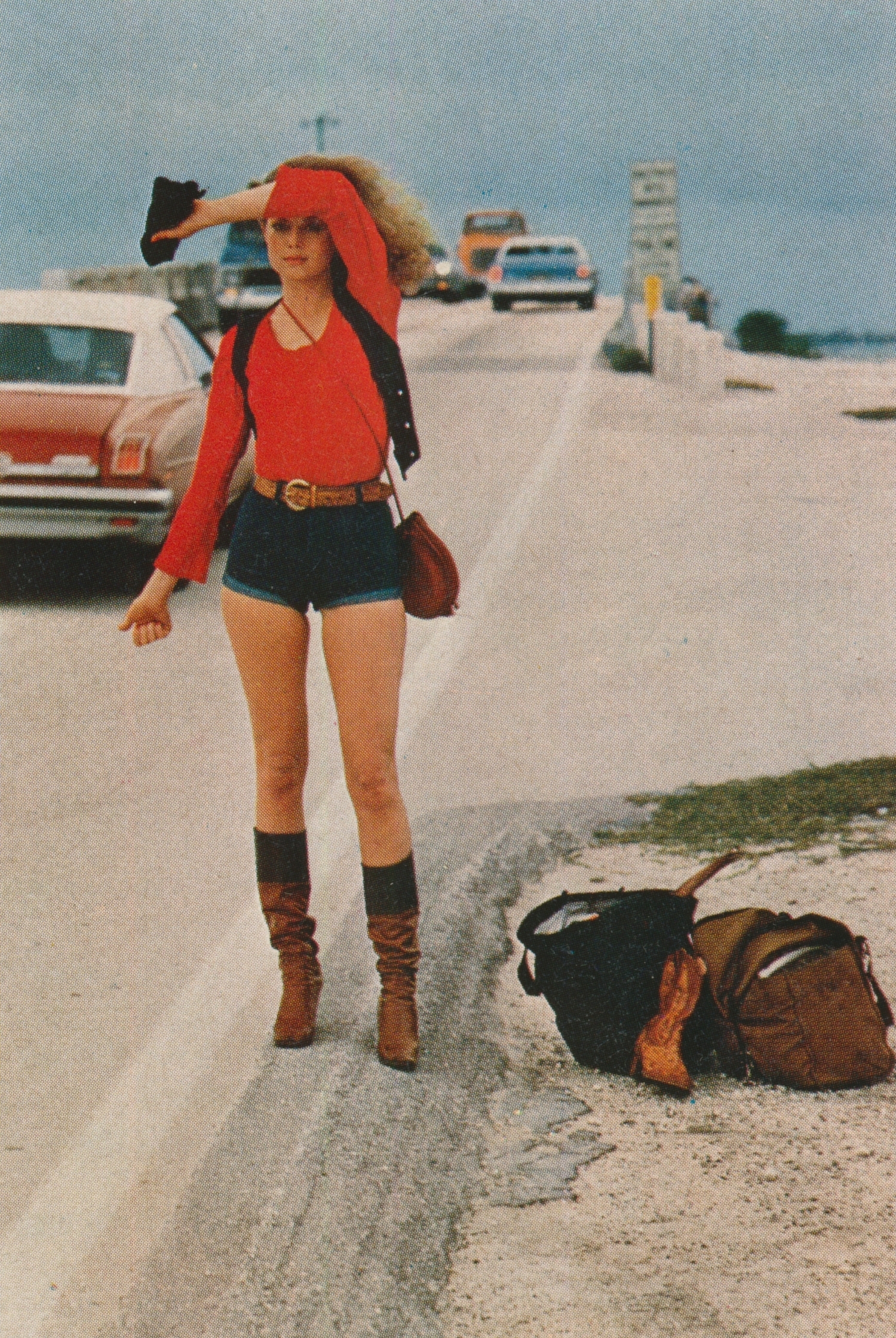
Denim shorts £8.90, from Elle, New Bond St, W1 and branches. Cotton jersey T-shirt £2, from Martha Hill, Marylebone High St, W1. Denim waistcoat with popper fastening and ‘V’ stitched front, Eagle £6.95, from Dickins & Jones, Regent St, Wl. Red velvet pouch bag, Macondo.
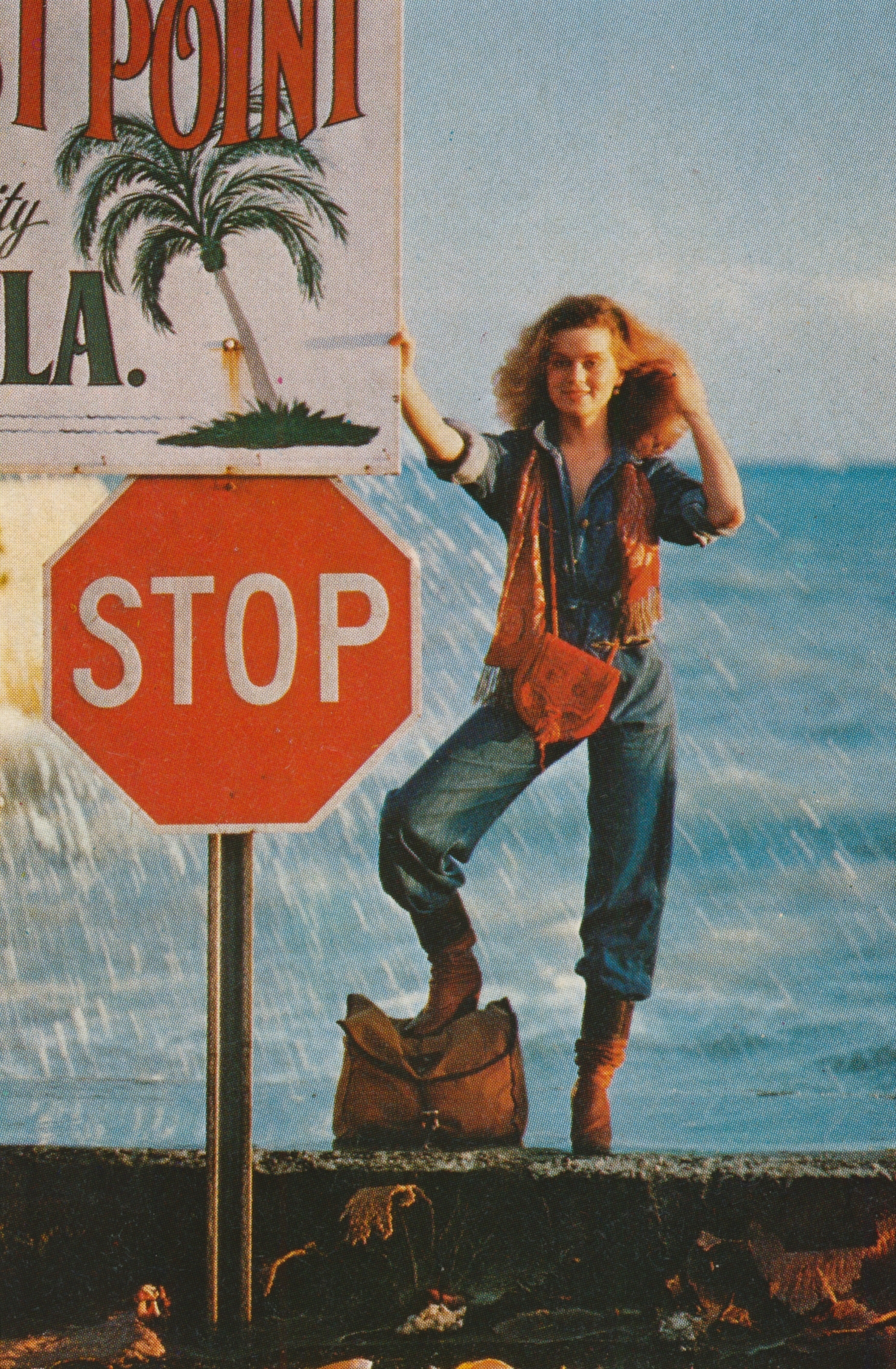
Button-through denim boiler suit, £18.99, from Jean Junction, King’s Rd, SW3 and branches. Red shoulder purse, Macondo ; scarf from a selection at Fenwick.
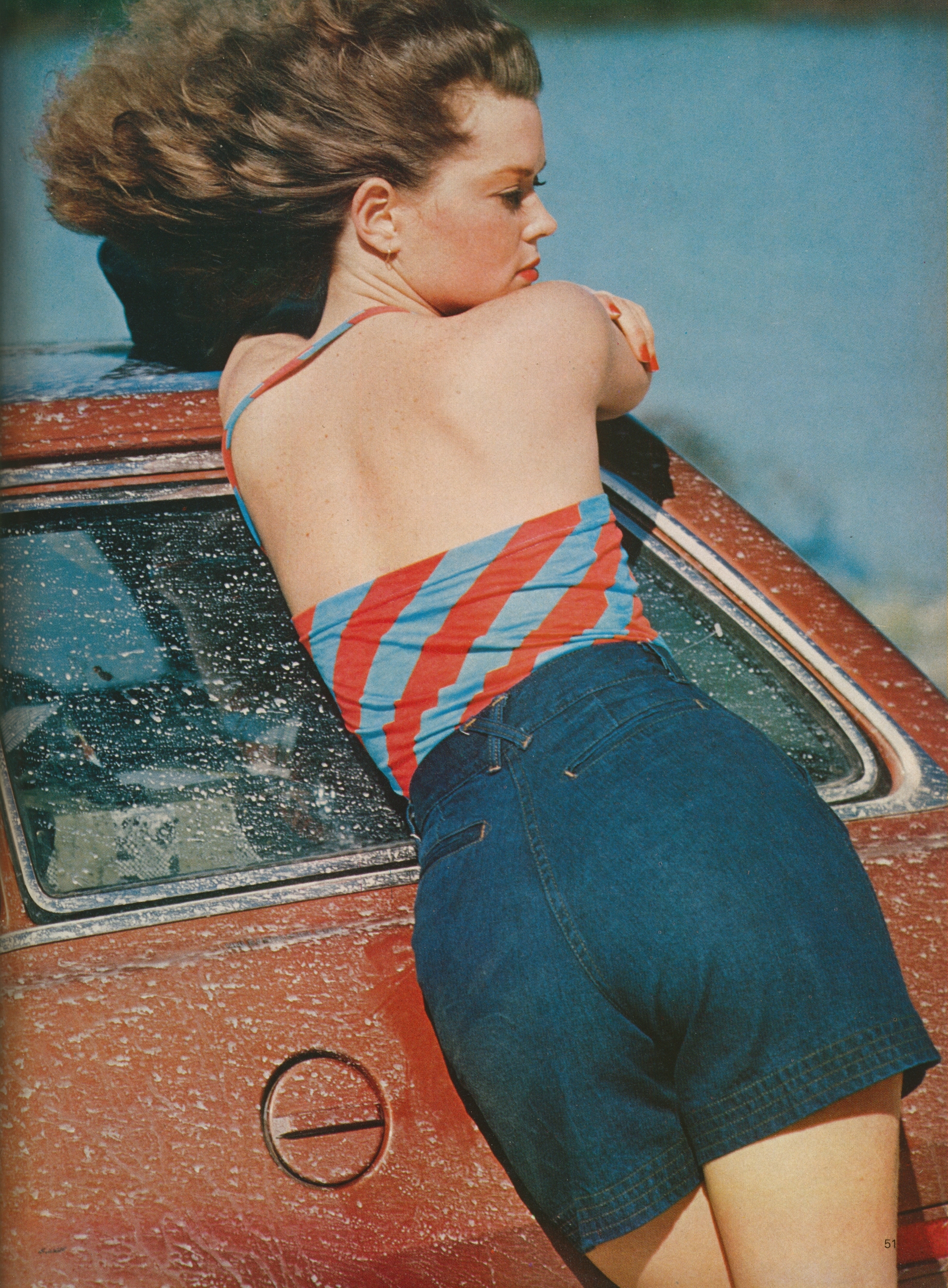
Skimpy striped cotton tube sun top with thin halter-neck straps, Jap £5.95, from Jap & Joseph, 20 Brompton Rd, SW1. Denim stitched Bermuda shorts, Eagle £6.95, from Miss Selfridge, Duke St, W1; Dickins & Jones, Regent St, W1.
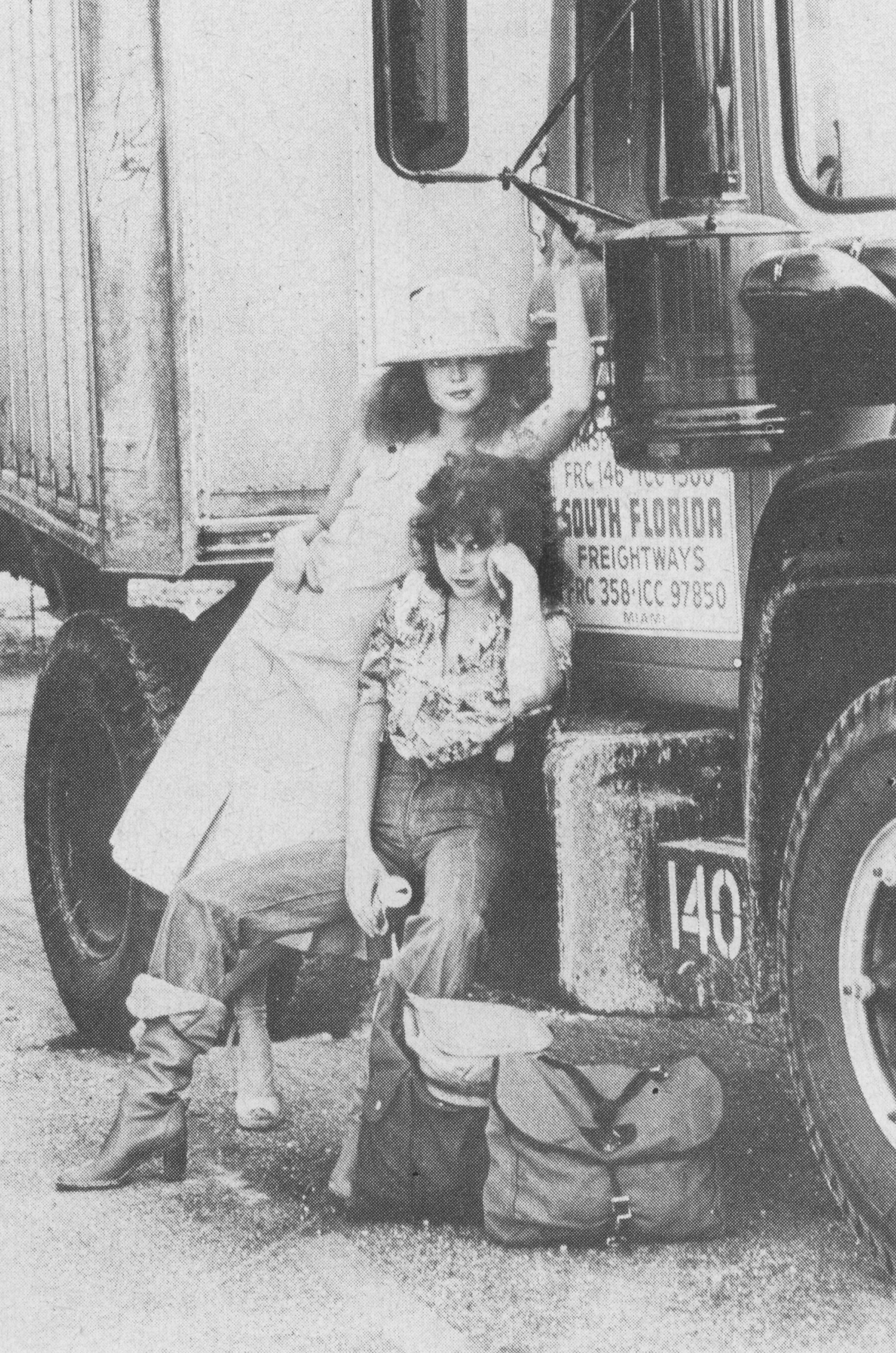
LEFT: Navy and white striped cotton back buttoned sundress with kick pleated front, Inega £10.95, from Jigsaw, Heath St, NW3 and Putney; DJ Girl, Dickins & Jones, Regent St, W1; Superstar, Leeds. Sunhat, Charles Batten £7; pale blue sandals, Russell & Bromley £18-99. RIGHT: Denim jeans with detachable cream braces £12.99, from Jean Junction, King’s Rd, SW3 and branches. Tropical printed cotton shirt, £6.50, from Tropical Belt, Beauchamp Pl, SW1. Boots, model’s own.
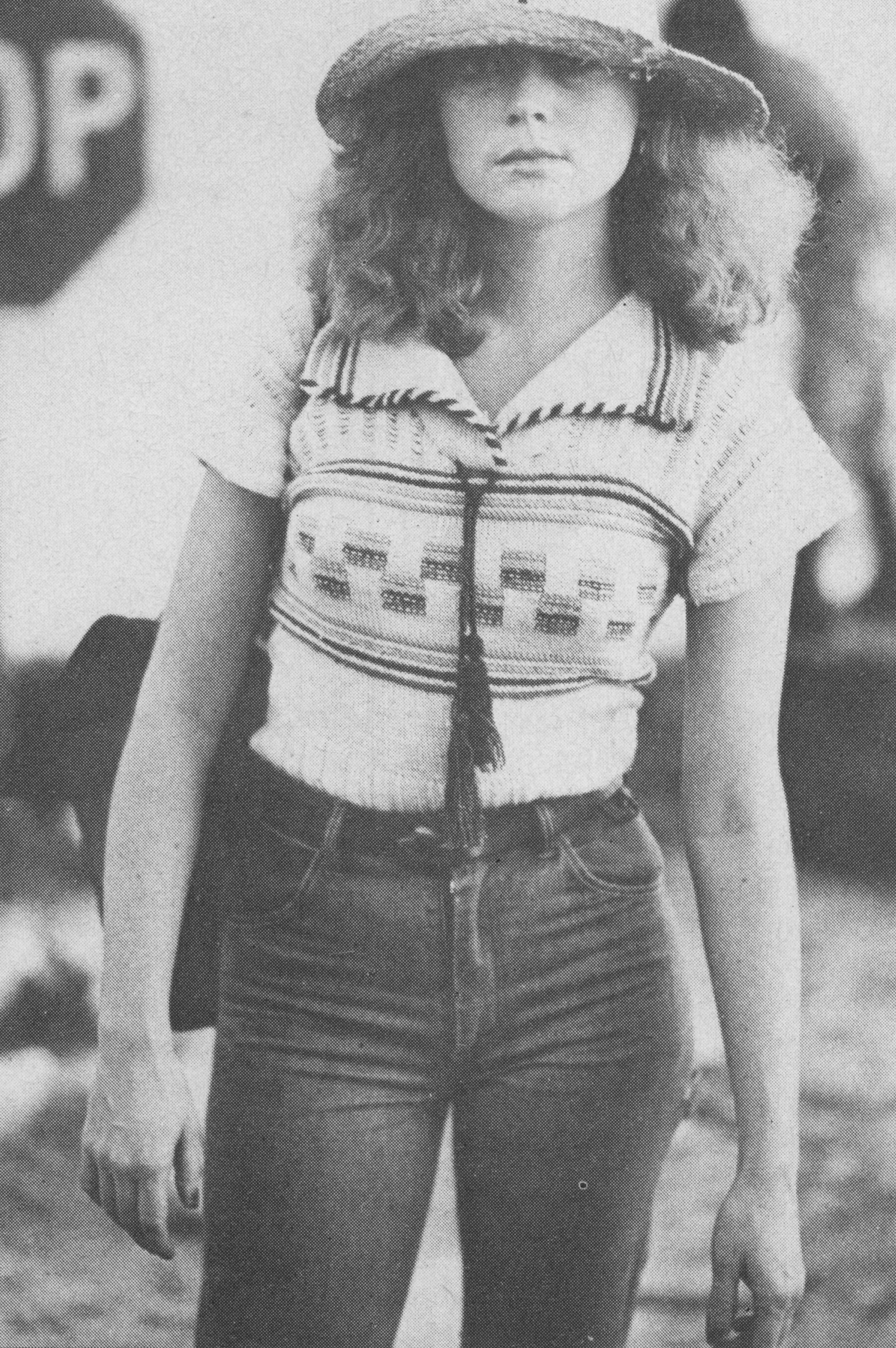
Oatmeal sweater with maroon and green trim, Ivory £13, from Harvey Nichols, Knightsbridge, SWI ; Miss Selfridge, Duke St, W1; Virgin Rags, Hull and branches. Denim painter’s jeans, Marshall Lester £10, from Harrods, Knightsbridge, SW1 ; Jane & I, Blackheath, SE3 ; Sidney Smith, King’s Rd, SW3. Sunhat, Charles Batten £7.
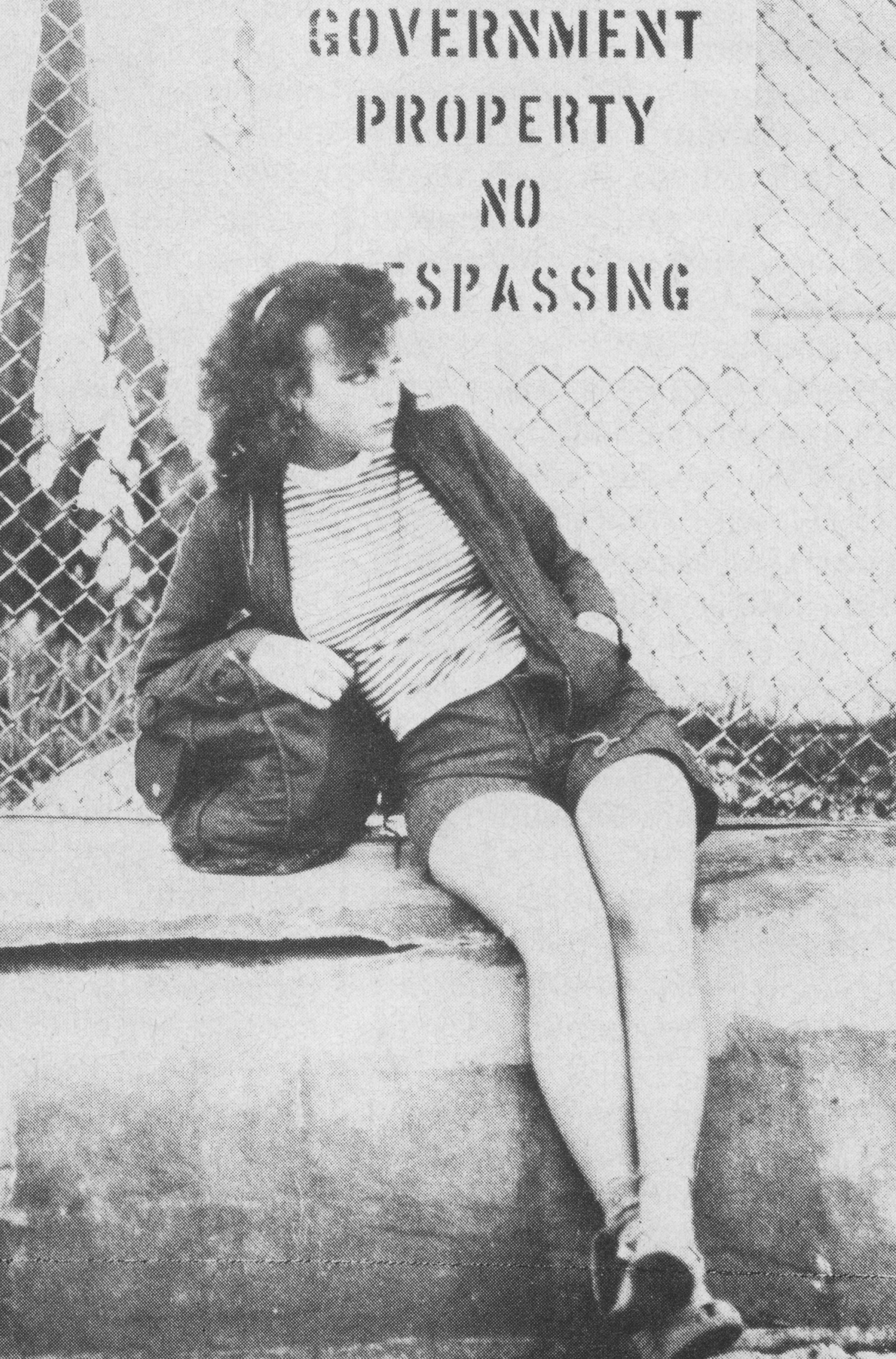
Hooded zip-up denim anorak £10.50, from Jean Junction, Kensington High St, W8, King’s Rd, SW3 and branches. Denim shorts, Marshall Lester £7, from Harrods, Knightsbridge, SW] ; Jane & Blackheath, SE3 ; Boa, Sheerness. Lime green and white striped cotton T-shirt, Stirling Cooper £2.95, from Ronnie Stirling, Bond St, W1; Top Shop, Oxford Circus, W1; Owen Owen, Coventry and branches.
Black and white seersucker skirt, Stirling Cooper, £8.50, from a selection of prints and designs at Miss Selfridge, Oxford Street, London W1 ; sweater 75p, also from a selection at Miss Selfridge; scarf from Chelsea Antique Market.
This summer’s new long day skirts might make attractive alternatives for those who fancy a change from shifts and pants. Worn as Italian film actress Nicholetta Machiavelli likes them, with simple T-shirts and an old prop-basket petticoat, they look casual and romantic, and are surprisingly cool to wear.
Styled by Meriel McCooey.
Photographed by Eva Sereny.
Scanned from The Sunday Times Magazine, August 6th 1972.
Bright tartan seersucker, £8.50, sweater £1.95, both at Miss Selfridge.
Frilled, elasticated top £2.50; split-sided skirt £3.70, both from Diana Doe.
halter top, Diana Doe £1.75, mail order from Do Do House, 69,Bedford Road, Reading RG1 7EY, Berks; skirt £8.50, at Miss Selfridge.
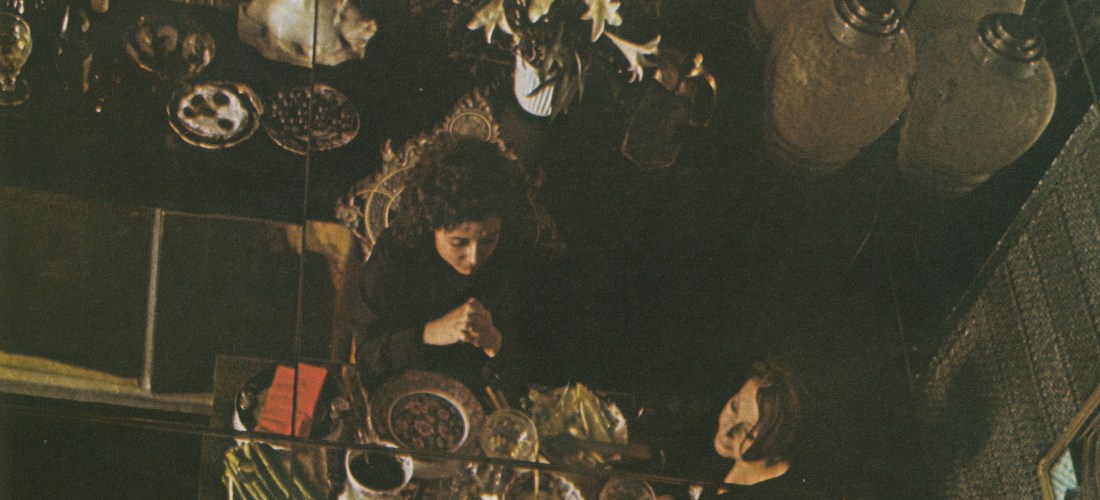
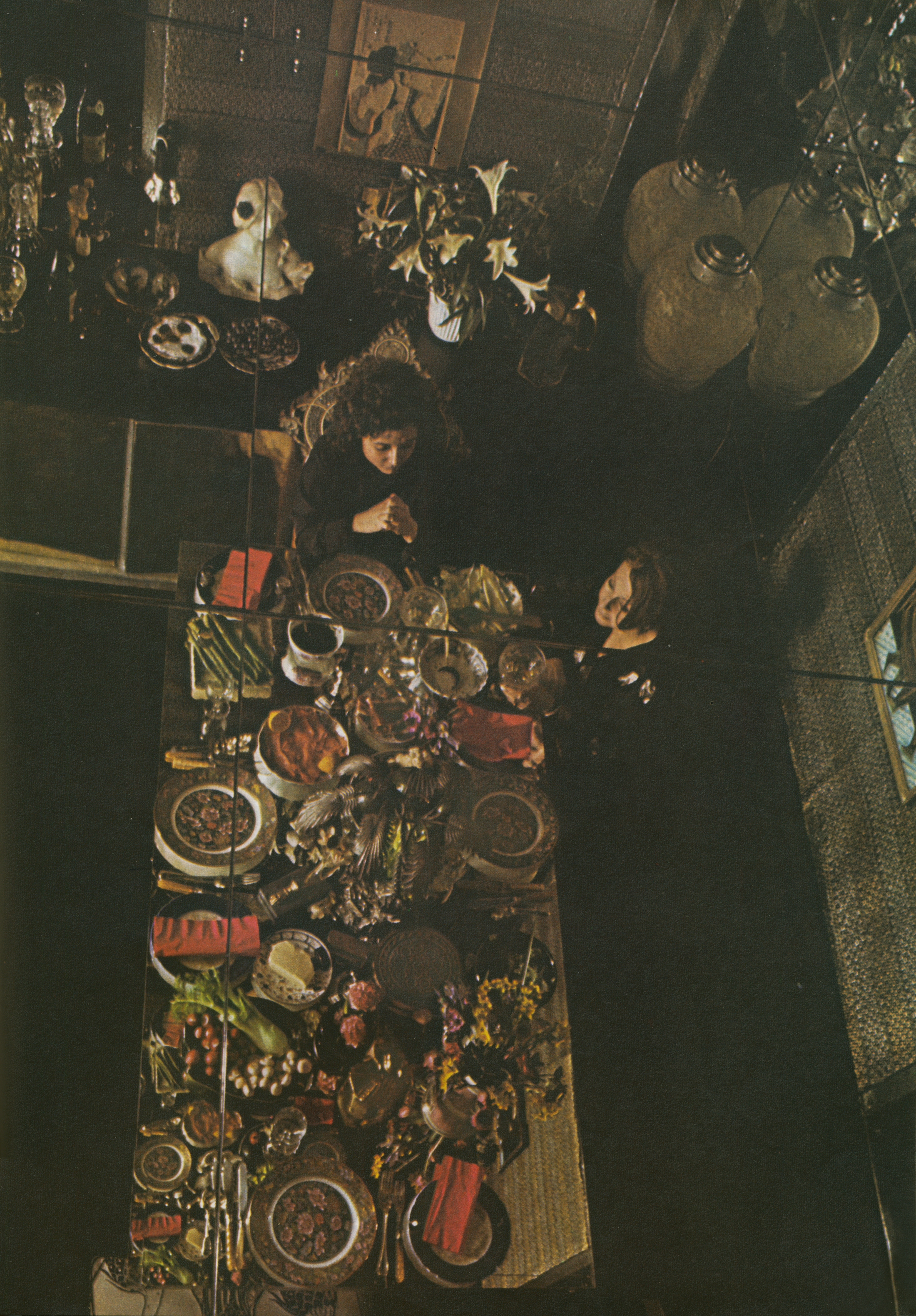
Thea Porter (right) and her daughter Venetia. On the richly decorated table are some of Mrs Porter’s favourite Lebanese dishes.
‘The great thing about an Arab meal is its variety’
Thea Porter, painter and dress designer, whose shop in Soho and flat off Piccadilly are ports of call for the international set, writes about cooking Arab food.
I love my kitchen – from the neatly stacked Margaux (Brane Cantenac is a current favourite) to the painted Louis XIV cherubs smiling innocently from the shiny brown wall into the mirror shelves opposite, lined with Damascus spices and French herbs. Even late at night I enjoy boiling up an anti-hangover drink, and gazing at my cookery books before carrying one up to bed to plan some future meal.
But I also get inspiration in restaurants. Sitting in the ordered splendour of the Orangerie in the Ile Saint Louis (where the waiters all look like jeunes premiers among the flowers) I think of my kitchen, and wonder how to re-create the delicious sauces without bothering the chef. How do people con recipes out of restaurant owners ? I try to guess the ingredients, and then have to keep going back to make sure the proportions are right.
At the Orangerie they have enormous baskets of crudités – like cornucopias by Tiepolo – overflowing with mush-rooms, avocados, grapelike tomatoes and black radishes to go with smoked ham, and two different sauces. One, I think, is made with thin cream cheese (Gervita from Roche, 14 Old Compton Street, W1 will do) mixed with cream or yoghourt and chives. Their vinaigrette is also excellent – the herbs are so finely chopped it breaks my heart. This type of hors d’oeuvres is my favourite start to a meal. I quite often add tarama to go with the avocado, or a mixture of cream, finely chopped shallots and artificial caviar. Smoked salmon is an alternative : it rather depends on what one can find.
I never have time to shop in London, and usually send someone out with a list. This system breaks down when smoked trout instead of fresh trout is discovered sitting in the kitchen -but it is also fun to improvise at the last moment. I always have a supply of tins from Roche to fall back on, and a packet of paper-thin Greek pastry from the Hellenic Provision Stores to make burreks . These can be layered and stuffed with practically anything, then rolled into thin cigars and baked.
The best thing about raw vegetables, apart from their crisp texture with the melting sauces, is that they are so pretty. Nothing is so exquisite as plumed sliced fennel or cauliflower. (Edna O’Brien says she finds even sliced leeks that tendril round her fingers beautiful.) I pile them into a motley collection of Japanese bowls and plates and arrange them with bowls of flowers, although not as ambitiously as they do at Parkes, where roses nestle expensively by the melon. I think I must spend as much on flowers as on food. (If I’m cooking something really smelly, I find even lilies aren’t enough, so I light one of those Rigaud candles on the stairs.)
But if you have crudites for starters, and have to peel mushrooms and clip radishes, there is very little time left for preparing the main course. So it has to be something easy like sirloin, very rare with horseradish, served with tinned flageolets from Roche – either heated up with cream, or cooked the way Arabs cook broad beans, with fried onion and pounded coriander – delicious.
Arab food is ideal for the hard-pressed woman, torn between trying to call New York and attend to her guests, as it is always better the next day. I’m very fond of a Lebanese Lenten dish: spinach leaves stuffed and slowly cooked in oil and water. This is a delicate dish and should melt in the mouth if cooked long enough. Another Lenten dish is artichoke hearts fried in oil with onions and then simmered in water and lemon. Lebanese food has a lot in common with Provençal cooking, which means that I can start with an aioli with cod, potatoes, hard-boiled eggs and salsify, and then go on to sfeeha – a kind of Arab pizza, spread with mincemeat and pome-granate seeds, and served with thick yoghourt and a sharp lemony salad of green tomatoes and cos lettuce. As a child I used to watch black-visored Muslim women on a Friday clustered round a waterfall, greedily stripping and eating cos lettuces the way people here eat chocolates at the theatre.
The great thing about an Arab meal is that there is always a large variety of things to eat – often all plonked on the table at the same time. So you can choose a spoonful of this and a taste of that – excellent when you want to talk and drink in a leisurely way, and easier than coping with a large plateful of the one thing you perhaps can’t stomach. It certainly takes quite a lot longer to prepare ten or fifteen small dishes, but to my mind it makes for a more exciting meal.
I try not to give food that I myself adore (like brandade de morue) to guests who may not happen to enjoy that very earthy taste, unless there’s another choice. Brandade de morue is rather a soothing thing to cook with the music programme full on : you slowly heat oil in one saucepan, and milk in another, then beat minute quantities of each in turn into the desalted and poached salt cod. Some people add mashed potato for instant smoothness.
As I’m extremely greedy, I find cooking soothing and enjoyable after working and thinking all day, and I enjoy every stage – breaking eggs and beating them into a smooth hollandaise to go with a pearly bass cooked with tarragon in champagne dregs, or chopping up cuttlefish and stewing it a la libanaise in its beautiful sepia ink to make a thick, wicked-looking sauce with an intoxicating smell.
French cooking is undeniably far more subtle than anything oriental can ever be, but you do need time the same day. I find the sauce cracks when I try and heat up a poulet en demi deuil , while Circassian chicken is just as good heated up.
These are two extremes of taste, and it’s difficult to find a wine that will stand up to highly flavoured food, but that still goes well with a subtle flavour. I do my wine tasting at the Jardin des Gourmets when I eat there, and can then usually find the same wines at a cut-price wine store, Milroy’s in Greek Street.
There are so many exciting things to eat, it’s difficult to choose – though it’s easier to prepare something you like enormously than to experiment. I sometimes regret not living in France because the matieres premigres are so good there: the first white truffles to make into a salad or to roast on skewers ; fresh, white, shelled and skinned walnuts soaked in salt water ; the endless herbs that are always around and that you do not have to hunt for. Alas, the herbs in my window boxes wither and die regularly, but I shall doubtless go on re-stocking them hopefully until I wither and die too.
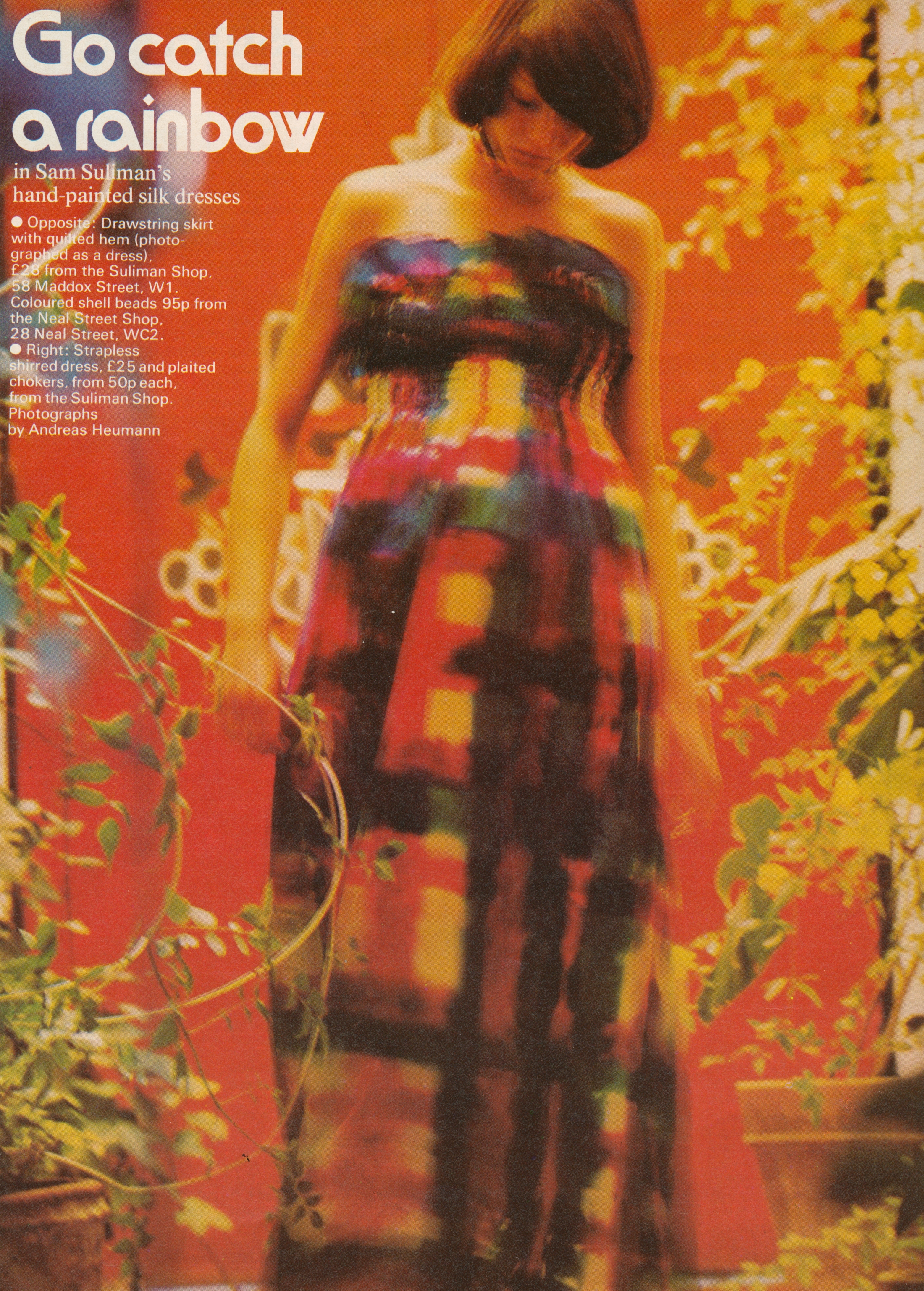
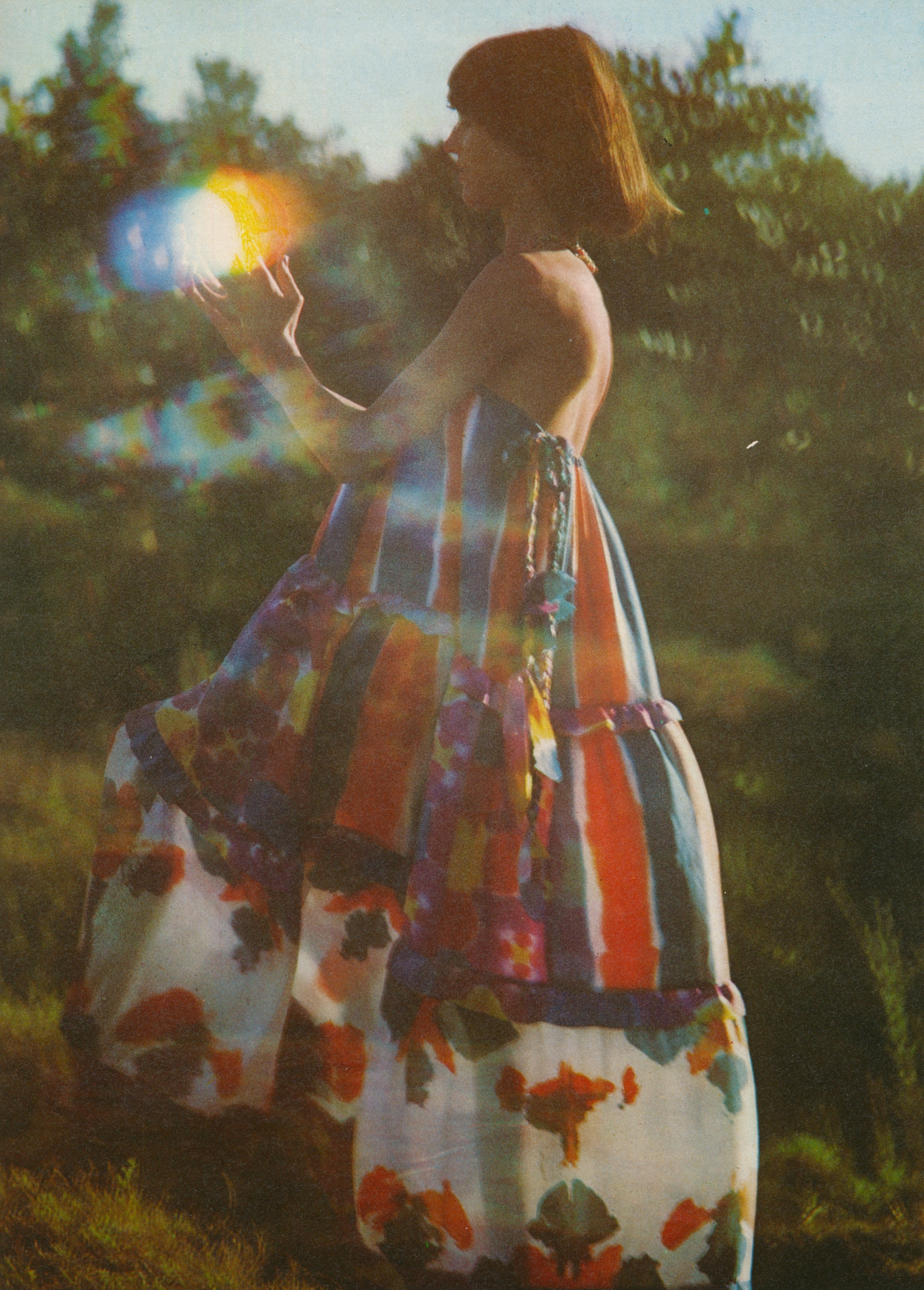
Strapless shirred dress, £25 and plaited chokers, from 50p each, from the Suliman Shop.
Go catch a rainbow in Sam Suliman’s hand-painted silk dresses.
Photographed by Andreas Heumann.
Scanned from Over 21 Magazine, July 1973.
Drawstring skirt with quilted hem (photographed as a dress), £28 from the Suliman Shop, Maddox Street, W1. Coloured shell beads 95p from the Neal Street Shop, 28 Neal Street, WC2.
Boa-skin vest with inlaid star, designed by Willy, Ibiza. Probably available in England soon. Vest costs 4,980 pesetas, island shoes 80 pesetas.
More impact-making ideas from the romantic island of Ibiza.
The designer of the boa-skin vest in the first picture is also the stunning model for this gorgeous mini editorial, Willy van Rooy. You can still buy her beautiful designs on her website http://www.shopwillyvanrooy.com/.
(If her face looks a bit familiar, it might be because she’s also the model for my mannequin over at Liz Eggleston Vintage.)
Styling by Sue Hone.
Photographed by Karl Ferris.
Scanned from Petticoat, 18th July 1970.
Fringed dress and pants by Silvien, Formentera. 5,000 pesetas from Zoe boutique, Ibiza. Jewellery chosen from a selection in the boutique.
Left: Jacket, dress and hat crocheted by Birgitta in Ibiza. She thinks of herself as a fashion artist and her clothes as portraits of the people who wear them. Dresses 1,660 pesetas approx.
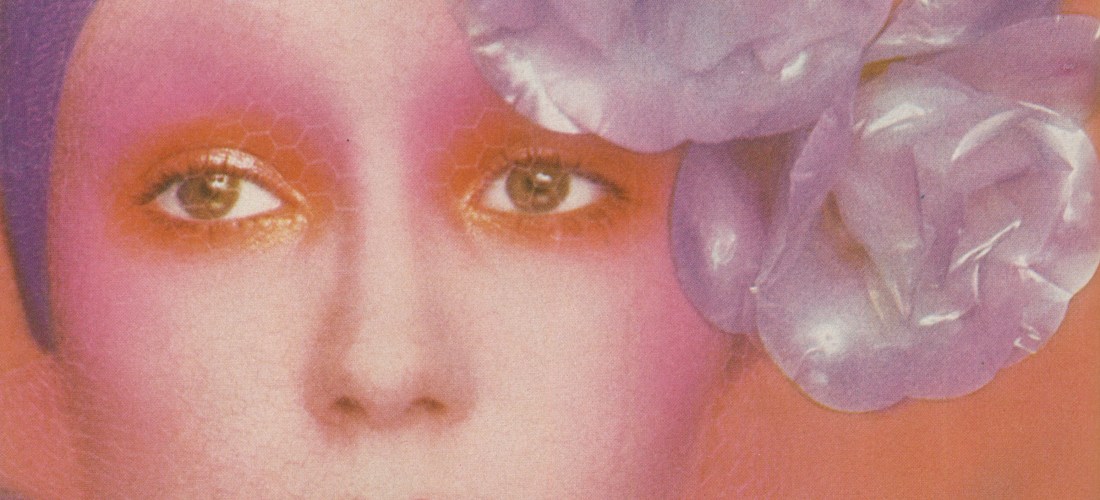
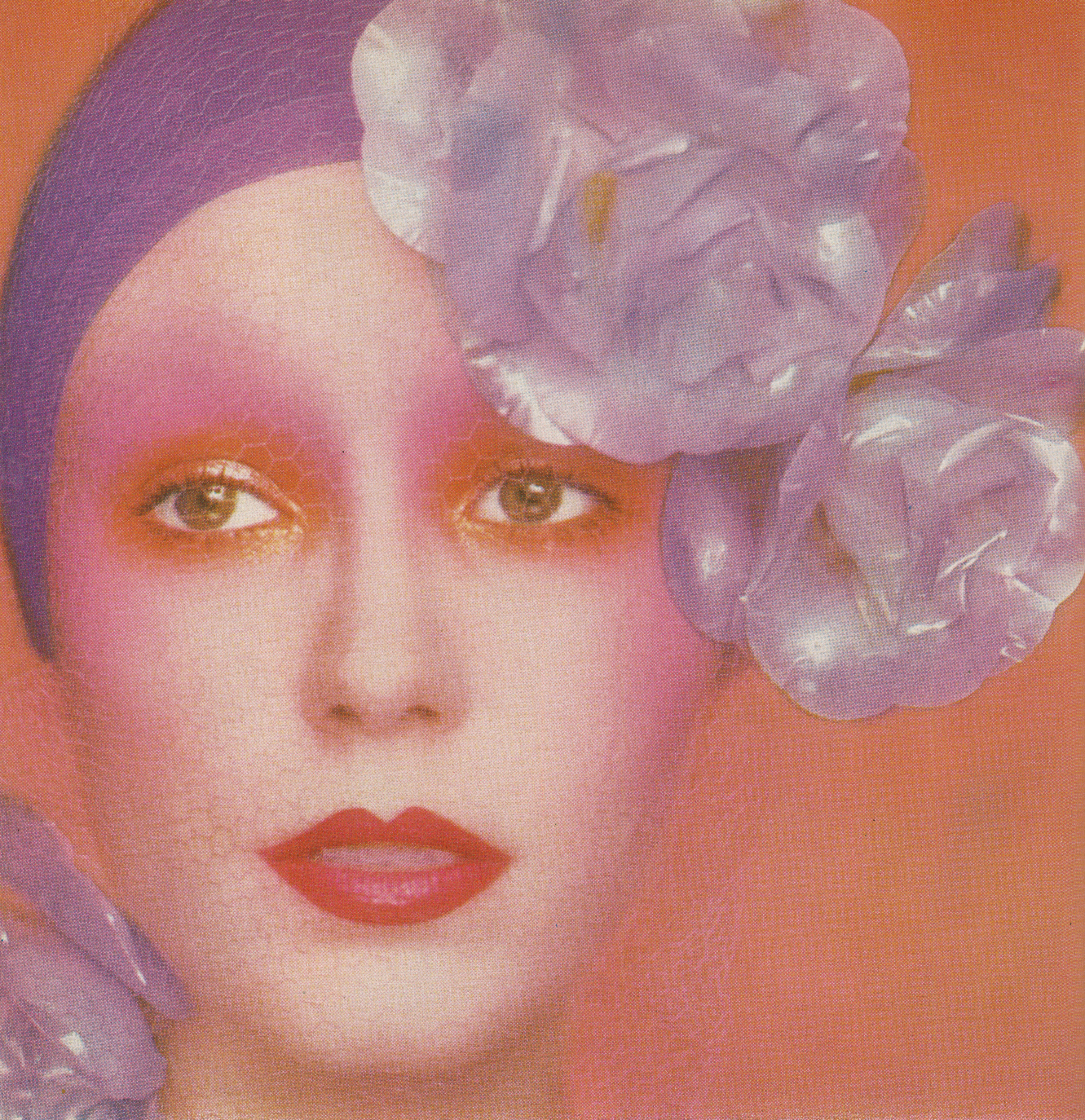
If you’ve never seen yourself like this, see yourself now… in a cellophane sheen, warmer, milkier, and pearlier than plain gloss. For the softest effect of all, here, a judicious use of rosy mauves and mother of pearl behind a shadow of pale veiling. The make-up is Gala’s: Barely There foundation in Honey, dusted with Translucent Light Powder. Pink Dazzle Lipstick used to make rosy shadows above and around the eyes, the gloss dusted away with Marshmallow Eye Shadow, and on the eyes, above and below, Shiny Apricot Liqui Tint pearled with Barely Frosted Highlighter. Liqui Lash Brownish/Black Mascara, and Burning Shimmer Super-smooth Lipstick. Imagine Gala’s Affair Perfume Oil Concentrate in the air. The head is wrapped in amethyst with pink veiling and pinned with pearly mauve flowers made in Italy by Ugo Correani.








 Liz Eggleston