
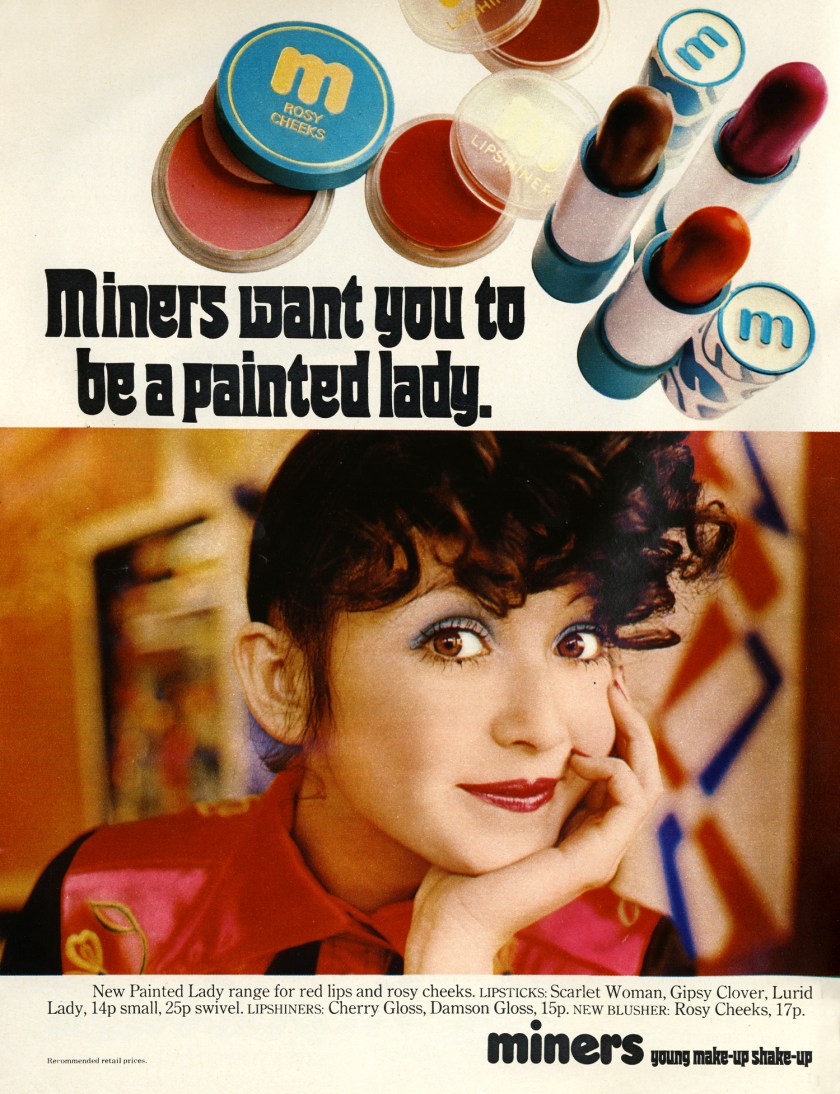
Vivienne Lynn modelling for Miners make-up. Looks like she might be wearing Mr Freedom as well. Divine…
Scanned by Miss Peelpants from 19 magazine, April 1972
Vivienne Lynn modelling for Miners make-up. Looks like she might be wearing Mr Freedom as well. Divine…
Scanned by Miss Peelpants from 19 magazine, April 1972
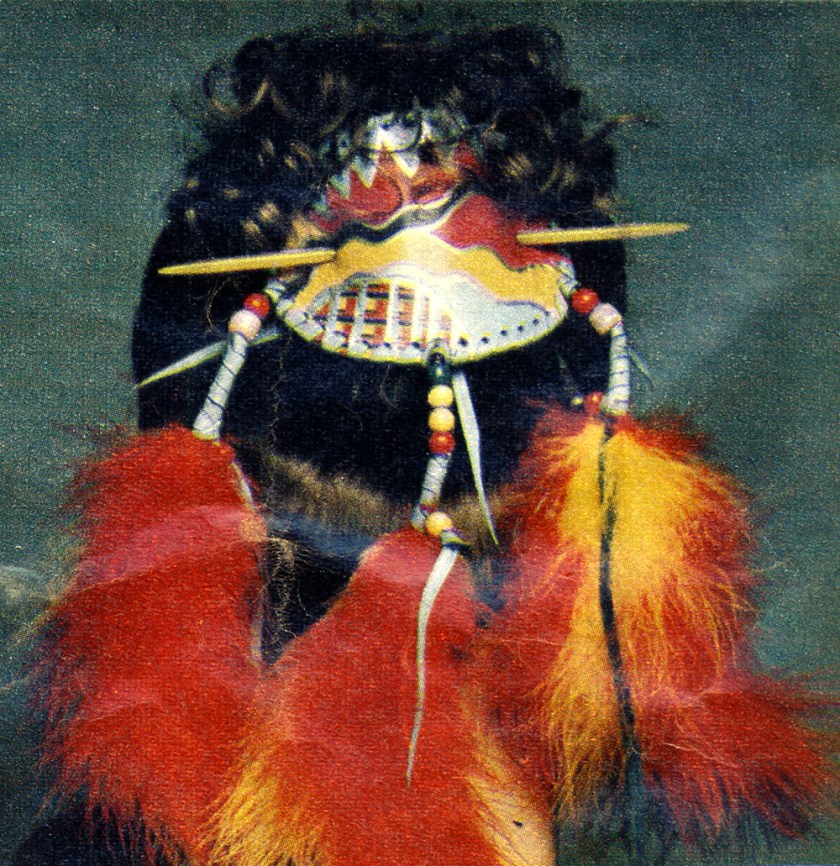
This feathered headdress by Pablo & Delia is exclusive to Leonards.
Get your hair all dressed up for Spring! Beauty girl Ann Morrow brings you the newest ideas for many a yer on the hair accessories scene. But no need to stop there all you want is a mop of hair and a little imagination to get a lot of head-turning effect.
Photographed by John Carter.
Scanned by Miss Peelpants from Petticoat, May 1971.
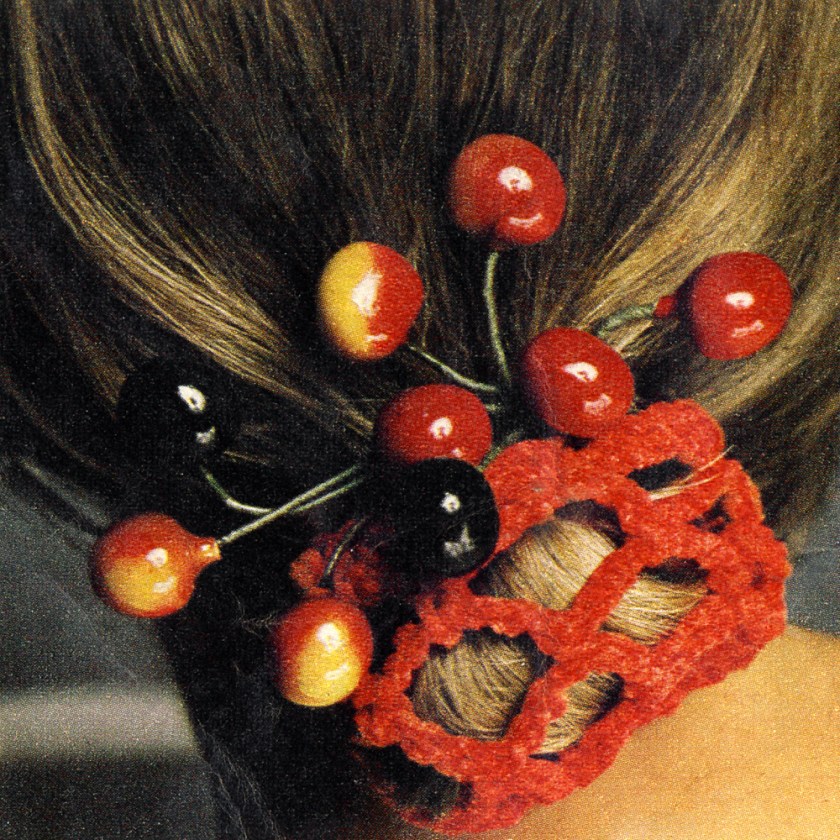
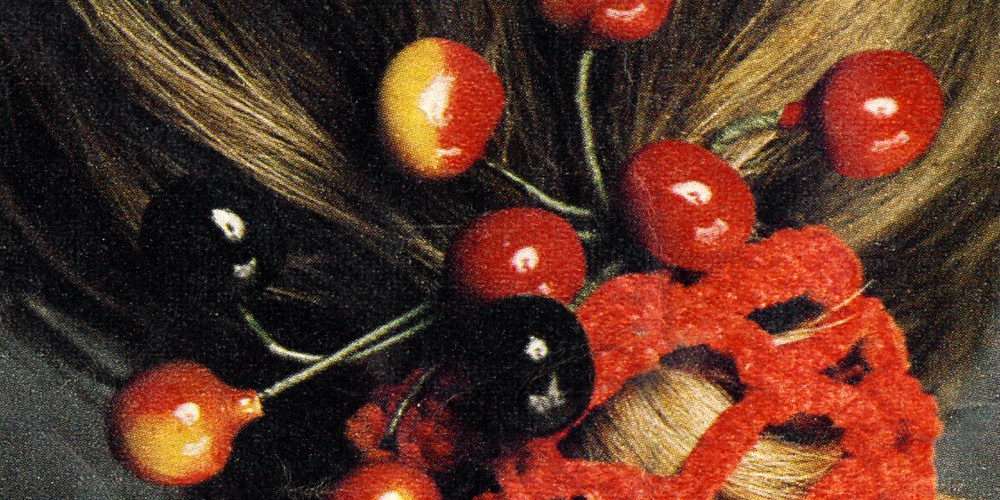
Severe little buns and topknots look good with a snood added. This one came from Fenwick, and we added a bunch of cherries by Mr Freedom.
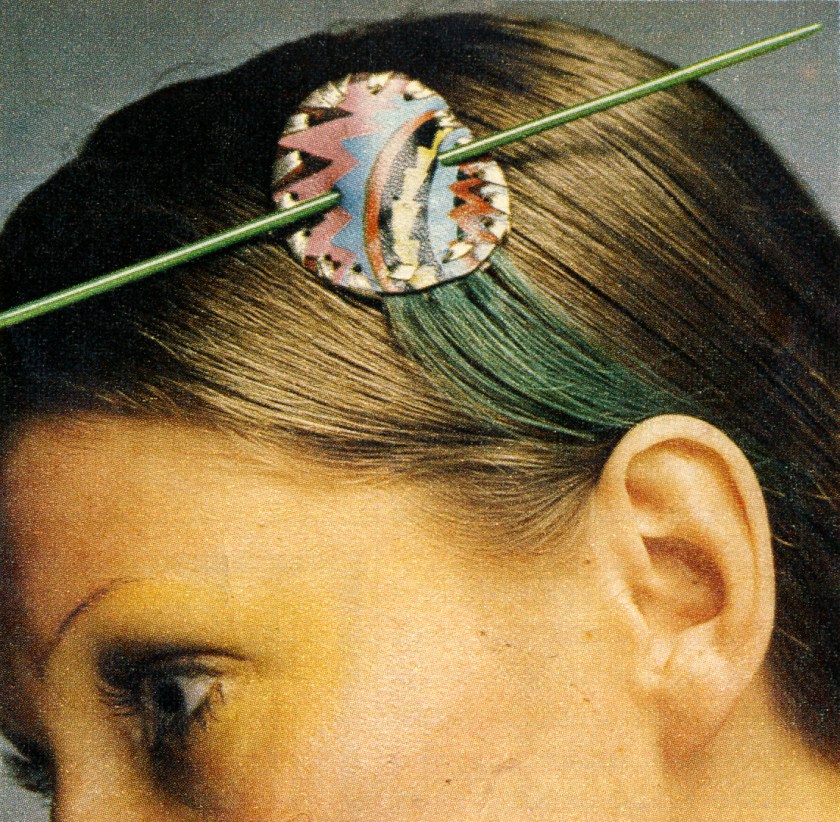
With this painted slide by Pablo and Delia, John at Leonard gave model Chrissie an oriental look. Her hair is drawn back tightly to show off the coloured streak attached to the slide.
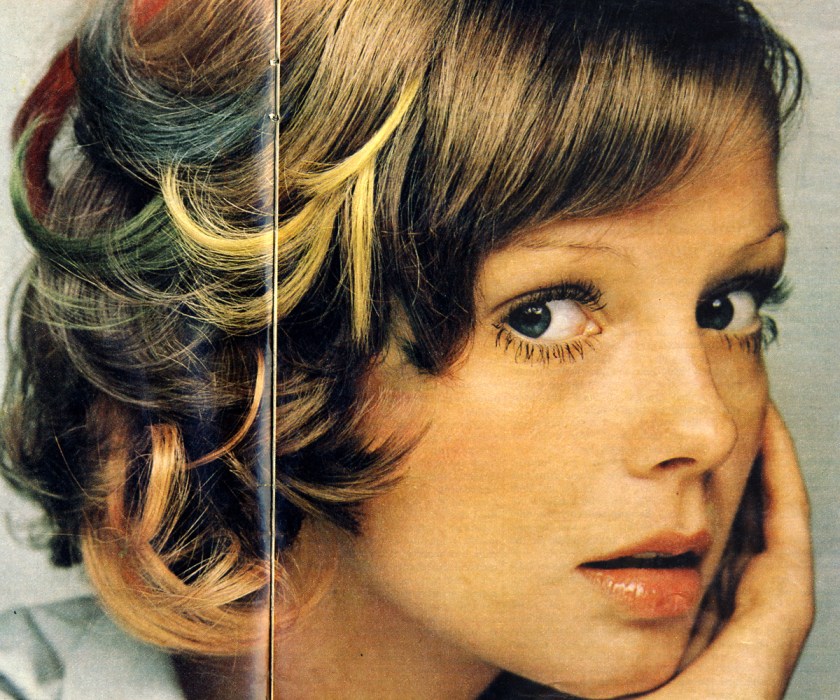
These coloured streaks look like a bird of paradise – mail order them each from Annie Russel, 398 Kings Road.
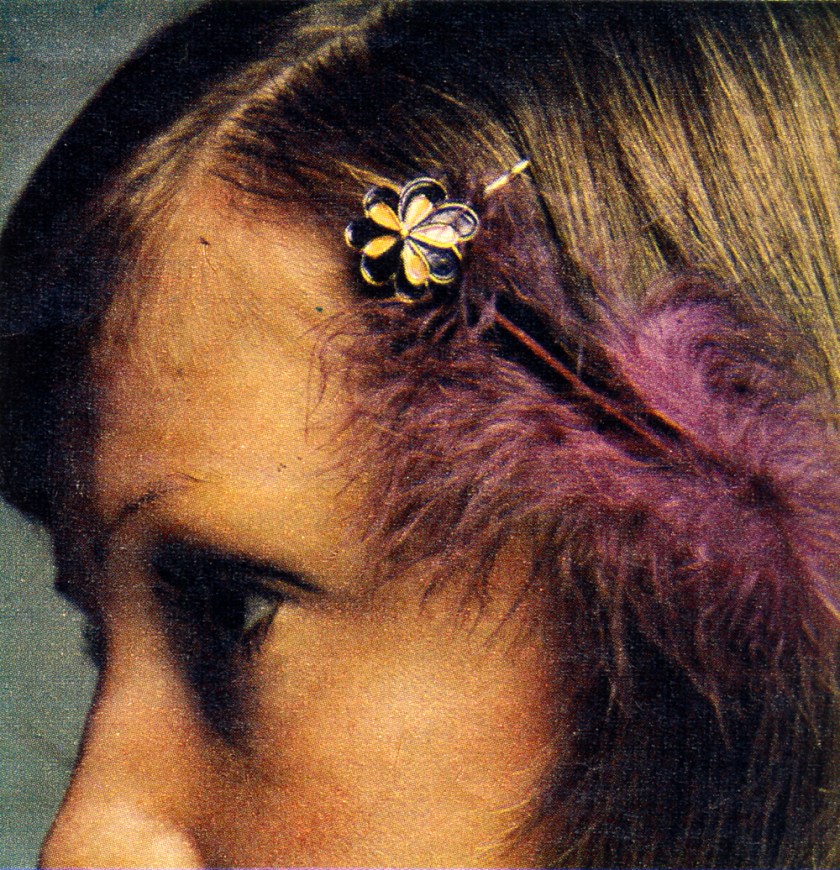
A slide with a feather from Miss Selfridge. Match your eyes to your slide.
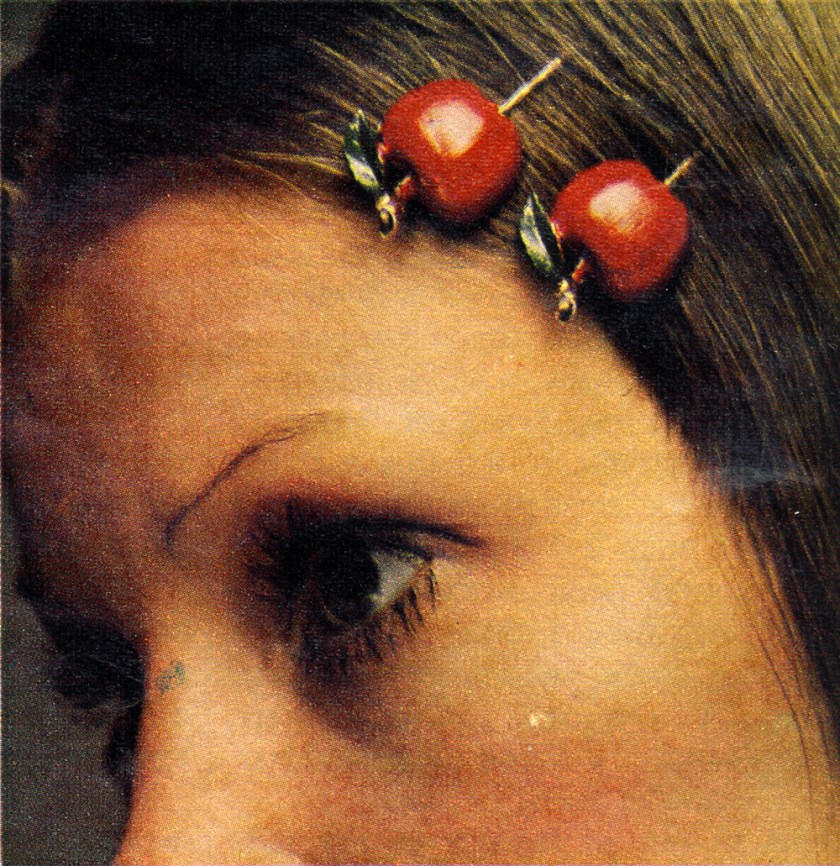
Play about with different slides. We found these in Miss Selfridge – apples that look good enough to eat.
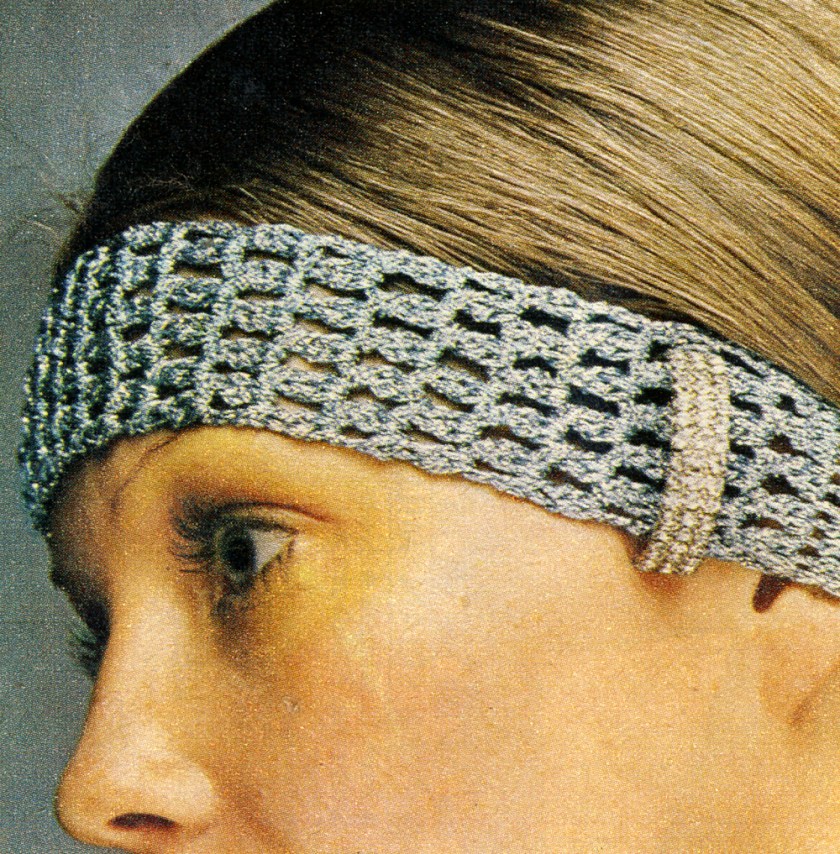
Evening hair goes all glittery with a headband from Fenwick and a Fortes-style slide with a sparkle from Boots.
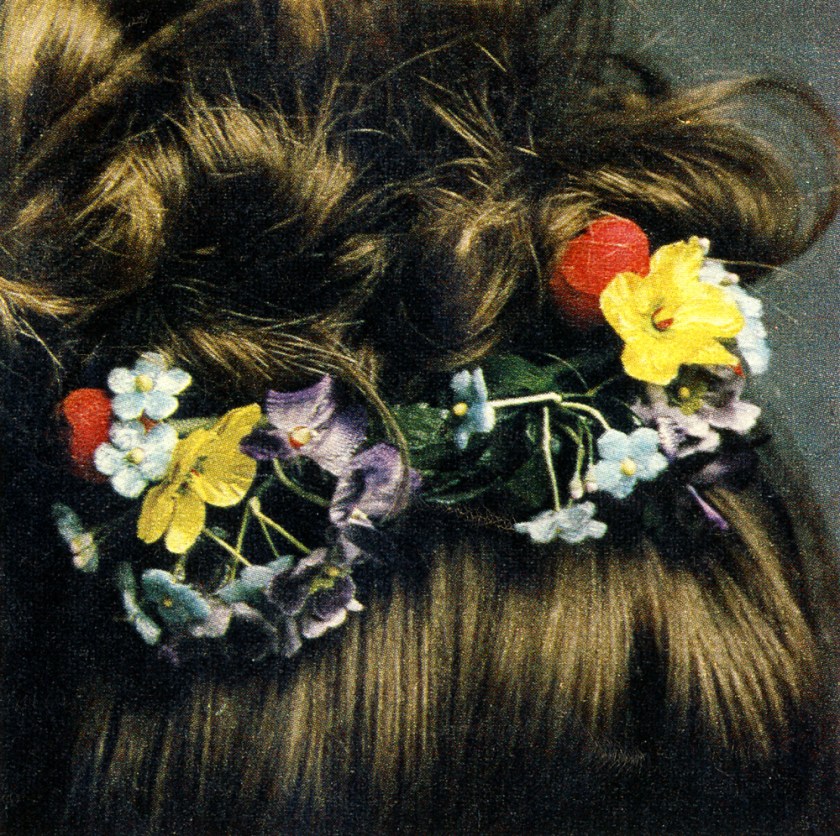
Flowered print are big news, so put some in your hair too This lovely spring bunch comes ready attached to a comb from Miss Selfridge.
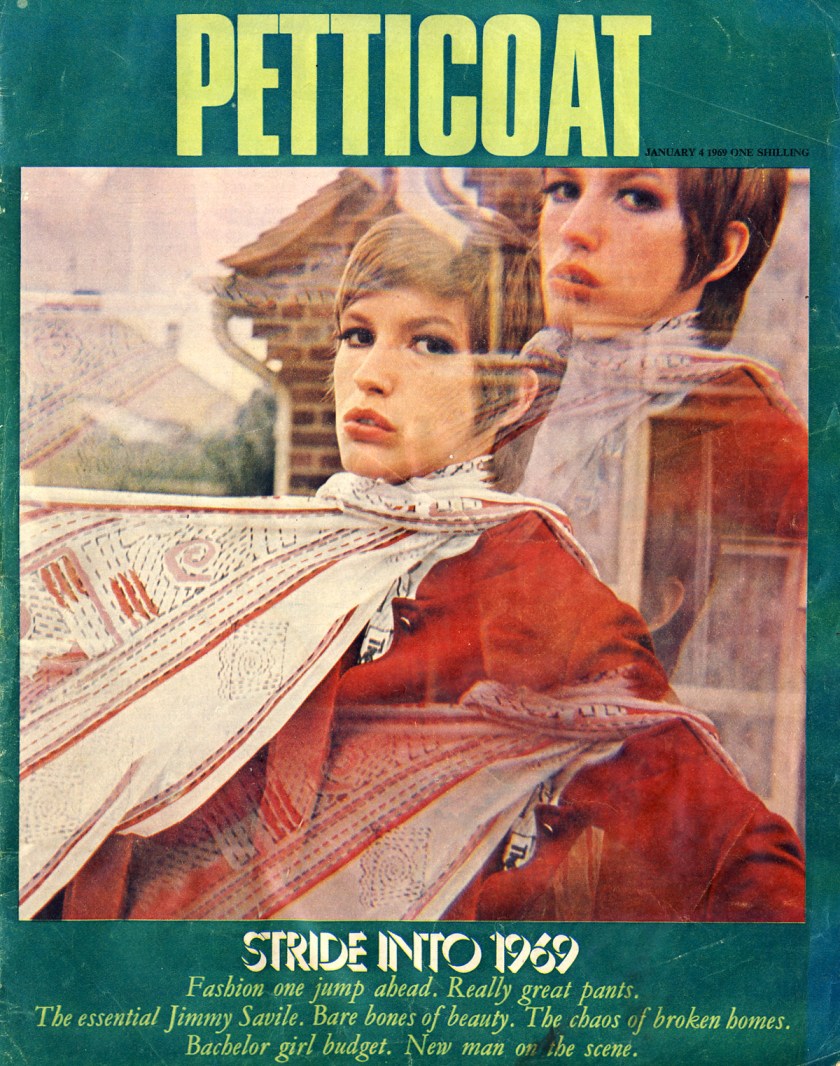
Be an exhibitionist. Entwine yourself with yards of machine-age screen printed scarf by Sylvia Ayton and Zandra Rhodes.
Why wait; be bold, be brave, stay cool! Now – before all the sheep latch onto the look for ’69. Ignore us if you like, but if we’re right (and we think we are) you could be way ahead of the crowd.
Janet Street-Porter modelling clothes by the immensely brilliant combination of Sylvia Ayton and Zandra Rhodes, whose short-lived Fulham Road Clothes Shop is one of the rarest and grooviest boutique labels.
Photographed by Tim Street-Porter.
Scanned by Miss Peelpants from Petticoat, January 1969.
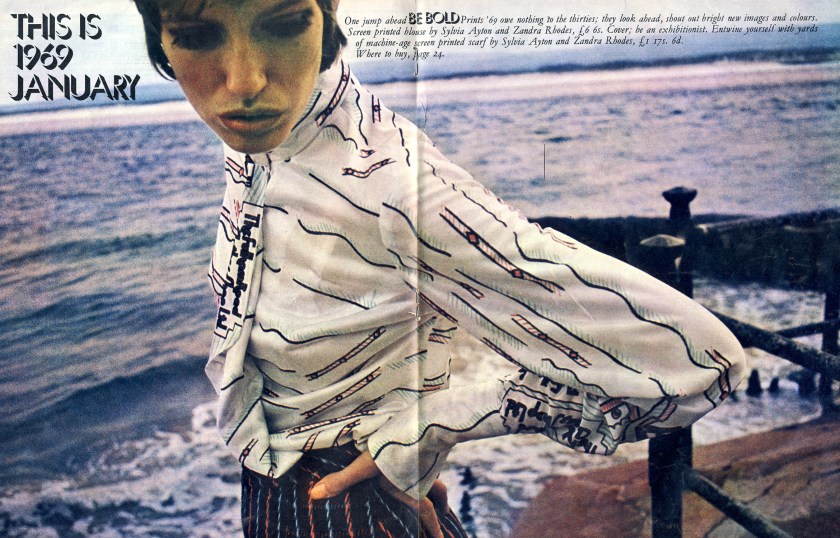
BE BOLD. Prints in 1969 owe nothing to the thirties; they look ahead, shout out bright new images and colours. Screen printed blouse by Sylvia Ayton and Zandra Rhodes.
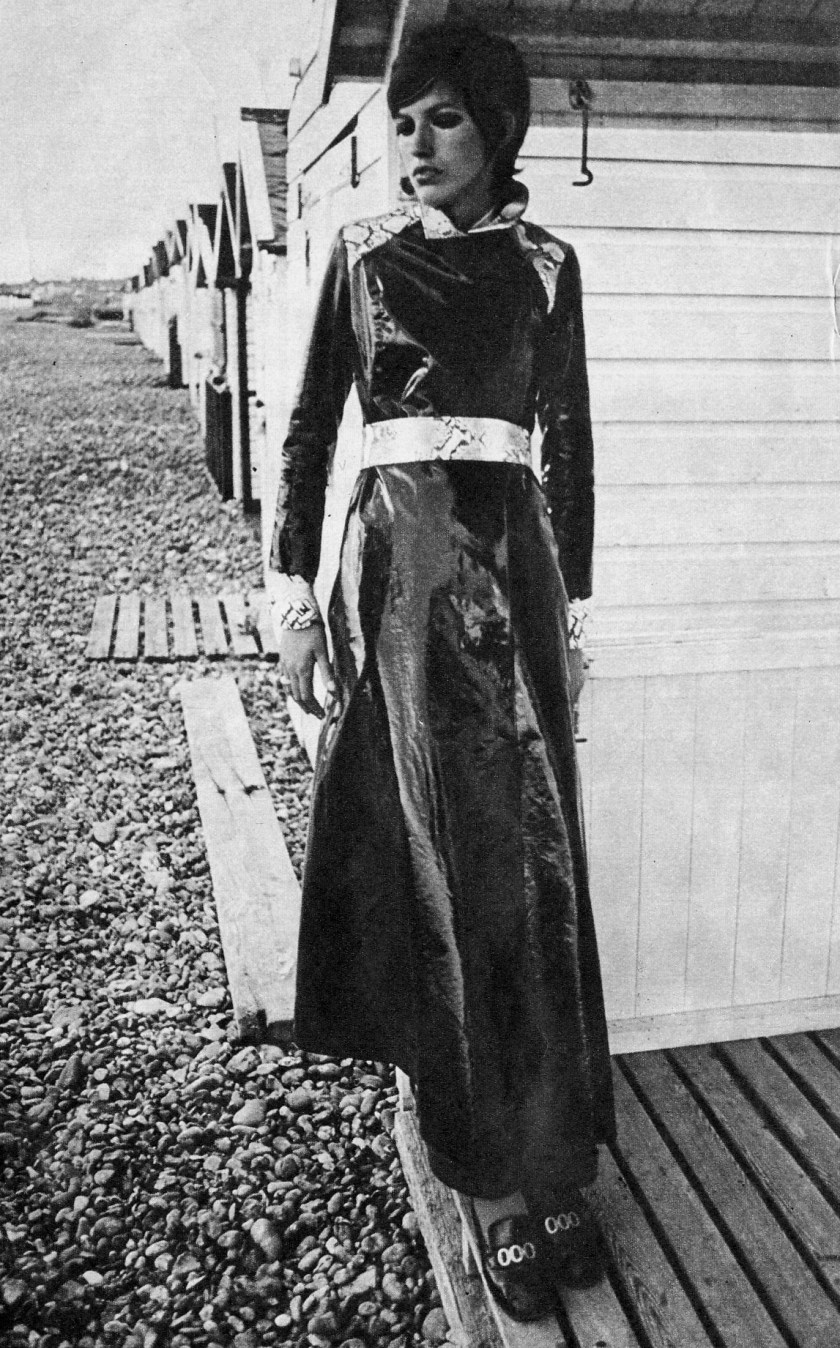
BE BRAVE. Dare to wear the most sensational raincoat we’ve seen for ages. Why wear mini coats when your knees are freezing and soggy. Plastivamp black PVC and snakeskin printed PVC raincoat by Sylvia Ayton and Zandra Rhodes.
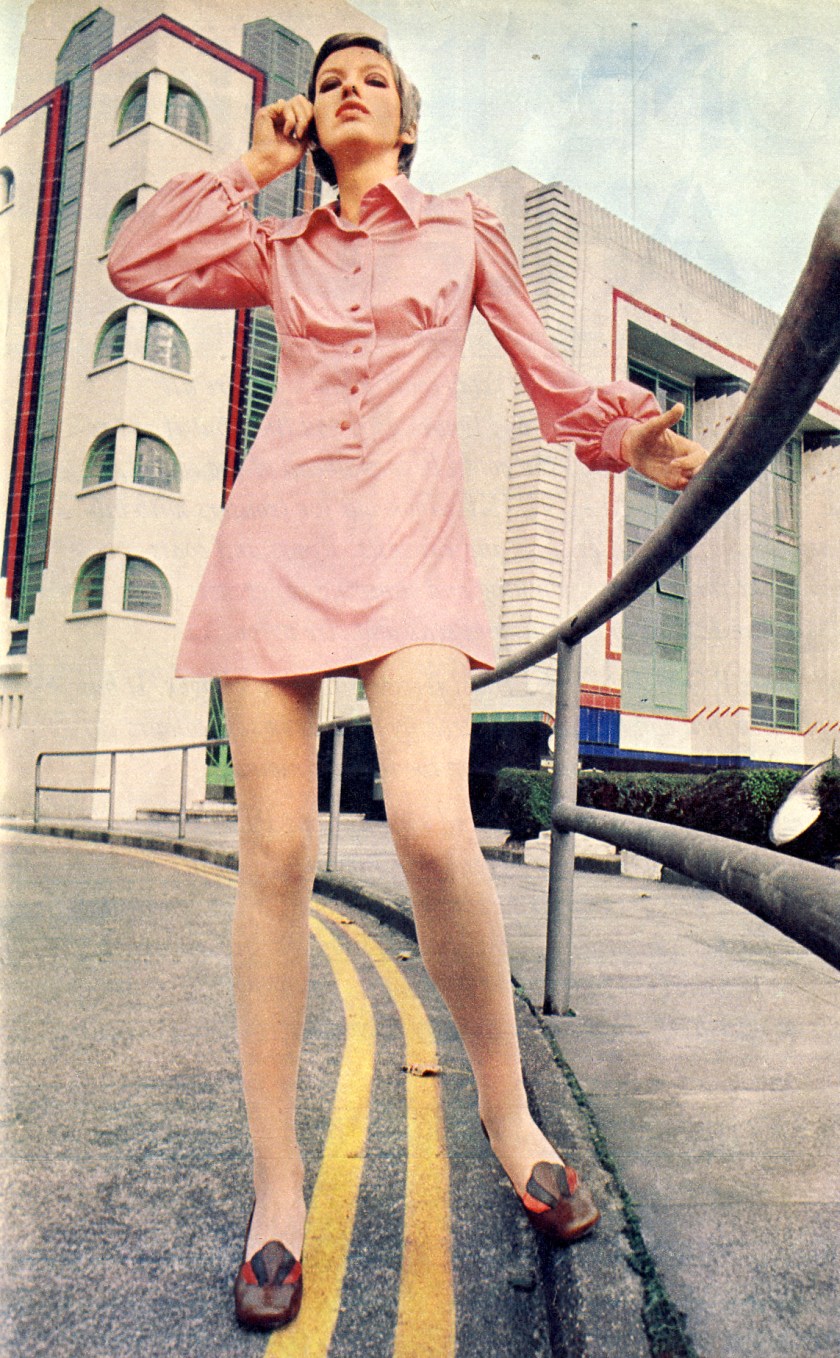
BE BRIGHT. Last year’s after-dark shiners are this spring’s day-time gleamers; pinky orange tricel jersey shirt dress with full sleeves by Simon Massey. Shoes by Lilley & Skinner.
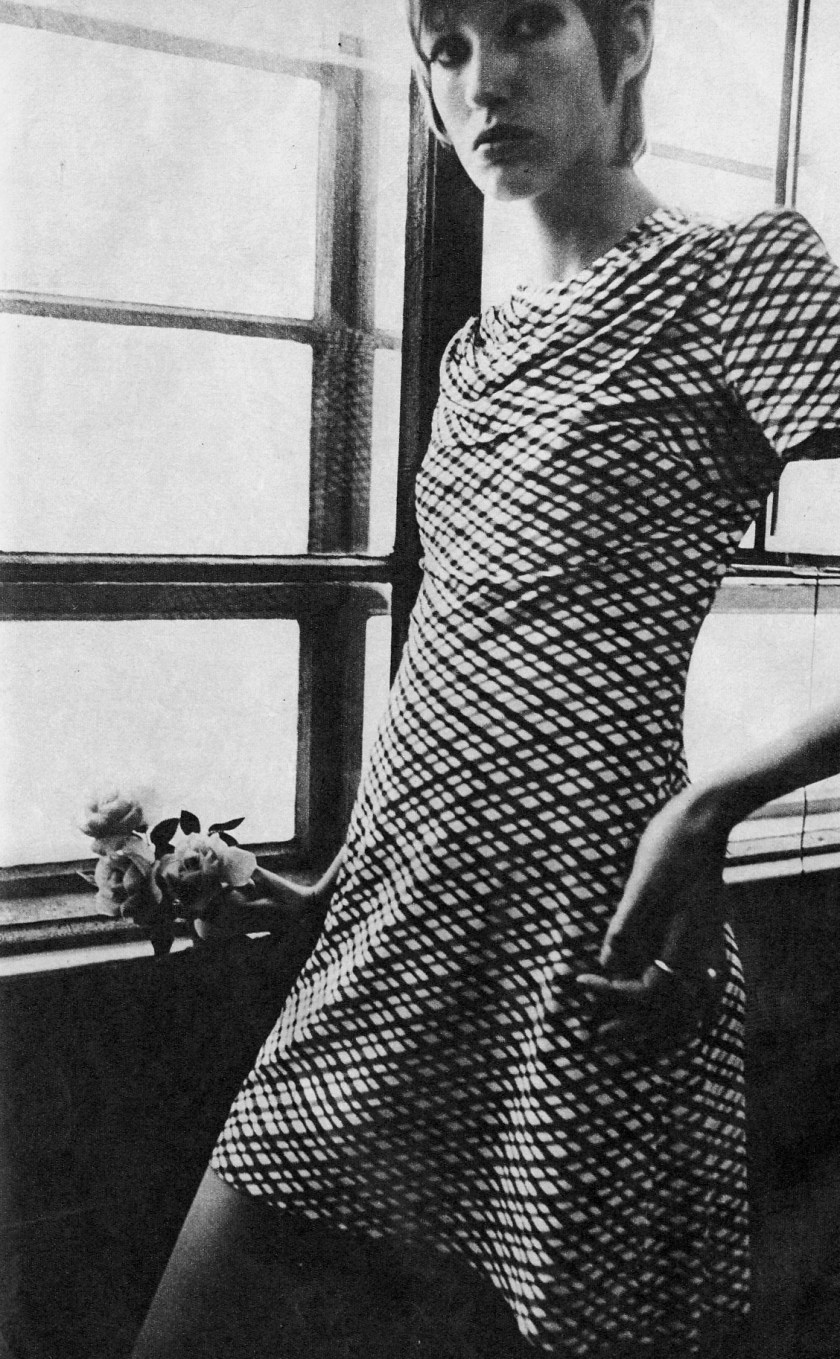
BE COOL. The new fabric cut the new way; clinging Tricel jersey frock with a neckline that mum would remember. Navy and white checked dress by Simon Massey.
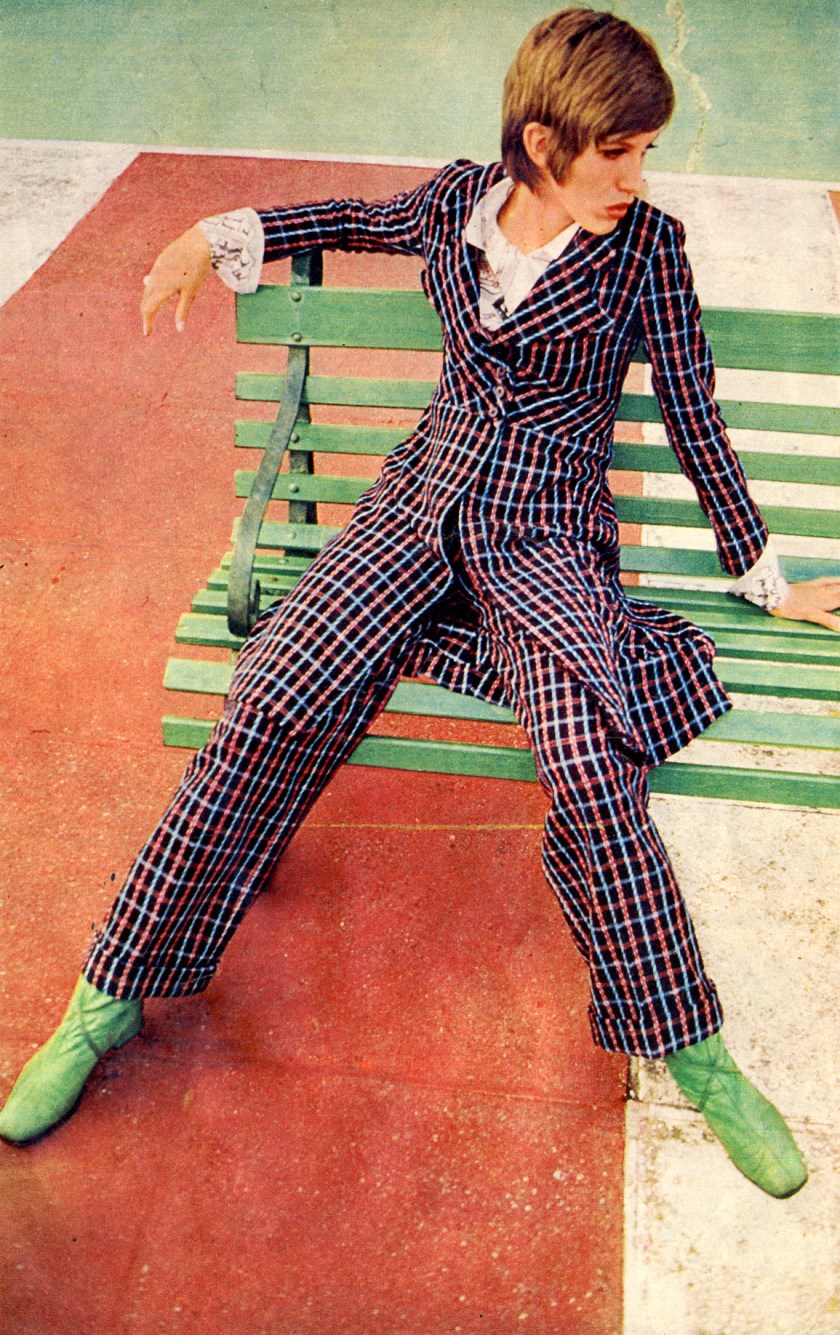
BE BRASH. Vulgar colours are carefully teamed and tastefully cut. Action-packed tweed trousers (with high fitted waistband and turn ups) together with waitsed and flared matching coat by Sylvia Ayton and Zandra Rhodes.
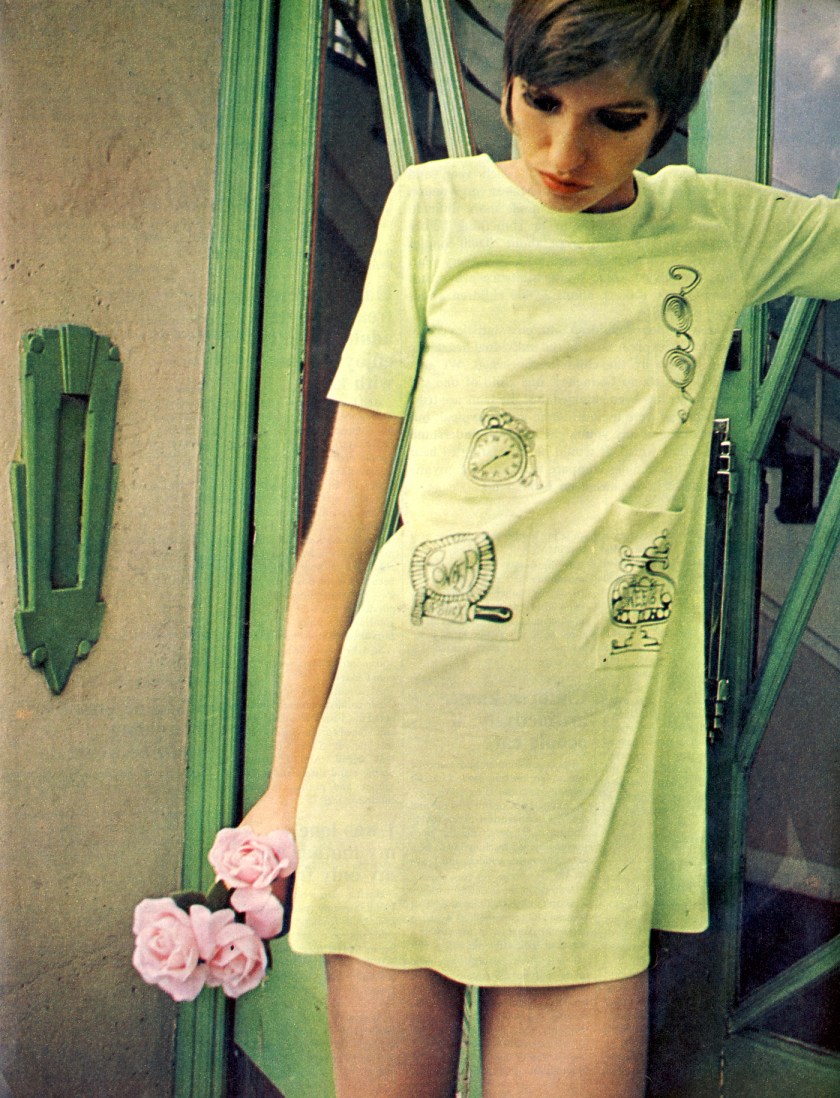
BE WITTY. Dare to laugh at yourself a little; see the funny side of fashion as well s the serious. Mint green courtelle jersey dress with handy pockets for sweeties, by Travers Tempos.

Photographed by Carin Simon.
Scanned by Miss Peelpants from Cosmopolitan, March 1975.
Sarah Drummond talks to six talented people about their highly original hang-ups.
CHRISTINE MARTIN hangs shawls in her shop Razzmatazz (12 North End Rd, London W14, 01-603 0514) where she sells ‘Twenties and ‘Forties clothes, and also in her home. Both places are diminutive, but that doesn’t stop Christine from fanning shawls on walls, canopying them over lamp-shades, draping them as bed curtains. “I like shawls because they’re dramatic —but they can be overpowering, too; you must be careful. I like variety, which is why I change them about all the time. I like to make different moods. If someone comes to dinner for the second time, I’ll certainly swop the shawls about for them. I’ve never hung pictures—they’re too expensive. and too many other people hang them. My husband Christopher is an antique dealer specialising in icons so, of course. I hang them. I hang handbags sometimes. too.” Most of Christine’s shawl collection is nineteenth-century oriental, heavily embroidered, made in the East specifically for the European market, not to wear, but to cover pianos and tables. Christine also buys cut velvet shawls. “… and I’m just reaching the stage where if I really like something I don’t want to sell it.” Where do the Martins pick up their stock? “Oh anywhere, everywhere … we’re always tooting about in junk shops. I’ll pay up to £40 for a good shawl now I’ve got the bread.”

KAFFE FASSETT makes needlepoint hangings of magical intricacy and originality. If you see a handsome bearded young man doing petit point on the tube. it’s bound to be Kaffe. His creative energy is astonishing: currently he is working on an exhibition of his paintings to be held in New York, designing knits for Bill Gibb (a job he’s ‘done gloriously for the last six years) and for Ritva. And he’s doing knitting and tapestry designs and patterns for Women’s Home Industries and Tapestry Bazaar—and designing the needlepoint hangings which are made at Weatherall Workshops (Coleford 2102) in Gloucestershire. The day I saw Kaffe. a half-finished jacket was hanging pinned to his studio wall, chrome pins keeping an outstretched arm in place next to the body of the jacket, the pattern infinitely more complex than any piece of marbled paper, all plummy earthy tones. “I’m working it on fourteen needles: it’s good to see the balance of the design, feel how it’s going, and seeing it unfinished spurs me on to continue.” Kaffe is relatively new to actual needlework, though he’s been designing tapestries for some time. “Pamela Harlech who writes for Vogue asked me to design some slippers for her, and they looked great stitched up. Suddenly I thought I’d have a go. I’d always imagined those tapestry chairs you see took a lifetime —I was amazed how easy and how quick needlework can be.” To prove his point, he designed and worked backs and seats for a set of three winged chairs. marvellously mysterious in misty shades of grey, blue and green, based on forests and corals. As we talked Kaffe was stitching a doll’s-house chair, another exquisite forest design, which would set you back £10. whereas a big scale wallhanging could cost up to £2,000. “I’ve always been terribly influenced by the Orient,” Kaffe says. “I can look at patterns on some rugs for hours. Scotland has influenced me, too: there’s an affinity between Scotland and the Orient somewhere.”
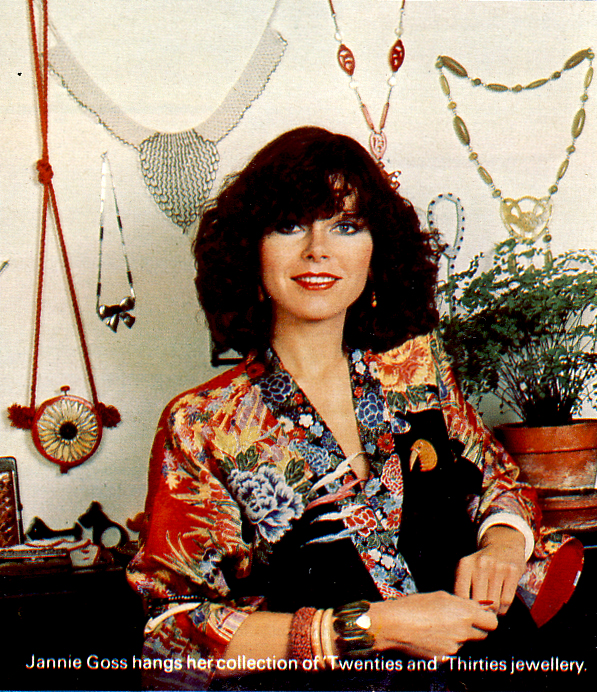
JANNIE GOSS is an Australian model, who has lived for the last eight years in London with her architect husband, Ian, their eleven year old daughter. Mini, and a cat. Their flat in Camden Town is big and airy, with white walls. high ceilings and potted geraniums twelve feet tall. Jannie hangs her jewellery on the walls: the effect is bold and beautiful. It’s also highly practical. “The great thing about pinning up jewellery is that I can find it so easily—it’s not just for show: of course I wear the stuff, too. I used to keep my necklaces around a mirror, hopeless because everything became knotted. and you couldn’t get at it in a hurry …I like organised clutter—great areas of space, then areas of things; it makes dusting easier, too. And Ian and I are both keen on a functional as well as decorative environment. I move my jewellery about, to change the shapes and patterns they make, which is fun. I just use ordinary pins. the very long dressmaking ones—anything heavier, like a nail, would mark the walls. I’m a collector by nature, I was buying up Art Deco jewellery before it became fashionable, when it only cost a few bob. I’ve never bought from the antique market, but sometimes at Portobello Road and Oxfam shops; mostly I just nose about in junk shops and jumble sales. People say I’m clever at finding things but for every four looks, only once will You find a piece you really like and want to buy.
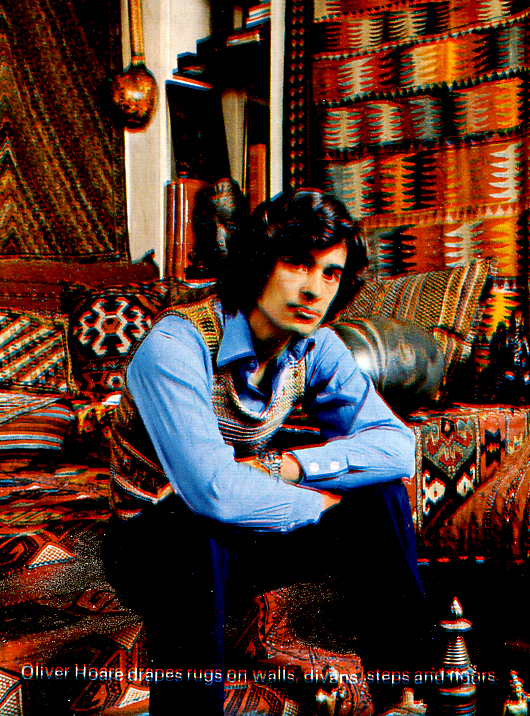
OLIVER HOARE‘s house gives you the feeling you’re in the Middle East. You are surrounded by carpets—kelims, to be precise—a dazzling juxtaposition of highly organised patterns and colours. Divans, steps, floors, cushions and wall are all covered with oriental rugs. When people hear about it, they imagine that so many patterns and colours clash. They don’t,” says Oliver. He’s right: the rugs harmonise, like music, and one of the reasons is that all the kelims’ colours are vegetable dyes, so the tones are constant—lots of brick and all the earthy colours. Oliver used to work at Christie’s where he ran the carpet department, but this summer set up on his own to sell Islamic works of art to the Middle East. and Far Eastern objets to Europe and America. “I was brought up with carpets, my father bought masses in Constantinople in the ‘Twenties, and always hung them up. Although I wasn’t terribly interested, something about them had rubbed off on me, and when I went to Christie’s I was immediately put into the carpet department. I became fascinated. I like kelims best of all. These are flat woven rugs, which have always been made by tribes, and it’s a tradition that hasn’t been interfered with or commercialised.” Buying carpets of any kind in the Middle East is an immensely ritualistic business: potential buyers sit for hours in carpet shops sipping tiny cups of Turkish coffee and tea endlessly. Bargaining goes on all day. Although Oliver enjoys this ritual. his business methods are Western. His dealing life means he must travel constantly though he spends as much time as he can in Iran where his caravanserai, on the old silk route, has just been nationalised by the government. Kelim prices have shot up, particularly now that so many are going back to their countries of origin. “Five years ago. you used to buy the really good kelims for £30 or £40. Nowadays, the best are £1,000 or £2,000 —but you can find decorative kelims for between two and three hundred pounds.”
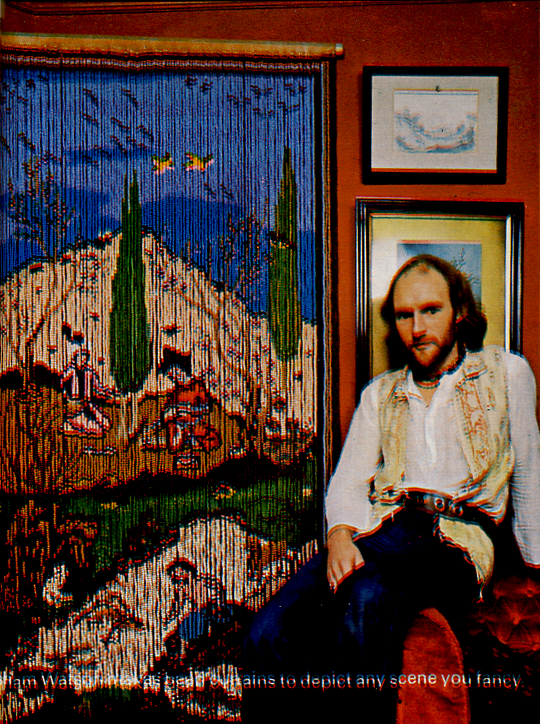
GRAHAM WATSON makes bead curtains that swish exotic-ally as you pass through, like a ‘Twenties shimmy dress, beaded strands trailing in your hair and on your shoulders. His beads can depict your portrait. a fantasy landscape, cinema curtains, an old poster—whatever you want. The curtains are hung in doorways. on walls, around baths. Graham’s clients in-clude Chris Squire of the rock group Yes, photographer David Bailey, and film director Joe Losey. “I started off bead-work when I was at drama school . . . act-ing’s an overcrowded profession, and I found it demoralising,” Graham explains. “I saw a play on television one night, and in the background there was a beaded curtain that looked as though it had some-thing painted on it, I couldn’t quite see. But it intrigued me.” . . . To the extent that the very next day Graham started threading beads him-self. But beads are hard to find in England. and Graham traced the best bead sources to Germany (for wood) and Czechoslovakia (for glass). He declared himself a registered company, and went to work three years ago. “I still import the beads, but we dye most of the colours our-selves, otherwise you’re landed with all the shades you don’t want. I often mix glass and wooden beads, because glass alone is too heavy.” Currently, Graham is working on a huge black and silver portrait of Buster Keaton, and he’s planning a three-dimensional number. If you want a curtain made, and they cost around £120 (door size), you can reach Graham Watson at 13c Cunningham Place. London NW8 (01-286 0891).
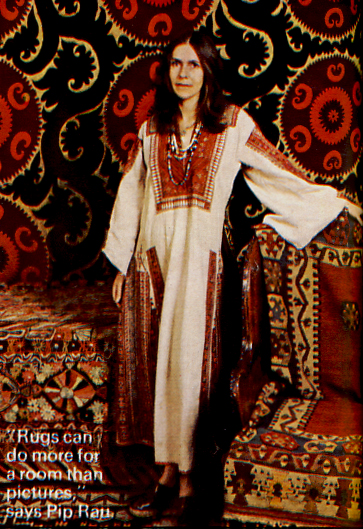
PIP RAU is hooked on folk tradition, on the embroideries, colours, prints and patterns of Central Asia and the Middle East. Home is like a bazaar, her shop like a souk where she sells dresses, waist-coats, robes, great pieces of faded cloth, incredibly bright embroideries. Her walls are jam-packed with treasures. and Pip’s body is covered with clothes of tribal designs, too. “I’d never put up pictures.” she says, “hangings do so much more for a room. They’re vibrant and vast and warm. Infinitely cheaper, too. I’ve been collecting ever since I can remember. I love markets. I lived in Israel for ten years. I was married to an Israeli. and travelled all over the Middle East. and now we’re separated I’ve come back to live in London.” So it seemed a natural move to open a shop (Rau Gallery, 36 Islington Green, London N1, 01-359 5337) selling all the things she loves, and it means she can justify her passion for travel. “I plan to go away three or four times a year to find stock,” she says. “My last trip took six weeks; I drove all through Eastern Europe, buying in Romania and Yugoslavia, and on to Turkey and Iran. and then Afghanistan. There are always difficulties at frontiers—you need all the invoices and endless bits of paper. Prices are going up and up. sources are drying up, too, as increasing numbers of people get interested. My customers are very mixed—specialist collectors, or people who fall in love with something. I don’t think clothes like these should ever be altered. Just buy what fits.” Pip hangs dresses and the lighter hangings with drawing pins, and uses tacks for anything heavier. Dresses can cost as much as £50 —an antique, hand-woven heavily embroidered Palestinian wedding dress, for example—and wallhangings vary enormously from small Persian cottons at £4 to kelims and Bokharas (large-scale embroideries on silk) at £230, or kelims for £400.

Elegant full length dinner dress in champagne Trevira with a matching tie belt, the yoke and shoulders lavishly oversmocked in bright colours. By John Bates at Jean Varon, £23.
Photographed by Jim Lee.
Scanned by Miss Peelpants from Flair, February 1970
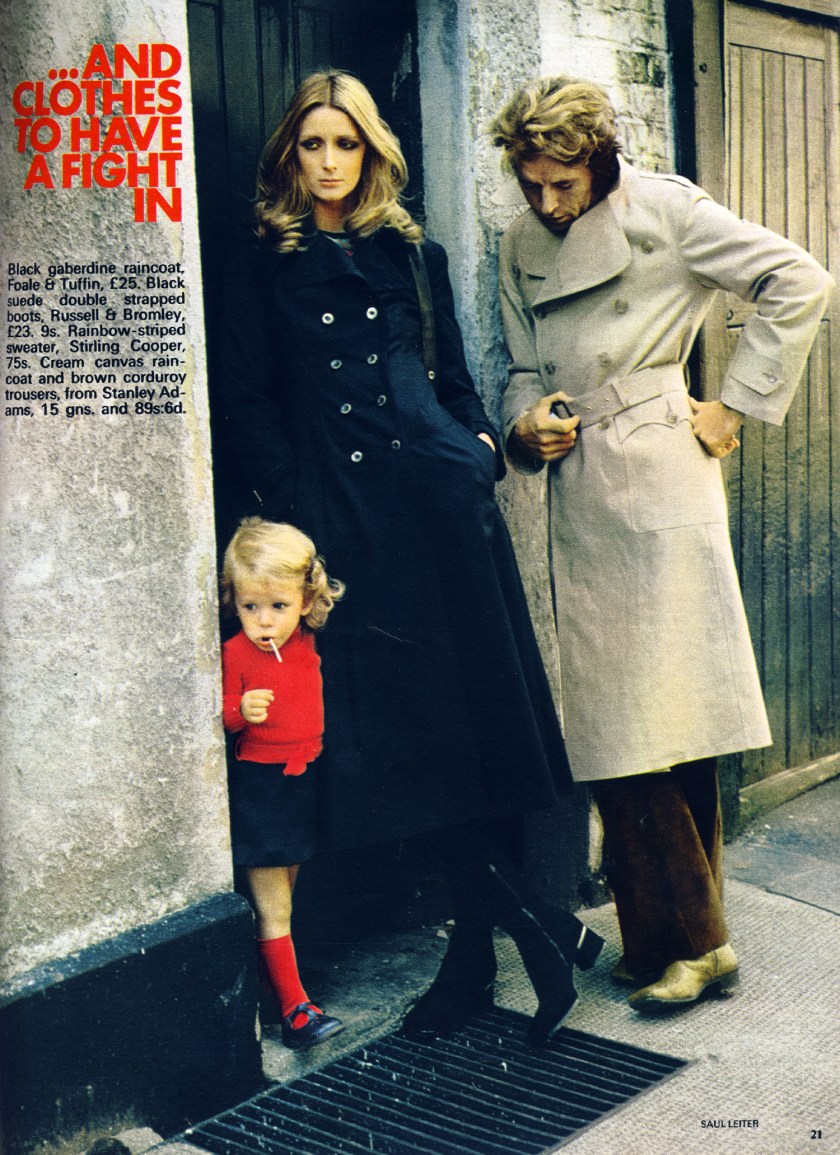
Black gabardine raincoat by Foale and Tuffin. Black suede double strapped boots from Russell & Bromley. Rainbow striped sweater by Stirling Cooper.
Reasons why Vanity Fair is one of the best fashion magazines ever #29847: A fashion editorial inspired by a fighting couple, photographed by Saul Leiter…
Scanned by Miss Peelpants from Vanity Fair, January 1971.
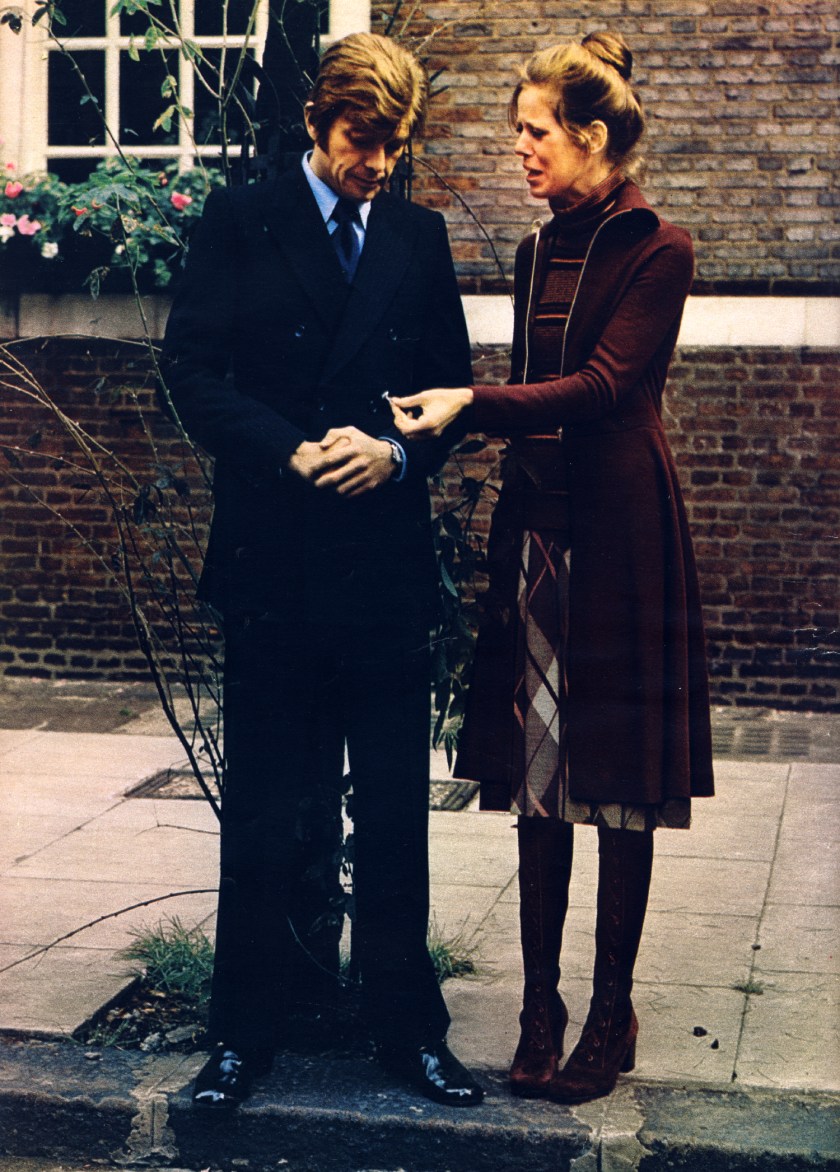
Maroon jersey coat and plaid skirt by Stirling Cooper. Sweater by Sonia Rykiel for Browns. Boots by Elliott’s.
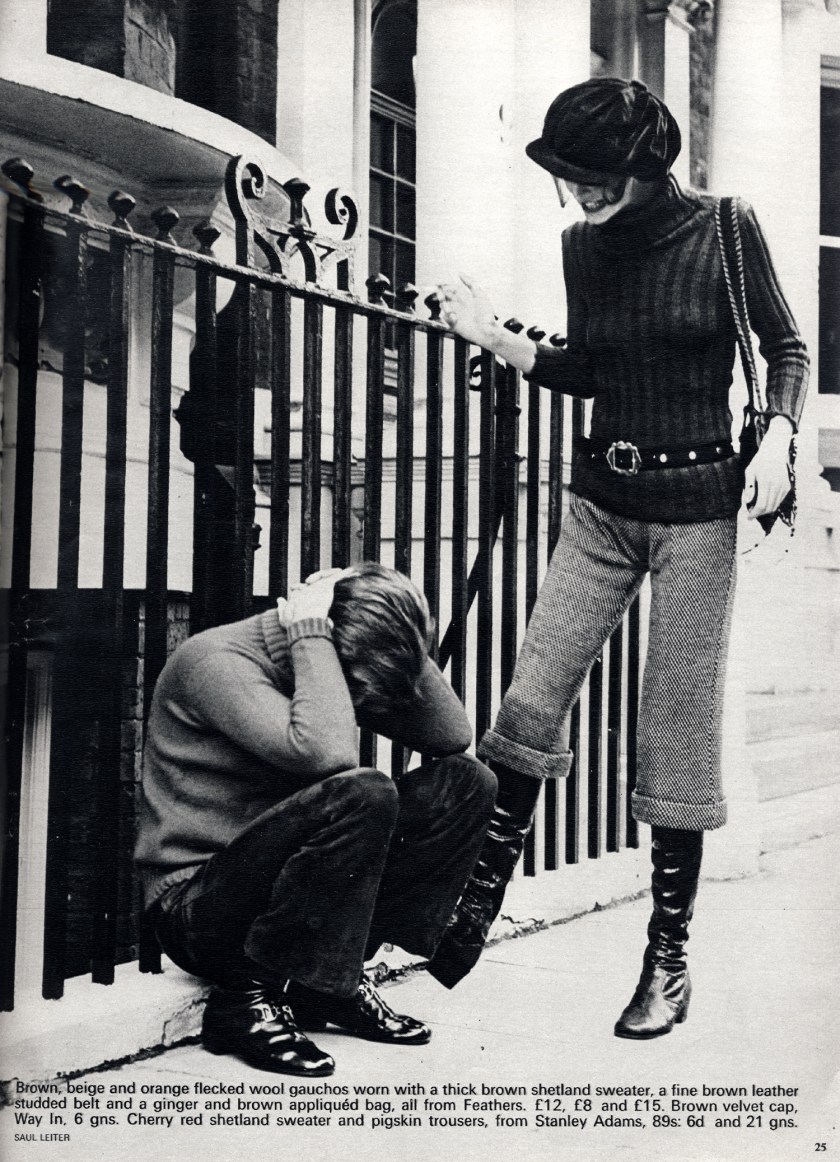
Brown beige and orange flecked wool gauchos worn with thick brown shetland sweater, leather studded belt and appliqued bag all from Feathers. Cap from Way In.
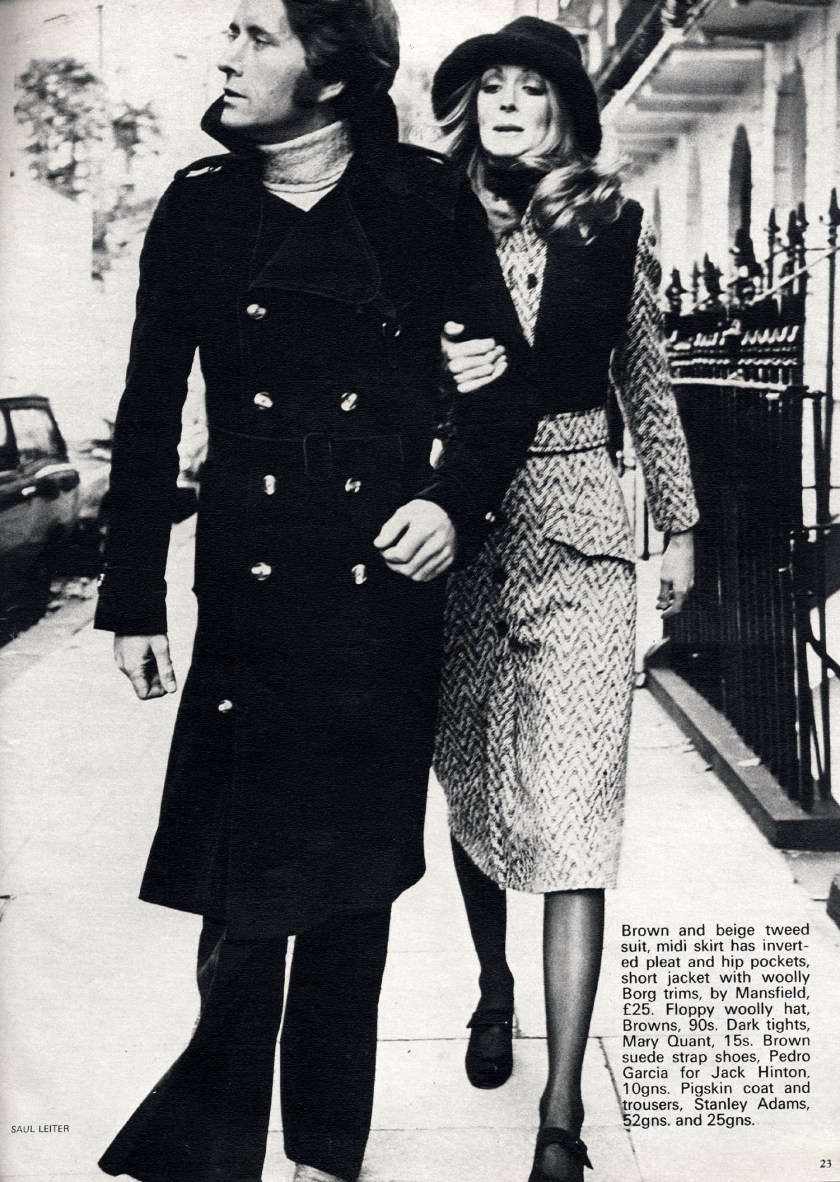
Brown and beige tweed suit with Borg trims by Mansfield. Floppy woolly hat from Browns. Brown suede shoes by Pedro Garcia for Jack Hinton.
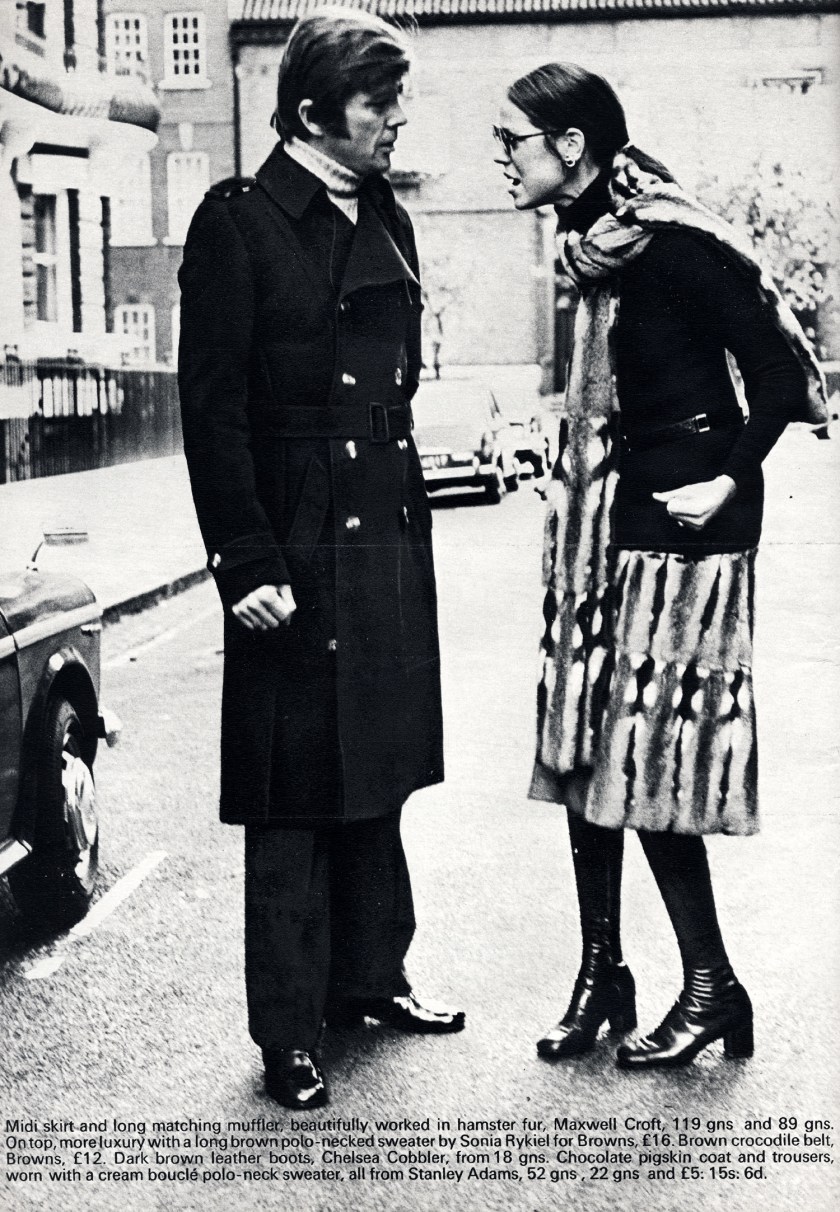
Midi skirt and matching muffler by Maxwell Croft. Brown polo necked sweater by Sonia Rykiel from Browns. Dark brown leather boots by Chelsea Cobbler.
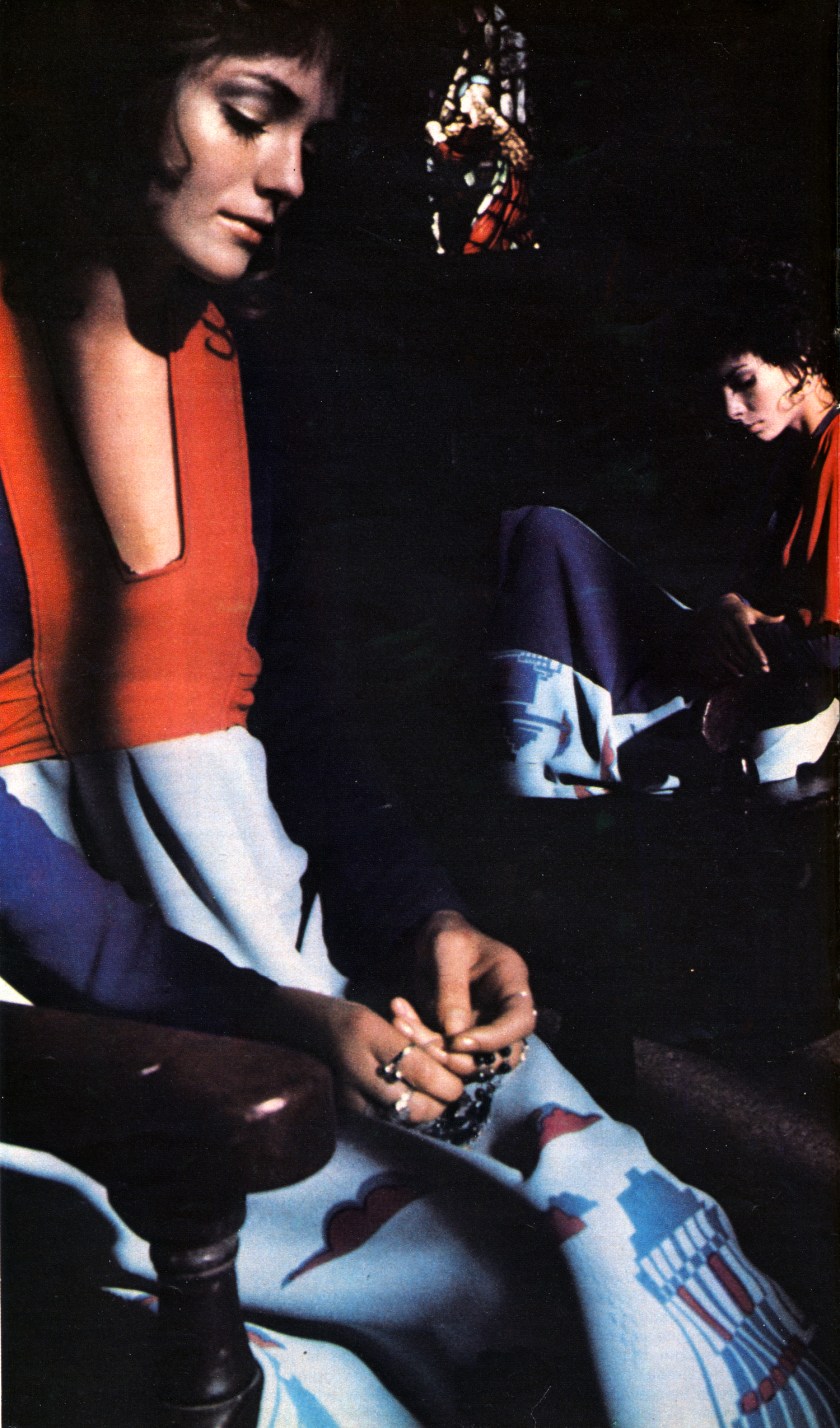
Calf length New York skyline-printed crepe dress with deep neckline, narrow fitting sleeves and wide sash tied at the back. The same dress with wide bell shaped over sleeves. Both from Mr Freedom. Rings from Biba.
The look for Christmas is definitely one of bright colours and generally good cheer. Fabrics are crepes, satins and velvets in stained glass hues of rich reds, blues, greens, yellows and purples…
Photographed by Stephen Bobroff.
Scanned by Miss Peelpants from 19 Magazine, December 1969.
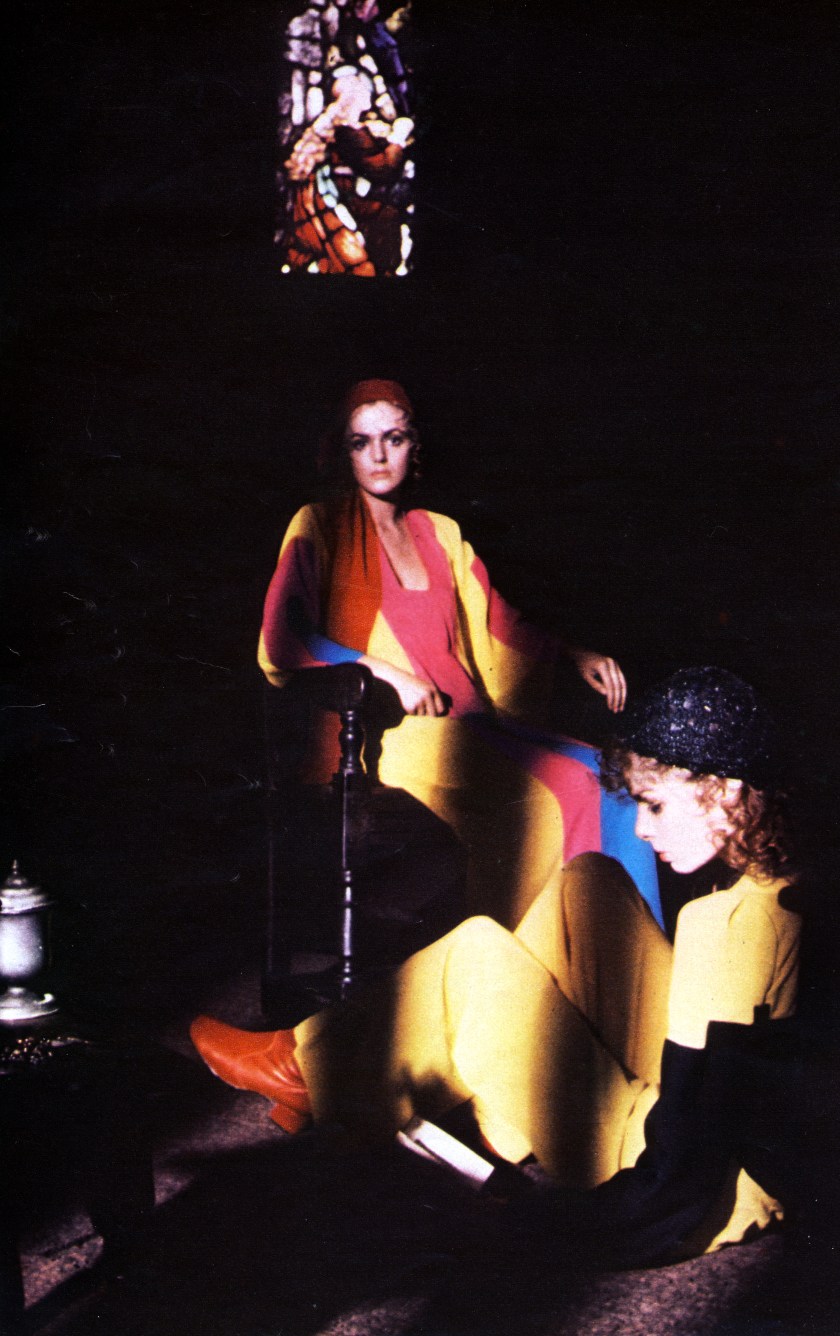
Long crepe kaftan style dress by Mr Freedom. Red chiffon scarf by Fenwicks. Yellow and black crepe trouser suit by Mr Freedom. Red leather boots from Sacha. Black crochet cap by Ritva at Feathers.
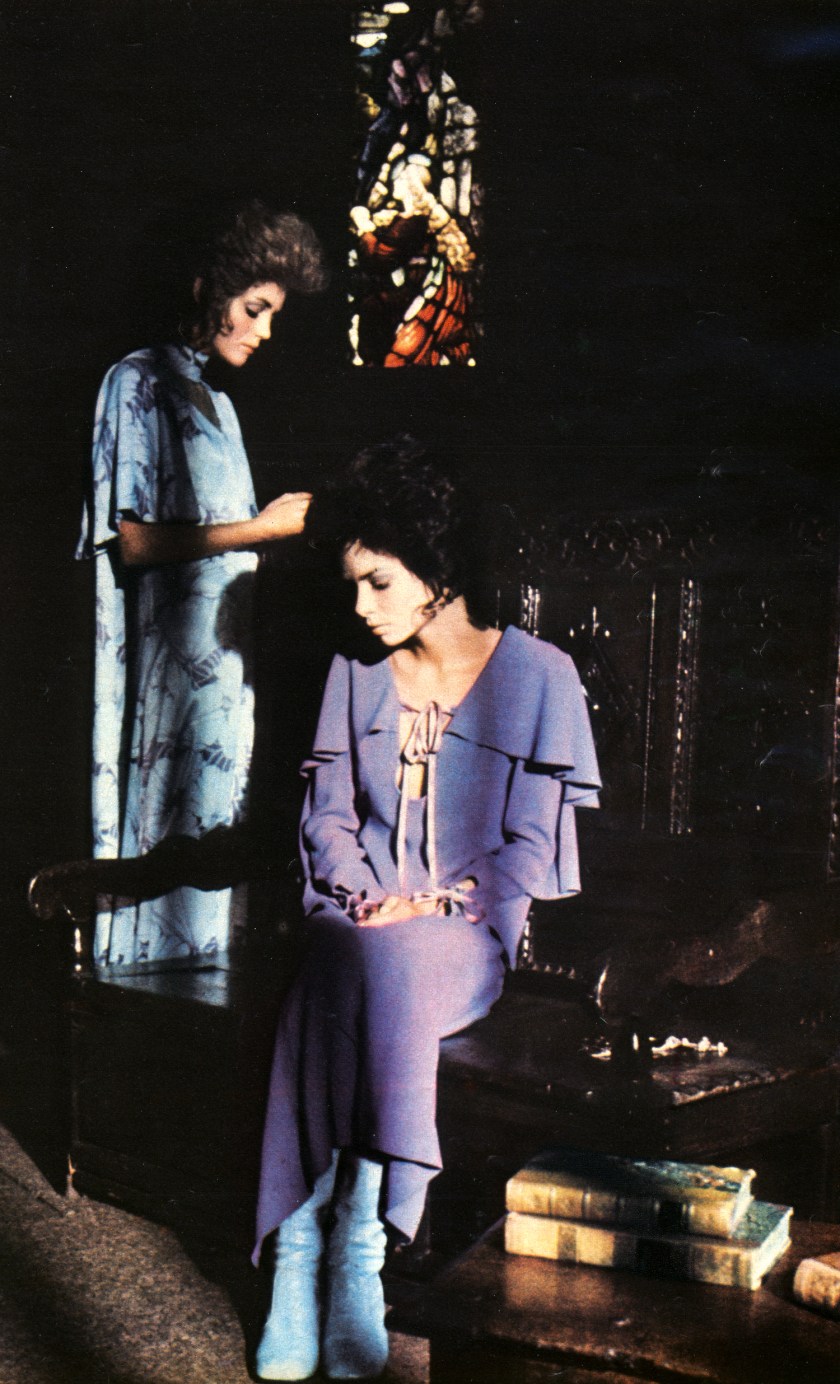
Ankle length satin dress over printed in mauve with floppy bell shaped sleeves and long matching scarf by Pourelle. Purple crepe calf length dress with narrow fitting sleeves, lace up neckline and wide cape style collar by Ossie Clark for Quorum. Boots by Sacha.
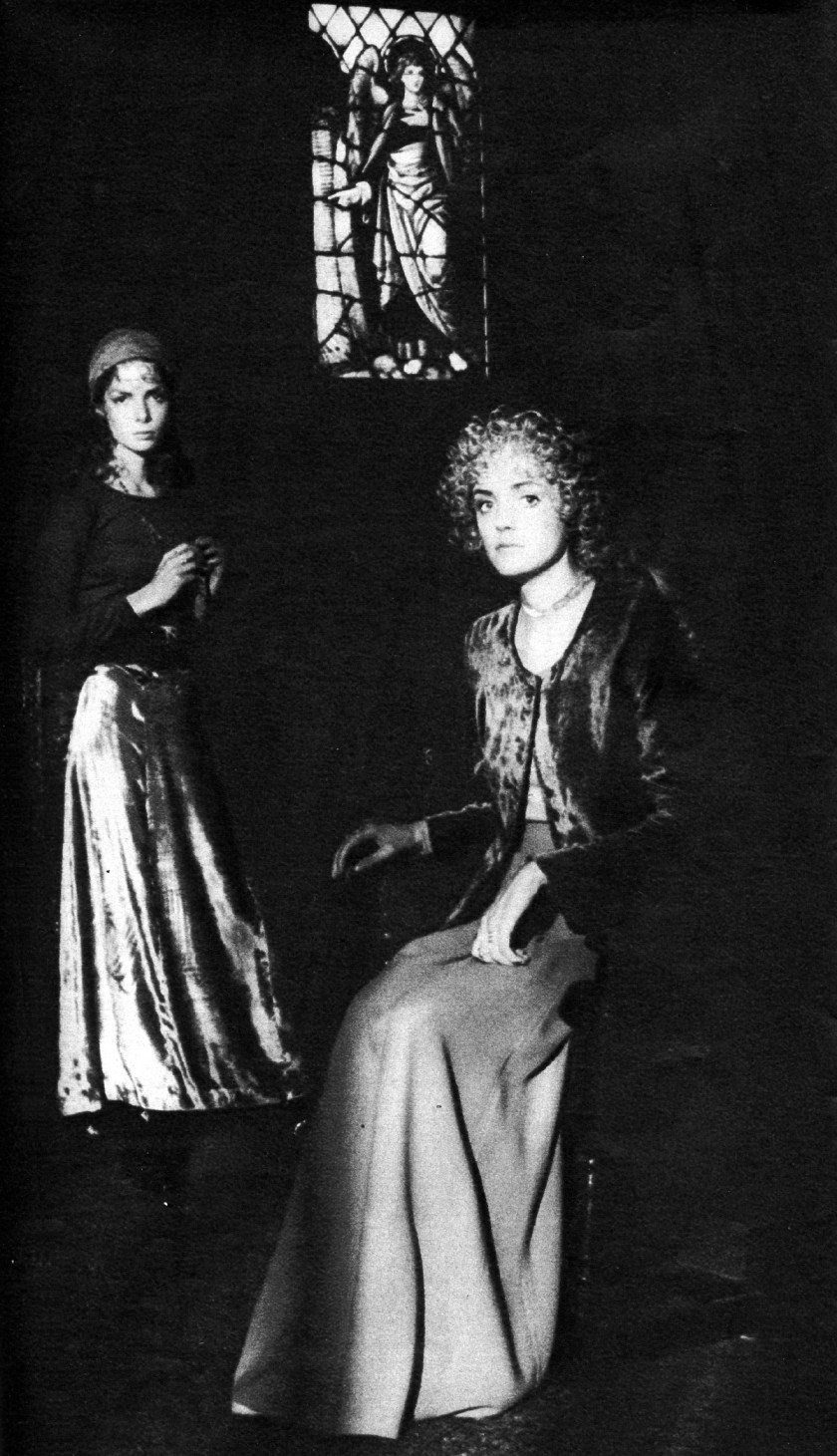
Purple narrow fitting t-shirt. Ankle length crushed velvet skirt in pink with purple velvet waistband. Both by Mr Freedom. Purple leather boots by Anello & Davide. Cardigan style dress in dark blue velvet splashed with yellow and red by Gordon King. Bright red crepe ankle length skirt by Ossie Clark for Quorum.
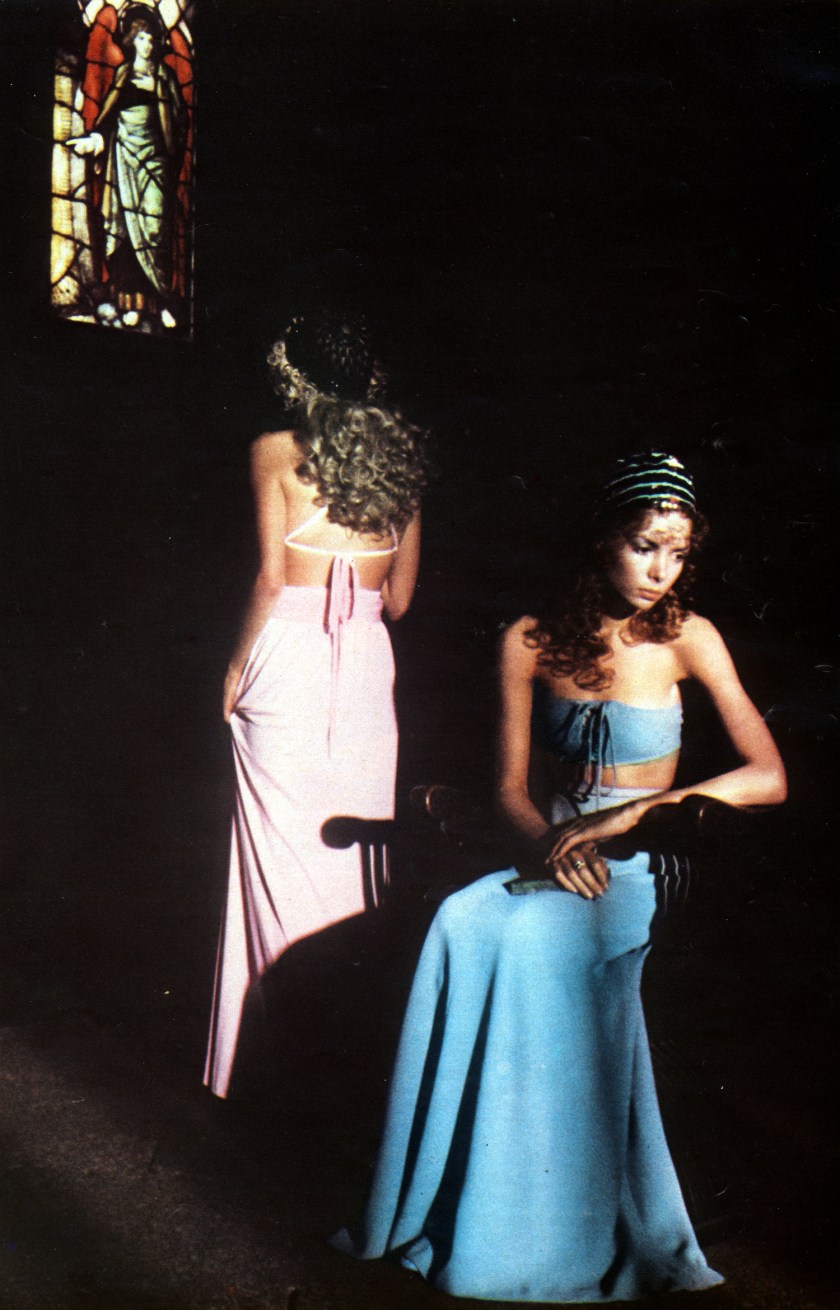
Pale pink acetate jersey ankle length skirt and v-shaped bra top with narrow straps crossing over at back by Wallis. Black crochet cap by Ritva at Feathers. Pale green crepe ankle length skirt with matching front lacing bra top by Tony Berkeley.
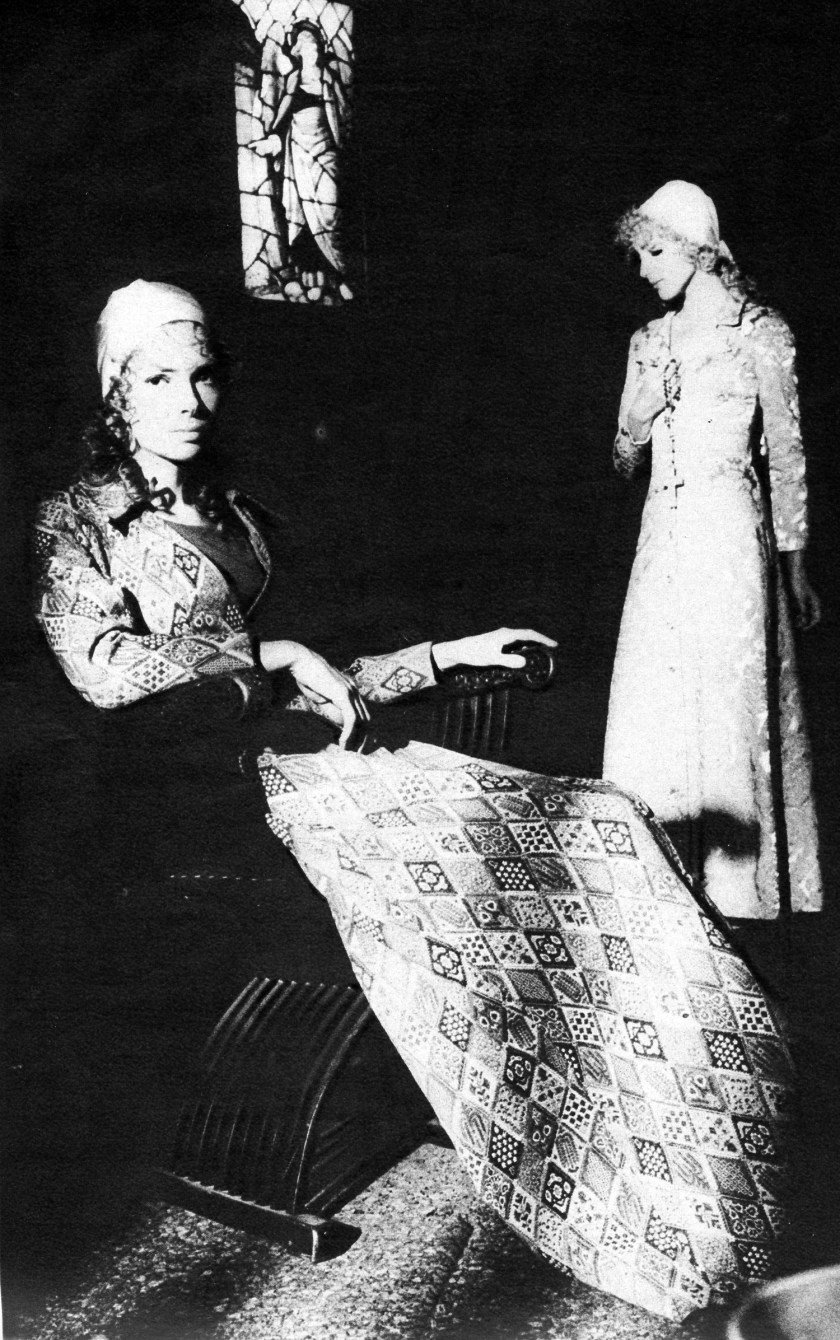
Long tapestry coat by Janice Wainwright at Simon Massey. Bright green narrow t-shirt by Mr Freedom. Pale pink damask narrow-fitting long coat by Janice Wainwright for Simon Massey. Silk scarves from Biba.
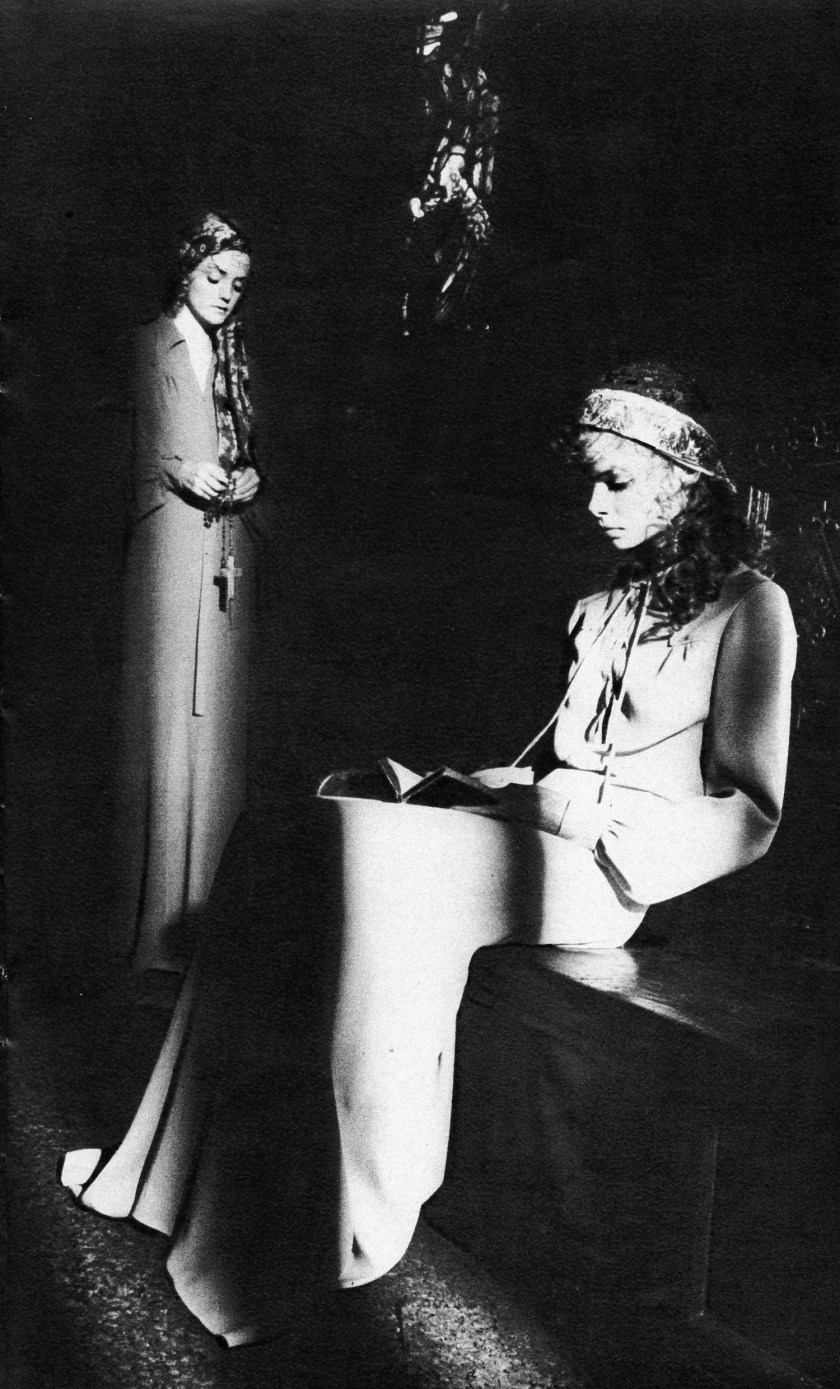
Ankle length zip fronted cafe crepe dress has softly gathered deep yoke by Tony Berkeley. Red, blue and yellow scarf by Sujon. Ankle length soft pink crepe dress by Tony Berkeley. Long printed Indian scarf from Feathers.
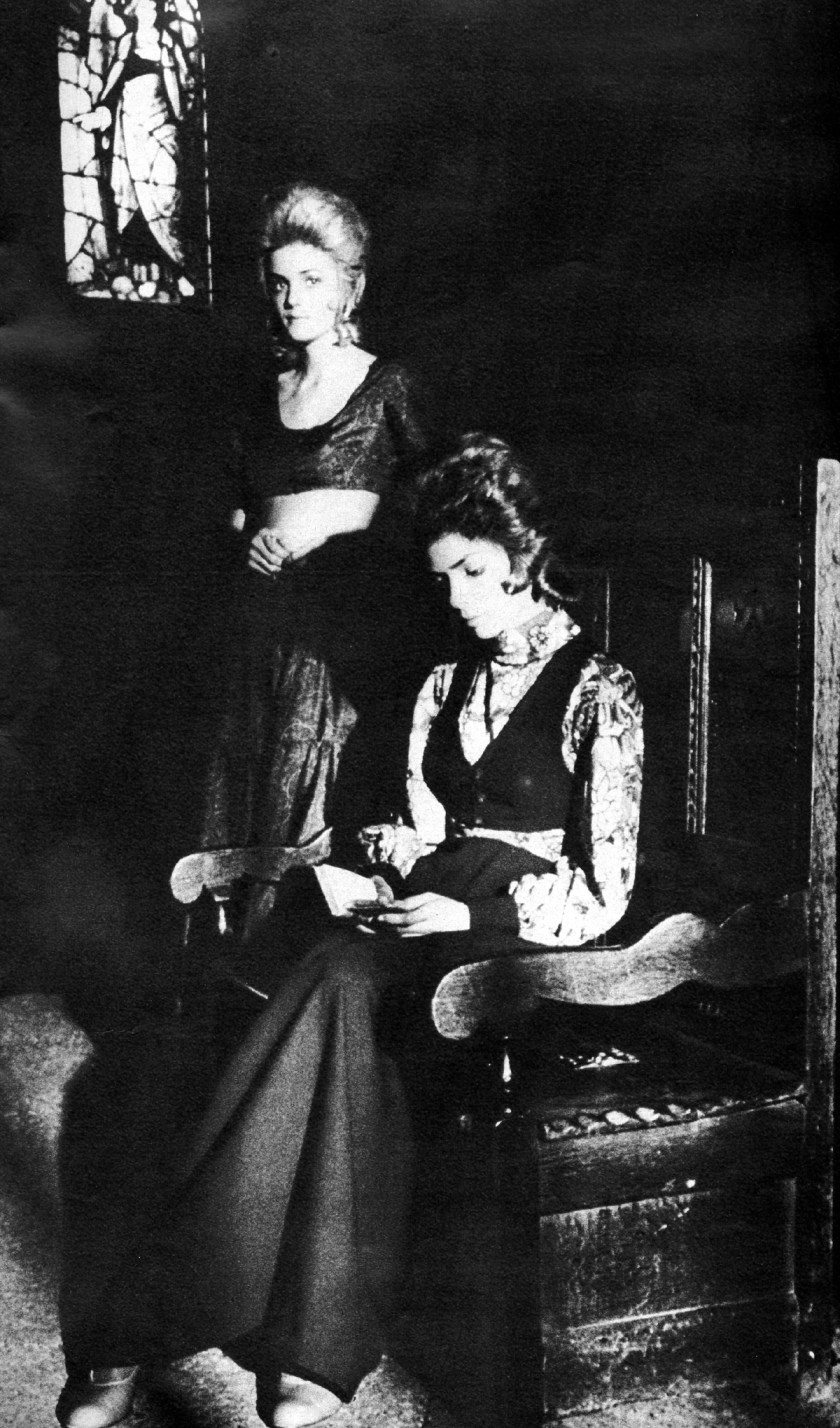
Bolero top and mid-calf skirt by Simon Jeffrey. Ankle length dress in pure Liberty wool and matching bolero by Gladrags. Red mid calf boots by Anello and Davide.
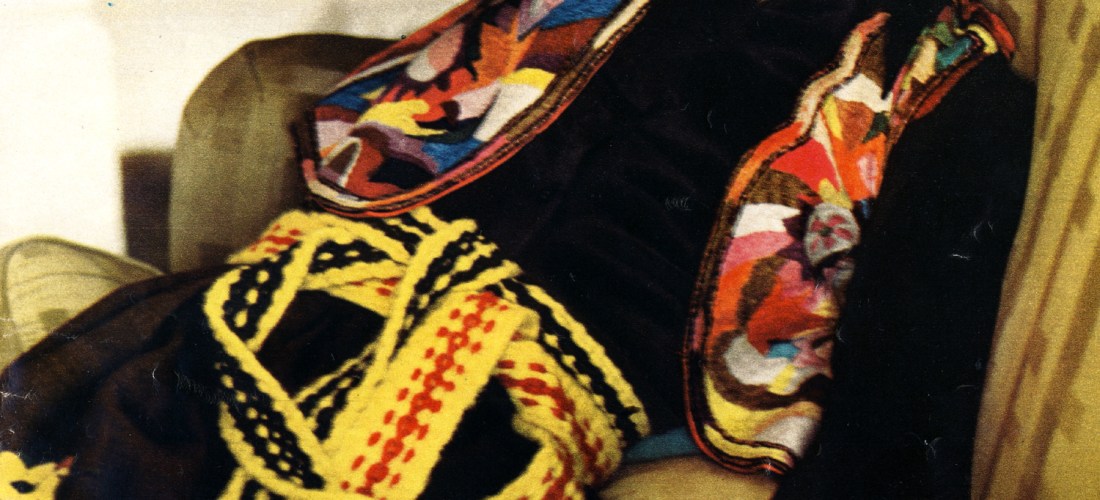
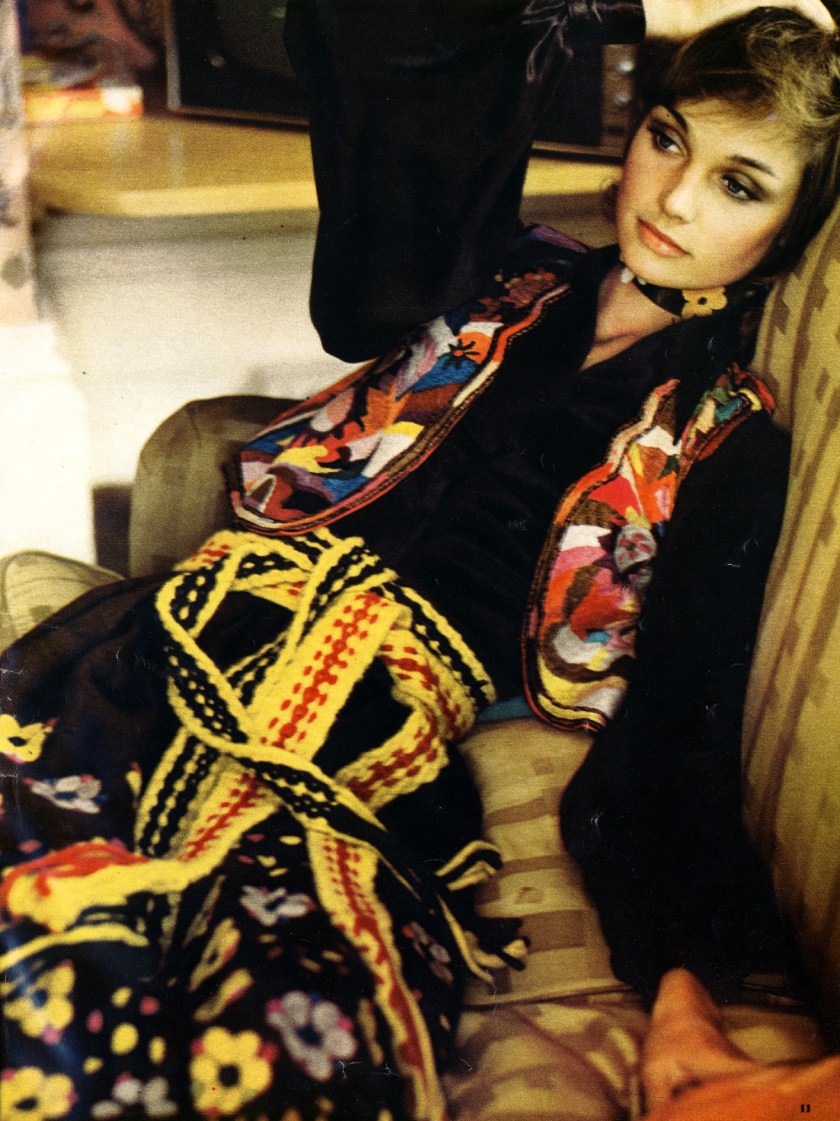
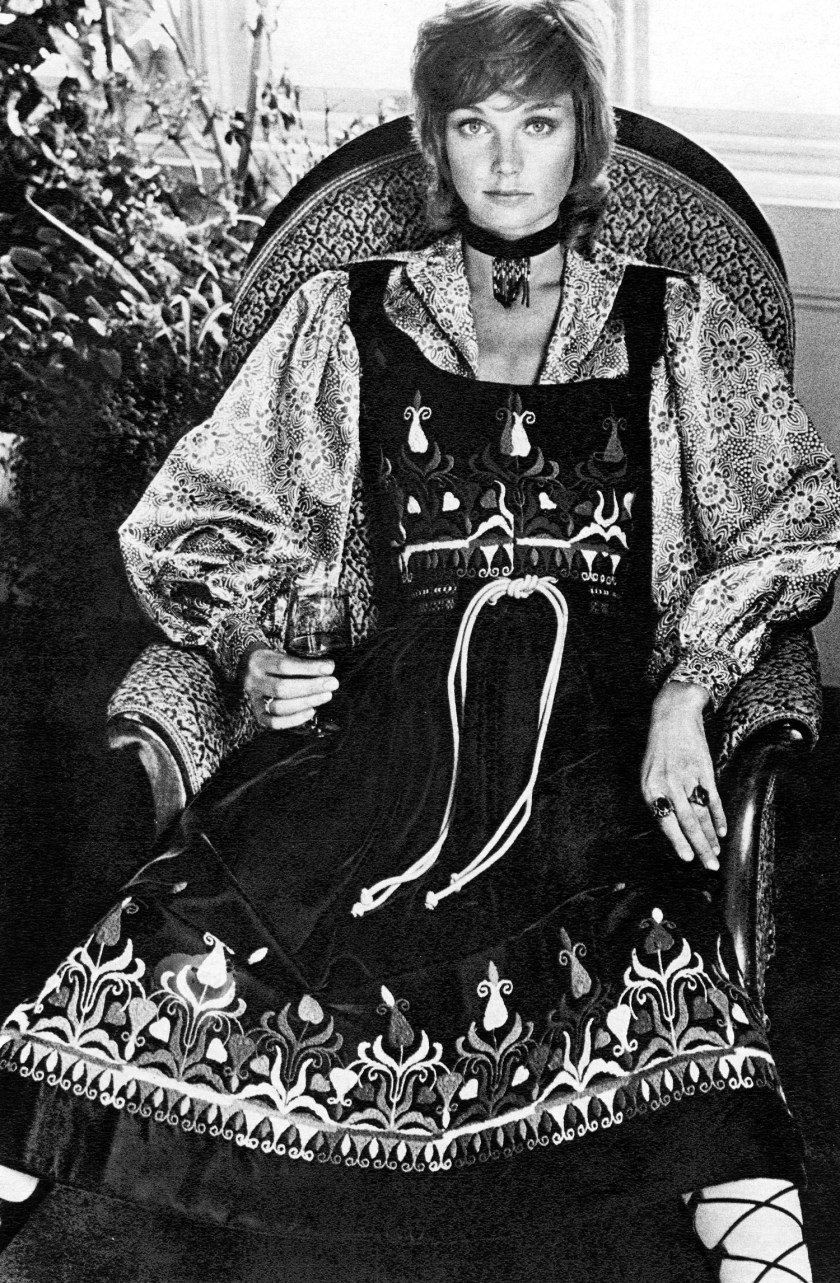
Every designer is saying it loudly, clearly, boldly, prettily… the hand-made look is here. Maybe it started as a reaction against the badly-made, thrown-together, hotch-potched dolly era; maybe this reaction set the tide running for antique markets where painstaking workmanship could be picked up still; maybe it’s that elusive feeling in the air that a designer’s sensitive seismograph picks up and translates in his own distinctive handwriting. Whatever it is – it’s here.
Jorn Langberg of Christian Dior – London plots it out in warm brown velvet, got together with a brief, embroidered waistcoat and a deeply embroidered peasant skirt… at the other end of the scale the Dress Den at Kensington Antique Market tops a thick aubergine cotton skirt spilled with bright wool flowers with a scrap of bolero, pictorially embroidered over every centimetre of the scalloped front. If you’re skilled with a needle, have a good eye for colour and shape there’s no reason why you can’t put yourself ahead of the game. But this is a painstaking look, a one-off original look that can’t be tossed off in an evening by a hopeful but bodgy amateur needlewoman.
Both shirts by Jeff Banks; all accessories from Kensington Antique Market.
Fashion by Lorna Cattell.
Photographed by Frank Horvat.
Scanned by Miss Peelpants from Vanity Fair, January 1971.
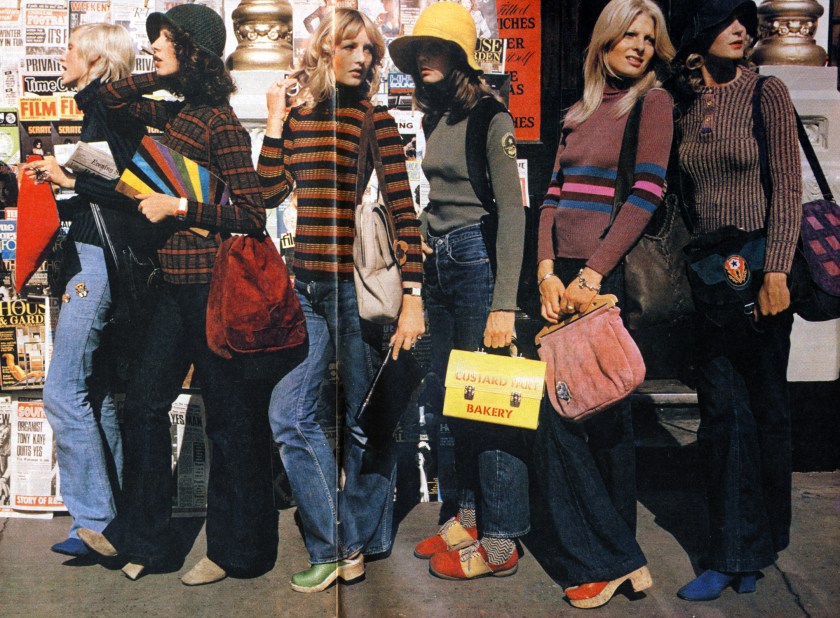
From left to right: John Craig polo, £4.50., Just Looking, SW3. Felt clutch bag, Tillers, £4., Miss Selfridge and Way In, SW1. Satchel tote bag, Avril Gordon, £3.99., from Miss Selfridge shops. Striped polo, John Craig, £4., at “27”, SW3. Rainbow suede clutch bag, Biba, W8., £7.75., and knit hat, 75p. Fringed duffle bag, Xanthe Leather, £3.99., Girl, Wl. John Craig polo, £3., Girl. Leather and snake clutch bag, Bus Stop, W8., £4. Canvas bag with daisy trim, Xanthe Leather, £3.50 at Girl, Wl. Polo sweater with badges, Erica Budd, £2.90., Neatawear, Girl and Peter Robinson Top Shop, Wl. Bus Stop hat, £2.60. Bag in leather cowboy style, Wild Mustang, £9., to order, 30 Gt. Portland St, Wl., p&p inc. Custard Tart metal workman’s lunchbox, Mr Freedom, Kensington Church St., W8., £2.65. Ribby polo with stripes, John Craig, £4., at Stop The Shop, SW3. Knitting bag, Baggage and General, £2.90., Peter Robinson, Great Gear Trading Co., SW3. Leather shoulder bag with criss cross stitching, Girl, £6.99. Vest sweater, John Craig, £4.50., at Just Looking, SW3. Suede shoulder bag with badge and wings, £5.75., with matching hat, £4.75., by Tony Alston to order from 52, Sutherland Pl., W2, p&p inc. Canvas bag, Xanthe Leather, £3.25., Chelsea Girl, Mail order: 15, Perrins Lane, NW3 and 20p p&p.
Carry-alls in all shapes and sizes… patterned pouches to go pretty places, tough canvas (and tin!) toters for trains and towns and big squashy suede and leather shoulder bags for catching buses and boats and being busy.
I am particularly enamoured of the ‘Custard Tart’ workman’s lunchbox from Mr Freedom.
Fashion by Sue Hone.
Photographed by John Carter
Scanned by Miss Peelpants from Petticoat, October 1971


Long silver, gold and blue taffeta dress with huge puff sleeves nd ruched bodice, £22. Blue leather court shoes on high platforms and very high heels, £7.45. Blue shot lurex chiffon scarf, 20p. All from Biba.
Unwrapping Christmas presents can cause thrills of excitement or groans of despair but, whatever you find inside, the sense of occasion is always there. We’ve proved our sense of occasion by wrapping up the best Christmas clothes for your parties; showing off the lovely, sexy, lurex, satins and natty netting you’ll be adorning yourself with this party season. Glamour and glitter are here to stay, so wrap yourself up in our Christmas wrapping and you’ll be the best Christmas present anyone’s had this year!
I can only hope in vain that I will find boxes of Biba and Miss Mouse under my Christmas tree, but still it’s a nice fantasy to have! As always, a deliciously quirky concept by Mr Peccinotti and 19’s usual flawless taste in clothes…
Photographed by Harri Peccinotti.
Scanned by Miss Peelpants from 19 Magazine, December 1972.

LEFT: Black satin elasticated tube sweater, covered in stretch netting, £7. Matching black skirt with silver braid and silver spots, £10-50. Both by Miss Mouse. Green tights, from Biba, 30p. Black suede shoes with silver snake-skin trim on heel and toe, from Derber, £13-99. Lurex shot chiffon scarf, 20p. Tiny fake diamond rings, 5p. each. Both from Biba. Green glass bead bracelet, by Paul Stephens, 25p. RIGHT: Black satin heart-shaped strapless top, with gold and silver spots in lurex. Matching Oxford bags. Both by Miss Mouse, £20 the set. Silver shoes with very high heels, by Zapata, £15.75. Red shot lurex scarf, 20p. Red stud ear- rings with gold flecks, 20p. Matching bracelets, £1.20 each. All from Biba.

Black jersey dress with silver lurex spotted top and inset pleats has long sleeves, by Gillian Richard, £8.20. Silver lurex tights, by Mary Ouant. £1-50. Black suede shoes with silver snake-skin print, from Derber, £13.99. Diamante choker, by Paul Stephens, 40p. Black wool halter-neck top spotted with silver lurex and with silver straps, by Erica Budd, £3.60. Black satin ankle-length skirt, from Bus Stop, £5.95. Silver lurex tights, by Mary Quant, £1.50. Silver metallic leather shoes, from Ravel, £10-50. Long silver lurex gloves, by Morley, £2.15. Diamante choker, by Paul Stephens, 40p. Diamante heart earrings, from Biba, £1.15.

LEFT: Silver and grey knitted lurex long-sleeved polo-neck sweater, £3.50. Silver lurex cardigan with grey rose and two pockets, £9.95. Both from Bus Stop. Long grey satin skirt, by Walter Albini from Browns, £6.30. Tights by Mary Quant. £1.50. Platform sandals. from Ravel, £10.50. Bracelets. from Fenwick, 90p. each. Diamante and pearl-drop earrings, by Paul Stephens, £1.20. RIGHT: Long silver lurex halter-neck dress with silver and black lurex wavy trim on heart-shaped neck and side pleat inset. by Gillian Richard. £9.50. Matching cardigan with wavy-trim pockets. by Richard Green. £6.80. Silver lurex tights, by Mary Quant. £1.50. Silver metallic leather shoes. with platform soles and peep-toes, from Ravel, £10.50. Diamante drop earrings. by Paul Stephens. £1.10. Silver and black halter-neck lurex top, which buttons at front of waist, £5. Matching ankle-length wavy-print skirt, £8.60. Both by Richard Green. Black suede shoes with snakeskin print, from Derber, £1399. Long black satin gloves, by F. G. Shave, £2.75. Diamante bracelets. £1 each. Drop earrings. £1. Both by Paul Stephens.

Green, gold and black lurex georgette shirt with long dolman sleeves and trimmed in black satin on v-neck and cuffs, £11. Long black satin skirt, £9.50. Both from Universal Witness. Green tights, from Biba, 30p. Silver court shoes with very high heel, and ankle strap, by Zapata, £15.75. Black and silver necklace. £2.90. Diamante stud earrings, £1. Both by Paul Stephens.

Black and silver fine-striped lurex halter-neck sweater, with matching striped cardigan, by McCaul, £8 the set. Black satin trousers with turn-ups and high waist, by Richard Green, £7.70. Silver tights, by Mary Quant, £1.50. Black suede shoes with silver and red ‘snakeskin’ print and silver ankle-straps, by Leicester Shoes. £15.95. Thin diamante belt. £7.50. Single row diamante bracelet, £1. Both by Paul Stephens. Dangling diamante earrings. from Biba, 60p.

Cream crepe shirt with long puff sleeves, £4.50. Matching tunic with green satin piping on short sleeves and green, yellow and cream sequin motif, £1850. Green satin trousers, £10. All by Quorum. Gold leather shoes with gold snakeskin print, from Derber, £13.99. Green lurex bow tie to make from remnants.
 Liz Eggleston