Blue swimsuit by Swanky Modes. Blue glasses by Monica Chong. Jewellery by Adrien Mann.
As it’s my *cough* 40th *cough* birthday next week, I thought I’d theme a few blog posts to celebrate. So this week, they will all be hailing from the July 1979 issue of 19 Magazine. It’s a fascinating period on the cusp between the decades, which I like to think had some kind of immense bearing on the person I am today. Being July I’m afraid it’s a bit swimsuit-heavy, but it’s also one of the greatest, most creative periods for swimwear which, in the case of Swanky Modes, is almost the purest distillation of their aesthetic.
Photographed by Ku Khanh. Hair and make-up by Colin Booker.
Scanned from 19 Magazine, July 1979.
Purple swimsuit with crossover back and purple and yellow swimsuit, both by Paul Howie. Red shoes by Ivory. Purple swimsuit by Elle.Black swimming costume with white trim by Dorothy Perkins. Black shoes by Ravel. White glasses by Monica Chong. Black slashed costume by Swanky Modes. Shoes by Russell and Bromley. Glasses by Stephen Rothholz. Striped costume by Betty Jackson for Quorum. Shoes by Ivory. Glasses by Monica Chong.Pink topless swimming costume by Paul Howie.Both bathing costumes by Swanky Modes. Jewellery by Adrien Mann.Bright blue costume by Paul Howie.
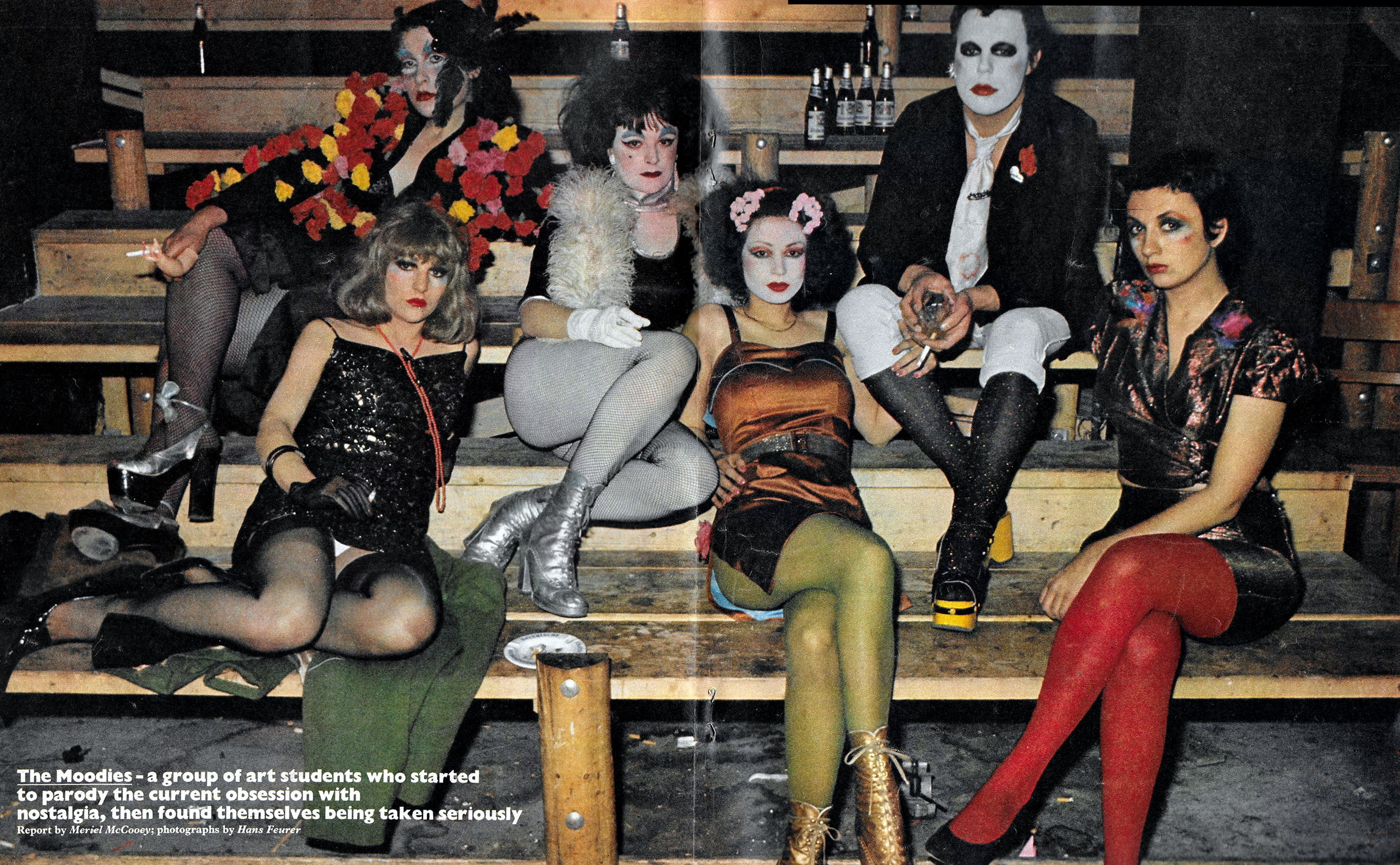
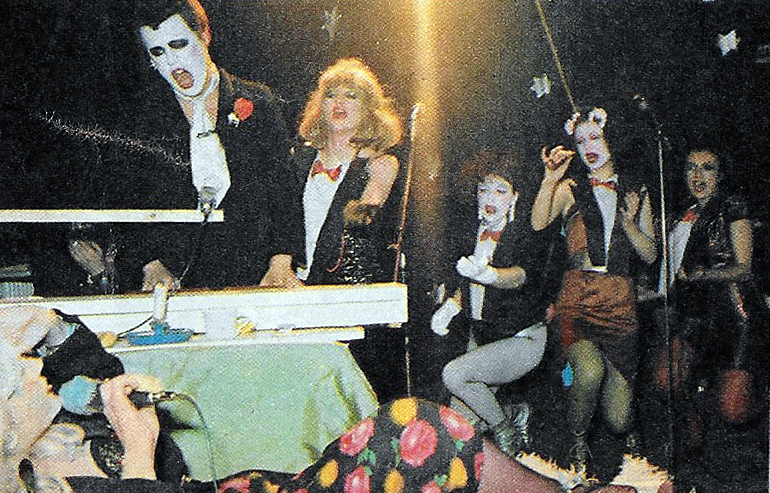
The Moodies – a group of art students who started the parody the current obsession with nostalgia, then found themselves being taken seriously
The numbers that The Moodies perform are firmly anchored in the Fifties and Sixties and ignore the current pop obsessions for necrophilia, drugs, suicide and the like. But under their bizarre make-up they are entertainers of the Seventies, rather than a group of decadent kids living off the nostalgia for ‘golden oldies’. On a good night, when the audience is firmly on their side, they create an atmosphere more like that of a private party than a sterile public performance; they earn their laughs through the juxtaposition of songs, their eccentric make-up, their idiotic props and their energetic dancing.
About a month ago, when they were playing at the tiny Moderna Theatre in Munich’s Schwabing district (surely the cleanest ‘quarter’ in the world), we noticed that the audience of all ages, shapes and sizes, were neatly dressed to the last man and woman; even their jeans had the knife-edge creases of an expensive boutique — the complete opposite of the people they had come to watch, who were described recently in Time Out as “looking like half a dozen friendly whores after a hard night in the Reeperbahn”.
“Everyone here tries to get us to mend our sweaters, they feel sorry for us. They think a hole is a sign of poverty. They wear the gear but they don’t understand what it’s about.
Perhaps that’s why we appeal to them,” said Anne Bean, who is a deceptively homely-looking girl off-stage and a powerhouse of energy on. She is one of the leaders of the group, though she denied that anyone actually led : “We are totally democratic -not that there is such a thing.” All art students at Reading, it was the second time they had played Munich. They banded together to play professional dates after they had sat their finals; they all passed except for buxom Suzy Adderley, who is on one year’s leave of absence and goes back soon to complete her course. They tried their luck at the Edinburgh Festival along with the rest of the Fringe: this was successful enough to land them their first book-ing in Munich.
“Actually, we were offered an Arts Council grant but we turned it down as we thought that it might restrict us,” said Rod Melvin, the pianist and the only man in the group. They still don’t have a pro-ducer, director, manager or agent. The only non-performing person to travel with them is Mickey Ekers who is a stage-manager-cum-electrician-cum-prop-master.
In the early days there were six girls, Anne Bean, Marianne Holliday, Polly Eltes, Suzy Adderley, Annie Sloan and Becky Bailey, but Becky Bailey deserted the group to paint. Anne Bean explained: “We really did the show as part of our finals.” Did this help them pass ? “Quite the contrary. It nearly sank us.”
At the start they followed the traditions of what was happening in pop music at that time: “Even the names we chose were just send-ups of those currently fashionable girlie groups like Lulu and the Luvvers and Martha and the Vandellas” said Anne Bean. “At one time we called ourselves Frank and the Furters” (she looked suitably ashamed) “then Lulu and the Lesbians, then prior to becoming The Mooches we were The Menstrual Seven.”
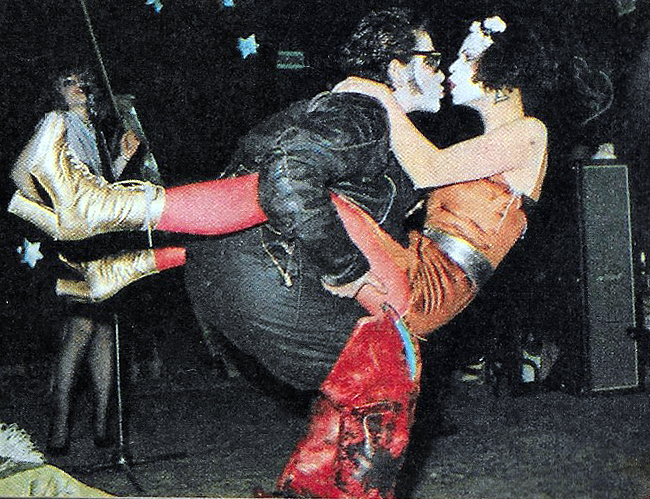
Before returning to Munich they had been playing at the Theatre at New End, Hampstead, where they had become quite a cult with late-night audiences. The group do num-bers like Gingold’s and Chevalier’s duet Ah Yes, I Remember It Well from Gigi and some of the more aggressive Presley songs, but they interpret these rather than imitate the originals. They make no announcements and use no words in spite of ‘gag fur gag’ written on the pink stars advertising the show. And they are very funny. Thank You For Being An Angel sung with melancholic grace by Rod Melvin became farce as the angel who drifted around stage shedding sequins at every step turned out to be a cross between Mae West and Jayne Mansfield. (Melvin is a talented pianist; the rest of the group are not musicians, but rely instead on improvisation and innovation.)
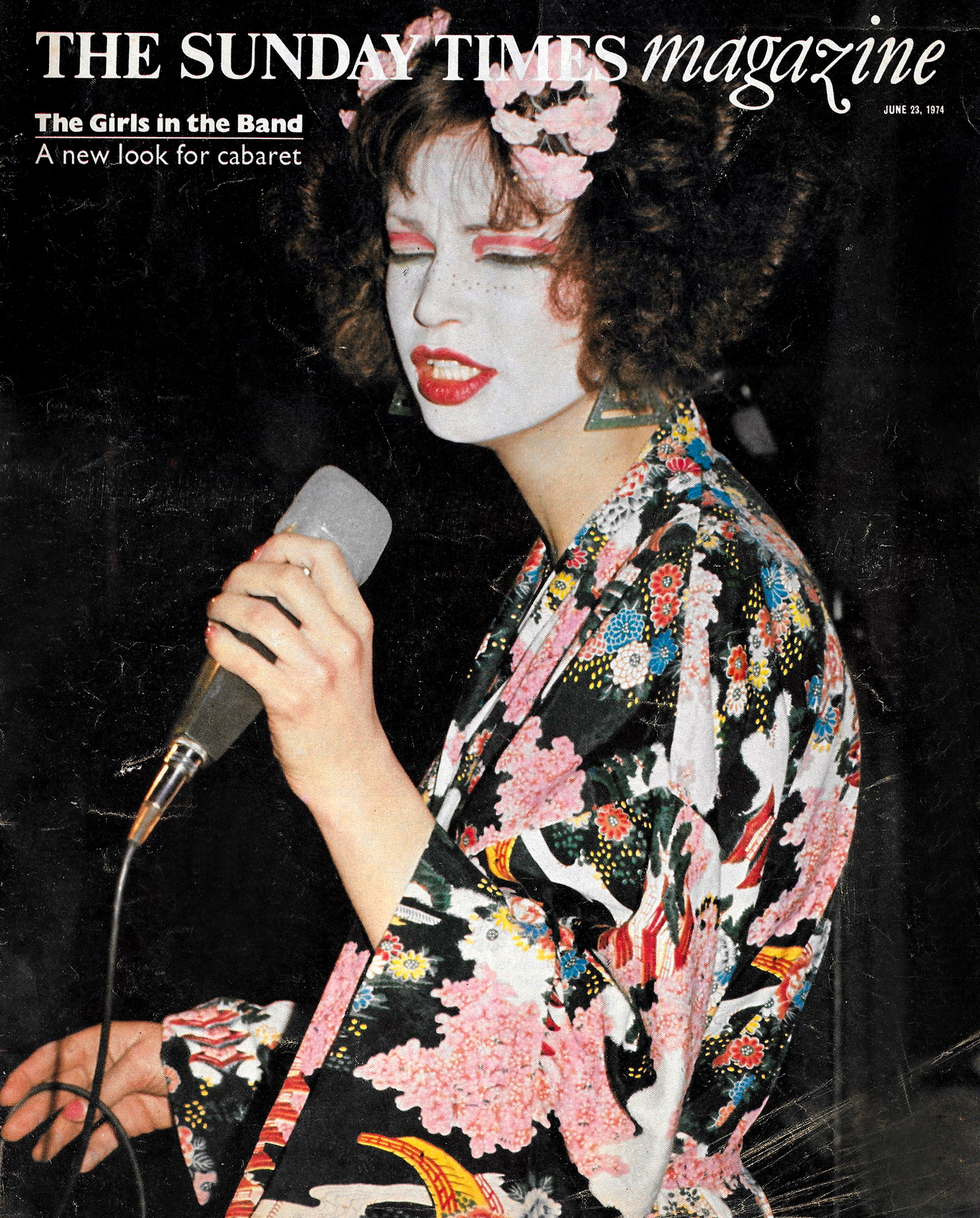
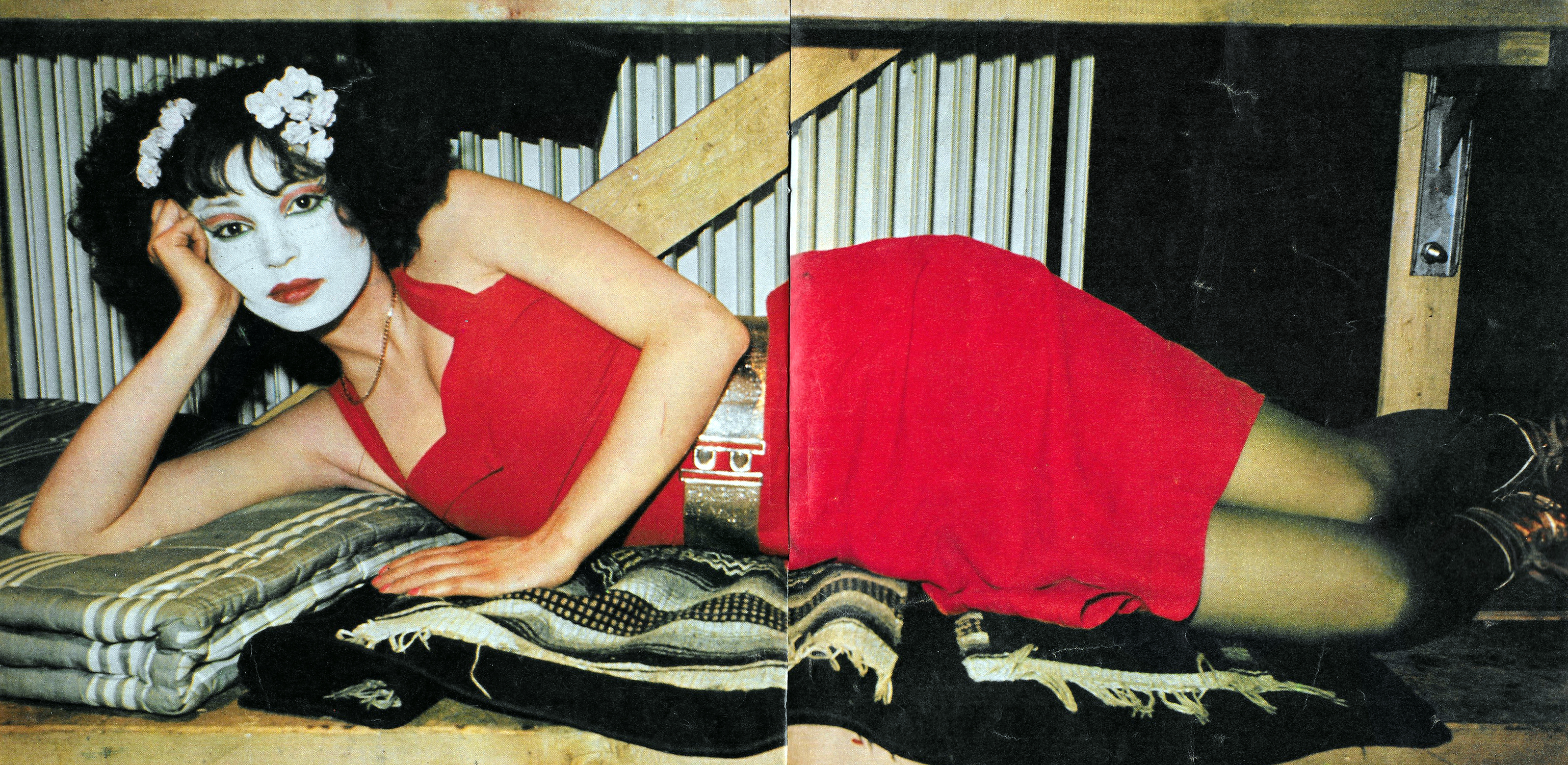
The make-up is startling. Polly Eltes said: “I really don’t quite know how we arrived at this present look. We started off quite simply looking brown and rather natural with perhaps blue eyelids, but gradually we progressed to what you see now.” They wear water-based wet-white foundation and then draw their features on to these masks. Anne Bean takes it the furthest by banding strips of coloured feathers to her eyebrows, while Rod Melvin, with his great carmine mouth and black sad eyes, looks somewhere between a clown and a Kabuki artist.
“I suppose we do reflect fashions, but I think it’s quite unconscious,” said Annie Sloan. “When Germaine Greer’s book came out (The Female Eunuch) we all wore strict little mannish suits, but somehow we have come to this.” ‘This’ is fishnet tights (with holes), gold-painted lace-up boots, long gloves and clothes they say they make themselves (which no-one would challenge). During the performance they swap clothes so that they look different but don’t use more costumes.
“I suppose that what we wear might seem eccentric and exaggerated; everyone marvels at Rod’s shoes but they came from Dolcis and mine came from Biba’s, so we are only picking up what’s around.” They admit that their art training and observations have probably influenced their act — the masks they wear at one point are exactly like those shown on some of John Davies’s sculptures shown at the Whitechapel Gallery a couple of years ago : “But we don’t want to intellectualise what we do,” said Annie Sloan, “or we might become self-conscious and unable to perform.”
The group pool their money; so much goes on running expenses, the rest on food and necessities. They were scheduled for seven more weeks on the road, ending at the Schiller Theatre in East Berlin. “When we are out of work we all do other things. I model, though I’m not much good at it,” said Polly Ekes. “I can’t really take it seriously, so when I go for jobs I mostly get turned down.” Rod and Anne teach, and sometimes Rod plays the piano for a girl singer and Marianne does typography and pho-tography. It is doubtful whether they will stick together : one has the feeling that they are enthusiastically filling in time before they move on to some-thing else.
Photographed by Hans Feurer. Report by Meriel McCooey.
Scanned from The Sunday Times Magazine, June 23rd 1974
Silk lace dress with boxer shorts underneath by Poole at Shape. Shoes by Biba. Choker and fake violets from John Lewis.
Rich renaissance colours in velvet, lace and crepe reflect the mood for Christmas. Emphasis is on the shape of the body – necklines plunge, backs are bared, and skirts are slit in a demure, but wanton, fashion.
Photographed by John Bishop.
Scanned from 19 Magazine, December 1970.
Crepe dress in black, mauve and green by Alistair Cowin. Shoes from Biba.
Plum silk lace wrap over blouse with matching waist ties by Poole at Shape. Gored skirt in deep green velvet by Foale and Tuffin. Shoes from Biba.
Charcoal green dress and crepe shoes all from Biba.
Velvet cap from Feathers. Veiling from John Lewis. Crepe dress by Stirling Cooper. Shoes from Elliott.
Lilac velvet cap from Feathers. Blue Tricel wrap over top and flared skirt both by Poole at Shape. Shoes from Biba.
Brown, beige and rust panne velvet dress by Gillian Richard. Black shoes by Elliott.
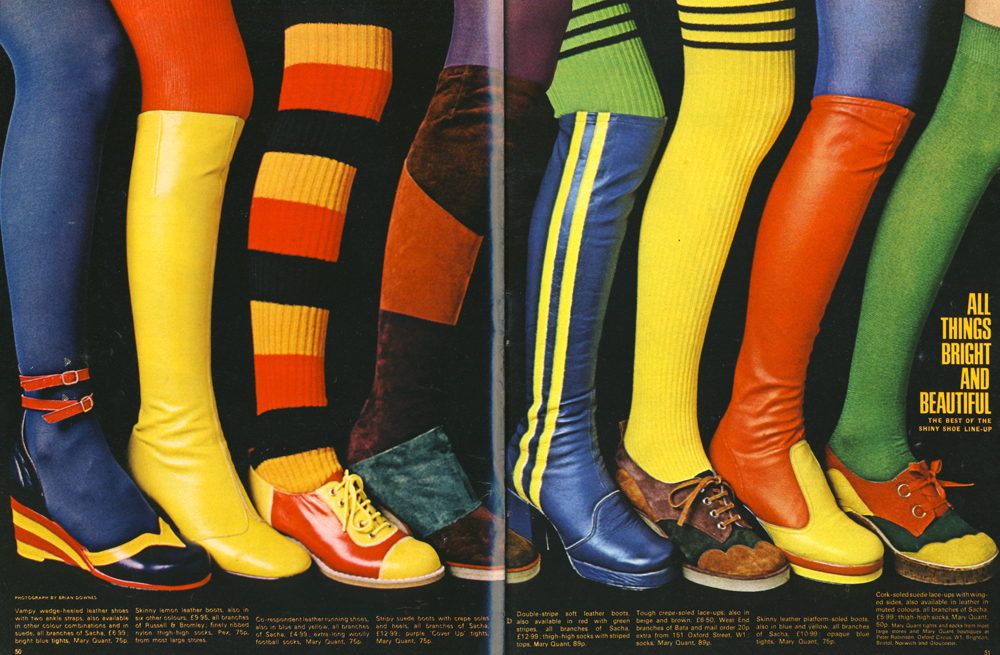
L-R Vampy wedge heeled shoes by Sacha, Skinny lemon boots by Russell & Bromley, Co-respondent leather running shoes by Sacha, Stripy suede boots with crepe soles by Sacha, Double stripe soft leather boots by Sacha, Tough crepe soled lace-ups by Bata, Skinny leather platform soled boots by Sacha. Cork soled suede lace ups by Sacha.
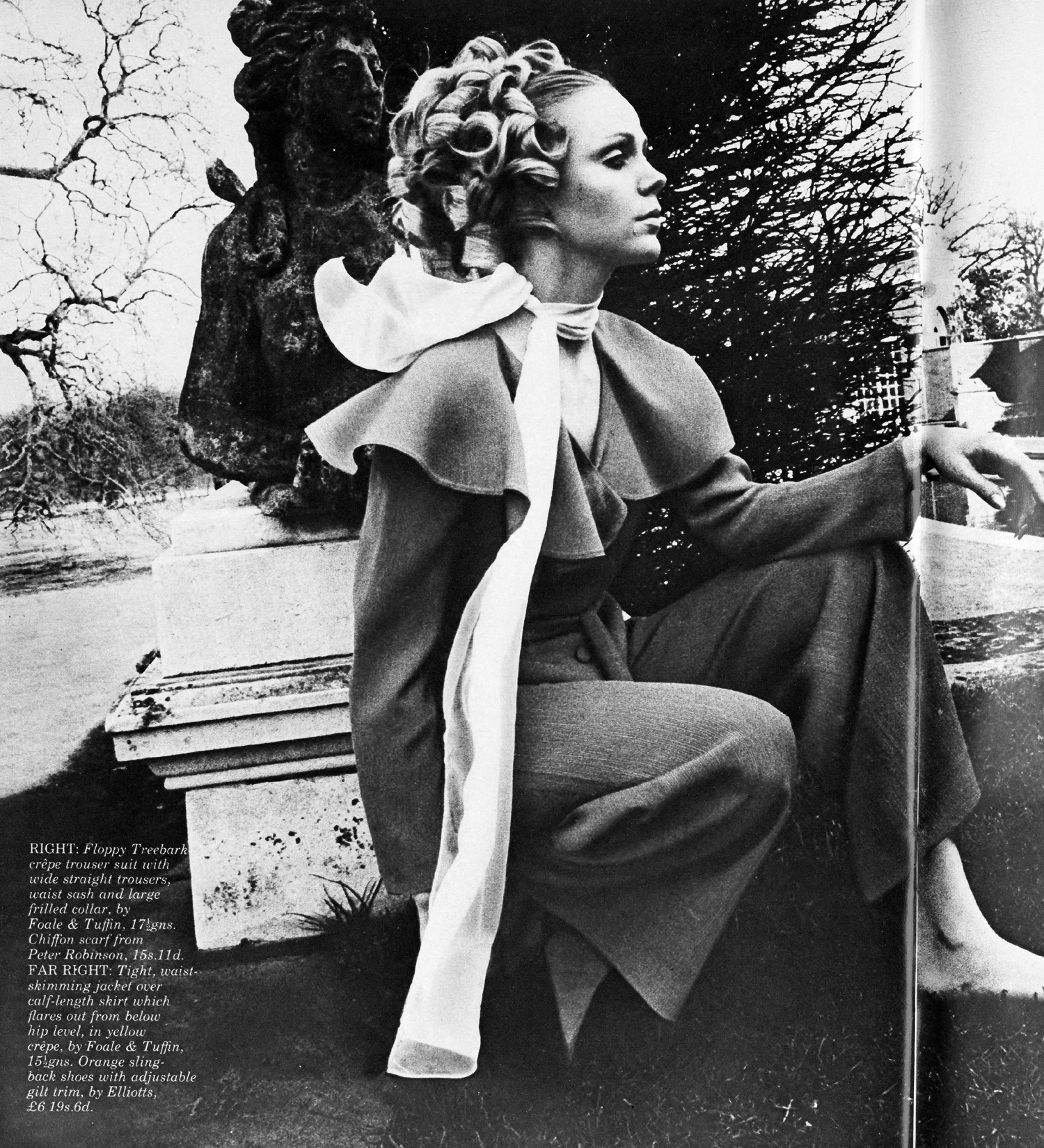
Floppy Treebark crepe trouser suit with wide straight trousers, waist sash and large frilled collar, by Foale and Tuffin.
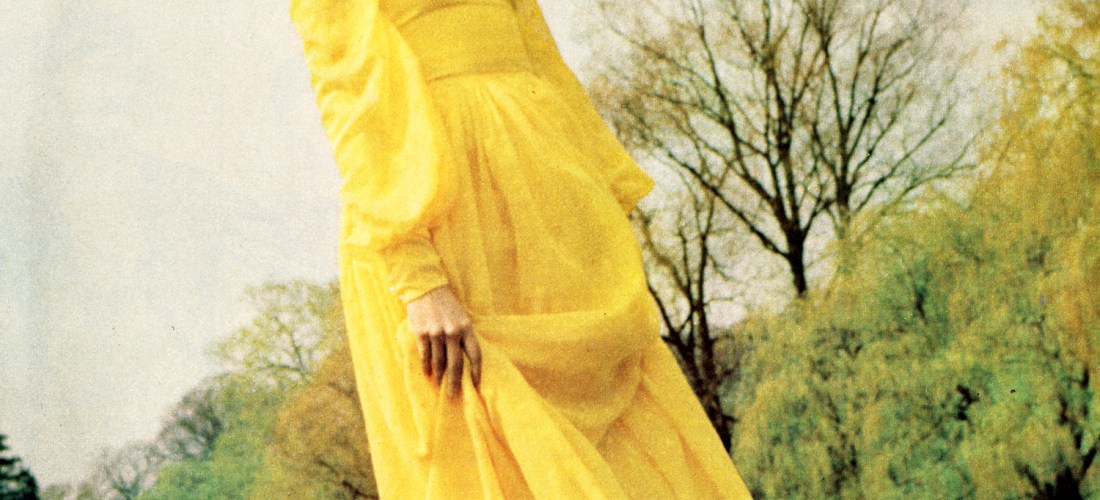
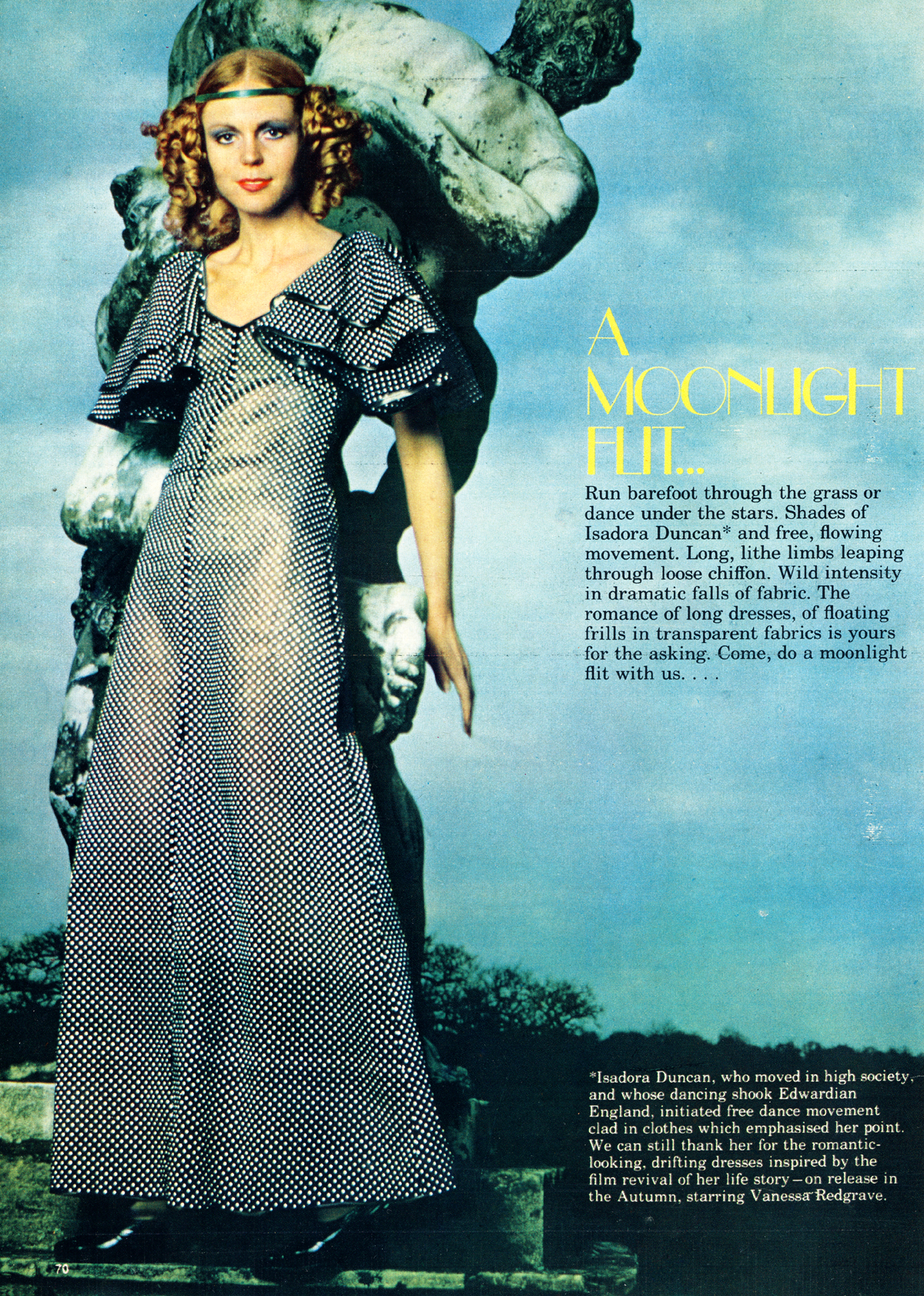
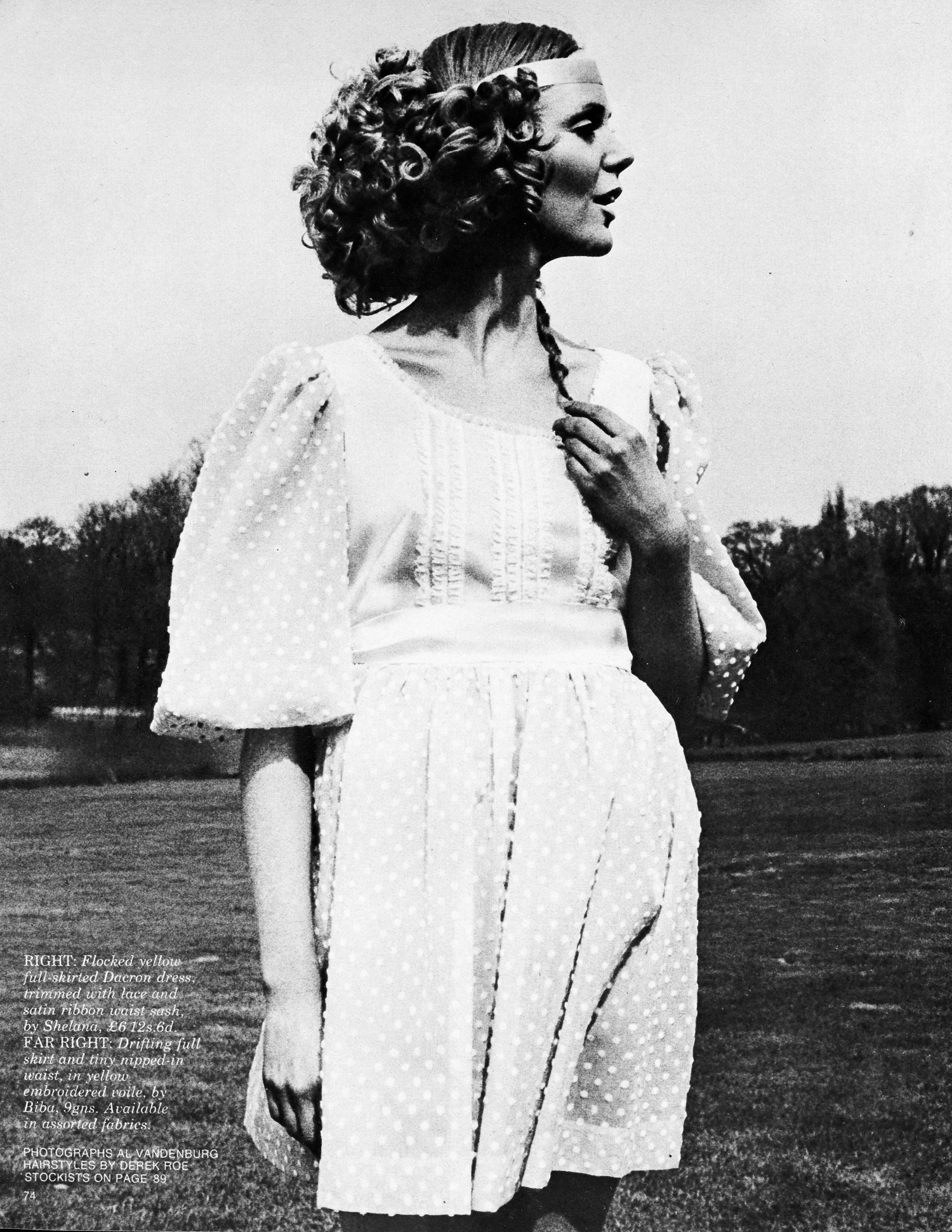
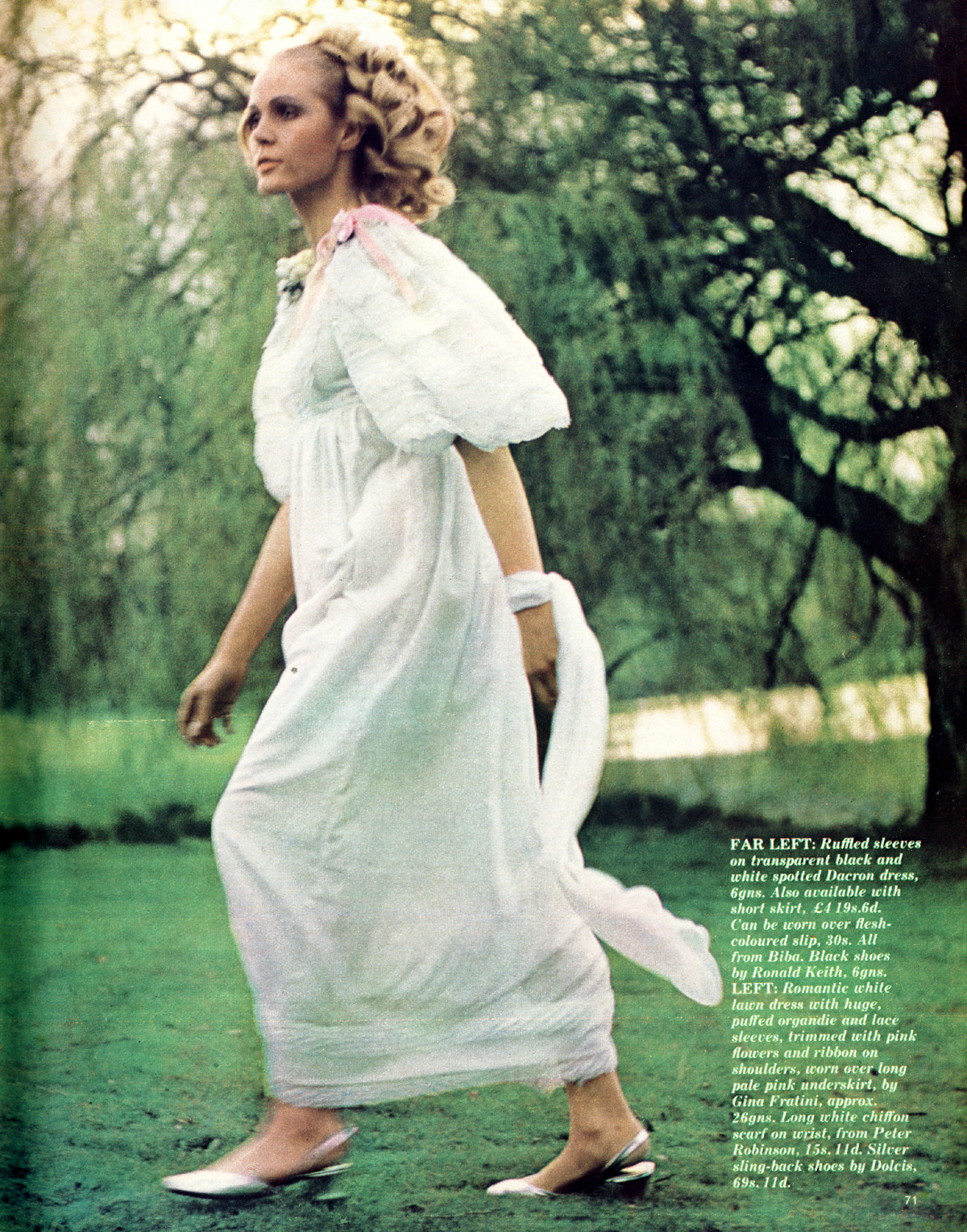
Run barefoot through the grass or dance under the stars. Shades of Isadora Duncan* and free, flowing movement. Long, lithe limbs leaping through loose chiffon. Wild intensity in dramatic falls of fabric. The romance of long dresses, of floating frills in transparent fabrics is yours for the asking. Come, do a moonlight flit with us…. *Isadora Duncan. who moved in high society, and whose dancing shook Edwardian England, initiated free dance movement clad in clothes which emphasised her point. We can still thank her for the romantic-looking, drifting dresses inspired by the film revival of her life story — on release in the Autumn, starring Vanessa Redgrave.
Photographed by Al Vandenburg. Hairstyles by Derek Roe.
Scanned from 19 Magazine, August 1968.
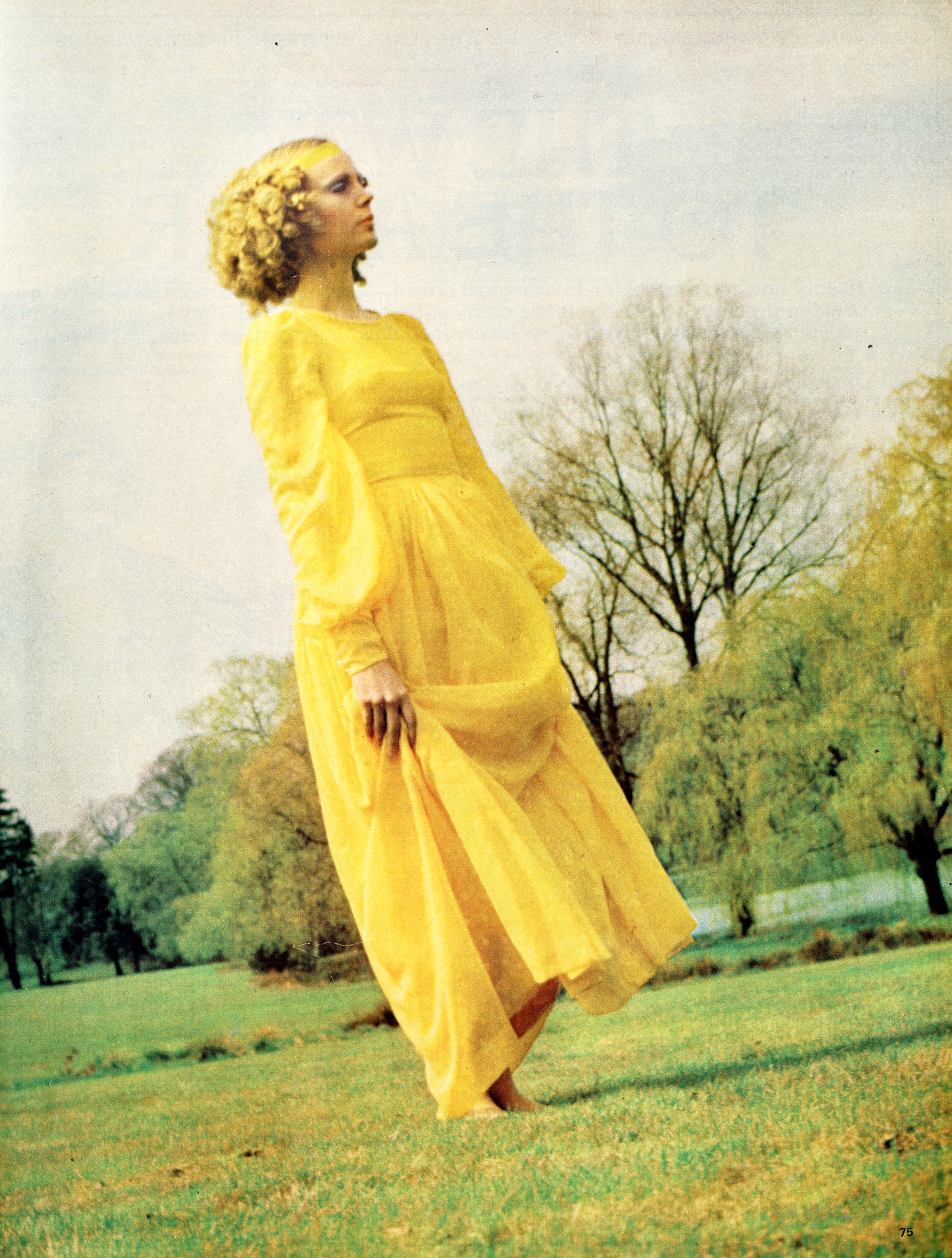
Dress in yellow embroidered voile by Biba.
Transparent black and white spotted dress from Biba. Shoes by Ronald Keith.
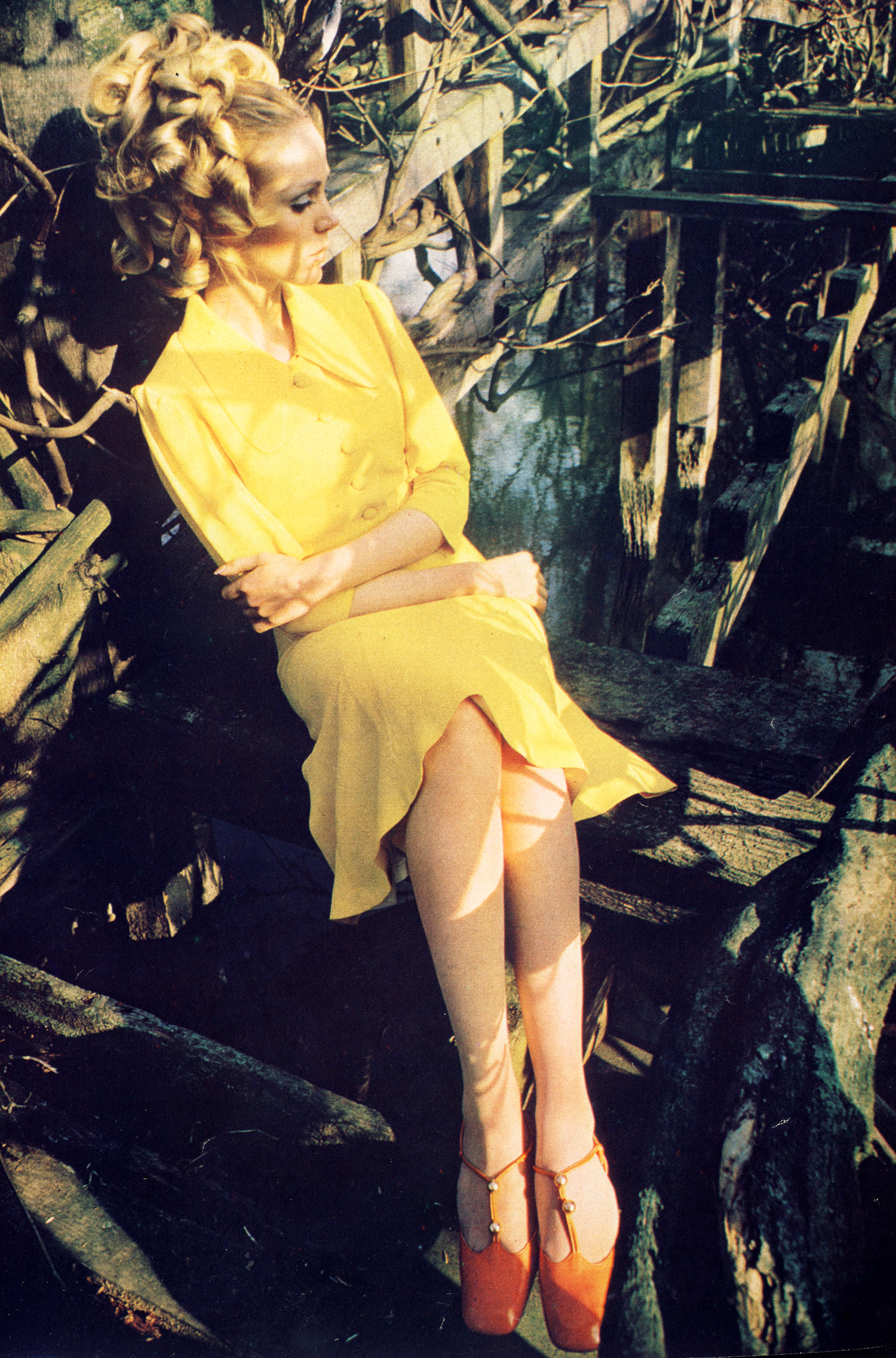
Tight waist-skimming jacket and knee length skirt in yellow crepe by Foale and Tuffin. Orange shoes by Elliotts.
Flocked yellow full-skirted Dacron dress by Shelana.
Romantic white lawn dress by Gina Fratini. Silver shoes by Dolcis.
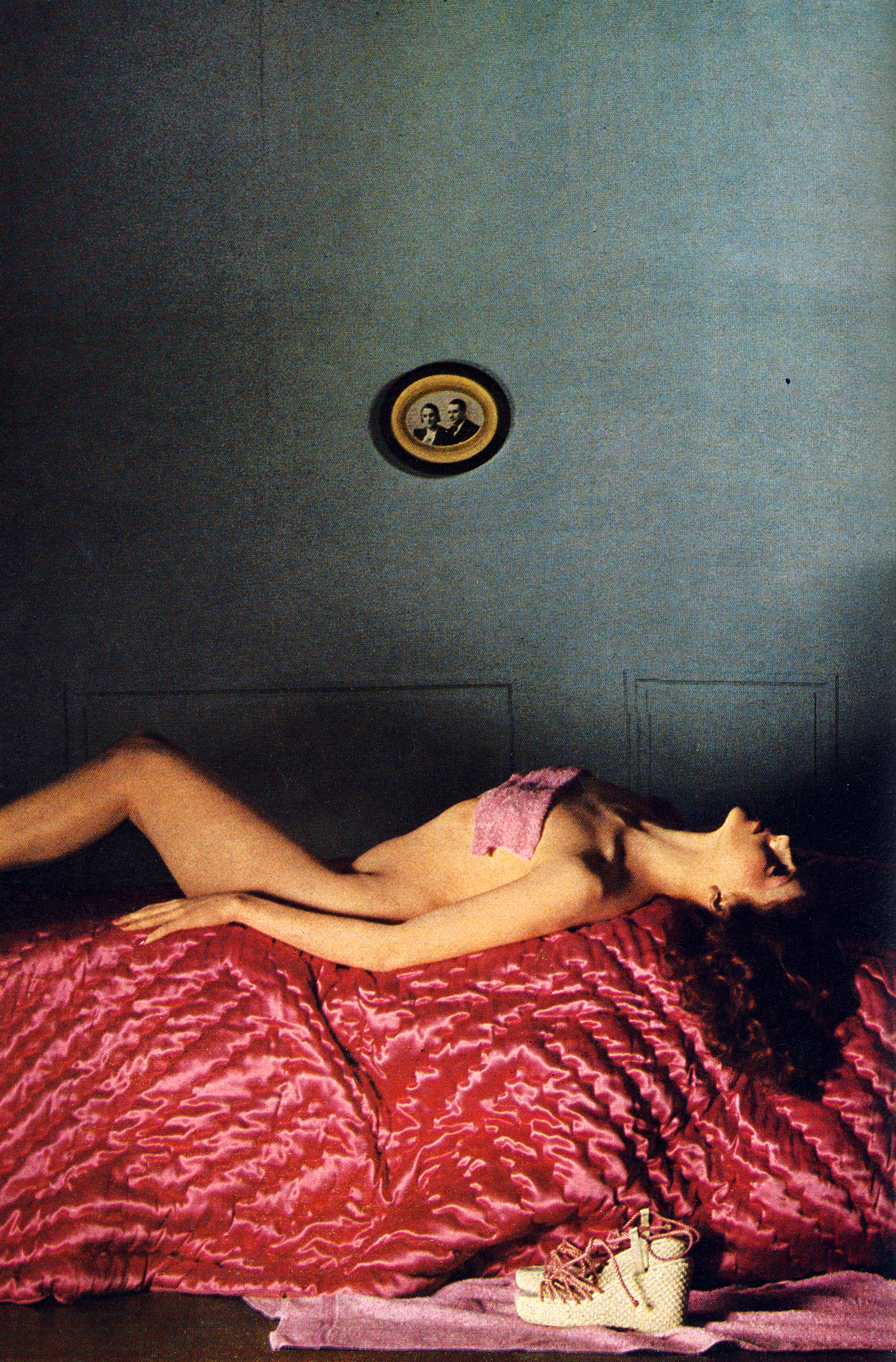
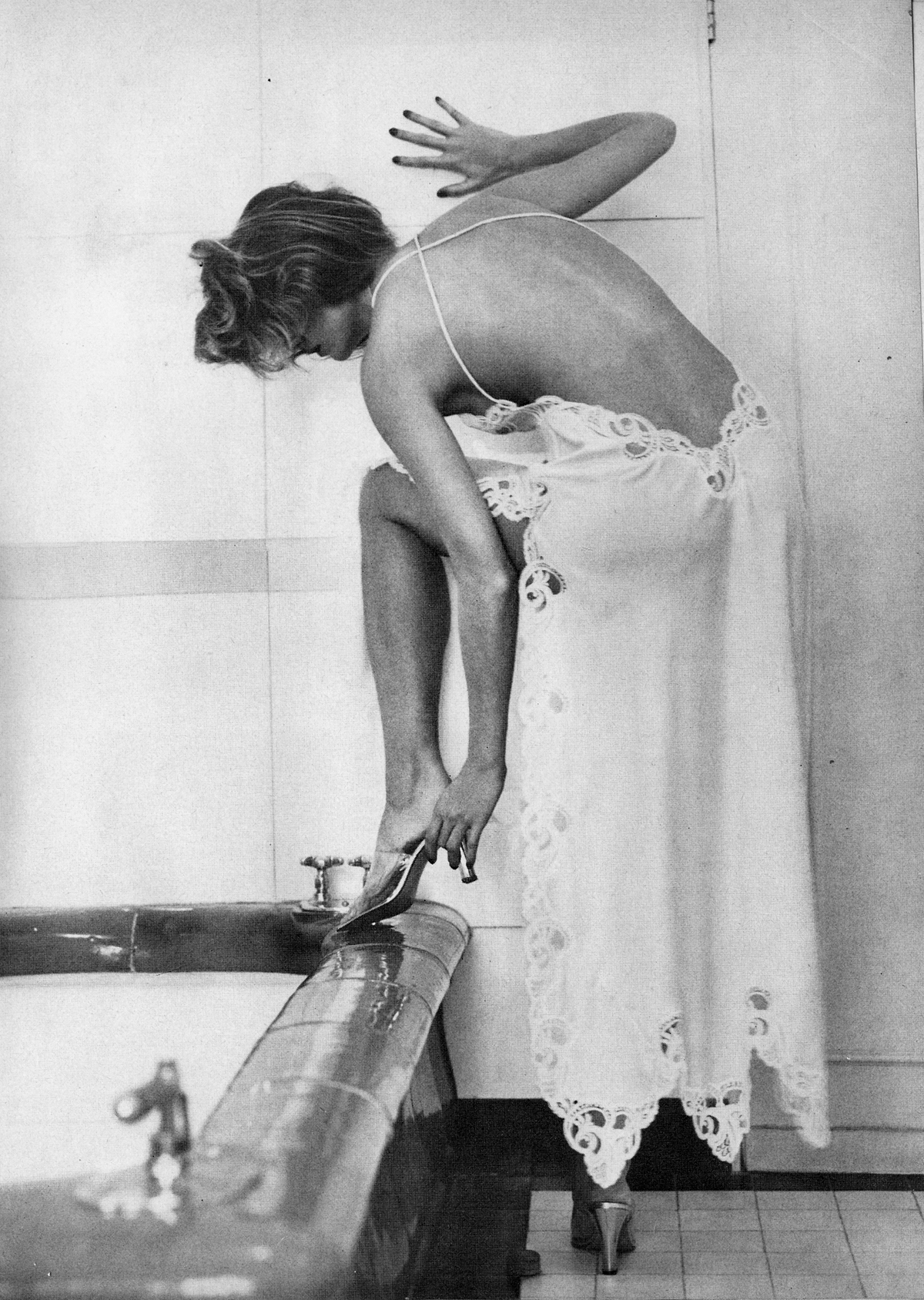
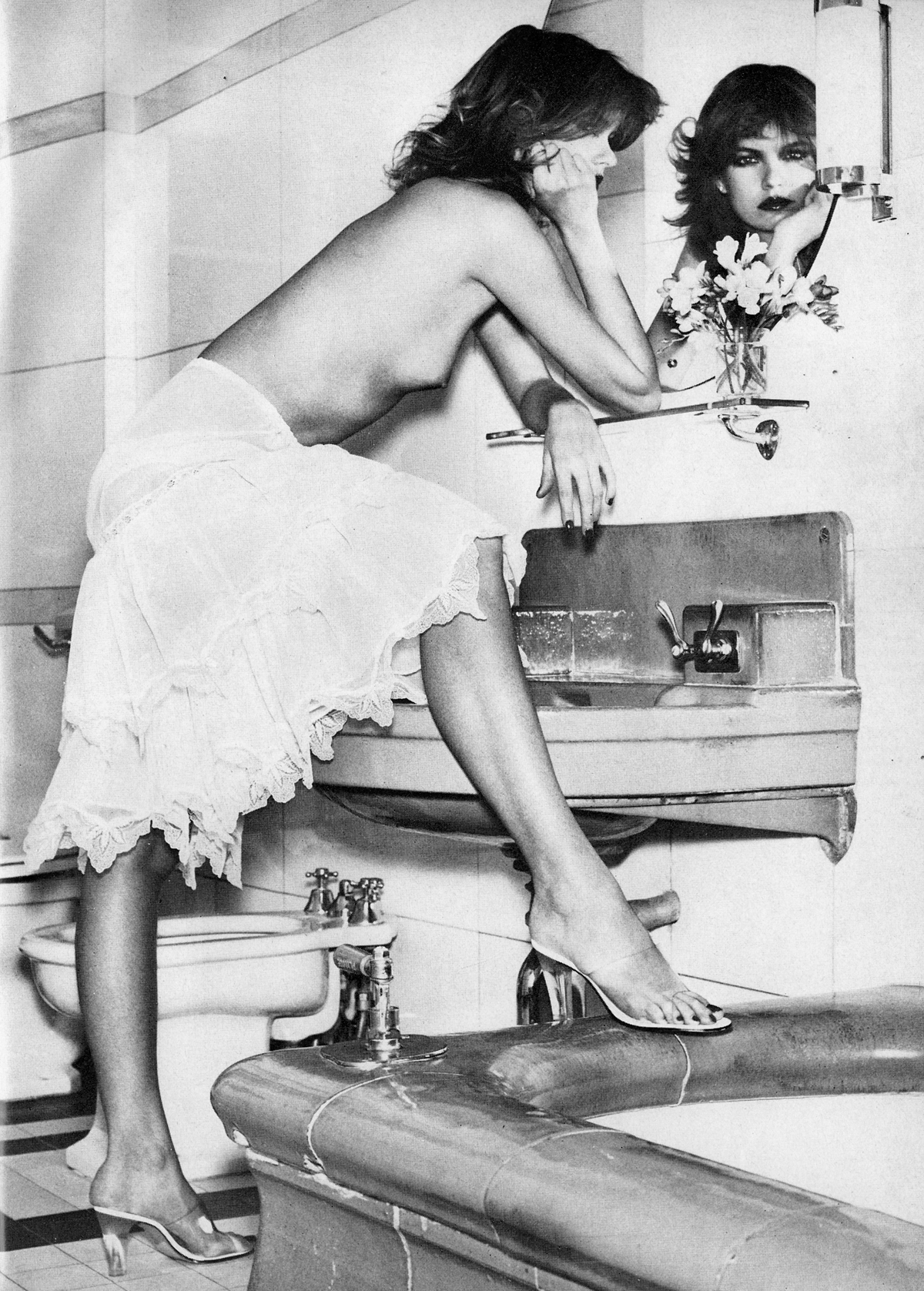
Lace and satin nightdress, turquoise and white, by Janet Reger. Mules by Midas.
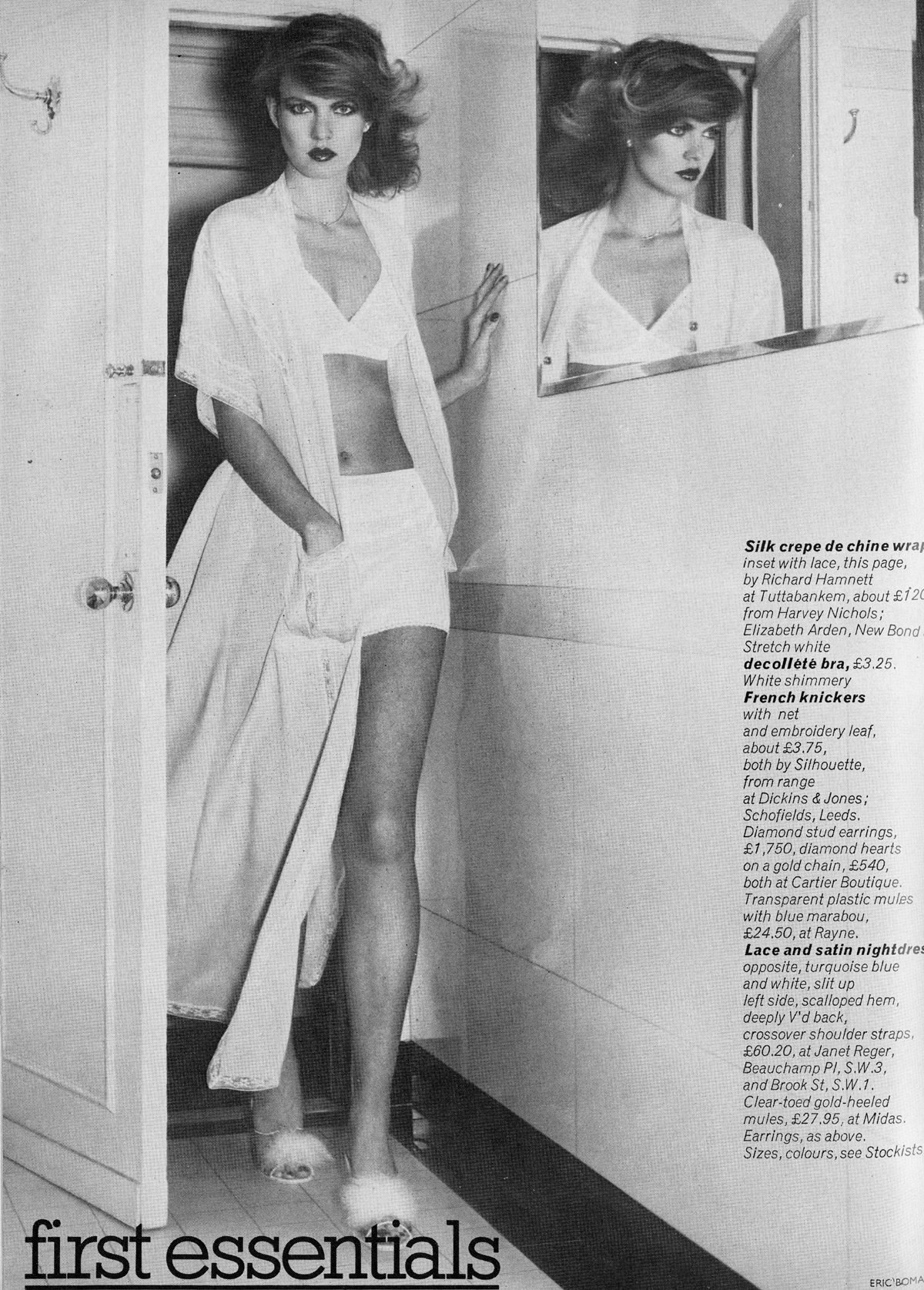
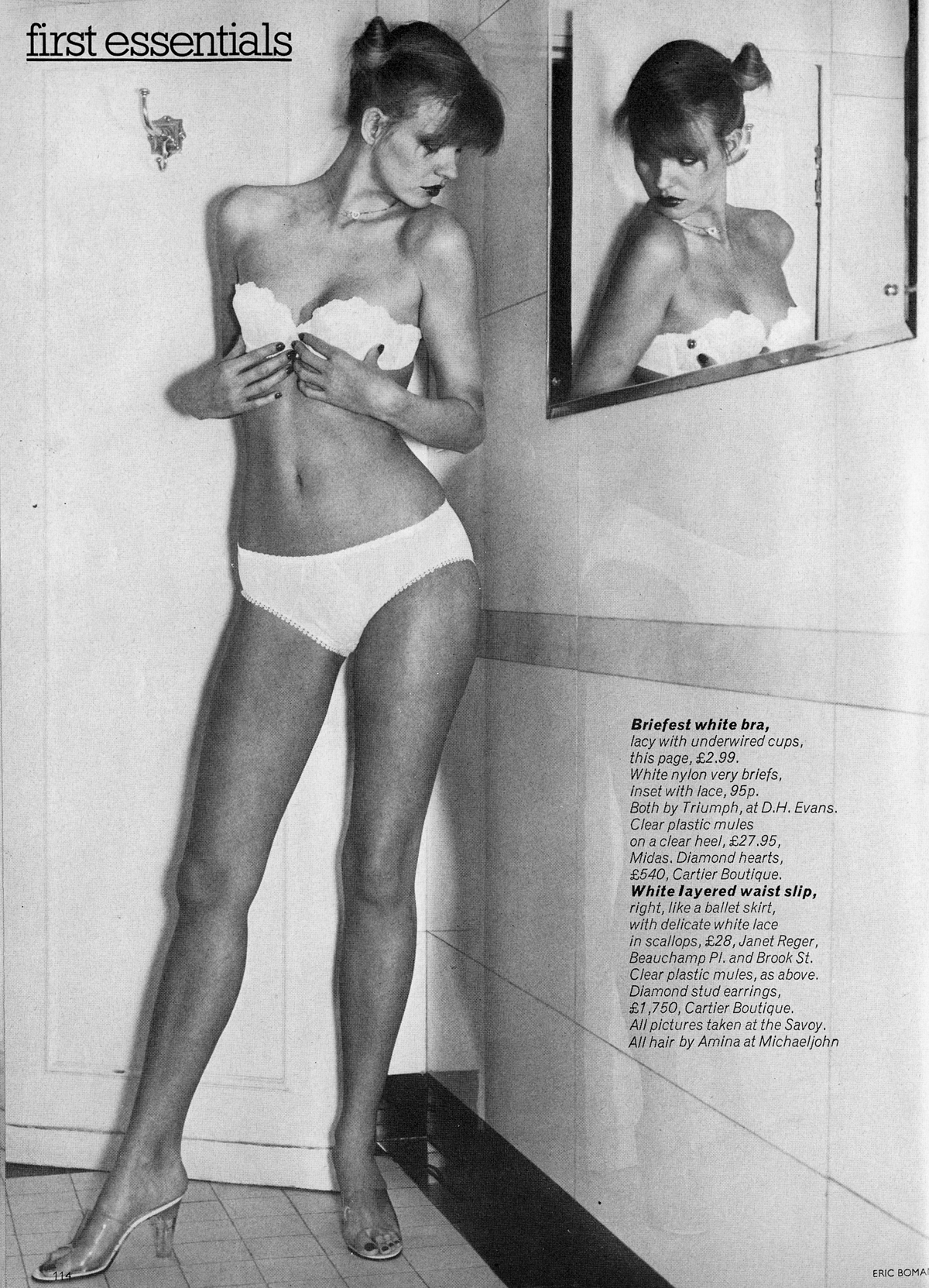
Photographed by Eric Boman at The Savoy.
Scanned by Miss Peelpants from Vogue, April 1977.
Silk crepe de chine wrap by Richard Hamnett at Tuttabankem White bra and French knickers by Silhouette at Dickins and Jones. Plastic and marabou shoes by Rayne.
White layered waist slip by Janet Reger. Clear plastic mules by Midas.
Briefest white bra and white nyloon very briefs, both by Triumph. Clear plastic mules by Midas.
Flower print skirt and top by Sujon. Crochet shawl by Mrs Cresswell. Shoes by Sacha.
Dusky dark dresses for the days when you’d rather take things cooler, in feminine earthy patterns galore, with more than their fair share of low key price tags…
Photographed by Steve Hiett.
Scanned by Miss Peelpants from Petticoat, February 1971.
Both outfits by Mary Quant’s Ginger Group. Inset below right, both dresses by Dranella.
Midi dress by Marielle. Rosie Nice satin shawl.
Liberty print tiered dress by Miss T. Shawl by Mrs Cresswell. Cream boots by Ravel.
Multiprint dress, left, by Alan Rodin. Belt from Elliott. Sacha boots. Button front Liberty print dress, right, by Miss T. Suede beaded shawl by Elliott. Choker by Buckle Under.
Long Liberty print dress by Wallis. Bag and choker by Elliotts. Shoes by Anello & Davide.
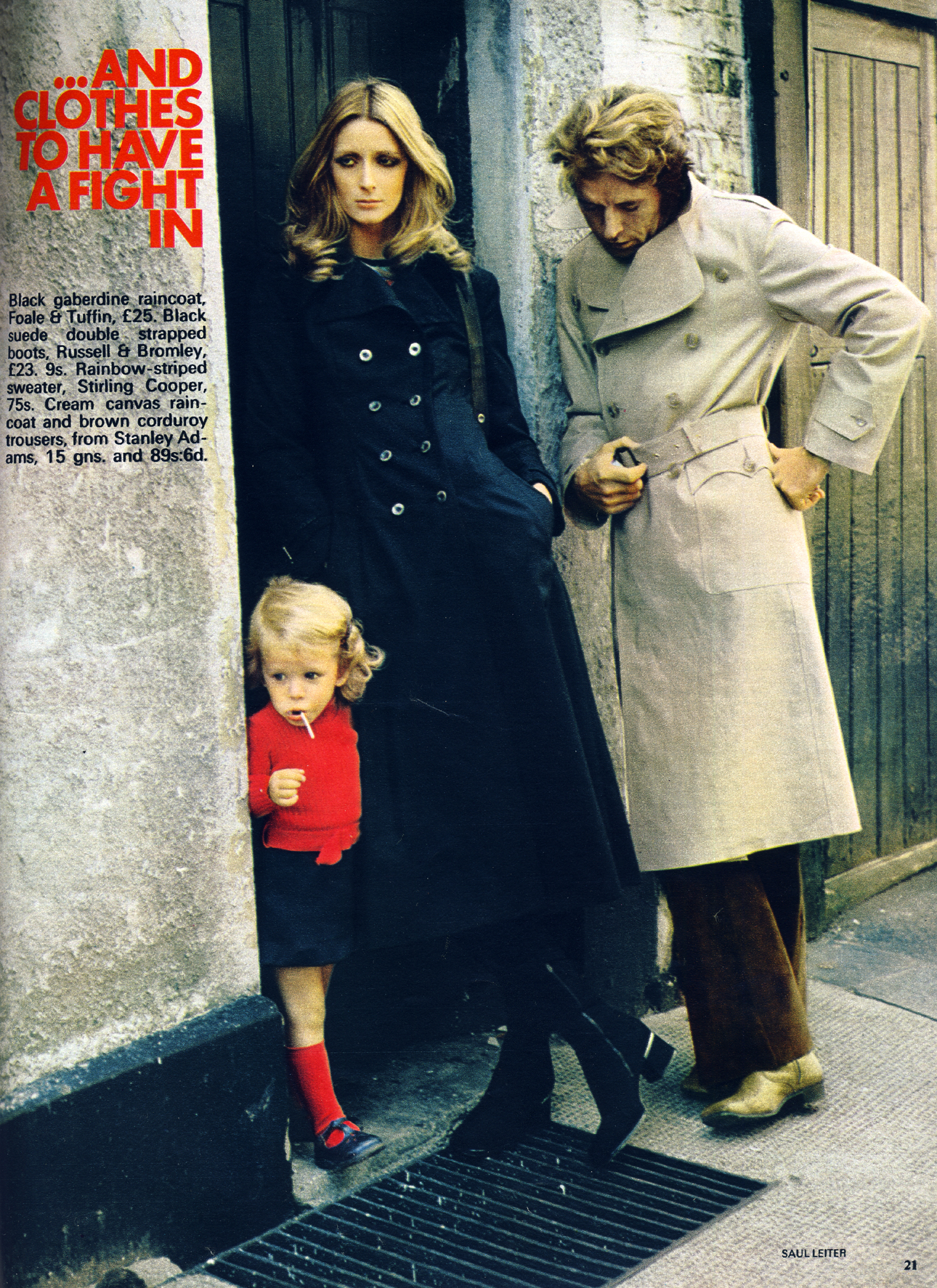
Black gabardine raincoat by Foale and Tuffin. Black suede double strapped boots from Russell & Bromley. Rainbow striped sweater by Stirling Cooper.
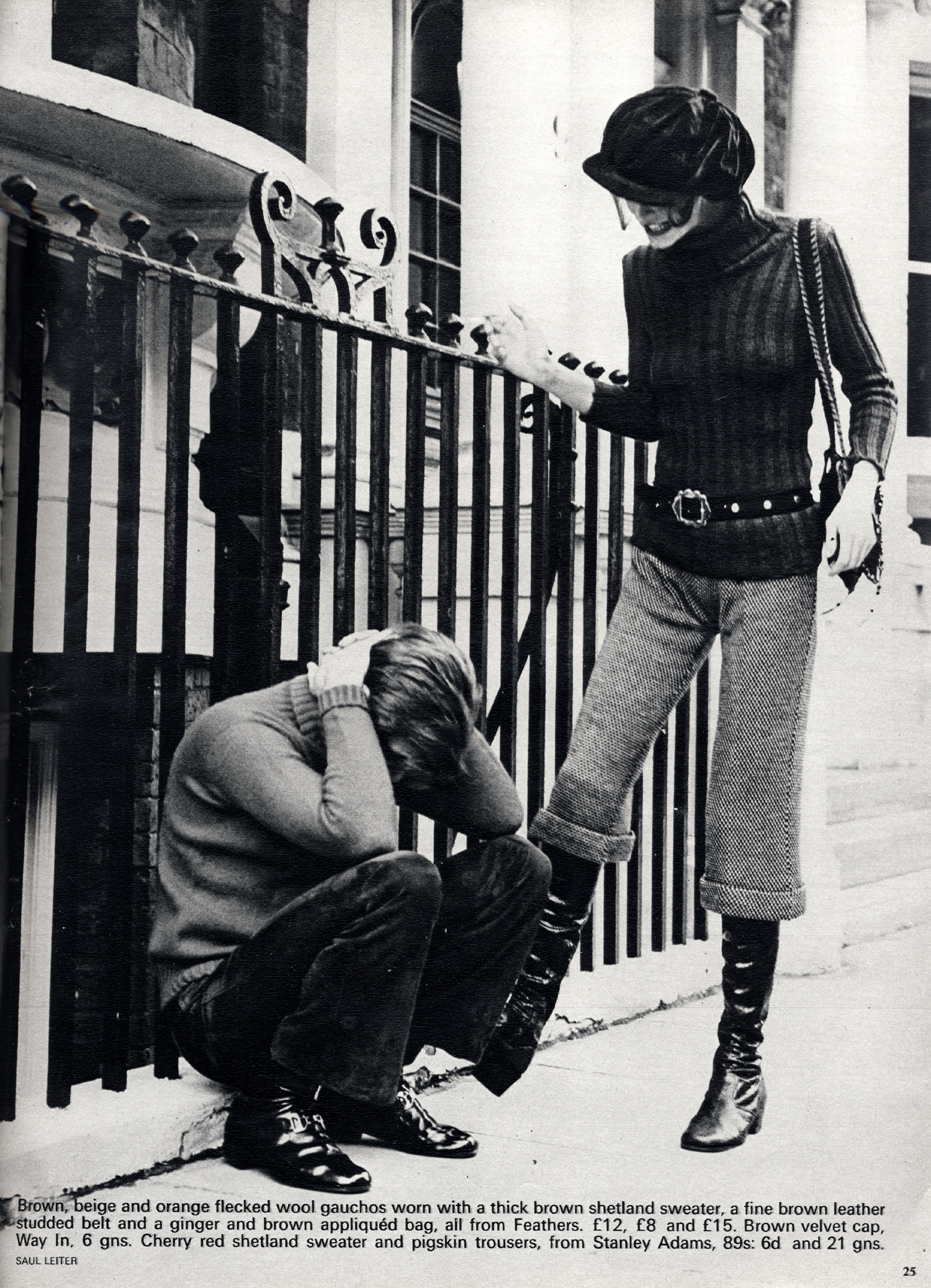
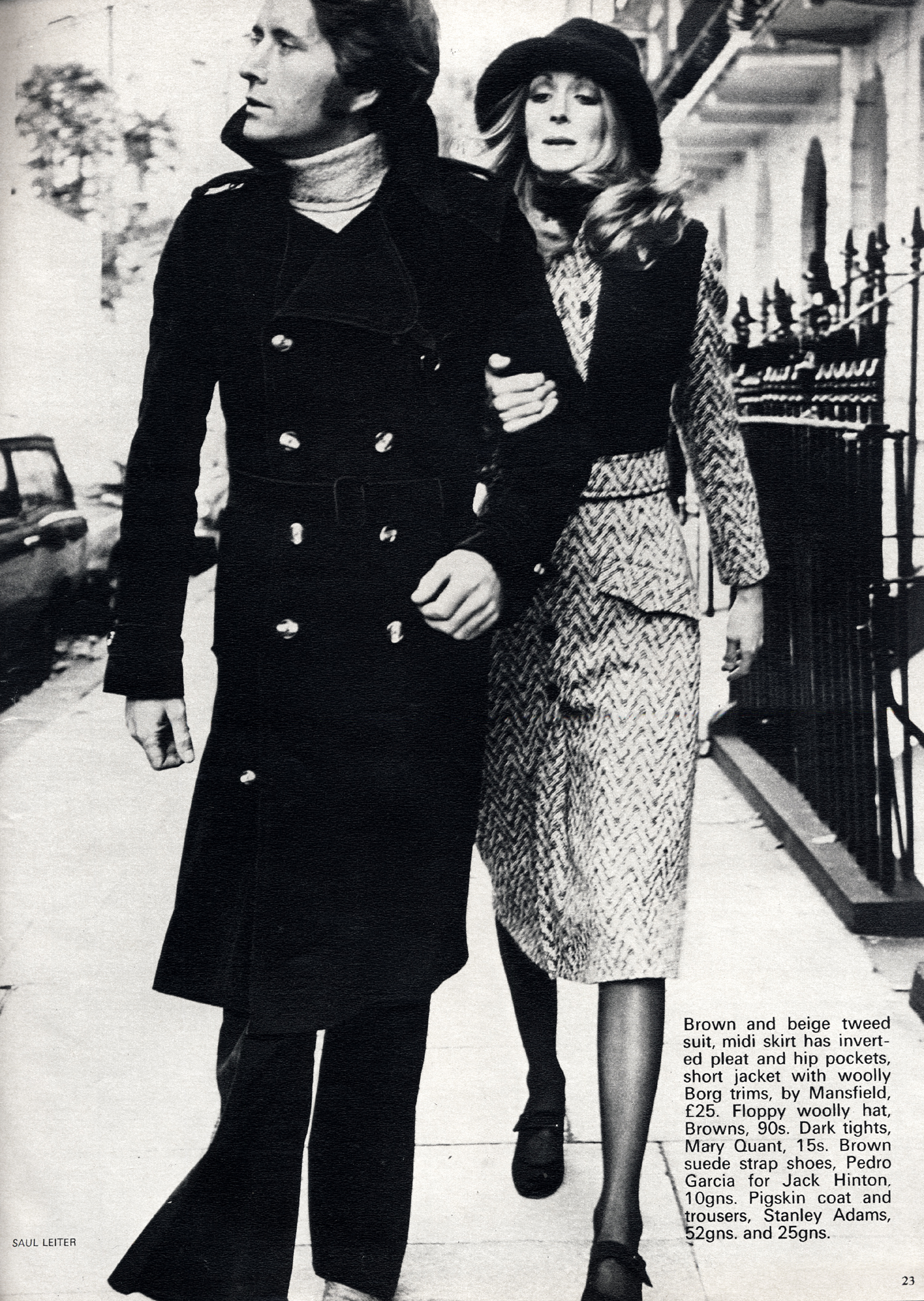
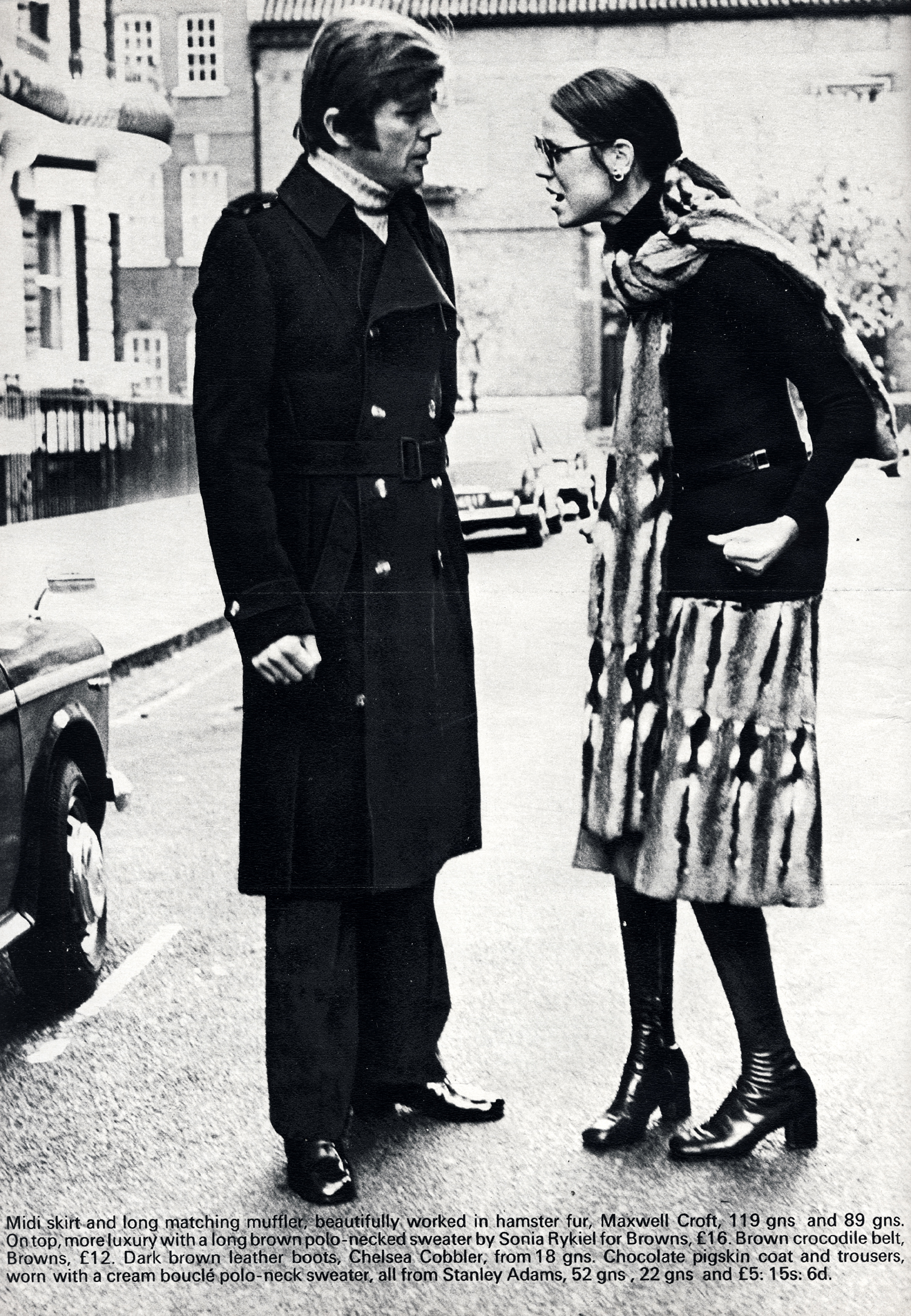
Reasons why Vanity Fair is one of the best fashion magazines ever #29847: A fashion editorial inspired by a fighting couple, photographed by Saul Leiter…
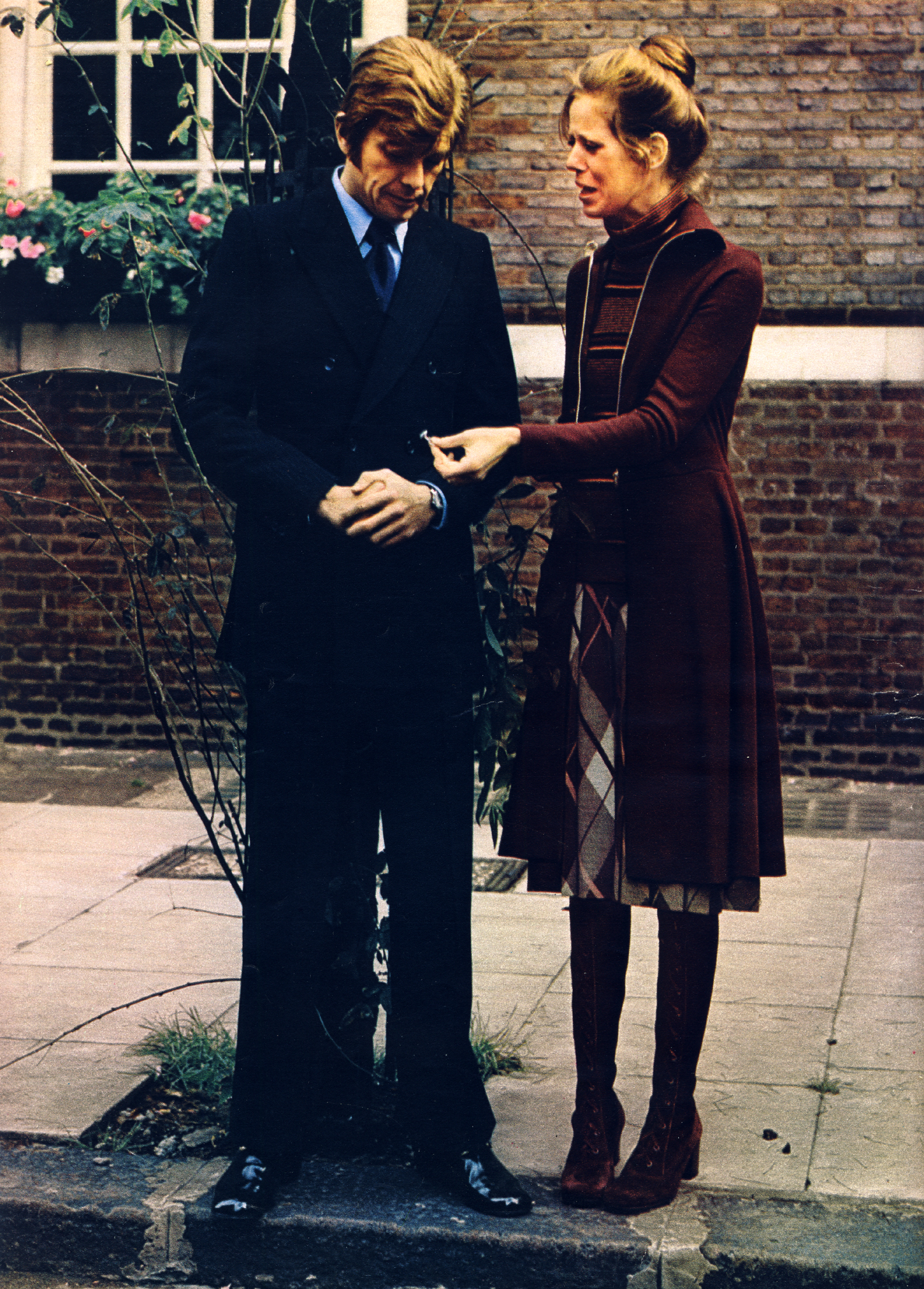
Scanned by Miss Peelpants from Vanity Fair, January 1971.
Maroon jersey coat and plaid skirt by Stirling Cooper. Sweater by Sonia Rykiel for Browns. Boots by Elliott’s.
Brown beige and orange flecked wool gauchos worn with thick brown shetland sweater, leather studded belt and appliqued bag all from Feathers. Cap from Way In.
Brown and beige tweed suit with Borg trims by Mansfield. Floppy woolly hat from Browns. Brown suede shoes by Pedro Garcia for Jack Hinton.
Midi skirt and matching muffler by Maxwell Croft. Brown polo necked sweater by Sonia Rykiel from Browns. Dark brown leather boots by Chelsea Cobbler.






 Liz Eggleston