
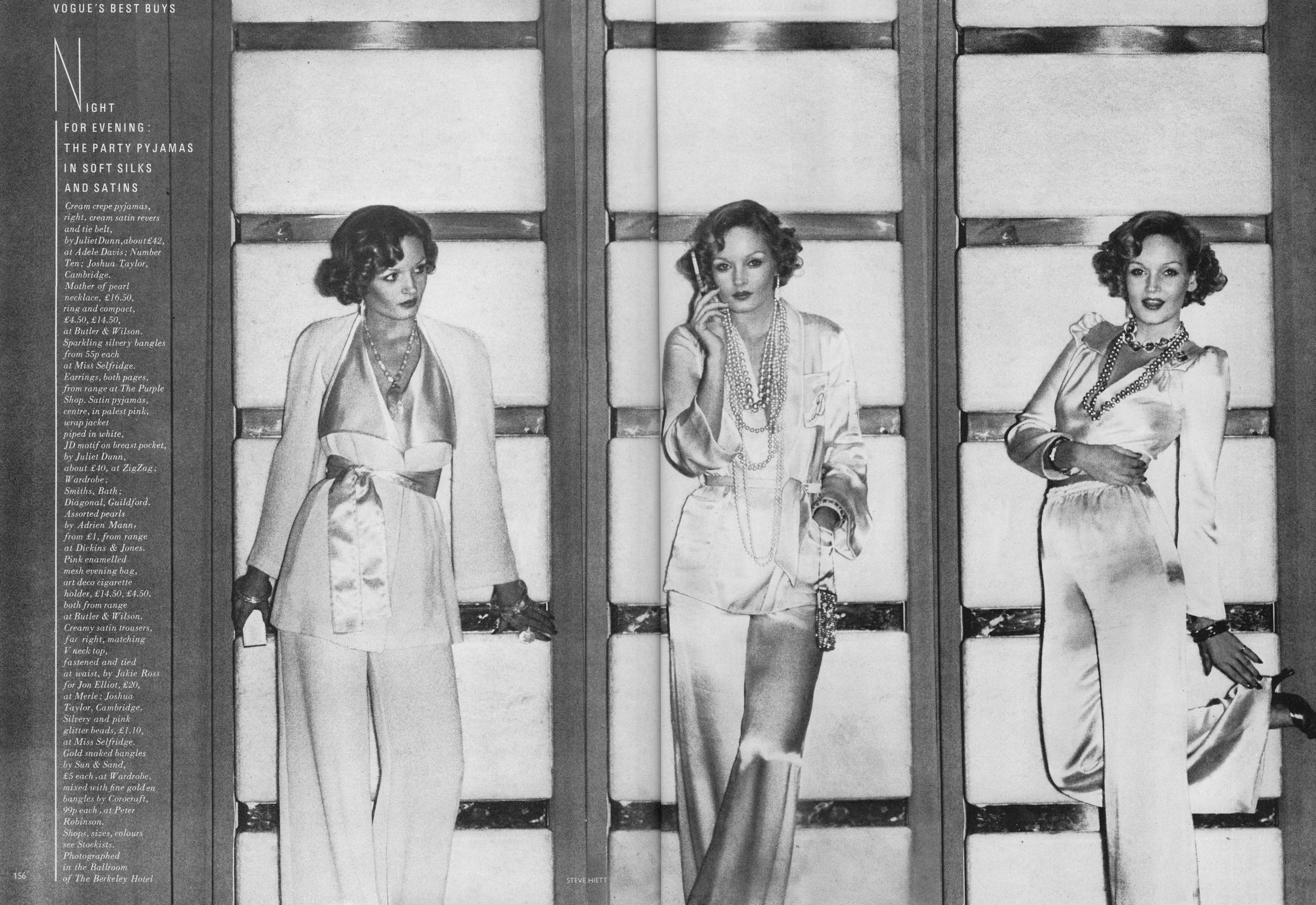
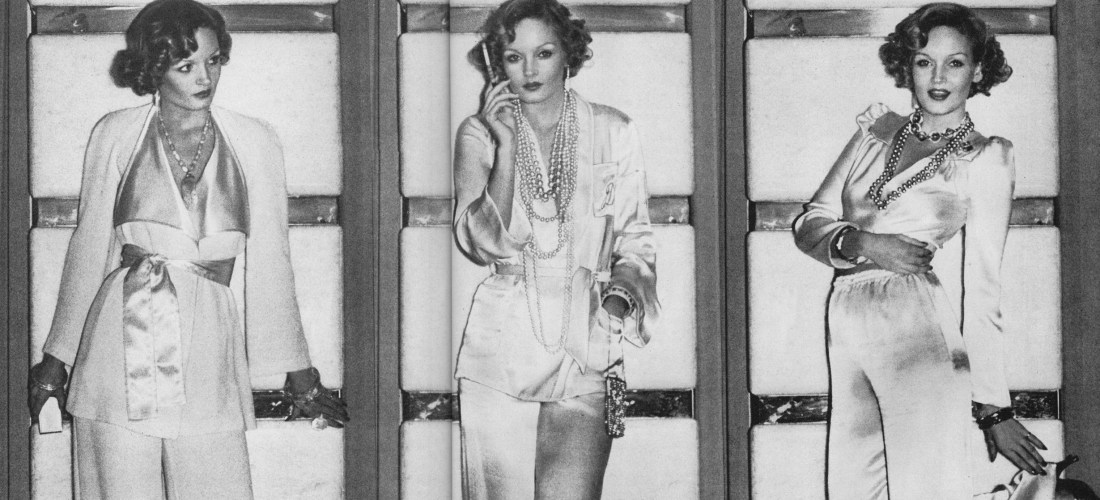
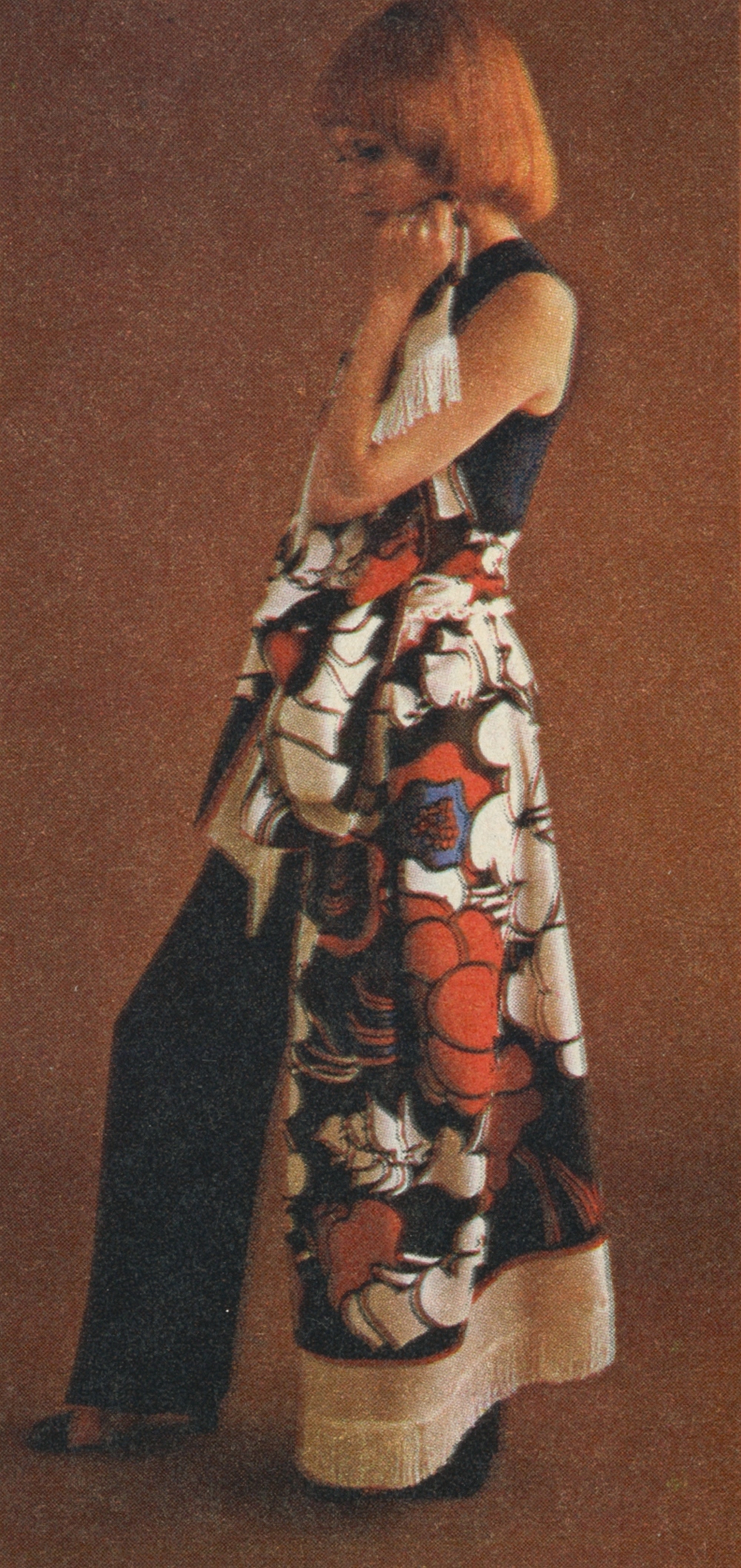
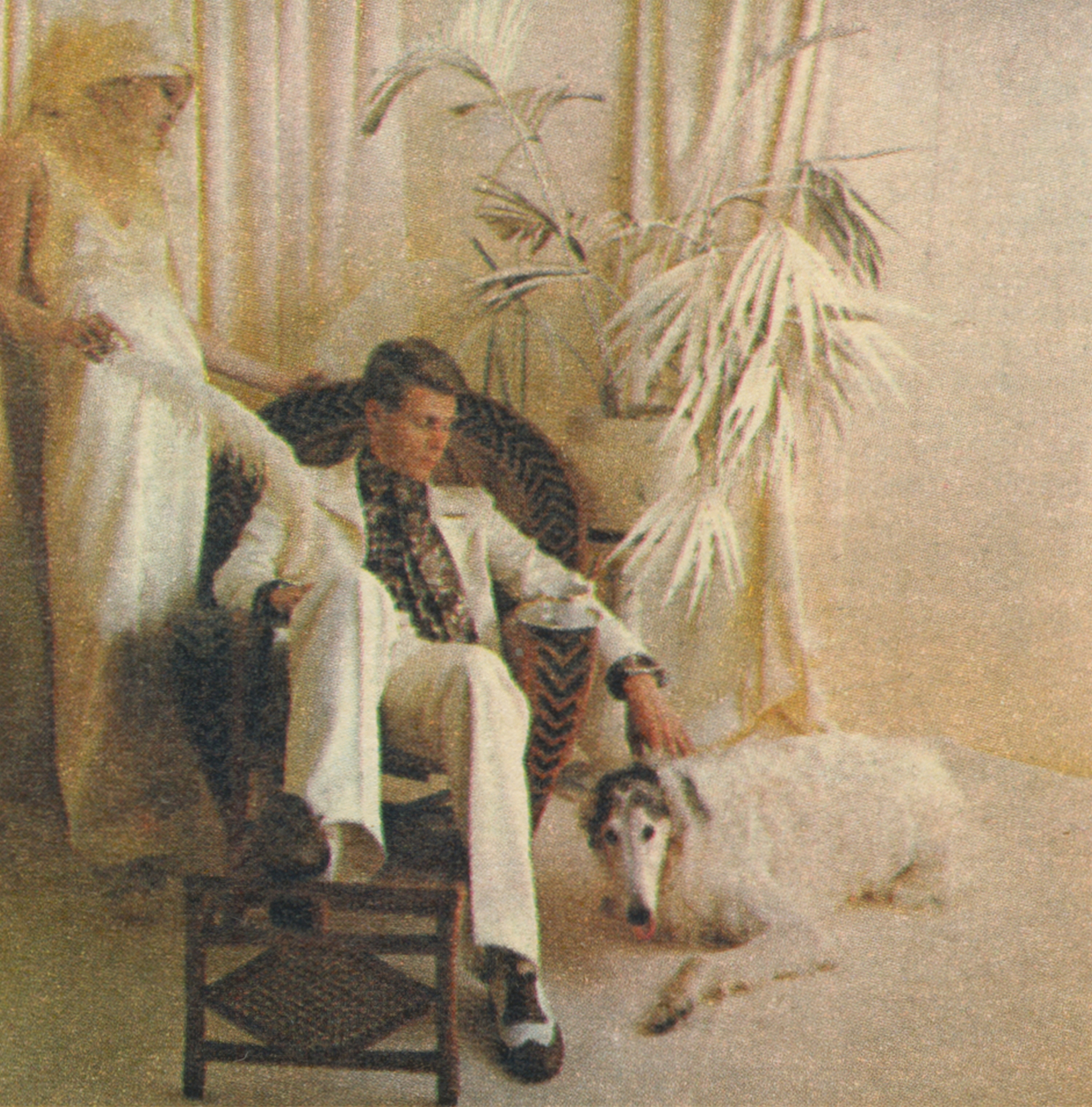
Night for evening: The Party Pyjamas in soft silks and satins.
Photographed in the Ballroom and Crystal Room of The Berkeley Hotel.
Hair by Keith at Smile.
Photographed by Steve Hiett.
Scanned from Vogue, late April 1974.
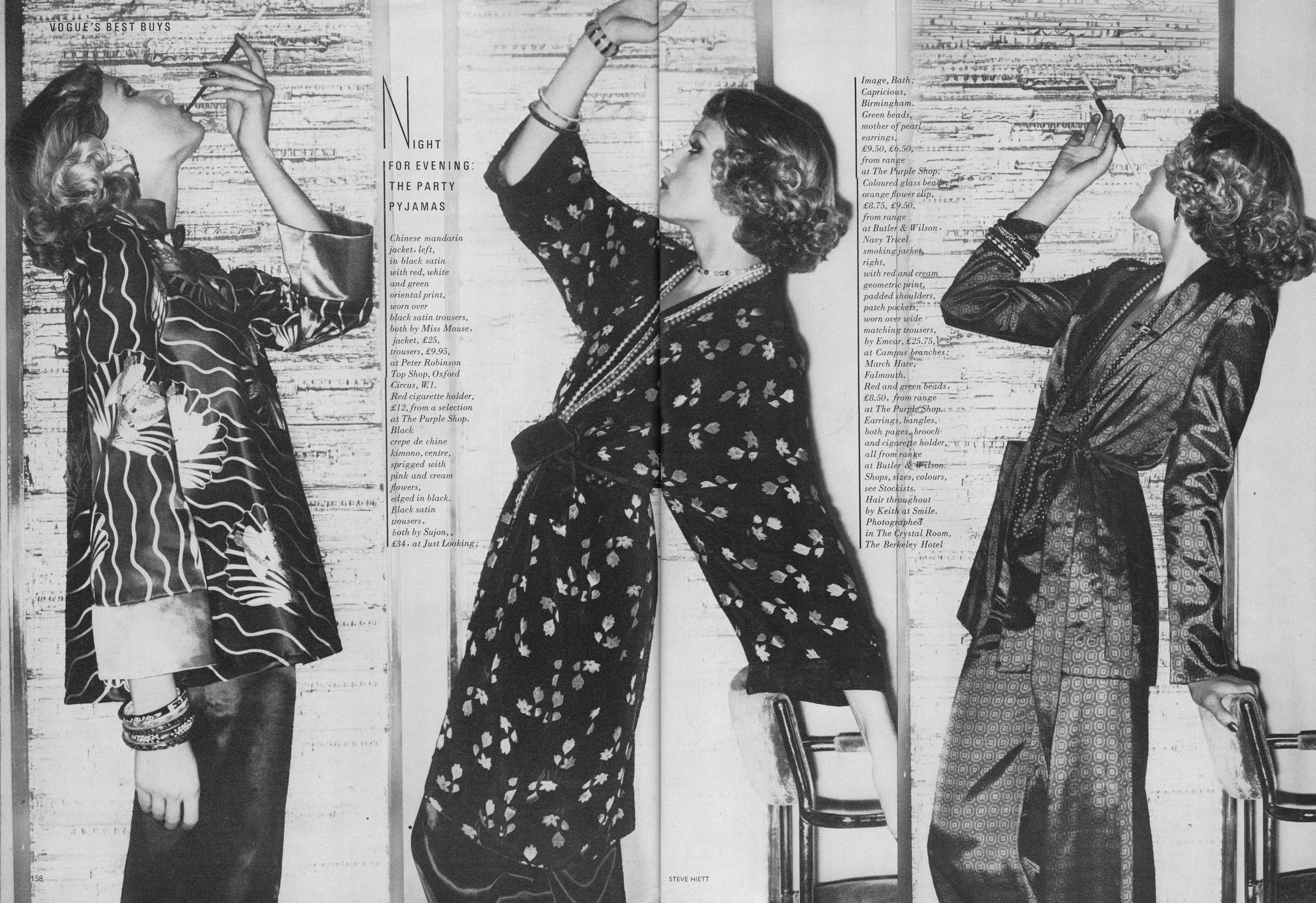
Night for evening: The Party Pyjamas in soft silks and satins.
Photographed in the Ballroom and Crystal Room of The Berkeley Hotel.
Hair by Keith at Smile.
Photographed by Steve Hiett.
Scanned from Vogue, late April 1974.
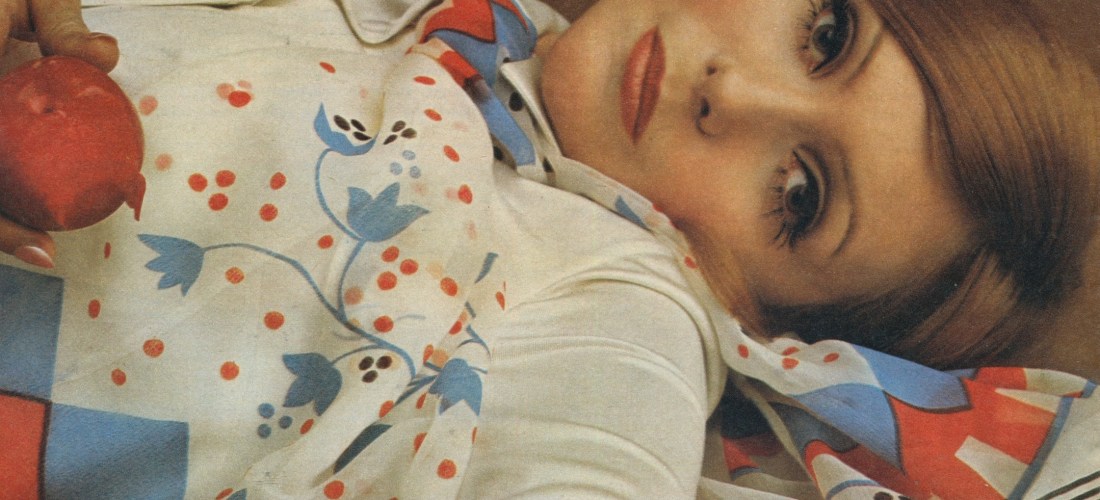

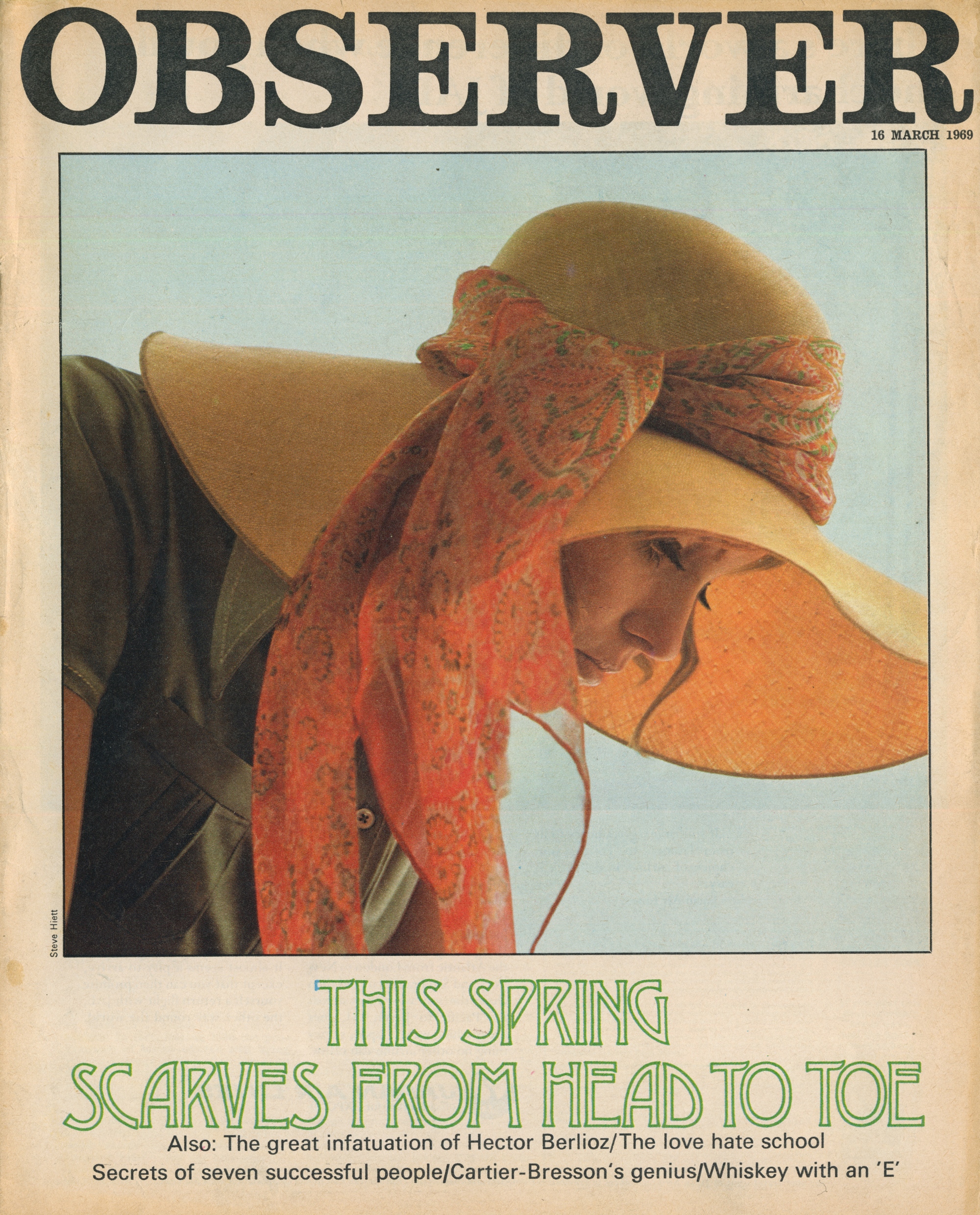
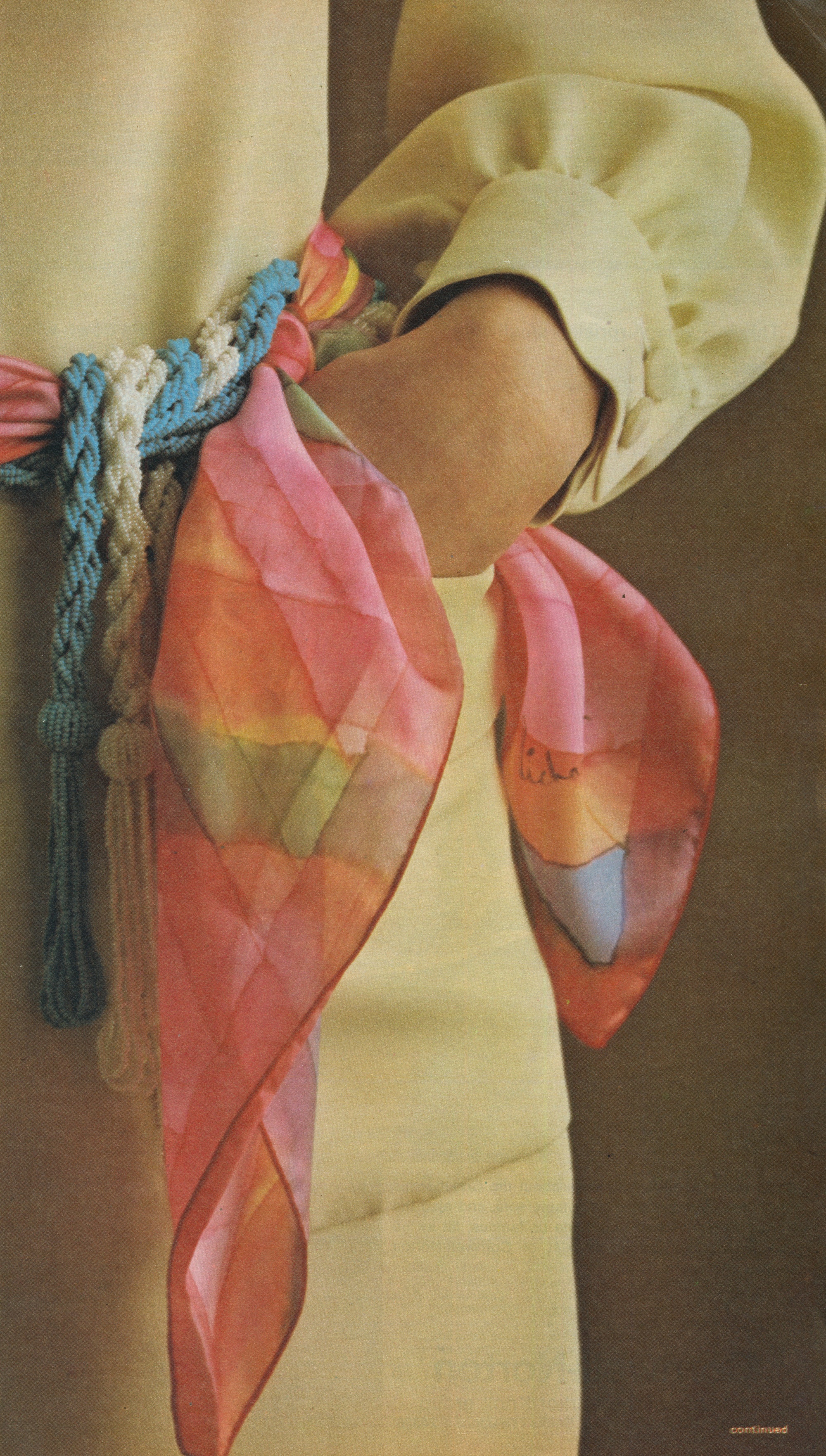
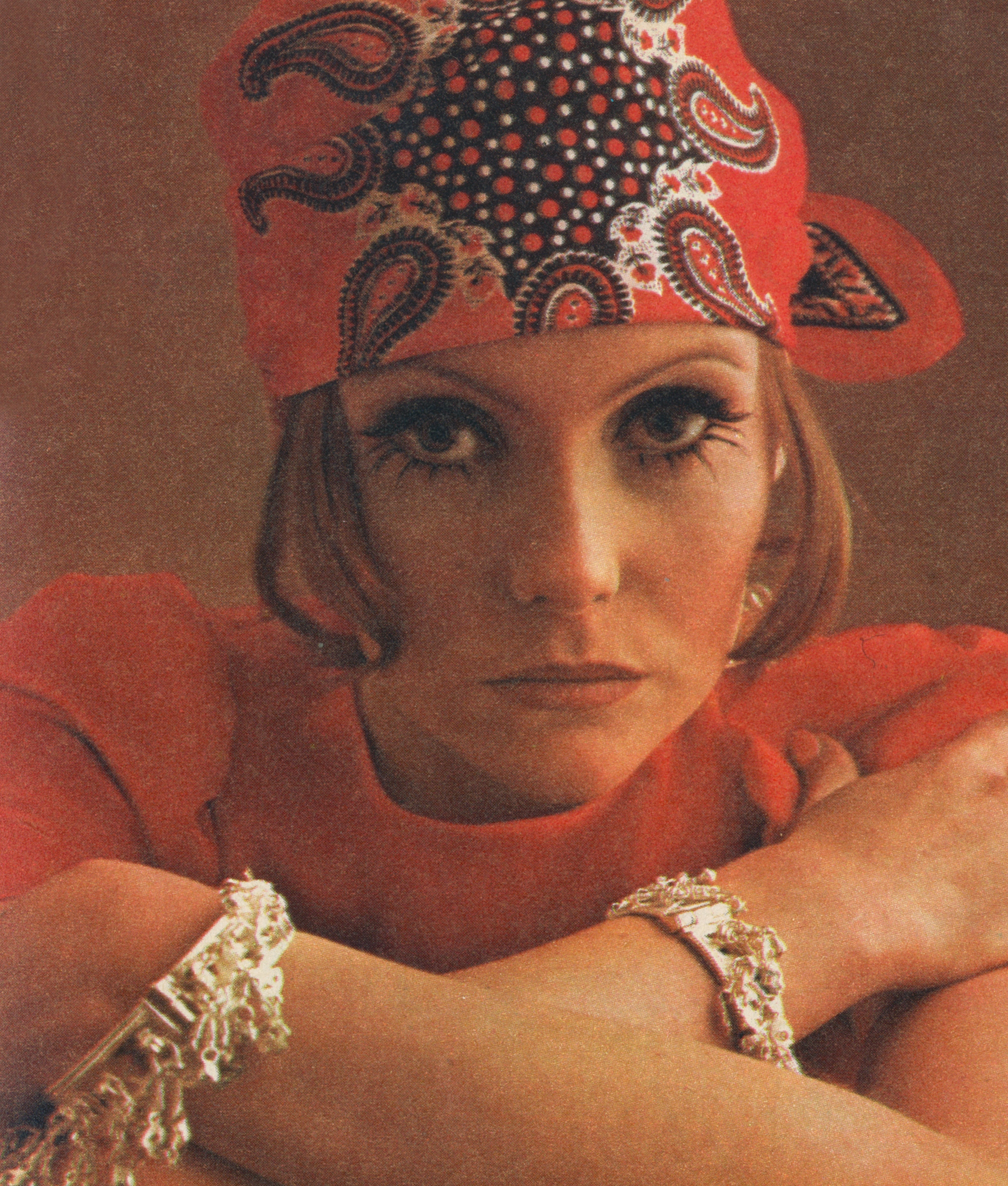
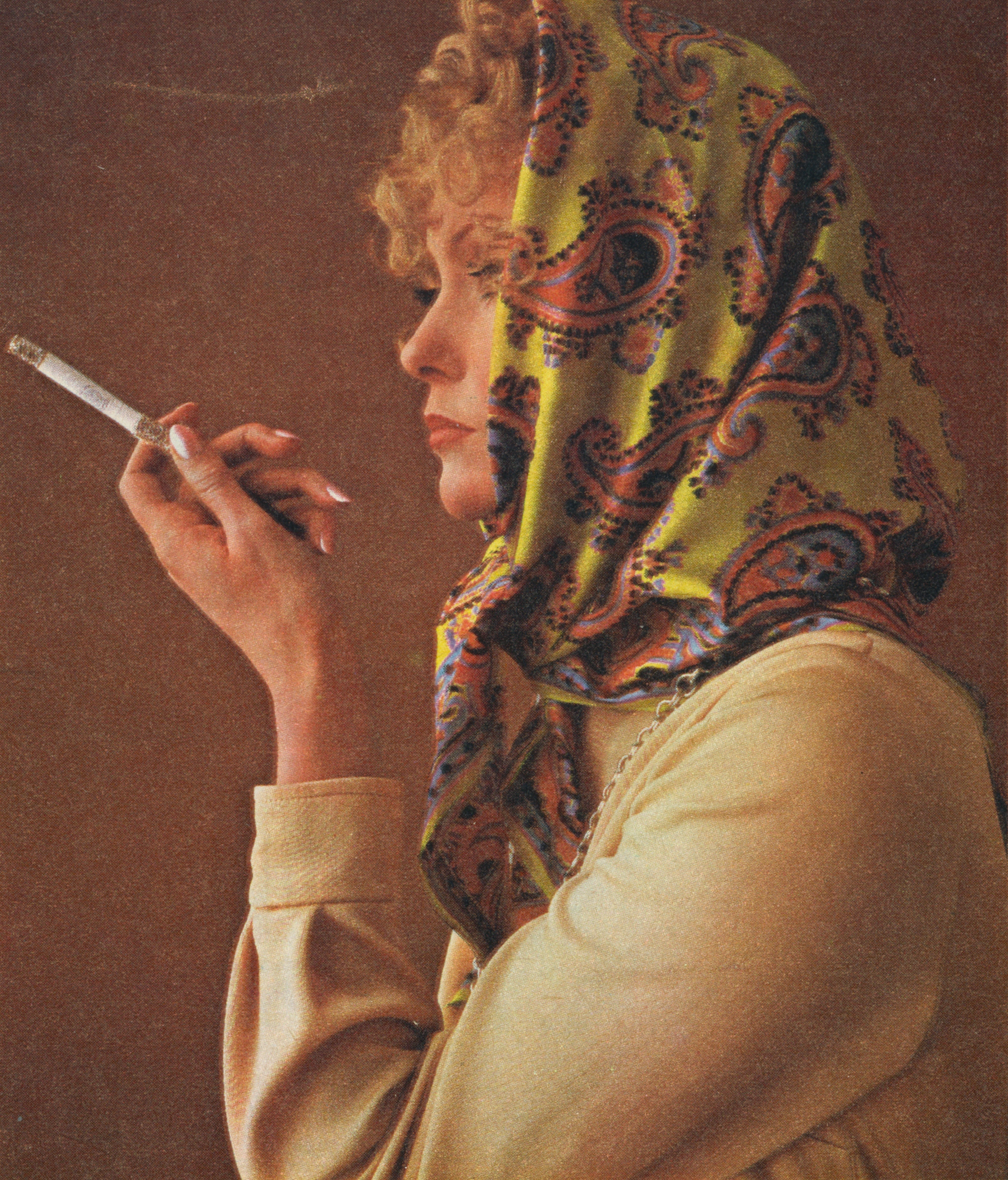
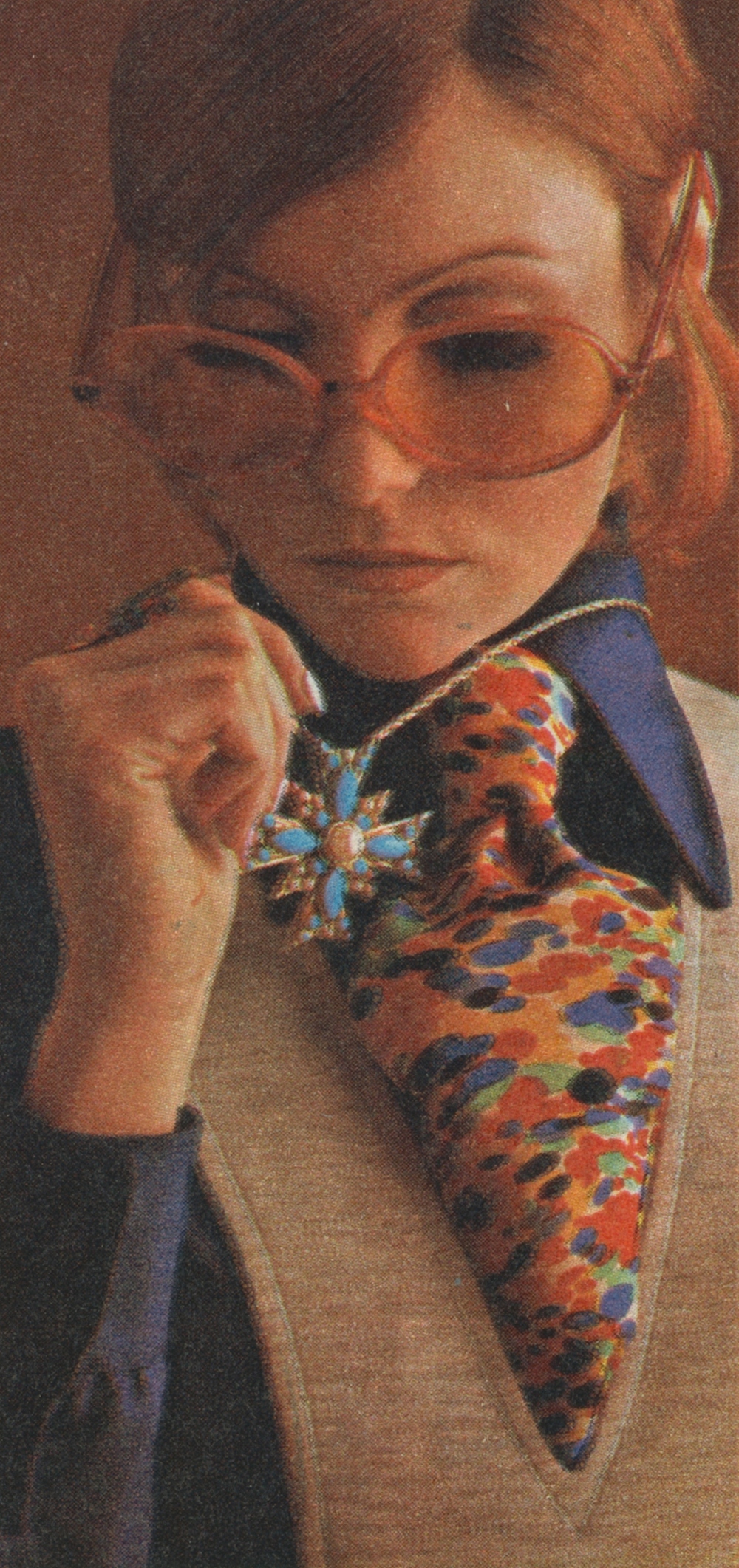
Scarves, instead of being dismissed as last year’s fashion gimmick, are being perpetuated as this year’s most important accessory. Still the simplest way to wear a scarf is to flip a long one casually college-style around the neck. As long as it’s not literally a college scarf this somehow adds enough chic to whatever you wear, without making you look fussily overdressed. There are dozens of different ways to tie a scarf. Smart French girls are tying scarves around their waists, twisted in with chain belts or beads. Marc Bohan at Dior makes headscarves tied pirate-style look young and chic, and shows scarves tied like a man’s tie. Although large squares will still be in demand to wear on the head or folded up as cravats, the big fashion in scarves is still for long ones, preferably fringed. Men will have to accept with a good grace that they have lost their long-established monopoly of fringed silk scarves. Until now almost the only places to find them were men’s departments, antique market stalls or somebody’s attic. (Shawls are the latest craze from jumble sales.) But shopping for scarves is easier this spring, with stocks at last in every shape and size. Hair by Valerie at Cheveux, 15 Abingdon Road, London W8.
Fashion by Liz Smith.
Photographed by Steve Hiett.
Scanned from The Observer Magazine, March 1969.

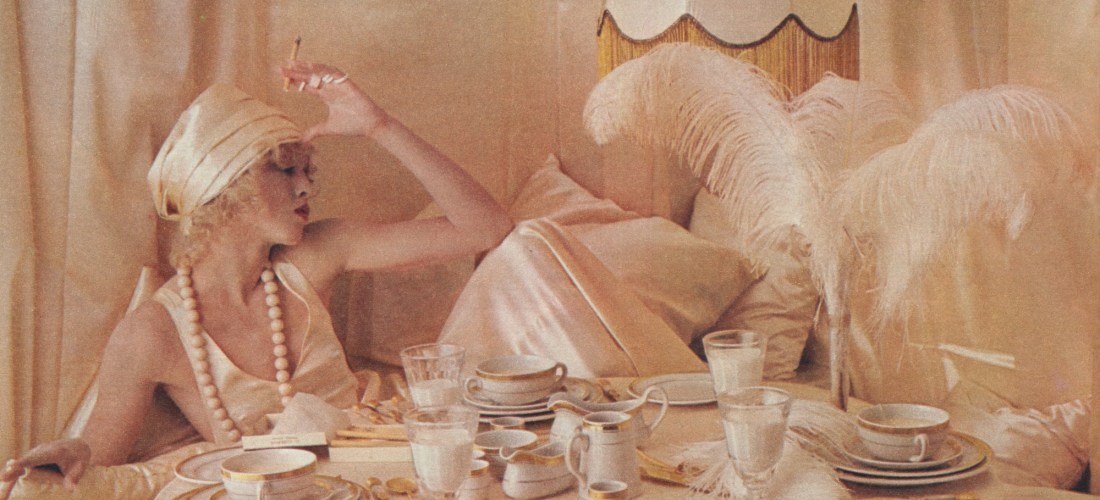

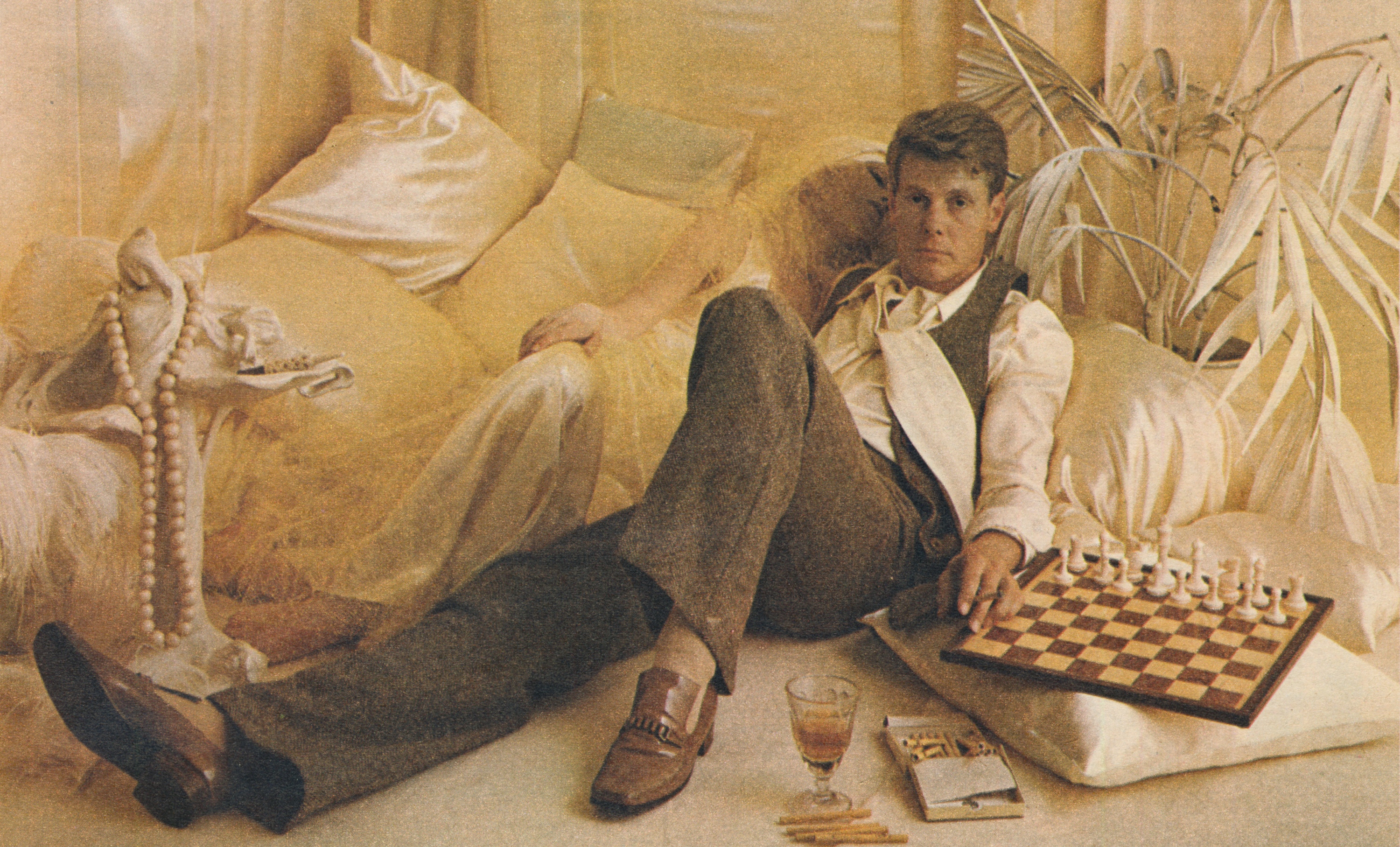
Now there’s hardware and haberdashery, furnishings and fabrics, cosmetics and mens-wear, all carrying the Biba label. Their brave transition from dolly boutique to department store was made last week when Biba opened in Kensington High Street. Although a baby store compared with neighbouring Barker’s, Biba does boast marble floors, a carved gallery from the old St Paul’s school, and a commissionaire at the huge glass doors.
Faithful customers can still find among the familiar palm fronds clothes to wear themselves or put on their children, but everything is on a much bigger scale. Colour-matched underwear and tights are on sale in a special conservatory-style department, and there’s a complete range of Biba makeup and cosmetics, and many more accessories.
But what’s really new, are the clothes for men, and the things for the house.
There’s nothing simple or austere about a Biba home life. The girl whose idea of some-thing comfortable to wear around the house is a slinky satin dress chooses a plush back-ground and hardware that’s softly elegant. Cutlery is rich-looking in gilt and mother of pearl, or silver and ebony. China is white and gold, glasses are chunky goblets. Specially printed wallpapers and furnishing fabrics, plain satins, felts, braids and trimmings, have carefully matched emulsion paints, lamp-shades and cushions, all in a range of 15 colours. Biba are selling the raw materials so that you can make what you want of them. The clue to their own style is Art Nouveau, but the way you choose to use them will be your own.
Biba men’s clothes are worn in these pictures by James Fox, who can currently be seen in ‘Isadora’ and whose new film, ‘Performance’, in which he co-stars with Mick Jagger, comes out next month.
Mr Fox is long and slender and can have little problem kitting himself out elegantly, but the clothes he wears here, plus others by Biba in velvets and tweeds, all come in a size range bigger than most. So fatter men can have fun with clothes too, and at a reasonable price.
By Liz Smith.
Photographed by Steve Hiett.
Scanned from The Observer Magazine, 21st September 1969.
Biba 3 is definitely the Biba I’m most captivated by, I think possibly because it was edged out so quickly by the much bigger (and more Deco) Big Biba and yet was, I think, the perfect encapsulation of the aesthetic and the first time the ‘department store’ ideal was manifested. Basically, I wish there were more photos so I do try and scan them when I find them! It’s also nice to see the menswear getting a bit of attention for once.

They break boring beauty traditions and riot lip colours go on eyes, eye colours go on lips. Upside down- Quite contrary. And why not? Make-up was getting so dreary. We just stuck to the rules and slicked warm colours—pink, amber, soft orange—on our mouths, and cool colours—grey, green, blue, brown—on our eyes. Till now. Till the anarchists started this new groove. Now things are happening. Putting on a face isn’t a daily chore to be done as quickly as possible. Make-up is something to enjoy. It’s art. Total fun. Total fantasy. After all, painting on warm mobile skin is so much more exciting than .cold fiat paper or canvas. Come, join the anarchy party and experiment with colour. Sit down this evening in front of a well-lit mirror, not the telly, and design surprise eyes.
Alice Pollock (top) says she would like to be invisible (can’t think why) and her favourite perfume is Chanel No. 5. She has tried every hair colour under the sun, including green, but she’s glad it’s her own shade now—”At least I know who I am when I wake up.” Every morning she washes it in the bath with Boots Herbal Shampoo, 2s. 11d. On her eye-lids she paints Leichner’s Ivory Stick No. 5, 5s. 3d., and then an arc of pale green under the brow and round along the cheek-bone. Her lip-colour is a mixture of the same Leichner stick and Christian Dior’s Sepia 61 lipstick, 15s.
Moon (centre left, whose real name is Constance Mullens and who was nicknamed after a South African cartoon character called Moon Mullens) wears Mary Quant’s Citrus Jeepers Peepers, 18s. 7d., on her eye-lids and a purple Caran D’ache water crayon all round the eyes to tone with her hair which is cleverly coloured mauve and butterscotch by Erik and styled by Herta at Vidal Sassoon, Grosvenor House; 01-629 2463. Her favourite perfume is jasmin and, asked what the most vital beauty product is, she said, “a razor.”
Gala Mitchell (centre right) is a beautifully original actress. You may have seen her before in Ken Russell’s television film about the Pre-Raphaelites. Her most treasured beauty product is lipstick. Here she’s wearing Biba’s purple lip-tint, 5s., with black liner round her mouth. She uses more of Revlon’s Natural Wonder Lid Liners, 17s. 6d., to paint intriguing black spots across part of her face to symbolise a veil, and then twists a string of blue curls, tinted by Erik, amongst her copper hair which she keeps in place with two ’40s tortoiseshell hair-combs.
Kari Ann Moller (bottom left) says she wants to look like the wicked witch in fairy tales, yet she loves cosy perfumes like Apple Blossom and Lily of the Valley (Coty’s Muguet des Bois Creamy Skin Parfum, 17s. 6d.), and she couldn’t live without Nivea. “I found an old purple crayon in my boyfriend’s car—he’s a painter—so I’m wearing purple with a dab of lipstick and Leichner silver sparklers on my eyes today, plus tart red lipstick by Elizabeth Arden.” Her soft ginger wig is by Ricci Burns, 151 Kings Rd., S.W.3.
Jill Harley (bottom right) never wears fake eyelashes now, she’s only interested in colour: Chrome stick by Leichner.. 5s. 3d., with Gait orange paint near the socket line and Dorothy Gray’s Light-Up Yellow lipstick, 11s. 6d., as a highlighter for her eyes. Woltz ltaliana’s pale green polish, Laguna, goes on her nails to match up with her pale green wellingtons. Instead of expensive face-shapers, she brushes on Miners’ Frosted Brown Powder Eye Shadow, 2s. 10d. For her lips, she mixes an old red lipstick with Boots 17 Shiny Brown Eye Shadow Stick, 2s. 6d.
Two of my favourite models + one of my favourite designers + some wild 1970 make-up = happy Liz.
Photographed by Steve Hiett.
Scanned from Honey, September 1970.
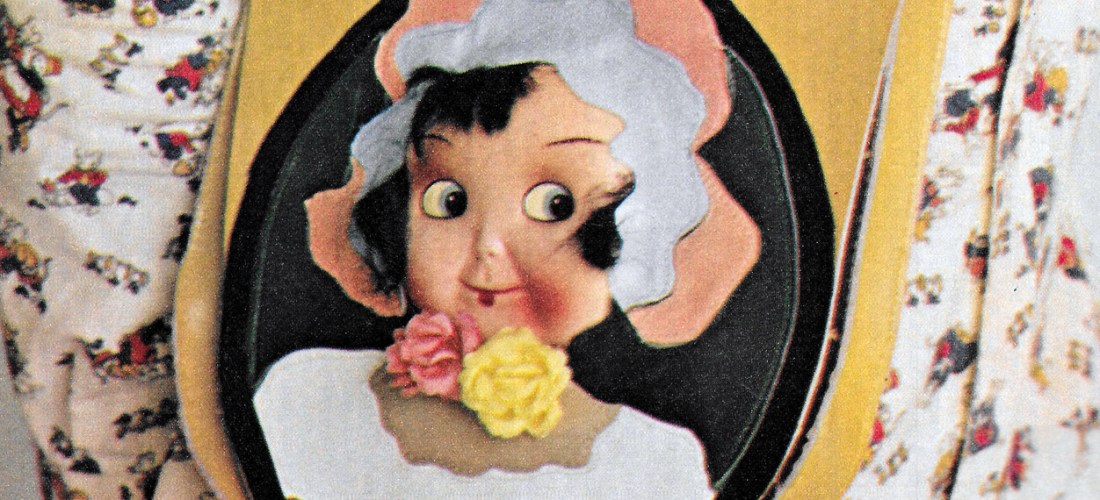
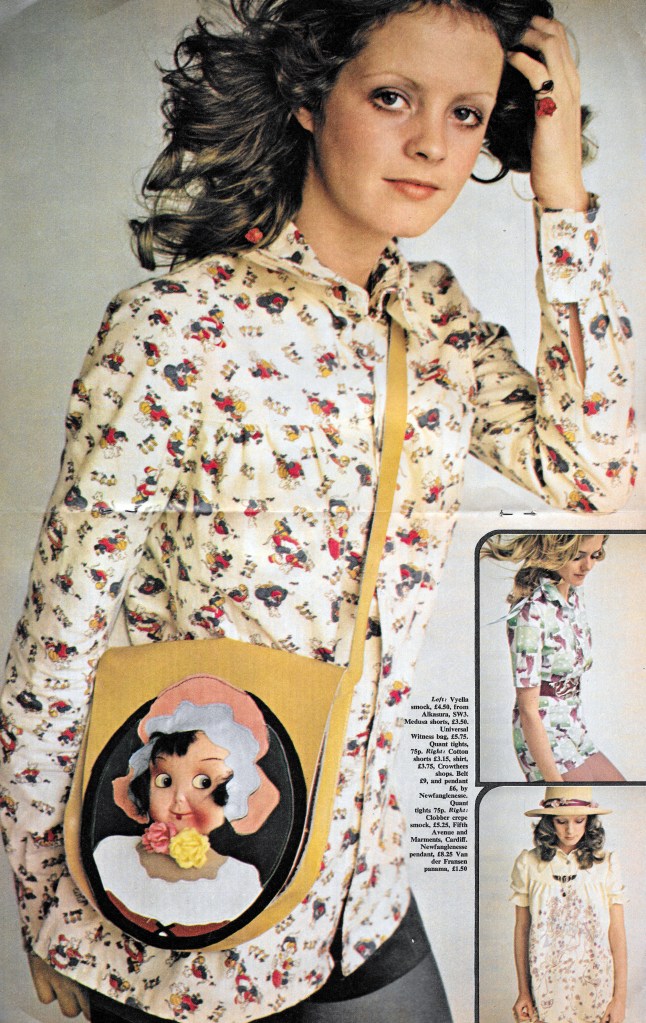
Picture yourself in a land of featherlight voile and dewy country cotton, buzzing with tiny weeny flybynight characters, and you might find a lovely romantic fairytale ending…
Photographed by Steve Hiett.
Scanned from Petticoat, 26th June 1971.
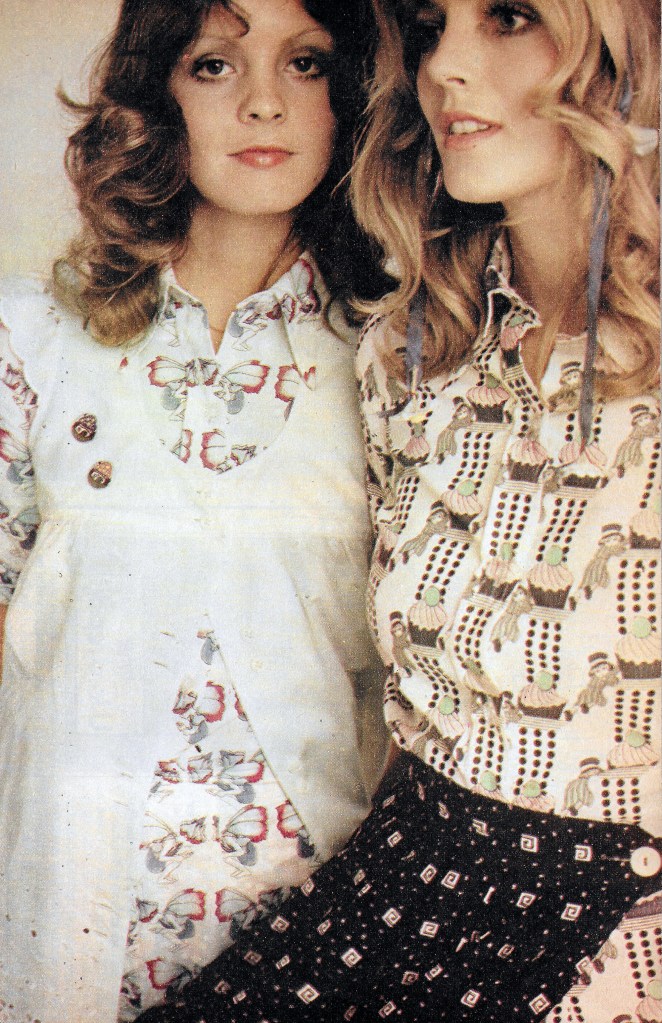
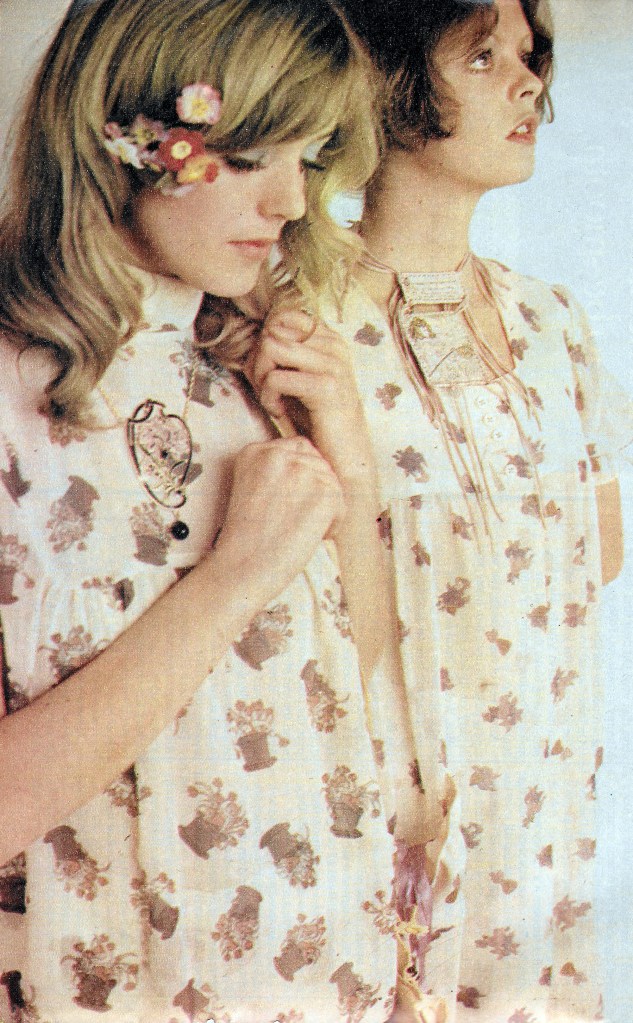
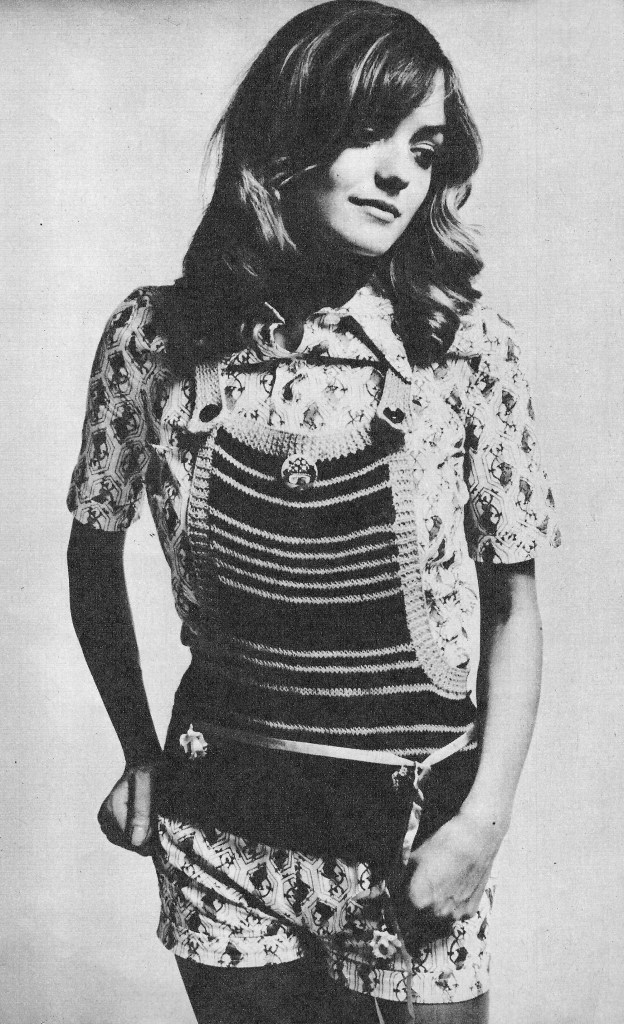
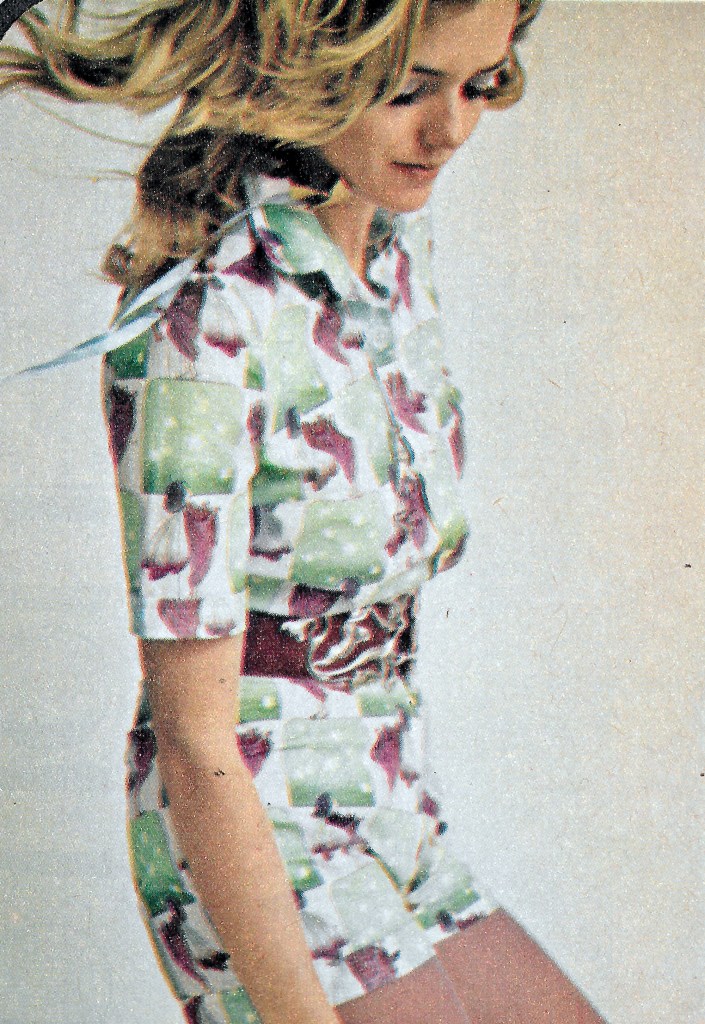
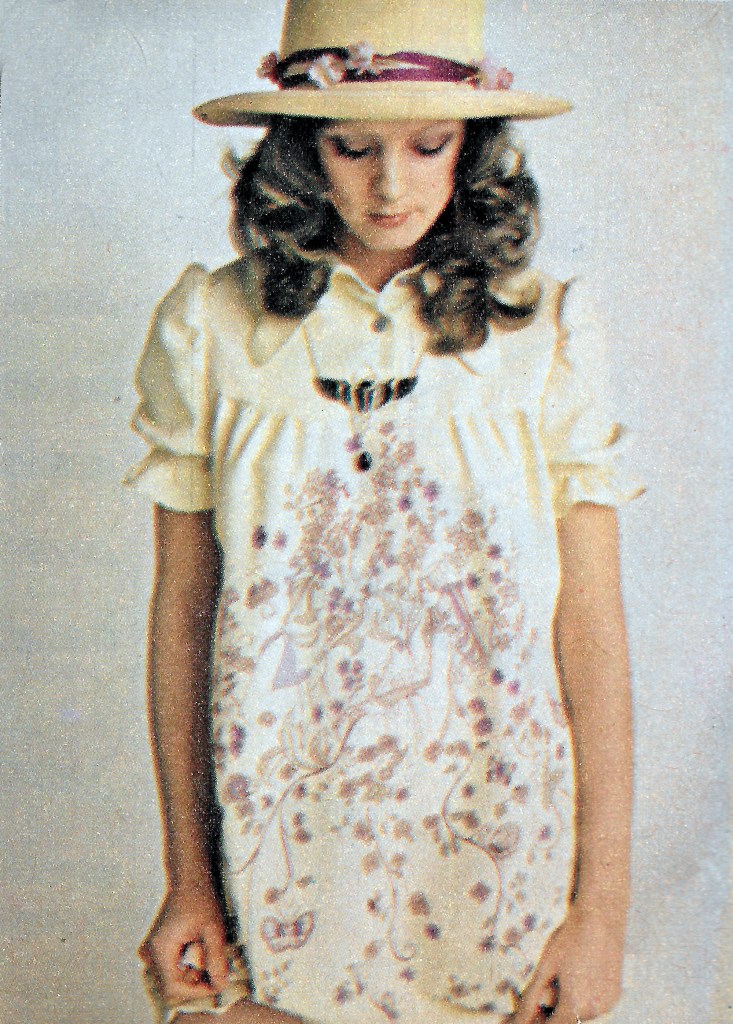

Flower print skirt and top by Sujon. Crochet shawl by Mrs Cresswell. Shoes by Sacha.
Dusky dark dresses for the days when you’d rather take things cooler, in feminine earthy patterns galore, with more than their fair share of low key price tags…
Photographed by Steve Hiett.
Scanned by Miss Peelpants from Petticoat, February 1971.

Both outfits by Mary Quant’s Ginger Group. Inset below right, both dresses by Dranella.

Midi dress by Marielle. Rosie Nice satin shawl.

Liberty print tiered dress by Miss T. Shawl by Mrs Cresswell. Cream boots by Ravel.

Multiprint dress, left, by Alan Rodin. Belt from Elliott. Sacha boots. Button front Liberty print dress, right, by Miss T. Suede beaded shawl by Elliott. Choker by Buckle Under.

Long Liberty print dress by Wallis. Bag and choker by Elliotts. Shoes by Anello & Davide.
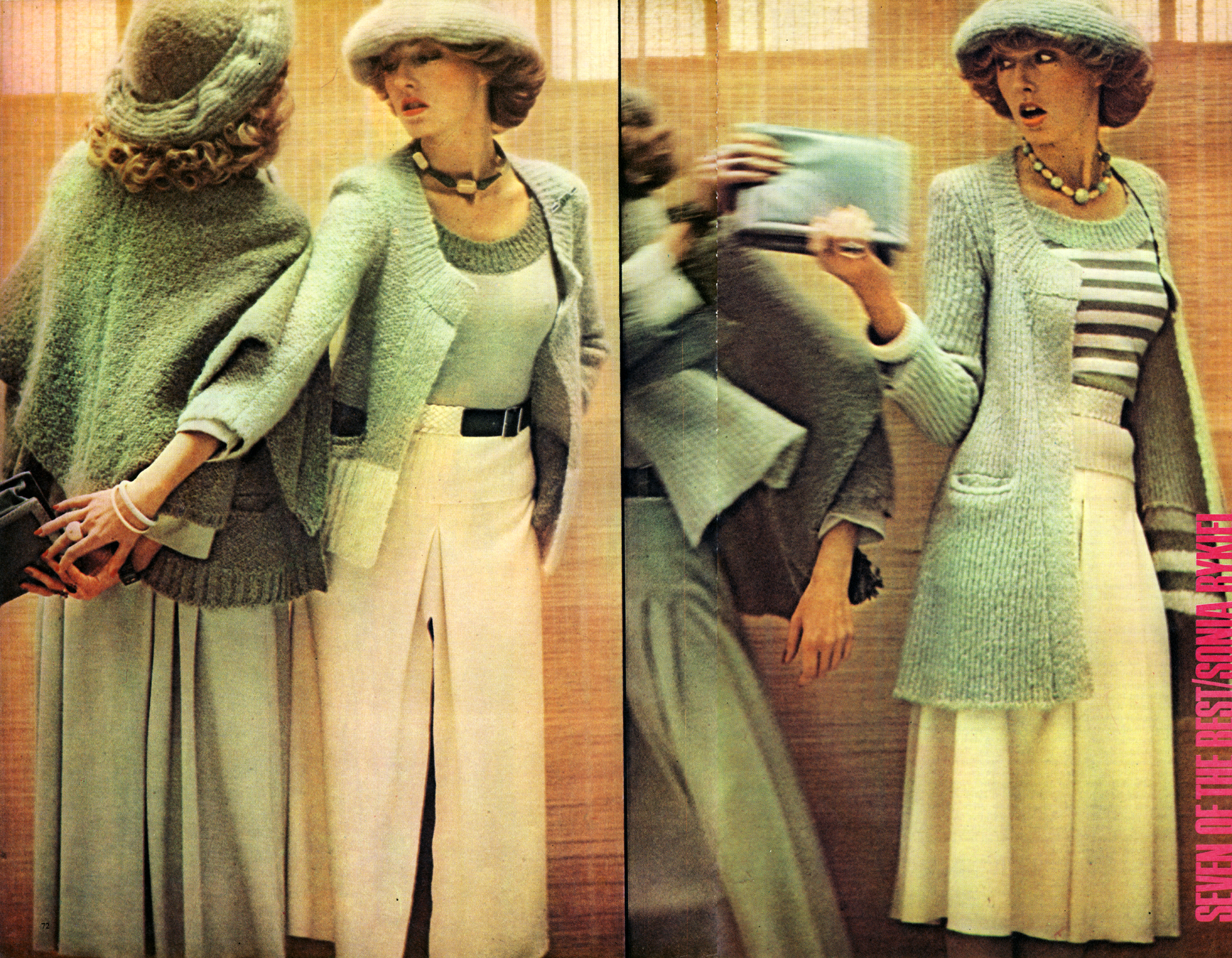
LEFT. Dark green hip-length cardigan with triangular poncho back; £52. Matching hat; about £10 to order. Pale green calf length jersey skirt, pleated back and front ; £45. All from Browns, 27 South Molton St, W1. Green bakelite and gilt bangle ; £3.50, Butler & Wilson, Antiquarius, 135 Kings Rd, SW3. Jade and gold rings ; from £15, The Purple Shop, 15 Flood St, SW3. Square clutch bag ; £39, Charles Jourdan, 47 Brompton Rd, SW3. /// MIDDLE. Pale green mohair cardigan with low, round neck, cream rib waist and dark green pockets; £40 Pale green jumper, with dark green neck and cream waist ; £26. Cream wool jersey mid-calf length skirt with an inverted pleat in the front slit to mid-thigh ; £42. Beige plaited leather belt trimmed with dark green and buckled to one side ; to order. All from Browns. Bakelite beads; £10-50. Art Deco brooch ; £17. Both from Butler &Wilson. Ivory bangle, £8, ring, £10, from Emeline, 45 Beauchamp Place, SW3. Jade bangle, £25, Jones, 52 Beauchamp Place, SW3. /// RIGHT. Long pale green mohair cardigan with padded shoulders and pockets lined with dark green and cream stripes ; £47. Cream and dark green striped jumper with light green trim ; £30. Cream skirt with pleats front and back; f45. All from Browns. Bakelite, glass and mother of pearl beads; £8.75, Butler & Wilson. Jade rings; from £3. Ivory rings; from £5. Bangles ; from £15. All from Emeline.
Spring greens by Sonia Rykiel. Jade greens and creams. Wool on wool, texture on texture. Bobbly mohair and smooth jersey to keep you warm on chilly days. Longer, looser skirts and interesting open cardigans with scooped necks.
Photographed by Steve Hiett.
Scanned by Miss Peelpants from Harpers and Queen, February 1974.
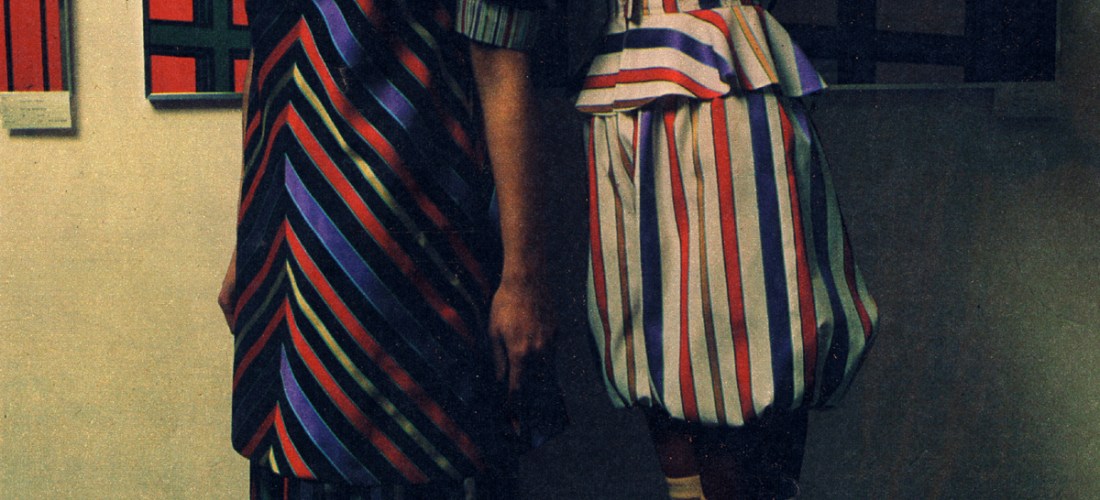
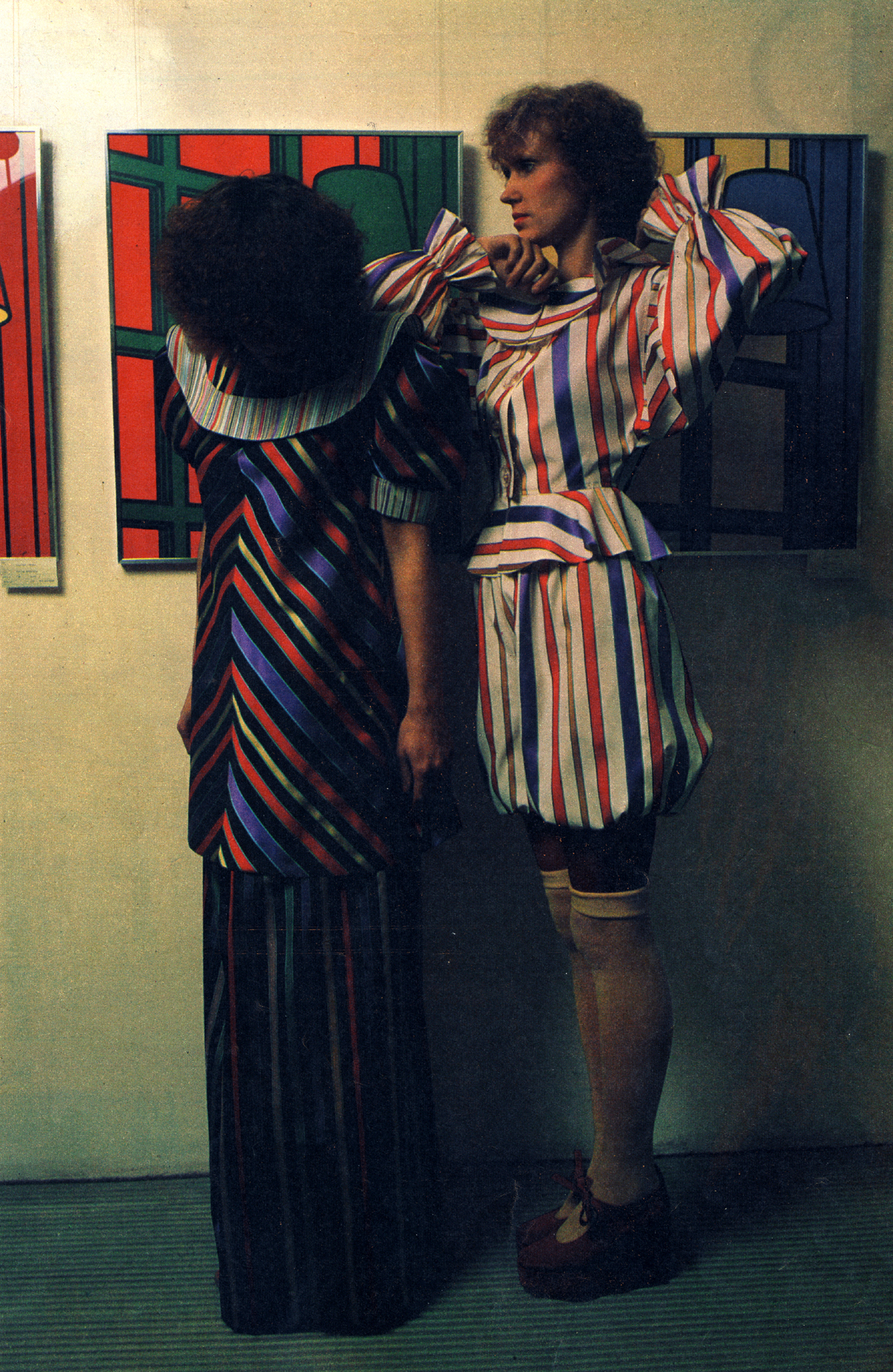
Sheridan Barnett at Simon Massey, stripe bloomers and coloured top, £10.50 at Clangers, Shrewsbury. Mary Quant tights, 75p. Quant socks, 50p. Biba wedgies, £4.90. Sheridan Barnett stripe taffeta pants, £5.50 with dress to match £6.75.
Sheridan is twenty-five and very much a designer’s designer. He lives clothes to such an extent that honestly he has no clear idea at all of the sort of person who might wear his things. At the moment he is working for Simon Massey doing his thing, while Janice Wainwright, their other designer, does hers. He does have to compromise with Simon Massey because when he designs he goes the whole way, cutting out, naturally, a large part of the more conservative public, so he produces some simpler clothes with each new range. His summer range certainly needs a lot of confidence to carry it off. When we saw it, a great big profusion of bright clown clothes, the only other people to pass come rent had been the press who loved every little bit. It’s a happy melee of taffeta stripes, little dresses to wear with frilly bloomers underneath. Vogue had photographed them and 19 were anxious to use them at the very same time as we were. Yet in December when we spoke to him, the powers at Simon Massey were having thoughts about the range, feeling that clowns might be too ‘avant garde’ for the moment. But mainly on the strength of all the publicity they are getting, Simon Massey put them through with their fingers crowd for their success. It would certainly have been a pity if they hadn’t. He has also organised some clown hats to go with them and he is talking about wafer-thin sandals or great big clogs. When we met him he was wearing Oxford bags, spotted bow tie and a beautiful satin blazer with a clown-inclined fuzzy feather button-hole.
The job of the designer starts long before anyone else’s. They have to be able to think ahead to judge the mood of the public, but more, at this stage to sort out their own feeling as to the coming moods.
As Mary Quant says, a designer lives with an idea for so much longer than everyone else, he or she naturally progresses from it on to the next thing. It’s a very slow, deliberate progress and a very natural one.
If you look at the trends over the last year or so you can see how and why the evolution has been such as it is.
Most designers see their year split down the middle. They usually work for spring and summer, keeping those two seasons quite closely connected and then for autumn and winter, again co-ordinated with each other.
What is a designer? As Philip Bergman pointed out as one of the six people we interviewed for this feature, a designer is actually one of many things. He could be a ‘designers’ designer’ thinking clothes as totally related to himself and his own feelings or he could be very much commercially-minded. In other fields you can see a lot of design work, bearing the mark of their owner, obviously performing a task as a pure art form. With clothes designing, a man or a woman must be able to do far more than just draw nice-looking sketches.
In actual fact the six we talked to were far more down-to-earth – and aware of the industrial/business side of their trade than we had imagined. We could have expected to find them living with their heads in a creative cloud, one hand on the drawing board, the other scratching their chins in bemusement at us worldy fashion morons. That wasn’t anything like true. Most of them have either gained a specific technical knowledge and gone in to design or accumulated it through years of experience.
It’s this technical knowledge that is essential to today’s successful designer. After all, there’s no point in him or her designing some fabulous creation that everyone would go crazy over, only to find it totally unpractical and extortionately expensive to produce. It’s difficult for any creative person to work in industry because basically it is almost impossible to compromise aesthetics with the practicalities of living.
The readers complained last week that either prices were too high or quality must be improved, but fashion is very much a business. A manufacturer is concerned with producing as many garments as he can at the lowest cost so that might mean a slightly lower quality fabric or faster production. The buyer, too, is chiefly concerned that sales and stores do put quite a high `mark-up’ on clothes (that’s the profit they make between the price they buy the clothes at from manufacturers and the cost of the garment in the shops). There really isn’t a lot the designers can do about the state of the affairs, other than use their technical knowledge to keep prices down.
Some of the letters we receive here at Petticoat from readers complain that all anyone’s thinking about is what people in London are wearing, that the clothes they see in the shops in London they just couldn’t find in the provinces. In actual fact, as the buyers and designers agreed, the image of London being the place is dead and gone. No buyer buys anything different for her provincial branches and likewise, no designer has the image of ‘a London girl’ in mind when he’s sketching.
Stylewise all the designers were agreed with our readers that girls should start looking like girls again. Some of the designers turned to the fabrics that will help, like Jeff Banks, others to feminine styles, like Mary Quant and Lee Bender. Take a look and read their comments on fashion. . . .
Fashion by Sue Hone. Photographed by Steve Hiett.
Scanned by Miss Peelpants from Petticoat, February 1972.
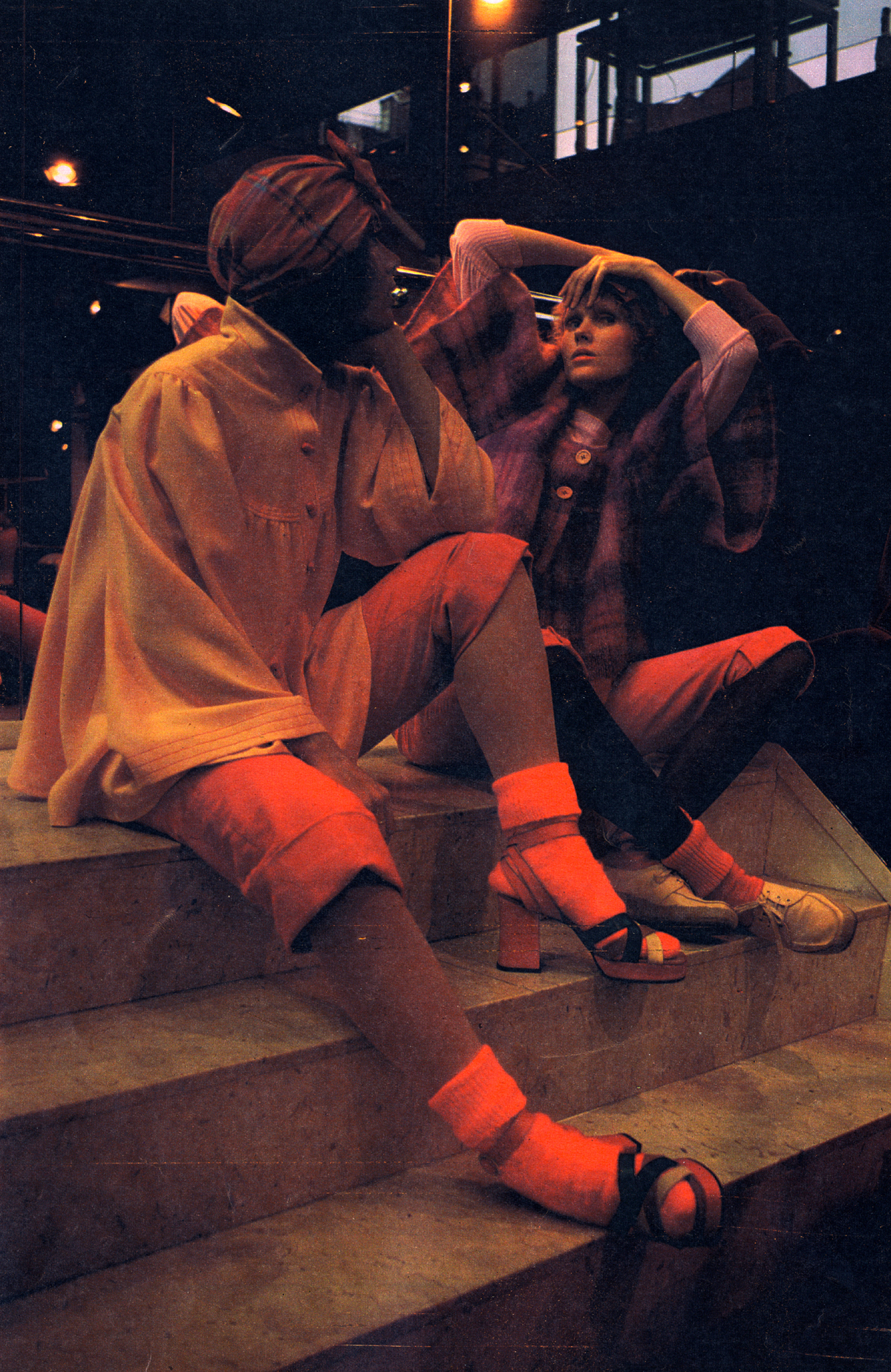
Lee Bender wool smock with toggle fastening, £6.50. Cord half mast pants, £3.95. Quant cover-ups, 75p. Stirling Cooper sox, 95p. Bata shoes, £4.99. Bermona madras print Mother Hubbard hat, £2. Bus Stop cord pants, £3.95. Angora top, £8.95. Russell & Bromley shoes, £4.95. Quant sox 50p. Stirling Cooper sox, 95p. Biba hat, £2.
Lee Bender, synonymous with the name of Bus Stop which started as a tiny shop five years ago, is now thirty-three and with eight big Bus Stops around the country. “Honestly,” she says, “it’s taken over my life now!” She’s famous for producing clothes that are right up to the minute fashion-wise but very positively wearable ones both as regards price and style. She is every inch a designer as such, doing her own thing and interpreting the current moods as she feels them, usually working on the idea that her customers want to look feminine. “I’m right off this butch thing,” she says, “and since the designers have so much more living time with an idea and consequently get fed up with it before anyone else we can always think ourselves into the next thing quite safely. Fashion is a natural evolution and a slow one and its definitely getting softer and prettier.” At the beginning of each season, Lee sits down and runs off about thirty sketches. They’re all talked through, leaving about twelve which then go to the toile-maker, and on to a design meeting for the final selection. “We don’t have many complaints about quality here,” she said, “because we have a very stringent passing department, but when you’re cutting thousands of garments there’s bound to be something faulty on one or two, isn’t there? “I try hard to maintain a standard of quality,” she said, “but the fabric and the manufacturing costs have gone up. Anyway when the Swinging London thing started everyone just wanted fashion regardless of quality, but surely that whole scene has gone now, hasn’t it? Now we’re back to the really good stuff.”
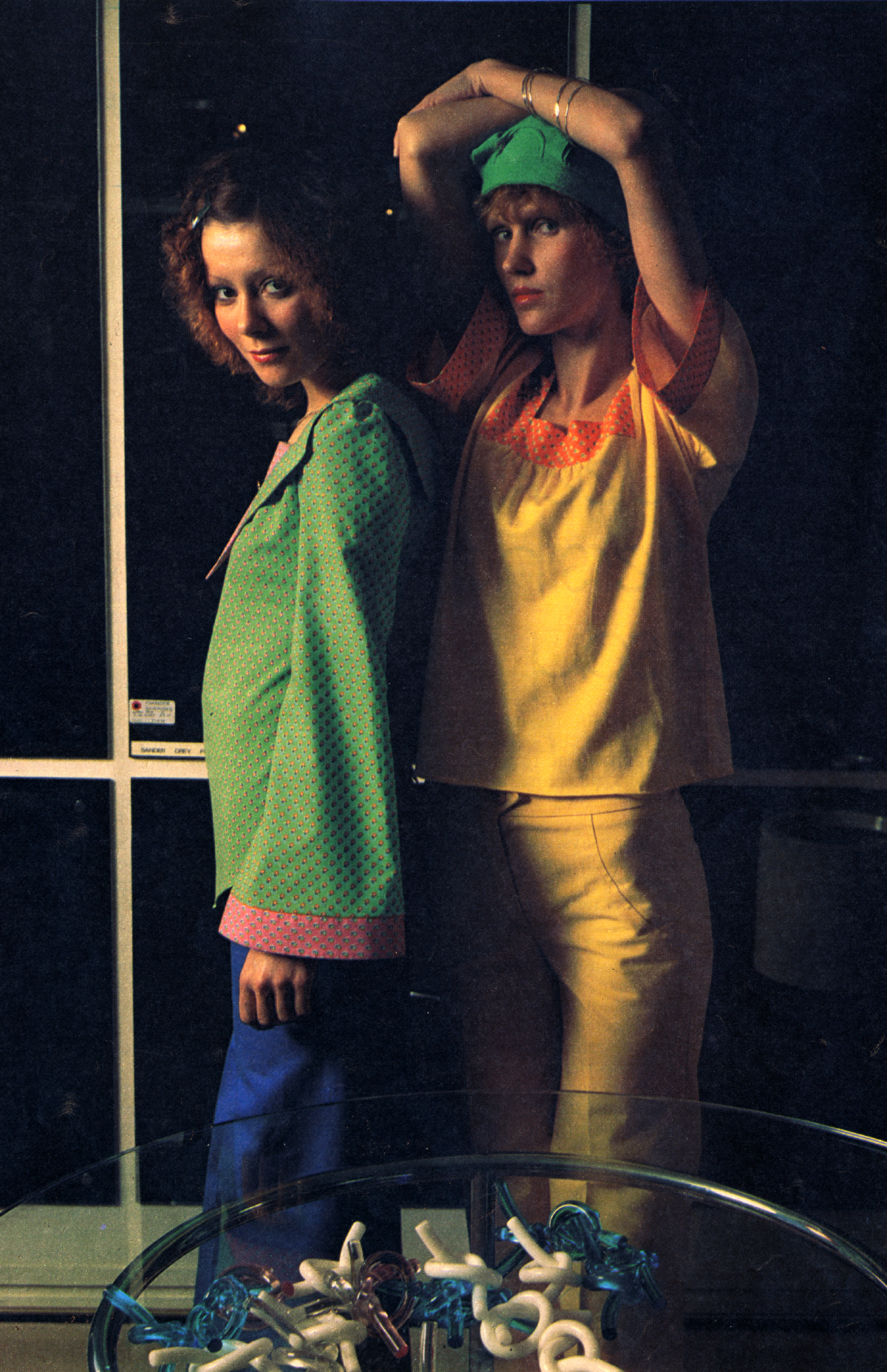
Gordon King pants with turn ups, £5.75 with smock top, £4.50 write to Gordon King, 106, Gt. Portland St., W1, for stockists. Biba felt hat, £2. John Plenders Leith bangles. Gordon King pants, £6.25 with collared top, £5.25
Sarah, at the age of twenty-seven, is responsible, along with two others, for the sort of separates that have made Gordon King’s name in the rag trade. To Sarah, the fabrics are all important, and, especially where trousers are concerned, the cut. “Fashion isn’t just a gimmicky culture any more — it’s more important,” she says. “It’s not just putting badges and more badges on things, it’s producing clothes the best way we can within the right price limits.” Her spring range saw really neat-looking sailor clothes and she’s taking the freshness of the range on into summer but in some pretty floral prints. She tries to design clothes that are flattering rather than sexy as such and as a woman thinking clothes for women she knows how much difference a simple seam somewhere can make. “Well,” she says, “people do wear things that don’t suit them, don’t they ?” There are plenty of pants in her summer range, just as well-cut but much more feminine. ‘Trousers have been so butch for such a tong time now, haven’t they?” she said, “so I’ve put in waistbands and lots of back zips. It’s taken a while for some of the buyers who’ve seen them to get used to them but I think that if by putting a seam scooping round the hip, it’s a nice way of looking good and staying in fashion . ” She’s also brought out a great new shirt range for summer, something she really wanted to do, “I wanted to take shirts away from the usual collar, cuffs and button-front image.” That’s just what she has done. In bright floral cottons, in greens, pinks, oranges, her shirts have sailor collars, huge kimono sleeves flap shoulders or frills and tie belts. You can always rely on a woman to know what women want, can’t you?
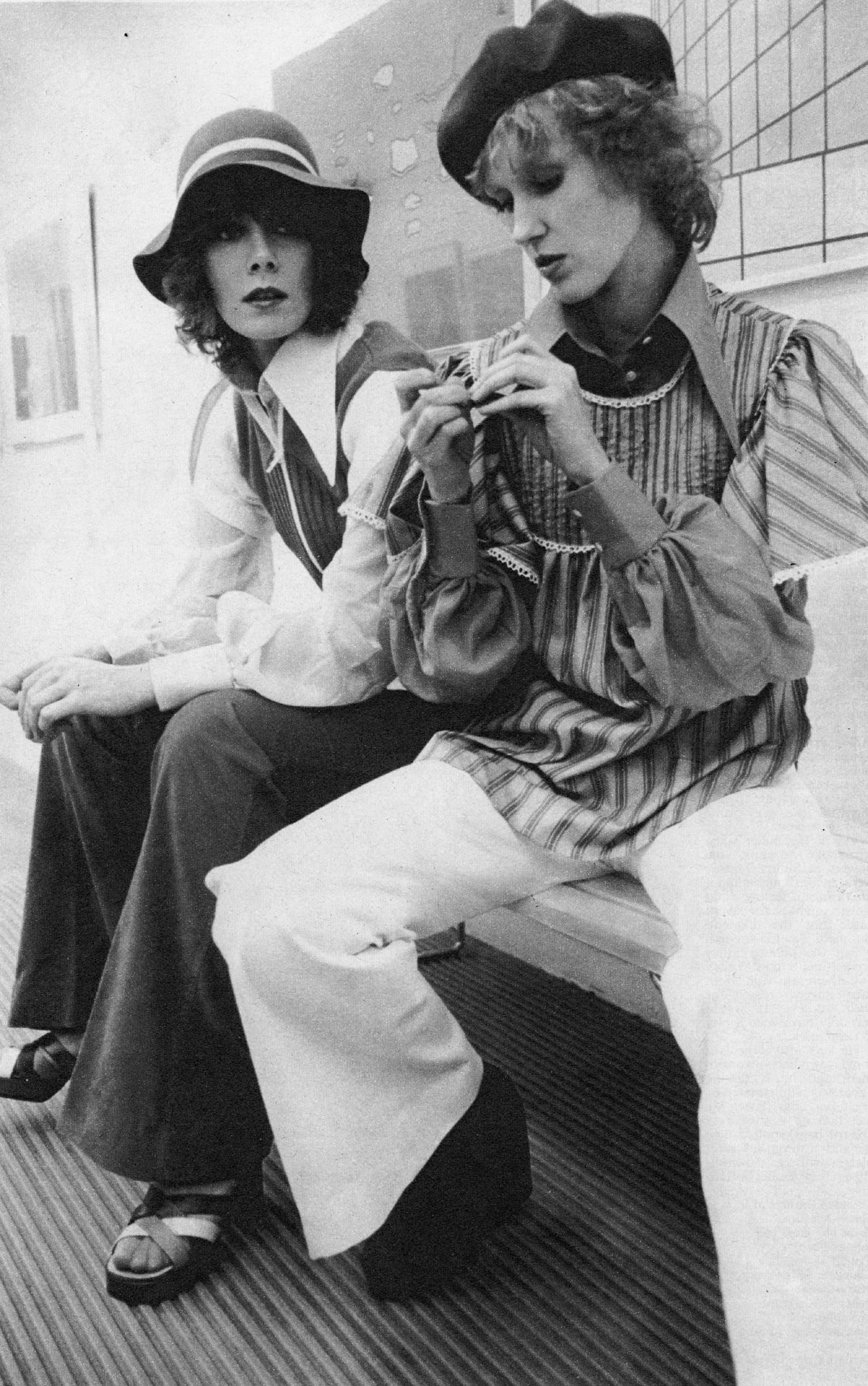
Yellow shirt, £4.50, Miss Selfridge. Jeff Banks velvet pants, £8.25 and zip up cardigan, £6.50, both from Stop The Shop, SW3. Bata shoes, £4.99. Edward Mann blue hat, £2.80. Jeff Banks drill pants, £5.75, Smock top, £5, both at Stop The Shop, SW3. Blue shoes, £4.90, Biba W8. Edward *Mann Main hprat .7f1
Of all the designers in fashion today, Jeff probably has the best reputation, not only for possessing tremendous perception but also for his ability to carry out his designs into production in a truly pr-fessional manner. His knitwear range can take him as long as seven or eight months to see completed, involving trips to the north where his knitters are, endless discussions on technicalities and constant checking. He sees his summer collections as being a natural follow-on to the spring one so if spring was cheesecloth, summer will be some amazing Lancashire striped cotton. “An honest six quid’s worth, these are, not just to wear on high days and holidays.” He starts each season with about twenty-four designs, ends up with eight when he sees how they’re working out. “What I try to do,” he says, looking pretty comfortable himself in a beautiful shirt, funky knit waistcoat, unobtrusive pants amid all the finery of his amazing offices, “is to give girls one or two pieces of clothing to start them off. They don’t simply want to zip on la dress and a look for the day. They want lots of nice things that are comfy.” The shirts he showed us were basic, but with something ‘alien’ about them like frills, bright ric rac or cream lace. They were the sort of thing you could wear to a “summer pop festival without being hot and sticky.” His knitwear you can see a sample of here, where he has gone all out for funky colours (“sickly” he calls them), like these and a lot of beautiful quilting. Generally he likes them to look loose and long with wide sleeves to wear over his shirts with butcher-striped pants. Jeff says he is more pleased with this collection than with any other he has done – no prizes for guessing why!
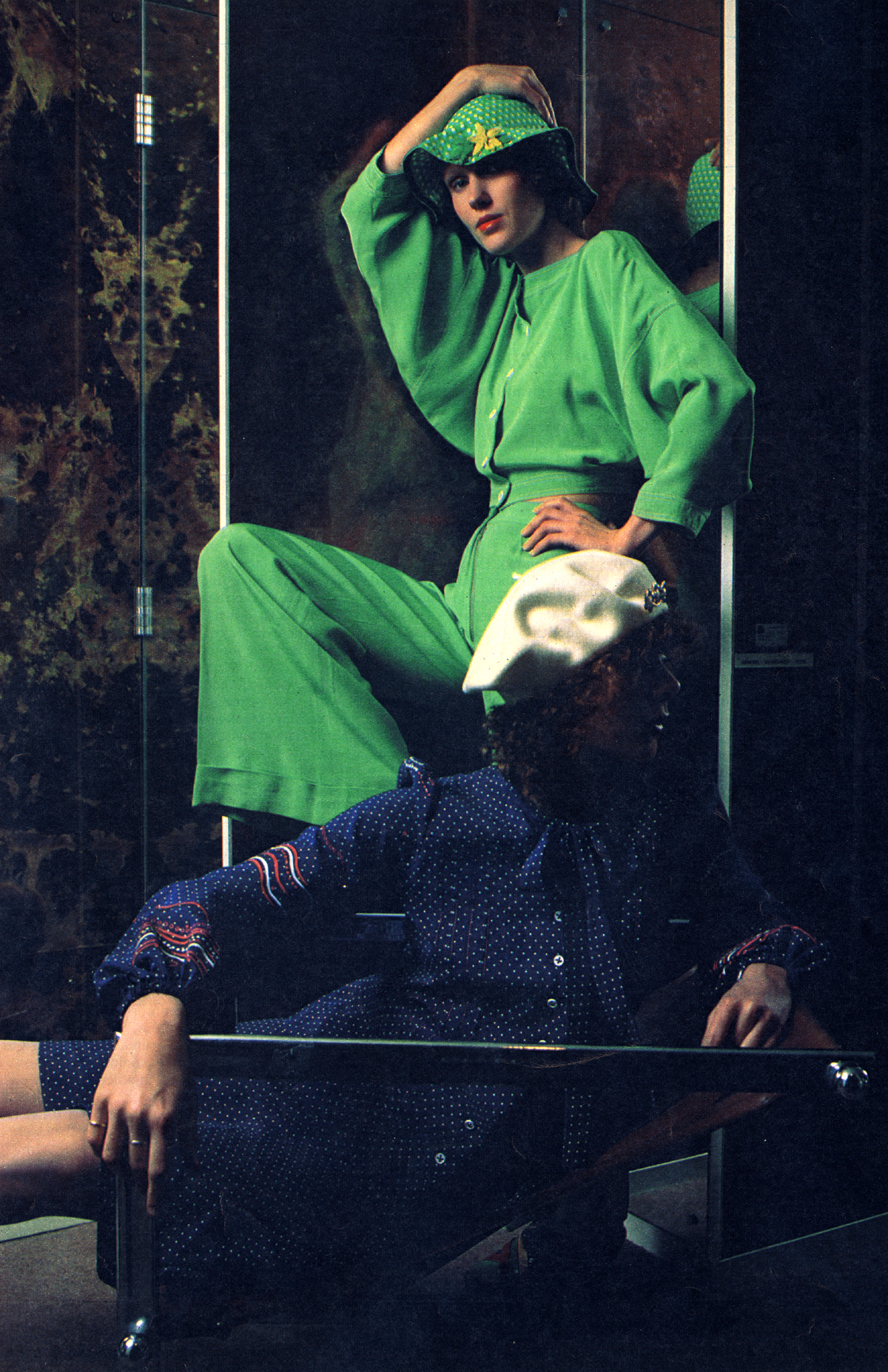
Mary Quant skirt and top, £13.85, from Simpsons, Piccadilly, Wl. Quant tights with seams, 75p. Kangol beret, 80p. Silky pants with top, £18.75, Escalade, SW3, Lucinda Byre branches. Dranella spot brim hat, £3.81. Van der Fransen flower brooch, £l.
She’s now thirty-seven and come a very long way since she opened her first shop, Bazaar in the King’s Road in 1955. In those days it was the clothes she’d learnt to produce at Gold-smiths and accessories she’d go all over the place to pick up. Two more Bazaars and the Ginger Group Production Co. later. She has a range of beautiful knitwear, a world-wide cosmetics firm, a hosiery organisation which includes bras and pants, shoes in her name and a domestic textile range for I.C.I. Mary was the first designer to think about the layered look, so naturally she is one of the first to feel that maybe we’ve had enough of “putting things together rather haphazardly” and that we really want to look a bit more grown up now. Her latest range is the slickest for many seasons, she’s using plenty of functional cotton from seersucker, through some amazing cotton spots and stripes to some fine, lined denim. Unlike other designers Mary doesn’t work totally from sketches. Sometimes she doesn’t sketch at all. An idea might occur to her and she’ll carry it in her head to their workroom, explain to the girls there what she is thinking about, watch it growing on a model. She’s really more of a “builder.” As to her prices, well, “she’s not actually price-conscious,” said her public relations officer, Heather Tilbury, “she’s more realistic.” Anyone can wear Mary’s designs, “just as long as they’re slim,” Her colours for the range are the brightest ones—really poisonous greens, shocking reds and yellows and plenty of pretty prints on fabrics that she travels all over the world to find. Mary’s seen a lot of her dreams come true, not in the least her year-old son Orlando making his presence very widely known.
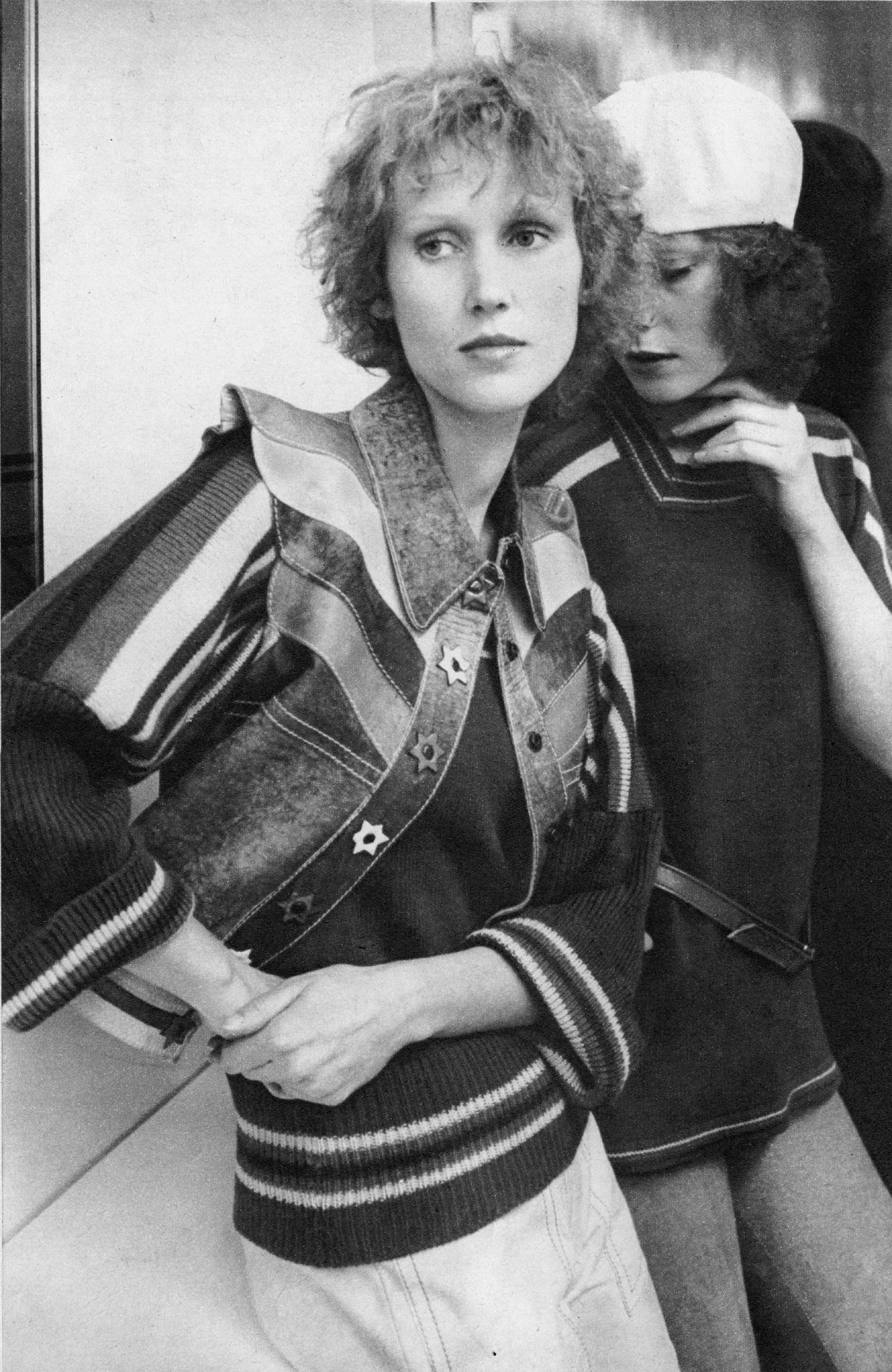
Henry Lehr for Muria leather pants, £32, from Muria Club at Harrods. Green jersey with stripes, £10, designed by Phillip Bergman for Muria at Hedgehogs, SW3. Kangol yellow beret, 80p. Paul Stephens belt. Henry Lehr for Muria yellow pants in leather, £32. Leather waistcoat with poppers and appliqué, £35, at Muria Club. Sweater with red. yellow and blue stripes, £12, by Philip Bergman.
To Phillip Bergman, technical knowledge must be the guiding light to a designer. He himself trained for four years as a fabric designer at St. Martin’s college, then went on to the fabric side of fashion at Marlborough Dresses then to designing tee-shirts at Miss Impact. “It’s like any business,” he says, “you must have a thorough technical knowledge. If you don’t there are a number of things you’ll never think of designing anyway!” He doesn’t actually think of himself as a designer at all. I “I simply take the elements needed at the time and produce them.” “There are very few actual designers. There are stylists who produce and editors who co-ordinate. Take these sweaters I’m designing for Muria’s new spring skin range. I told the knitter the colour and shape she knitted them– so who’s the ‘designer’?” Designs must be, above all else, functional. To Phillip, the biggest and strongest influence on fashion in recent years has come from America, whose basic culture has produced the most functional clothes ever. “Basically America has the most powerful media influence in the world. From there the look was emphasised in Paris and mass-produced over here. Every so often you get ethnic feelings creeping in, like the Japanese look or the peasant thing, but the American culture, the Andy Warhol pop thing and Mr. Freedom are the strongest influences. The naval look is a spin off the sort of genuine combat gear the kids in the States were wearing but now we’ve really taken away the whole point of the look.” It’s opinions like these that produced the beautiul sweaters pictured here.
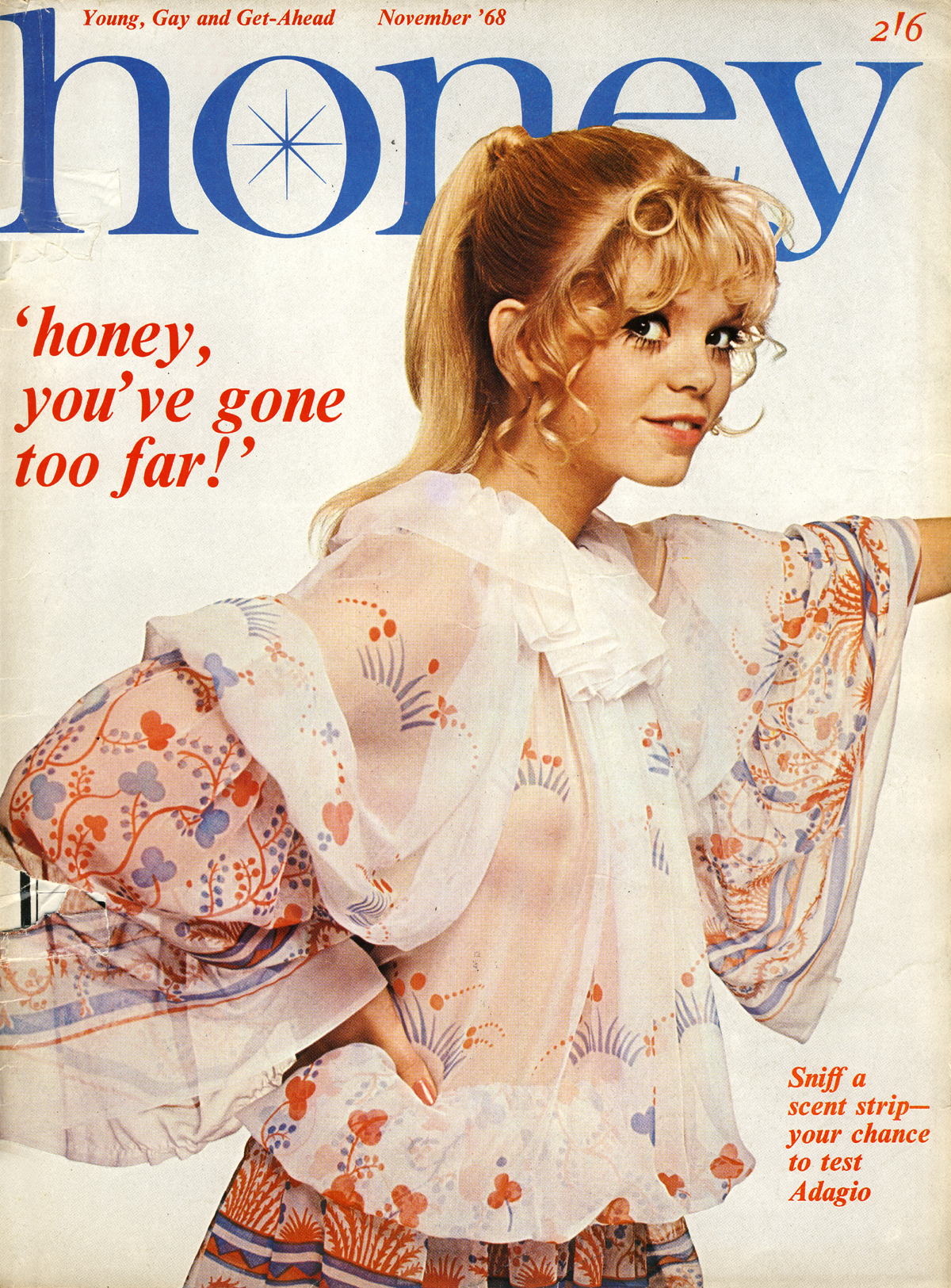
The gist of this editorial seems to be that only the tinest breasted ladies can wear the Ossies, but I have to respectfully and fundamentally disagree. The Ossie tunic on the cover was, along with some matching trousers, later chosen as The Fashion Museum‘s Dress of the Year 1969.
Blonde model photographed by Mike Berkofsky.
Brunette model photographed by Steve Hiett.
Scanned by Miss Peelpants from Honey Magazine, November 1968.
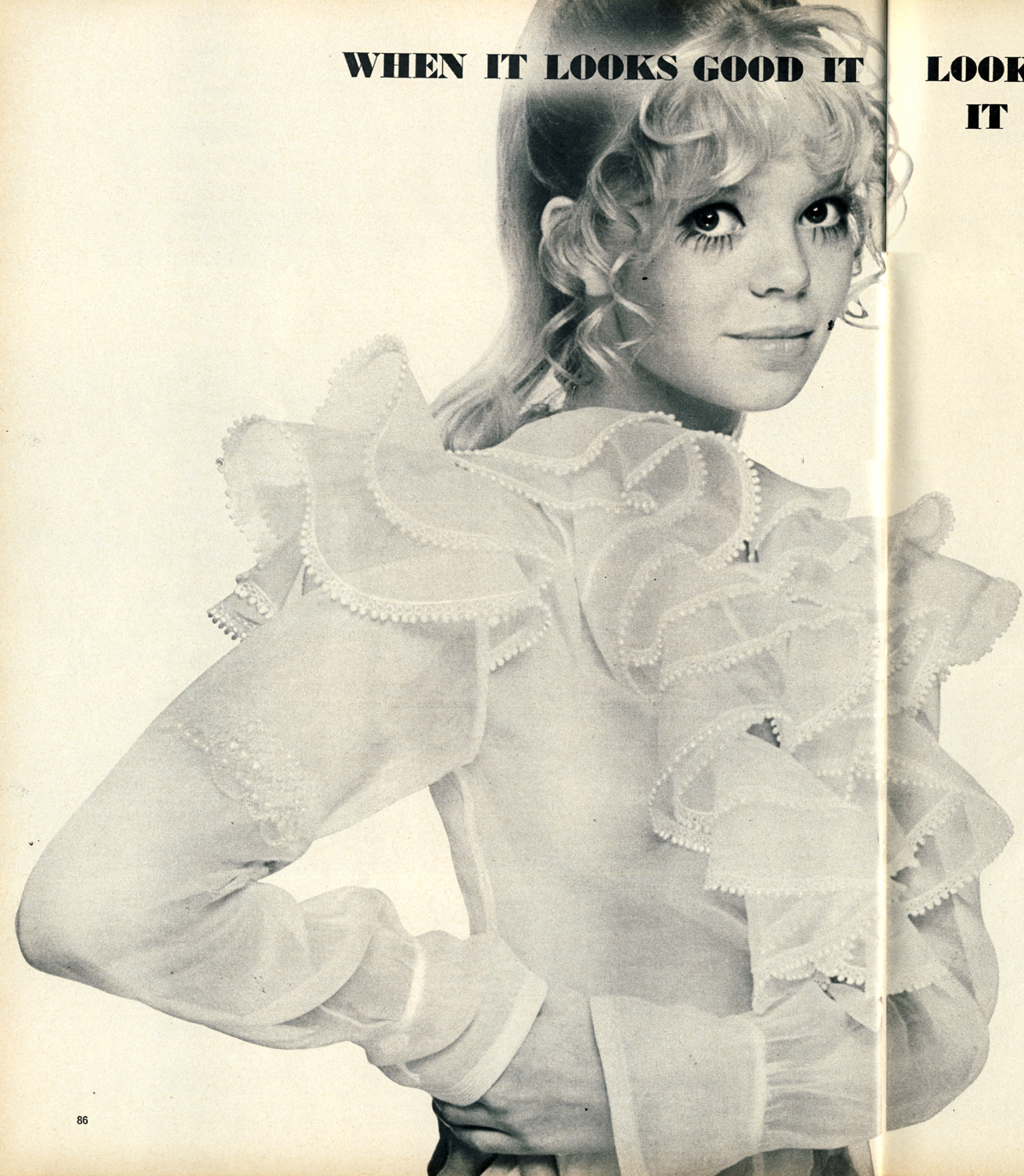
Fluffy frilly blouse by Quorum.
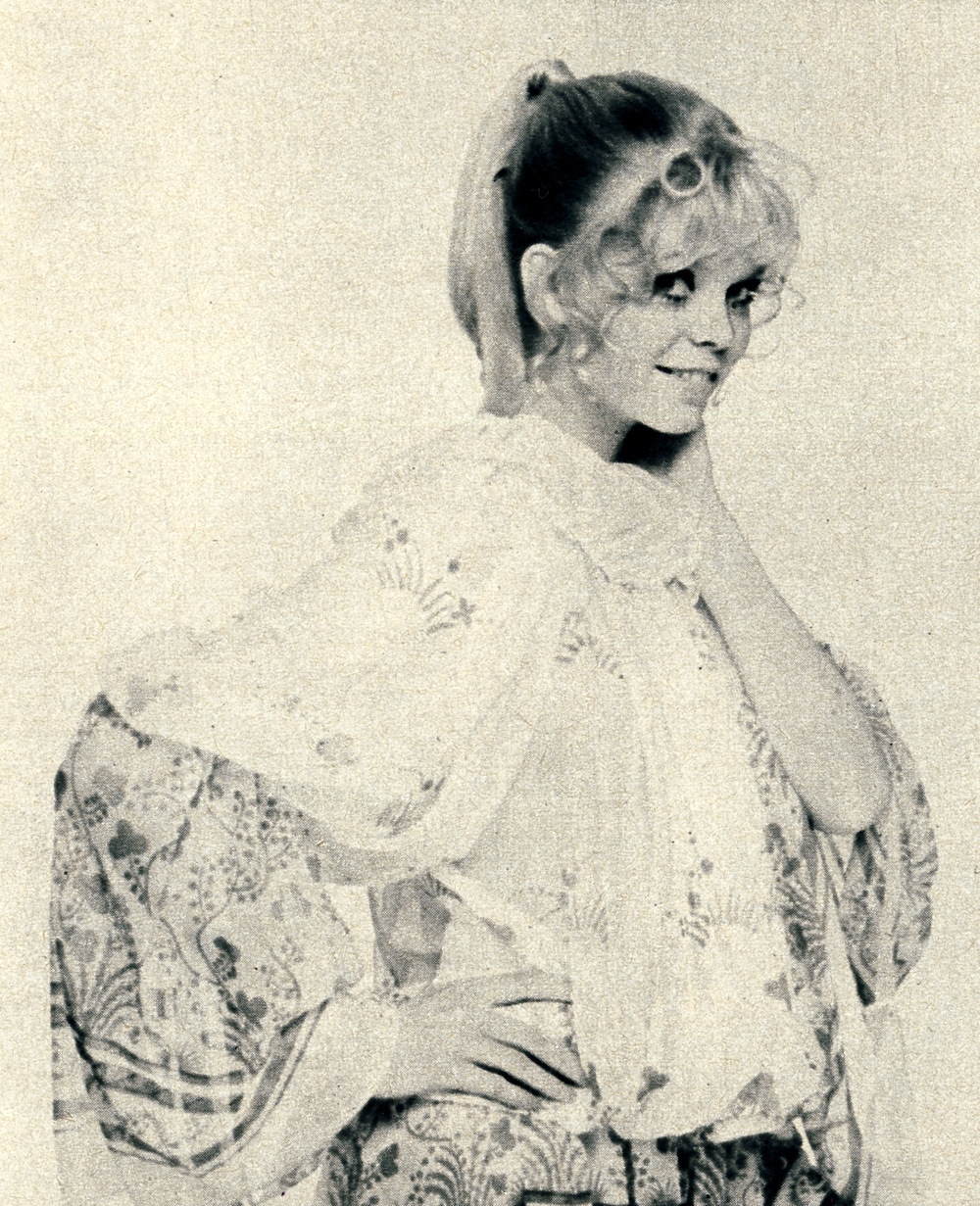
Tunic by Ossie Clark.
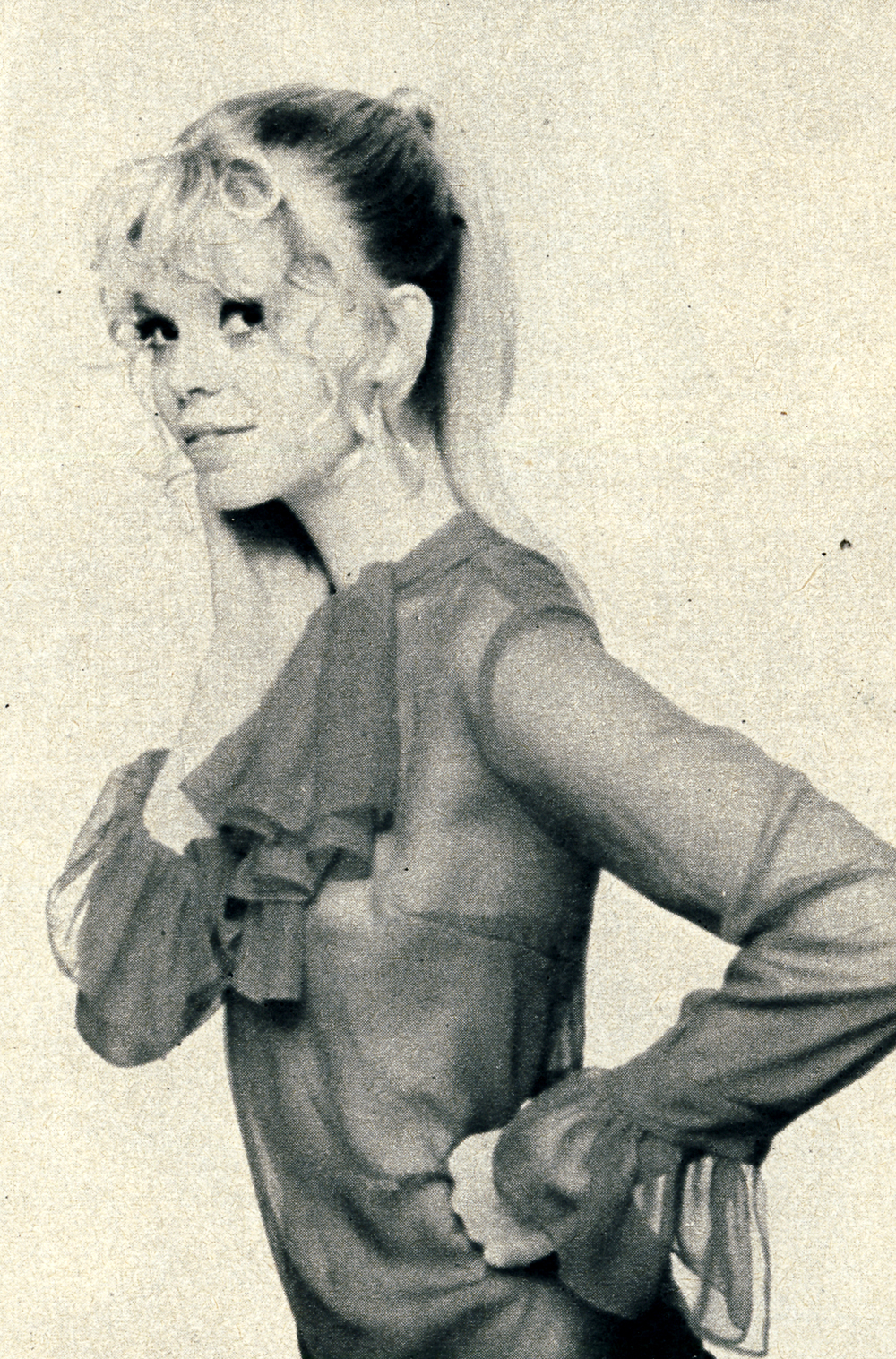
Red chiffon blouse by John Craig.
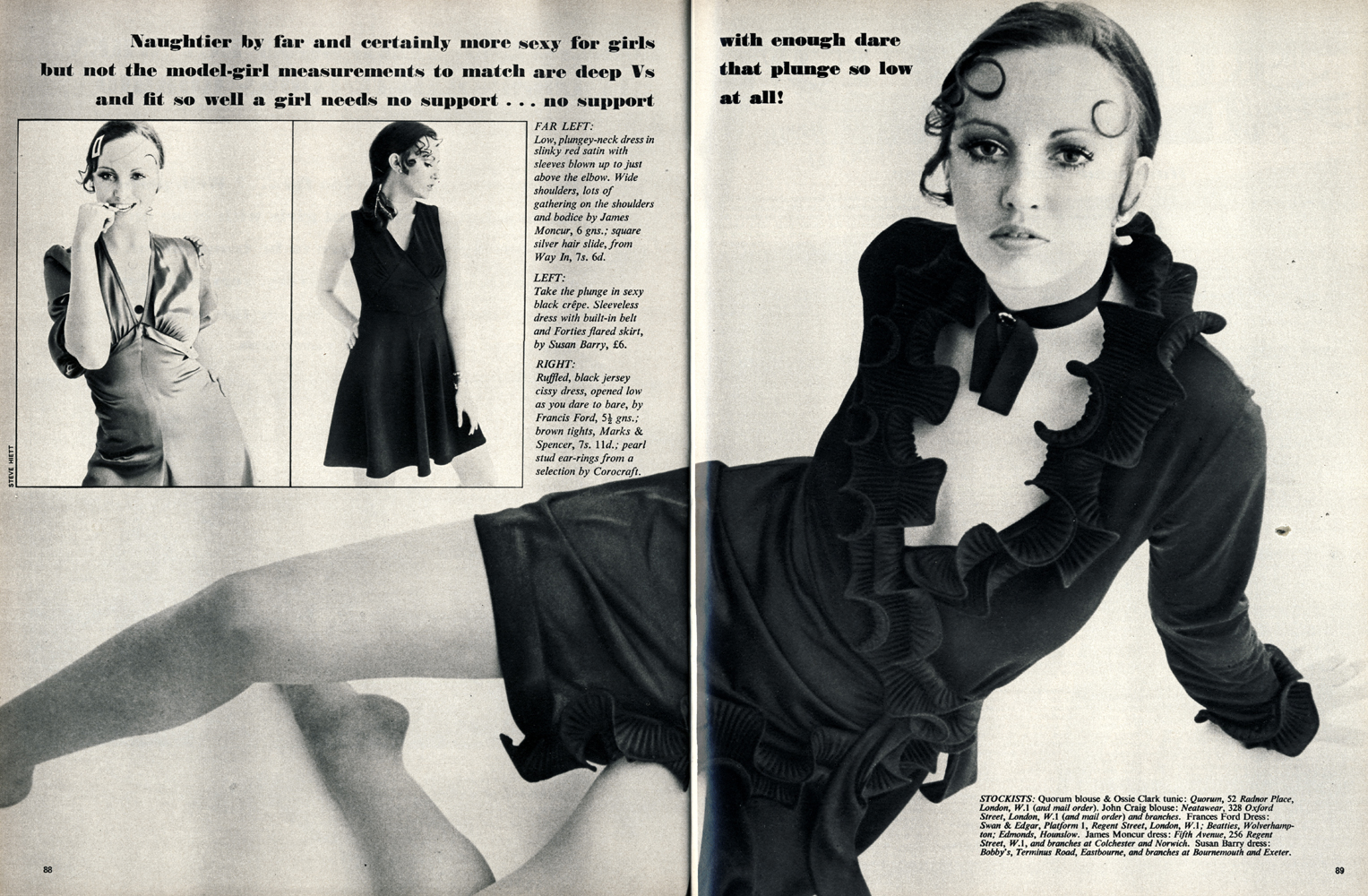
Ruffled black dress by Francis Ford.
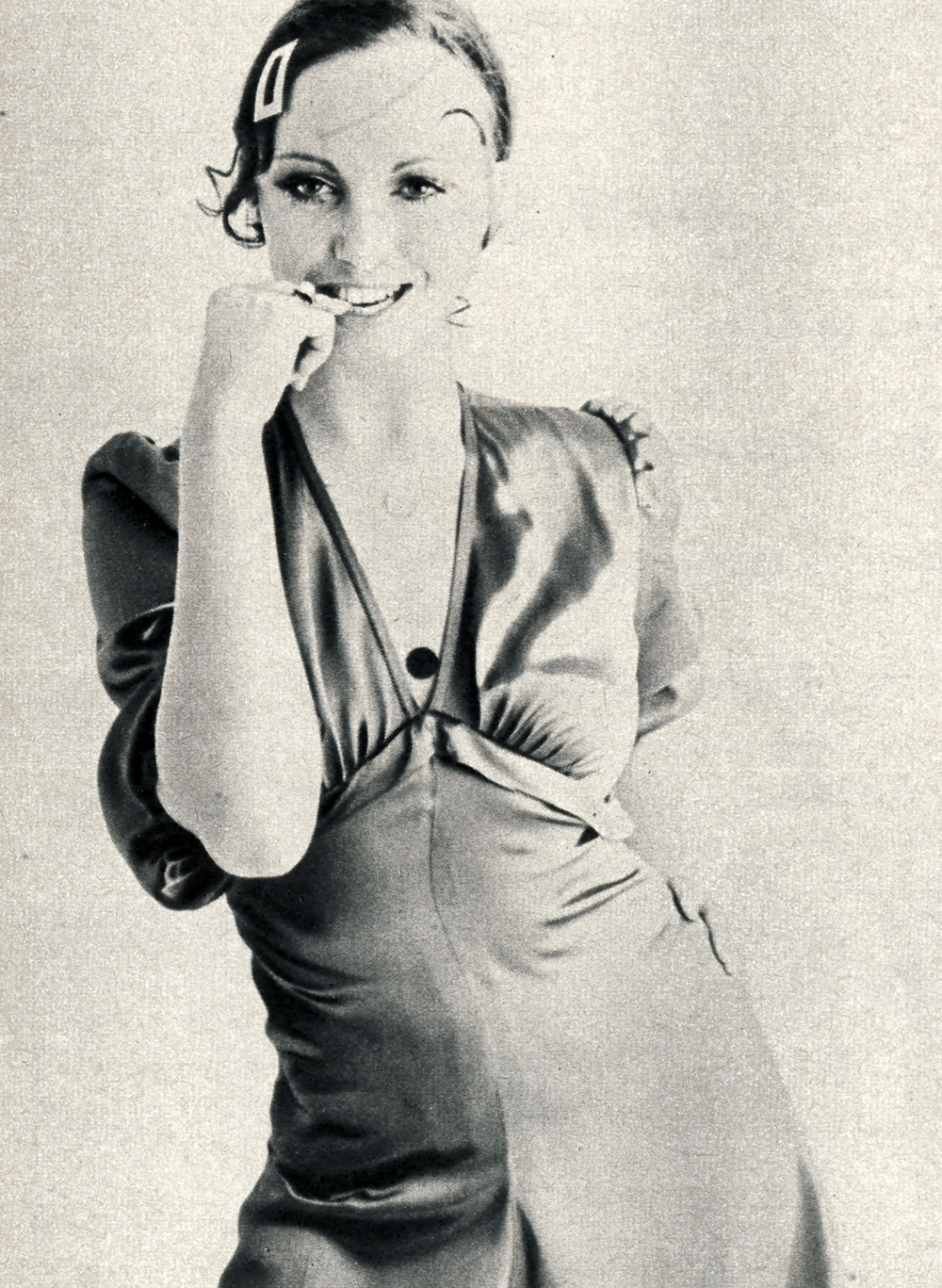
Low, plungey-neck dress in red satin by James Moncur.
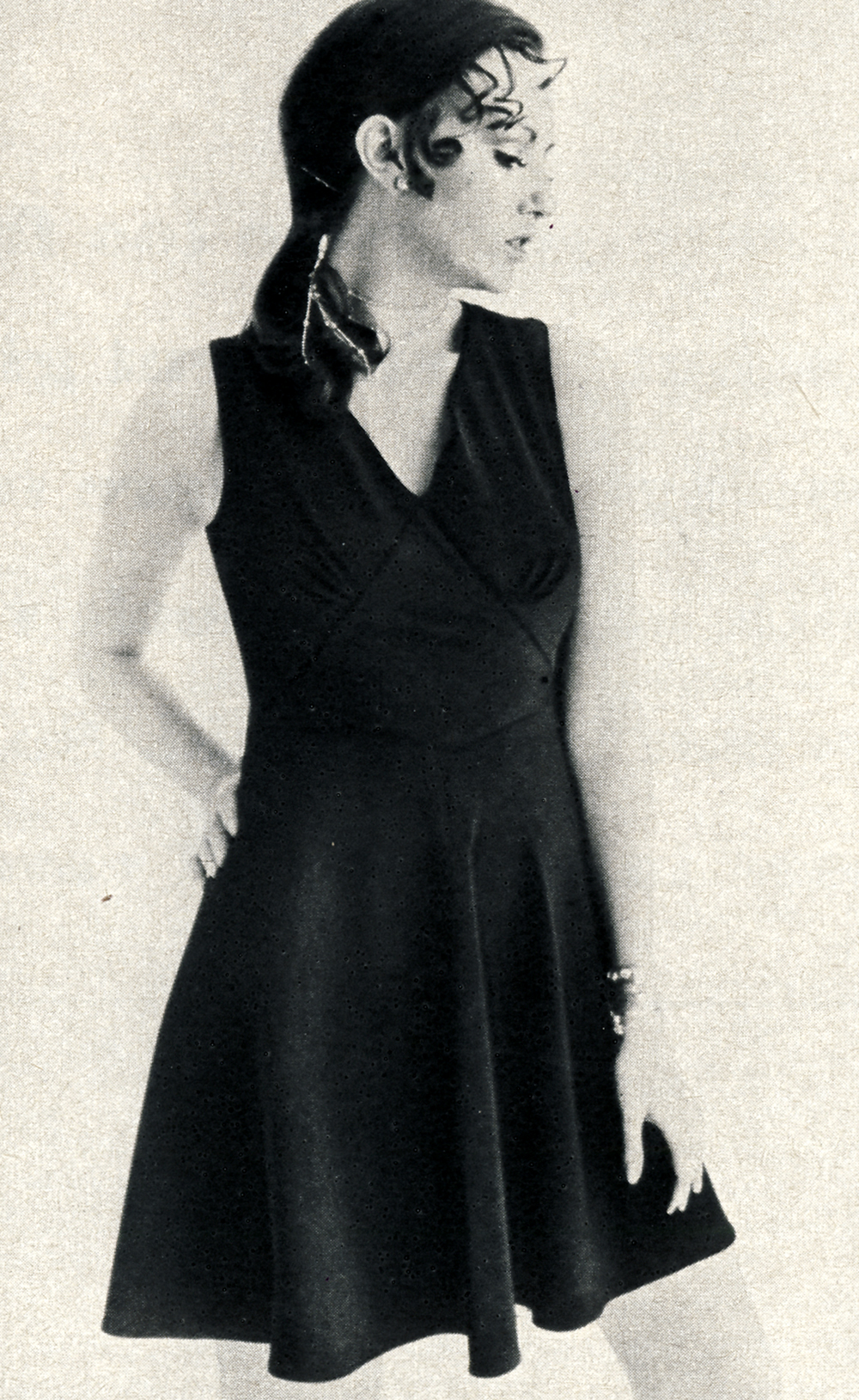
Black crepe sleeveless dress by Susan Barry.
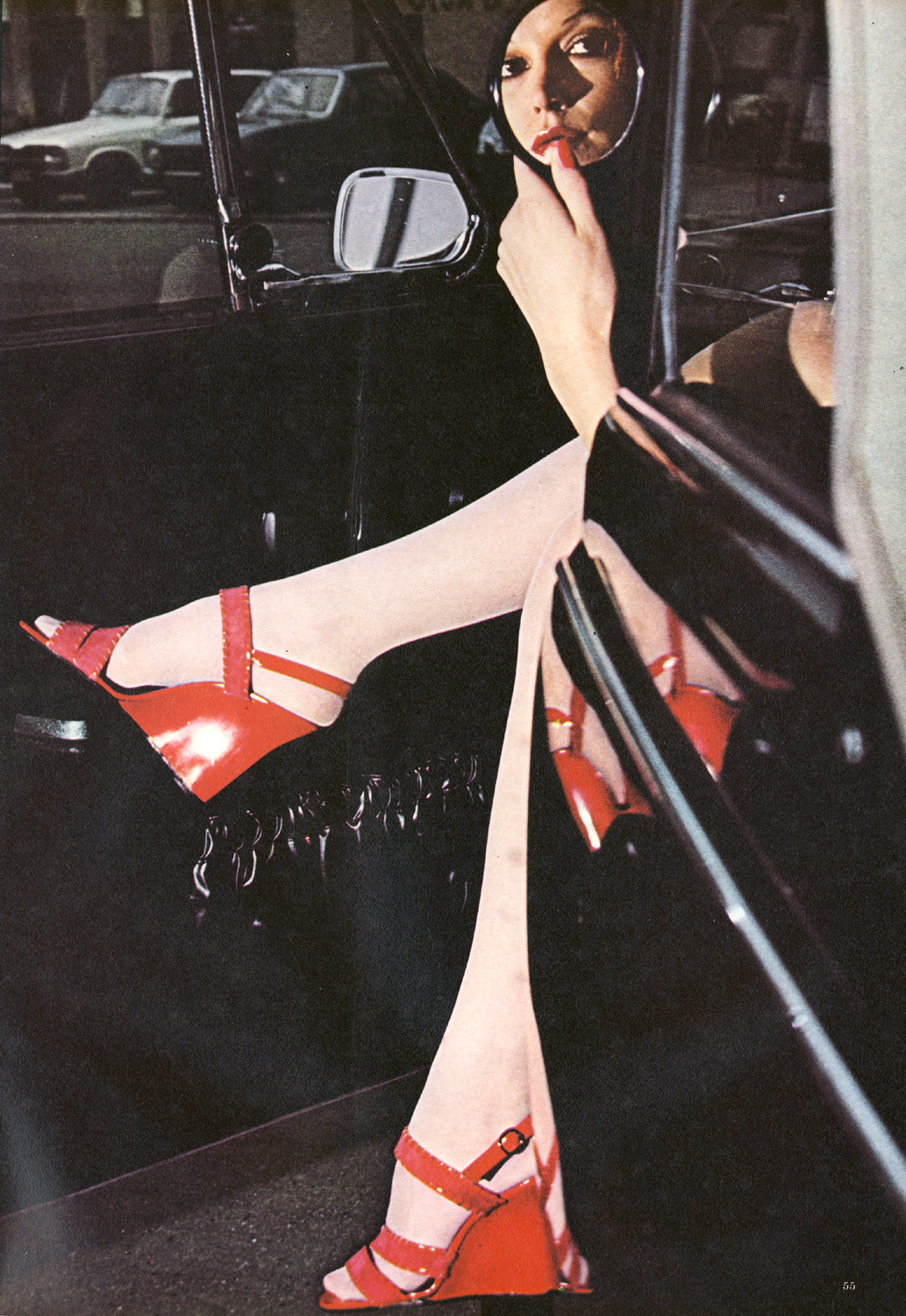 Brilliant red patent leather sandal with suede straps thonged in patent. By Saint Laurent Rive Gauche.
Photographed by Steve Hiett.
Scanned by Miss Peelpants from Harpers and Queen, January 1975.
 Liz Eggleston