
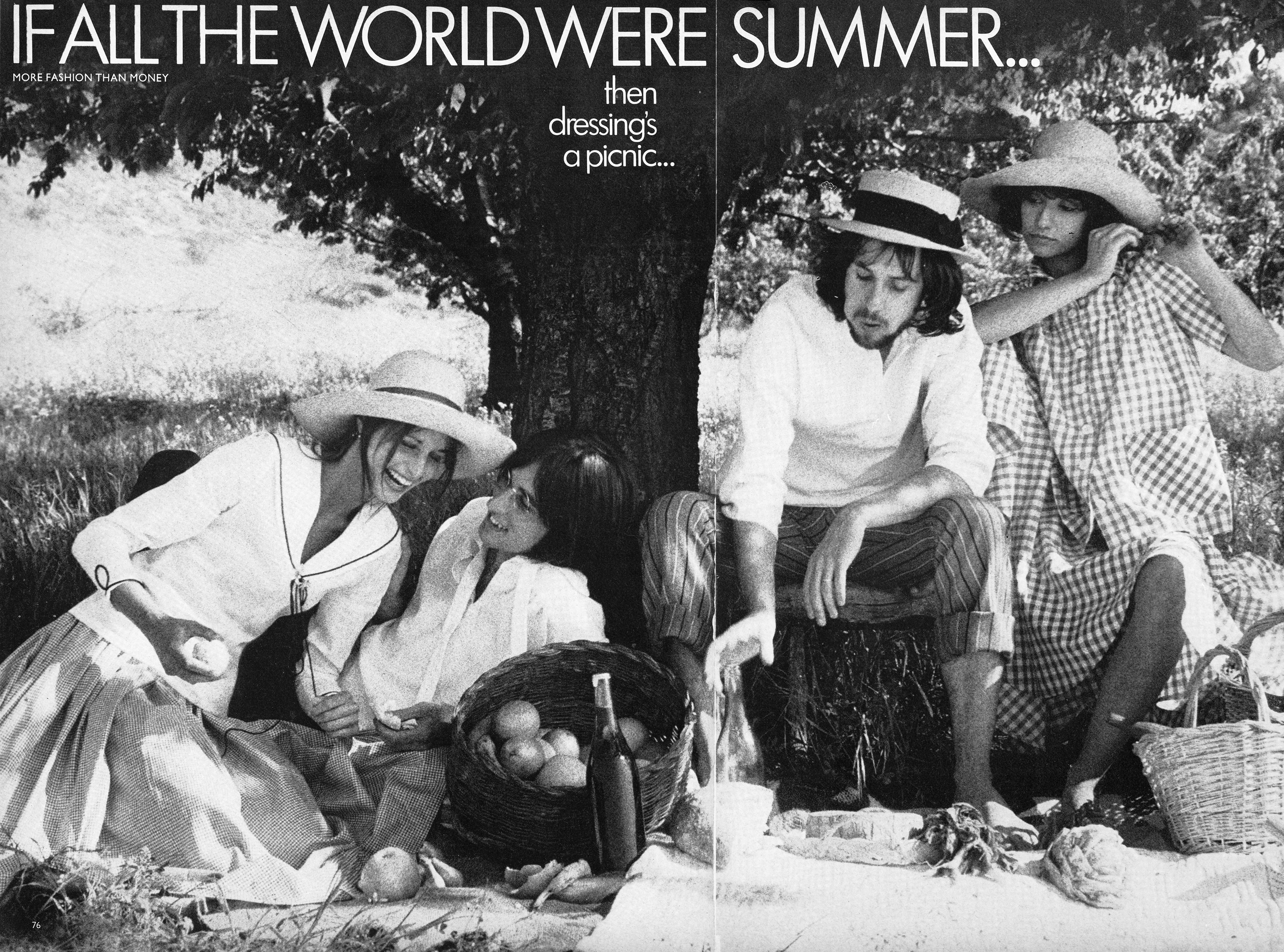
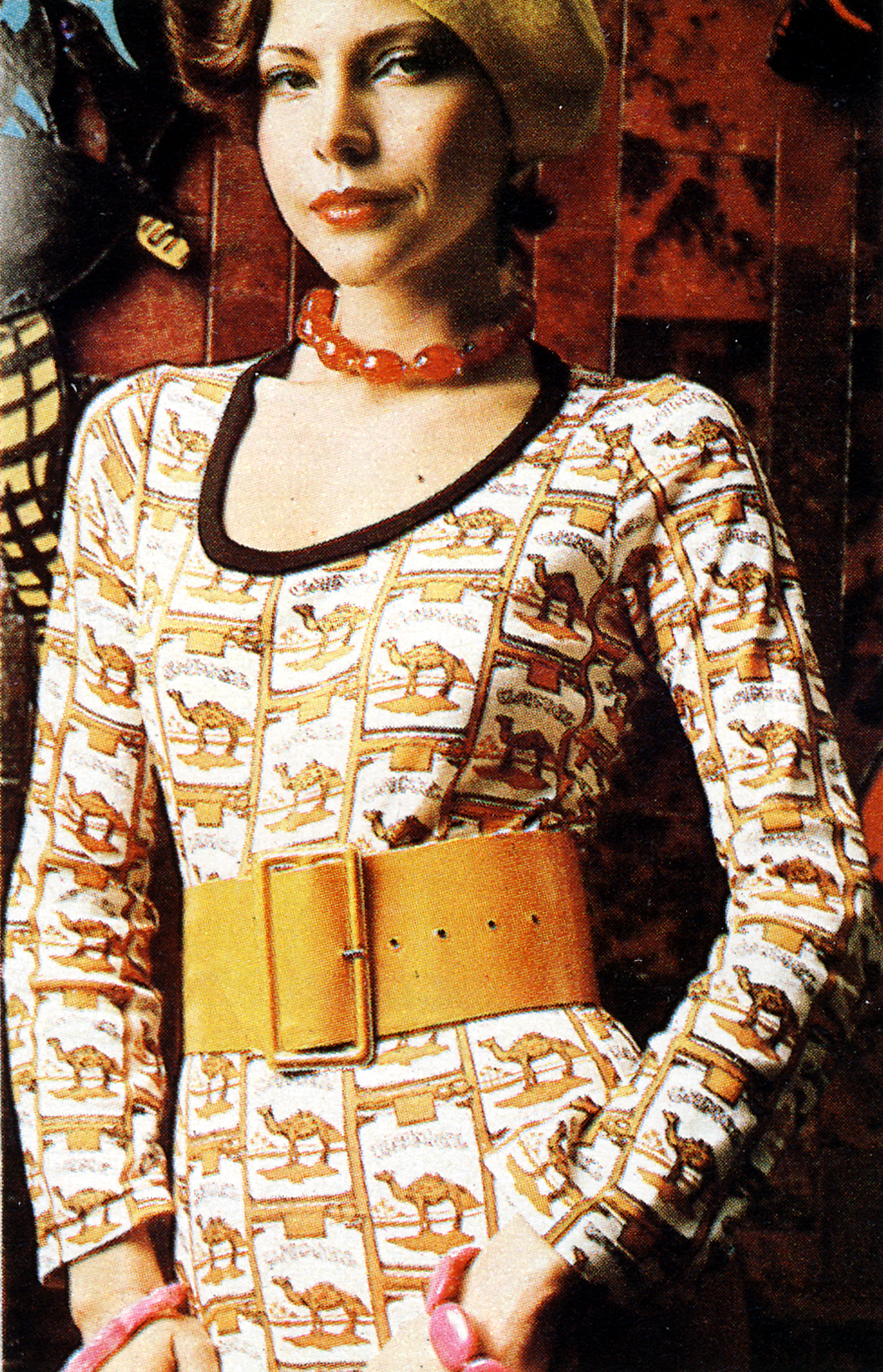
…Then dressing’s a picnic. All these nice new laundered clothes and country girls from Colette stories out in the green fields under blue Provençal skies, with wine and fruit and flowers.
Photographed by Jonvelle.
Scanned from Vogue, July 1971

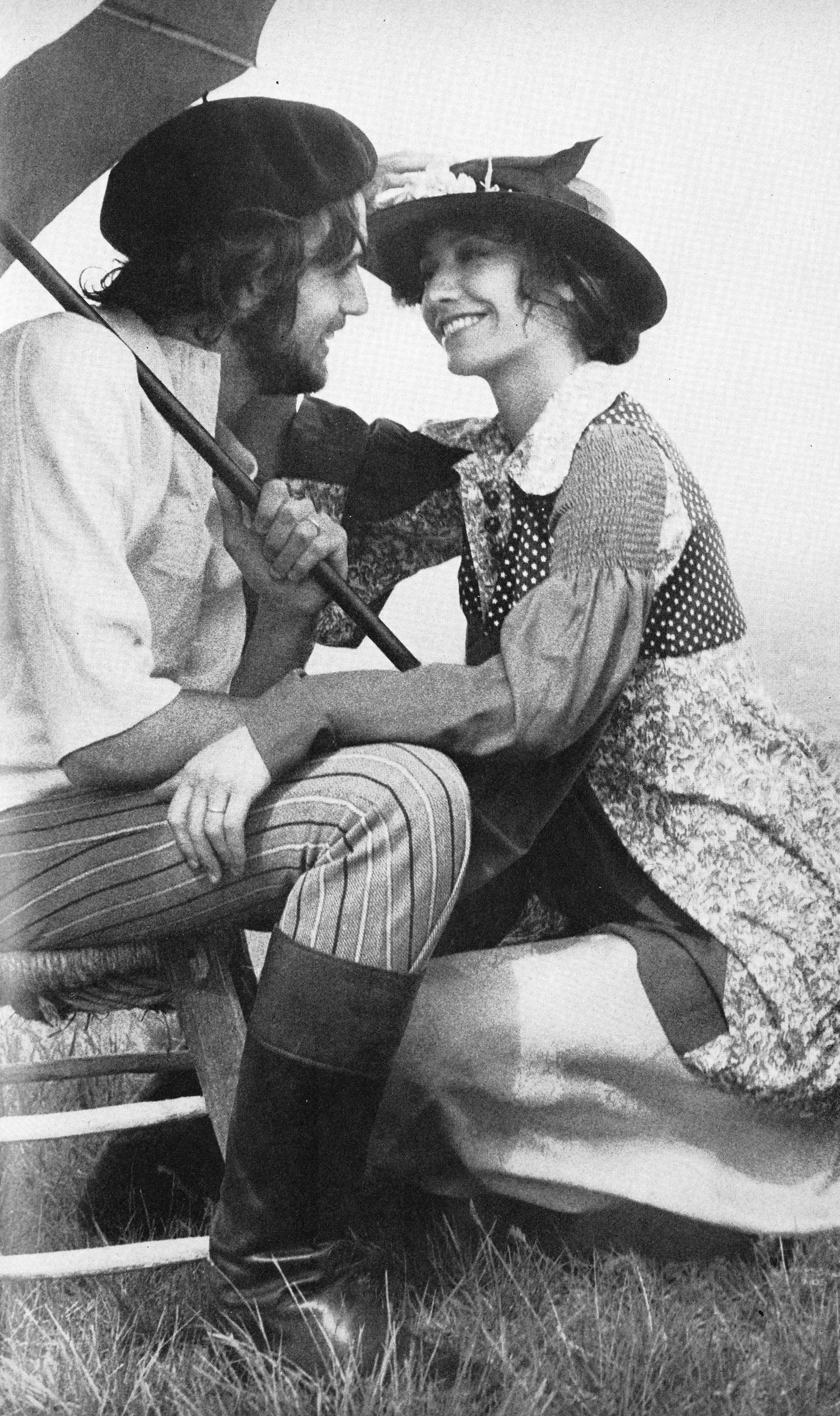
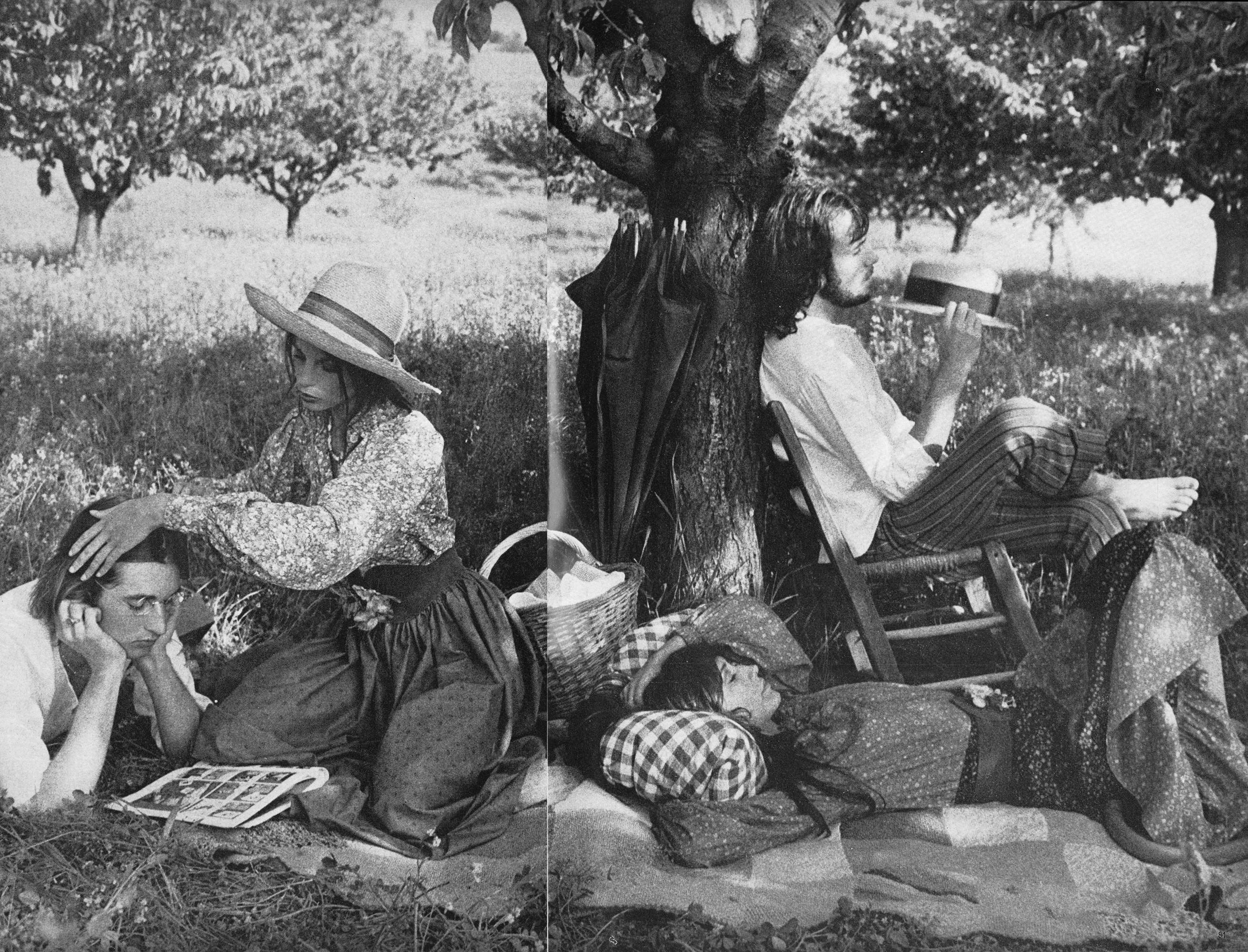
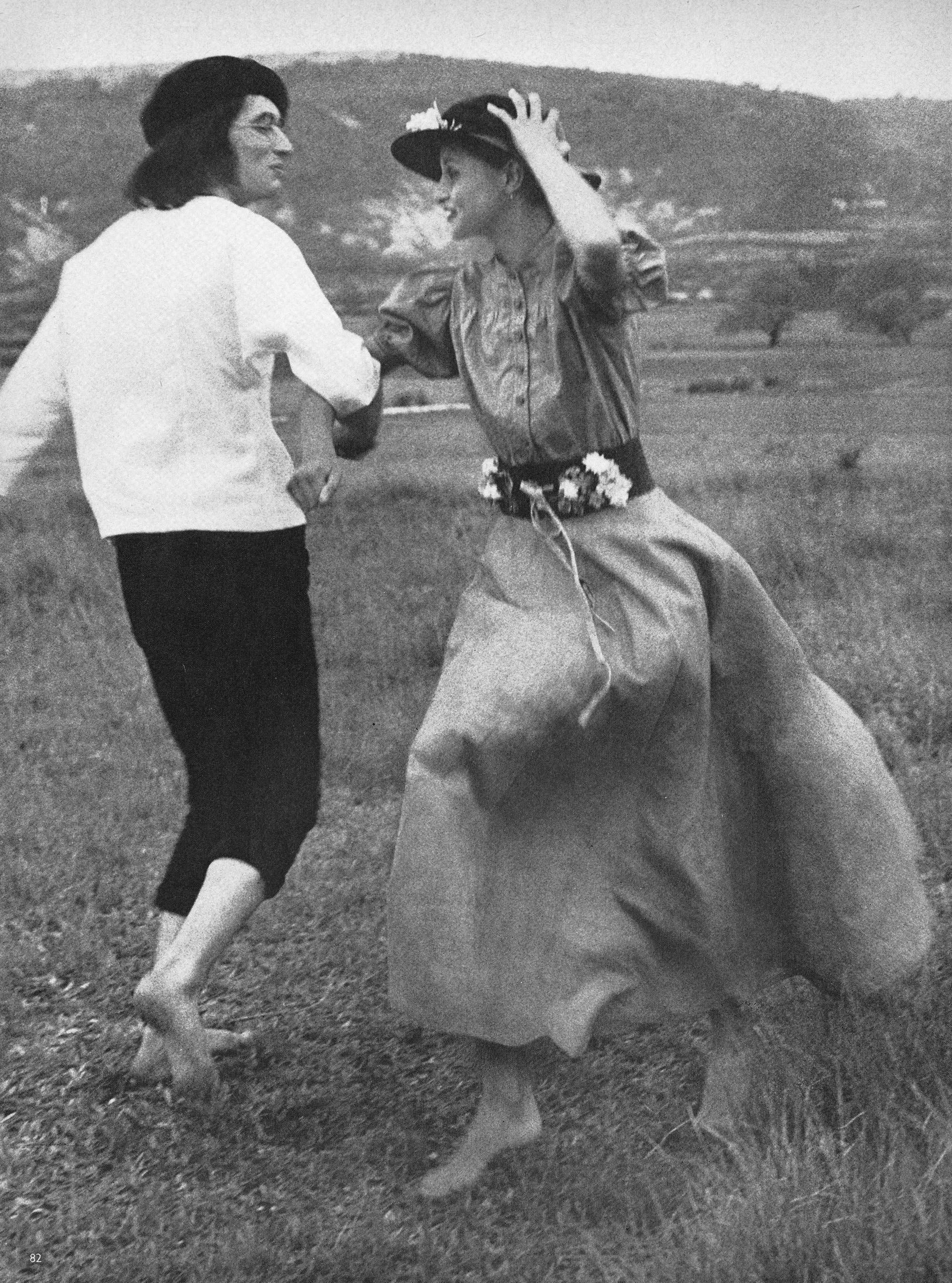

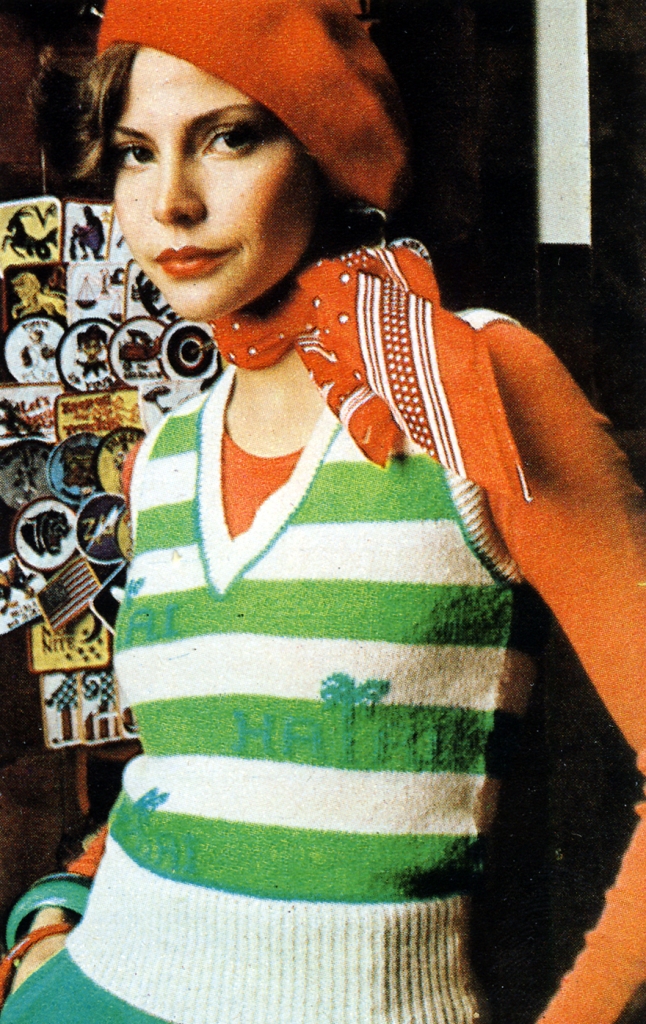
…Then dressing’s a picnic. All these nice new laundered clothes and country girls from Colette stories out in the green fields under blue Provençal skies, with wine and fruit and flowers.
Photographed by Jonvelle.
Scanned from Vogue, July 1971
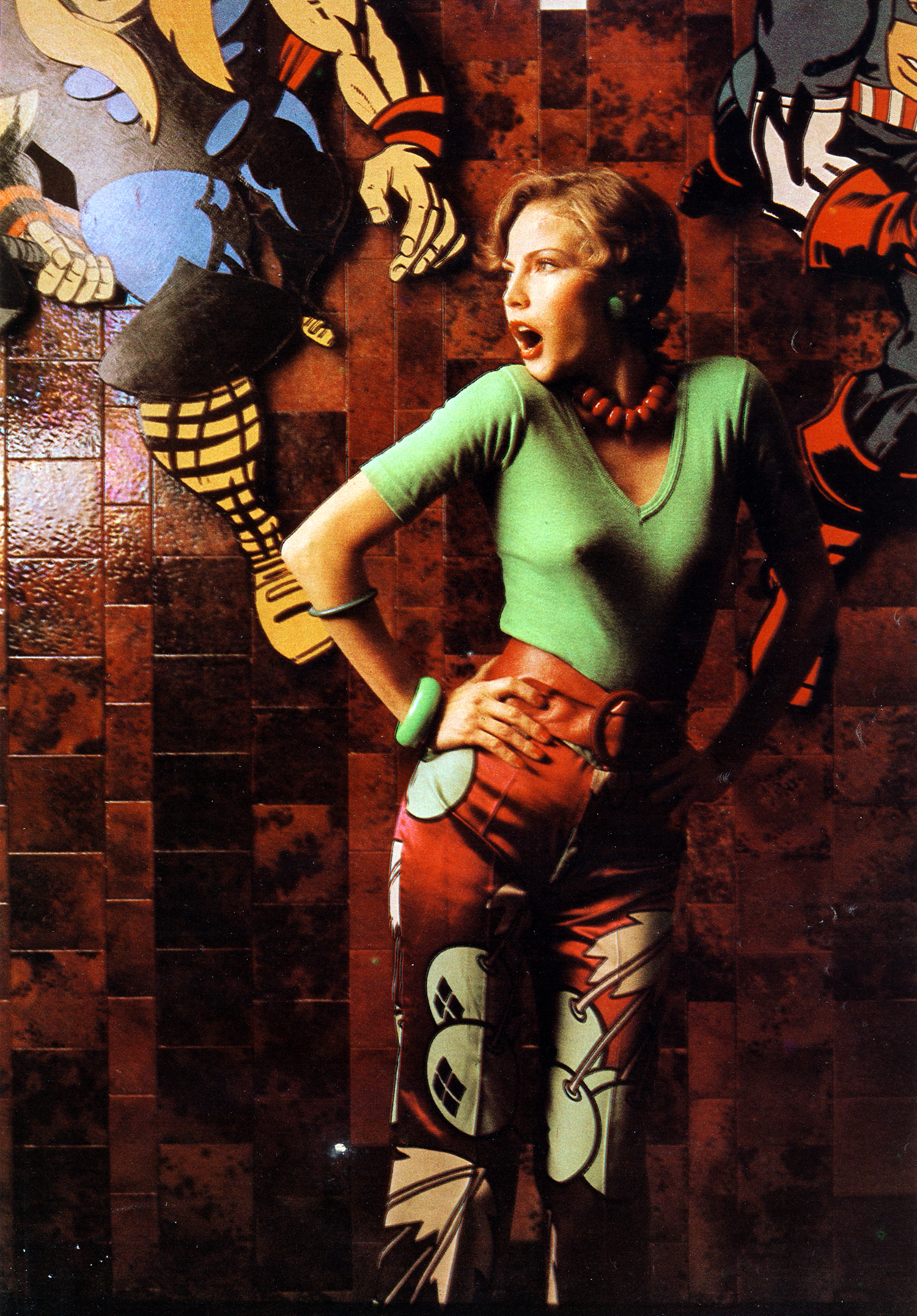
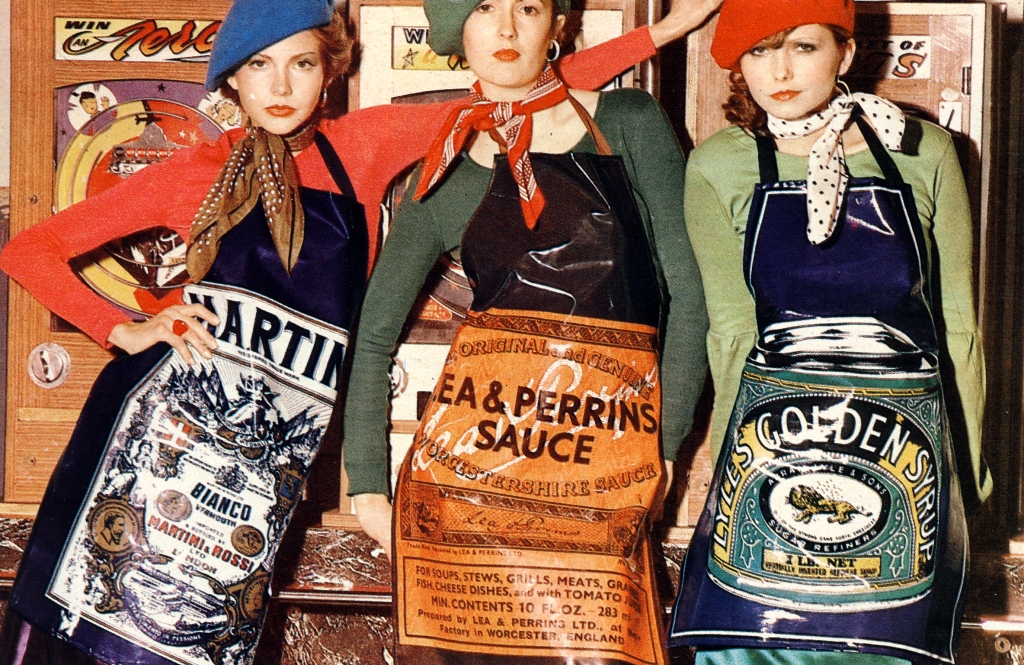
This post is brought to you in two parts. The editorial was, unusually, photographed by two different photographers in two different locations. Tomorrow I will post the photos from Brighton Pier (very exciting for me, as you can guess!). Today’s were photographed in Meeny’s, which was a King’s Road boutique started by Gary Craze in 1972 – specialising in American brands for both adults and children. Clearly showing the same influences as Mr Freedom, this is the first I’ve seen of the interior. The clothes are the very creme de la creme of boutique ‘pop art’ joyfulness.
Photographed by Dick Polak.
Scanned from Honey, May 1973.
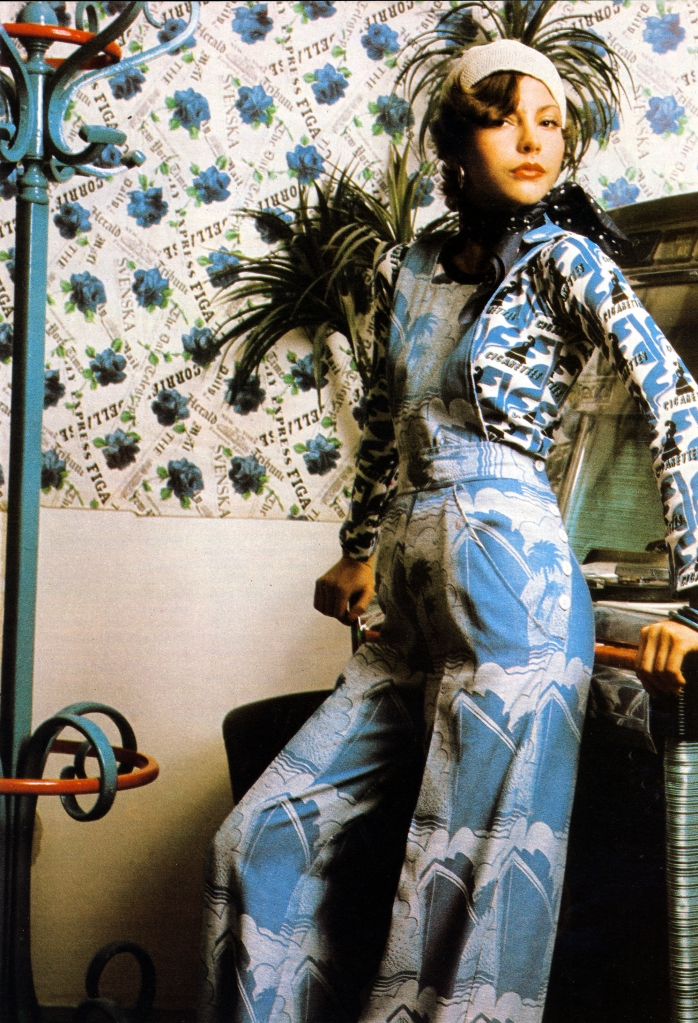
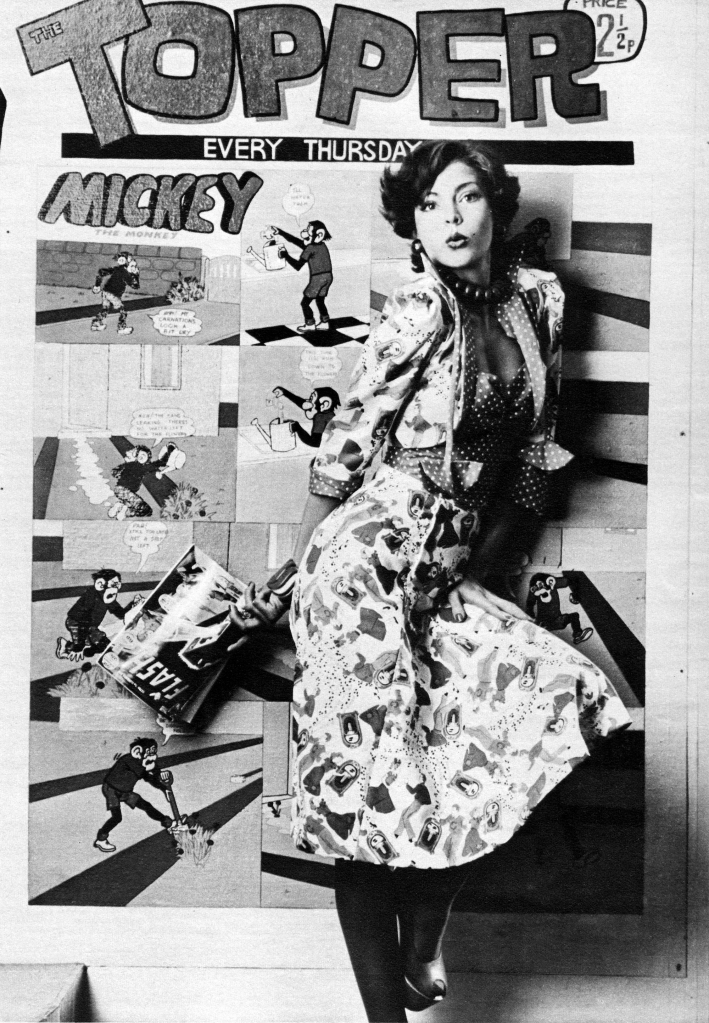
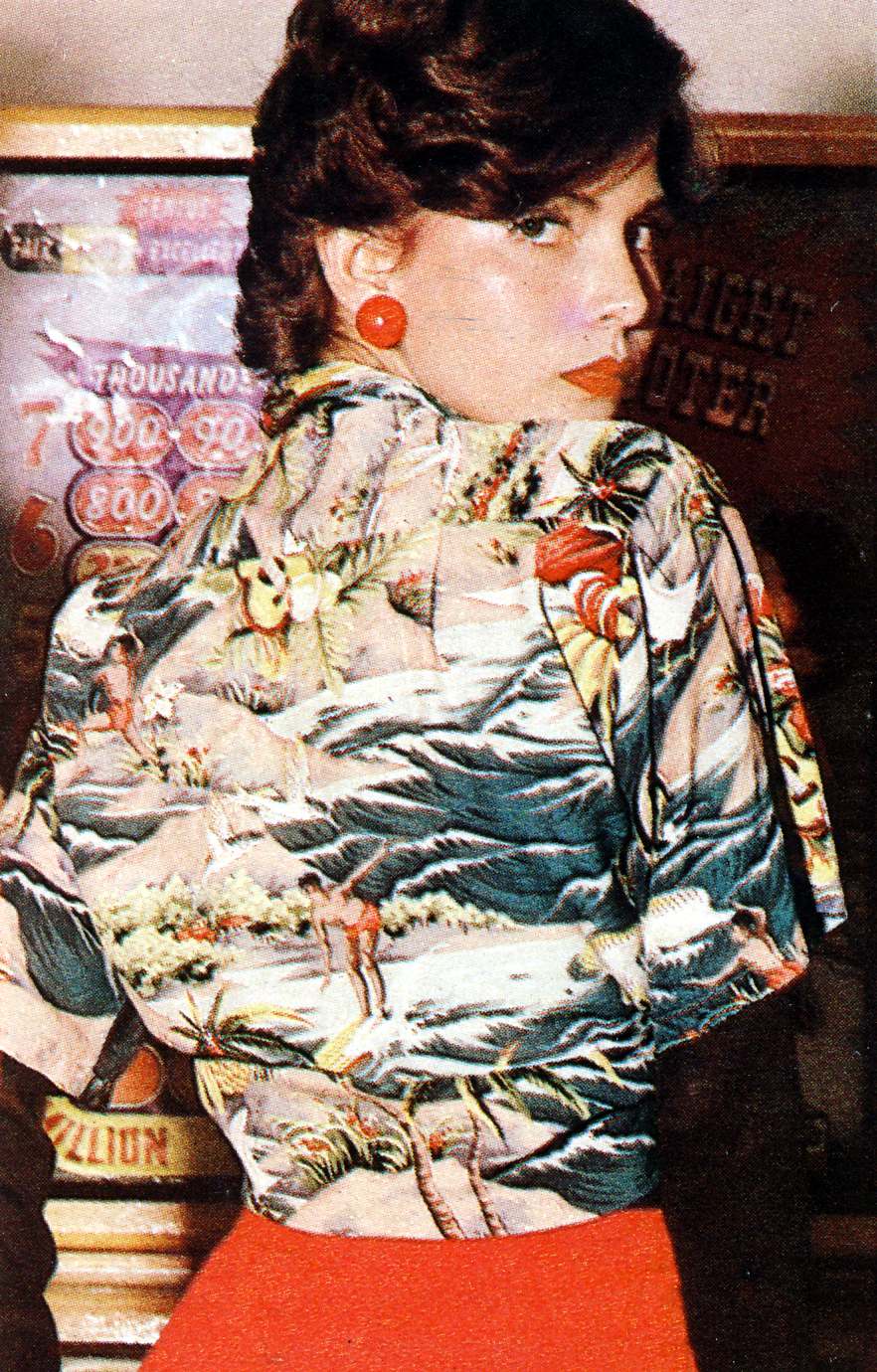
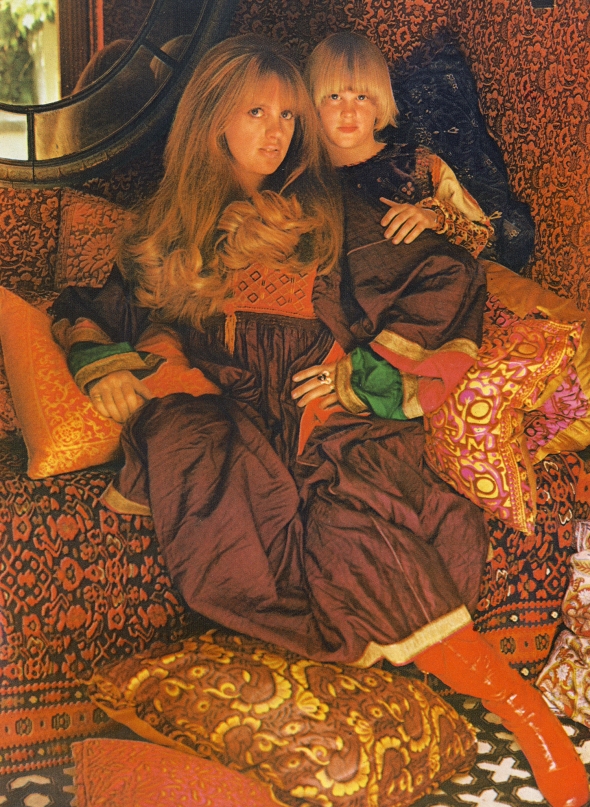
Tessa Kennedy lives down amongst trees and flowers on the Bayswater edge of Hyde Park; on a broiling blue July day it seemed more like the South of France with mimosa yellow awnings over the windows, white iron table and chairs set up on the terrace. On the corner of a great white classical block of houses, it’s a garden flat — no agent’s euphemism — knocked together from two; in the centre are a pair of tiny courtyards Tessa is changing into conservatories so that flowers can flower all year round: her sons can also wheel their bicycles straight out of doors to play. They are Cassian, Damian and Cary Elwes., 11, 10 and 7, and there’s Dylan, the baby, 7 months old.
Inside, a dramatic maze of rooms opens off the central chocolate-varnished corridor; everywhere carpets, tapestries, tartan and Indian silks make endless patterns. The old wine cellars have turned into great scarlet felt lined storage cupboards like the ones she designed for the Donald Davies shop, no dust can creep in. The drawing-room converts to a cinema built when Stanley Donen lived there; Tessa has hardly changed this at all. The projection room has mighty machines like the Marble Arch Odeon, she has registered herself as Kennedy Previews and has a projectionist hired full time—to show films to friends after dinner once or twice a week, or a couple of James Bond epics for the boys: “They love it of course and get absolutely boss-eyed.” Her fascination with gadgetry extends to video tapes, high-powered headphones for the stereo, intercom and a splendid American push-button dial telephone you can ring in on but not out. With the push-button stuff are clumps of fresh flowers, dog roses, daisies, piles of cushions in antique fabrics or in the flame stitch tapestry she sews on plane journeys, her collection of walnut shell sewing boxes, photograph, paintings—including a quartet of Louis XIV’s wife and mistresses—and carpet in a different colour but the same pattern as the one she designed for Burke’s restaurant. Burke’s is one of her decorating jobs she likes the best—along with Sir George and Lady Weidenfeld’s house and the flat she made for John Barry in an office block overlooking the Thames: “We installed such powerful sound that it moves right across the river and people coming out of the Tate look quite dazed.” Now she is working on a couple of country houses, one is for John Aspinall, and offices for Polydor records, and several new ideas, like a sauna in a storage cupboard, to build into this family and garden flat.
Yes, that’s little Cary Elwes at the tender age of seven. And of course it goes without saying that I would kill for those Theas…
Photographed by Norman Parkinson.
Scanned from Vogue, September 1970.
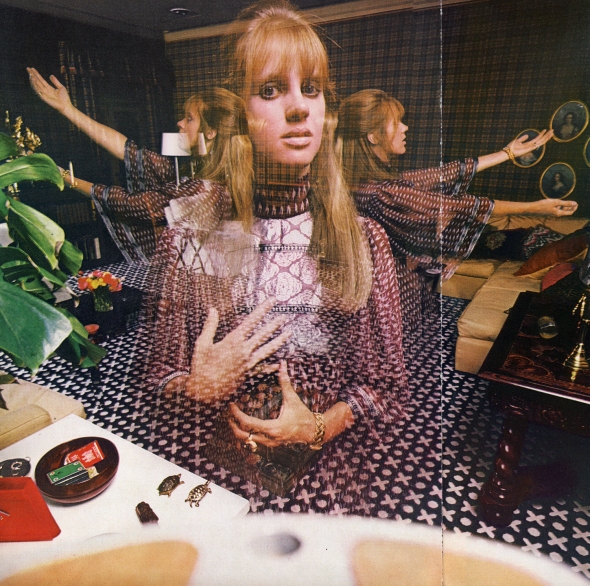

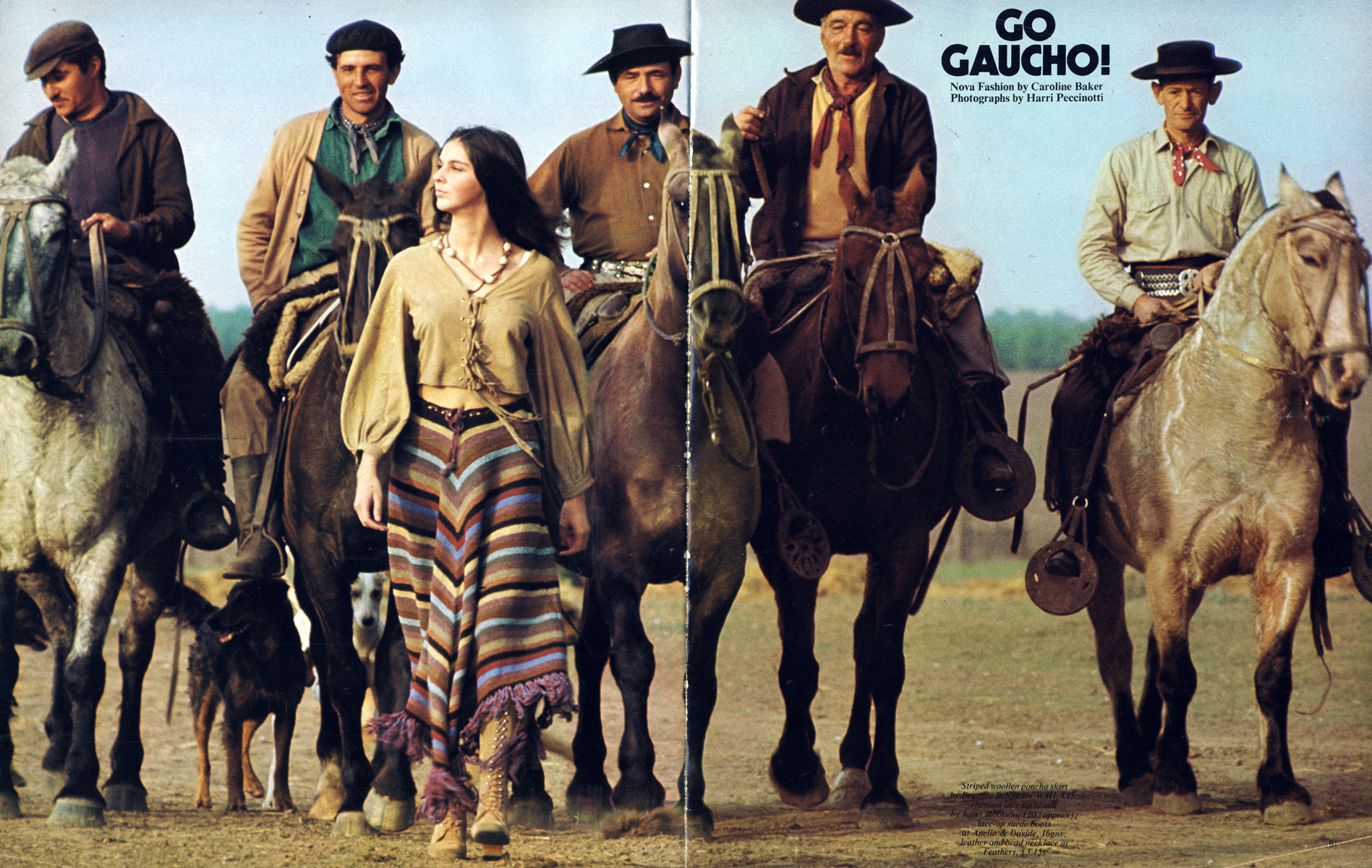
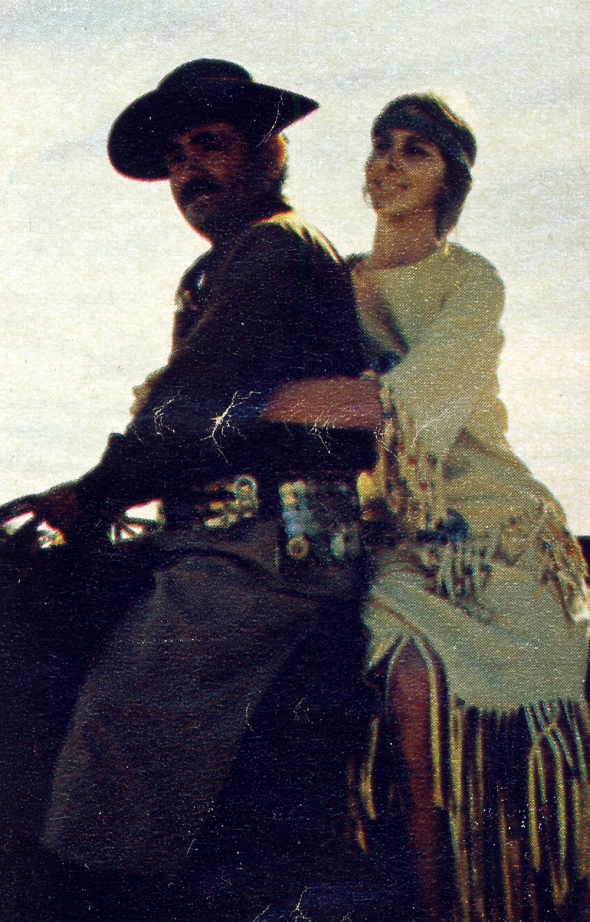
Not only does leather feel good, it smells delicious, like a trip out West. Suede and chamois are even better than leather because they are so much softer and easier tow ear. They’re not as expensive as they used to be. Cheap they will never be if you want value for your money. Leather, properly looked after, lasts for age; in fact, the more beaten up and old it looks the better. So when it comes to buying remember that and invest in something safe – like the clothes photographed on these pages. Thy are not desperately in fashion but, on the other hand, they are not out and never will be…
Fashion by Caroline Baker. Photographed by Harri Peccinotti.
Scanned from Nova, October 1970.




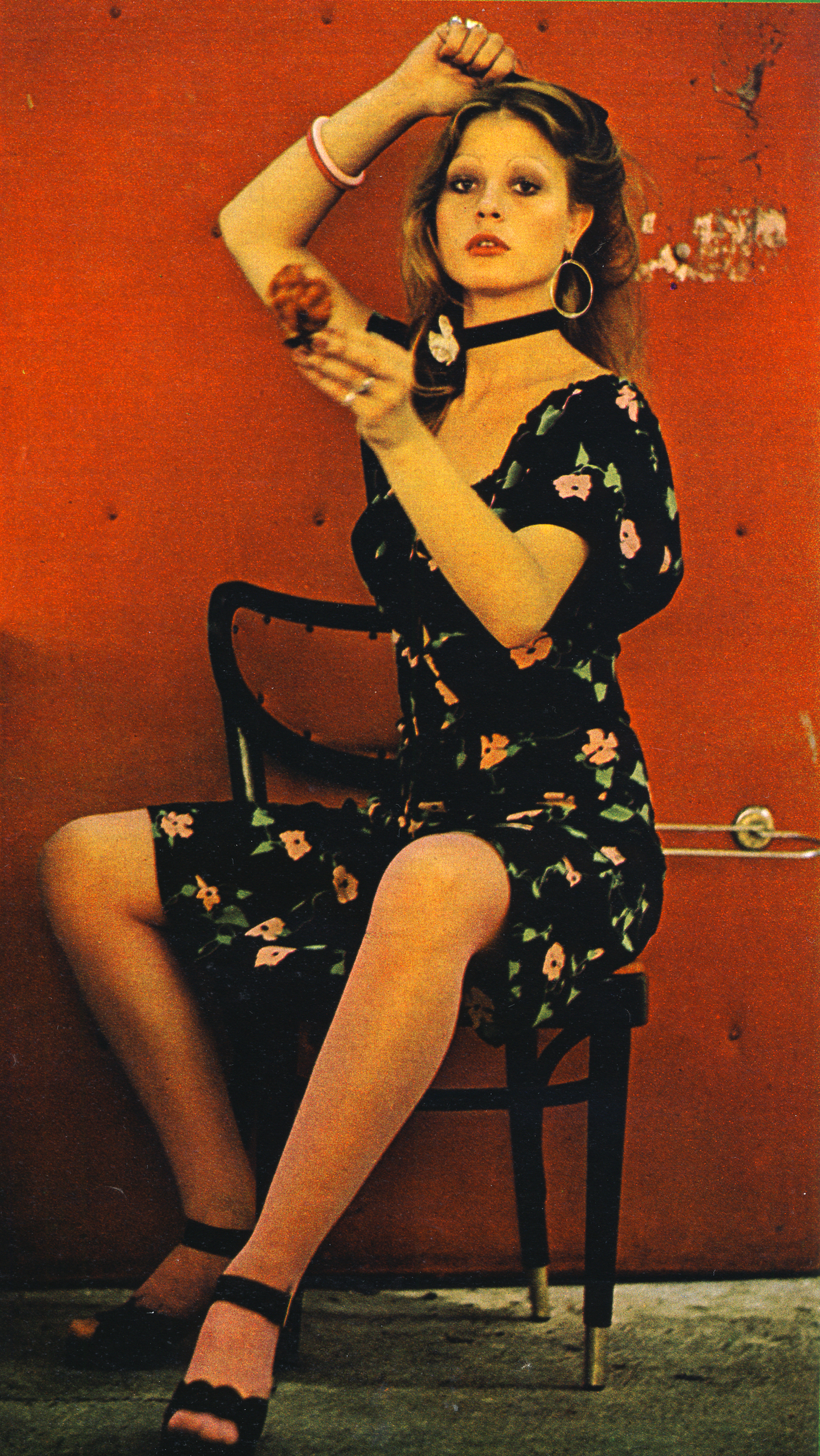
Poppy field morocaine dress with drawstring neck by Ossie Clark for Radley. Plaited suede sandals by Bata.
Flirty little crêpe dresses so irresistibly feminine you’ll never be alone for long.
Anyone who knows me at all will know that *I* cannot resist crêpe, never mind what a fella thinks. This is a stunning editorial, with a model I’m not sure I recognise from anywhere else – so do comment if you can identify her. Featuring two covetable dresses by Ossie Clark but also featuring two by the mysterious ‘Boobs’ boutique label (by designer Linda Warren). I have found mention of a ‘Boobs’ boutique in Edinburgh, but I think it might just be coincidence. Again, holler if you know anything!
Photographed by Roy A. Giles.
Scanned from Honey, November 1971.
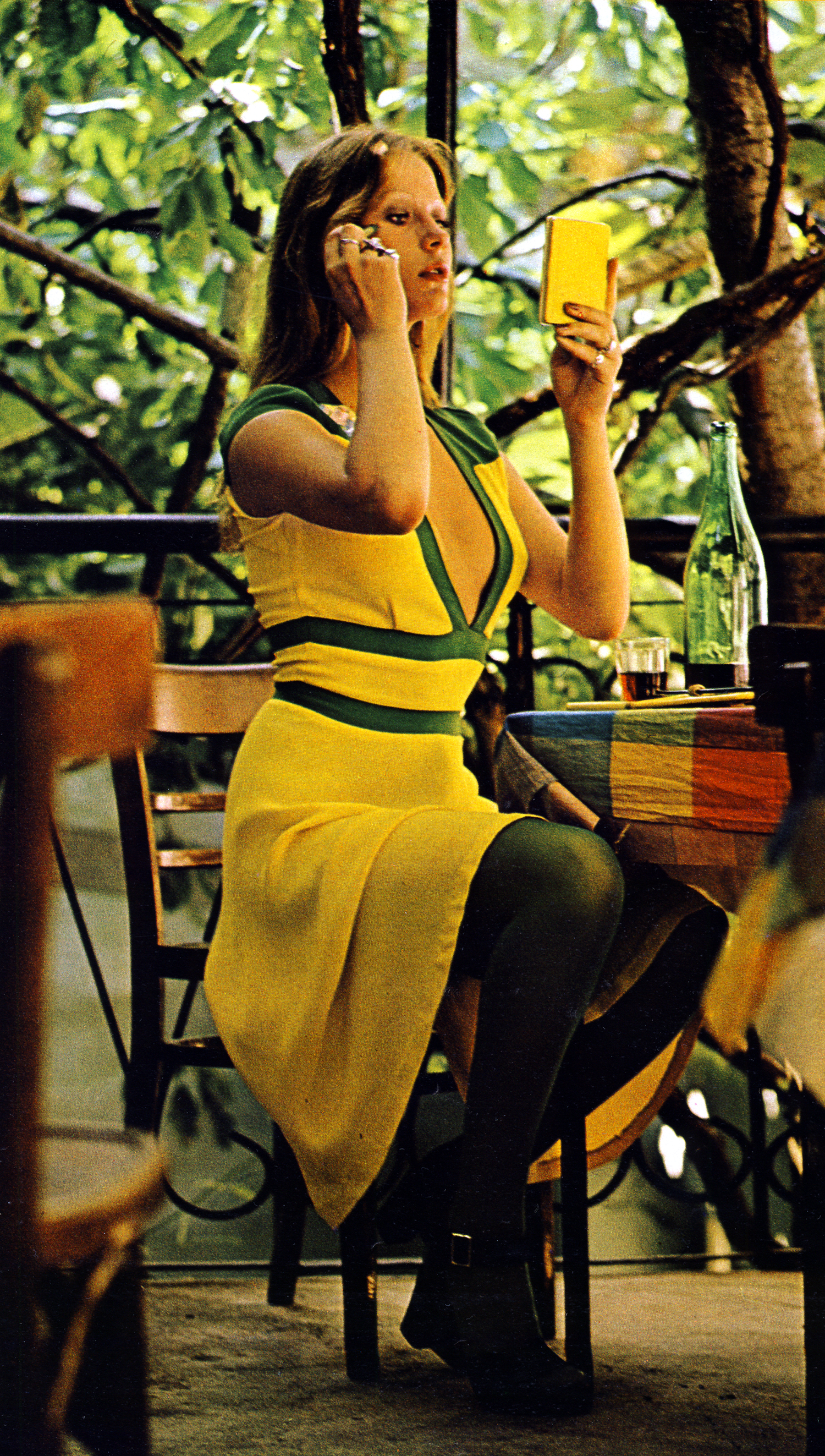
Daring slash necked lemon and lime striped Dicel crêpe dress with paste brooch by Linda Warren at Boobs. Suede plaited shoes by Bata. Tights by Mary Quant.
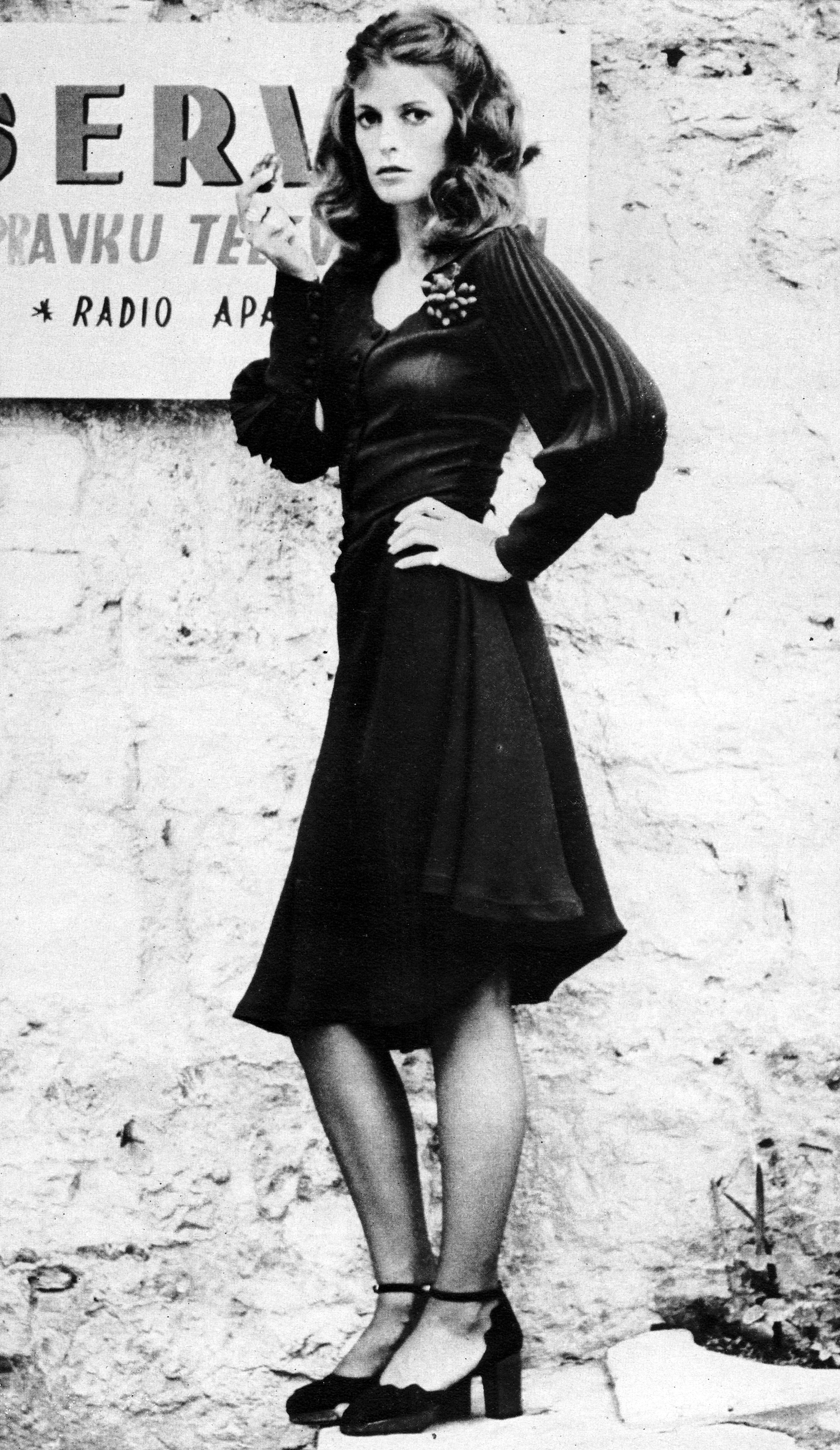
Chocolate brown Dicel crêpe dress with wide accordian pleated sleeves gathered into deep buttoned cuffs by Linda Warren for Boobs. Scarlet and black scalloped shoes by Ravel. Red art deco compact from Universal Witness.
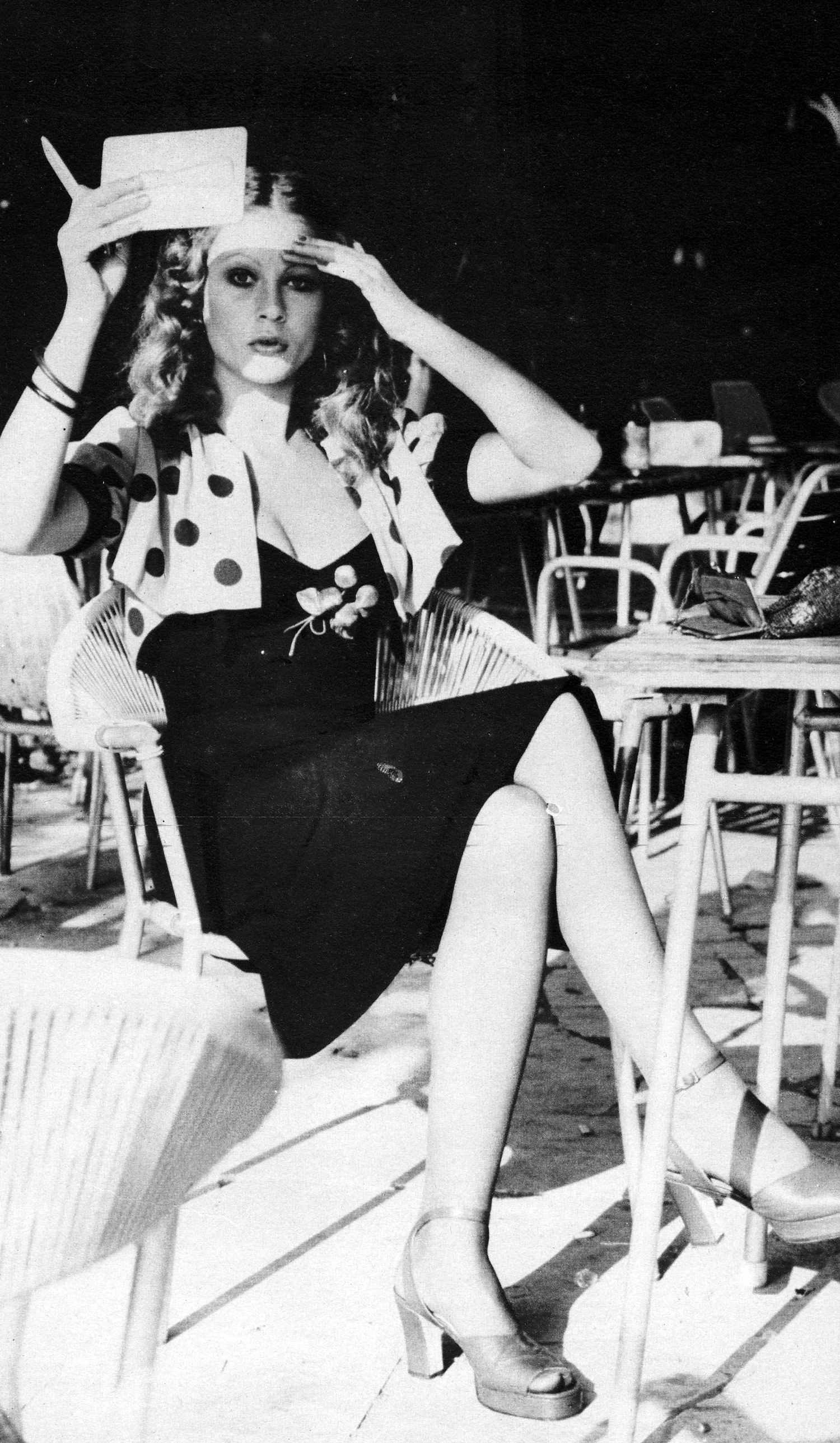
Skimpy jet black halter neck bonded moss crêpe dress with pink and black polka dot fluted bolero jacket by Rosy Bradford for Quorum. Scarlet glacé leather peep toe shoes from Zapata. Flocked red cherries by Adrien Mann.
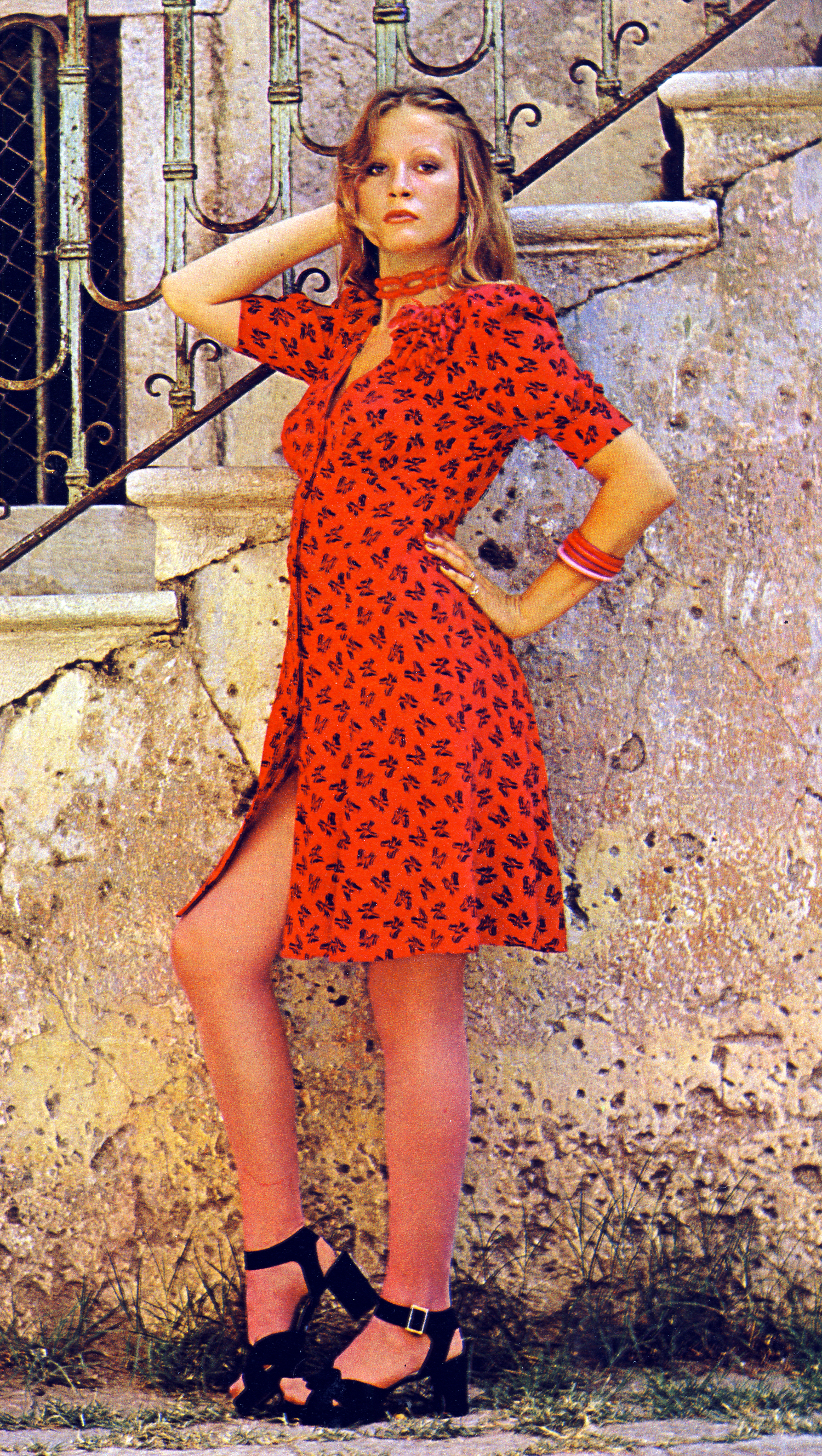
Button-through bow-scattered gently flaring crêpe dress from Bus Stop. Black sude sandals by Bata.
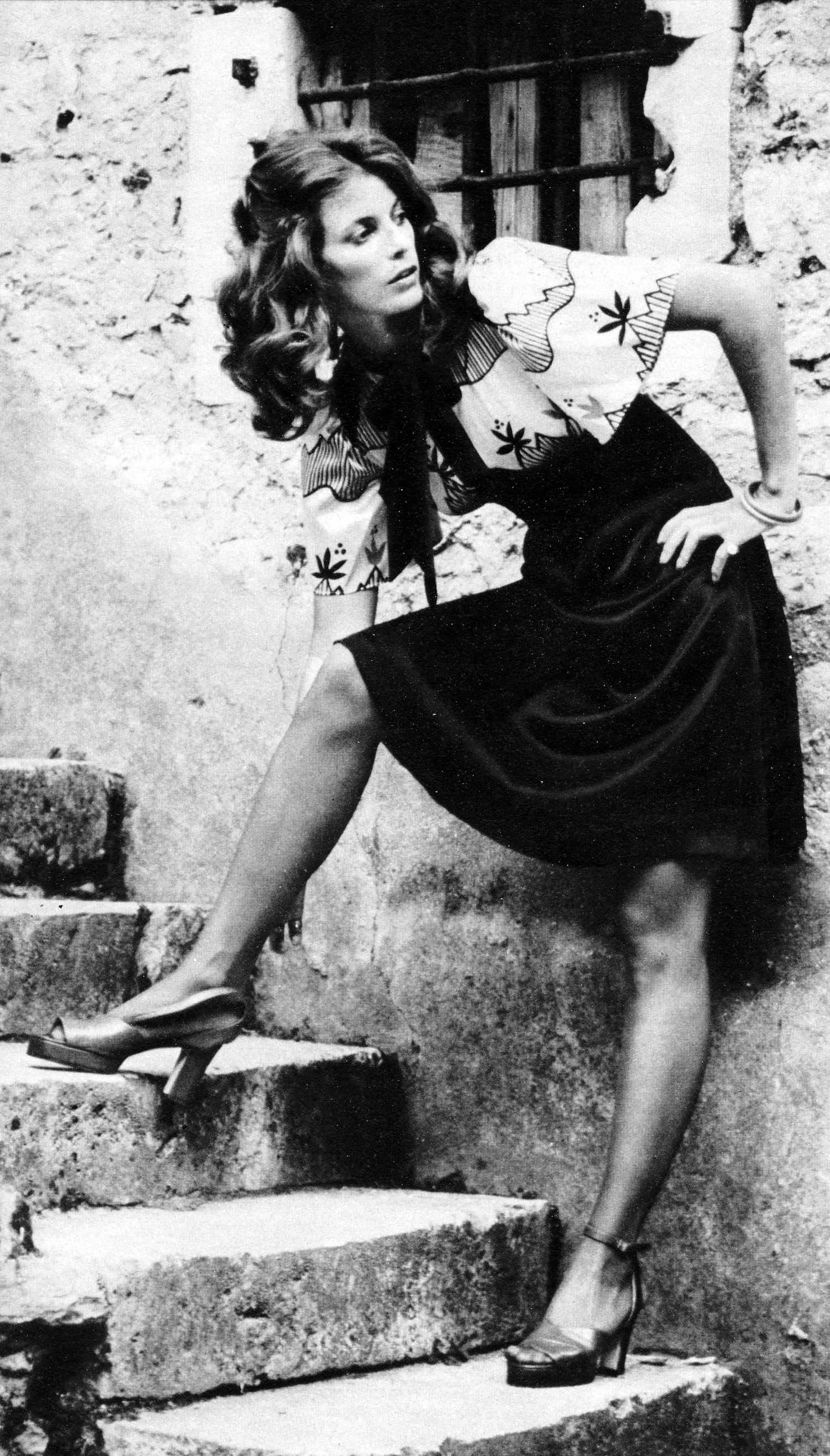
Slippery satin dress with palm tree printed bodice by Ossie Clark for Radley. Scarlet leather peep toe shoes by Zapata.

White dress with music and rose print by Miss Mouse. Snakeskin shoes from Bilbo. Red and white spotted dress with white trimming by Miss Mouse.
Photographed in Singapore by Harri Peccinotti.
Scanned from 19 Magazine, May 1975.

Black and green floral print halterneck dress from Biba. Black and gold shoes by Sex. Green floral halterneck dress by Biba. Black and gold brocade shoes by Biba.

Shocking pink pintucked cotton dress by Sheridan Barnett at Quorum. Black snakeskin shoes by Bilbo. Red cotton sack dress with hip pockets by Sheridan Barnett at Quorum. Red suede and snakeskin shoes by Terry de Havilland.

Dusty pink sun dress with black piping by Strawberry Studio. Grey suede shoes by Terry de Havilland.

Blue cotton dress with Dorchester motif. Coffee dress with Savoy motif, both by Jeff Banks.

White cotton culotte dress by Stirling Cooper. White shoes from Secondhand Rose, Chelsea Antique Market. White cotton sun dress by Stirling Cooper. White shoes from Secondhand Rose.

Navy cotton sundress with cross over straps by Gordon King.
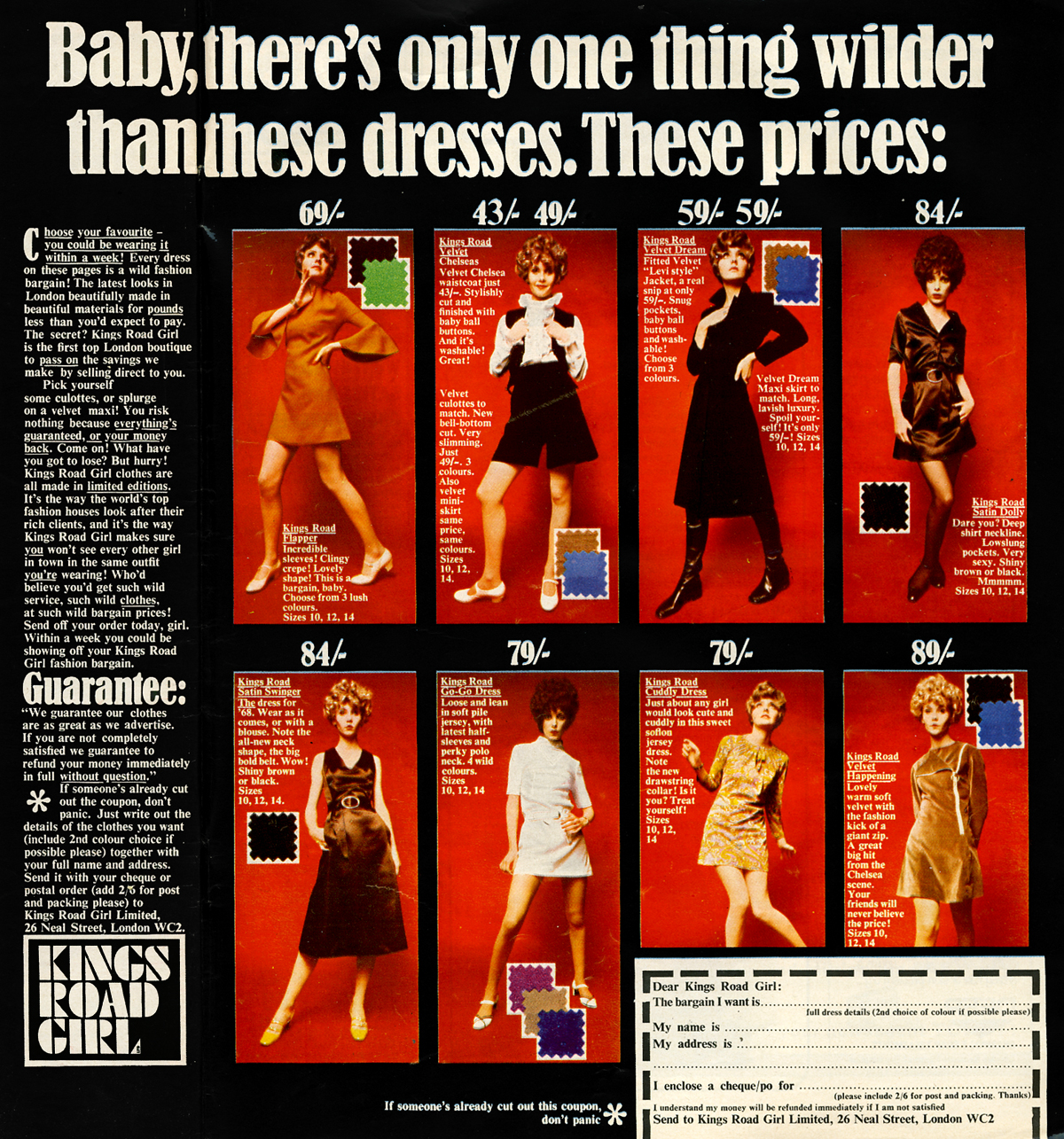
I’ll take them all, please and thank you…
Scanned by Miss Peelpants from Honey, March 1968.
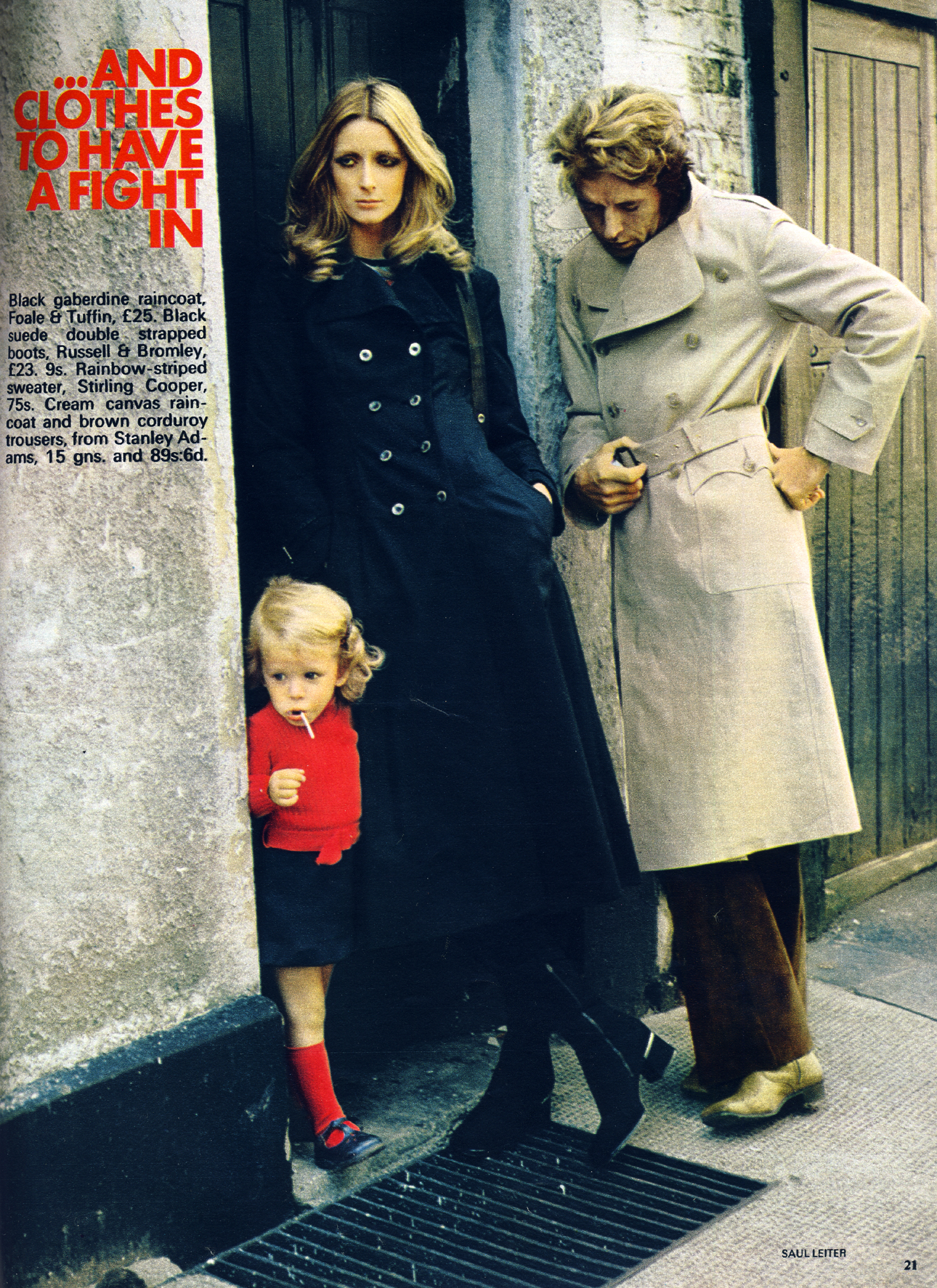
Black gabardine raincoat by Foale and Tuffin. Black suede double strapped boots from Russell & Bromley. Rainbow striped sweater by Stirling Cooper.
Reasons why Vanity Fair is one of the best fashion magazines ever #29847: A fashion editorial inspired by a fighting couple, photographed by Saul Leiter…
Scanned by Miss Peelpants from Vanity Fair, January 1971.
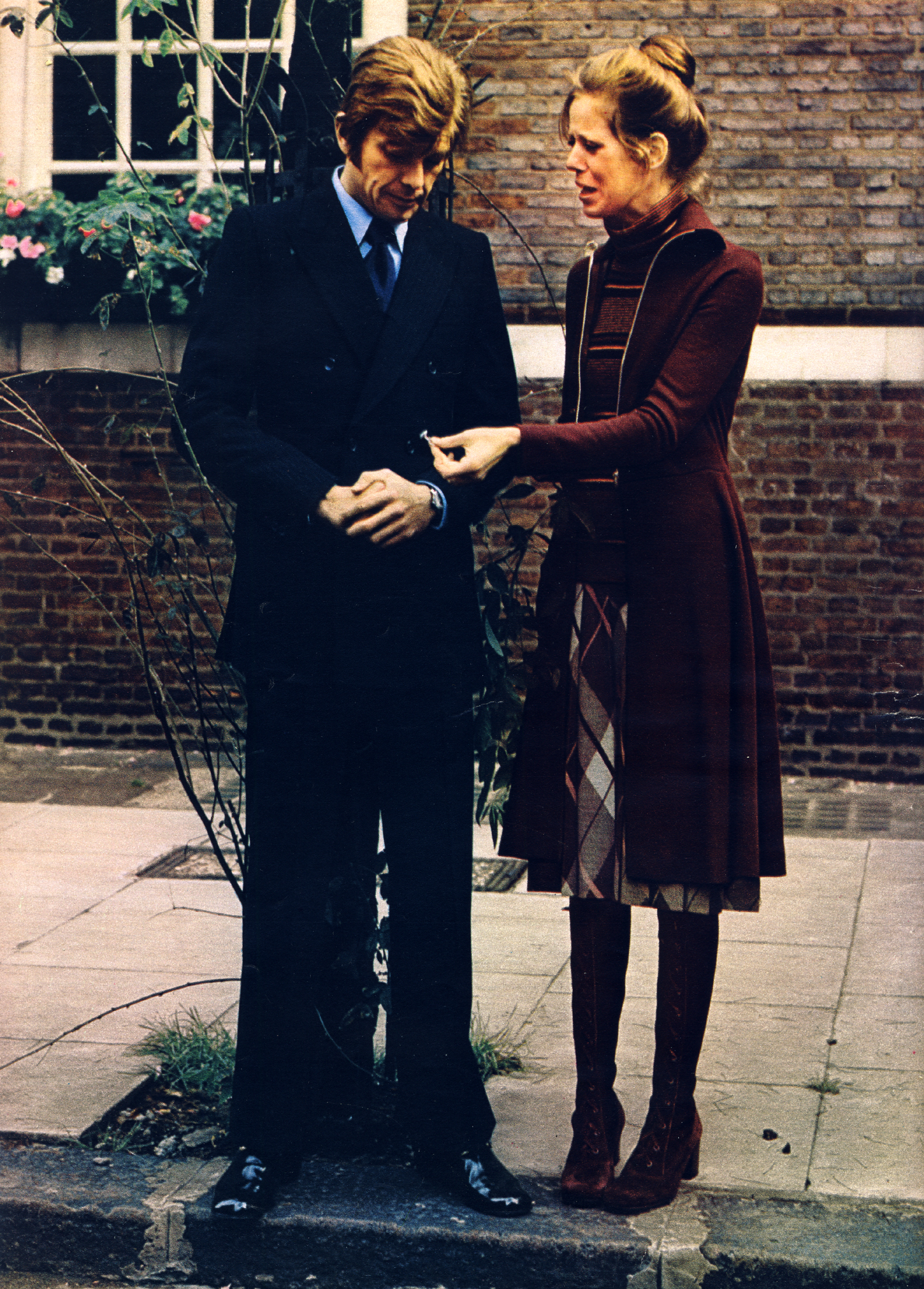
Maroon jersey coat and plaid skirt by Stirling Cooper. Sweater by Sonia Rykiel for Browns. Boots by Elliott’s.
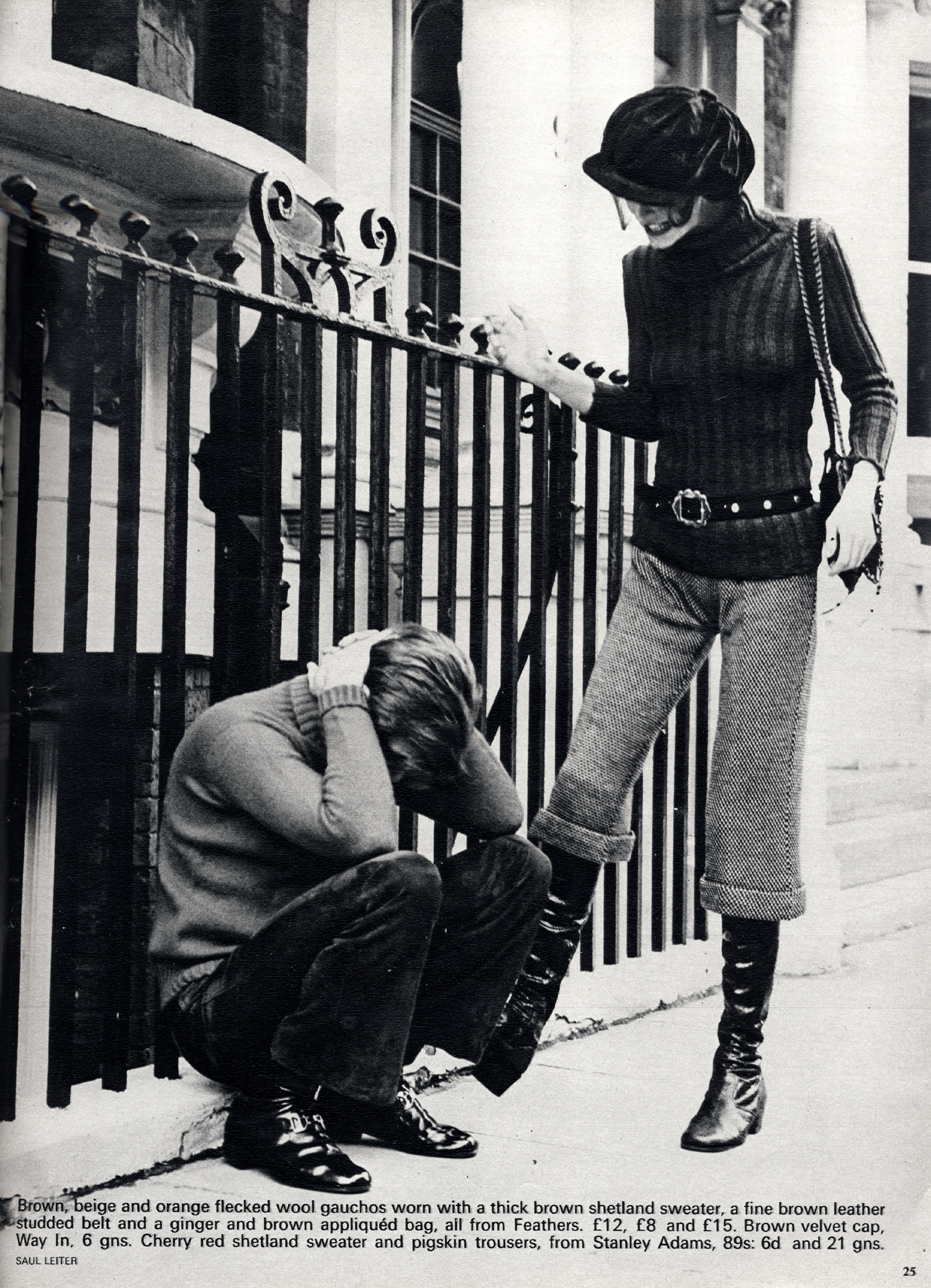
Brown beige and orange flecked wool gauchos worn with thick brown shetland sweater, leather studded belt and appliqued bag all from Feathers. Cap from Way In.
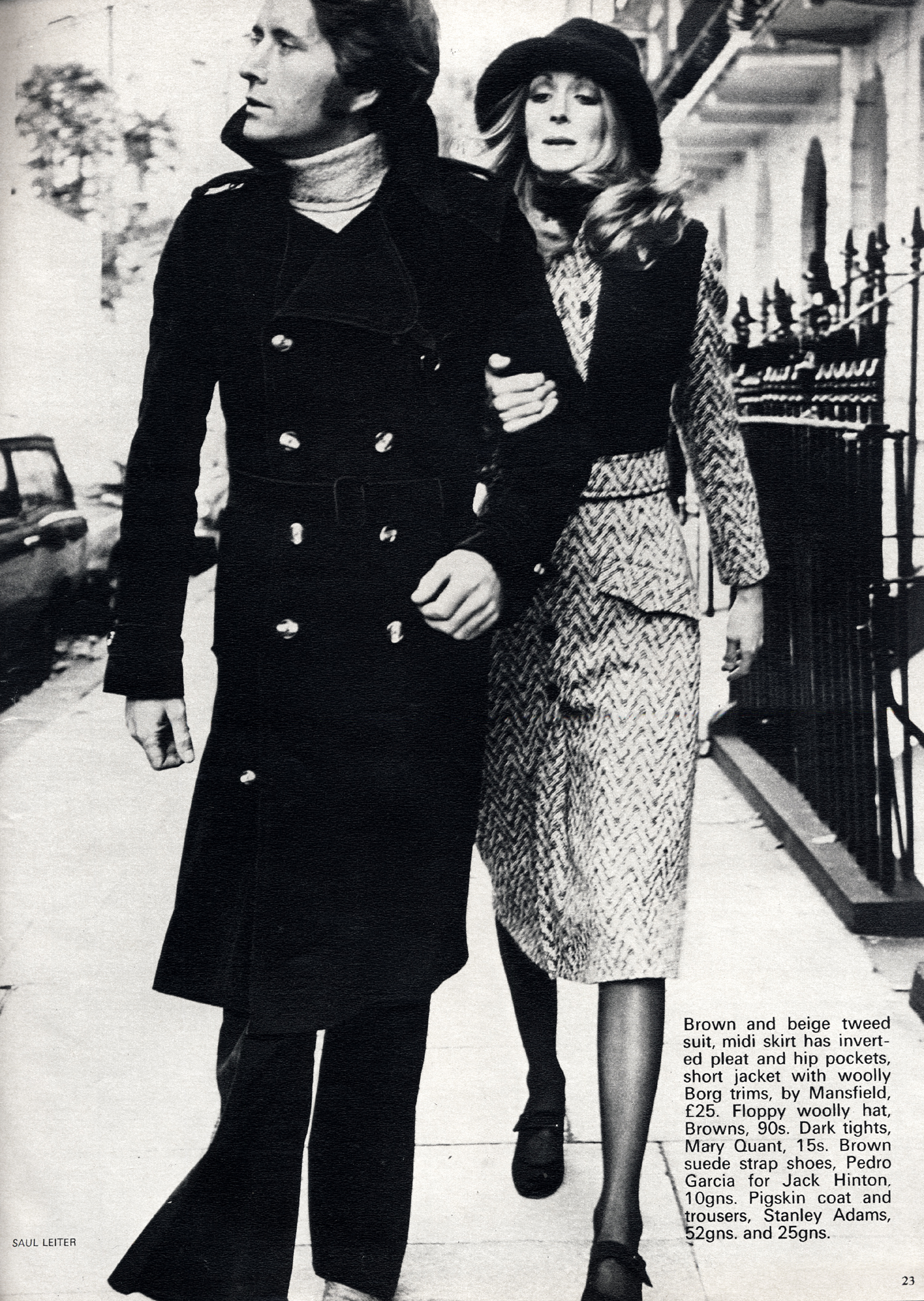
Brown and beige tweed suit with Borg trims by Mansfield. Floppy woolly hat from Browns. Brown suede shoes by Pedro Garcia for Jack Hinton.
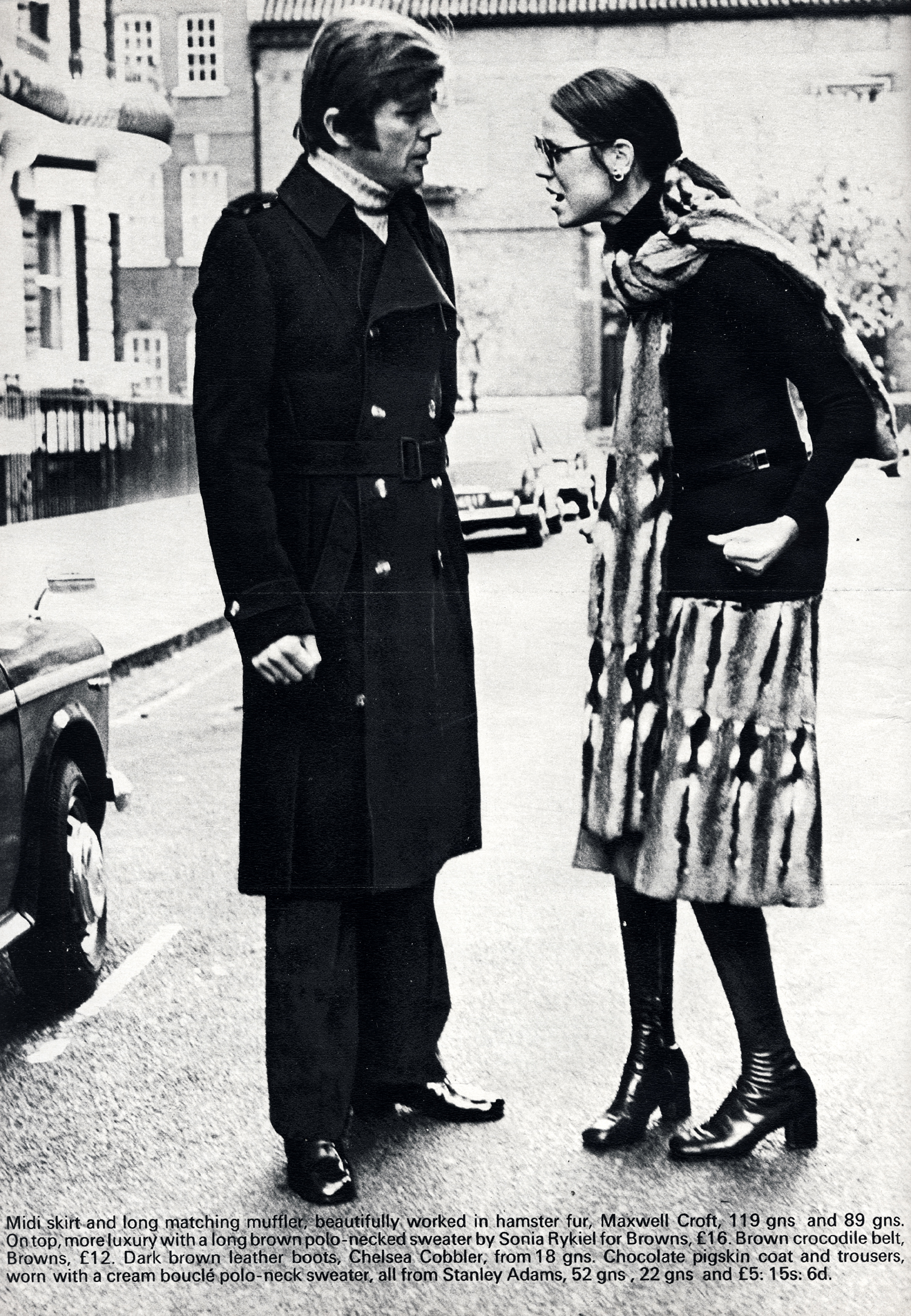
Midi skirt and matching muffler by Maxwell Croft. Brown polo necked sweater by Sonia Rykiel from Browns. Dark brown leather boots by Chelsea Cobbler.
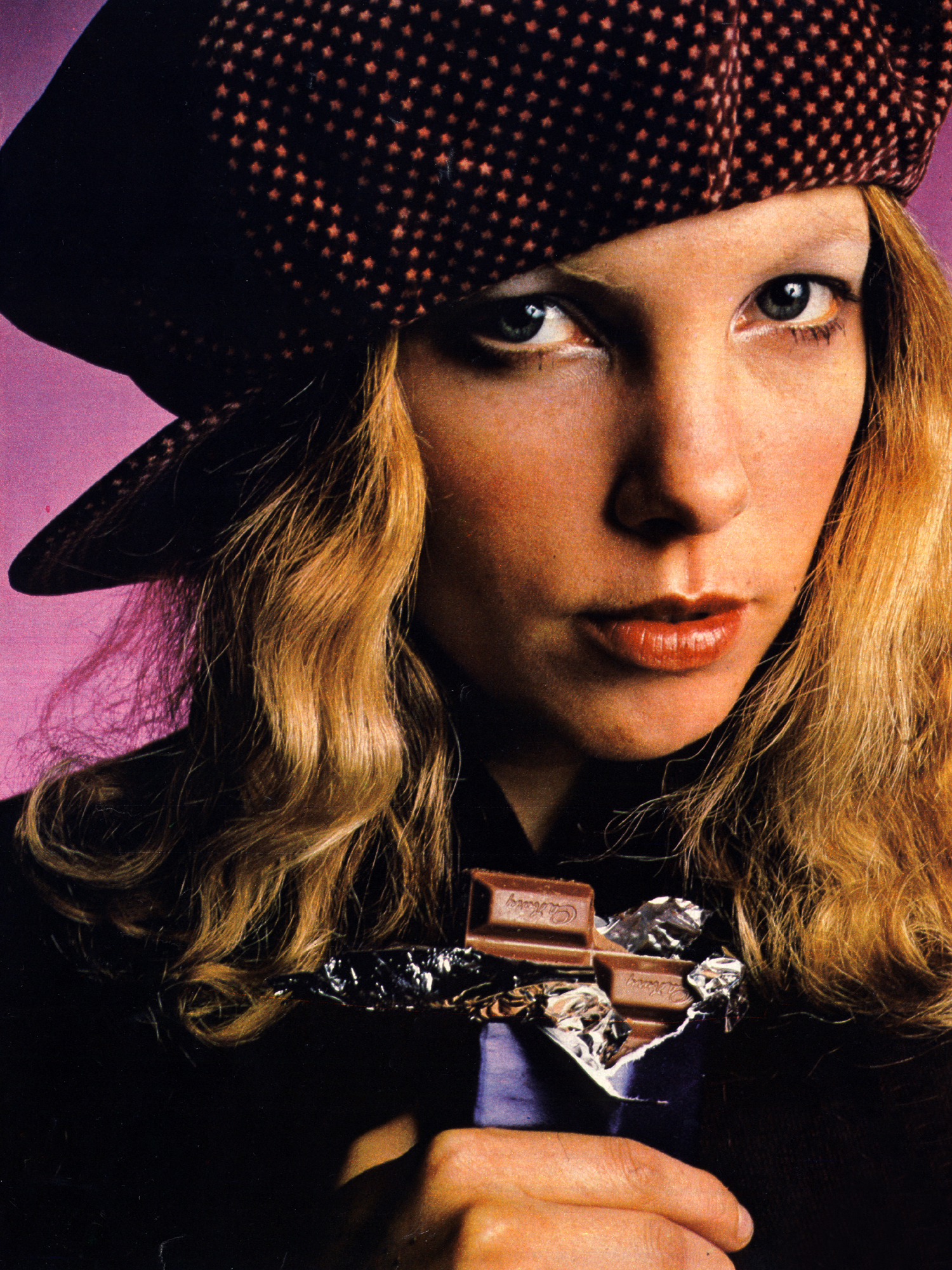
Plum spotted baker boy hat by Mr Freedom.
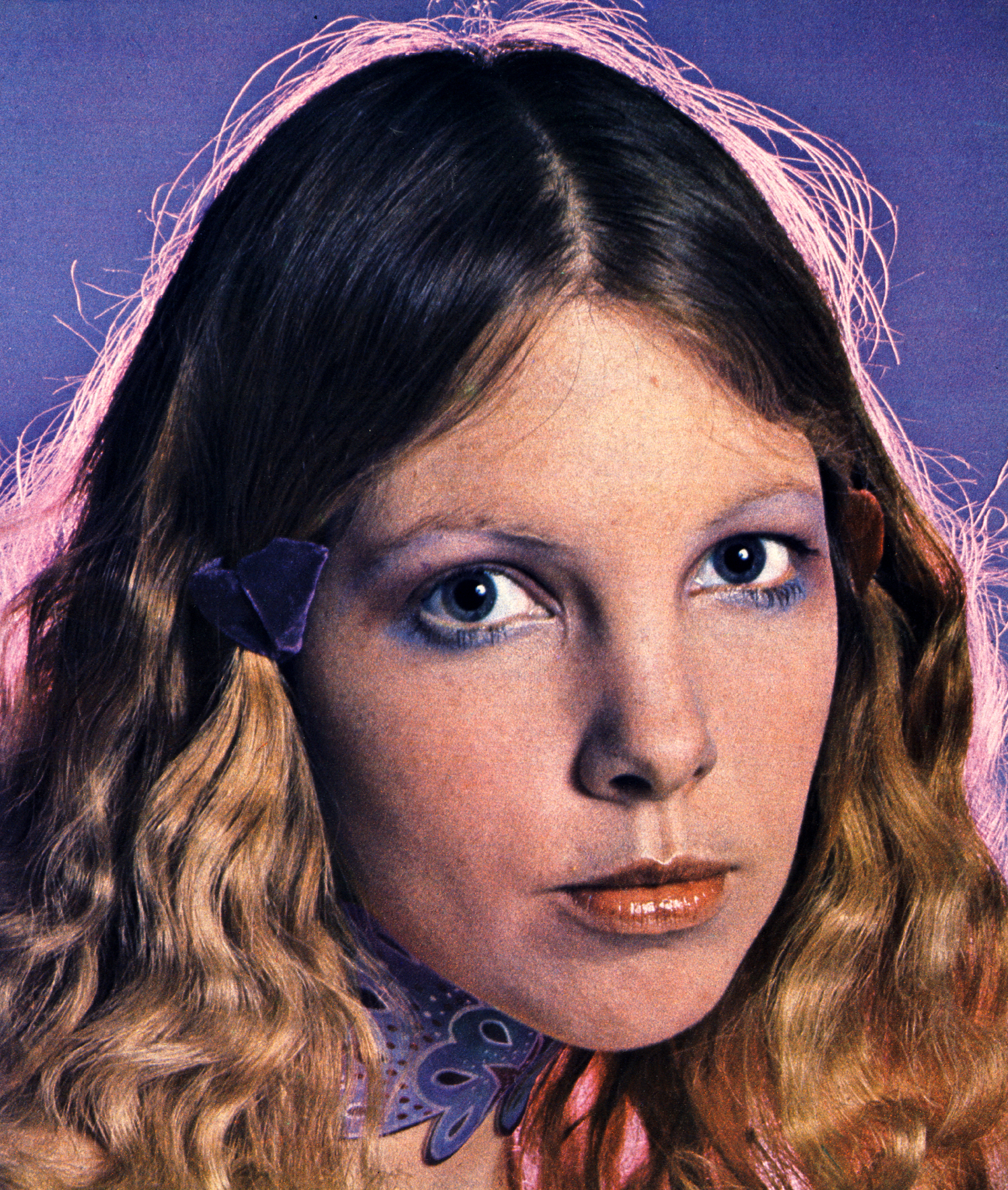
Looks: Eyes, hair, lips, the way they are now.
Clothes: Pink and purple and plum – the length is midi of course
Props: The right accessories make the look come right
Mood: How to wear your feelings on your face
Basically, this editorial is everything I wish for from my autumn wardrobe, colours and textures and shapes, complete with a mouthful of chocolate…
Photographed by Roger Stowell.
Scanned by Miss Peelpants from Honey, October 1970.
Choker from Browns.
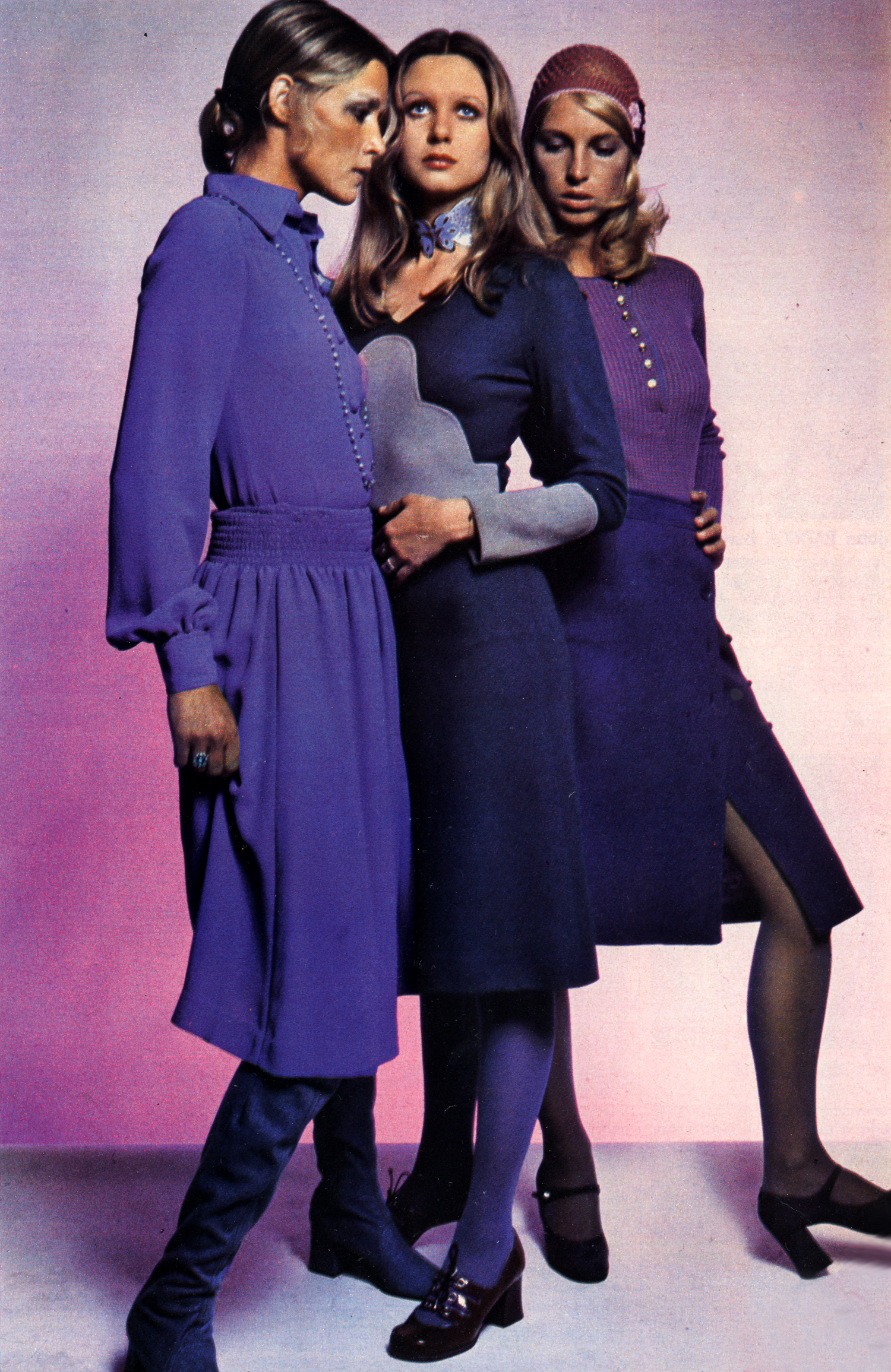
Left: Lavender shirt with matching midi skirt by Sujon. Canvas boots by Biba. Centre: Parma violet dress by Stirling Cooper. Leather butterfly choker from Browns. Shoes by Saxone. Right: Rose and lilac sweater by Harold Ingram. Jersey midi skirt by Etam. Crochet cloche by Browns. Shoes by Saxone.
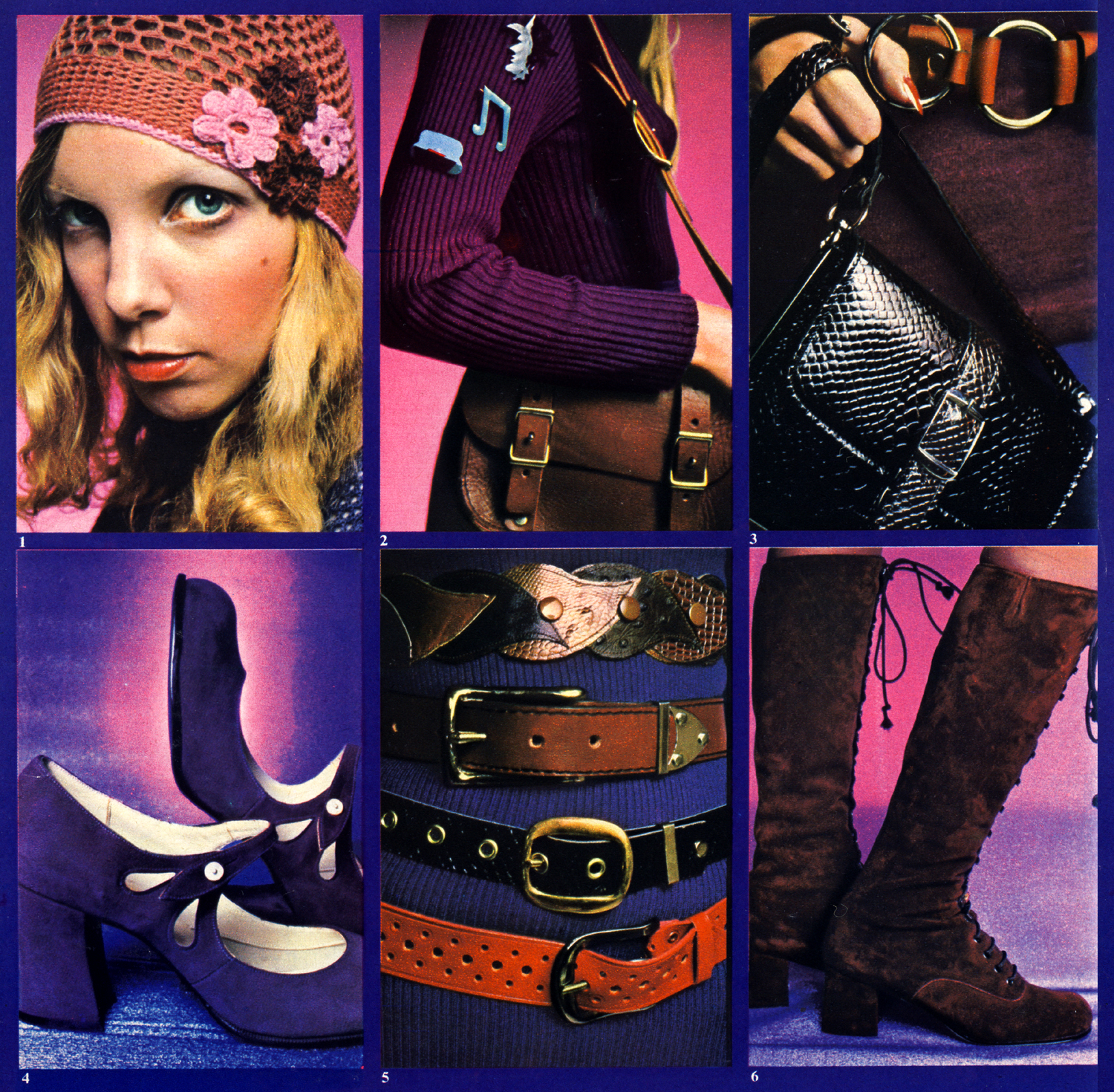
1. Crochet flower cloche by Browns. 2. Plum leather satchel by Wild Mustang. Brooches from Mr Freedom. 3. Conker brown bag by Fenwicks. Leather belt by Wild Mustang. 4. Purple suede shoes by Ravel. 5. Belts from Browns, Wild Mustang and Adrien Mann. 6. Maroon suede boots by Russell and Bromley.
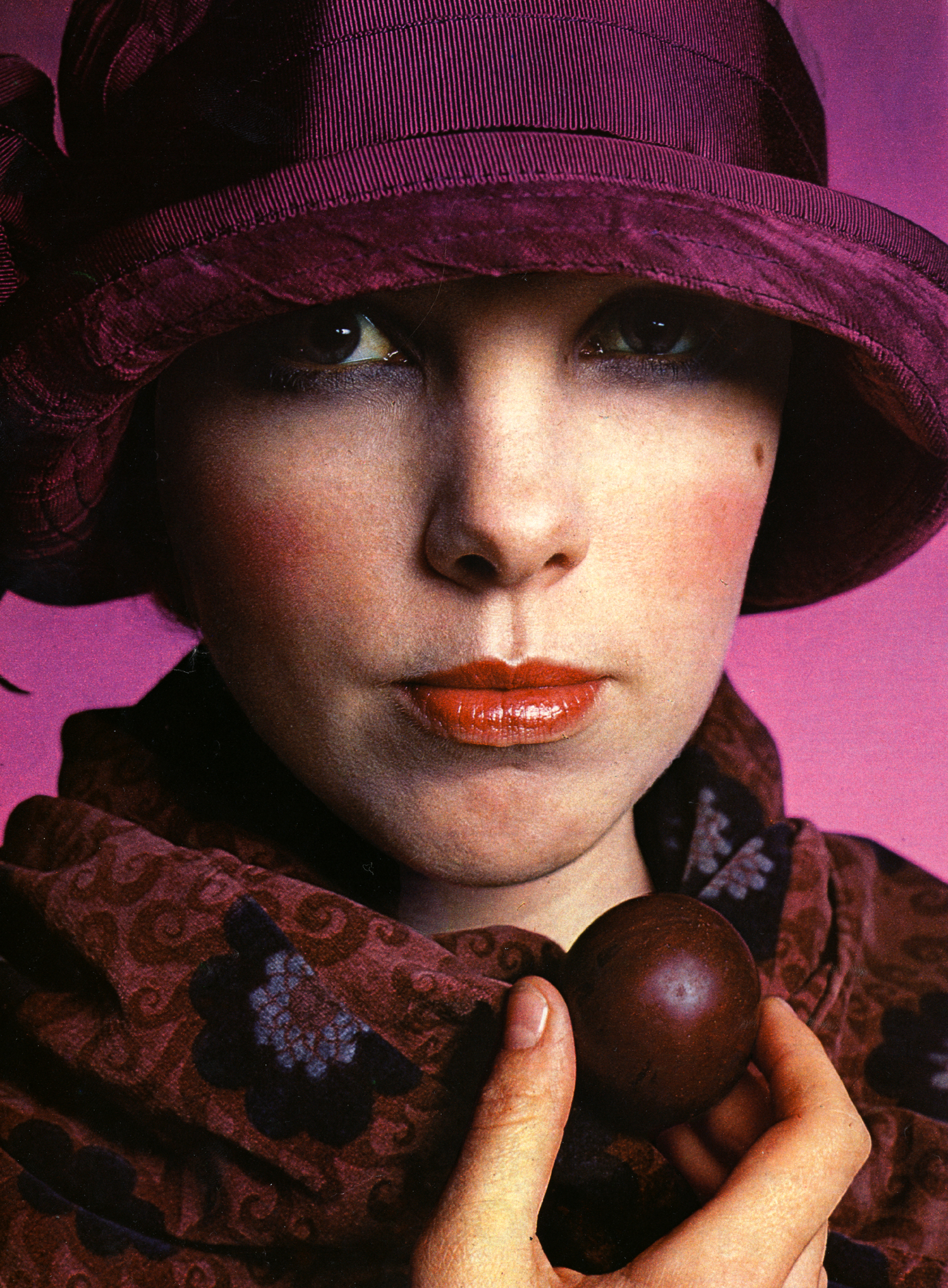
Crushed velvet cloche by Bermona
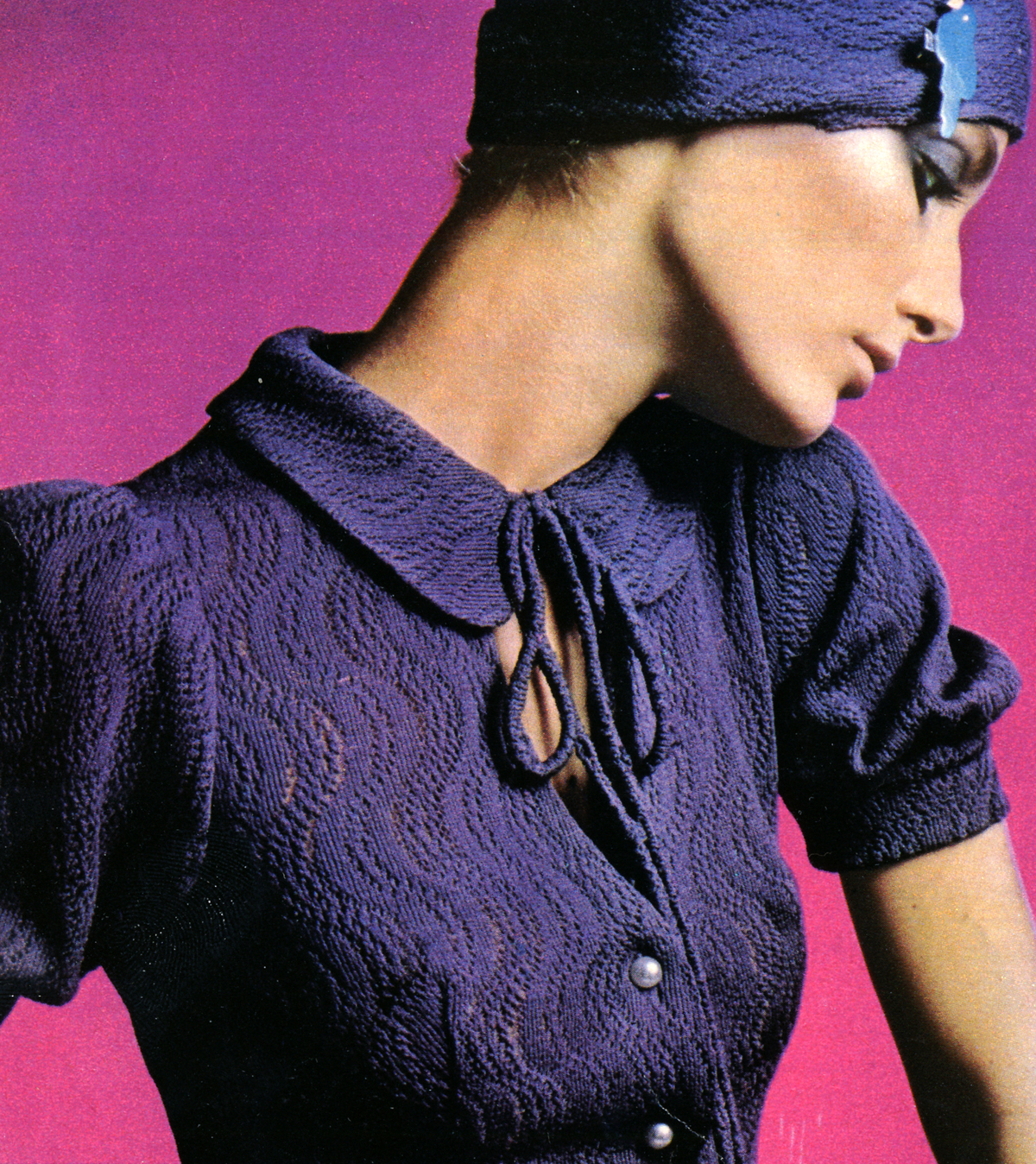
Cloche and dress by Anji. Badge by Mr Freedom.
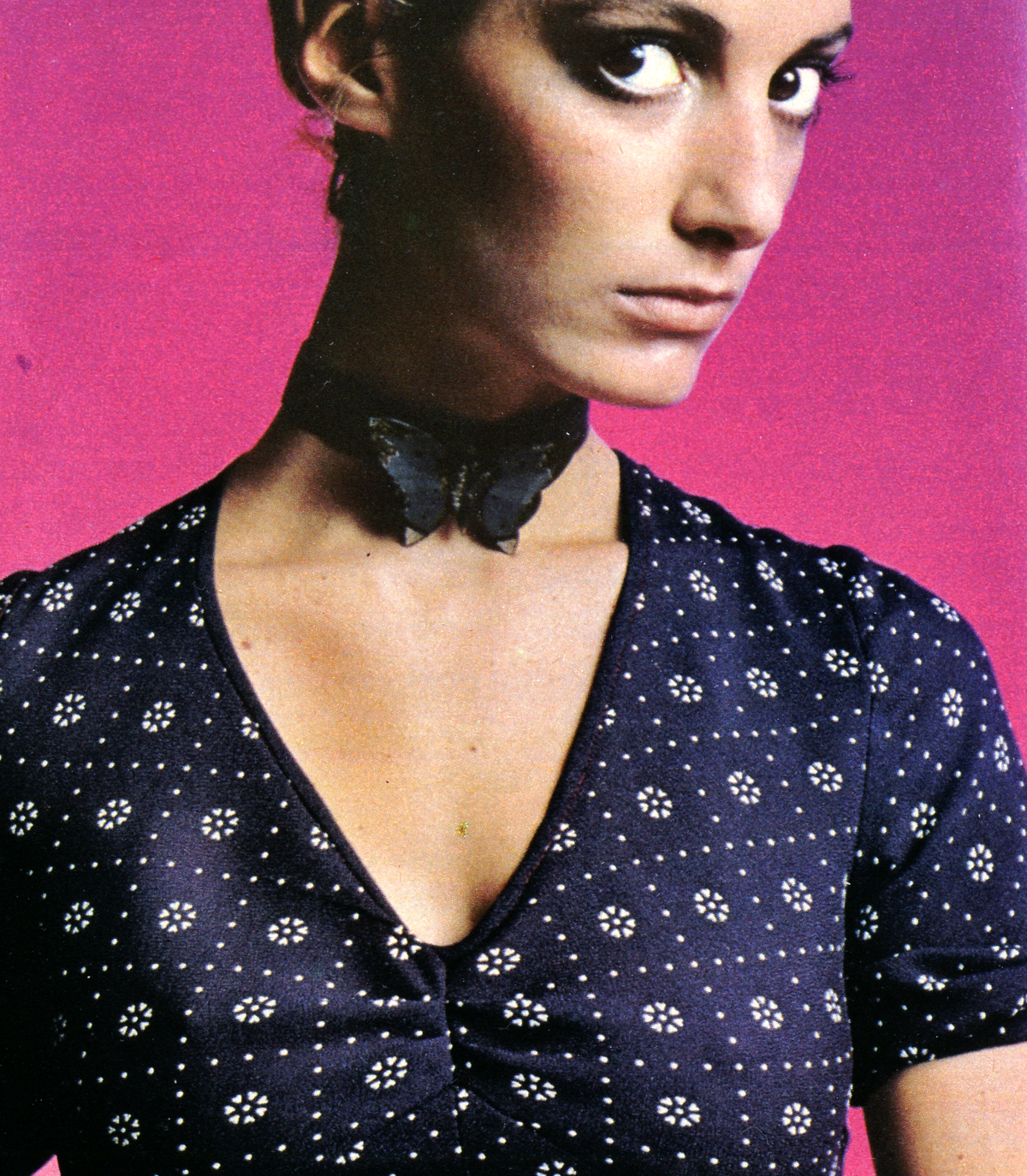
Floor sweeping crepe dress by Kadix. Choker from Hope and Eleanor.
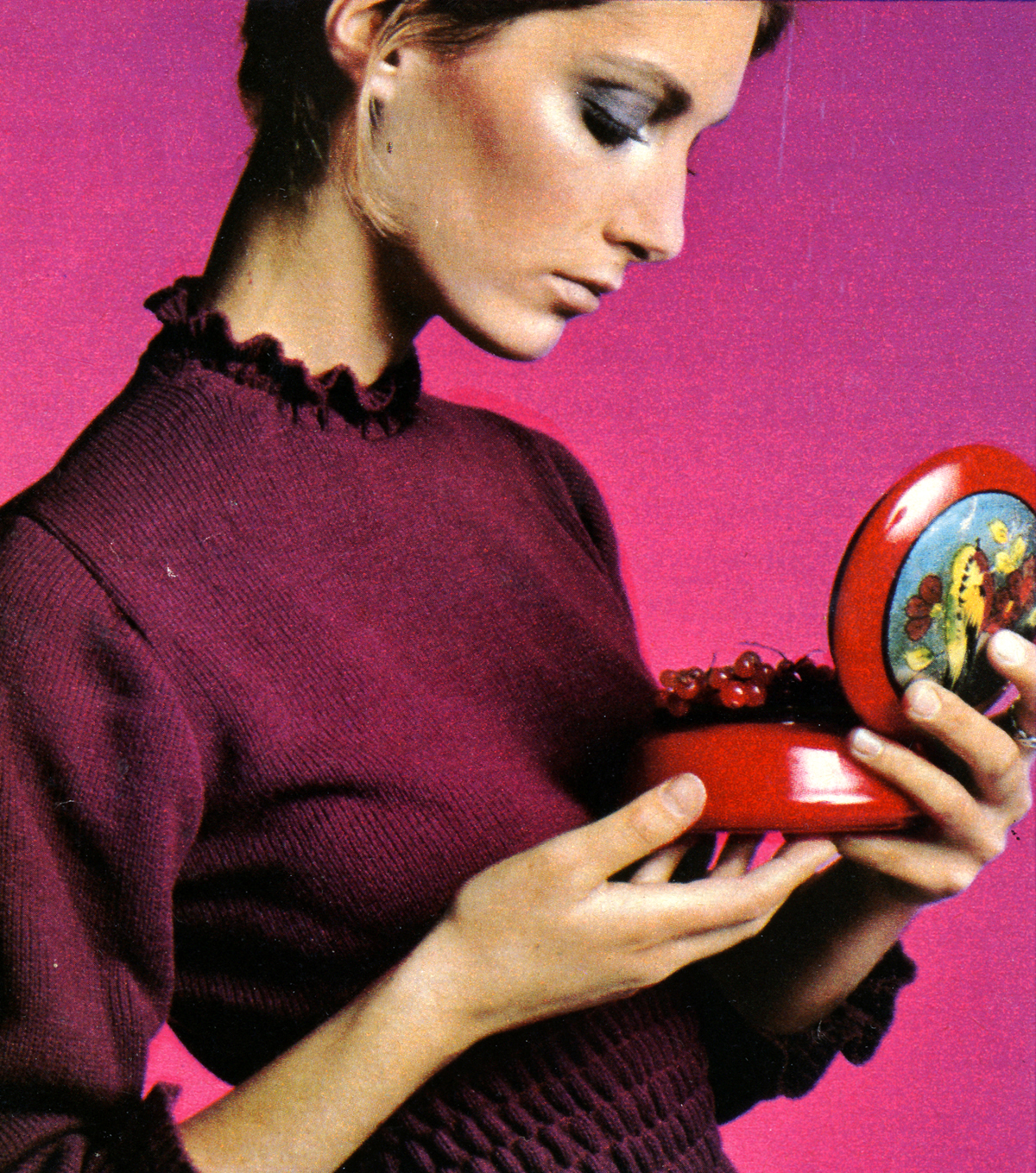
Sweater by John Craig.
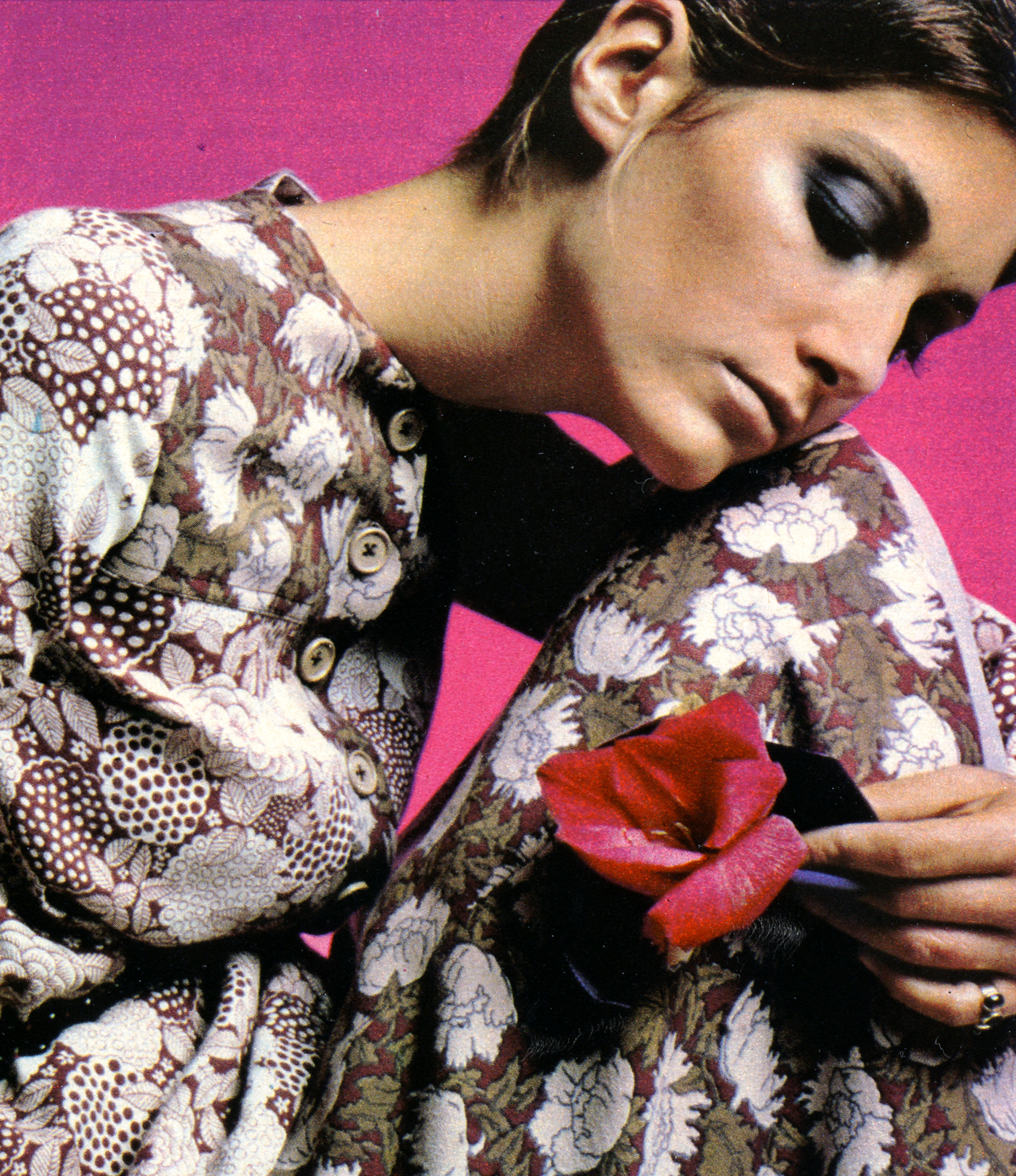
Peasant shirt and midi skirt by Sujon.
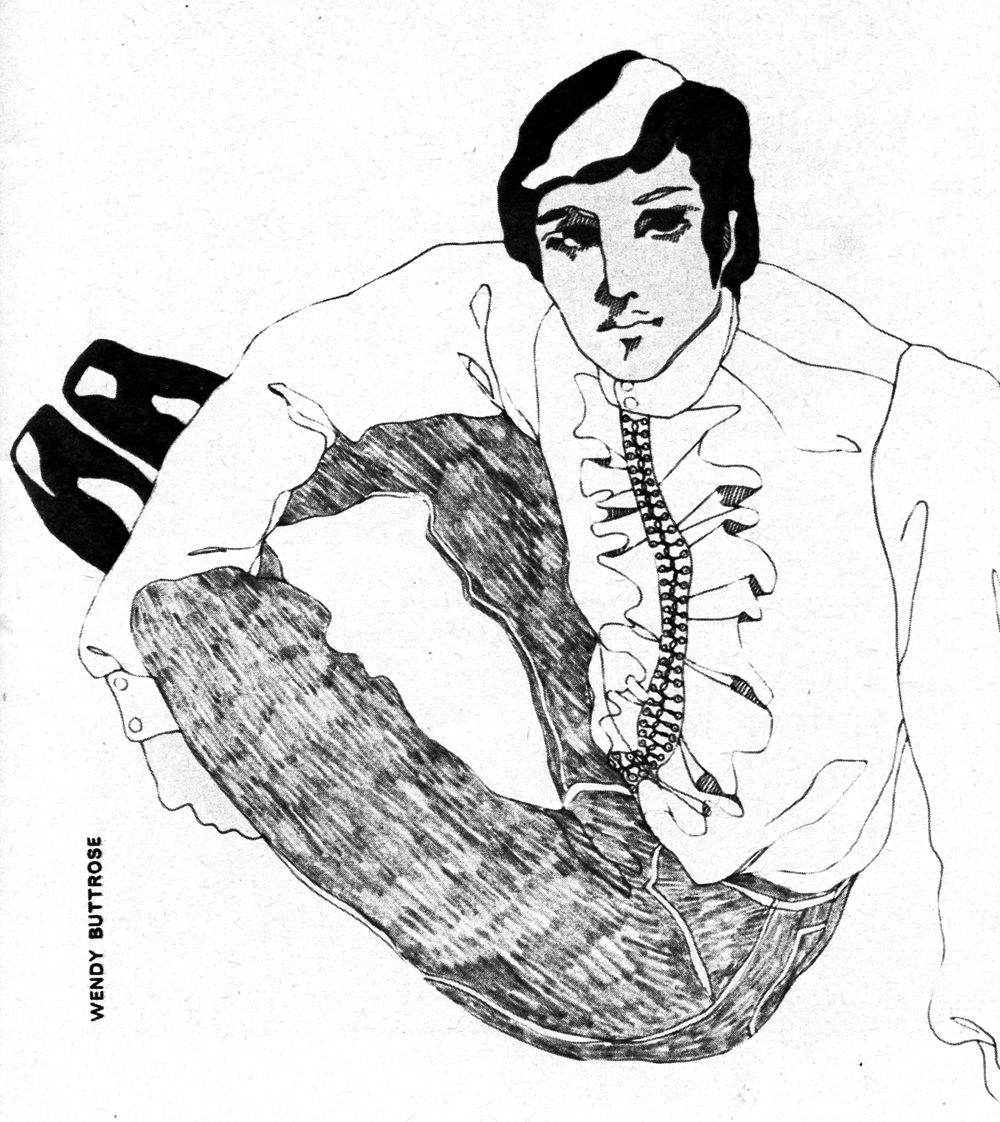
Have just formed a new organisation. It’s called SPOCC or the Society for the Protection of Clothes Customers. Idea came last night when I collected a couple of suits from the cleaners, only to find that the shoulder padding of one jacket was lost somewhere down the sleeve, and the trousers, supposed to be drip dry, were wrinkled like a Dutch dyke. The first suit came from Carnaby Street, the second from the Kings Road. Jose, my flat-mate, tried to pacify me by saying, “I thought you said clothes now are fashionable and short-lived. So what do you expect?” Simply that a suit shouldn’t disappear at the first clean! I accept built-in obsolescence and all those rubbishy excuses for using cheap materials, but I expect a suit to last a year, not a month. How about you? Let me know what you think … it might add up to some interesting revelations. Like the super trousers in the sketch. They’re Newman jeans from France; they cost much more than English or American but, in my view, are twice as good. I got a pair from the Heavy Metal Kids in the Kensington Market for £5. Elsewhere you can pay up to 8 gns. Shirts are another racket. The shirt here looks as if it costs 10 gns., and so it can at some places. In fact, it’s made by a man called Bryan King, who works in a Queensway attic, turning out great shirts handmade, frilled, tapered, for £2—£4, and sells them at his stall, Mother Wouldn’t Like It, also in the Ken Market. The tie-makers have become so ridiculously expensive that ties are out except for the odd occasion, and these shirts are as logical a take-over as the polo sweater. If Bryan can turn them out at this price, why can’t others? Remember—next time you think you’ve been rooked, let Luke SPOCC Jarvis know.
Written by Luke Jarvis.
Illustration by Wendy Buttrose.
Scanned by Miss Peelpants from Honey, March 1968.
 Liz Eggleston